Hans Thoolen on Human Rights Defenders and their awards

share information on human rights defenders, with special focus on human rights awards and laureates


Posts Tagged ‘Zimbabwe’

« Older posts
Newer posts »

How can the human rights defenders use new information technologies better?

November 28, 2019

Mads Gottlieb (twitter: @mads_gottlieb) wrote in Impakter about Human Rights, Technology and Partnerships and stated that these technologies have the potential to tremendously facilitate human rights defenders in their work, whether they are used to document facts about investigations, or as preventive measures to avoid violations. His main message in this short article is an appeal to the human rights sector at large, to use technology more creatively, to make technology upgrades a top priority, and to engage with the technology sector in this difficult endeavor. The human rights sector will never be able to develop the newest technologies, but the opportunities that technology provides is something they need to make use of now and in collaboration with the technology sector

…Several cases show that human rights are under threat, and that it is difficult to investigate and gather the necessary facts in time to protect them. Duterte in the Philippines, ordered the police to shoot activists who demonstrated against extra-judicial killings. He later tried to reduce the funding of the Philippines National Human Rights Commission to 1 USD a year. This threat followed a period of 15 months of investigating the killings, and Duterte responded with the claim that they were “useless and defended criminal’s rights.” 

Zimbabwe is another country with a difficult environment for human rights defenders. It is not surprising that few people speak out, since the few that dare to demonstrate or voice opposing political views disappear. A famous example is the activist and journalist,  from Occupy Africa Unity Square. He was allegedly beaten in 2014, and in 2015 he went missing and was never found. His disappearance occurred after a period of public demonstrations against Mugabe’s regime. To add to the challenging conditions that call for better tools to defend human rights, is the fact that many European countries digitalise their public services. The newly introduced data platforms store and process sensitive information about the population, such as gender, ethnicity, sexual orientation, past health records, etc. Information that can easily be used for discriminative purposes, whether intentionally or not.

Human rights defenders typically struggle to find adequate resources for their daily operations and as a result, investments in technology often come second. It is rare for human rights defenders to have anything beyond the minimum requirements, such as the internally-facing maintenance of an operational and secure internet connection, a case system, or a website. At the same time, global technology companies develop new technologies such as blockchain, artificial intelligence, and advanced data and surveillance techniques. These technologies have the potential to tremendously facilitate human rights defenders in their work, whether they are used to document facts about investigations, or as preventive measures to avoid violations. It is also important to facilitate and empower rights-holders in setting up and using networks and platforms that can help notify and verify violations quickly. 

Collaboration is an excellent problem-solving approach and human rights organizations are well aware of it. They engage in multiple partnerships with important actors. The concern is therefore not the lack of collaboration, but whether they adequately prioritize what is now the world’s leading sector — technology (the top 5 on Forbes list of most valuable brands are all technology companies; Apple, Google, Microsoft, Amazon, and Facebook). It is not up to the technology sector to engage with the human rights sector (whether they want to or not), but it should be a top priority for the human rights sector to try to reduce their technology gap, in the interest of human rights.

There are several partnership opportunities, and many are easy to get started with and do not require monetary investments. One opportunity is to partner up with tech universities, that have the expertise to develop new types of secure, rapid monitoring systems. Blockchain embraces most of the principles that human rights embraces, such as transparency, equality and accountability, and rapid response times are possible. So why not collaborate with universities? Another opportunity is collaborating with institutions that manage satellite images. Images provide very solid proof regarding changes in landscape, examples include deforestation that threatens indigenous people, and the removal or burning of villages over a short period of time. A third opportunity is to get in dialogue with the technology giants that develop these new technologies, and, rather than asking for monetary donations, ask for input regarding how the human rights sector can effectively leverage technology. 
 

Human Rights, Technology and Partnerships 

Posted in human rights | Leave a Comment »
Tags: Blockchain, digital security, documentation tools, human rights documentation, information technology, information technology companies, Itai Dzamara, Mads Gottlieb, Philippines, Zimbabwe

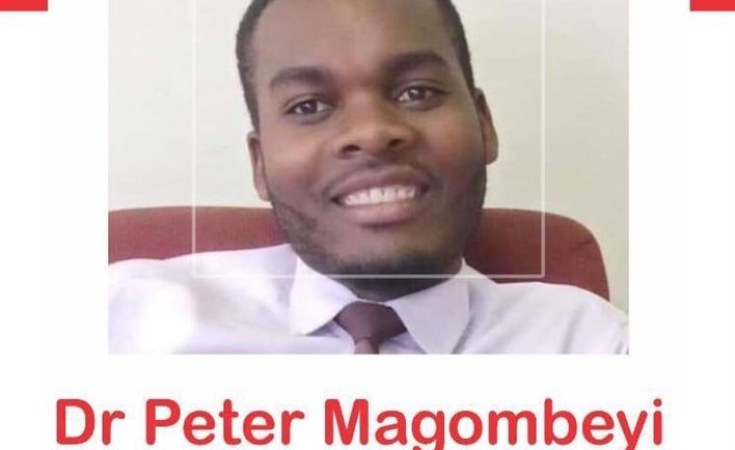
Peter Magombeyi, doctor in Zimbabwe, on the growing list of victims

September 18, 2019


LATEST NEWS: On 20 September BBC news reported that he was doiund alive just outside the captial [https://www.bbc.co.uk/news/world-africa-49764231?intlink_from_url=https://www.bbc.co.uk/news/topics/crr7mlg0rpvt/zimbabwe&link_location=live-reporting-story]
On 18 September 2019 several outlets (here NewsDay Zimbabwe) reported that the Southern Africa Human Rights Defenders Network (SAHRDN) has called on the government of Zimbabwe to guarantee the safety and security of Zimbabwe Hospital Doctors Association acting president Peter Magombeyi, who was allegedly abducted by suspected State security agents on Saturday night and to ensure his immediate release.

Magombeyi, who was abducted by three masked men from his Budiriro, Harare home at the weekend, had been leading an industrial job action by junior doctors nationwide over poor salaries and working conditions. “The SAHRDN further calls on authorities to curb the emerging pattern of abductions, enforced disappearances and torture of human rights defenders and legitimate political opponents,” said SAHRDN in a statement. The government has denied that its security agents were involved in the abduction and blamed a third force trying to tarnish the image of President Emmerson Mnangagwa’s government. Before Magombeyi’s abduction, he had reported to his lawyers a variety of threats he was receiving some via his mobile phone.

“Since January 2019 when Zimbabweans protested against the worsening economic situation, thousands of people have been arbitrarily arrested and detained and scores of civil society activists, human rights defenders and legitimate political opponents have faced abductions and enforced disappearances. Unfortunately, some of them have died as a result of torture such as Blessing Toronga,” said the organisation chaired by prominent lawyer, Arnold Tsunga. The organisation accused the Zimbabwe Republic Police of failing to enforce the law and to hold those responsible for perpetrating attacks on human rights defenders accountable. See also: https://humanrightsdefenders.blog/2019/08/26/zimbabwe-two-years-emmerson-mnangagwa-have-shown-little-difference-from-mugabe/.

———-

https://www.frontlinedefenders.org/en/case/abduction-human-rights-defender-peter-magombeyi

https://www.newsday.co.zw/2019/09/pressure-piles-over-missing-doctor/

https://allafrica.com/stories/201909180043.html

Posted in Human Rights Defenders | Leave a Comment »
Tags: Arnold Tsunga, disappearance, doctors, medical profession, Newsday Zimbabwe, Peter Magombeyi, Southern Africa Human Rights Defenders Network (SAHRDN), Zimbabwe, Zimbabwe Hospital Doctors Association

Zimbabwe: two years Emmerson Mnangagwa have shown little difference from Mugabe

August 26, 2019
Anna Chibamu, writing in the New Zimbabwe of 26 August 2019, summarises the latest report of Amnesty International which shows that President Emmerson Mnangagwa has shown little difference with his predecessor Robert Mugabe and his near-two year reign has been replete with human rights abuses. In a statement, AI deputy director for Southern Africa Muleya Mwanawanda said Mnangagwa’s administration, since taking charge following the removal of Mugabe and the subsequent general elections last year, has been marred by a systematic and brutal crackdown on human rights and a decline in socio-economic conditions. “What we have witnessed in Zimbabwe since President Emmerson Mnangagwa took power is a ruthless attack on human rights, with the rights to freedom of expression, peaceful assembly and association increasingly restricted and criminalised,” said the group.

Amnesty International said it has documented at least 15 killings by police when nationwide protests erupted mid-January this year and last week, 128 protesters were reportedly arrested with 400 having been convicted in the disturbances that rocked the country early this year. To date, the human rights organisation said 22 people including Evan Mawarire, a well-known local cleric and activist, and trade union leader Peter Mutasa – still face trumped-up subversion charges in connection with the protests. Some of the activists and human rights defenders were arrested at Robert Mugabe International Airport in May as they returned from a capacity-building workshop on non-violent protest tactics in the Maldives [https://humanrightsdefenders.blog/2019/05/21/four-zimbabwe-human-rights-defenders-detained-at-at-the-mugabe-airport-on-their-return-from-foreign-trip/]

On 24 August the Zimbabwean made similar statements.
That not everyone agrees is obivious and in a long anti-opposition rant in the Sunday Mail of 25 August one can find gems like:
“The joint statement by the EU member states and the unashamed US was as condescending as it was patronising. Stripped to its bare essentials, the August 20 statement, without an iota of evidence, accuses Government of “intimidation, harassment and physical attacks” of hooligans disguised as human rights defenders.“…
and :“..they overly concerned with the rights of those who want to demonstrate — purportedly under the guise of freedom of assembly, association and expression, or any such gobbledygook — while ignoring the rights of those still nursing sutured, serrated and weeping wounds from the recent orgies of violence? Have these Excellencies, so besotted with human rights, ever lent an ear or a measly penny to those still counting losses and smarting from the recent violence, which destroyed their businesses and sources of livelihood? Is it not Mr Government who is picking up the tab? Hypocrites! But no sooner had the ink on the statement of these meddlesome Excellencies dried than we began discovering wholesale abductions, all played out to an excitable Twitter audience. Dear reader, it all happens on Twitter.”

For the diplomatic statement see: https://humanrightsdefenders.blog/2019/08/21/statement-by-western-diplomats-in-zimbabwe-on-human-rights-defenders/

———
https://www.newzimbabwe.com/ai-mnangagwas-horror-first-year-in-office-marked-by-repression/
https://www.thezimbabwean.co/2019/08/violence-in-zimbabwe-is-escalating/
https://www.sundaymail.co.zw/when-excellencies-grace-chitungwiza-shebeen

Posted in AI, Human Rights Defenders | Leave a Comment »
Tags: Amnesty International, Emmerson Mnangagwa, Human Rights Defenders, killings, Muleya Mwanawanda, New Zimbabwe, Robert Mugabe, Sunday Mail (Zimbabwe), violence, Zimbabwe

Statement by western diplomats in Zimbabwe on human rights defenders

August 21, 2019

The Heads of Mission in Zimbabwe of the European Union, France, Germany, Greece, the Netherlands, Romania, Sweden, the United Kingdom, Australia, Canada and the USA issued the following statement on 20 August 2019:

Intimidation, harassment and physical attacks on human rights defenders, trade union and civil society representatives, and opposition politicians – prior to, during and following the demonstration in Harare on 16 August – are cause for great concern.

The Zimbabwean Constitution guarantees the right to personal security from violence and prohibits physical or psychological torture. The Heads of Mission urge the authorities to respect these fundamental rights, and to hold perpetrators of violence legally responsible.

The Heads of Mission call on the authorities to respect the constitutional rights to freedom of assembly, association and expression as well as to peaceful protest, and urge all political party leaders and supporters to abstain from threats and incitement to violence as well as acts of violence or vandalism. The security forces must adhere to their Constitutional mandate and exercise restraint and proportionality while maintaining public order.

Only by addressing concretely and rapidly these human rights violations will the Government of Zimbabwe give credibility to its commitments to address longstanding governance challenges. The Heads of Mission reiterate their calls for the implementation of the government’s political and economic reform agenda, underpinned by inclusive national dialogue and increased efforts to address the severe social situation.

See also the Government’s reaction: https://allafrica.com/stories/201908210061.html

https://eeas.europa.eu/headquarters/headquarters-homepage/66559/joint-local-statement-respect-human-rights-and-freedom-assembly_en

https://www.africanews.com/2019/08/20/joint-local-statement-on-respect-for-human-rights-and-freedom-of-assembly/

Posted in EU, Human Rights Defenders | 1 Comment »
Tags: Diplomatic mission, diplomatic pressure, EU, Human Rights Defenders, joint statement, USA, Zimbabwe

2019 edition of the Africa Shield Awards by AfricanDefenders

June 21, 2019
On 14 June 2019, AfricanDefenders (Pan-African Human Rights Defenders Network) awarded distinguished five human rights defenders on the African continent [for more on this and other regional awards, see: http://www.trueheroesfilms.org/thedigest/awards/african-human-rights-defenders-shield-awards]The winners are Beatrice Mtetwa, Felix Agbor Aniyor, Donald Deya, Fatou Jagne Senghor, and the Sudan Women Protest. The Shield Awards highlight the positive impact of their outstanding human rights work and their unwelding motivation.
The Shield Awards comprise five sub-regional awards and an overall Africa Shield Award. For this third edition, a jury composed of Hon. Commissioner Soyata Maiga, Chairperson of the African Commission on Human and Peoples’ Rights (ACHPR); Hon. Commissioner Rémy Ngoy, Special Rapporteur on Human Rights Defenders in Africa; Margaret Sekaggya, former UN Special Rapporteur on Human Rights Defenders; and Hassan Shire, Chairperson of AfricanDefenders, acknowledged that Sudan Women Protest should be granted the overall Africa Shield Award – also the winner of the North African Regional Award. Sudan Women Protest is a community of Sudanese women activists at the frontline of the Sudanese revolution since December 2018 – bringing to the fore women voices and rights. “This is for all the women, mothers, daughters who stood up to mobilise the people and to ensure that their rights are not forgotten – we all stand in solidarity with them,” said Walaa Salah, a Sudanese activist living in Kenya, who received the award on behalf of the community, as the women activists on the ground are immobilised due to the ongoing violence. “I hope I will be able to travel to Sudan, and bring this shield as a testimony to your solidarity.”
Beatrice Mtetwa, Shield Award winner for Southern Africa, is a Zimbabwean human rights lawyer Mtetwa has protected and promoted human rights for years, with a focus on HRDs and journalists, by representing on pro-bono hundreds of HRDs facing harassment and abusive detention in Zimbabwe. As a founding member and board member of Zimbabwe Lawyers for Human Rights (ZLHR), she continues to nurture leaders on the continent who carry her visionary mission of establishing a blue chip human rights lawyer’s organisation in Zimbabwe that has made access to justice for HRDs facing judicial persecution a reality in her home country. “This means a lot, particularly because it comes from my fellow African HRDs,” she said while receiving the award from Sekaggya. [see also: https://humanrightsdefenders.blog/2014/11/06/human-rights-documentary-beatrice-mtetwa-the-rule-of-law-on-television-and-internet/].
The Central African Shield Award was presented to Felix Agbor Anyior Nkongho, a Cameroonian lawyer and the founder of the Centre for Human Rights and Democracy in Africa. He has provided pro bono legal services to hundreds of victims. While seeking social justice and equality in the Anglophone region of Cameroon, he was arrested, charged, and tried at a ilitary tribunal for terrorism, rebellion to incite civil war, revolution, contempt against the State, and secession, which carries the death penalty. He was thrown into a cell with 12 alleged members of the Boko Haram terrorist group, later transferred to solitary confinement for 45 days, and was not allowed to attend his father’s funeral. Today, he is documenting and reporting systematic human rights violations committed by both government security forces and the armed separatist groups in the Anglophone region of Cameroon. “We, HRDs, defend the rights of others, so I thank you for protecting us,” he said.
Fatou Jagne Senghor, Executive Director of Article 19 West Africa, received the Shield Award for West Africa for her engagement on freedom of expression and media freedom. The award recognises Senghor’s longstanding human rights work in West Africa in general, and in The Gambia in particular. She plays an important role in regards to ensuring accountability on human rights violations, building the capacity of civil society, and strengthening the reforms in The Gambia. “Freedom of expression is increasingly under attack, and we need defenders like Fatou to protect us,” emphasised George Morara, Commissioner of the Kenya National Commission on Human Rights, while handing Senghor her shield.Donald Deya received the Shield Award for the East and Horn of Africa sub-region. Deya is an international human rights lawyer who represent and support victims of human rights abuses on the African continent. He represented numerous victims before the ACHPR, , the African Court on Human and Peoples’ Rights, the East African Court of Justice, and several national High courts. Deya is also the head of the Secretariat of the Pan African Lawyers Union (PALU), chair of the Boards of the Centre for Citizens’ Participation on the African Union (CCPAU) and the International Coalition for the Responsibility to Protect (ICRtoP). He dedicated the award to all African HRDs who suffer from persecution.
Through their human rights work, the awardees have faced harassment, intimidation, arbitrary detention, and even the threat of death – but they have never abandoned their tenacious commitment to human rights protection and promotion. Expressing her appreciation to their efforts, Hon. Maiga said: “I congratulate all the winners for their courage, and acknowledge the risks they take, and their strength that enables them to stand up for the rights of others.”

On a special note, Hassan Shire  presented the Shield of Africa award to Hon. Commissioner Maiga Soyata. This special award is presented by AfricanDefenders to valuable dignitaries  who have demonstrated longstanding contributions to protecting and promoting the rights of African citizens. Hon. Maiga dedicated 12 years of her life to protecting the rights of Africans across the continent, notably promoting the rights of women in Africa through the Maputo Protocol. “This is a coronation for her outstanding role in the protection of the rights of African citizens,’’ said Hassan Shire.


Posted in awards, human rights, Human Rights Defenders | Leave a Comment »
Tags: Africa, Beatrice Mtetwa, Cameroon, digest of human rights awards, Donald Deya, Fatou Jagne Senghor, Felix Agbor Anyior Nkongho, Hassan Shire, human rights awards, Maiga Soyata., Pan-African Human Rights Defenders Network, shield of africa awards, Sudan Women Protest, the Gambia, Zimbabwe

Two welcome paroles in Russia and Zimbabwe but justice is still to be done

June 11, 2019

Having reported earlier on the Oyub Titiev case in Russia [https://humanrightsdefenders.blog/2019/03/19/human-rights-defender-in-chechnya-oyub-titiev-sentenced-to-4-years/] and that of the seven human rights defenders arrested in Zimbabwe [https://humanrightsdefenders.blog/2019/05/21/four-zimbabwe-human-rights-defenders-detained-at-at-the-mugabe-airport-on-their-return-from-foreign-trip/], I am now happy to report some progress:

Responding to news that Shali City Court in Chechnya has granted parole to the imprisoned human rights defender Oyub Titiev after almost one-and-a-half years behind bars, Marie Struthers, Amnesty International’s Director for Eastern Europe and Central Asia said: “We have been calling for Oyub Titiev’s immediate and unconditional release since his detention. The real agenda behind his criminal prosecution on trumped up charges was to stop a human rights defender from doing his lawful human rights work….In spite of overwhelming evidence that the case against him had been fabricated, the authorities in Chechnya crudely abused the justice system to convict an innocent man. Today the court decided to at least partially amend the gross injustice by releasing Oyub in ten days time.” “But if justice is to prevail, Oyub Titiev’s conviction should be quashed, and he must be given access to an effective remedy, including compensation, for his unlawful imprisonment.  “This decision comes just days after prominent Russian investigative journalist Ivan Golunov was detained and charged with supplying drugs amid allegations that he was framed, held incommunicado and beaten in custody. He is currently under house arrest and we call on his allegations against the authorities to be immediately investigated.”

On 10 June, 2019 Shorai Murwira reports on http://www.263chat.com that two of the seven human rights defenders charged with plotting to subvert a constitutional government, Stabile Dewa and Rita Nyamupinga were released on bail at the Harare High court after spending more than two weeks at Chikurumbi maximum prison. But what about the others??

High court Judge Justice Army Tsanga ordered for the release of the two activists seized at the Robert Mugabe International Airport upon arrival from Maldives. The state is alleging that the accused are members of the civil society organizations who connived with their accomplices went to Maldives where they underwent a training workshop by a Serbian non-governmental organisation called Center for Applied Non-Violent Action Strategies (Canvas) with intend to subvert a constitutionally elected government.

———-

https://www.amnesty.org/en/latest/news/2019/06/russia-titievs-parole-a-welcome-step-but-not-justice/

Breaking: Five Zim ‘Terrorists’ Out On Bail

Posted in AI, Human Rights Defenders | 2 Comments »
Tags: Amnesty International, arrest, Chechnya, fair trial, Ivan Golunov, Marie Struthers, Oyub Titiev, parole, release on bail, Rita Nyamupinga, Russia, Stabile Dewa, Zimbabwe

Four Zimbabwe human rights defenders detained at at the Mugabe Airport on their return from foreign trip

May 21, 2019
Police have arrested four human rights activists at the Robert Gabriel Mugabe International Airport on their return from a foreign trip. Police officers also took away cellphones and laptops belonging to the activists. In a statement on Tuesday, 21 May 2019 Zimbabwe Lawyers for Human Rights (ZLHR) spokesman Kumbirai Mafunda said: “They were detained upon disembarking from a South African flight at Robert Mugabe International Airport last night and held for several hours without access to their lawyers”. Lawyers were only allowed access to them 5 hours hours after they were arrested.

The four are George Makoni, 38, advocacy officer for the NGO Centre for Community Development Zimbabwe; Tatenda Mombeyarara, 37, coordinator for lobby group Citizens Manifesto; Gamuchirai Mukura, 31, executive director of Community Tolerance Reconciliation and Development (COTRAD); and Nyasha Mpahlo, 35, governance officer at Transparency International Zimbabwe.

The arrest of the human rights activists follows a report carried in State daily publications, The Herald and Chronicle that suggested that civic organisations are plotting to cause mayhem in the country. The Herald ran a story claiming that “a group of shady organisations with links to the (main opposition) MDC-Alliance has been hard at work laying the groundwork for civil unrest to be unleashed next month.” The newspaper said some activists had attended a workshop on the Maldives archipelago that was conducted by a non-profit Serbian organisation, Center for Applied Nonviolent Action and Strategies (CANVAS).

The civil society alliance Crisis in Zimbabwe Coalition condemned the latest arrests. It said in a statement: “The police, government and state media have been colluding to criminalise the work of human rights defenders, laying unfounded allegations against civil society leaders as agents of regime change who want to topple the government.”

On 27 May 2019 ZW News adds that two more human rights defenders were arrested: https://zwnews.com/human-rights-arrested-at-harare-international-airport/

https://www.iol.co.za/news/africa/four-human-rights-activists-arrested-in-zimbabwe-23677924

Govt Goes After Human Rights Activists

Posted in Human Rights Defenders | 2 Comments »
Tags: arrest, Center for Applied Nonviolent Action and Strategies (CANVAS), fair trial, Gamuchirai Mukura, George Makoni, Nyasha Mpahlo, state media, Tatenda Mombeyarara, Zimbabwe, Zimbabwe Lawyers for Human Rights (ZLHR)

Plea to see labour rights defenders as human rights defenders

May 21, 2019

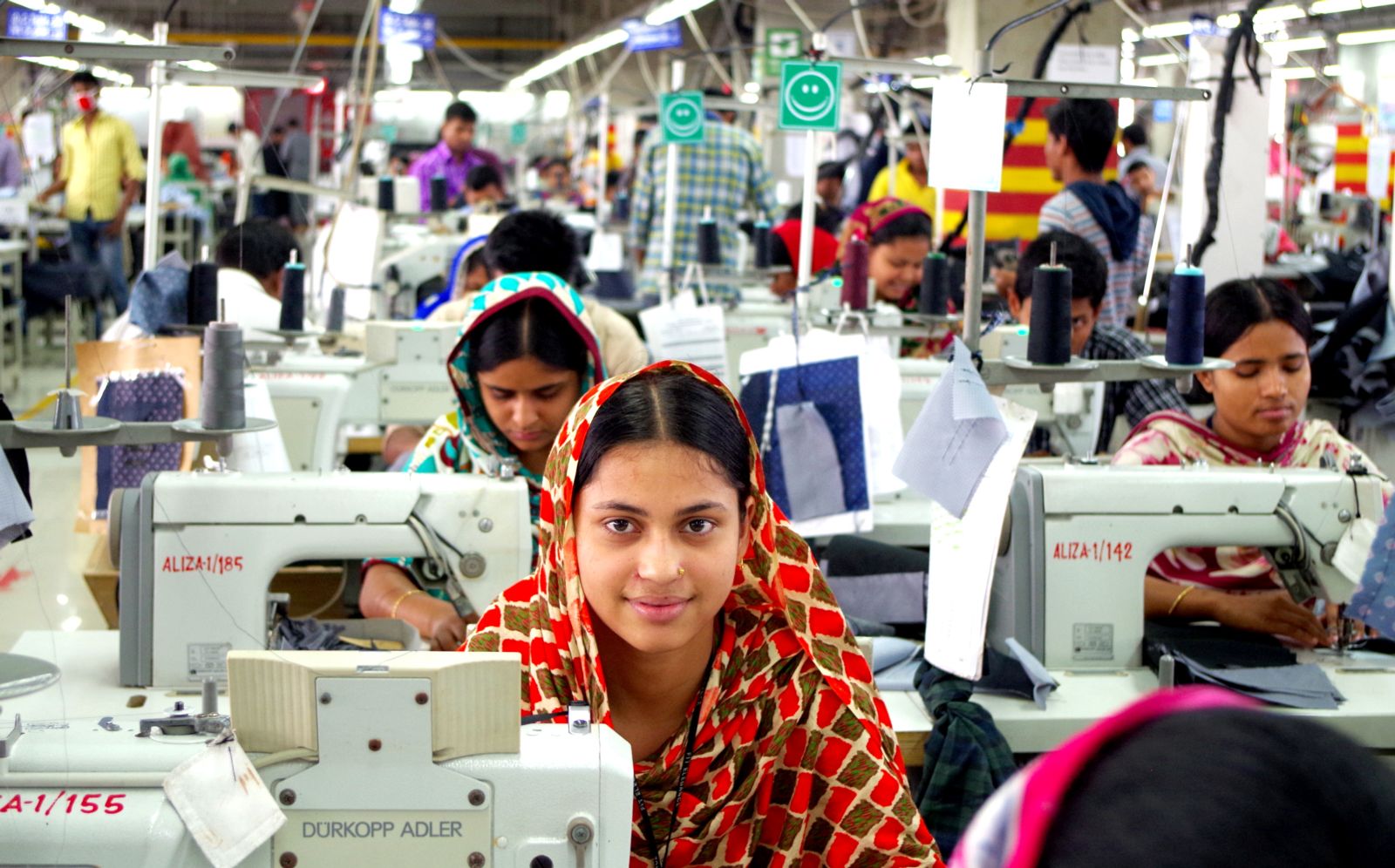
Appropriately on  Labour Day, 1 May 2019, Ana Zbona and Sanyu Awori (at the Business & Human Rights Resource Centre). wrote in Open Global Rights “When space closes for labour rights defenders, the situation is far worse for those at the margins. Labour rights are human rights and must be protected“.

Photo: SolidarityCentre/Flickr


…..Several recent examples of human rights movements that have been led and supported by labour rights groups include: coalitions to rebuild democracy in Honduras after a coup; the mobilizing of workers in Tunisia, Egypt and Bahrain during the Arab uprisings; and the pro-democracy movement in Zimbabwe, led by the country’s labour federation…

Distinctions are often made between labour rights defenders and human rights defenders, but as former UN Special Rapporteur on Freedom of Assembly and Association Maina Kiai expressed: these distinctions are artificial. Labour rights are human rights, and any person or organisation defending them is a human rights defender.. As Sharan Burrow, the Secretary General of the ITUC, put it: “Workers and their unions are the defenders of rights and freedoms.” We must be vigilant to any distinctions that try to separate our struggles”.

Labour rights defenders regularly experience violence and restrictions on their rights in various ways, including clamp downs on unions where governments and employers obstruct them from functioning freely and independently, laws that limit collective bargaining, and dismissals. In the past year, the International Trade Union Confederation reported an increase in violence, especially to prevent unionizing, and the safety of trade union leaders remains precarious. In Colombia, 19 trade unionists were killed in 2017; in Cambodia, trade union leaders are criminalized; and in Zimbabwe trade union leaders are regularly harassed by government authorities. With respect to laws that limit labour rights, 81% of countries deny some or all workers the right to collective bargaining and 65% of countries exclude some groups of workers from labour law, such as domestic, agricultural and contract workers, up 5% from 2017. Peaceful protests by workers are often met with heavy handed policy or army responses. In addition, the most common reprisal workers face for speaking up about violations are dismissals, a tactic used by employers to stifle civic action. As one example, over 12,000 garment factory workers in Bangladesh were fired for their protests in December 2018 and January 2019 over wages.

The Business & Human Rights Resource documents attacks against defenders working on corporate accountability, and our database shows that agriculture, food and beverage, and apparel are the most dangerous sectors for labour rights defenders. The most common forms of violence against individual union leaders and workers are arbitrary detentions and lawsuits, followed by intimidation and threats, and killings.

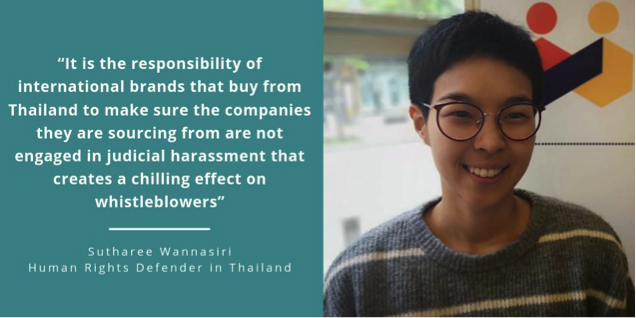
A particularly concerning trend is the use of defamation lawsuits to silence labour rights defenders. As one example, since 2016, Thammakaset Company Limited, a Thai-owned poultry company, filed more than 13 civil and criminal lawsuits against former workers who denounced labour rights violations, as well as against the activists and journalists supporting them. Governments and companies, including international brands, need to ensure such judicial attacks do not happen. As Sutharee Wanasiri, a labour rights defender from Thailand, and one of the people sued by Thammakaset, said: “It is also the responsibility of international brands that buy from Thailand to make sure the companies they are sourcing from are not engaged in judicial harassment that creates a chilling effect on whistle blowers and other defenders. They should establish mechanisms that allow workers and defenders to communicate with the brands directly and ensure that they are protected from any retaliation from suppliers during the investigation. The results should be made public and bring accountability for the abuses.”

…

With long and fragmented supply chains, it is particularly important to ensure that we hear workers’ voices, especially those of the most marginalized at the bottom of economic hierarchies, and guarantee dignified and decent work. This includes people working in the informal economy. Workers and civil society organizations are currently focusing on redefining legal employment terms, and reconsidering union strategy in light of changing labour relations, especially in the gig economy, in which non-conventional workers are not afforded adequate legal protection—either because they do not fall within the definition of a “regular employee” under national laws, or because of gaps in legislation when it comes to regulating new forms of employment. The lack of an applicable legal protection and collectively agreed terms of employment hinders the ability to exercise work-related rights, including the right to organise and collectively bargain.

……..

Labour rights defenders should be seen as critical allies in building equitable and sustainable societies. Several businesses are also beginning to recognise that the protection of human rights defenders and the ability for them to do their work is in their interest, and that an attack on defenders is an attack on responsible business. This is encouraging, as now more than ever we need to be brokering connections and building solidarities across movements and sectors to counter threats to the shared space we all depend upon.

https://www.openglobalrights.org/rising-restrictions-on-labour-rights-threaten-the-heart-of-social-justice/

Posted in human rights, Human Rights Defenders | Leave a Comment »
Tags: Ana Zbona, defamation laws, human rights and business, Human Rights Defenders, labour rights, labour rights defenders, Open global rights, Sanyu Awori, social economic and cultural rights, Thailand, trade unionists, workers rights, Zimbabwe

World Press Freedom Day celebrated on 3 May 2019

May 6, 2019

Friday 3 May was World Press Freedom Day. Read the rest of this entry »

Posted in Human Rights Defenders, RSF | Leave a Comment »
Tags: Advox, CPJ, freedom of expression, Global Voices, journalists, new media, RSF, Unesco, World Press Freedom Day (3 May), Zimbabwe

Internet shutdowns to silence opposition – what to do?

January 28, 2019

“African governments use Internet shutdowns to silence opposition more and more —what can people do?” asks Viola Stefanello  on EuroNews of 26/January 2019/

What would you do if your government decided to intentionally shut down your access to the Internet? Millions of people around the world have had to answer this question time and time again over the past few years, as government-mandated Internet blackouts are on the rise. Less than a month into 2019, Sudan, the Democratic Republic of Congo, Gabon and Zimbabwe have experienced government crackdowns on Internet connections.

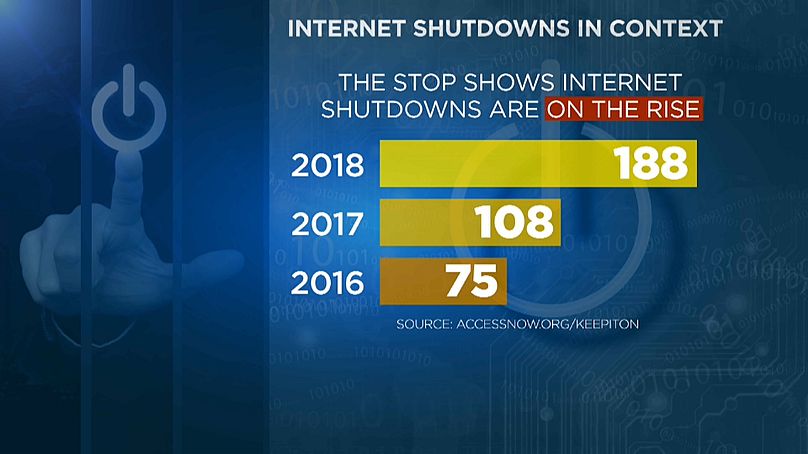
From 2016 to 2018, 371 separate cases of Internet shutdowns were documented around the world. More than half of them occurred last year alone, according to international non-profit organisation Access Now.

Authorities have used a number of reasons to justify the blackouts, including public safety, national security and stopping the dissemination of rumors and illegal content. However, advocacy groups investigating governmental tendencies to exert control over the flow of information don’t buy it. They claim it has more to do with silencing opposition movements and protests and trying to limit political instability.

“They harm everyone: businesses, emergency services, journalism, human rights defenders, and demonstrators. They don’t help victims or restore order,” Access Now’s website reads.

In the past few weeks, several African governments have turned to partial or complete shutdowns in attempts to control the public discussion.

Sudan doubled down on social media amid widespread anti-government protests, with Access Now and the #KeepItOn coalition calling on network operators to fight back against state pressure — but it wasn’t the only African country to do so.

Zimbabwean authorities were quick to gag social media — including Facebook and Whatsapp — as soon as civil unrest over rising fuel prices spread in Harare and other major cities, and the DRC also ordered a full blackout following recent elections…..

From 2016 to 2018 alone, Africa witnessed 46 Internet shutdowns,…….Chad, Sierra Leone, Ethiopia, Somaliland, Algeria, Togo, Cameroon, Gambia, Uganda, Gabon, Algeria, Morocco, Lybia, Tunisia, and Algeria have all cracked down on their citizens’ access to the Internet in the past.

How did citizens react to Internet or social media shutdowns?

“People always find a way”, Zimbabwean analyst Alexander Rusero told Euronews. “But it {VPN} doesn’t work for everyone”, Rusero pointed out. “Usually the ones in Harare, at the centre of the country, manage to”.

The analyst was quick to underline the issues behind similar crackdowns…”During the Internet blackout there were a lot of lies and rumors — they spread faster than you would believe. Media relies on social media, and so do critical opinion leaders. Outside those platforms, fake news manifest”.

Jean-Hubert Bondo, a journalist from the Democratic Republic of the Congo, doesn’t believe the problems end here. “Many Congolese families live off their small cybercafés. Also, we are in a country where there are not enough physical libraries. Students and researchers use the Internet to research their work at the university. Young people animate pages on Facebook and WhatsApp”, he told Euronews. “To deprive us of the Internet is to take us back to antiquity”. As for the VPNs Rusero mentioned — the most common ways to avoid Internet censorship worldwide — Bondo said that, during the latest shutdown, they failed to work. “In response to what is being perceived as a violation of human rights, Bondo reported that several Congolese civil society organisations have now lodged a complaint against the main telecommunication companies.

In Uganda, a crackdown on Twitter, Facebook, WhatsApp, YouTube, and mobile money apps in February 2016 as citizens were heading to the polls sparked a legal case that will be discussed in court in February 2019. “Shutdowns may not silence people, but they do hinder communication”, said Ugandan blogger Ruth Aine Tindyebwa….

https://www.euronews.com/2019/01/26/african-governments-use-internet-shutdowns-to-silence-opposition-more-and-more-what-can-pe

https://www.dailynews.co.zw/articles/2019/01/27/ed-justifies-internet-shutdown

Posted in human rights, Human Rights Defenders | 1 Comment »
Tags: Access Now, Africa, DRC, Econet, Euronews, freedom of expression, freedom of information, internet, internet shutdown, Uganda, Viola Stefanello, Zimbabwe

« Older posts
Newer posts »
  • Enter your email address to subscribe to this blog and receive notifications of new posts by email.

    Join 1,786 other subscribers
  • Recent Posts

    • Ales Bialiatski free but more human rights defenders must be released in Belarus
    • New study shows that on-line attacks against women human rights defenders doubled
    • International Federation for Human Rights keeps growing
    • Human rights defender: Cressida Kuala from Papua New Guinea
    • Human Rights Defenders in Greece on trial for baseless charges for assisting people on the move
    • 10 NGOs Taking Action for Transitional Justice
    • UN experts concerned by Interpol red notices against human rights defenders from El Salvador
    • NGOs call on Malaysian authorities to stop intimidating human rights defenders
Blog at WordPress.com.
Entries and comments feeds.Valid XHTML and CSS.
  • Subscribe Subscribed
    • Hans Thoolen on Human Rights Defenders and their awards
    • Join 441 other subscribers
    • Already have a WordPress.com account? Log in now.
    • Hans Thoolen on Human Rights Defenders and their awards
    • Subscribe Subscribed
    • Sign up
    • Log in
    • Report this content
    • View site in Reader
    • Manage subscriptions
    • Collapse this bar
 

Loading Comments...