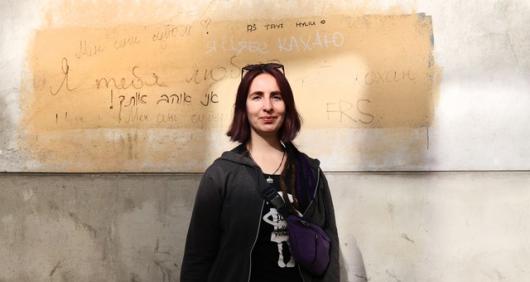
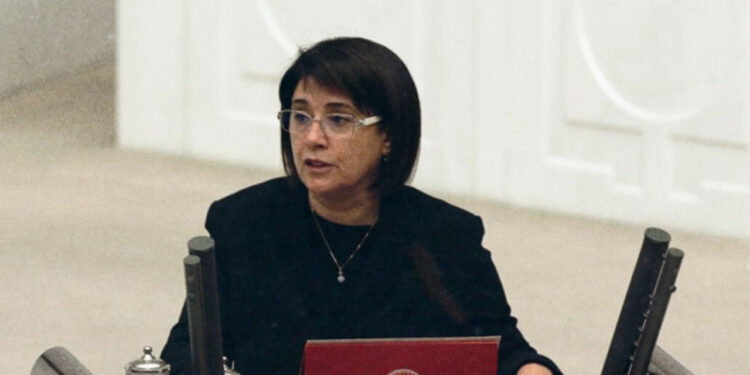
Nasta (Anastasia) Loika was sentenced to 7 years in a penal colony for “inciting racial, national, religious or other social enmity or discord” on 20 June 2023. She is a prisoner of conscience, targeted in retaliation for her human rights work.
Nasta (Anastasia) Loika is a prominent human rights defender and educator, focusing her work on human rights violations resulting from the use of the repressive “anti-extremist” legislation in Belarus, the protection of foreign nationals and stateless persons in Belarus, and on human rights education.
Nasta Loika was sentenced for “inciting racial, national, religious or other social enmity or discord” under Part 3 of Article 130 of the Belarusian Criminal Code on 20 June 2023. The Belarusian human rights defender and prisoner of conscience was arbitrarily detained on 28 October 2022, accused of “petty hooliganism”, a violation under Article 19.1 of the Code of Administrative Offences. As the Belarusian authorities repeatedly brought the allegations against her, she served a total of five consecutive 15-day terms in detention for the same purported offence. On 24 December 2022, she was arbitrarily charged under Articles 342.1 (“Organization and preparation of actions that grossly violate public order, or active participation in them”) and 130.3 (“inciting racial, national, religious or other social enmity or discord”) of the Belarusian Criminal Code.
Nasta Loika reported that she had been tortured by electric shock during questioning and that whilst in detention she was left out in the courtyard for eight hours without outerwear in cold weather. She has consistently not been provided with the medical care she requires, which in itself may amount to inhumane and degrading treatment.
On 10 August 2023 Matthew Ogune of the Nigerian Guardian reported that Nigerian lawyer and human rights activist, Oluwafunke Adeoye, has emerged as one of the winners of the 2023 Waislitz Global Citizen Awards, with a prize money of $75,000. Adeoye is the founder of Hope Behind Bars Africa.
Adeoye was officially announced as a winner in the 2023 edition by the global body. The honour makes her the first individual working in the Criminal Justice sector to win this global award.
The Waislitz Global Citizen Awards are annual cash prizes totaling $250,000 that recognize the excellence of individuals in their work to end extreme poverty. The grand prize is $100,000 with two additional prizes at $75,000 each, for a total of three prizes. The awards are presented by the Waislitz Foundation and Global Citizen, and supported by the US and Australian based cellular medicines company, Mesoblast Ltd. and Unico Capital Holdings.
“Ending extreme poverty is not a choice, it’s an obligation. My hope is that it will inspire many thousands of people around the world to do what they can to improve the living standards of those in dire need,” Chairman and Founder of the Melbourne-based Waislitz Foundation, Alex Waislitz.
The Waislitz foundation exists to create a positive social impact locally and globally through innovative projects that empower individuals to meet their full potential and make a measurable difference to the world.
According to the global body, the Nigerian born lawyer has over the years helped in providing free legal services and direct support to indigent incarcerated people, while promoting criminal justice reform through research, advocacy and technology.
Reacting to the award in a statement on Wednesday in Abuja, Adeoye said she was inspired to begin the initiative in 2018, after some personal encounters with the justice system, including one where her father was arrested and detained for a crime he did not commit several years ago.
The organisation closes the justice gap by providing free legal services and direct support to low-income incarcerated individuals while promoting criminal justice reforms through research, evidence-based advocacy, and technology. Over 7,000 incarcerated individuals have benefitted from their interventions.
With the award, Adeoye plans to fully launch Justicepadi, a tech platform that will revolutionise legal aid in West Africa and also expand her work for climate justice.
“It is crucial for people to understand that behind the labels of ‘convicts’ or ‘prisoners’, there are human beings with stories, hopes, and dreams. By offering legal aid, we strive to ensure that every person, regardless of their circumstances, has access to fair representation and a chance to rebuild their lives,” Adeoye said.
The other winners of the award are: Peter Njeri and Esther Kimani, both Kenya citizens. They were named 2023 Waislitz Global Citizen Award winner and the Waislitz Global Citizen Disruptor Award winner respectively.
Leyla Zana, a renowned Kurdish politician and human rights activist, and the first Kurdish female member of the Turkish parliament, will face prosecution on 7 September 2023, with her international awards being cited as “criminal evidence” in the indictment.
Former Member of Parliament Leyla Zana is due to stand trial in a Turkish court on 7 September 2023, facing accusations of “terrorist propaganda” in her speeches and charges of accepting international awards, deemed as “crimes” under Article 325/1 of the Turkish Penal Code. The penal code article, titled “Acceptance of Titles and Similar Honours from the Enemy,” stipulates that a citizen who accepts academic degrees, honours, titles, medals, or other honorary ranks from a state at war with Turkey could face imprisonment from one to three years.
Zana’s lawyer, İbrahim Çeliker, has questioned the basis of the charges, asking, “Which awards received by Ms. Zana could be a source of crime? Which country has Turkey declared war on? These need to be clarified. The awards in question that Ms. Zana received are awards given from European countries and America on human rights,” Çeliker stated. [see: https://www.trueheroesfilms.org/thedigest/laureates/82F7AAA5-88D1-47E8-8B62-4EBC66D1602D]
Zana is internationally recognised for her human rights work and political activism. Her accolades include the Thorolf Rafto Memorial Prize, the Sakharov Prize for Freedom of Thought, the Aachen Peace Prize, the Bruno Kreisky Prize, and the Freedom Medal by the American Human Rights Association. One should add the Juan Maria Bandres Prize for Human Rights and Refugee Protection in 2008. She has also been awarded the Silver Medal of the City of Paris and has been recognised as an “Honorary Citizen” by the cities of Paris and Geneva.
The indictment also implicates pro-Kurdish Democracy Party (DEP) former MP Orhan Doğan and Vedat Aydın, the People’s Labour Party (HEP) Diyarbakır (Amed) Provincial Chairman who was killed in 1991, citing their participation in memorial programmes as criminal. Çeliker responded to this, stating, “The prosecutor considers Orhan Doğan and Vedat Aydın as members of the PKK [Kurdistan Workers’ Party]/KCK [Kurdistan Communities Union]. He sees the mention of these names as a criminal element. However, Orhan Doğan is a Kurdish politician who spent years in prison with Leyla Zana and served as an MP. Vedat Aydın is a Kurdish intellectual who fell victim to an unsolved murder.”
Çeliker also emphasised that the indictment targets freedom of speech, stating, “The main point that the prosecutor focuses on is Ms. Zana’s speaking in Kurdish. There is a special clause in the indictment about her speaking in Kurdish. He emphasises this as a fault and evidence of the alleged crime; the crime of making terrorist propaganda. There are expressions picked out from speeches made in the fields of peace, brotherhood, and democracy … Ms. Zana has never praised violence, she has fought for peace to come, she is a politician who has paid the price.”
On 26 July 2023 Front Line Defenders stated that it stands in solidarity with Hiba Ezzideen Al-Hajji, and calls on the de facto authorities in Idlib to put an end to the targeting of the Syrian woman human rights defender.
Despite the efforts of human rights organisations, women human rights defenders in Syria continue to face many forms of restrictions and threats. In this context, Hiba Ezzideen Al-Hajji, a woman human rights defender and CEO of the feminist organisation Equity and Empowerment, has recently been targeted by a malicious online defamation campaign because of her work on women’s rights and democracy in Syria. On 4 July 2023, Hiba Ezzideen Al-Hajji received death threats from unknown individuals who disagreed with her advocacy efforts for “equality and democracy,” asserting that such work went against the teachings of Islam. Subsequently, the Facebook page of her organisation Equity and Empowerment was overwhelmed with hateful comments and threats, further escalating the distressing situation.
Those behind the defamation campaign are believed to be Jihadists operating in Idlib, northwestern Syria, where the woman human rights defender conducts her human rights work. The woman human rights defender has previously reported that these radical groups were responsible for similar threats, indicating a pattern of persecution and harassment against her and other human rights defenders in the area.
The attacks have also manifested in offline harm. On 18 July 2023, a family member of the woman human rights defender was insulted by a stranger who threatened them saying that if Hiba Ezzideen Al-Hajji does not stop her work, one of her family members will be killed. The defamatory narrative against Hiba Ezzideen Al-Hajji aims at inciting further hatred and violence against her, all in an effort to undermine her human rights work.
On 21 July 2023, an imam in the countryside outside of Idlib gave a sermon which mentioned the woman human rights defender Hiba Ezzideen Al-Hajji and the organisation Equity and Empowerment. The sermon called for the organisation to be closed, incorrectly mentioning its links to western states as a means of discrediting its work.
On 2 March 2020, Ahmed Shaheed, the UN Special Rapporteur on freedom of religion or belief declared that they “firmly reject any claim that religious beliefs can be invoked as a legitimate ‘justification’ for violence or discrimination against women or girls.”
The campaign has taken place over various online platforms, including WhatsApp, Facebook, Twitter and Telegram, using fake and verified accounts to post derogatory fake images of the human rights defender along with hateful captions. In addition to this, she has been subjected to death threats, harassment, and incitements against her and her family, along with doxing, deep fakes, threats of rape and sexual slurs.
Front Line Defenders believes that the defamation campaign is directly related to Hiba Ezzideen Al-Hajji’s work in defence of human rights, in particular her work towards the promotion of women’s rights in Syria. Front Line Defenders strongly condemns the defamation campaign against the woman human rights defender Hiba Ezzideen Al-Hajji. It calls on the de facto authorities in Idlib to put an end to the targeting of the woman human rights defender, including the defamation campaign, and demands that Hiba Ezzideen Al-Hajji’s safety and well-being be protected as well as that of all women human rights defenders facing similar threats and attacks in the country.
On 25 July, 2023 – International Afro-Latina, Afro-Caribbean and Diaspora Women’s Day, – Amnesty International highlighted nine defenders and collectives who have devoted their lives to ending inequality and violence, advocating a dignified life for all people because their work deserves the recognition, visibility, protection and resources necessary for it to continue to spread.
Rede Vozes Negras pelo Clima, Brazil
Rede Vozes Negras pelo Clima is an initiative of 11 Black Brazilian women who are working in their respective territories to protect human rights, confront climate racism and promote anti-racist socio-environmental justice. They belong to traditional, riverine quilombola communities. They are also activists and leaders of communities that live on the margins of large urban centres, communities that are being directly affected by the consequences of the climate crisis and development projects that fail to take into account the rights of local populations.
They are thus fighting for anti-racist adaptation policies and an energy transition that will guarantee the promotion of human rights and nature. Mitigation initiatives need to incorporate the ancestral knowledge and wisdom of traditional peoples and communities and ensure the participation of those people affected by extreme weather events when decisions are being made as to the investments that need to be made to repair losses and damage.
Dayana Blanco Acendra, Colombia
Dayana Blanco is a renowned Colombian lawyer who heads ILEX Acción Jurídica, an Afro-Colombian and Afro-LGBTQI+ organization committed to racial justice in Colombia, Latin America and the Caribbean. According to Blanco, “Racial justice in Colombia requires all of society to commit to combatting the historical inequality that has affected the Afro-descendant population. This means actions to address social and economic inequality.”
With an outstanding academic background and experience in different sectors, Dayana has promoted innovative research on racist police violence, statistical invisibility in the systematization of violence against Afro-descendant leaders and economic and social rights. In addition, together with her team and in coordination with other civil society organizations, she has obtained notable rulings in defence of Afro-Colombian midwifery, overcoming the statistical invisibility of the Afro-descendant population, among others, and demonstrating her dedication to the struggle for equality and justice.
Under her leadership, ILEX has – through legal mobilization, research and strategic communications – become a reference for promoting the rights of the Afro-descendant population. Dayana and her team highlight the importance of addressing social and economic inequality as a fundamental element of racial justice in Colombia, calling on the whole of society to unite in the struggle and build a more equitable future for all.
Donaida Pérez Paseiro, Cuba
Donaida Pérez Paseiro is a Black activist, religious leader and president of the Asociación Yorubas Libres de Cuba. Yoruba is a religion of the African diaspora that is practised in many countries, including Cuba. Donaida was arrested on 16 July 2021 and sentenced in February 2022 to eight years’ imprisonment by the Santa Clara Municipal People’s Court for “public disorder”, “contempt” and “attacking” an official. According to the information available to Amnesty International, Donaida should never have been charged with these crimes.
The charges of “contempt” and “public disorder” are frequently used in Cuba to limit the right to freedom of expression and peaceful assembly. Both she and her husband, Loreto Hernández García, were tried along with 14 other protesters in what appears to have been an unfair trial.
Donaida is the wife of Yoruba leader and activist Loreto Hernandez Garcia who was unjustly sentenced to seven years in prison for demanding respect for human rights in Cuba during the 11 July 2021 demonstrations.
Donaida is an example of courage and perseverance in the resistance against repression in Cuba. Her commitment has manifested itself in numerous peaceful marches and protests. According to her family, she was a freelance journalist and founded the Laurel Express press agency, where she gave visibility to the injustices and challenges faced by her community in the city of Placetas. Her activism spans multiple spheres, having been a member of the Orlando Zapata Tamayo resistance front and the central opposition coalition. Donaida’s legacy transcends borders and leaves a profound inspiration for those who seek a Cuba without repression.
Guerline M. Jozef, Haiti
Guerline M. Jozef is the founder and executive director of the Haitian Bridge Alliance, the only Black and Haitian women-led organization serving migrants on both sides of the U.S.-Mexico border. Named one of the most influential people in 2021 on racial issues by Politico, she is also co-founder of the Black Immigrants Bail Fund and the Cameroon Advocacy Network.
The Haitian Bridge Alliance (HBA), also known as “the Bridge,” is a grassroots community-based organization that advocates for just and humane immigration policies and provides migrants and immigrants with humanitarian, legal and social services, with a special focus on Black migrants, the Haitian community, women and girls, LGBTQIA+ people, and survivors of torture and other human rights abuses. HBA also seeks to highlight issues specific to Black migrants and encourages solidarity and collective action to bring about policy changes. Through her work, Guerline reminds us that together, Anpil men, chay pa lou! Many hands lighten the load!
Miriam Miranda, Honduras
An Afro-indigenous Garífuna leader from Honduras, Miriam Miranda stands out as a courageous defender of human and environmental rights. As coordinator of the Organización Fraternal Negra Hondureña (OFRANEH), she has carried out invaluable work to protect and defend the rights of the Garífuna people in Honduras. Her tireless work, lucidity and commitment have earned her the recognition of prestigious awards, such as that of the Friedrich Ebert Foundation, as well as the Carlos Escaleras and Oscar Romero awards.
Miriam’s struggle is deeply rooted in the Garífuna territory of Honduras and is manifested through the history of OFRANEH, an organization through which these people are building their dignity and their future. The land and the sea, as an indispensable part of their identity, determine an essential struggle to preserve the natural assets of their territory.
Miriam is a highly respected thinker and leader within the social movement. She has an enormous capacity to devour books and mobilize energies from all sides to defend her people. She is one of those people who make life possible, whose words always point forward and who finds strength in the deep roots of her origin, where her future of freedom was born. As the daughter of Barauda (representing Garífuna female strength, Barauda is an historical character who pushed the Garífuna hero Sathuye to continue the struggle for the liberation of his people), Miriam has turned her critical eye to the source of it all: the predatory civilization of consumerism.
Her tireless work and courage inspire others to keep fighting. Her contribution and leadership have already left an indelible mark on the history of Honduras and global struggles for territory. [see also: https://humanrightsdefenders.blog/tag/miriam-miranda/]
Shackelia Jackson, Jamaica
The extrajudicial killing of her brother, Nakiea Jackson, in 2014 pushed Shackelia Jackson into a life of activism. Since then she has been healing, evolving, learning and gathering the tools with which to reconcile her conflicting realities. A political science scholar and communicator, Shackelia is the mother of an empathetic child, who longs with innocence to experience the world. Despite challenges and setbacks, Shackelia remains dedicated to the wider struggle, supporting causes that prevent the institutionalization and normalization of practices that violate human rights and erode the sanctity of life.
Through her grassroots organizing efforts in Jamaica, she has raised funds to support back-to-school initiatives and education programmes, recognizing the importance of empowering the younger generation. Shackelia’s work has gone far beyond her local community. She has become a global force, lending her voice and expertise to international platforms. As keynote speaker at an Amnesty International event in London, she captivated the audience with her powerful words, urging them to stand up and take action. In 2017, Shackelia also participated in roundtable discussions at Amnesty International events in Brazil and the United States, amplifying the voices of the oppressed and demanding accountability.
It was on this journey that Shackelia realized that change starts with each individual. She has encouraged others to join her in writing for rights, and to use their words as weapons against injustice. “Let us write until we are heard, let us write until justice is done,” she said.
Ivana C. Fred Millán, Puerto Rico
Ivana Fred is a prominent Black and transgender activist, writer and leader from Puerto Rico. She has dedicated her life to fighting for human rights and equality for transgender people in her country. Her passion for justice has made her an influential figure and a powerful voice in Puerto Rican society.
Since her first steps into activism in 1999, Ivana has formed part of pioneering projects aimed at trans people and has used her voice and pen to amplify the stories and needs of trans people.
As she says: “Life put me in a place where I could develop as a leader, the ‘Ponte el Sombrero’ project gave me the tools to empower and educate socially disadvantaged and discriminated populations. That was how I came to understand that to exist is to resist”.
Ivana has also made her mark in the media, writing for the Metro newspaper and participating in acclaimed documentaries and films such as “Mala Mala” and “Las Muchachas”. Her presence and perspective have helped generate greater visibility and understanding of transgender experiences in Puerto Rico.
Ivana Fred is currently one of the directors of the organization Trans Goofy Games, where she continues to lead and support initiatives that promote transgender inclusion and empowerment. With unwavering commitment, Ivana has remained a visible leader and loyal activist. From her early days of activism to the present day, her voice has been resolute in seeking dignity and respect for all transgender people.
With her courage and determination, Ivana has shown that to exist is to resist and has paved the way for a more inclusive and respectful future in Puerto Rico and beyond. Her legacy as a visible leader and her tireless activism inspire us all to continue fighting for a world where everyone can live with equality and dignity.
Elena Lorac, Dominican Republic
Elena Lorac is a prominent activist and advocate for human rights in the Dominican Republic, especially on the part of Dominicans of Haitian descent. As national coordinator of the Movimiento Reconoci.do, she has led the fight for the right to nationality and full integration of this community into Dominican society.
With more than 12 years’ experience, Elena has worked to strengthen community leadership and empower black women in the country’s bateyes [sugar mill settlements]. She also provides support to Haitian migrants and Venezuelan migrants and refugees, and is known for her community-based approach.
Elena is also a nationally and internationally renowned speaker, speaking on issues such as nationality, discrimination and racism, and raising awareness of policies that affect Dominicans of Haitian descent in the Dominican Republic. Her tireless work has been instrumental in promoting human rights and achieving the real inclusion of this community in Dominican society.
Aracelis Sánchez, Venezuela
Aracelis Sánchez, a human rights defender and the founder of Organización de Familiares de Víctimas de Violación de Derechos Humanos (Orfavideh), is promoting solidarity and demanding justice together with more than 200 mothers of victims of extrajudicial executions in Venezuela.
Aracelis, who lost her son Darwilson Sequera, has been fighting for more than 10 years to get cases of human rights violations committed by Venezuelan state security forces investigated. Orfavideh provides human rights training workshops for mothers, equipping them with tools with which to demand guarantees and use the mechanisms of justice in Venezuela.
Aracelis stresses that when victims are empowered and able to put pressure on prosecutors, their cases are investigated. She believes that support and empowerment are essential to transform grief into positive action and thus achieve justice for victims and their families.
Camila Zuluaga is an international advocacy lawyer at the Colombian Commission of Jurists (CCJ). She spoke to ISHR about her hopes for Colombia, which she hopes to make a safer country for human rights defenders. Camila was also one of the participants to ISHR’s flagship training course, the Human Rights Defender Advocacy Programme (HRDAP).
On 1 July 2023, woman human rights defender and author Viktoria Amelina died in hospital in Dnipro, Ukraine after sustaining fatal injuries during the Russian missile attack on Kramatorsk, Ukraine on 27 June 2023. PEN Ukraine reported the death of the woman human rights defender on 3 July 2023 with the consent of her relatives. Viktoria is survived by her husband and 10-year old son.
Viktoria Amelina was a woman human rights defender and writer. In June 2022, after the beginning of Russia’s full-scale invasion of Ukraine on 24 February 2022, she joined the Ukrainian human rights organisation Truth Hounds to document war crimes. She had been documenting apparent Russian war crimes in the liberated territories of eastern, southern and northern Ukraine, and particularly the village of Kapytolivka in Kharkiv region. During one of her missions, Viktoria Amelina discovered a diary of Volodymyr Vakulenko, a Ukrainian writer who was abducted and killedby the Russian military. She was also working on a non-fiction project “War and Justice Diary: Looking at Women Looking at War”, a research project about the Ukrainian women human rights defenders documenting and investigating war crimes committed by the Russian military. Before joining Truth Hounds, Viktoria Amelina actively campaigned for the liberation of Oleh Sentsov, a Ukrainian film director from Crimea who was a political prisoner of the Russian authorities from 2014 to 2019.
Viktoria Amelina won the Joseph Conrad Literature Prize for her prose works, including the novels Dom’s Dream Kingdom and Fall Syndrome, and was a finalist for the European Union Prize for Literature. In 2021, she founded the New York book festival in the Donetsk region of Ukraine, where New York refers to a village in Donetsk that is very close to the military frontline.
On 27 June 2023, the woman human rights defender Viktoria Amelina was in Kramatorsk, in the Donetsk region of Ukraine, accompanying a delegation of Colombian writers and journalists who represented #AguantaUcrania, a group that raises awareness about Russia’s full-scale invasion of Ukraine in Latin America. Before coming to Kramatorsk, the group took part in a prominent Ukraninan literary fair “Book Arsenal.” They all arrived to Kramatorsk to document the situation in Ukrainian cities in the Donetsk region to support the visibility work of #AguantaUcrania.
On the evening of 27 June 2023, the group was having dinner in the Ria Lounge restaurant in Kramatorsk, when a Russian missile hit the building in which the restaurant was located. This missile killed 13 civilians and injured a further 60. As a result of the missile strike, Viktoria Amelina suffered a severe head injury and was hospitalised in Kramatorsk, before being transferred to the hospital in Dnipro. The woman human rights defender died in the hospital in Dnipro three days later, on 1 June 2023.
Truth Hounds and PEN Ukraine reported that, in the aftermath of the attack, Russian state propaganda media falsely claimed that the target of the missile was the temporary headquarters of one of the Ukrainian Armed Forces brigades. In reality, the Ria Lounge restaurant in Kramatorsk was one of the most popular restaurants in the city and was frequented by Ukrainian and international human rights and civil society actors, humanitarian volunteers, and media and film crews. Truth Hounds and PEN Ukraine’s report stated that there were no military objectives that the Russian military could have have been targetting with a missile attack that day. Together, the human rights organisations made a public statement concerning the strike, stating that the precision of the Iskander missiles leads them to believe that the missile strike was an attack against the civilian population.
In light of the death of the woman human rights defender Viktoria Amelina, Front Line Defenders once again reiterates its grave concern about the killings of Ukrainian human rights defenders, civil society activists, humanitarian volunteers and other community leaders as a result of Russia’s full-scale invasion in Ukraine. According to Front Line Defenders’ HRD Memorial, at least 50 human rights defenders were killed in Ukraine in 2022, including humanitarian actors and human rights journalists, as a result of the activities of the Russian military forces.
Front Line Defenders strongly condemns the killing of the woman human rights defender Viktoria Amelina and urges the authorities of the Russian Federation to cease targeting civilian objects in accordance with Russia’s international humanitarian and human rights law obligations, recalling that the deliberate targeting of civilians is prohibited under the Fourth Geneva Convention. The attack on the Ria Lounge restaurant may qualify as a war crime pursuant to Article 8(2)(b)(ii) of the Rome Statute of the International Criminal Court (ICC) – “intentionally directing attacks against civilian objects.” Alternatively, such an attack may be qualified under Article 8(2)(b)(i) – “intentionally directing attacks against the civilian population”; or Article 8(2)(b)(iii) – “intentionally directing attacks against personnel, installations, material, units or vehicles involved in a humanitarian assistance […] mission.” Front Line Defenders calls for an impartial and independent investigation into the killing of human rights defender Viktoria Amelina while she was on mission conducting her human rights work. All those involved in the commission of this crime must be brought to justice.
Mariana de la Fuente, is a human rights defender who fights against slave labour and human trafficking in Brazil. According to ILO, more than 57,000 workers in Brazil were rescued in conditions similar to slavery – between 2003 to 2021.
Image caption, Niloufar Hamedi and Elaheh Mohammadi have been detained in Iran for more than 200 days
BBC Persian Service on 5 May 2023 drew attention to the fate of the two journalists who reported first on Mahsa Amini, whose name made headlines around the world when she died in custody last September, sparking waves of protests in Iran. But not many people have heard of Niloufar Hamedi and Elaheh Mohammadi.
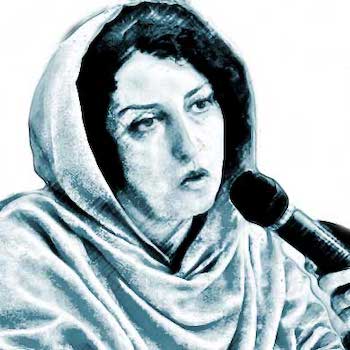
The two female journalists helped break the story of Ms Amini’s death and have been detained in two of Iran’s most notorious prisons ever since. On Tuesday, they and the imprisoned Iranian human rights activist Narges Mohammadi were awarded the 2023 Guillermo Cano World Press Freedom Prize by the United Nations’ cultural agency, UNESCO.”They paid a hefty price for their commitment to report on and convey the truth. And for that, we are committed to honouring them and ensuring their voices will continue to echo worldwide until they are safe and free,” said Zainab Salbi, the jury chair. For more on Narges, see; https://www.trueheroesfilms.org/thedigest/laureates/07C20809-99E2-BDC0-FDC3-E217FF91C126
On 22 September, just six days after she tweeted a photograph of Mahsa’s grieving family, Niloufar Hamedi was arrested. Security forces also raided Elaheh Mohammadi’s home at the same time, seizing her electronic devices. On 29 September, she too was arrested.
Both Ms Hamedi and Ms Mohammadi were already known for hard-hitting news reports and coverage of human rights issues.
“Journalists in Iran are risking their lives on a daily basis to report on the conditions and oppressions there,” the Harvard fellows noted.
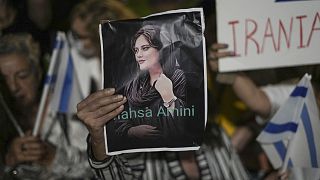
Image caption, Mahsa Amini’s death led to a wave of protests in Iran and rallies in solidarity around the world
Ms Hamedi and Ms Mohammadi have meanwhile been kept in harsh conditions at Evin prison in Tehran and Qarchak Women’s Prison, south of the city. Reports from inside Qarchak suggest that the facilities are inhumane, with a lack of medicine, food and even safe drinking water or clean air. Ms Mohammadi lost 10kg (22lbs) in the first three months of her detention, her husband wrote on his Instagram page.
Both women have also struggled to access legal support. The first lawyer appointed to represent the pair said in October that he was unable to communicate with them or access the legal documents surrounding their arrests. Less than a month later, he was himself arrested. The journalists’ families have struggled with the pain of not knowing what is going to happen to them.
“I’m asked, ‘What do the authorities tell you?’ I’m not even sure which institution or person to contact,” Ms Hamedi’s husband, Mohammad Hossein Ajorlou, said in an interview with Sharq.
He too has found it difficult to get information about what his wife is accused of and what is likely to happen to her.
At the end of October, Iran’s ministry of intelligence and the intelligence agency of the Revolutionary Guards issued a statement accusing Ms Hamedi and Ms Mohammadi of being trained by the US Central Intelligence Agency to foment unrest in Iran.
Their newspapers denied the allegations and insisted they had just been doing their jobs.
Last week, after they had both spent more than 200 days in custody, the Iranian judiciary announced that Ms Hamedi and Ms Mohammadi had been indicted and their cases referred to a court.
Burundian authorities should immediately and unconditionally release five human rights defenders arbitrarily arrested on February 14, 2023, and drop the baseless charges against them, Amnesty International, the Burundi Human Rights Initiative, and Human Rights Watch said on 14 March 2023.
The five human rights defenders are accused of rebellion and of undermining internal state security and the functioning of public finances. The charges appear to relate only to their relationship with an international organization abroad and the funding they have received from this organization. Two of the defenders work for the Association of Women Lawyers in Burundi (Association des femmes juristes du Burundi, AFJB) and three for the Association for Peace and the Promotion of Human Rights in Burundi (Association pour la paix et la promotion des droits de l’Homme, APDH).
“The arrests of the five human rights defenders and the serious charges brought against them signal a worsening climate for independent civil society in Burundi,” said Clémentine de Montjoye, Africa researcher at Human Rights Watch. “If working in partnership with or receiving funding from international groups is treated as a criminal offense and a threat to state security, what little space was left for civil society to operate in Burundi will be closed.”
On February 16, Martin Niteretse, Minister of Interior, Community Development and Public Security, accused the organizations of working with an international nongovernmental organization. Intelligence agents arrested four of the defenders – Sonia Ndikumasabo, president, and Marie Emerusabe, general coordinator, of AFJB; Audace Havyarimana, legal representative, and Sylvana Inamahoro, executive director, of APDH – on February 14 at Bujumbura’s Melchior Ndadaye Airport as they were preparing to fly to Uganda for a meeting with partners.
Prosper Runyange, the APDH land project coordinator, was arrested in Ngozi on February 14 and transferred to Bujumbura the next day. The five defenders were held at the National Intelligence Service (Service national de renseignement, SNR) headquarters in Bujumbura, then transferred to Mpimba central prison in Bujumbura, on February 17. On March 2, the high court of Ntahangwa in Bujumbura confirmed their pretrial detention.
The two organizations work on gender-based violence and land rights and are officially registered in Burundi. They help some of the most marginalized groups in Burundian society. The judicial authorities’ decision to pursue prosecution of the defenders, apparently solely on the grounds of their organizations’ partnership with and funding from an international organization, has triggered fears of another civil society crackdown in Burundi and undermines the president’s stated reform agenda, the organizations said. In October 2018, the authorities suspended the activities of most foreign organizations in Burundi and forced them to re-register, which included submitting documentation that stated the ethnicity of their Burundian employees.
The government policy, based on a law on foreign nongovernmental organizations, adopted in January 2017, caused some international organizations to close their offices in Burundi because they disagreed with government-imposed ethnic quotas and objected to the requirement to provide information on the ethnicity of their staff. Some said they feared that submitting this information could put their employees at risk of ethnic profiling and targeting.
“The charges of endangering state security and rebellion against these five human rights defenders are absurd,” said Carina Tertsakian from the Burundi Human Rights Initiative. “If the authorities have questions about their sources of funding, these can be solved through normal administrative channels, as provided for by the law.”
During late President Pierre Nkurunziza’s third and final term, from 2015 to 2020, independent civil society and media were often targeted, and their members attacked, forcibly disappeared, detained, and threatened. Scores of human rights defenders and journalists fled the country and many remain in exile. There has been almost total impunity for these crimes.
Since President Évariste Ndayishimiye came to power in June 2020 and despite his promises to restore freedom of expression and association, the government’s hostility toward Burundi’s once thriving civil society and media remains. The arrests of the five rights defenders followed the conviction, on January 2, 2023, of an online journalist, Floriane Irangabiye, to 10 years in prison, on charges of “undermining the integrity of the national territory” in violation of her rights to free speech and to a fair trial.
These latest arrests and Irangabiye’s conviction reverse a brief moment of optimism after the acquittal and release, in December, of Tony Germain Nkina, a lawyer and former human rights defender who spent more than two years unjustly imprisoned on unsubstantiated charges of collaboration with a rebel group. Twelve human rights defenders and journalists in exile were convicted in June 2020 of participating in a May 2015 coup attempt. The verdict, which was only made public in February 2021, came after a deeply flawed trial during which the defendants were absent and did not have legal representation, flouting the most basic due process principles. The 12 were found guilty of “attacks on the authority of the State,” “assassinations,” and “destruction.”
The arrest of Ndikumasabo, Emerusabe, Havyarimana, Inamahoro, and Runyange appears to be designed to punish the human rights defenders and their organizations for collaborating with an international organization, obstruct their organizations’ activities, and intimidate other activists. Such behavior belies Burundian authorities’ claims that they respect human rights and further stains the image of openness and reform that they try to project internationally, the organizations said.
“Actions speak louder than words,” said Flavia Mwangovya, Deputy Regional Director at Amnesty International. “If the Burundian authorities want their human rights promises to be taken seriously, they should allow civil society to do its valuable work – including defending and assisting victims of human rights violations – without harassment.”