On 29 October, 2025 Amnesty International came with a report: “Closing the door – How Europe’s Schengen area visa policies fail human rights defenders“. International travel is crucial for human rights defenders (HRDs), and the Schengen area is a key destination, offering many opportunities for human rights advocacy, networking, learning, and for temporary respite for those facing threats and burnout. The importance of mobility for HRDs has been recognized by EU institutions and Schengen states. However, gaps remain between commitments and practice.
HRDs who are nationals of the 104 visa-restricted countries and who are in their vast majority racialized as Black, Asian and/or Muslim, continue to encounter huge barriers in obtaining a visa.
The report brings together real-life cases showing the impact of these obstacles on racialized HRDs, including many examples of visa denials because HRDs were not believed for the purpose of their travel. These experiences occur within a broader context of systemic racism, a legacy of colonial practices that shape visa policies and practices to this day. The report calls on authorities to ensure the full implementation of existing flexible arrangements for HRDs applying for visas, to develop a new visa procedure specifically designed to facilitate the process for HRDs, and to eliminate and prevent racial discrimination in the context of visa policies and processes.
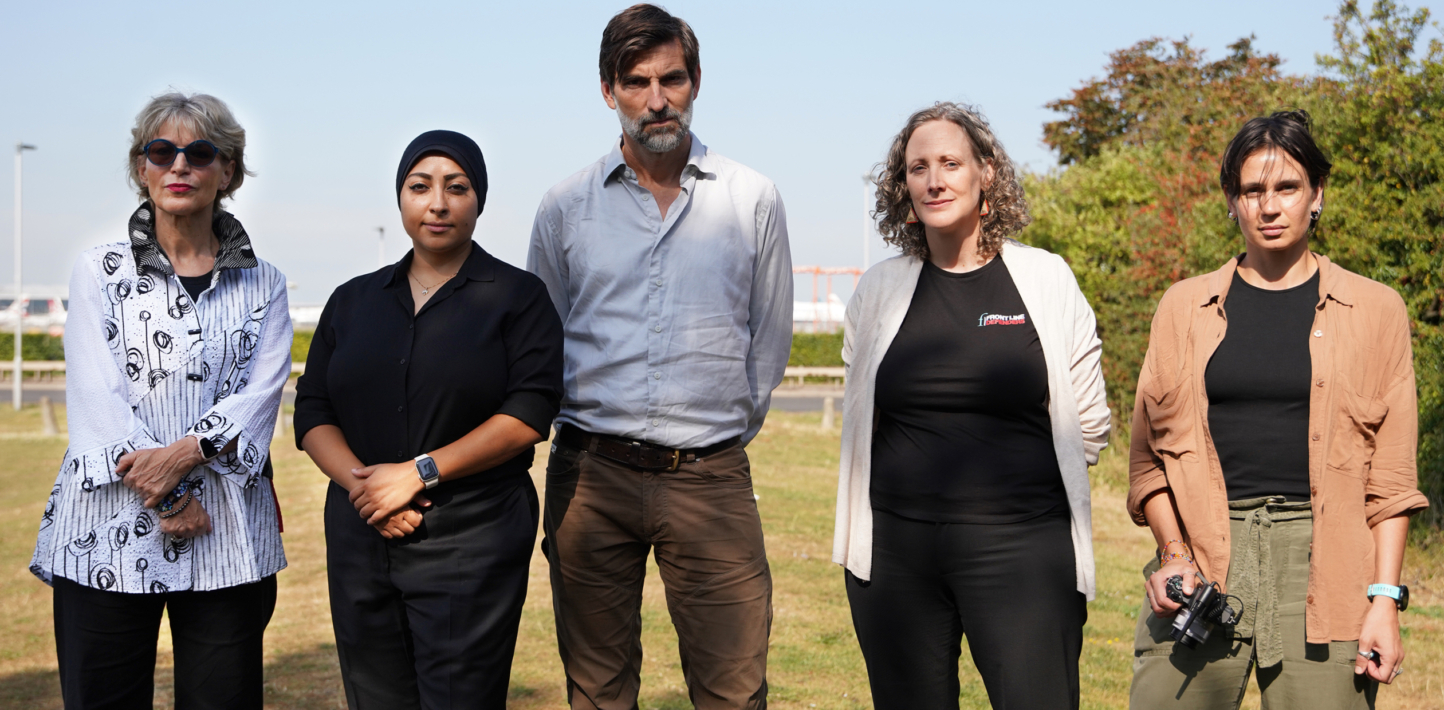
In a video message posted on X, Khawaja said she was not allowed to board a flight at London’s Heathrow Airport “despite being a Bahraini citizen”.
“I was told I have to speak to Bahraini immigration if I want to get a boarding pass to Bahrain. So effectively we are being denied boarding by British Airways on behalf of the Bahraini government,” she said.
Agnes Callamard, the secretary-general of Amnesty International, was among those accompanying Khawaja and said on X that she had also been denied boarding. “Our human rights delegation members are all denied a boarding pass. We are told that British Airways has been instructed by the Bahrain immigration authorities not to give us a boarding pass,” she posted.
A spokesperson for the British Airways Press Office said: “All airlines are legally obliged to comply with immigration control laws and entry requirements for customers as set by individual countries,” he told Middle East Eye in a statement and a government spokesperson in Bahrain added: “…as with other countries, Bahrain reserves the right to refuse entry, if deemed necessary.”
Sayed Alwadaei, a Bahraini activist, and the director of advocacy at the UK-based Bahrain Institute for Rights and Democracy (BIRD), raised concern over al-Khawaja being denied boarding the flight.
Campaigners and the heads of human rights organisations informed MEE that they are planning to peacefully protest outside the Bahraini embassy in London later today in response to not being allowed to travel to Bahrain.
Responding to the news, Olive Moore, the Executive Director of Frontline Defenders said that the decision not to let her board the flight was “unjustifiable“.
“Bahrain’s hosting of sporting and high-level international events is a transparent attempt to launder its decades-long campaign to crush political opposition and suffocate the country’s vibrant civil society,” said Tirana Hassan, Human Rights Watch’s acting executive director. “Its unilateral reversal of Human Rights Watch’s access to the IPU conference is a blatant example of its escalating repression. Governments, organizations with influence, and key officials should speak out loudly against Bahrain’s abuses so they are not complicit in its efforts to whitewash its horrific rights record.”
Bahrain is hosting the meeting of the IPU, a global organization of national parliaments, from March 11-15. The organization’s slogan is “For democracy. For everyone,” and the theme of the 146th Assembly is “Promoting peaceful coexistence and inclusive societies: Fighting intolerance.” These statements are in stark contrast to the extensive record of serious human rights abuses in Bahrain that Human Rights Watch and other rights organizations have documented, Human Rights Watch said. This includes the continued detention of the prominent human rights activist and Danish-Bahraini dual citizen Abdulhadi Al-Khawaja. Al-Khawaja is reportedly suffering serious health problems while being denied adequate medical care. He is this year’s laureate of the MEA [see: https://humanrightsdefenders.blog/tag/abdul-hadi-al-khawaja/]
….. Two of Bahrain’s former parliament members are in prison for exercising their freedom of expression, and the government has forced many more into exile and stripped them of their citizenship.
On March 5, Bahrain hosted Formula One’s (F1) opening season race. Twenty-one groups, including Human Rights Watch, sent a letter to F1’s president to raise “serious concerns over F1’s ongoing role in ‘sportswashing’ amidst a deterioration in Bahrain’s human rights situation.” An F1 driver, Lewis Hamilton, recently said that he is “not sure [the human rights situation] has got better while we have been coming all these years” to countries like Bahrain and Saudi Arabia.
“With local civil society severely restricted by Bahrain’s autocratic government, members of the IPU Assembly should live up to its organizational values and speak out on behalf of Bahrain’s victims of repression,” Hassan said.
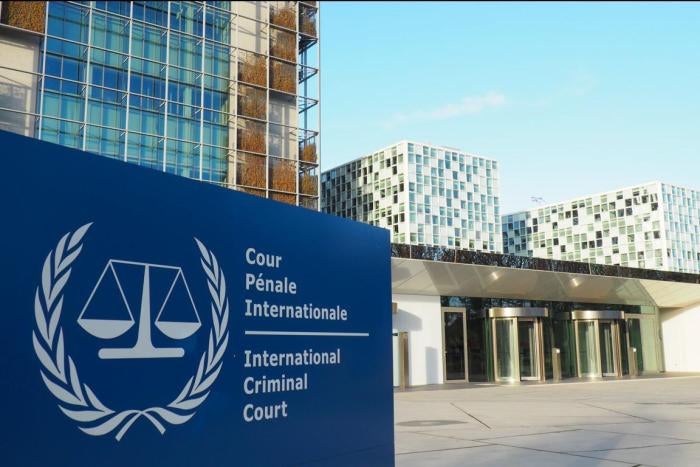
US President Joe Biden’s cancellation of punitive sanctions targeting the International Criminal Court (ICC) removes a serious obstacle to the court’s providing justice to the victims of the world’s worst crimes, Human Rights Watch said on 2 April 2, 2021. Biden revoked a June 2020 order by then-President Donald Trump authorizing asset freezes and entry bans to thwart the ICC’s work. This was expected after an appeal by many NGOs, see: https://humanrightsdefenders.blog/2021/02/19/large-group-of-ngos-call-on-biden-administration-to-repeal-icc-sanctions/
In announcing the repeal of the executive order, Secretary of State Antony Blinken said that “[t]hese decisions reflect our assessment that the measures adopted were inappropriate and ineffective.” The State Department also lifted existing visa restrictions.
“The Trump administration’s perversely punitive sanctions against the ICC showed stark contempt for the victims of grave international crimes and the prosecutors who seek to hold those responsible to account,” said Richard Dicker, international justice director at Human Rights Watch. “In removing this unprecedented threat to the global rule of law, President Biden has begun the long process of restoring US credibility on international justice through the ICC.”
Israel, which was angered in February by the UN listing companies with activities in illegal Israeli settlements, has granted no visas to UN rights staff for months, the agency said Friday. “Visa applications have not been formally refused, but the Israeli authorities have abstained from issuing or renewing any visas since June,” UN rights office spokesman Rupert Colville told AFP in an email.
He stressed that Israel had not formally refused any of the office’s visa applications, but had simply not acted on new requests or requests for renewal. Nine international staff members (including country director James Heenan) had been forced to leave so far after their visas were not renewed. And “three newly appointed international staff have not been able to deploy because they have not received their visas,” he said. Only three international staff members of the agency still have valid visas to work in the country.
This, Colville lamented, was creating a “highly irregular situation and will negatively impact on our ability to carry out our mandate.”
Israel has not provided an official explanation, but the blockage comes after the UN rights office in February released a list of over 100 companies with activities in Israeli settlements, which are considered illegal under international law. And in June, the country reiterated its decision to “freeze ties” with UN High Commissioner for Human Rights Michelle Bachelet and her office.
Colville stressed that the UN rights agency’s offices in Israel and the Palestinian territories remained open, with 26 national staff members and the remaining three international staff onsite. The remainder of the international staff were working remotely, he said, adding that this was not having a big impact on operations yet, since remote work had become a norm in many places anyway due to the ongoing pandemic. “We continue to hope that this situation will be resolved soon, and we are actively engaged with various relevant and concerned parties to that end,” Colville said.
Shakir, who is currently based in Amman after being expelled from Israel after claims he supported calls for a boycott, said it is part of a wider trend in which other human rights activists are being denied entry due to their criticism of Israel’s human rights record.
However, Shakir said that if Israel’s goal was to silence criticism it had failed, as human rights activists continue to do their work as “strongly” as before.
Mr. Barghouti was supposed to speak at a series of events in the United States organized by the Arab American Institute in Washington, including at panels at Harvard University and an event with New York University. He was also planning to attend his daughter’s wedding in Texas.
Mr. Barghouti, a permanent resident of Israel, was stopped at Israel’s international airport when he tried to board a flight to Washington via Frankfurt, and airline staff told him only that the American Consulate in Tel Aviv had been directed to stop him from traveling. He said he was told it was an immigration matter but was given no further explanation.
Nishita, JhaBuzzFeed, reports on 20 March 2019 that many women who were slated to participate in the UN Commission on the Status of Women have been denied visas, especially lawyers, activists, and women who deliver reproductive health care services from African and Middle Eastern countries that fell under Donald Trump’s travel ban.
The International Service for Human Rights said it was aware of at least 41 women who have been denied visas to attend the conference this year — but this figure is said to be only “the tip of the iceberg” and likely to increase.
Women who wanted to attend CSW this year from countries like Iran, Sudan, Zimbabwe, and Syria were asked to provide supporting documents like marriage certificates, proof of property ownership, letters stating employment status, proof of finances, and even proof of birth certificates or proof showing that they have children, according to the petition.
Lyndal Rowlands, advocacy officer with the UN-accredited organization CIVICUS, told BuzzFeed News that among all the people that were denied visas, women from countries that fell under the Trump administration’s travel ban were disproportionately affected. “Last year and this year we have also heard of women from Pakistan and Nepal who were denied visas,” she said. …Most of the women applying for visas, Rowlands said, had not traveled to the US before — a deliberate decision by organizers who wanted a diverse range of women present at the United Nations, not just pundits and experts who travel all the time but women who work at the grassroots.
“It’s essential that women who are at the front lines working on women’s rights are present when their rights and the rights of the women they serve are being discussed,” she said. “Governments and UN officials that attend the conference can make better policies when they are informed by the experiences of women who face some of the biggest uphill battles when it comes to fighting for gender equality — for example, delegates who were unable to attend include lawyers and advocates who represent women who have been imprisoned for their activism, [and] women who deliver reproductive health care services.”
Jessica Corbett, staff writer for Common Dreams writes on 25 March “‘Blatant Effort to Intimidate and Retaliate’: Pompeo Imposes Visa Ban on ICC Staff Probing US War Crimes“
Secretary of State Mike Pompeo announced new visa restrictions in a press briefing on Friday. (Photo: U.S. State Department)
Human rights defenders expressed outrage on Friday after Secretary of State Mike Pompeo revealed that the Trump administration is revoking or denying visas for any International Criminal Court (ICC) personnel who try to investigate or prosecute U.S. officials or key allies for potential war crimes. The move, Pompeo confirmed is a direct response to ongoing efforts by the ICC to probe allegations of war crimes and crimes against humanity tied to the war in Afghanistan. There was an immediate and almost unanimous outcry by the key human rights NGOs in the USA:
Jamil Dakwar, director of the ACLU‘s Human Rights Program (the ACLU currently represents Khaled El Masri, Suleiman Salim, and Mohamed Ben Soud, who were all detained and tortured in Afghanistan between 2003 and 2008): “This is an unprecedented attempt to skirt international accountability for well-documented war crimes that haunt our clients to this day,” Dakwar said. “It reeks of the very totalitarian practices that are characteristic of the worst human rights abusers, and is a blatant effort to intimidate and retaliate against judges, prosecutors, and advocates seeking justice for victims of serious human rights abuses.”
Richard Dicker, international justice director at Human Rights Watch,called it “an outrageous effort to bully the court and deter scrutiny of U.S. conduct.” He encouraged ICC member countries to “publicly make clear that they will remain undaunted in their support for the ICC and will not tolerate U.S. obstruction.”
Daniel Balson, advocacy director at Amnesty International USA, noted that this is just “the latest attack on international justice and international institutions by an administration hellbent on rolling back human rights protections.” Visa bans, as Balson pointed out, are “powerful tools typically reserved for the most serious of human rights abusers.” But rather than targeting global criminals, the Trump administration has set its sights on the ICC—an impartial judicial body that aims to promote accountability under international law by probing and prosecuting crimes of aggression, crimes against humanity, war crimes, and genocide.
The move is “is highly indicative of [the administration’s] culture of disregard for rights abuses,” said Balson. “Throwing roadblocks in front of the ICC’s investigation undermines justice not only for abuses committed in Afghanistan, but also for the millions of victims and survivors throughout the world who have experienced the most serious crimes under international law.”
Pompeo’s announcement came after John Bolton, President Donald Trump’s national security adviser and a longtime critic of the ICC, threatened to impose sanctions on court officials in September if they continued to pursue an investigation of potential crimes by U.S. civilians or military personnel in Afghanistan….”These visa restrictions may also be used to deter ICC efforts to pursue allied personnel, including Israelis, without allies’ consent,” Pompeo added. “Implementation of this policy has already begun.”
The idiocy of Trump’s recent executive orders on immigration is probably not better illustrated than by the case of Vian Dakhil (Yazidi MP in Iraq and ‘Isil’s most-wanted woman’). She may be barred from from coming to Washington to accept the Lantos Human Rights Prize.
CREDIT: AFP
Vian Dakhil was set to receive the Lantos Human Rights Prize at the US Capitol in Washington DC for her “courageous defence” of the Yazidi people as they faced mass genocide two years ago at the hands of the Islamic State of Iraq and the Levant (Isil). However, as a carrier of an Iraqi passport she is unlikely to be allowed to enter the country next week despite holding a US visa. “It is not clear yet if I will travel or not,” Mrs Dakhil, 46, said. “The decision was a complete surprise.” The Lantos foundation dubbed her “ISIS’s most-wanted woman”. She used her position in parliament to inform the world of the atrocities being committed against the Yazidi people
Josh Rogin wrote in the Washington Post of 30 that Vian Dakhil was set to receive the Lantos Human Rights Prize at the U.S. Capitol on 8 February 2017. The prize is given by the foundation named after the late Tom Lantos, a Holocaust survivor who championed human rights for decades while serving in the U.S. Congress. Dakhil’s case is a startling example of how the executive order signed by President Trump is having unintended consequences and ensnaring not only those who have no links to terrorism but also those who have risked their lives to fight terrorism in cooperation with the United States. “It adds a deep level of irony that this award is given in the name of my late father, the only Holocaust survivor ever to be elected to Congress,” said Katrina Lantos Swett, the president of the foundation. “He exemplified how America is strengthened and enriched by immigrants and refugees. I assure you he is turning in his grave at this.”





 Hans Thoolen on Human Rights Defenders and their awards