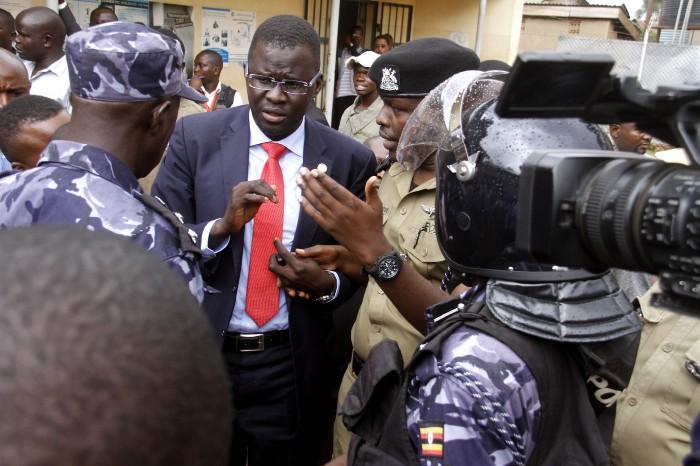
Nicholas Opiyo is confronted outside a magistrate court in 2018 after attempting to prosecute Uganda’s chief of police. (Photo courtesy of Nicholas Opiyo)
In a message on its Facebook page, the Uganda Police Force stated that Opiyo was arrested by a “Joint Task team of Security and Financial Intelligence, on allegations of money laundering and related malicious acts. The investigations are progressing well and any new developments will be communicated in due course,” the message continued. “He remains in our custody at the Special Investigations Division.”
Opiyo, a strong ally of the LGBTI community in Uganda, is the executive director and lead attorney of Chapter Four Uganda, a human rights advocacy organization. As an attorney, he represented presidential candidate Robert Kyagulanyi (Bobi Wine) after Wine’s arrest before a campaign rally on Nov. 18. That arrest sparked widespread violence. Opiyo said Wine was arrested on a coronavirus violation, but “the actual reason really is that it is part of the broader attempt to stifle opposition campaigns.” He noted that Ugandan President Yoweri Museveni was also holding political rallies during the same period, but without police interference.
National Unity Platform Presidential candidate Robert Kyagulanyi Bobi Wine claimed Opiyo was arrested because he was looking into the aftermath of the November 18th protests in which over 50 people were killed. The protests were sparked by the arrest of the candidate. Bobi Wine said Opiyo was “abducted by security from restaurant in Kamwokya [a section of Kampala, the capital of Uganda], alongside other lawyers investigating murders of 18th & 19th, Nov. Thrown into private van with tinted glasses and driven at breakneck speed to unknown destination.”
The Uganda Police Force message about Opiyo was harshly criticized in hundreds of comments on Facebook, including remarks.
He was until March of 2017, a member of the Team of Expert to the United Nations Special Rapporteur on the Rights to Peaceful Assembly and Association. He is also a visiting scholar at the Centre for African Studies, Stanford University, CA, USA and the Global Health Program at the University of San Francisco (UCSF), California, USA.
Nicholas is the Board Chair of Action Aid Uganda, a member of the Human Rights Advisory Board BENETECH, a Silicon Valley human rights and tech company based in Palo Alto in California and African Middle Eastern Leadership Project (AMEL), a Washington, DC-based think and action group.
Kyra Dupont for Geneva Solutions News of 20 November 2020 interviewed two environmental defenders: Vanessa Nakate, a 24-year-old Ugandan and and Solar Impulse founder Piccard to see how their actions resonated.
The Young Activists Summit (YAS) taking place online today aims to shine a spotlight on young activists who are advancing climate action – but also foster greater dialogue between generations. Young activists have become the face of today’s climate crisis. But the fight did not start with Generation Z – nor are they the only ones affected by the realities of global warming. The Young Activists Summit, hosted in Geneva, will give young people a platform to speak up on climate issues, while at the same time encouraging dialogue with an older generation of climate influencers, including Solar Impulse founder Bertrand Piccard.
Roots of a fight. Vanessa Nakate grew up in Kampala in a middle-class family inspired by a father trader in solar batteries and involved in community work as a member of the Rotary Club. “Like my father, I wanted to help out those in my community, find a way to change their lives.” As she was looking for a meaningful cause to dedicate herself, the student in business administration discovered climate change.
“I had already seen floods, landslides, droughts but I had never connected them to climate change because in schools in Uganda this is something we do not worry about: it either belongs to the past, or to the future. When I started reading about it, I grew to understand that this is the current threat humanity faces right now. I decided that I had to take action and be part of the climate movement.”
Like Nakate, Piccard – the son of oceanographer Jacques Piccard – was also inspired by family members. While studying at medical school (he became psychiatrist) he started fighting for cleaner aviation and ultralight airplanes.
“I was horrified by how human beings could pollute and all the disrespectful way of treating the environment.”
The power of youth. Worried by the unusually high temperatures hitting Uganda, Nakate began protesting against climate inaction in front of Ugandan parliament in 2019. She also staged hunger strikes every Friday for three months. It did not have much impact nor did it attract much attention being the sole protester outside the government gates. But an activist was born. Eventually, other young Ugandans started responding to her calls on social media.
For Piccard too, beginnings were hard. To his great surprise, his fiercest opponents were the ecologists who did not want cleaner aviation, only fewer planes. It took a good 35 years to win his case. Today, he is respected for realising the impossible: he is the visionary initiator of Solar Impulse, the first zero-fuel aircraft with perpetual autonomy. Thanks to his round-the-world flight, the “explorer for sustainability” was able to launch the Solar Impulse Foundation and its 1,000 solutions to protect the environment in a profitable way. He is now listened to by chiefs of state and respected institutions like the European Commission or the United Nations.
Swiss psychiatrist and pilot Bertrand Piccard receives the Knight of the Legion d’Honneur insignia from French President François Hollande. (Credit: Keystone / Etienne Laurent)
Injustice as a driving force. Nakate’s energy comes from her desire to end the injustice afflicting her country and the African continent in general. In Uganda, 90 per cent of the population depends on agriculture for their survival, “a matter of life and death”.
This is why she is not afraid to tell the truth and speak up in front of decision-makers. Convinced young people can make a difference, she founded Youth for Future Africa and the Rise Up Movement Africa before joining the ranks of a handful of activists at the UN climate summit, COP25, in Madrid in December 2019 where she met Greta Thunberg. She was also invited by Arctic Basecamp in Davos where she co-wrote a letter to the participants of the World Economic Forum (WEF).
Climate activists Isabelle Axelsson, Loukina Tille, Vanessa Nakate, Greta Thunberg, and Luisa Neubaue, from left, arrive for a news conference in Davos on 24 January 2020. (Credit: Keystone / Markus Schreiber)
Thousands of young people mobilised for climate change, a powerful grassroots movement that did not exist in the same way when Piccard started to voice his concerns.
“They are very fortunate to be such a big group with such a loud voice. When I was their age, I was very lonely and not a lot of people were speaking about these climate issues. It gives us strength. It gives power. People listen to them. But it also gives them responsibility.”
The keys to sucess. In order for youth aspirations to bear fruit, their message must be practical and concrete with very targeted requests, says Piccard. Development aid should help incentivise developing countries to be cleaner, more efficient and sustainable so donors and investors know that they are not losing their money.
“To say they want to fight climate change is too vague (…) By being practical and voicing specific and understandable claims, they will have a much more positive outcome than if they just protest and say “we are paying the cost of rich countries”.”
Refusing economic growth is purely idealistic, according to Piccard. Its reduction would lead to social chaos, the bankruptcy of thousands of companies and the unemployment of millions of people. The decision-makers must find an advantage in investing in developing countries. Solidarity, yes, but with good leverage.
“To fight poverty in developing countries, you need to localize the production of energy and give energy access to everybody. And you can only do that with renewable energies. If you put solar energy in a village in Uganda, it will create a local economy. People who have solar energy will sell the electricity to people charging their phones, doing business, pumps for irrigation. They will store it in batteries and sell the electricity further…”
Nakate says she is fighting for the fact that the impacts of climate change are not borne equally or fairly between rich and poor, women and men, and older and younger generations. Many victims of climate change have disproportionately low responsibility for causing the emissions responsible for global warming. Meanwhile the $1bn promised by the Green Climate Fund is still underfunded. A balance still needs to be found between the young activist’s call for climate justice and proper use of funds seniors like Piccard insist on.
The power of education. Well aware of the interactions between climate and social justice, Nakate started to work on the Green Schools Project, a renewable energy initiative which aims to transition schools to solar energy and install eco-friendly stoves. This way, she hopes to bring transition to renewable energy in rural schools and give them access to electricity and a better education.
“I never had the opportunity to learn about it, to understand the danger that our planet is facing. If you know that you are in a burning house, you will do everything you can to stop the fire. So, I believe in creating awareness, and this awareness only comes through education.”
Nakate especially believes in educating girls, the number six tool to fight the climate crisis on the list of the DrawDown project.
“There are a lot of different technologies to move towards sustainability but most of them need so much funding. Educating girls is something we can do right now. When you educate these girls from the most affected communities, it also benefits their families and cascades into their communities. They will make better decisions in their lives, have fewer children, survive the risk of hunger, resist school drop-outs, know how to build resilience. They are tomorrow’s leaders, tomorrow’s campaigners, tomorrow’s scientists who will make the best decisions for their countries.”
“Women leaders make the best decisions for their countries. We need more girls in decision-making positions,” says Nakate (Credit: Ronald Meyna)
Africa’s contribution to the world’s greenhouse gas emissions is less than four per cent of the total. But despite being one of the lowest emitters, it is the continent most vulnerable to the impacts of climate change. Yes, those who are the least responsible are suffering the most and yes, it comes as an injustice, says Nakate. But like Piccard in his own time, she resorted to take control of her own destiny.
“We cannot lay back and feel comfortable because our emissions are limited. If we do not speak up for ourselves, we will continue experiencing direct impacts of climate change.”
The Business and human rights resource Centre on 18 august 2020 published an interview with Sarah Bireete, executive director of the Center for Constitutional Governance (CCG), Uganda
Sarah Bireete – Personal Archive
Sarah Bireete is an energetic human rights defender from Uganda, who is currently busy setting up a working group on civic space research in the country, while also running the Center for Constitutional Governance (CCG), a constitutional watchdog. We sat down with her to explore her views on trust between business and civil society, and how multinational companies should respond to a growingly heavy-handed response to protests in the country.
Hi Sarah! Please tell us about you and your work!
I am a lawyer, a Human rights activist, and the executive director of the Center for Constitutional Governance (CCG), a constitutional watchdog in Uganda. I also have my own social media channel, Good Morning Uganda, followed by over 20000 followers.
How are businesses in Uganda affecting civic space and human rights in general? Are they cooperating well with civil society or is there something that could be improved?
The first thing is that international companies should observe the laws of the country in which they operate and the international law and best practice. But the practice is that most international companies that come from democratic countries, where they respect people’s rights, when they come to Uganda they tend to be blind to people’s rights, especially labour rights, people’s protection, especially in risky sectors like the flower farms. We have had experiences in the country where women worked with no protection against the pesticides, and they experienced health hazards, which made them unable to fend for families.
One of the most shocking experiences was from the flower sector, where one of the embassies was protecting an irresponsible investor from their country against the labour rights of local people. It was really amazing that ambassador called the HRD directly, and threatened them to keep quiet about labour rights of ordinary women working on flower farms.
In the oil sector as well, most multinational companies are ignoring the basic human rights, the right to property, clean environment, fair and prompt compensation. Civil society believes that most of them are not helpful as they are not upholding practices that are respected in their own countries and are not following best practices established by international processes, such as the Extractive Industries Transparency Initiative. We are struggling with this, because we expect multinational companies to come in with an upper hand, and improve practice in oil governance in the country. What we expect is a partnership with developed countries, in line with international protocols governing diplomacy, and with companies based in this countries – this would help us improve the welfare of the people in the least developed countries. We don’t expect big companies to come in and negatively affect people and shrink space for civil society.
Is there trust between multinational companies and civil society in Uganda? Can multinational companies help civil society protect and expand civic space in some way?
Trust between civil society and multinationals gets eroded when we see them coming in to exploit the most vulnerable of our people.
Multinational companies come into the country and give work to mainly low wage workers – they have limited knowledge, they are vulnerable, they need to make a living for their families – and then they get exploited by people that we would expect would have higher protection standards. This erodes people’s trust because it appears as though they are just trying to exploit the situation, instead of trying to improve the welfare of society they’re coming into. But in the context of the business and human rights approach, we as civil society need to work a lot with these companies to show them that they shouldn’t lower standards – they should maintain the same standards as in their countries of origin.
Multinational companies should also work with civil society actors to help us push back against the government if it is shrinking civic space and to push the government to help improve the welfare of the people, as they make profit.
We have seen more attacks on journalists and opposition figures in Uganda in the past year, and more heavy-handed response to protests – how should have the business community reacted?
When there is unrest in the country, the companies will not be able to do their business they came to do. When people are not happy and are agitated, they will not deliver at their place of work. So these businesses need to come into the country, and make human rights a condition for them doing business in a country: that would ensure human rights are observed. In their conversations, they should tell the government that if they continue to violate human rights, they might suspend business there.
We expect multinationals to say to government ‘these are not the standards we expect to work in. They cannot make profit when country is not governable, so they should help improve the situation and tell government that they cannot violate human rights because it will make situation worse for everyone.
Aimé Moninga was nominated for the Human Rights Defenders Award due to his work in support of male survivors of conflict-related sexual violence and his leadership of Men of Hope, a survivors’ association. He has put this difficult and sensitive issue on the policy agenda in an unprecedented way, both on a national and international level, and he is developing a generation of survivors who are prepared to testify in public to their experiences. He was chosen as this year’s award winner from among 50 nominations received from members of the public in Uganda.
Only a few years ago, the problems faced by male victims of sexual violence were barely discussed, even in human rights circles. Being a refugee and a violence survivor himself, Aimé Moninga has managed to mobilise many other survivors to speak. His advocacy efforts have also yielded results. For example, the Ugandan Police Force training curricula now includes references to both female and male victims of sexual abuse and violence. He is also advocating for further legislative changes.
Responding to the announcement, Aimé Moninga said, “This prize is for me and all the survivors of sexual violence, a consideration and a recognition of our struggle against impunity.”
“Being an activist is not easy but being a refugee human rights activist in an area of rights that sometimes is not even recognised or acknowledged is indeed the sharp end of activism”, said Mr. Per Lindgärde, the Ambassador of Sweden to Uganda speaking at today’s award ceremony in Kampala.
Mr Attilio Pacifici, Ambassador of the European Union to Uganda also spoke at this morning’s award ceremony. “Human rights are not advanced by themselves, it takes the courage and dedication of women and men, organisations and institutions to advance this agenda and ensure that rights become a lived reality for everyone in society”.
The Human Rights Defenders Award is presented every year by the European Union and Norway to recognise an outstanding contribution by a human rights defender active in Uganda. This year’s award, which is in its 9th year, is also given in memory of the late Hon. Med Kaggwa [see: https://humanrightsdefenders.blog/2019/11/24/ugandan-human-rights-commissioner-med-kaggwa-dies/].
Deo Wasswa stated on 11 May 2020 on Capital Radio in Uganda that “Attacks on human rights defenders have become rampant in Africa”. He bases himself on a report dubbed “African youth defenders perspectives 2019 from rhetoric to action” launched by Transformative leaders Network-Africa, which says these attacks are carried out by a range of state and non-state actors, including armed militant and extremist groups, police and military forces, government authorities and off campus groups among others.According to Fredrick Ekakoro Etoori, head of secretariat at Transformative Leaders Network -Africa (TRANET-Africa), the report, provides a general situation of youth human rights defenders in 2019, the category of the youth human rights defenders at most risk, the country and or region that recorded the most cases of youth human rights defenders at risk among others.
The report documented 70 cases in Uganda, 25 cases in South Sudan, Kenya 25, Sudan 16, Tanzania 2, south Africa 5 Among others.
This week, the International Women’s Day 2020 (8 March) celebrates the remarkable work carried out by women human rights defenders worldwide. However, the work of women human rights defenders is often accompanied by intimidation, violence, imprisonment, and threats. In the 2019 report on the situation of women human rights defenders by the UN Special Rapporteur on the situation of human rights defenders, Michel Forst, it is stated that “women defenders are often perceived as challenging traditional notions of family and gender roles in society, a perception that can generate hostility from State actors, and from the public, the media, and other non-State actors.”
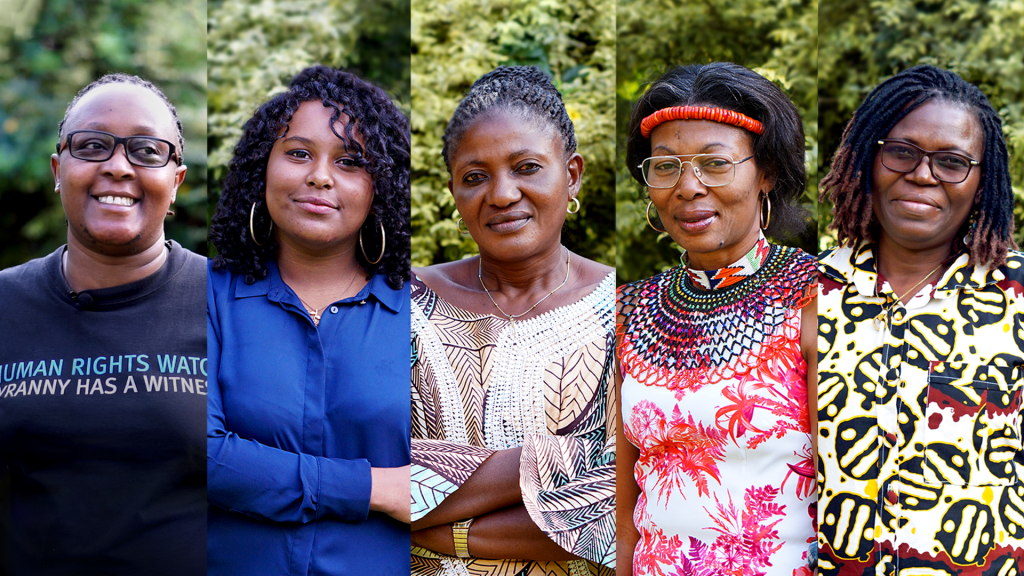
Women human rights defenders Diane Bakuraira, Maysaa Osama, Bernadette Ntumba, Maximilienne Ngo Mbe, and Mélanie Sonhaye Kombate. Photos: Civil Rights Defenders.
Civil Rights Defenders and DefendDefenders highlight individual women human rights defenders who, despite threats and challenges, continues their fight for human rights in Africa.
A report on how Ugandan LGBT rights defenders celebrated Kuchu Memorial Day was posted by Kikonyogo Kivumbi on 28 in ‘Erasing 76 Crimes’. Human rights defenders in Uganda have earmarked January 26 as Kuchu Memorial Day to remember and celebrate the life of David Kato and other LGBT human rights defenders killed because of their activism and sexuality.
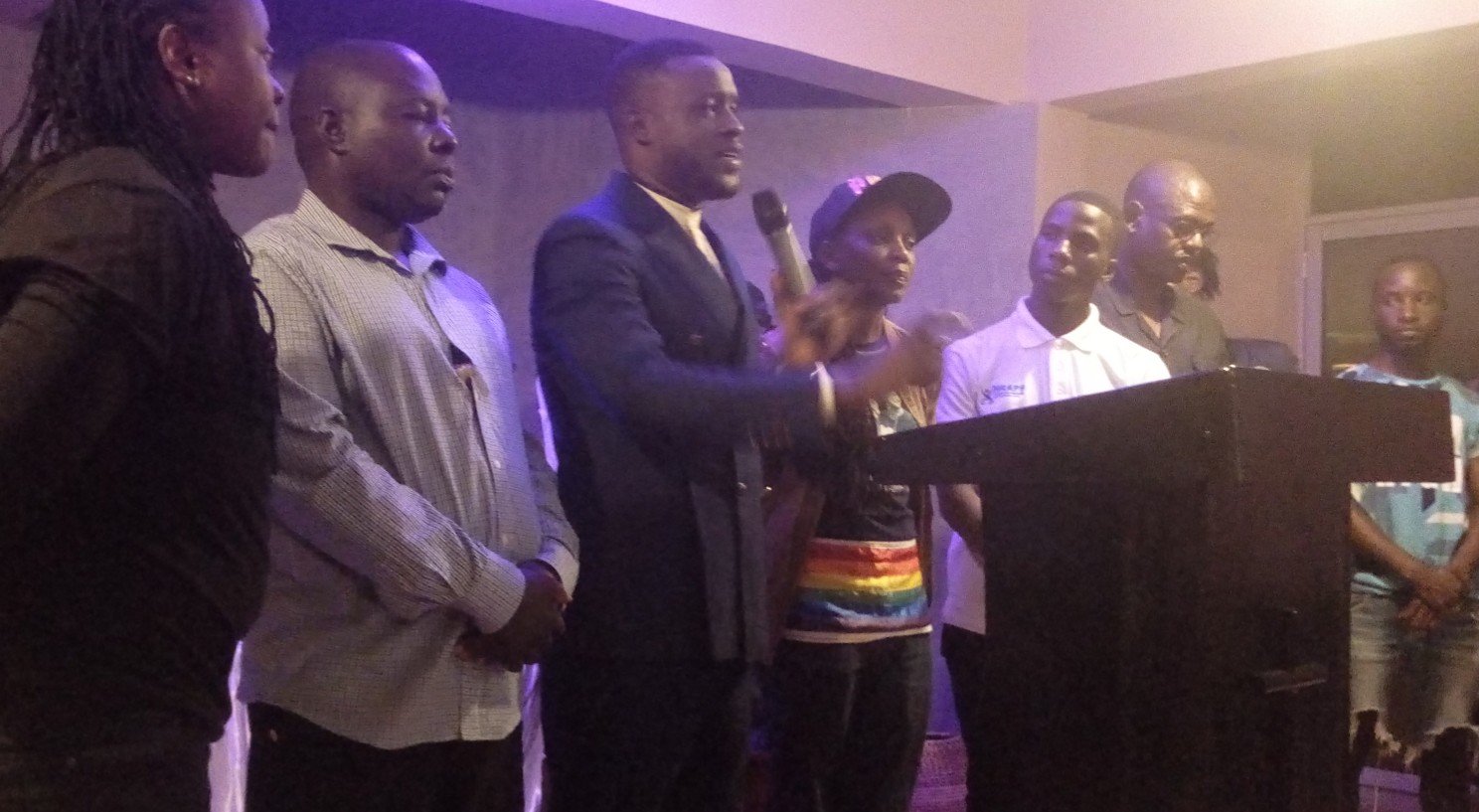
Pastor Simon Anthony addresses the Kuchu Memorial Day service in Kampala. Kasha Nabagesera stands beside him. (UhspaUganda photo)
At a memorial church service on Sunday, 26 January in Kampala, human rights defenders paid tribute to David Kato (murdered that day in 2011, at his home).
The remembrance service was led by Pastor Simon Anthony, a senior pastor from The Fellowship of Affirming Ministries (TFAM) Uganda. The fellowship embraces all people with love, irrespective of their sexuality or any other considerations.
On 8 0 Witnessradio.org in Uganda reported about the criminal trial of the 28 land rights defenders.
…Grace Nantubiro and Ronald Mugwabya are among the 28 land defenders and also members of witnessradio.org. They were arrested because of being on the frontline defending over 3000 people from were being violently evicted by local businessman George Kaweesi. Kaweesi was shielded by police and the due process was never followed. Their pleas fell on deaf-ears until a violent crash ensued between the communities and the workers of a businessman that claimed a life of one Yunus Kasajja. Kasajja had been tasked by Kaweesi to supervise the eviction exercise.
The land under dispute is registered on Block 168, Plot 19, 22 and 23 with over 322.5 hectares covering five villages namely, Kambuye, Kikono, Kyabaana, Kanseera and Lwensanga in East Division, Mubende Municipality, Mubende district. The land forcefully taken was hosting some of the families that were evicted by Kaweeri Coffee Plantation limited in the early 2000s. The 600 families are part of the 2000 families, relocated to that land as compensation for what they had lost to Kaweeri Coffee Plantation limited. That land was formerly owned by Emmanuel Kayiwa Bikko who has since passed on.
Lately, the land-grabbing elements have resorted to using the Penal Code to charge land defenders because the law is lethal. It imposes harsher prison sentences than any other and also obtaining bail once charged under it is either legally hard or too expensive for the rural communities in Uganda. These persecutions are manifesting majorly in districts that host minerals including sub-regions of Karamoja, Bunyoro and Buganda. Essentially, the prosecution alleges that on October, 12th, 2018, the accused: Nantubiro Grace and Mugwabya Ronald and others at Kambuye-Kanseera, Mubende district, robbed Yunus Kasajja Tabu of his three mobile phones and thereafter proceeded to end his life. If found guilty of the murder charge, they stand a chance of facing the ultimate punishment which is death.
On 22 November 2019 Carmel Rickard reorted that a prominent human rights defender, Med Kaggwa, died unexpectedly this week, aged 64. At the time of his death Med Kaggwa chaired the Uganda Human Rights Commission. But his wide experience included serving two terms as a member of the East African Legislative Assembly. He had also been part of the Constitution Review Commission, a country-wide drive to collect the views of the public on proposed content of an amended constitution. Well-qualified in various legal fields, Kaggwa worked with the African Commission on Human and Peoples’ Rights as a commissioner and special rapporteur on prisons and conditions of detention.
He had been a member of the Uganda Law Society. Staff at the commission described him as gentle, committed to human rights, a very competent manager and ‘a great person to work with’. ‘The country has lost a person who will be very (hard) to replace.’ During his funeral, a message from President Yoweri Museveni, read by Vice-President Edward Ssekandi, described Kaggwa as a great servant of the people from whom other public servants could learn. During his tenure he transformed the Human Rights Commission, said Museveni. Despite the widespread praise for the work he did, however, his death has also exposed some concern that the commission he headed did not have enough power to act against human rights abuses.
Human Rights Defender of the Month (September 2019): Moses Kabaseke
Moses Kabaseke, a talented hip-hop artist and activist from the Democratic Republic of the Congo (DRC), was forced to flee to Uganda in 2013 only 16 years old. Kabaseke, known by his stage name Belidor, has produced music since he was a child. “I use music as a weapon – music has power. I use music to promote human rights.”
Moses Kabaseke refers to DRC as the rich country with the poor people. “Back home a life means nothing. In Congo, life is something that can be taken from human beings easily – there’s no justice,” he states. “It’s difficult for people that have not experienced atrocities to understand how that feels like. With my music, I try to capture the trauma and injustices experienced by so many.” When he was only seven years old, his father was killed. “Every night when my mother was crying, I felt so bad. Since that age, I decided to fight for what was right.” In 2012, history repeated itself when his stepfather was killed before his eyes. At that point his mother had to make the difficult decision to leave home. In a quest to find safety, she brought her four children to Uganda.
“We don’t want to be here, but we are forced to be here,” he stresses, pointing out that life in exile is difficult. Being away from home, without external support and regular income, they face many challenges. “We need to look for ways to pay our bills. However, my siblings and I all have the blood of our father, so the thing we know how to do is music; so, we perform.”
In Uganda, Kabaseke continued his human rights promotion by composing music. After five years of hard work, often performing in Kampala’s bars, restaurants, and churches to finance his music, he recently finished his first autobiographical album. The album, ‘Les Mille Cris’ (Thousands of Cries), which contains ten songs written and produced by himself, conveys messages about human rights violations and injustices in DRC, and life as a refugee, among others. “Les Mille Cris is about breaking down the truth, sensitising Africans and victims of violations, and giving a voice to the voiceless.”
Through his music, he encourages people to tell their story, and moreover, urges the world to listen. Speaking the truth can come at a high cost. “As the number of my followers increase, my personal insecurity increase. Personal safety is essential as an artist talking about human rights,” he says. When asked what inspires him to continue despite the many challenges he is faced with, he states that “I promote human rights because I have been a victim of the system […] we are the main actors in the process of change. We have to stand for our rights.” Moses Kabaseke has partaken in several trainings organised by DefendDefenders, and performed at DefendDefenders’ events.


 Pastor Simon Anthony addresses the Kuchu Memorial Day service in Kampala. Kasha Nabagesera stands beside him. (UhspaUganda photo)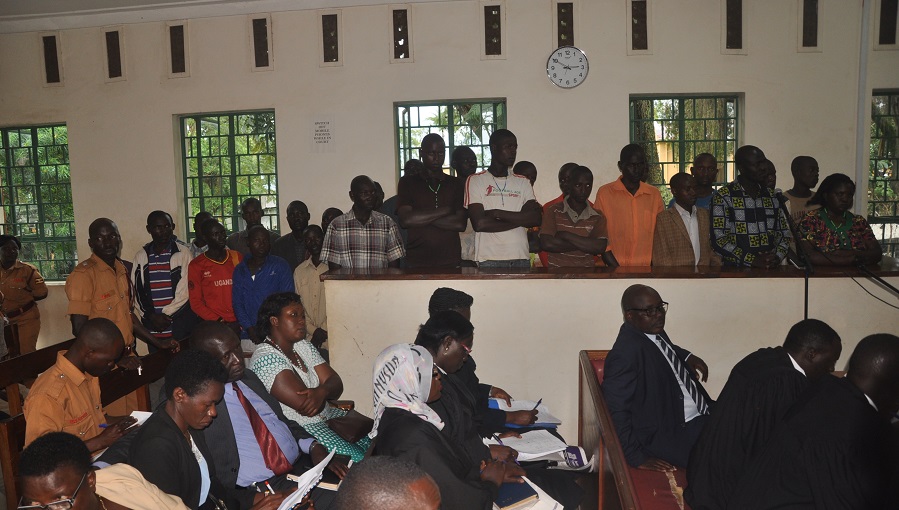

 Hans Thoolen on Human Rights Defenders and their awards