The Nairobi Office of Amnesty International’s Regional Office for East and Southern Africa (ESARO) is seeking an enthusiastic, and strategic campaigner with substantial experience in developing and implementing campaigns for a short-term consultancy. Under the supervision of, the Deputy Regional Director – Campaigns, the consultant will provide support to ongoing campaigns in Tanzania and Uganda whose thematic focus include freedom of expression, association and assembly, gender justice, right to health, right to housing among others and will do this using an intersectional approach.
This is a four-month contract (March to June 2022) and the consultant could be based in Nairobi or remotely in Tanzania or Uganda. Consultant profile includes: – Very good knowledge of the human rights and the political context in East Africa with specific knowledge of Tanzania and/or Uganda. – Knowledge of and experience working with the UN mechanisms, African Union institutions, sub-regional and national authorities is also essential. – Excellent oral and written communication skills and ability to understand and express ideas in English. Ability to communicate in Swahili is also desirable.
To apply for the role, please provide your CV (three pages maximum) and a cover letter outlining how your skills and profile are aligned to the role as described above. Please send applications to amnesty.earo@amnesty.org 2022.
The deadline has been extended to Thursday 17 March 2022.
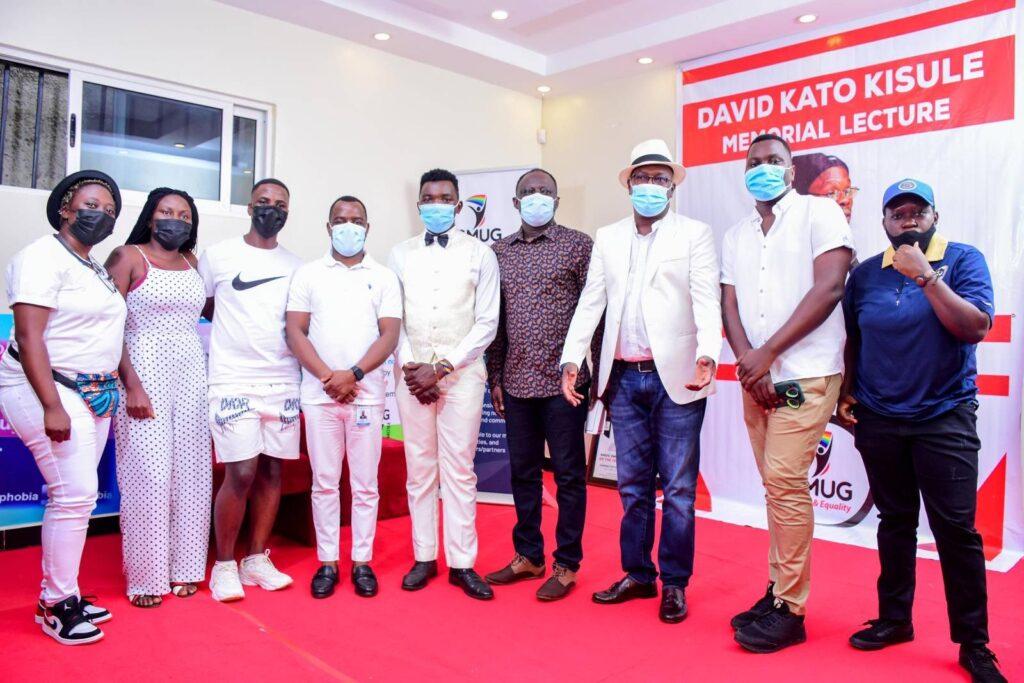
Human rights defenders pose at Kuchu Remembrance Day on Jan. 26, 2022, in honor of LGBT people killed. The event marked the launch of the planned David Kato Memorial Lectures in Kampala, Uganda. (Photo courtesy of Frank Mugisha)
The future “David Kato Memorial Lectures” were launched on 26 January 2022, during an event in Kampala organized by Hassan Shire, executive director of Defend Defenders, and Clément Nyaletsossi, United Nations Special Rapporteur on the Rights to Freedom of Peaceful Assembly and of Association. That date, the anniversary of Kato’s death, has been commemorated by Ugandan LGBT people since 2020 as Kuchu Remembrance Day, a day to remember the lives of LGBT activists who have been killed because of their activism and sexuality.
David Kato was considered a father of Uganda’s gay rights movement and described as “Uganda’s first openly gay man.” He became highly involved with the underground LGBT rights movement in Uganda, eventually becoming one of the founding members of Sexual Minorities Uganda (SMUG) in 2004.
On 26 January 2011, Kato was murdered in his home in Bukusa, Mukono Town, by a man who hit him twice in the head with a hammer. Kato died en route to hospital. Nsubuga Enoch, the man who confessed to murdering Kato, was found guilty at Mukono High Court and sentenced to 30 years with hard labour on 10 November 2011.
In October 2010, Kato was among the 100 people whose names, addresses, and photographs were published by the Ugandan tabloid newspaper Rolling Stone in an article which called for the murder of homosexuals. Kato and two other SMUG members who were listed in the article – Kasha Nabagesera and Pepe Julian Onziema – sued the newspaper to force it to stop publishing the names and pictures of people it believed to be gay or lesbian. The petition was granted on 2 November 2010, and the court later ordered the newspaper to pay Kato and the other two plaintiffs 1.5 million Ugandan shillings each (approx. US$450 as of May 2012).
Giles Muhame, the paper’s managing editor, was defiant at the time. “I haven’t seen the court injunction but the war against gays will and must continue. We have to protect our children from this dirty homosexual affront,” Muhame said of the court’s decision against his paper.
Several homophobic attacks have happened since Kato’s murder, resulting in deaths, body injuries, property damage and displacement. In memory of Kato, his former colleague Frank Mugisha, the executive director of SMUG, released a video on Twitter in which he pays him tribute. “The memorial lecture will bring out the core values that Kato stood for,” Mugisha says.
In a tweet about the David Kato memorial lectures, SMUG writes:
“It’s been 11 years since we lost David Kato due to homophobia and transphobia. Today we remember and celebrate the life of a remarkable man, an outstanding Human Rights activist.”
At the occasion of International Human Rights Day, Ugandan NTV Uganda broadcast on 13 December 2021 a talk show: “DEFEND DEFENDERS: Human rights defenders’ voices at the centre”.
Ugandan human rights lawyer Nicholas Opiyo was awarded the 2021 Human Rights Tulip. The Dutch Ministry of Foreign Affairs awards the honour, which is accompanied by a cash prize of 100,000 euros to help the recipient continue or expand their work. For more on this award and its laureates, see: https://www.trueheroesfilms.org/thedigest/awards/D749DB0F-1B84-4BE1-938B-0230D4E22144
Opiyo opposed a controversial anti-gay law that included a life sentence for homosexuality. According to the ministry, the human rights defender also played an important role in criminalizing torture in his country. His work often leads to him being accused of criminal violations with no evidence to back up the charges, and he is often closely monitored by security forces. “Human rights activists see the charges against Nicholas as a way to hinder his work as a human rights lawyer. Even in jail, he used his time to talk to prisoners who sought advice,” the ministry stated. [see also: https://humanrightsdefenders.blog/2020/12/23/ugandan-human-rights-defender-nicholas-opiyo-arrested-like-a-criminal/]
“His work has made the LGBTI community in Uganda feel stronger, knowing that there are allies who support them,” said caretaker Foreign Minister Ben Knapen.
A committee of 5 human rights experts has selected a shortlist of 12 human rights defenders from among the nominees for 2021; since then an independent jury composed of 5 members has select 3 candidates from this shortlist. The Minister of Foreign Affairs will now choose a winner from the three remaining candidates:
Human rights activist and lawyer in Uganda
As a child, he grew up in the epicentre of a brutal war between the Lord Resistance Army and government forces. Today, working as a human rights lawyer, he is being threatened, spied on and shadowed. This is his story.
Nicholas Opiyo.
As a human rights lawyer, Ugandan Nicholas Opiyo is not afraid to take on sensitive cases. He challenged the law that gave the police the right to ban public gatherings. He led the campaign for the enactment of a law criminalizing torture and drafted the initial bill that was enacted by parliament in 2012. He, alongside other brave Ugandan activists, successfully challenged Uganda’s anti-gay law in 2014. He has provided legal representation to the gay community in Uganda.
Nicholas is executive director of Chapter Four Uganda, an NGO that works to protect civil liberties and improve universal observance of human rights. He defends human rights activists who are being persecuted in Uganda. He also stands up for people who are in trouble with the government and lack the resources to defend themselves. See: https://www.trueheroesfilms.org/thedigest/laureates/6743A94B-BA1A-AA2A-AC6C-592EBD981EDA
Surviving war
Nicholas grew up on the outskirts of the northern Ugandan city of Gulu. His village was repeatedly attacked by the Lord’s Resistance Army (LRA), a rebel group that used child soldiers. Unlike many young people abducted into the ranks of the rebels, he survived abductions. The rebels kidnapped his father and sister, who managed to return after several months in captivity. To avoid being kidnapped, Nicholas walked several kilometres every day so he could sleep in the city. It was safer in a church compound or on the pavement in front of shops than in his village.
Government soldiers detained Nicholas’ father as part of an operation to eliminate traitors. The soldiers took all men 18 and older to a stadium where they were held for days without food. Looking through a crack in the stadium wall, Nicholas could see his father being beaten. Nicholas’ father was released after three days because he was innocent. Unable to forget these events, Nicholas decided to become a lawyer. ‘First I wanted to be a journalist so I could speak about [mistreatment],’ he said in an interview met Buzzfeed News. ‘But I thought … I can go to court and change things.’
Nicholas’ work often gets him in trouble with the state. He is being threatened, spied on and shadowed. In December 2020, in the run-up to the elections, he was arrested and imprisoned. Although he was charged with money laundering, the government presented no evidence. He spent Christmas and New Year’s Eve in jail. Human rights activists see the charges against Nicholas as a way to hinder his work as a human rights lawyer. Even in jail, he used his time to talk to prisoners who sought advice. In fact, he says, his arrests give him the energy to do even more. [see also: https://humanrightsdefenders.blog/2020/12/23/ugandan-human-rights-defender-nicholas-opiyo-arrested-like-a-criminal/]
Nunca Más: they had to flee from Nicaragua, but their struggle continues
Banished from Nicaragua, a target of cyberattacks: despite all these setbacks, the activist collective Nunca Más is continuing to work for human rights in Nicaragua. This is their story.
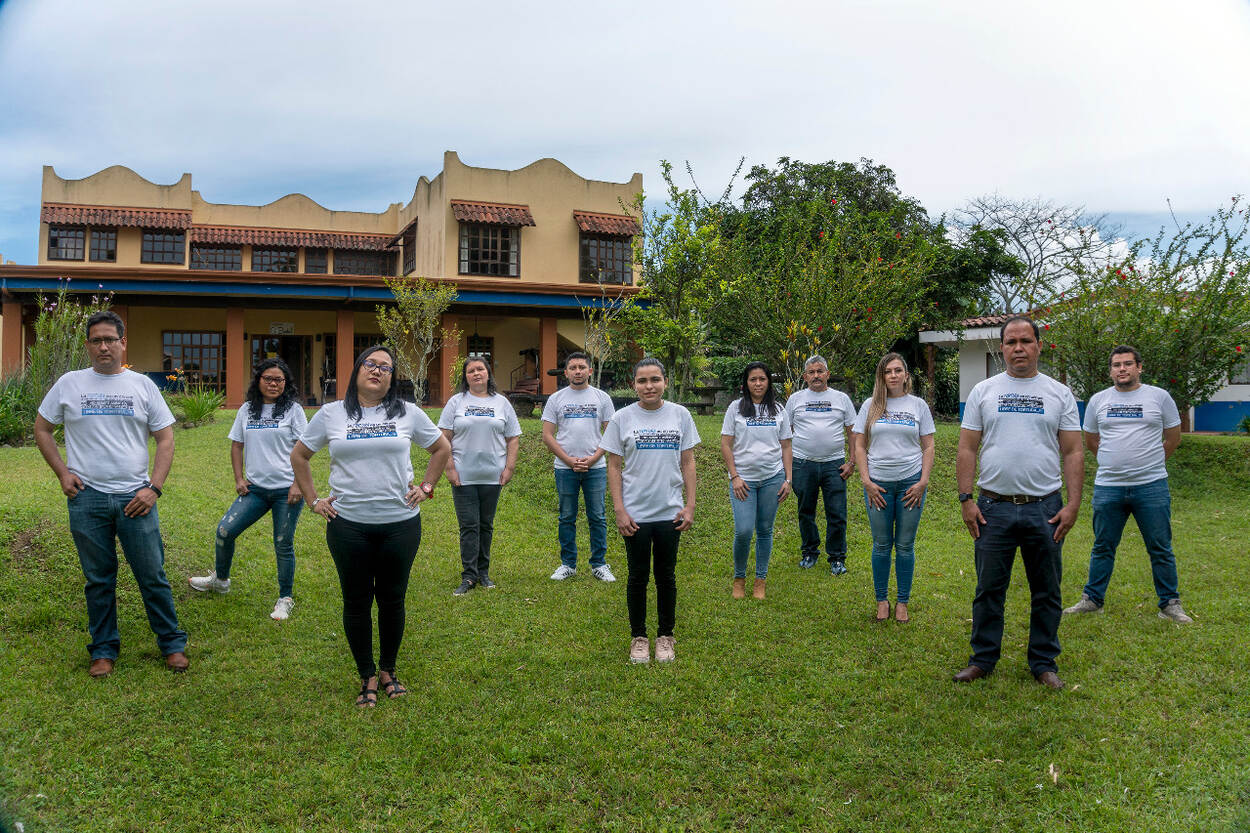
Nunca Más.
‘When Daniel Ortega became president of Nicaragua, his supporters said that there was no longer any reason for us to exist. That human rights work in Nicaragua was a thing of the past. But that can never happen! Anyone who exercises power is capable of abusing it.’ So said human rights defender Gonzalo Carrión Maradiaga in an interview with the Nicaraguan magazine Envío. For 14 years he had been legal adviser of the Nicaraguan Center for Human Rights (CENIDH), which combats impunity and human rights violations.
In December 2018 the Ortega government closed CENIDH by force. The human rights defenders on its staff were expelled from Nicaragua. Gonzalo and his colleagues fled to Costa Rica, where they continued their work and in 2019 founded Nicaragua Nunca Más. Nunca Más reports on torture and other human rights violations in Nicaragua, in the interests of justice and to discourage new violations. They offer legal and psychosocial support to victims and their family members, journalists and human rights defenders, and conduct human rights training courses. They also work at international level on behalf of victims of human rights violations. At the moment, justice cannot be sought through the Nicaraguan legal system, as it is under influence of the president. Nonetheless, gathering evidence is crucial to ensure justice for human rights violation in the future.
It was not easy to make a fresh start in a new country, but the founders of Nunca Más have managed to recover. Between 2019 and 2021 the group documented over 400 cases of serious human rights violations. The collective has now issued five reports, including information on victims who have been tortured, humiliated and arbitrarily imprisoned. The reports also contain information about extrajudicial executions and denial of the right to organise. Such reports are crucial in the absence of free press.
Under pressure
The Nicaraguan government have not been pleased with Nunca Más’ reports, and are subjecting the organisation to severe pressure. Its website has been the target of repeated cyberattacks. Extra digital security measures have enabled the collective to safeguard personal data and sensitive digital information. Despite these difficult conditions, including being forced to live far from their familiar surroundings, its human rights defenders are persisting bravely with their struggle. Gonzalo has not seen his wife or one of his daughters for 18 months. ‘But the time will come. One day I’ll go back,’ he said resolutely in the interview with Envío.
It was not easy to make a fresh start in a new country, but the founders of Nunca Más have managed to recover. Between 2019 and 2021 the group documented over 400 cases of serious human rights violations. The collective has now issued five reports, including information on victims who have been tortured, humiliated and arbitrarily imprisoned. The reports also contain information about extrajudicial executions and denial of the right to organise. Such reports are crucial in the absence of free press.
Mari Davtyan, lawyer in Russia, opposes domestic violence
The Russian police do not always respond to domestic violence complaints. Sometimes their failure to act has fatal results. Lawyer Mari Davtyan has been working for years now to change this situation. This is her story.
Mari Davtyan.
In December 2017 Margarita Gracheva’s husband chopped her hands off with an axe. She had asked the police for help several times in the preceding months – in vain. Mari Davtyan was Margarita’s lawyer. Now Mari is working on the case of three teenage sisters who killed their father on 28 July 2018, when they could no longer bear his many years of physical and sexual abuse. Their mother had reported the violence to the police, but was ignored. Domestic violence is seen in Russia as a ‘family issue’, and outside interference is viewed as meddling, Mari noted in an interview with Voice of America. Mari’s strong defence for the teenage sisters has sparked a debate in Russian society on domestic violence and conservative family values.
Since 2017 domestic violence is no longer a serious offence in Russia, but a misdemeanour. Perpetrators are fined, have to do community service or are served with a training order. They are only taken to court in cases of repeated violence or serious injuries. This law is meant to preserve the ‘unity of the family’; according to this logic, fathers don’t belong in jail. Mari has been fighting for years now to change this law, ‘because it has been proven dangerous for the safety of thousands of women in Russia’, Mari said in an interview with Marina Pisklakova-Parker of the Anna Center in Moskou. Fighting and winning cases like this has ‘helped the government understand that we are not dealing with violence in the right way,’ said Mari in an interview with the Washington Post. Growing numbers of people are putting pressure on the courts and government to reflect on how they are treating victims.
Mari is also the head and legal expert of the Consortium of Women’s NGOs, which works to protect victims of domestic violence in Russia. The organisation gives courses on women’s rights to lawyers and the police and helps victims with their legal cases. ‘We have more than 100 lawyers working with us today, this year we have more than 150 cases, and I think about 1,000 consultations with individual women,’ said Mari in an interview with the European Human Rights Advocacy Centre (EHRAC). She sees that women are becoming more confident and more often have the courage to seek her out. ‘They are finding the power to ask for help and they’re starting to understand what a healthy relationship should look like,’ she said in her interview with Voice of America.
Ocen Ivan Kenneth is a Program Director at Foundation for Development and Relief Africa (FIDRA), with more than 10 years of experience working in the human rights field. Ivan’s ambitions for change focus on building inner peace, defending human rights and empowering local communities using theatre and storytelling. He creates a space where people from the community share their personal stories of trauma and resilience as well as identify mechanisms of healing.
“There may be times when we are powerless to prevent injustice, but there must never be a time when we fail to defend justice.” Ocen Ivan Kenneth Tweet
As an activist, Ivan has faced several challenges including personal threats that sometimes extend to his family and colleagues. His work with victims of conflict related sexual violence also at times takes a toll on him.
“I get moved when speaking to people whose human rights have been violated in some way, or those who have survived sexual violence, or those brutalised by militia. I can see the trauma in their eyes and hear it in their voices. It has always been the most difficult aspect of my job.”
Just like many other human rights defenders, the lack of adequate equipment and limited resources coupled with limited capacity and skills, plus legal restrictions curtail his ability to efficiently execute his work. Despite all these challenges, Ivan’s commitment to keep protecting and promoting human rights remains unwavering.
“After decades of armed conflict, now we are facing another attack, this time affecting our health and life. I am motivated because we are strong resilient workers. We keep resisting this new attack as we have always done by staying together, helping each other, and keeping our spirits high,” he says.
He believes that there should be more work done to support human rights defenders through building their capacity and expertise, strengthening their recognition, and protecting them from threats, risks, and reprisals particularly those who are marginalised or most at risk.
“I believe that current protection measures for human rights defenders in Uganda are insufficient. Particularly protection offered from the government mechanisms towards human right defenders is insufficient. A mechanism needs to be created and developed, and people working on other protection mechanisms for human rights defenders should truly address the different vulnerabilities for male and female human rights defenders.” Ocen Ivan Kenneth
Noelyn Nassuuna in KFM of 30 April 2021 reports that Ugandan women’s rights activist Rita Aciro is the winner of the 2021 European Union Human Rights Defenders’ Award.
The award is given annually by the European Union and Norway to recognise a human rights defender in Uganda for their outstanding contribution.
Speaking during the award ceremony last evening, the Germany Ambassador to Uganda Matthias Schauer said human rights need to be defended all over the world especially for disadvantaged groups.
While receiving the award, Aciro said it was an honour of the invisible Human Rights Defenders in homes, and public spaces who never have the spot light yet do an incredible job in giving a voice to women and girls.
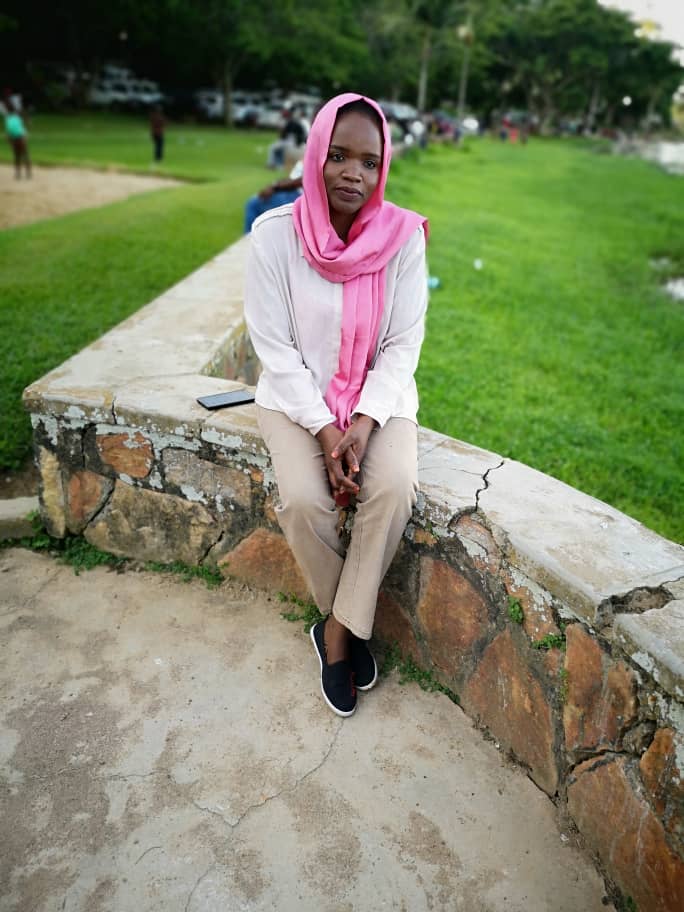
By the time Elrudia Abdalla Hussein, a Sudanese woman human rights defender was in secondary school, she had witnessed the killings of countless people. Growing up in Darfur, she observed violence and human rights abuses. “If you do not have power, you do not have rights,” she concluded. As a result, she decided to join a student association during her tertiary education to raise awareness about human rights and fight injustice.
When strangers entered their family home in 2010, Elrudia and her husband decided to flee to Uganda with their children. As a refugee, Elrudia faced new human rights challenges. Many of the Sudanese refugee women in her community are single mothers struggling financially. Coming from a war zone, they often face mental health challenges. Many of them only know basic English, making it difficult to navigate the Ugandan refugee system. When one of the women in Elrudia’s community struggled to pay rent, she got together with a group of Sudanese refugee women to help out.
“We decided to come together as sisters, and all put in a financial contribution to pay two months of her rent. After this, we decided to continue the communal support and founded an association.” Sudanese Women for Peace and Development association not only helps refugee women financially, but also with asylum procedures, referrals for support by other NGOs, counselling, trainings, and raising awareness about their rights. It is run entirely by volunteers from the Sudanese refugee community, who also fund the project to a large extent.
As refugees, it can be quite tricky to defend human rights in Uganda: involvement in politics can lead to an investigation that could ultimately revoke refugee status, but the line between politics and human rights is often rather thin. Elrudia’s association clearly focuses on social work, yet they carefully steer clear of any speech or activity that could be interpreted as political – a difficult balancing act sometimes. Another difficulty Elrudia and other exiled HRDs face is how to generate income for their families. Refugees have to rely on informal jobs to cover expenses like rent, food or school fees, so Elrudia often sells food she has prepared – while running the women’s association and also completing her master’s degree in Agriculture and Economics.
What keeps her going is hope: “I see things getting better around me. It’s easier to be in touch with friends and family back in Darfur. That gives me hope. Seeing the impact that we make in our community pushes me to continue, despite the difficulties. And: when I start something, I finish it!”
In February 2021 Defenddefenders announced Sandra Aceng as Human Rights Defender of the Month Sandra Aceng is an outspoken and energetic woman human rights defender (WHRD). She is a gender and ICT researcher and policy analyst for Women of Uganda Network (WOUGNET) where she coordinates the Women ICT Advocacy Group, advocating for internet access for all. In addition, she writes on various platforms such as Global Voices, Freedom House, and Impakter Magazine. Her regular contributions to Wikimedia Uganda often focus on profiling WHRDs, female politicians, and journalists. “After Uganda’s January [2021] elections, many female politicians joined parliament. We want to increase their online visibility. For example, most of the profiles on Wikipedia are on men, so we need to close the gender digital divide,” Sandra says.
After Uganda’s January [2021] elections, many female politicians joined parliament. We want to increase their online visibility. For example, most of the profiles on Wikipedia are on men, so we need to close the gender digital divide.
Having grown up in the digital age, the 27-year-old is a digital native and mainly focuses on defending women’s rights online. Her employer WOUGNET empowers women through the use of ICT for sustainable development. Their three main pillars are information sharing and networking, gender and ICT policy advocacy, and providing technical support to WOUGNET staff, beneficiaries, and members. As a Programme Manager, Sandra analyses internet and ICT policies to ensure that they are gender inclusive. She has noticed that oppressive patriarchal structures are shifting and perpetuating online. Part of her work is to document women’s rights violations and gather evidence, but she has also learned that it’s not enough to just talk about statistics. To truly understand the problems, it is important to talk to the victims and listen to find out what they face, she says.
Having experienced some forms of online gender-based violence (GBV) herself, she knows how stressful and draining it can be. On top of receiving non-consensual content, she also felt pressure to keep quiet, women are not supposed to complain, she says. As a WHRD, she is used to the subtle pressure that women not abiding by patriarchal gender norms experience. A continuous trickling of seemingly small questions can be rather stressful: “Why are you so loud and outspoken as a woman? When will you get married? How will you take care of your family if the authorities come for you? These kinds of questions make me feel uncomfortable, they make me wonder if I am doing the right thing,” Sandra shares, “but if we want online GBV to end we also need to end these harmful gender stereotypes. Establishing women’s rights is a slow process and keeping quiet won’t speed it up.”
Why are you so loud and outspoken as a woman? When will you get married? How will you take care of your family if the authorities come for you? These kinds of questions make me feel uncomfortable, they make me wonder if I am doing the right thing.
There is still a lot of work ahead of Sandra and her fellow Ugandan women’s rights activists. She recently researched digital rights violations during the COVID-19 pandemic and struggled to find female interviewees. Female journalists reporting on politically sensitive topics experienced reprisals like rape, but due to stigma and worries how this will affect their future, they were not willing to speak out. While male journalists on the other hand expressed themselves freely: men are often perceived as bold and brave, making it easier to speak out on reprisals and rights violations they endured.
But the more women speak out, the easier it gets, Sandra is convinced. “It really motivates me when I see that other women have faced the same kind of challenges with online violence, and they have dealt with it. Whatever I go through, it’s not the end of life. Hearing other stories helps me to keep working hard, to be a better version of myself and to go beyond the difficulties.” Fighting the digital gender divide is Sandra’s way to make sure that it gets easier for women to speak out and be loud.
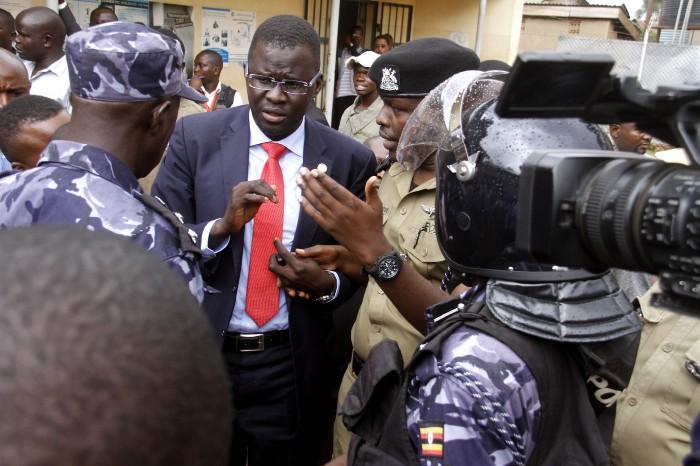
Nicholas Opiyo is confronted outside a magistrate court in 2018 after attempting to prosecute Uganda’s chief of police. (Photo courtesy of Nicholas Opiyo)
In a message on its Facebook page, the Uganda Police Force stated that Opiyo was arrested by a “Joint Task team of Security and Financial Intelligence, on allegations of money laundering and related malicious acts. The investigations are progressing well and any new developments will be communicated in due course,” the message continued. “He remains in our custody at the Special Investigations Division.”
Opiyo, a strong ally of the LGBTI community in Uganda, is the executive director and lead attorney of Chapter Four Uganda, a human rights advocacy organization. As an attorney, he represented presidential candidate Robert Kyagulanyi (Bobi Wine) after Wine’s arrest before a campaign rally on Nov. 18. That arrest sparked widespread violence. Opiyo said Wine was arrested on a coronavirus violation, but “the actual reason really is that it is part of the broader attempt to stifle opposition campaigns.” He noted that Ugandan President Yoweri Museveni was also holding political rallies during the same period, but without police interference.
National Unity Platform Presidential candidate Robert Kyagulanyi Bobi Wine claimed Opiyo was arrested because he was looking into the aftermath of the November 18th protests in which over 50 people were killed. The protests were sparked by the arrest of the candidate. Bobi Wine said Opiyo was “abducted by security from restaurant in Kamwokya [a section of Kampala, the capital of Uganda], alongside other lawyers investigating murders of 18th & 19th, Nov. Thrown into private van with tinted glasses and driven at breakneck speed to unknown destination.”
The Uganda Police Force message about Opiyo was harshly criticized in hundreds of comments on Facebook, including remarks.
He was until March of 2017, a member of the Team of Expert to the United Nations Special Rapporteur on the Rights to Peaceful Assembly and Association. He is also a visiting scholar at the Centre for African Studies, Stanford University, CA, USA and the Global Health Program at the University of San Francisco (UCSF), California, USA.
Nicholas is the Board Chair of Action Aid Uganda, a member of the Human Rights Advisory Board BENETECH, a Silicon Valley human rights and tech company based in Palo Alto in California and African Middle Eastern Leadership Project (AMEL), a Washington, DC-based think and action group.
 Hans Thoolen on Human Rights Defenders and their awards