Posts Tagged ‘training course’

Amnesty Tech call for nominations for 3rd Digital Forensics Fellowship

January 6, 2025

On 2 January 2025 Amnesty Tech – a global collective of advocates, hackers, researchers, and technologists – announced the launch of the third Digital Forensics Fellowship (DFF).

This innovative Fellowship is an opportunity for 5 – 7 human rights defenders (HRDs), journalists, and/or technologists working in civil society organisations around the world to train with Amnesty Tech’s Security Lab to build skills and knowledge on advanced digital threats and forensic investigation techniques. This is a part-time Fellowship that will last 3-4 months and will come with a stipend.

Fellowship start and end date: The Fellowship is expected to run from April – July 2025.

Application Deadline, 23 January 2025 
Location: dependent upon the suitable applicant’s location.

Remuneration: Successful applicants will be given a stipend of £500/month for their time.

Background

Across the world, hard-won rights are being weakened and denied every day. Increasingly, much of the repression faced by HRDs and journalists begins online. Since 2017, Amnesty Tech’s investigations have exposed vast and well-orchestrated digital attacks against activists and journalists in countries such as Morocco, Egypt, Azerbaijan, Qatar, Serbia, Mexico and Pakistan.

Advanced technical capacity is needed in all world regions to tackle the mercenary spyware crisis. By fostering a more decentralised, global, and diverse network of well-trained incident responders and investigators, we can jointly contribute to more timely and effective protection of HRDs and journalists against unlawful surveillance.

The spyware landscape changes rapidly, and creativity and persistence are needed to research and identify new trends, tools, and tactics used to target civil society. The curriculum for the third edition of the DFF will be tailored to the cohort and will be future facing to prepare Fellows to work on current and future spyware threats. [see also: https://humanrightsdefenders.blog/2024/05/16/two-young-human-rights-defenders-raphael-mimoun-and-nikole-yanez-on-tech-for-human-rights/]

Objectives and deliverables

Participants in the Digital Forensics Fellowship will be expected to:

  • Attend an in-person, week-long convening where the majority of trainings will be conducted. This training will take place in June 2025, the exact location is set to be confirmed shortly.
  • Dedicate approximately 10 – 12 hours per month to the Fellowship, outside of the convening, by participating in remote training sessions and through independent work outside of scheduled sessions to deepen understanding of training topics.
  • Engage with the programme cohort and the Security Lab during the in-person and remote trainings, and in discussion groups on an ad-hoc basis.

Essential Requirements

  • An understanding of the technical threats, digital attacks and challenges faced by journalists, HRDs, and civil society organisations in their local contexts.
  • Demonstrated interest in conducting investigations to identify digital attacks against civil society, with the goal of building resilience among civil society actors in the face of surveillance after the Fellowship.
  • Familiarity using command line tools and basic knowledge of scripting languages like Bash and Python to analyse data.
  • An understanding of how internet infrastructure works, for example the role of IP addresses, TLS certificates, and DNS queries.
  • Technical familiarity with GNU/Linux operating systems, as well as Android and iPhone systems.
  • Engaging with the English language as the primary language throughout the Fellowship.
  • Application instructions:

To apply, applicants will be required to submit the following via our recruitment system eArcu – please upload all relevant documents to the CV section of the application portal.

  1. A copy of your most recent CV.
  2. A cover letter explaining your motivation and interest in the Fellowship and outlining how you meet the essential requirements outlined in the job description.

Applications must be in PDF, Word, PowerPoint or Excel format.

Application Process:

Shortlisted applicants will be invited to complete a record video interview week commencing 10th February, answering a series of pre-set questions via video, which allows us to learn more about you and your suitability for the Fellowship. Successful applicants from this process will be invited to a Microsoft Teams interview with the panel week commencing 3rd March.

How to apply;

Careers | Amnesty International

Amnesty International

The 7th Human Rights summit of Southern Defenders took place in November in Johannesburg – reports Puleng Motaug

December 23, 2024

ACTSA intern Puleng Motaung reports back on the 7th Human Rights summit of Southern Defenders

Being at the Southern Human Rights Defenders summit in Johannesburg was exceptional, I had a chance to meet with people who put others’ wellbeing before their own. People who sacrifice their lives for the benefit of others. The greatest part was hearing survivors tell their traumatic stories first hand, hearing about the challenges that civil societies face, and learning about Khenana community, in South Africa, the murders that take place there and the trauma that the kids are going through, seeing their parents killed in front of them.

I had an opportunity to network with people from different organisations and backgrounds, and the outstanding interaction was with a lady named Zanele from Eswatini who works for Swavisa a struggling organisation that focuses on helping the victims of the 2021 uprising who got injured and can’t afford medication to treat their injuries due to financial strains.

Across the Southern African region, the civic space continues to shrink as governments suppress and silence civil societies. Many defenders have been imprisoned, injured and even killed in the fight for equality and dignity. The issue of Israel was also raised and that all civil societies must stand in solidarity with Gaza.

I met Robson Chere, a teacher and trade unionist, and the Secretary General of the Amalgamated Rural Teachers Union (ARTUZ) in Zimbabwe, which advocates against teachers’ low wages, lack of electricity in rural schools and poor working conditions as well as unsafe learning conditions for students. Along with Namatai Kwekweza and Samuel Gwenzi, he was hauled off a plane by police on 31 July, then tortured and held without bail for 35 days by the Zimbabwe regime. Their release on bail only came after much international pressure.

When civil space is stifled, said Adriano Nuvunga, Chairperson of Southern Defenders, we lose the foundation of democracy. He continues that it is up to us to ensure that the elections across Southern Africa reflect true will of the people, fostering trust, inclusion and hope for a democratic future. “Together we must ensure that the future is one where justice, freedom and human rights prevail, where every voice is heard and every right is protected”.

Adriano Nuvunga’s statement had me wondering: what am I doing to better the future of the upcoming generation?

I learnt that being a Human Rights Defender (HRD) isn’t easy because of the traumatic experiences people go through, but Mary Lawlor, UN Special Rapporteur on the situation of Human Rights Defenders, said “don’t buy the narrative that it is the worst time ever to be a human rights defender”. The most important resources in civil space are networks, unity and trust. That gave me hope…

My takeaway as a young person is that I must stand up and lead the pack. It’s never been more necessary for people to band in solidarity with southern African Human Rights Defenders. We need to protect the civil space. It is about time we as young people go out and occupy spaces, because the youth are the heartbeat of the revolution.

Dejusticia 2025 fellowships for defenders from the Global South

December 20, 2024

Members of the 2024 cohort of our Global South Defenders program.

This opportunity allows human rights defenders from countries in the Global South who are in emergency or high-risk situations to develop their projects and participate in an academic and cultural exchange in a safe space.

There are 14 thematic areas within Dejusticia to whichyou can apply.

The fellowship will begin in the second semester of 2025.

Who is eligible to be part of the program?

We seek human rights defenders from the Global South who meet the following criteria:

  • They come from an emergency or high-risk context. This includes regions affected by armed conflict, civil unrest, or authoritarian regimes, where there is an imminent threat to the security of the grantee. This may involve situations where the grantee and/or their organization have been subjected to threats, intimidation, or populist propaganda, or where they have been excluded from funding due to government or private sector influence.
  • The grantee may be at risk of burnout and is seeking a quiet place to continue working on human rights issues, but in a different context.
  • They belong to human rights organizations in the Global South that are interested in engaging in exchanges and joint research or advocacy work with Dejusticia.
  • They aim to build lasting relationships with other fellows and with Dejusticia. This ensures that our fellowships function as acceleration hubs for connections that will make the human rights movement more cohesive and impactful.

What will fellows receive from Dejusticia?

Dejusticia will cover travel expenses (visa, tickets) and provide a monthly stipend based on the fellow’s profile and experience. Although Dejusticia will offer support at the beginning of the process, including a two-week training period on applied research and on the fellow’s specific work, it is important to note that fellows will be responsible for managing their stipend to cover housing, transportation, and food expenses.

What are the commitments of the Global South Fellow?

The fellow will allocate their time at Dejusticia as follows:

How to apply for the fellowship program?

Before January 31, 2025, please fill out the form

CF: 2024:

EUROPEAN MASTER’S DEGREE IN HUMAN RIGHTS & DEMOCRATISATION (EMA)

December 20, 2024

The European Master’s Programme in Human Rights and Democratisation (EMA)EMA is a one-year, full-time interdisciplinary programme that reflects the indivisible links between human rights, democracy, peace and development. The programme offers an action- and policy-oriented approach to studying human rights and democratization as well as offering an interdisciplinary approach to the intellectual frameworks that underpin human rights and democratization such as law, international relations, philosophy, history and anthropology.

While studying in a multicultural environment, students have the opportunity to be taught by leading academics representing the 43 EMA participating universities, representatives of international organizations (including the European Union, the United Nations and the Council of Europe), NGO experts and activists and human rights defenders.

EMA is both a residential and an exchange programme, structured in two semesters. Students spend their first semester (September to January) at the Global Campus of Human Rights headquarters in Venice. During the second semester they are hosted by one of the participating universities where they follow courses and prepare a research thesis.

The call for applications for the academic year 2025/2026 is now open

Deadline for both scholarship and self-funded applicants: 2 February 2025

Additional information can be found at: https://emahumanrights.org/

New call for applications for human rights defenders at risk for Shelter City Netherlands. 

August 5, 2024

Justice & Peace Netherlands is launching a new call for applications for human rights defenders at risk to participate in Shelter City Netherlands. The deadline for applications is 30 August 2024 CEST ­ Shelter City is a global movement of cities, organizations and people who stand side by side with human rights defenders at risk. Shelter City provides temporary safe and inspiring spaces for human rights defenders at risk where they re-energize, receive tailor-made support and engage with allies. 

From March, June and September 2025 onwards, 14 cities in the Netherlands will receive human rights defenders for a period of three months. At the end of their stay in the Netherlands, participants are expected to return with new tools and energy to carry out their work at home. Journalists’ Safe Haven initiative Justice & Peace aims to promote the safety of journalists, and in particular women journalists, worldwide so that they can build new strategies and continue their important work for freedom of expression in their country of origin. 

With support from the Dutch Ministry of Foreign Affairs, Justice & Peace will be able to provide two additional temporary safe spaces per year in The Hague for journalists at risk and provide them with tailormade support. 

To be eligible for Shelter City Netherlands, human rights defenders should meet the following conditions: They implement a non-violent approach in their work;They are threatened or otherwise under pressure due to their work or activism;They are willing and able to return to their country of origin after 3 months;They are willing to speak publicly about their experience or about human rights in their country to the extent that their security situation allows; They have a conversational level* of English;They have a valid passport (with no less than 18 months of validity at the time of applying) or be willing to carry out the procedures necessary for its issuance. Justice & Peace covers the costs of issuing a passport and / or visa (if applicable);They are not subjected to any measure or judicial prohibition to leave the country;They are willing to begin their stay in the Netherlands around March, June or September 2025.
Please note that only under exceptional circumstances are we able to accept human rights defenders currently residing in a third country.

­ Apply now!

https://7a2pv.r.ag.d.sendibm3.com/mk/mr/sh/SMJz09SDriOHWo9lOH3CCxH3Sm28/qRd0o2XPi-BI

Dejusticia: Fellowship Program for Human Rights Defenders from the Global South

June 26, 2024

On 25 June 2024, Isabel de Brigard and Christy Crouse described this fellowship programme taking place in Bogota:

Dejusticia’s work as part of the human rights movement has always been carried out alongside individuals and partner organizations with whom we have collaborated to advance various agendas. The value of these encounters drives us to constantly seek ways to better articulate our work with leaders, activists, and professionals from different areas of the human rights movement in Colombia and different countries of the Global South. As part of this effort, the Fellowship Program for activists and human rights defenders from the Global South was born. With this program, we seek to generate South-South collaboration ties that are sustained over time and contribute both to building a more coordinated and organized civil society, as well as supporting the individual efforts of those who work for global justice on a daily basis.

What does the program entail? Dejusticia provides fellowships for cohorts of 5 to 8 human rights defenders who come to Bogota, Colombia, to live and work here for periods of 3 to 6 months. They are integrated into one of Dejusticia’s teams to work with its researchers on collaborative projects. The program offers fellows a collaborative and creative space to reflect on various relevant issues, strengthen their work in the struggle for social and environmental justice, and get inspired by new strategies, approaches and possibilities of transformative actions. 

For those who in their places of origin often face risks derived from the work they do, Dejusticia offers a quiet and safe space for research, advocacy, and fellowship with those who share their struggles. The program is a useful opportunity for exchange, in which those who come to Dejusticia can explore our tools and action-research strategies to enrich the work they do in their home countries, while Dejusticia learns from their experience and that of their organizations.  

A new kind of profile for fellows 

The program we designed at Dejusticia takes a slightly different approach. We look for human rights defenders and activists with three key characteristics: (1) people who are at risk due to threats, armed conflict, an authoritarian government, or obstruction of their work; (2) people who may be at risk of burnout from their job; and (3) people linked to a human rights organization in the global south that is interested in working with Dejusticia. 

This approach has allowed us to receive people from Brazil, India, Mexico, Nigeria, Turkey, Venezuela, among other countries. Our fellows are professionals and activists in political science, law, sociology, communications, and more, many with extensive experience, as well as people who are just beginning their careers. Welcoming each of the people who have participated in the program has been an opportunity to add hospitality to the strategies with which we seek to strengthen the human rights movement in the Global South. And in the same vein, programs like this one are a fundamental part of our efforts to strengthen the voice and presence of actors from the Global South in debates, academic production, and the setting of human rights agendas.

Cohort 2023

In the second semester of 2023 we had a cohort of fellows whose time with Dejusticia was enormously enriching. 

Jorge Lule, for example, is a political scientist and public administrator from Mexico, specializing in public security issues and conflict analysis. He has worked on issues of militarization, drug policy, serious human rights violations and international crimes. During his fellowship at Dejusticia, he collaboratively wrote an article, with a researcher of the Transitional Justice line, regarding the serious crisis of disappearances and the search for missing persons faced by both countries. This text was published in Dejusticia’s Global Blog and in the Mexican news portal Animal Político. 

Another fellow, Danielly Rodriguez, comes from Venezuela and is an activist and social documentarian. She has a long history of telling the stories of  Venezuelans, their struggle against authoritarianism and in favor of human rights. She has been working in the field of human rights for more than 11 years, especially through documentary photography. According to her, the fellowship at Dejusticia helped her understand other contexts of human rights situations, both in the countries of the other fellows and in Colombia. It also confirmed her belief that although we are separated by borders, there are situations that affect us in very similar ways.

Miracle Joseph comes from Nigeria and joined the tax justice team. With a background in geography, he specializes in economic, social and behavioral geography, focusing on the connections between government policies and social patterns. His main project at Dejusticia was an investigation that aimed to understand how corruption affects the advancement of human rights and sustainable development in Nigeria, focusing on health, education and climate change.

Finally, Fabian Hernandez is a young activist from the Colombian Caribbean region with campesino roots, linked to the peasant resistance movement in the department of Cesar. He is active in social movements, especially in the struggle for the recovery of land, water and ecosystems. Fabián strengthened his research skills and exchanged tools with Dejusticia’s Land and Peasant Rights team, which he joined during his stay. During this time he wrote a text on autonomy and peasant resistance in the Sumapaz region and organized a discussion with peasant leaders from different parts of Colombia to discuss the challenges and stakes in agroalimentary farming territories.

Having these four talented and committed people be part of our team in 2023 was a great privilege and an opportunity to learn and build valuable partnerships. By the middle of 2024 we will have a new cohort, which will continue to enable us to strengthen the knowledge, experiences, and collaborative networks essential to the work of those of us who fight for global justice.

https://www.dejusticia.org/en/fellowships-program/

https://www.dejusticia.org/en/human-rights-in-the-global-south/

Columbia University’s Human Rights Advocates Program

June 17, 2024

Founded in 1989, the Human Rights Advocates Program (HRAP) is a model of human rights capacity building. HRAP capitalizes on its affiliation with Columbia University and its location in New York City to provide grassroots leaders the tools, knowledge, access, and networks to strengthen their organizations and promote human rights.

HRAP’s comprehensive program of advocacy, networking, skills-building, and academic coursework provides advocates the opportunity to hone practical skills, develop a deeper understanding of human rights, and foster mutually beneficial relationships with organizations and individuals in their fields.

hrap_lespinasse.jpg

Before I came to HRAP, I knew that people were suffering in Bosnia and that people were dying in Sudan. But when I came to HRAP, I met Advocates from Bosnia, Sudan, and other countries – people who are living and making a difference in their countries.

See also: https://www.york.ac.uk/cahr/human-rights-defenders/past/natalia-zviagina/

https://www.york.ac.uk/cahr/human-rights-defenders/past/tewodros/

https://www.humanrightscolumbia.org/hrap

The Marianne Initiative for human rights defenders

June 4, 2024

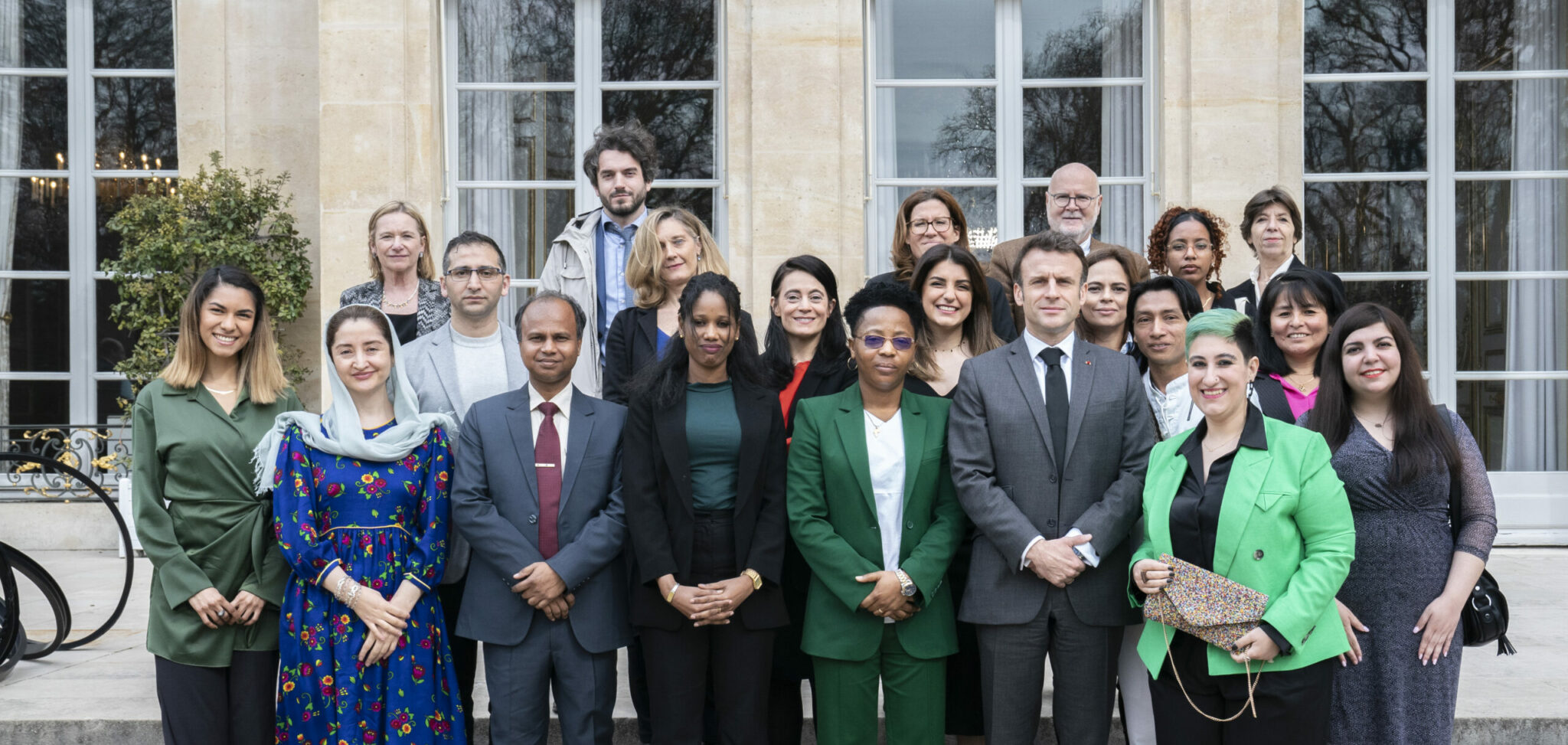
On 3 June, 2024 Ifeoma Chuks wrote about the Marianne Initiative 2025 for human rights defenders

©Sarah Steck/ Présidence de la République

In 2021, French President Emmanuel Macron announced the launch of the Marianne Initiative for human rights defenders, aimed at better supporting them in their fight, both abroad and in France. The Marianne Association for Human Rights Defenders was created to federate the actors involved in our country (State, organisations and associations for the promotion of human rights and reception, local authorities, qualified personalities, etc.) and to carry the initiative’s support pillar in France, for the benefit of about fifteen laureates per year (reception, personalised support, networking, etc.).

After receiving the first all-female class in 2022 and a mixed class in 2023, the third class was officially launched now.

Some fifteen men and women from every continent have been welcomed to France for six months as part of the Initiative. The winners benefit from a training program designed to strengthen their skills and commitment in their home country or in France, whether in favour of civil and political rights, women’s rights, minority rights or environmental rights.

Recipients complete a comprehensive program consisting of:

  • Training in negotiation, leadership, advocacy, physical and digital security, project management, etc. ;
  • Courses from the School of International Affairs of Sciences Po Paris and French language;
  • Contact with French or international personalities involved in human rights and development issues;
  • Meetings with inspiring personalities and potential partner organizations (NGOs, foundations, institutions, etc.);
  • Conferences and cultural activities ;
  • Individual interviews to support the activist project;
  • Visits to international institutions and organizations;
  • Exchanges with members of the program’s alumni network.

The hosting programme in France provides for accommodation near Paris, the payment of a monthly grant to cover daily needs, a training programme, support, and networking with Human Rights Defenders for a period of 6 months. After the 6 months, participants no longer benefit from the grant, the accommodation and the support provided in the programme. Participation is individual and does not provide for the laureate to be accompanied by their family.

Class of 2025 runs from January-July 2025. The Application Deadline: 17th June 2024

Apply here

Visit Award Webpage for Details

https://www.afterschoolafrica.com/83981/marianne-initiative-2025-for-human-rights-defenders/

Call for Applications 2024 ASEAN Human Rights Advocacy Academy

April 8, 2024

On 4 April 2024 the Asian Forum for Human Rights and Development (FORUM-ASIA) announced the call for applications for the 2024 ASEAN Human Rights Advocacy Academy. The Academy is a capacity building platform for youth activists in Southeast Asia to gauge a strong understanding and skills to engage with the ASEAN Human Rights mechanism.

Since 2005, FORUM-ASIA has been actively engaged in the development and strengthening of the ASEAN human rights mechanisms. Against the backdrop of a global shrinking civic-space due to the rise of authoritarianism and a lack of capacities for civil society to meaningfully engage and influence law and policy making spaces, the Academy aims to bolster regional civil society participation and capacity to influence the regional human rights mechanisms to strengthen its human rights protection and promotion mandate. 

The Academy will be held in-person for a total of five days (including travel days) in one of the Southeast Asian countries. It will consist of a series of knowledge sharing sessions and skills development workshops and field visits to engage with relevant stakeholders. 

Programme: 

The Academy, which will take place in the last week of May 2024 in one of the Southeast Asia countries (details will be shared upon announcement of successful application). Participants will be engaged in knowledge sharing and interactive group work involving the ASEAN and UN human rights mechanisms. They will meet with AICHR representatives, diplomatic missions, experts, and relevant regional stakeholders and gain first-hand insights into the workings of ASEAN and its human rights mechanisms. 

Eligibility Criteria:

  • Youths of Southeast Asian nationality within the age of 18-35 who are in their early and mid-level stages of work or activism in human rights, peace and democracy. Those based in Southeast Asia will be prioritized. 
  • All Southeast Asian individuals are eligible to apply regardless of race, ethnicity, color, SOGIESC, religion, disability, etc. 
  • Application from FORUM-ASIA’s Southeast Asia member organizations will be welcomed 
  • Prior knowledge or experience in engaging with regional or international human rights mechanisms is a plus. Those without prior knowledge or experience are also welcome to apply. 

Interested applicants must complete this application form by midnight of 18 April 2024 (BKK time). Late applications will not be considered. 

For inquiry regarding this program, contact ea-asean@forum-asia.org

Minority Rights and Advocacy Toolkit Online Course

January 24, 2024
Minority Rights Group

Challenges to freedom of religion and belief and abuses to the human rights of religious minorities are on the rise across the world, with increased violence, harassment, and threats often met with a lack of accountability. They occur against a backdrop of long-standing social, political, economic, and cultural marginalization and exclusion, particularly for those who face intersectional discrimination, such as religious minority women or persons with disabilities.

It is, therefore, vital to support organizations and activists representing these communities who work towards strengthening the rights of minorities of faith and belief and combatting the discrimination, prejudices and persecution these communities experience daily.

What is the course about?

The free, 7-week online course aims to build an understanding of regional and international minority rights mechanisms and ways to implement these rights frameworks at the national and local levels and build the capacity of human rights defenders (HRDs) to advocate for the rights of minorities.

The course will offer opportunities to exchange and collaborate with other HRDs to:

  • Monitor and report on violations against religious minorities
  • Raise awareness amongst key stakeholders of the human rights violations, persecution and discrimination these communities face
  • Campaign from local to international levels to secure commitments from key stakeholders to improve the situation of religious minorities
  • Train Graduates will also have the opportunity to follow up with access to a Training of Trainers that will give them the opportunity to develop their skills and share the knowledge they learned

Who can apply for this course?

Civil society organizations and activists representing religious minority and indigenous communities from two regions of the world where religious minorities are suffering from serious human rights violations, widespread discrimination and marginalization are welcome to apply.

Applicants from and/or based in the following countries will be prioritized: Bangladesh, Egypt, India, Indonesia, Iraq, Iran, Lebanon, Morocco, Myanmar, Nepal, Pakistan, Sri Lanka, Syria, Thailand, Tunisia.

  • Basic Concepts in Human Rights and Minority Rights
  • UN Declaration on the Rights of Persons Belonging to National or Ethnic, Religious and Linguistic Minorities
  • UN Treaties and Human Rights Mechanisms
  • Freedom of Religion or Belief (FoRB)
  • UN Mechanisms to Protect Minorities
  • Regional Human Rights Systems and Mechanisms
  • Advocacy Campaigns

To complete the course, participants must submit three written assignments: a briefer, an outline of a shadow report and an advocacy plan.

How many hours a week is the course?

The course will require approximately 3 hours per week for the duration of the course. Your participation will be facilitated by a tutor who will offer mentoring on a one-on-one basis as required. Our tutor is an expert in minority rights and community networking.

During the course we also organize a webinar, which offers a unique opportunity to learn more about the mandate of the UN Special Rapporteurs and engage in a Q&A session with them.