Posts Tagged ‘Thailand’

Front Line Defenders Award 2025

May 25, 2025

Laureates hail from Benin, Dominican Republic/Haiti, Thailand, Uzbekistan and Western Sahara

On 22 May 2025 Front Line Defenders announced the five winners of its 2025 Award for Human Rights Defenders at Risk, which was presented at a special ceremony in Dublin that morning.

Laureates from each of the major global regions (or their representatives) traveled to Ireland to accept the Award, including:

  • Africa: Luc Agblakou of Hirondelle Club International (Benin)
  • Americas: The Movement for Human Rights, Peace and Global Justice (MONDHA) (Dominican Republic / Haiti)
  • Asia and the Pacific: Arnon Nampa of Thai Lawyers for Human Rights (Thailand)
  • Europe and Central Asia: Sharifa Madrakhimova (Uzbekistan)
  • Middle East and North Africa: Mhamed Hali (Western Sahara)

In a world that has become harsher for human rights defenders, these five courageous individuals and organisations face tremendous risks while carrying out their peaceful work to uphold the rights of their communities,” said Alan Glasgow, Executive Director of Front Line Defenders.

“These laureates are rays of light in some very dark situations of repression, discrimination and detention. Their steadfast commitment to human rights provides the solutions we need to brink humanity back from the brink, and to create a better, more just world. Governments must begin to see human rights defenders, not as a threat to their grasp on power, but as positive changemakers who can improve societies and defend the human rights of their citizens.”

For more on the Annual Front Line Defenders Award for Human Rights Defenders at Risk and its laureates see: https://www.trueheroesfilms.org/thedigest/awards/2E90A0F4-6DFE-497B-8C08-56F4E831B47D.

This year’s laureates were selected from among hundreds of candidates put forward in a secure, public nomination process carried out between November 2024 and January 2025. In addition to a cash prize aimed at bolstering their protection, the winners receive support from Front Line Defenders on digital and physical security, advocacy, visibility, wellbeing and more.

The 2025 Front Line Defenders Award winners are:

Africa

Luc Agblakou is a human rights educator and defender for LGBTIQ+ rights in Benin. He is the Founding President of Hirondelle Club International, the first LGBTIQ+ organisation promoting integration in the country. His work has led to the inclusion of LGBTIQ+ people in the strategic plan to combat HIV/AIDS in Benin as well as court rulings promoting the protection of the LGBTIQ+ community.

Americas

The Movement for Human Rights, Peace and Global Justice (MONDHA), representing the Dominican Republic and Haiti, is a non-governmental organisation (NGO) founded in 2005 with the aim of improving the living conditions of vulnerable communities, with a particular focus on women and young people in these communities. MONDHA’s work is particularly strong in support of people of Haitian descent. To achieve this goal, they implement human development programmes related to community health, legal aid, human rights and education for communities and people of Haitian descent.

Asia and the Pacific

Arnon Nampa is a human rights lawyer who volunteers with Thai Lawyers for Human Rights. TLHR was established in 2014 to provide legal assistance to alleged violators of lèse-majesté (insulting the monarchy) and HRDs targeted by the authorities following the military coup of 22 May 2014. Arnon Nampa has defended numerous individuals accused of lèse-majesté under Article 112 of the Criminal Code, including the cases of several jailed HRDs.

Europe and Central Asia

Sharifa Madrakhimova is an Uzbekistani woman human rights defender, journalist, and respected community leader from the Fergana region. As a freelance reporter, she collaborates with various media outlets in Uzbekistan.[https://www.frontlinedefenders.org/en/statement-report/uzbekistan-front-line-defenders-award-winner-sharifa-madrakhimova-was-prevented]

Middle East and North Africa

Mhamed Hali from Western Sahara is a dedicated human rights defender and a member of the Sahrawi Association of Victims of Grave Human Rights Violations committed by the Moroccan State (ASVDH). He holds a doctorate in international humanitarian law, and currently serves as the Secretary General of the Association for the Protection of Sahrawi Prisoners in Moroccan Prisons (LPPS).

https://www.frontlinedefenders.org/en/statement-report/five-courageous-human-rights-defenders-receive-front-line-defenders-award

UNDP report says Thai human rights defenders are targeted by businesses

February 23, 2024

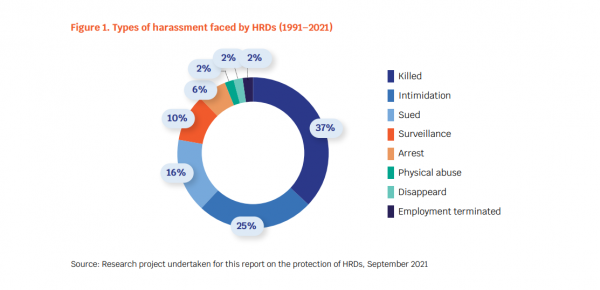
A new UN report claims that, between 2001 and 2021, 30% of outspoken Thai activists experienced violence resulting in a loss of life, by the businesses against which they had campaigned. Released by the United Nations Development Programme (UNDP), on 11 February 2024, the report says that businesses have used legal action, intimidation and violence to silence human rights defenders.

The categories of abuse faced by human rights defenders, per the report.

Activists, affected villagers and attorneys are among the groups considered to be human rights defenders in the report. Over the last 25 years, businesses filed 109 lawsuits against human rights defenders. 68.9% of these were by those with stakes in the mining, livestock and energy industries.

One anonymous interviewee said the lawsuits are used as strategic roadblocks and that they found themselves “going to court approximately once a month, incurring expenses and losing time.” Outside of the judicial system, human rights defenders were reportedly spied upon, or threatened with violence and job loss.

“After making a turn in my car, someone fired shots at me,” claims another anonymous interviewee, adding “I was in the orchard, a single home in the orchard. It was dark. Five shots were fired. I did not report the case, thinking it was an act of intimidation.”

4% of human rights defenders have died or been forcibly disappeared in the 25 years covered by the report, published on February 12th, the International Day for the Prevention of Violent Extremism.

In 2015, Thailand pledged to work towards the fulfilment of the UN’s 17 Sustainable Development Goals (SDGs), alongside other members of the organisation. SDG 16, one of the goals, asks countries to “uphold peace, justice and strong institutions,” and another, SDG 10, aims for “reduced inequalities”.

The report recommends that government and relevant agencies recognize the status and importance of human rights defenders and develop measures that protect them from violence and harassment.

https://www.undp.org/thailand/blog/human-rights-defenders-reports

https://www.thaipbsworld.com/undp-report-says-human-rights-defenders-are-targeted-by-businesses-30-are-victims-of-violence-resulting-in-loss-of-life

Interview with labour rights defender Prak Pheaktra

January 20, 2024

On 9 January 2024, Global Voices posted an interview with labour rights defender Prak Pheaktra. [This article by Klaing Kimhuoy was originally published by Prachatai, an independent news site in Thailand. An edited version has been republished by Global Voices under a partner content-sharing agreement.]

Despite threats from the Cambodian government, who claim he is damaging the country’s image, 39-year-old Prak Pheaktra, a Cambodian migrant worker-turned-advocate, is striving to help other Cambodian workers facing unfair treatment from their employers.

In 2000, Pheaktra, who is from Pusat province, came to Thailand to find work. His family was facing financial difficulties after the death of his mother, and his father could no longer afford to send him to school. Chasing the promise of better pay and less strenuous work, he decided to come to Thailand.

Pheaktra started out working as a construction worker in Don Mueang province, but he later faced exploitation and abuse from his employer. Once, his employer withheld wages and threatened legal action against him. Having experienced first-hand the unfair treatment and exploitation of migrant workers in Thailand, he became an advocate so he could help other workers get fair treatment in the workplace.

Pheaktra’s dedication led him to become a Khmer-Thai interpreter for the Ministry of Labour of Thailand in from 2018–2019, where he began studying Thai law. After completing his ministry contract, he joined the Labor Rights Promotion Network (LPN) in 2019–2020 as a Complaints Receiving Officer.

Having worked with both government and civil society, he is now working as an independent advocate for migrant workers. He offers assistance to workers dealing with wage issues, pressure from employers, sexual harassment, and other threats — all pro bono. He also uses social media to educate workers on how to legally live and work in Thailand and warn them of exploitation by brokers. He works with NGOs as part of research projects, including one on child exploitation in Phuket and another on labour abuses faced by fishing boat workers.

However, his advocacy has attracted criticism and threats, including from Cambodian officials, who claim he could damage the Cambodian government’s public image. Last February 2023, when he assisted 10 Cambodian workers in Samut Prakan whose employer wasn’t paying them, he faced some questions from the chief of the Labour Attaché Office at the Cambodian Embassy. When he was in Rayong working on another case, he was asked if he knew that what he was doing could affect the public image of the Cambodian government and was threatened with having his passport revoked.

The chief of the Labour Attaché Office threatened to revoke my passport if I continued to engage in activities that negatively impact the public image of the Cambodian government. I said, you can block my passport if you think what I am doing is really wrong. I’m not afraid.

He has also faced threats from Thai officials, who he observed can be biased in favour of employers and accuse him of putting excessive trust in the workers. He gave an example of a particular case he worked on where an inaccurate resolution led to a worker being unfairly blamed.

He suggested the need for greater accuracy within the Ministry of Labour’s processes and expressed frustration at being accused of trusting workers too much. He’s urging a more balanced approach to better serve the rights and interests of migrant workers.

Despite the threats he faces, Phaektra persists. “I love what I’m doing right now, and I will continue to help Cambodian workers no matter what,” he said.

Those who have worked with Phaektra described him as kind and dedicated. Prum Somnang, a Cambodian worker at a plastic bag factory, was assisted by Phaektra after being abruptly dismissed by her Thai employer, citing lack of work. Somnang had worked there for ten years and was laid off along with 40 other workers. Her employer wanted to sue her, she said, because she started a protest against the layoff. At the same time, her visa was expiring in seven days, and she needed to find a new job within the week. Her friend advised her to seek help from Pheatra.

“He’s very kind. He helped me get money back from the employer and even assisted me in finding a new job before my visa expired,” Somnang said…

Pheaktra said that one key concern about the lives of migrant workers in Thailand is the risk of falling victim to scams orchestrated by middlemen or company representatives when filing documents. Pheaktra emphasized the need for workers to take charge of their documentation to prevent such scams.

Looking ahead, Pheaktra expressed a commitment to continue social work aimed at assisting migrant workers. Despite the presence of numerous NGOs and institutions offering help, some workers hesitate to seek assistance directly due to concerns about influential individuals associated with these organizations. Pheaktra sees himself as an advocate for migrant workers, standing by their side and addressing their problems.

https://globalvoices.org/2024/01/09/advocate-for-migrant-rights-persists-despite-threats-from-thai-and-cambodian-officials/

HRW asks to drop charges against Human Rights Defenders in Thailand

March 20, 2023
Three Thai human rights defenders—Angkhana Neelapaijit, Puttanee Kangkun, and Thanaporn Saleephol—face criminal defamation charges for reporting abuses.
Three Thai human rights defenders—Angkhana Neelapaijit, Puttanee Kangkun, and Thanaporn Saleephol—face criminal defamation charges for reporting abuses. © 2022 Prachatai

Prosecutors in Thailand should immediately withdraw the criminal defamation cases brought by Thammakaset Company Ltd. against three prominent human rights defenders for their support of other activists facing criminal charges, Human Rights Watch said on 16 March 2023. The Thai government should act to repeal criminal defamation provisions and introduce strong safeguards to prevent the use of frivolous, vexatious, or malicious legal actions that would have chilling effects on free speech.

On March 14, 2023, the Bangkok South Criminal Court began the trial that involves 28 counts of alleged criminal defamation under Thailand’s Criminal Code sections 326 and 328. The charges stem from posts or re-posts on social media by Angkhana Neelapaijit, Puttanee Kangkun, and Thanaporn Saleephol expressing solidarity with other human rights defenders already facing lawsuits brought by Thammakaset for alleging labor rights abuses at the company’s chicken farm in Lopburi Province. The company has filed at least 37 civil and criminal cases against rights defenders, journalists, and workers since 2016.

See also: https://humanrightsdefenders.blog/2022/03/03/fortify-rights-calls-on-thailand-to-drop-charges-against-human-rights-defender-angkhana-neelapaijit/

The Thai authorities should not help companies use criminal defamation or other legal avenues to silence workers from filing complaints about their working conditions or human rights defenders or journalists for reporting about alleged abuses at the company,” said Elaine Pearson, Asia director at Human Rights Watch. “The charges against Angkhana, Puttanee, and Thanaporn should be immediately dropped, and Thai authorities should act to prevent similar cases from being filed in the future.”

The United Nations Human Rights Committee has stated in its General Comment No. 34 on freedom of expression that governments “should put in place effective measures to protect against attacks aimed at silencing those exercising their right to freedom of expression, including persons who engage in the gathering and analysis of information on the human rights situation who publish human rights-related reports.”

On December 16, 2022, the UN Working Group on Business and Human Rights urged Thai authorities to take action to stop the Strategic Litigation Against Public Participation (SLAPP) lawsuits increasingly used by Thai companies to intimidate reporters and human rights advocates.

The Working Group specifically mentioned Thammakaset, stating that: “The cases filed by companies, such as Thammakaset Company Limited, against human rights defenders are a clear example of businesses abusing the legal system in order to censor, intimidate, and silence criticism through SLAPPs as a method of judicial harassment.” See also: https://humanrightsdefenders.blog/2022/04/28/eu-finally-moves-on-law-to-protect-media-from-legal-abuse-slapps/

Thai Prime Minister Prayut Chan-ocha has repeatedly emphasized the importance of companies respecting human rights in their operations and upholding the UN Guiding Principles on Business and Human Rights. In October 2019, Thailand was the first country in Asia to announce a National Action Plan on Business and Human Rights, committing to protect human rights defenders and prevent judicial harassment. But the charges against Angkhana, Puttanee, and Thanaporn, as well as the failure to assist those still facing many of the other civil and criminal cases filed by Thammakaset, stand in stark contradiction to the Thai government’s pledges to take action to protect rights, Human Rights Watch said.

In 2018, the National Assembly amended the Criminal Procedure Code to prevent the misuse of criminal cases. While that is a useful step, the Thai government should repeal all criminal defamation provisions. Neither prosecutors nor courts in Thailand have actually carried out, much less considered, amended section 161/1, which allows judges to dismiss and forbid the refiling of a criminal complaint by a private individual if the complaint is filed “in bad faith or with misrepresentation of facts to harass or take advantage of a defendant.” Furthermore, section 165/2 allows the presentation of evidence to show that the complaint “lacks merit.”

These reform provisions of the Criminal Procedure Code remain unused and untested, though. It is also crucial to provide prosecutors with adequate resources and support to exercise their powers under section 21 of the 2010 Public Prosecutor Organ and Public Prosecutors Act to screen out frivolous cases.

Human Rights Watch, along with an increasing number of governments and international agencies, has consistently called for the repeal of criminal defamation laws because they are an inherently disproportionate punishment for expressions of speech judged to damage reputations. Civil defamation laws, when supplemented by strong anti-SLAPP safeguards, balance the need for fair reporting in the public interest with concerns about reputational harm to private actors. In addition, as the charges against Angkhana, Puttanee, and Thanaporn show, criminal defamation laws in Thailand are easily abused and can have adverse impacts on free expression in the public interest.

Thailand should enact comprehensive anti-SLAPP legislation to strengthen safeguards to protect freedom of speech and expression and prevent retaliation against workers, human rights defenders, and journalists, Human Rights Watch said.

The UN special rapporteur on rights of freedom of peaceful assembly and association recommended that “States should protect and facilitate the rights to freedom of expression, assembly and association to ensure that these rights are enjoyed by everyone” including by “enacting anti-SLAPPs legislation, allowing an early dismissal (with an award of costs) of such suits and the use of measures to penalize abuse.”See also: https://humanrightsdefenders.blog/tag/strategic-lawsuits-against-public-participation-slapps/

“The UN and governments from around the world should share with Thailand their reform efforts to strengthen anti-SLAPP protections and point out that criminal defamation laws coupled with the absence of strong anti-SLAPP protections impede the ability of businesses to conduct essential human rights and environmental due diligence,” Pearson said. “Unless the Thai government moves now to protect Angkhana, Puttanee, and Thanaporn from retaliation, the promises that Thai officials made on business and human rights will ring hollow.”

https://www.hrw.org/news/2023/03/16/thailand-drop-charges-against-rights-defenders

Where is Dong Guangping?

November 23, 2022

Disappeared Chinese human rights defender must be allowed to reunite with his family in Canada

After 31 months in hiding in Vietnam, on August 24, 2022 Chinese human rights defender Dong Guangping was arrested by Vietnamese police.  There has been no news of his fate since then. His wife and daughter, who live in Toronto, are fearful that he has been handed over to Chinese authorities. In China he would face a grave risk of once again being jailed for his human rights activism. He has previously served three prison terms there, simply because he believes in human rights and refuses to remain silent in the face of grave violations in the country.

Dong Guangping had been recognized by the UN High Commissioner for Refugees and accepted for resettlement to Canada as a refugee in 2015. He was in Thailand with his wife and daughter at that time. However, Thai police unlawfully handed him over to Chinese authorities before he was able to travel to Canada.  See also: https://humanrightsdefenders.blog/2015/12/08/thailand-returns-recognized-refugees-to-china-and-falsely-claims-they-did-not-know-about-their-status/

He was sentenced to 3 ½ years in prison in China. After he was released in 2019, Dong Guangping wanted to reunite with his wife and daughter in Canada. However, as China refused to issue him a passport, he was not allowed to leave the country through official channels. He first tried unsuccessfully to reach safety by swimming to a nearby Taiwanese island. In January 2020, he clandestinely crossed the border into Vietnam.

With backing from the Canadian government, Dong Guangping and his family had been hopeful that he would soon be allowed by Vietnamese officials to leave the country and travel to Canada. His arrest was unexpected and his subsequent disappearance has come as a crushing blow.

You can express Your Concern to the Embassies Please write, phone or send an email to Vietnam’s and China’s Ambassadors to Canada:

  • expressing your concern about Dong Guangping’s arrest in Vietnam on August 24, 2022 and the fact that there has been no news of his whereabouts or wellbeing since then;
  • asking them to immediately disclose where Dong Guangping is at this time and that Canadian officials be granted access to him; and
  • requesting that Dong Guangping be allowed to travel to Canada without any further delay, to join his wife and daughter.

His Excellency Cong Peiwu
Ambassador of the People’s Republic of China in Canada

515 St. Patrick Street
Ottawa, Ontario
K1N 5H3

Tel: 613-789-3434

Email: chineseembassy.ca@gmail.com

His Excellency Pham Cao Phong
Ambassador of the Socialist Republic of Viet Nam in Canada

55 Mackay Street
Ottawa, Ontario
K1M 2B2

Applications open for the Global Advocacy Learning Programme on Human Rights and Development #GALP2022

September 22, 2022


On 22 September 2022 Forum Asia announced the Call for Applications for its “Global Advocacy Learning Programme on Human Rights and Development” which provides a comprehensive set of knowledge and skills to human rights and development activists. Extremely qualified and experienced facilitators, as well as international experts, will guide the participants through the most relevant and pressing issues related to human rights and development. The participants will learn and engage in interactive sessions throughout the 7-day programme touching upon, among others, human rights advocacy and mechanisms at national, regional, and international level, business and human rights, gender, and environment. All participants will receive high-quality reading and training materials. All sessions will be conducted in English.

Dates and Venue

The fourth edition of the Global Advocacy Learning Programme on Human Rights and Development will take place in Thailand from 29 November to 5 December 2022. Details about the venue will be communicated to all confirmed participants.

Participants

Participants from all over Asia are expected to participate in the fourth edition of the Global Advocacy Learning Programme on Human Rights and Development. Their participation will be fully covered by FORUM-ASIA. Participants will be selected based on the following criteria:

  • Genuine interest in issues related to human rights/sustainable development/gender/environment
  • Being currently employed or actively partner with a national, regional or international civil society organization and/or community-based group;
  • Preferably 3 years working experience in organisations addressing issues related to human rights/ development/environment/gender (applicants with less than 3 years will be considered on an exceptional basis);
  • Excellent command of English, both spoken and written.

Only those selected will be contacted.

All interested applicants should apply promptly by submitting the duly filled application Online Application Form by Friday 7 October 2022.

For more information, email globalacademy@forum-asia.org

Portraits of disappeared defenders paraded in Bangkok

September 14, 2022

This article – originally published by Prachatai, an independent news site in Thailand – was republished by Global Voices on 5 September 2022

To mark International Day of the Disappeared on August 30, a dozen people affiliated with the Mok Luang Rim Nam student activist group gathered at Ratchaprasong Intersection in downtown Bangkok. A small parade was held by activists in Siam Square to raise awareness about forced disappearances. The marchers carried portraits of abducted activists, some of whom were later found dead.

The group carried photos of Porlajee Rakchongcharoen, Surachai Danwattananusorn, Wanchalearm Satsaksit, and Siam Theerawut — Thai victims of forced disappearance. Hanging photos of the victims around their necks, some covered their heads with plastic bags in imitation of a suffocation torture technique.

Porlajee Rakchongcharoen is a Karen environmental activist last seen in April 2014 in the custody of Kaeng Krachan National Park officials in Phetchaburi province. [see: https://humanrightsdefenders.blog/2022/08/22/karen-activist-porlajee-billy-rakchongcharoens-murder-finally-an-indictment/]

Surachai Danwattananusorn, a veteran activist who fled the country after the 2014 coup, disappeared in December 2018 in a neighboring country, and his dead body was later found at the Thai-Laos border. Siam Theerawut also fled in 2014 and was arrested by Vietnamese authorities in 2019 before his reported extradition to Thailand. His whereabouts are still unknown.

Speaking on the occasion, activist Tanruthai Thaenrut said that the group wanted to raise awareness about forced disappearances, to tell people that the government is ignoring these disappearances and silencing the people to make disappearance seem normal.

A 2020 report by the UN Working Group on Enforced or Involuntary Disappearances estimates there are at least 75 victims of enforced disappearance in Thailand .

Uniformed police were seen standing guard at the National Police Headquarters on the way to Siam Square. Plainclothes police were reportedly taking photographs of event participants before the event started. When they reached their destination, the Superintendent of Pathumwan police station arrived with other police officers, to quietly monitor the situation.

During the gathering, activists staged a performance symbolizing an abduction. One of the participants placed a black bag over Tanruthai’s head while she was giving a speech. Two others then carried her away while other activists shouted, “Free our friends.”

Mint, a Thai traditional dancer-turned-activist who participated in the march, said that the performance signified that anyone could become a victim of forced disappearance. She noted that human rights lawyer Somchai Neelapaijit was abducted in the middle of Bangkok, and added that the fates of most people who disappeared remain unknown

Karen activist Porlajee ‘Billy’ Rakchongcharoen’s murder: finally an indictment

August 22, 2022

The Thai authorities should fully and fairly prosecute all those responsible for the murder of a prominent ethnic Karen environmental activist, Porlajee ‘Billy’ Rakchongcharoen, in 2014, Human Rights Watch said on 16 August 2022. See also: https://humanrightsdefenders.blog/2014/05/06/un-high-commissioner-condemns-disappearance-of-billy-in-context-of-retaliation-against-environmentalist-in-south-east-asia/

Porlajee “Billy” Rakchongcharoen
Porlajee “Billy” Rakchongcharoen, a prominent ethnic Karen community and environmental activist, was allegedly murdered in the custody of the Kaeng Krachan National Park officials in Phetchaburi province, Thailand, in April 2014. © 2014 Private

On August 15, 2022, the Attorney General’s Office formally notified the Justice Ministry’s Department of Special Investigation (DSI) of its decision to indict four park officials accused of abducting and murdering Porlajee “Billy” Rakchongcharoen in April 2014. The charges include illegal confinement, premeditated murder, and concealing the victim’s body.

“Thai officials have long hindered justice for Billy through cover-ups and exploitation of legal loopholes,” said Elaine Pearson, acting Asia director at Human Rights Watch. “The authorities can right this wrong by ensuring that the attorney general’s decision to indict four officials moves promptly to an effective and fair prosecution.”

Billy was last seen on April 17, 2014, in the custody of Chaiwat Limlikitaksorn, then-head of Kaeng Krachan National Park in Phetchaburi province, and his staff. The park officials said they released him after questioning him briefly and had no information regarding his whereabouts. On September 3, 2019, DSI officials announced that his remains had been found in Kaeng Krachan National Park. Chaiwit was among the four indicted.

Pinnapa Prueksapan, Billy’s wife, told Human Rights Watch that she hoped there would be answers to basic questions, such as who had abducted and killed her husband, and who had obstructed justice.

Thailand is obligated under international human rights treaties to which it is a party to investigate and appropriately prosecute enforced disappearance, torture, custodial deaths, and other alleged human rights violations. In addition, in September 2019, Prime Minister Gen. Prayut Chan-ocha ordered the Department of Special Investigation to ensure that the case was watertight so the culprits could be brought to justice, regardless of their rank or position.

However, the investigation has suffered from a cover-up, Human Rights Watch said. Despite a long list of allegations against Chaiwat for serious abuses and misconduct during his tenure as head of Kaeng Krachan National Park, he has never been held to account.

In addition, Thai law does yet not recognize enforced disappearances as a crime. Human Rights Watch has repeatedly urged Prime Minister Prayut and his government to ratify the International Convention for the Protection of All Persons from Enforced Disappearance, which Thailand signed in 2012, and make enforced disappearance a criminal offense.

Chaiwat and his staff arrested Billy on April 17, 2014, for alleged illegal possession of a wild bee honeycomb and six bottles of honey.

At the time of his enforced disappearance, he was traveling to meet with ethnic Karen villagers and activists in preparation for an upcoming court hearing in the villagers’ lawsuit against Chaiwat and the National Park, Wildlife, and Plant Conservation Department of the Ministry of Natural Resources and Environment.

The villagers alleged in the lawsuit that, in July 2011, park authorities had burned and destroyed the houses and property of more than 20 Karen families in the Bangkloy Bon village. Billy was also preparing to submit a petition about this case to Thailand’s monarch. When he was arrested, he was carrying case files and related documents with him. Those files have never been recovered.

In September 2014, Police Region 7 officers filed malfeasance charges under article 157 of the penal code against Chaiwat and three other park officials for unlawfully detaining him. The other suspects named in the case are Boontaen Bussarakham, Thanaseth or Pitoon Chaemthes, and Krissanapong Jitthes. The DSI found traces of human blood in a vehicle belonging to the park office, but was not able to verify if the blood belonged to Billy because the vehicle was cleaned before forensic experts could examine it.

On September 3, 2019, the DSI announced that his remains had been found in Kaeng Krachan National Park, where he was last seen in custody of the park officials. The investigation team found an oil barrel, its lid, two steel rods, a burned wooden piece, and two bones at the bottom of the reservoir on April 26, 2019.

The Central Institute of Forensic Science subsequently confirmed the genetic trace of one of the bones found inside the barrel matched Billy’s mother. The investigation team then concluded it was part of his remains. The condition of this piece of human skull, which was burned, cracked, and shrunk due to exposure to heat of 200 to 300 degrees Celsius, suggests the killers burned his body to conceal the crime.

“The indictment of Chaiwat and other park officials is an important step for justice for Billy and all those whom Thai government officials have forcibly disappeared and killed,” Pearson said. “Thai authorities should recognize that they can’t escape being held accountable for the most heinous crimes.”

https://www.hrw.org/news/2022/08/16/thailand-officials-indicted-karen-activists-murder

Human Rights Defender Angkhana Neelapaijit in Thailand harassed

April 14, 2022
Photo captured on a security camera of the alleged assailant, a woman wearing a mask and a black t-shirt.
Photo captured on a security camera of the alleged assailant, a woman wearing a mask and a black t-shirt. © 2022 Private

The authorities in Thailand should urgently investigate an incident intended to intimidate a prominent human rights defender, Human Rights Watch said on 13 April, 2022.

On April 12, 2022, at about 6 a.m., an unidentified assailant threw a pair of 9-inch-long scissors at the house of Angkhana Neelapaijit in Bangkok, making a hole in her front door. Security camera footage showed what appeared to be a woman wearing a face mask and a dark t-shirt with the Thai numeral 9 standing in front of the house, throwing the scissors, and then running away. Angkhana, 66, is a former commissioner of the National Human Rights Commission of Thailand and a newly appointed member of the United Nations Working Group on Enforced or Involuntary Disappearances. See: https://www.trueheroesfilms.org/thedigest/laureates/0D5DED3E-F79F-4AB4-8261-F6A19486F062

Violent acts intended to intimidate a well-known figure like Angkhana not only pose a threat to her and her family, but send a spine-chilling message to the entire Thai human rights community,” said Elaine Pearson, acting Asia director at Human Rights Watch. “The Thai government should respond immediately by undertaking a serious investigation to ensure that everyone responsible for this incident is held accountable.”

Angkhana told Human Rights Watch that she and her family felt vulnerable after the Justice Ministry canceled her protection under the government’s witness protection program on April 1. The authorities claimed the service was no longer needed because Angkhana’s life would no longer be in danger after the Department of Special Investigation ended its investigation of the enforced disappearance of her husband, the prominent human rights lawyer Somchai Neelapaijit. [See also: https://humanrightsdefenders.blog/2021/03/17/where-is-somchai-a-brave-wifes-17-year-quest-for-the-truth/]

The Thai government should not ignore this disturbing incident, which appears to be a response to Angkhana’s effective human rights advocacy,” Pearson said. “Foreign governments and the United Nations should press the Thai government to urgently act to protect Angkhana and other human rights defenders in the country.”

https://www.hrw.org/news/2022/04/13/thailand-prominent-rights-defender-harassed

Fortify Rights calls on Thailand to drop charges against human rights defender Angkhana Neelapaijit

March 3, 2022

On 2 March 2022, Fortify Rights called on the Thai authorities to drop all remaining cases brought by Thai chicken company Thammakaset Company Limited against human rights defenders and protect the right to freedom of expression. On February 22, the Bangkok South Criminal Court rescheduled the start of the criminal defamation trial against Angkhana Neelapaijit to 25 April. See: https://www.trueheroesfilms.org/thedigest/laureates/0D5DED3E-F79F-4AB4-8261-F6A19486F062
 
Delaying the trial affects access to justice and leaves the defendant in fear and worry,” said Angkhana Neelapaijit. “It affects the person’s livelihood and freedom during the bail process. The delays are incredibly traumatizing.” 
 
Thammakaset first filed a complaint against Angkhana Neelapaijit more than two years ago, on October 25, 2019, alleging criminal defamation for posting two tweets on social media on December 3, 2018 and June 28, 2019 that expressed support for human rights defenders facing lawsuits by the company. On August 16, 2021, the court concluded that the case should proceed to trial following four preliminary hearings that spanned more than 17 months. The court originally scheduled the trial to start on March 3, 2022 but postponed the start due to rising COVID-19 cases in Thailand.
 
Angkhana Neelapaijit also faces a second criminal defamation complaint brought by Thammakaset in June 2020 that is part of a combined case that includes charges against Fortify Rights Senior Human Rights Specialist Puttanee Kangkun and Thanaporn Saleephol, a former Fortify Rights Communications Associate. The complaints against the three women all relate to similar social media posts expressing solidarity with others facing lawsuits brought by Thammakaset. The Bangkok South Criminal Court is scheduled to continue preliminary hearings on the combined case on March 21.

The Community Resource Center Foundationa Thai nonprofit and legal aid organization committed to promoting human rights, community rights, and environmental protection – is providing legal representation to human rights defenders facing complaints by Thammakaset, including in the cases against Angkhana Neelapaijit, Puttanee Kangkun, and Thanaporn Saleephol.

“Thailand should be proud and promote the work and achievements of Angkhana Neelapaijit as a strong Thai woman human rights defender, a winner of the prestigious Magsaysay award, and a former National Human Rights Commissioner,” said Amy Smith, Executive Director of Fortify Rights. “These types of lawsuits create an insecure environment for human rights defenders, hampering their ability to conduct critical activities that benefit the public. The case against Angkhana Neelapaijit and others should be dropped.” See: https://humanrightsdefenders.blog/2019/08/03/magsaysay-awards-2019-honor-4-outstanding-asians/

On March 31, the Court of Appeal will also decide whether to uphold an earlier decision by the Criminal Court to acquit human rights defender and former Thammakaset employee Nan Win and former Fortify Rights Thailand Human Rights Specialist Sutharee Wannasiri of criminal defamation charges brought by Thammakaset in October 2018.
 
Since 2016, Thammakaset has filed at least 37 complaints against 22 human rights defenders. The courts have dismissed or ruled against the company in almost all cases.
 
In 2018, the National Legislative Assembly amended Section 161/1 of the Thailand Criminal Procedure Code, allowing judges to dismiss and forbid the refiling of a complaint by a private individual if the complaint is filed “in bad faith or with misrepresentation of facts to harass or take advantage of a defendant.” Section 165/2 also allows the presentation of evidence to show that the complaint “lacks merit.” Despite these amendments and specific requests for the court to apply Section 161/1 to prevent cases brought by Thammakaset from moving forward, the courts have allowed these cases to proceed.

See also: https://humanrightsdefenders.blog/2020/07/09/andy-hall-finally-acquitted-of-criminal-defamation-in-thailand/

https://www.scoop.co.nz/stories/WO2203/S00035/thailand-drop-criminal-complaint-against-2019-magsaysay-award-winner-angkhana-neelapaijit.htm