The Free Expression Legal Network, a new initiative dedicated to strengthening legal protections for free expression and media freedom, was launched at Webber Wentzel’s Sandton office on 18 February 2025, with more than 50 People in attendance. Developed by the SA National Editors’ Forum (Sanef), the Press Council, the Campaign for Free Expression (CFE), and other organisations and legal experts, the network aims to ensure that individuals and organisations facing legal threats can access the support they need.
Among those that this new initiative aims to support are journalists, smaller media outlets, community-based organisations and businesses that lack access to corporate or external legal representation. It aims to ensure co-ordination with several other international efforts of this kind to provide a stronger framework for defending free expression,
The network will focus on several key areas to strengthen legal protections for free expression and media freedom. Media freedom is critical – ensuring that individuals and media organisations can report and impart information freely and hold power to account without fear of legal repercussions. Additionally, the network will support media viability by providing legal guidance to help media outlets navigate financial and operational challenges, ensuring their long-term sustainability. Another critical area is policy advocacy, where the network will assist with legal challenges related to media regulation and press freedom policies, helping to create a more supportive legal environment for journalism. Lastly, the initiative will prioritise small and community media, offering essential legal resources to newsrooms and organisations that often lack adequate legal support, ensuring they have the protection needed to operate effectively.
But this initiative comes at a time of new and sinister threats to freedom of expression more generally. Unchecked and unprecedented powers to platform and platform certain voices and sources of information present pronounces threats to freedom of expression globally. It is intended that this network, enabling resources and expertise, is able to respond innovatively, nimbly and effectively in meeting these dangers.
The keynote address was delivered by Navi Pillay, former UN High Commissioner for Human Rights, Judge of the International Criminal Court, and President of the International Criminal Tribunal for Rwanda. Drawing from her extensive experience in international human rights law, she provided invaluable insight into the legal challenges surrounding free expression and the role of judicial systems in upholding these rights. Emphasising the power of collective action, she stated, “If you clap with a single hand, nobody yells for you. But if a lot of people form a network clap, they will be heard. So, I can only see success for an initiative like this, I encourage them to go for it here.
Anton Harber, Campaign for Free Expression Director, emphasised the importance of the new body in defending free speech, stating, “This new body will be a vital tool in preventing attacks on free speech and free media, bringing together a range of resources to respond quickly and strongly. It will help ensure that anyone whose free speech is threatened will be properly defended. It will also be proactive – pushing for change to laws that don’t defend free speech or the right to information. In the face of growing threats to free speech, we are building a strong defence“.
Echoing this urgency, Nicole Fritz, Executive Director of Campaign for Free Expression, highlighted the global nature of these challenges, adding, “I think that the threats to free expression are especially intense at this time, not only in our country but in the world generally. It is especially important that those who have their rights to expression violated and threatened are offered expert support and legal assistance in order to counter those threats”.
Dario Milo, a partner at Webber Wentzel and a leading expert in media law, emphasised the importance of this initiative, stating: “The Free Expression Legal Network is a significant step forward in ensuring that journalists, media organisations and other human rights defenders, particularly those with limited resources, have access to the legal guidance they need. At a time when media freedom is under increasing pressure, this initiative will play a crucial role in safeguarding free expression and upholding the public’s right to know.”
For more information on the Free Expression Legal Network and how to get involved, please contact Anton Harber, Director, CFE, anton@harber.co.za
On 11 June 2024 it was revealed that Professor Pumla Gobodo-Madikizela has been awarded the Templeton Prize, an honour that commends those who have used their scholarly paths to explore “the deepest questions about humanity and the universe”,
The South African professor, psychologist, has been commended for career-defining victories including winning the Harry Oppenheimer Fellowship Award (2020) and a fellowship at Harvard University’s Radcliffe Institute, not to mention the leadership positions she hold. Professor Gobodo-Madikizela is the SARChi Chair for Violent Histories and Historical Trauma, the Founding Director of the Centre for the Study of the Afterlife of Violence and the Reparative Quest (AVReQ). Notably, she was also an influential member of the Truth and Reconciliation Commission.
Through her work, the professor has been imperative to knowledge on the transgenerational impact of historical traumas. The John Templeton Foundation’s president, Heather Dill spotlighted Prof Gobodo-Madikizela as “a guiding light within South Africa as it charts a course beyond apartheid, facilitating dialogue to help people overcome individual and collective trauma.”
For the acclaimed professor, the Templeton Prize is a gracious gift (it is a prize of £1.1 million: “I am excited that I can use the Templeton Prize to help fund our postgraduate students and postdoctoral fellows at a time of reduced funding all-round,” said the professor who has pledged to donate R8 million to Stellenbosch University.
I am not a professional obituary writer, but I surely wished I were, as writing about my dear friend Leah Levin deserves the best possible skills. Fortunately, I received some excellent input from her caring family of which I am making good use. A celebration of Leah’s life will be held by the family on 13 June, 4 pm BST which can also be followed online.
Leah Levin, was a well-known figure in the international human rights movement of the 1970’s and onwards. She died of cardiac arrest on 25 May, 2024, at the formidable age of 98. For over half a century, she served and led a range of human rights organisations and collaborated globally with some of the world’s leading activists. For which she received an honorary doctorate from the University of Essex in 1992 and an OBE in 2001.
She was the author of UNESCO’s “Human Rights: Questions and Answers”, one of the world’s most widely disseminated books on human rights, (translated into more than 30 languages).
From 1982-1992, she was director of JUSTICE, a pioneering organisation that sought to right miscarriages of justice and which was a national section of the International Commission of Jurists . She served as a board member or trustee of the United Nations Association, the Anti-Slavery Society, International Alert, Redress, Readers International and The International Journal of Human Rights. But most of all, I remember her from the work she did to make sure that we would not forget one of our most impressive friends: Martin Ennals, who had led Amnesty from 1968 to 1980 and had been one of her closest friends until his death in 1981. [see his biography in the Encyclopedia of Human Rights, OUP, 2009, Vol 2, pp 135-138].
Frances D’Souza, said about Leah: “without any pretension she was nearly always right. She hit the nail on the head whether dealing with world affairs or people. She made a significant difference by her wise counsel and fact that she could really see what the issues were, read the situation and do something about it.”
Leah Levin had the special talent to draw other like-minded people to her and help coalesce a community of activists with whom she would collaborate throughout her entire life.
Her own life story is one of human rights struggle: Leah was born Sarah Leah Kacev on 1 April 1926 in Lithuania. She grew up as Leah Katzeff in Piketberg, South Africa, a small, rural town in Western Cape to where the family had to flee to escape poverty and anti-Semitism in the difficult years after the First World War and Russian revolution. Leah was the first of four children and the first person in her family to go to university. She graduated in 1945, when at the end of the second world war, the Katzeffs found out that their family along with their entire Jewish community in Mazeikiai, had been murdered by local Lithuanians organized by the Germans in the very first days of the Nazi advance in 1941.
In 1947 she married Archie Levin, fifteen years her senior. Like Leah, Archie was the child of European Jewish immigrants. Together they set up a new business, writing travel guides to Central and Southern Africa. In 1960, disgusted by the repression of anti-apartheid protest, the couple moved to the British colony of Southern Rhodesia (now Zimbabwe) with their two children Michal and Jeremy. A third son, David, was born in Salisbury (now Harare).
In Rhodesia, Leah completed a second degree in international relations at the University of Rhodesia and Nyasaland, while her husband became politically active. His activities angered those in power; shortly before Rhodesia unilaterally declared independence. Archie was tipped off that he was likely to be arrested. He rapidly left for the UK with his daughter Michal and later was joined by his son Jeremy; a few months later, Leah and her infant son David joined the rest of the family in the UK.
In London, Leah found a volunteer post as Secretary of the newly founded United Nations Association. The UNA human rights committee brought together people who became lifelong friends as well as colleagues: Martin Ennals, Sir Nigel Rodney, Amnesty’s first legal officer and later UN rapporteur on torture, and Kevin Boyle, who ran the Human Rights Centre of the University of Essex. After the death in 1977 of her husband Archie, Leah threw herself still more wholeheartedly into human rights work. In 1978, she took a job as Secretary of the Anti-Slavery Society, which connected her to the United Nations in Geneva. And in 1982 she moved to run JUSTICE for a decade. In 1992, she co-founded Redress, representing victims of torture to obtain justice and reparation for them.
Even when fully retired Leah continued to keep an active interest in children and grandchildren as well as her human rights “children”. I will bitterly miss her almost yearly phone calls to check on me to make sure I am doing the right thing.
The organisation released a statement to mark [South Africa’s] Human Rights Day on Thursday 21 March 2024. It said human rights defenders, such as the Abahlali baseMjondolo activists, continue to be threatened or killed for standing up for fighting for basic services or speaking against corruption.
“Currently, the movement’s general secretary Thapelo Mohapi is in hiding and facing threats because of his activism.“
Quintal says the attacks on those fighting for basic rights are a violation of human dignity.
“It is imperative that our government takes decisive action to ensure the protection of these individuals and enacts strong legislation to safeguard their rights…There is an urgent need for legislative measures to safeguard the lives of human rights defenders.”
South Africa in the special position to have its own human rights day, not on 10 December but on 21 March, historically linked with 21 March 1960 and the events of Sharpeville. In a Maverick Citizen panel discussion on Monday 21 March, representatives of a range of civil society movements explored what it means to be an activist. The panellists discussed their own experiences of activism: the world needs activists, who in turn need commonality for success and survival
The current times — filled as they are with uncertainty and suffering — require all or most people to be active rather than passive. Though those involved in activism will become weary, they should not step back from the struggle, according to Delani Majola, communications officer for the Ahmed Kathrada Foundation. The need for activism in today’s world is far more urgent than it ever was before.
“It means that we need to… find linkages with one another, we need to recharge each other. I think we will not achieve anything — so whether it’s small victories, small gains — but we will not achieve anything if we sit back and become passive and give in to defeat,” said Majola.
Among the speakers involved in the discussion were also Nkateko Blessing Muyimane, a medical student who recently fled Ukraine and started the non-governmental organisation, SA Safe Corridor for Students; Jennifer Matibi, founding member of Nirvana, an initiative that assists young women of the Johannesburg inner city to create spaces in which they can grow; Thandeka Gqubule-Mbeki, former SABC economics editor and current PhD student at the University of Johannesburg; Siyabonga Ndlangamandla, board member at Makers Valley Partnership; and Shaeera Kalla, board member of Section27 and member of the #PayTheGrants campaign. Nkateko Blessing Muyimane, a medical student who recently fled Ukraine and began an NGO, SA Safe Corridor for Students, to assist those students still trapped in the country.
The discussion was facilitated by Maverick Citizen editor Mark Heywood and journalist Zukiswa Pikoli. Zukiswa Pikoli, journalist with Maverick Citizen.
Spaces for activism have become smaller in recent years, according to Kalla. This not only calls for more voices and action in these spaces but also cooperation and support among the different groups within civil society. There are, she emphasised, links between the various causes for which people advocate — from basic income and food sovereignty to free media and mental health.
“Being a good activist is really about also building relationships, and I think those spaces that one creates are filled with those relationships,” said Kalla. “[T]hat’s how you sustain momentum and that’s how you figure out how to take one idea and create an intersectional… spectrum, a spectrum of issues that support it, and they take it to the next level.”
She added that the “typical image” of an activist should not override the everyday struggles that people face in society. While activism is a choice for some, for others it is a lived reality; a state of fighting a system that was built against them.
Activism should come from a place of compassion, according to Muyimane. He defines activists as those who want to make an environment a better place. The decision of a person to throw themselves into a course of action is often very personal, said Gqubule-Mbeki. It can be rooted in their worldview, an innate sense of justice or outrage at something they have witnessed or experienced.
Gqubule-Mbeki’s own journey as an activist began with her experience of forced removals under apartheid. She saw both her grandparents and her parents lose their homes to this unjust policy. Thandeka Gqubule-Mbeki, PhD student and part-time lecturer at the University of Johannesburg addressing the audience. Johannesburg, 21 March 2022. (Photo: Shiraaz Mohamed)
“So, [activism is] partly personal, partly a decision to make your beliefs publicly relevant and to impact policy and how human beings relate to each other, and how societies are constructed,” she said.
Over and above the “imagination” it takes to stand up for something, Kalla believes activism is about sustaining human beings, creating a political culture and ensuring that people feel safe. In this way, separate causes are united by their common drive to see people live with dignity.
“It’s about making sure people feel seen, feel safe and feel cherished, whether or not you’re personally affected, in a direct sense,” she said. “[T]he fact that you are a human being, and you can have empathy and you can see an unjust system and want to do something about it, is enough to start trying to understand what it is that you can contribute to, in whatever form.”
There is currently a large pushback against democracy defenders by capital, corporations and institutions, according to Gqubule-Mbeki. If the victimisation of human rights activists is to be addressed, there is a need for an examination and improvement of certain laws, including the Protected Disclosures Act and Witness Protection Act.
“We must ratchet up the consequences of acting against activists, vulnerable human beings, women, and so on. So, I think that’s one of the challenges that we tend to have going forward,” said Gqubule-Mbeki.
Another challenge related to activism is the toll it can take on people’s mental health. Kalla recalled a period in her time as an activist when she struggled to eat and live healthily, saying that it taught her about creating sustainable spaces within movements. ..It is important to address the issue of “toxic behaviour” within movements, should it arise, she continued. “A lesson that I’ve learned is that you have to be tender. So, tenderness is fundamental, but firmness is equally fundamental, so that you don’t create an unhealthy space, then it collapses.”
Being a young woman whose activism has brought her into meetings dominated by older, more experienced people, Matibi has sometimes questioned her own standards and achievements. She manages these uncertainties by building supportive networks within civil society. Jennifer Matibi, founding member of Nirvana, an initiative that assists young women of the Johannesburg inner city to create spaces in which they can grow.
“Being involved with other activists, being involved with other people that are doing the work that you’re currently doing, …I have people that I can reach out to who are actually in the space and doing the kind of work that I’m doing,” said Matibi.
As an activist, it is important to guard against the potential for hubris, said Gqubule-Mbeki. This can be done through supporting other activists and offering solidarity to those who are struggling for change. However, it also requires a keen awareness of those representatives of commercial and state interests who might try and “sidle up” to a cause.
“So, when you read vested interests, then you are able not to [sell out] to money, because money – once it comes into your cause and is not properly governed – it becomes toxic and [those providing the money] can go to communities and you can give them a disproportionate power,” said Gqubule-Mbeki. “And then when the state sidles up to you, you have to be equally weary, but also conscious that this is the state’s job. The state is the collective people.” Siyabonga Ndlangamandla, board Member at Makers Valley Partnership as he listens to other panelists talk. Johannesburg, 21 March 2022. (Photo: Shiraaz Mohamed)
Activism is not an exclusive or an elite phenomenon, according to Majola. It can take the form of signing a petition, joining a demonstration or simply participating and engaging as part of an audience.
“[W]e shouldn’t sanctify or glorify activists, because ultimately, we’re still human,” he said. “So, I think anybody can get into activism, and those who are already in, I think it’s important to base and ground your movements in fact and truth.”
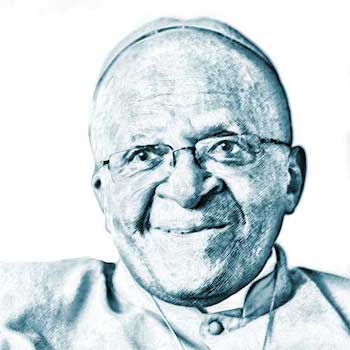
Archbishop Emeritus Desmond Tutu, who was post-apartheid South Africa’s moral compass and the driver of its troubled reconciliation process, has died. He was 90 years old.
He is the laureate of at least 10 human rights awards: For the complete list, see:
Andrew Donaldson in News24 of 26 December 2021 published an interesting obituary: A tireless social activist and human rights defender, Tutu not only coined the term “Rainbow Nation” to describe the country’s ethnic diversity but, after the first democratic elections in 1994, went on to become its conscience, using his international profile in campaigns against HIV/Aids, tuberculosis, poverty, racism, xenophobia, sexism, homophobia and transphobia, among others…
His was a powerful, forthright voice, one that irked both the Nationalist government and its successor, the African National Congress and its allies. He was, an activist noted, “given to expressing his opinion in ways that are guaranteed to be outside the realm of comfortable politics”. As Tutu himself put it, in 2007, “I wish I could shut up, but I can’t, and I won’t.“..
Both at home and abroad, Tutu’s opposition to apartheid, which he often likened to Nazism, was vigorous and unequivocal. The Nationalists twice revoked his passport, and he was briefly jailed in 1980 after a protest march. Many felt that his increasing international reputation and his advocacy of non-violence had spared Tutu from more harsh treatment by the government…
He was a born orator and, according to the journalist Simon Hattenstone, “a natural performer [with] his hands and eyes flying all over the place, his voice impassioned and resonant; a tiny ball of love.”
Tutu would often play down such adulation. “I was,” he once said of his reputation, “this man with the big nose and the easy name who personalised the South African situation.”…
Following the Soweto riots in 1976, Tutu became an increasingly vocal supporter of economic sanctions and a vigorous opponent of US president Ronald Reagan’s “constructive engagement” with the Nationalist government.
In 1978, he was appointed general secretary of the SACC, a position he used to further rally support, both local and international, against apartheid. He was just as harsh in his criticism of the violent tactics later used by some anti-apartheid activists, and was unequivocal in his opposition to terrorism and communism.
Tutu’s finest hour came when he chaired the Truth and Reconciliation Commission, which was set up to bear witness to, record and in some cases grant amnesty to the perpetrators of apartheid-relation human rights violations, as well as rule on reparation and the rehabilitation of victims…
He is survived by his wife, four children, seven grandchildren and great-grandchildren.
Desmond Tutu was responsible for countless notable quotes throughout his life as an activist and elder. TimesLive (Ernest Mabuza) of 26 December 2021 in “In his own words: Desmond Tutu’s unwavering stance on human rights” published 12 of his best:
Germany and France honoured this year 15 people who have made outstanding contributions to the protection of human rights, campaigning for causes including women’s rights in Afghanistan, the freedom of the press in South Africa and children who are born as a result of rape in wartime.
On 10 December, international Human Rights Day, Foreign Minister Annalena Baerbock and French Foreign Minister Jean‑Yves Le Drian presented fifteen people with the Franco-German Prize for Human Rights. This award recognises the efforts of all those who work tirelessly every day to advance the causes of human rights and the rule of law. It is presented decentralised by the French and German missions in various locations around the world.
Jake Epelle who works to combat the ongoing stigmatisation and discrimination faced by people with albinism in Nigeria.
Noelah Godfrey Msuya who promotes the rights of children and women in Tanzania.
Monika Borgmann who is a German-Lebanese documentary-maker.
Jacques Letang who is a judge and lawyer in Haiti.
Cristina Palabay from the Philippines who leads the national association Karapatan.
Alexandrine Victoire Saizonou who is an advocate for women’s and children’s rights in Benin.
Ajna Jusic from Bosnia discovered at the age of 15 that she was born as a result of rape during wartime, and since then she has advocated for others in the same situation.
Erika Lorena Aifán Dávila is a judge who has been the target of constant attacks from the authorities of Guatemala.
Nebahat Akkoc is the Managing Director of the NGO Kamer in Turkey.
The Venezuelan Education-Action Program on Human Rights or PROVEA.
Narges Mohammadi who is spokesperson and vice chairman of the Iranian organisation Defenders of Human Rights Center.
May Sabai Phyu is a Kachin activist from Myanmar/Burma.
Shaharzad Akbar is an Afghan human rights defender who campaigns in particular for the rights of women in Afghanistan.
Tabelo Timse is an investigative journalist and a member of an independent non‑profit media centre in South Africa.
Most recently, Professor Heyns was the was the Director of the Institute for International and Comparative Law in Africa at the University of Pretoria, and had also served as United Nations Special Rapporteur on extrajudicial, summary or arbitrary executions from 2010 to 2016. See: https://www.trueheroesfilms.org/thedigest/laureates/dfa7df54-3cb2-465c-9655-d139b5486591.
His friends and colleagues pay tribute to a giant of global human rights:
The Centre for Human RightsCHR, in its tribute, called him their “founding father, a trail-blazer, and a constant source of inspiration and encouragement. He was our dynamic initiator-in-chief. He played a pioneering role in positioning the Centre as a pan-African centre of excellence. Constantly brimming with new ideas and grand schemes, plans and projects, he propelled the Centre into new directions and challenged it to explore different dimensions. “To Christof, if something could be conceived, it could be achieved.”
On Monday, the CHR created a memorial page on Facebook in his memory which, within hours, contained hundreds of entries from all over the world. The reactions registered on Facebook, on WhatsApp groups and emails speak volumes about how highly Heyns the man, the mentor, the “rock star” and the lawyer was regarded.
Arnold Tsunga, chairperson of the Southern Africa Human Rights Defenders Network
“The sudden demise of Professor Christof Heyns is a real tragedy to us as a community of human rights activists in southern Africa. As a member of the United Nations Human Rights Committee his contribution to production of General Comment Number 37 on the right to peaceful assembly is invaluable at a time when we are experiencing democratic regression and authoritarian consolidation globally. He is irreplaceable and shall be sorely missed. May his soul rest in eternal peace.”
Raenette Taljaard, former politician and independent analyst
“Prof Christof Heyns was one of South Africa and the world’s great thought leaders and moral authorities on human rights. Beyond his contribution to academia, his work as a UN Special Rapporteur stands as a towering tribute to the right to life in a world where algorithms and lethal autonomous weapons can make life and death decisions that are core to who we are as humanity. His work will live on in the many principled human rights fighters and public intellectuals that have had the privilege to encounter him and to be mentored by him. He will be greatly missed.”
Jason Brickhill, human rights lawyer and former director of the Constitutional Litigation Unit at the Legal Resources Centre
“So very shocked and sad to hear that Christof Heyns has passed on. Such a gentle, wise and self-deprecating soul. I was lucky to be taught by him (about the African regional human rights system) and he supervised my master’s dissertation just over a decade ago. “He did so much to advance human rights in very real, meaningful ways, especially with his work on the African regional system (he was a true pan-Africanist!) and on the right to life at the UN. “He shared with me and other classmates his ‘struggle approach’ to human rights, which is still the foundation for how I think about the law’s role in the world. We will remember you, Christof, and carry with us the ideas that you shared.”
Faranaaz Veriava, head of the Basic Education Rights programme at SECTION27
“Around 1995 I was young and green in my first job, working in the Idasa Pretoria office. Ivor Jenkins, our director, talked me into meeting with a Moroccan delegation visiting the Centre for Human Rights at the University of Pretoria to discuss human rights law. Prof Christof Heyns hosted the delegation. I was probably terrible in that meeting but Prof Heyns was warm and encouraging and I became very interested in the work of the Centre. The next year I registered in the LLM programme at the centre which was a pioneering programme at the time for students all over Africa interested in human rights law. Later I would teach annually in that same programme. Much later, complete my doctorate through the UP law school and then teach at the law school myself. If Ivor Jenkins had not thrown me in at the deep end that day, I wonder if I would have any history with UP – a historically Afrikaans university – and that is now such a positive part of my life. RIP Prof Heyns, a warm and inspiring man and pioneer in human rights law.”
Alice Brown, former resident coordinator, Ford Foundation
“What sad news. I met Christof in the late 1980s through my work with the Ford Foundation. Christof was an innovative human rights academic who was a trailblazer for a number of important rights-focused training programs. In addition, in all my interactions with him over the years, I found him to be a very decent human being.”
Thuli Madonsela, former Public Protector, current law trust chair in social justice, University of Stellenbosch
“What a sad occasion. He was such a mensch, resolutely devoted to developing leaders to advance democracy and human rights in this continent. “The news of the passing of Christof Heyns hit me like a ton of bricks. I have known Christof for all my grown-up life. “A quintessential professional, Christoff invested a lot in developing leaders that are anchored in a sound knowledge and values system regarding human rights and democracy. He was passionate about the African continent and building scholarship in the continent on human rights, democracy and the rule of law. “The country, the continent and the entire world is poorer because of Christof Heyns’ untimely passing, yet richer because of the legacy he leaves behind. It is said leaders do not die, they multiply. Christof leaves pieces of himself among the many scholars he nurtured and policymakers he touched. May his great soul Rest In Peace.” Christof Heyns and the Outlaws — the rock and roll band of the Faculty of Law at the University of Pretoria. Formed in 2007, they always played at the annual Faculty Festival. (Photo: Yolanda Booyzen)
Bongani Majola, Chairperson of the SA Human Rights Commission
“We deeply mourn the untimely passing of Prof Christof Heyns, a giant in the promotion of human rights. Empowering young people has always been his passion. I first met him in the late 1980s/early 1990s when he and I ran a project that sought to open opportunities for final-year law students from the then historically black universities to find placements in commercial law firms. At the time, it was hard for many black law graduates to be admitted to articles of clerkship and even harder – almost impossible to get placed in commercial law firms.
“Another empowerment project that Christof Heyns employed significantly to empower the youth was the moot court competitions that he and his colleagues took beyond the borders of South Africa, the borders of SADC and beyond the boundaries of the African continent. Recently, he had taken the promotion of human rights to schools in the basic education environment, a project that he passed on to the South African Human Rights Commission once it had taken a firm hold among basic education schools.
“He was a visionary who believed in investing in the youth in order to build a strong human rights culture. The country has lost a true human rights activist. He will be sorely missed.”
Edwin Cameron, former Constitutional Court judge
Really terribly shocked and saddened by Christof’s sudden death yesterday. He was a meticulous, conscientious, persistent, courageous fighter for justice and human rights.
Rose Hanzi, director of Zimbabwe Lawyers for Human Rights
“Very very sad. Prof Heyns raised the African continent high with his contributions at the ACHPR [African Commission on Human and Peoples’ Rights] and UN.”
Muleya Mwananyanda, Amnesty International
“So saddened to learn of the death of Prof Christof Heyns. Many of you may know him. He was my teacher and I suspect a few others on this group. What a dedicated Human Rights Activist he was. Beyond teaching, he will be remembered for drafting the General Comment on Freedom of Assembly … he was until his death after a heart attack while hiking a member of the HRC. MHSRIP”
Steven LB Jensen, Danish Institute for Human Rights
“Oh no, this is so sad and shocking news. I met him twice – first in Lund for a two-hour conversation just the two of us and again at the Danish Institute for a meeting on collaborations between our institutions. He was a wonderful person and so easy to engage with. He will be sorely missed by many all around the world.” DM/MC
From Amnesty International staff:
Dr. Agnès Callamard, the new Secretary General of Amnesty International, said: “Christof Heyns was a brilliant human rights lawyer and thinker, gentle person…He leaves behind such an extraordinary legacy.”
Shenilla Mohamed, Executive Director of Amnesty International South Africa, said: “A mighty baobab has fallen! The untimely death of renowned human rights law expert, Professor Christof Heyns, is a devastating loss. In Africa the Baobab Tree is considered a symbol of power, longevity, presence, strength and grace. Professor Heyns was a baobab in the human rights world. A giant in his field, he fought hard for a just world. As Director of the Institute for International and Comparative Law in Africa, he was involved in a number of critical initiatives. His contributions included: Chair of the UN independent investigation on Burundi, leading on the drafting of UN human rights guidelines on peaceful assembly and the use of less lethal weapons. He also served as the UN Special Rapporteur on extrajudicial executions. Hamba Kahle Professor Heyns, Ke a Leboga, Enkosi, Ngiyabonga, Thank you for your service to humanity. You have left indelible footprints and we salute you!”
Sam Dubberley, Amnesty International’s Head of Crisis Evidence Lab, said: “Christof’s support for establishing a hub of Amnesty’s Digital Verification Corps at the Centre for Human Rights at the University of Pretoria was unequivocal. He gave time, advice and space for this project to emerge, and welcomed the Amnesty team on every visit to Pretoria despite his always frantic schedule. Christof made everyone feel valued, and was a source of energy and sage advice. How he will be missed.”
Netsanet Belay, Research and Advocacy Director of Amnesty International, said: “Words fail me to express the profound sense of loss with the sudden passing of Professor Heyns. Like many, I had the privilege of working with him and benefited much from his wisdom, mentorship and guidance. He was a rare breed, one of Africa’s great legal minds, a passionate human rights defender and a kind, passionate, humble person. He nurtured and cultivated a cadre of human rights experts and activists in Africa, including by transforming the human rights centre at the University of Pretoria into a world class institution that produced Africa’s leading human rights scholars and practitioners. His publications on various human rights issues in leading academic journals are testament to his brilliance, wisdom and dedication. He was a true pan-Africanist, as exemplified in his work to champion and strengthen the African Commission on Human and Peoples’ Rights. His passing is also a great loss to Amnesty International. As [recently] as last week we were working with Professor Heyns on the draft report by the African Commission on Human and Peoples’ Rights on the use of force by law enforcement officials in Africa. We shall strive to ensure his last vision [is seen] to fruition. Rest in peace dear brother!”
Rasha Abdul-Rahim, Director of Amnesty Tech, said: “It was devastating to hear of the passing of Professor Heyns. All my thoughts and prayers are with his family and friends. Not only was Christof a renowned human rights expert, he was fiercely justice-focused and an absolute joy and pleasure to work with. Christof wrote the seminal Human Rights Council report that put the human rights risks of autonomous weapons systems on the agenda. He was always extremely generous with his expertise and time. This is a huge loss for the human rights movement, and we will miss him deeply.”
Avner Gidron, Senior Policy Adviser on Amnesty International’s Law and Policy Programme, said: “I worked most closely with Professor Heyns on The Minnesota Protocol on the Investigation of Potentially Unlawful Death in 2016. It’s a practical tool for human rights defenders and advocates around the world seeking accountability for unlawful killings; and it is now a small, but important, part of Christof’s vast legacy. As well as his importance as a brilliant legal mind, scholar and activist, I will remember Christof for actually embodying human rights values: being an incredibly warm, generous and considerate human being. His death is a tremendous loss for the human rights movement, and an unimaginable tragedy for his family and friends.”
Simon Crowther, legal advisor at Amnesty International, said: “Christof was a legal giant who approached his work with kindness, humility, humour and immense intelligence. He will be greatly missed.”
Anja Bienert, Senior Programme Officer at Amnesty International Netherlands, said: “I first met Christof in 2013 and immediately felt connected to him: his sharp mind, the careful and perfectly articulated thoughts on the many pressing human rights issues, but more importantly, his warm and welcoming personality, with whom it was a pleasure to discuss. Since then, he was an ongoing source of inspiration to me and a great ally in the fight for greater protection of human rights. He constantly strove not just to write excellent publications, but to have a real impact for the respect of human rights across the world. We will miss him incredibly. It will be our mission to uphold his great legacy in the field of human rights.”
Century Property Developments and Riversands Developments are suing Kristin Kallesen and her nonprofit, Greater Equestrian Kyalami Conservancy (Gecko), for the income they have allegedly lost because of objections raised by her and Gecko against development approvals in and adjoining the conservancy.
A Johannesburg environmentalist and the conservancy she runs have been slapped with a R197-million lawsuit by two property developers after raising what they allege are “obstructive, delaying and frustrating” objections to their projects in Riversands and Helderfontein.
“This threat against Kirstin and Gekco should be opposed vehemently,” said Duigan. “Gekco has been a bulwark against unremitting pressure from development, pushing the urban boundary further and further into natural areas that include essential wetlands and threatened species such as grass owls.”
Developers too often use, “for their own profit”, ecosystem services that residents have conserved for many years at their own cost, she said. “In their advertising, developers glorify the open space, the lovely views, the fresh air — which the development tends to destroy.”
In legal papers, the developers say that Kallesen and Gekco have “abused” the statutory objection and public participation procedures because “frivolous and baseless” objections were filed against all the township applications by both defendants, none of which were upheld by the City of Johannesburg.
This, the developers allege, was to “procure delays”, prevent the developers from developing the properties and cause financial harm.
“The defendants, similarly, for the same reason, abused the statutory appeal procedures provided for in the prevailing town planning legislation and have lodged several entirely unsubstantiated and mala fide appeals against the decisions of the municipality, by virtue of which such townships have been approved.
“Not a single one of such appeals lodged by or on behalf of the defendants have been upheld by the municipal appeal tribunal.”
The financial harm, the developers allege, includes the extension of the holding cost period in respect of such properties before these could be developed in terms of the approved township applications; the continuous escalation of construction costs to be incurred for the development of such properties; the extended period to which the developers were obliged to pay assessment rates charged by the municipality and interest on such amounts as well as the loss of rental income from the delayed occupation of developed structures.”
For Duigan, the lawsuit is a stark reminder of the Strategic Litigation against Public Participation (SLAPP) suit brought in 2005 against five members of the Rhenosterspruit Conservancy, now proclaimed as the Crocodile River Reserve, by Robbie Wray, the developer of Blair Atholl Estate.
“We were sued for R210-million — my share was R45-million. The case was concluded in December 2010 with the developer given short shrift, with costs at the maximum level against him.”
This was the first major SLAPP suit in South Africa, garnering astounding publicity, particularly after the verdict, she said. “It clearly struck a nerve nationally and we were bombarded by calls and letters from people who had been threatened by developers, warning them that they would be dealt with in the same way as the Rhenosterspruit Five. This made people realise that they could oppose intimidation tactics from developers.”
In early February, the high court in Cape Town held that a series of defamation lawsuits totalling R14.25-million brought by the Australian mining company, Mineral Commodities Ltd, and its local subsidiary, Mineral Sands Resources, against three environmental lawyers, two activists and a social worker who criticised its operations is an abuse of legal process.
.On 15 March 2021 Katharina Rall, Senior Researcher, Environment and Human Rights at Human Rights Watch, wrote about Mama Fikile’s murder, It is almost five months since an environmental activist, Mama Fikile Ntshangase, was gunned down in her home in Somkhele in KwaZulu-Natal province, after raising concerns about a coal mine in the area. No arrests have been made. Mama Fikile had received threats to her life but carried on with what she perceived to be the only way to protect her community’s health and livelihood.
On March 3, the UN expert on human rights defenders used Mama Fikele’s story to begin a new report to the Human Rights Council in Geneva that highlights the risks many environmental defenders operate under, and the widespread attempts to silence their voices.
South African environmental justice groups have urged the government to carry out a prompt, thorough, and impartial investigation into Mama Fikile Ntshangase’s killing and ensure that those found responsible are held to account. But her family is still waiting for justice.
Beyond the individual tragedy and injustice, there is another reason the UN expert, Mary Lawlor, highlights the South African case in her global report. Killings of activists create an environment of fear and can have a chilling effect on the people around them. Or, as the UN expert frames it, “[t]here is no more direct attack on civil society space than the killing of human rights defenders.”
As a community rights defender opposing coal mining in Fuleni, a small rural village not far from the place where Mama Fikile was killed, Billy Mnqondo once heard gunshots at the gate of his house and was warned by community members that he and his family will be in trouble if he continues to oppose mining. When, in 2018, Human Rights Watch visited Somkhele, Fuleni, and other communities affected by mining, some activists confirmed they were afraid to speak out about the impact of mining in their community, especially after Sikhosiphi “Bazooka” Rhadebe, another prominent environmental rights defender, was killed in Xolobeni in 2016.
Violence and intimidation against those who raise their voices to defend their right to a healthy environment is endemic in South Africa. Human Rights Watch, in its 2019 report, published jointly with groundWork, the Centre for Environmental Rights, and Earthjustice, documented how activists in mining-affected communities across the country have experienced threats, physical attacks, or property damage that they believe is retaliation for their activism. Most of these cases are not widely known and have not made headlines like the killings of Sikhosiphi “Bazooka” Rhadebe and Mama Fikile. Yet, investigations into these killings or other attacks are moving very slowly, if at all.
Other, less brutal ways to silence the voices of environmental rights defenders are nuisance lawsuits, known as “strategic lawsuits against public participation” (SLAPPs) – baseless cases brought forward by companies to intimidate and burden activists with the onerous costs of mounting a legal defense.
South African courts are beginning to take a stance against these tactics. In February, the High Court in Cape Town issued a ruling that strengthens the constitutional right to freedom of expression. The court held that a defamation suit brought by an Australian mining company, Mineral Commodities Ltd (MRC), and its local subsidiary against three attorneys, two activists, and a social worker in relation to their statements about its operations is an abuse of legal process. The defamation trial may still proceed, but activists can now defend themselves by arguing that the Court should assess the SLAPP nature of the case.
Following this ruling it will be harder for corporations to use South Africa’s legal system against citizens and activists to silence and intimidate them when they raise human rights concerns or seek accountability for past abuses. The government should now do its part to follow the recommendations of the UN expert by bringing those responsible for killings of environmental defenders to justice. Unless there are prompt, effective, and impartial investigations into the killings—and those responsible are brought to justice— human rights defenders will continue to live in an environment of fear.






 Hans Thoolen on Human Rights Defenders and their awards