Posts Tagged ‘reprisals’

Attack on human rights defenders in India are an attack on the very idea of India

September 22, 2018

When India was named as a major sinner in this year’s report on reprisals against human rights defenders, there was understandable shock. Many NGOs and newspapers reported on this (a small selection below).

ARUNA ROY published on 21 September a piece called: “Attack on the conscience keepers; Attempt to silence the messenger”, which is an excellent overview of the issues at stake:

There have been a set of simultaneous raids and arrests of eminent social activists and public intellectuals over which the BJP government in Maharashtra and the Centre, and many human rights organizations have been locked in a sharp polarized debate. The arrest of Sudha Bharadwaj, Gautam Navlakha, Vernon Gonsalves, Varavara Rao and Arun Ferreira, in the Bhima Koregaon is a case that has all the elements of an attempt to use an FIR to target a particular kind of dissenting voice, and use undefined terms like “urban naxal” to divert from the main issue itself. This is not just baffling for the ordinary reader – but is a new kind of threat to the democratic practices in India. 

The attack on human rights workers is an attempt to silence the messenger. Given the very high credibility of the people concerned, an orchestrated campaign with the media has been used. News has itself become a strange brew of half-truths, rhetorical statements and deliberate mis-communication. In addition, the state and corporate interests exercise huge commercial control over the media, and many of the causes of tribal communities that are espoused by these activists are in direct conflict with the commercial interests of the media ownership. Users of “social media” advocate causes, make twisted statistical representations, and generate propaganda –all under the credibility that “media” enjoys in large part. The citizen is caught in a web of cross cutting information, where truth is elusive, and it is difficult to differentiate between fact and fiction.

Let’s try and examine some of the facts of this FIR. The Elgar Parishad was an event organized by Dalits in celebration of an old tradition- a historic defeat of the Peshwas at the hands of the Mahars in the 1800s. Two ex judges, Justice Patil and Justice Sawant, former Supreme Court judge and former Chair of the Press Council, were part of the organizing team. On January 1, 2018, there was a clash between the Dalits and the upper castes. FIRs were lodged by the Dalits and a cross case later by the others. The accusations now added to the list, were not in the FIR and none of those arrested were present either at the Elgar Parishad, or on the of January 1. The first claim made by the Pune police was, that these were Maoists responsible for planning and fomenting the violence that took place on January 1. The claim that the arrested activists were a threat to the state and national security has been added subsequently.

There is no doubt that rising inequalities in India are the leading marginalized communities – particularly Dalits and Tribals– to organize to fight for survival and reclaiming citizenship. The citizen’s exercise of sovereignty, ie asking questions about land and natural resources, non-delivery of services, justice and dignity, especially for the most marginalized and discriminated, is branded as anti- national to escape scrutiny. Their advocates suffer the same fate and are hounded to prevent the amplification of the voices against corruption and injustice. The categorization of “anti-national” has now a twin in “urban naxal”. Vague and subjective and incomprehensible; and yet they are used to prosecute and silence people.

The governments, normally riddled with corruption and arbitrary use of power, are afraid of disclosures, accountability and the rule of and by law. When they are confronted by public scrutiny into the exercise of unconstitutional power, they take refuge in accusations of terrorism, sedition etc. to suppress all questioning. The suffering communities and individuals are often the victims of the privileged elite. The RTI has legitimized questioning and the corrupt system is feeling threatened by it, as the attempts to amend and the killing of RTI users amply prove.

Branding of opposition as “Maoists or terrorists”, and “urban naxalites” has enabled governments to build public acceptability, supporting arbitrary decisions made in camera. Rationality falls victim to the fear of government vendetta and silence prevails.

The system protects its charges with dossiers and secret files created to indict activists. The use of the RTI has proven quite clearly that the sovereign citizen is often in ignorance of acts done in her/his name. Therefore any claim of “evidence” is suspect unless it is allowed public scrutiny. There are few tools besides the RTI to test sources of the evidence and the veracity of the testimonies.

This attack on civil rights defenders is in some ways worse than the declaration of the Emergency in 1975, where the motivation was to cling to political power. This is not just about political power, but to change the ideas of justice and equity. Like then, civic space is being narrowed down and an atmosphere of fear is created. But today, people who have dedicated their lives to and speak for constitutional rights are branded as criminals and terrorists and there is a vicious attempt to destroy their credibility. An attack on the rights of civil society by gagging its spokespersons will destroy the idea of India. This idea was crafted carefully by the constituent assembly to give legitimate space for the peaceful and just co-existence of disparate cultures, ideologies and thought, to enable a steady, though difficult journey towards a more just and equitable India.

For some of my earlier posts on India: https://humanrightsdefenders.blog/tag/india/

—–

http://www.catchnews.com/politics-news/attack-on-the-conscience-keepers-attempt-to-silence-the-messenger-133682.html

https://www.newsx.com/world/india-human-rights-un

https://thewire.in/external-affairs/india-a-history-sheeter-in-un-records-for-reprisals-against-human-rights-activists

https://www.counterview.net/2018/09/suspend-all-agreements-with-india-till.html

http://www.asianews.it/news-en/India,-five-Modi-critics-arrested.-Attempt-to-%27create-a-culture-of-silence%27-44800.html

High Commissioner, please put human rights defenders up front

September 20, 2018

In a briefing paper for the new UN High Commissioner for Human Rights, Michelle Bachelet, ISHR has set out ten concrete and practical ways in which the High Commissioner and her Office can contribute to protecting human rights defenders and promoting a safe and enabling environment for their work at the international and national-levels.

‘Supporting and empowering these defenders – and protecting them against those governments, corporations and fundamentalists whose currency is prejudice, profit or privilege – should be the new High Commissioner’s highest priority. She should consult closely with defenders, speak out and pursue accountability when they are attacked, push for laws and mechanisms to protect them at the national level, and ensure that the UN human rights system is safe, accessible and effective for them,‘ ISHR Director Phil Lynch said.

The ISHR briefing paper complements a broader civil society letter supported by more than 750 civil society [https://humanrightsdefenders.blog/2018/09/08/civil-society-sends-letter-to-new-high-commissioner-for-human-rights-bachelet/].

Recommendations for the High Commissioner to support human rights defenders

  1. Be proactive in regularly consulting and working in partnership with human rights defenders and other independent civil society actors.
  2. Make clear and regular statements on the essential role played by human rights defenders and the need to ensure they can work in a safe and enabling environment without fear or hindrance, acknowledging the protection needs of particular groups of defenders.
  3. Speak out and demand accountability on cases of threats, attacks and reprisals against human rights defenders, including by calling for and supporting impartial investigations, prosecution of perpetrators, and effective remedies for victims.
  4. Push and work with States to fulfil the commitments laid out in the UN Declaration on Human Rights Defenders, including through repealing restrictive legislation and developing specific laws, policies and mechanisms to protect defenders.
  5. Establish a comprehensive set of indicators to assess State fulfilment of human rights obligations related to human rights defenders, which could be used as an evidentiary basis for assessing compliance.
  6. Build strategic alliances with States, civil society, academics, business enterprises and other actors with a shared interest in human rights, ensuring an enabling environment for civil society and respect for the rule of law.
  7. Define an operating procedure at OHCHR to ensure that all offices establish and apply minimum standards in regard to their work on and with human rights defenders.
  8. Encourage the Secretary General to carry out a full audit of UN work on human rights defenders and to develop an organisation-wide policy on supporting and protecting defenders. More generally, work closely with the Secretary-General to ensure that all UN agencies contribute to, and coordinate on, the protection of defenders and ensuring an enabling environment for their work.
  9. Encourage the development and implementation of an effective UN-wide policy on preventing and addressing reprisals and strongly support continuation and adequate resourcing of the mandate of the UN Senior Official on reprisals.
  10. Work to ensure that UN human rights bodies and mechanisms are accessible, effective and protective for human rights defenders, in particular by ensuring that any reform efforts are informed by the full and meaningful participation of civil society. Strong leadership from the High Commissioner is essential to ensure that the process to strengthen the Treaty Bodies in 2020, and the General Assembly mandated status review of the Human Rights Council in 2021, are underpinned by these principles.

http://www.ishr.ch/news/high-commissioner-put-human-rights-defenders-front

Important side event in Geneva on ending reprisals coming up

September 12, 2018

On Wednesday 19 September (16:00-17:30 – Room XXIV, Palais des Nations, Geneva) the International Service for Human Rights (ISHR) is organizing a side event Ending reprisals: Discussion with human rights defenders and experts.

This event seeks to provide a space for human rights defenders and experts to shed light on the nature and extent of reprisals and intimidation against those cooperating with the UN; discuss and expand on the Secretary-General’s report; and to consider efforts to date to address reprisals and intimidation against those cooperating with the UN as well as ways to further develop and strengthen policies and practices to prevent and address reprisals.

Participants: 

  • Andrew Gilmour, Assistant Secretary General for Human Rights
  • Victoria Tauli-Corpuz, Special Rapporteur on the Rights of Indigenous Peoples
  • National human rights defenders

Moderator: Phil Lynch, Director of ISHR (see also: https://humanrightsdefenders.blog/2018/06/08/ishr-new-report-on-reprisals-and-restrictions-against-ngo-participation-in-the-un/)

The event is co-sponsored by the Permanent Mission of Ireland to the United Nations and the Permanent Mission of Uruguay to the Office of the United Nations.

Download the flyer here

some of my earlier posts on reprisals: https://humanrightsdefenders.blog/tag/reprisals/

Many HRD issues at the 39th session of the UN Human Rights Council

September 8, 2018

The 39th session of the UN Human Rights Council is held from coming Monday to 28 September 2018. Human Rights Defenders issues abound. Thanks to the excellent overview of the ISHR I can provide a short summary. To stay up-to-date, follow @ISHRglobal and #HRC39 on Twitter.

Reprisals

On 19 September, the Council will hold its first dedicated interactive dialogue on reprisals. It will engage with the Assistant Secretary General for Human Rights (Andrew Gilmour) who as UN senior official on reprisals will present the Secretary General’s annual report on the United Nations’ “the reprisals report”. The dedicated dialogue to address acts of intimidation and reprisals was mandated by the resolution on reprisals in September 2017 and provides a key opportunity for States to raise concerns about reprisals, and demand that Governments involved in existing cases provide an update on any investigation or action taken toward accountability. [for some of my earlier posts on reprisals: https://humanrightsdefenders.blog/tag/reprisals/]

Other key thematic reports relevant to HRDs

The Council will hold interactive dialogues and consider the reports of the Working Group on Arbitrary Detention, including on their country visits to Argentina and Sri Lanka, as well as the Working Group on Enforced or Involuntary Disappearance including on their country visit to Gambia.

The Council will consider the human rights of indigenous peoples on several occasions: it will hold a panel on the issue (see further below), the annual reports by the High Commissioner,  the Special Rapporteur on the rights of indigenous peoples, including on her visits to Mexico and Guatemala, and the Expert Mechanism on the Rights of Indigenous Peoples.

The Special Rapporteur on the promotion of truth, justice, reparation and guarantees of non-recurrence will also present his annual report, followed by an interactive dialogue, in addition to discussing the Secretary General report on the prevention of genocide.

The Council will discuss the report of the Secretary-General on capital punishment and the implementation of the safeguards guaranteeing protection of the rights of those facing the death penalty.

The Council will also discuss the report of the High Commissioner on mechanisms concerned with ensuring the safety of journalists and the Council will consider a resolution on the issue. The first informal consultation is scheduled for 11 September at 15:30.

The Special Rapporteur on the implications for human rights of the environmentally sound management and disposal of hazardous substances and wastes will present a set of principles for States, businesses and other actors to protect workers, including the need to protect worker representatives and human rights defenders from reprisal.

Country-specific developments

Burundi. During its 36th session, the Council passed two resolutions on Burundi (read here ISHR’s analysis of these two resolutions). At the 39th session, the Council will hold an interactive dialogue with the High Commissioner on his final report on Burundi on 11 September from 15:00 to 18:00. The Council will also hold an interactive dialogue with the Commission of Inquiry on 17 September between 09:00 and 12:00. ISHR continues to remain highly concerned about the human rights situation in Burundi and its refusal to cooperate with the Council’s mechanisms, which clearly warrant an invitation to the General Assembly to consider the suspension of Burundi as a member of the Council. ISHR joined a group of NGOs in calling for the renewal of the mandate of the Commission of Inquiry. [for earlier posts on Burundi: https://humanrightsdefenders.blog/tag/burundi/]

Yemen. Last September, the Council appointed a Group of Eminent Experts to carry out a comprehensive examination of all alleged violations of international human rights law committed by all parties to the conflict since September 2014. They will present their report followed by an interactive dialogue on 26 September from 09:00 to 12:00. The Council will also consider a report of the High Commissioner on the human rights situation in Yemen and on the implementation of the technical assistance. The Group of Eminent Experts’ report strongly suggests that parties to the armed conflict have perpetrated, and continue to perpetrate, violations and crimes under international law. Over 50 civil society organisations have called on the Council to renew and strengthen the mandate of the Group of Eminent Experts through the enhancement of its reporting structure and strengthening language on accountability.

China. The 39th session is the final session before China’s Universal Periodic Review. [https://humanrightsdefenders.blog/2016/03/15/remember-2nd-anniversary-of-the-death-of-cao-shunli/; https://humanrightsdefenders.blog/2018/03/26/chinas-win-win-resolution-gets-the-votes-in-the-un-council/ and many more]

Other country situations where HRD issues are relevant

The Council will hear reports on and is expected to consider resolutions addressing a range of country situations, in some instances involving the renewal of the relevant expert mandates.

They include:

  • Interactive dialogue with the Commission on Syria
  • Interactive dialogue with the Commission on human rights in South Sudan
  • Interactive dialogue with the Fact-finding mission on Myanmar
  • Interactive dialogue on the High Commissioner’s oral update on Ukraine
  • Interactive dialogue on the High Commissioner’s report on the Democratic Republic of the Congo
  • Interactive dialogue on the High Commissioner’s oral update on Libya
  • Interactive dialogue with the Special Rapporteur on Cambodia
  • Interactive dialogue with the Independent Expert on Somalia
  • Interactive dialogue with the Independent Expert on Sudan
  • Interactive dialogue with the Independent Expert on the Central African Republic

Adoption of Universal Periodic Review (UPR) reports

During this session, the Council will adopt the UPR working group reports on Turkmenistan, Burkina Faso, Cabo Verde, Colombia, Uzbekistan, Tuvalu, Germany, Djibouti, Canada, Bangladesh, Russian Federation, Azerbaijan, Cameroon, and Cuba.

Appointment of mandate holders

The President of the Human Rights Council has proposed candidates for the following two vacancies of mandate holders to be filled at this session:

  1. Special Rapporteur on the situation of human rights in Belarus
  2. Special Rapporteur on the situation of human rights in Eritrea

Resolutions to be presented to the Council’s 39th session

At the organisational meeting the following resolutions relevant to HRDs were announced (States sponsoring the resolution in brackets):

  1. The human rights situation in Yemen (Yemen and a group of countries)
  2. The protection of human rights in the Democratic Republic of Congo (Togo on behalf of the African group)
  3. The protection of human rights in the Sudan (Togo on behalf of the African group)
  4. World Programme for Human Rights Education (Brazil, Costa Rica, Italy, Morocco, Slovenia, Senegal,  Philippines, Thailand)
  5. The human rights situation in Syria (France, Germany, Italy, Jordan, Kuwait, Morocco, Qatar, Saudi Arabia, Turkey, the United Kingdom)
  6. The human rights situation in Somalia (the UK and a group of countries)
  7. The safety of journalists (Austria, Brazil, France, Greece, Morocco, Qatar and Tunisia)
  8. The human rights of indigenous peoples (Guatemala and Mexico)
  9. The promotion and protection of the human rights of peasants and other people working in rural areas (Bolivia, Cuba, Ecuador, South Africa)
  10. The human rights situation in Burundi (the European Union)
  11. The human rights situation in Myanmar (the European Union)
  12. Equal participation in political and public affairs (Botswana, Czech Republic, Indonesia, Netherlands, Peru)
  13. The situation of Rohingya muslims and other minorities in Myanmar (Pakistan on behalf of the Organisation for Islamic Cooperation)

Panel discussions

During each Council session, panel discussions are held to provide member States and NGOs with opportunities to hear from subject-matter experts and raise questions. All panel discussions will be broadcast live and archived on http://webtv.un.org. Three panel discussions are scheduled for this upcoming session:

  • The high-level panel discussion to commemorate the seventieth anniversary of the Convention on the Prevention and Punishment of the Crime of Genocide will take place on 13 September from 10:00 to 12:00.
  • The annual half-day panel discussion on the rights of indigenous peoples will take place on 19 September from 9:00 to 11:00. The theme will be the participation and inclusion of indigenous peoples in the development and implementation of strategies and projects in the context of the 2030 Agenda for Sustainable Development.
  • The annual discussion on the integration of a gender perspective throughout the work of the Human Rights Council and that of its mechanisms will take place on 24 September from 16:00 to 18:00. The theme will be gender integration and human rights investigations: strengthening a victim-centred approach.

Side events. As always there will be many side events concerning HRDs to which I will refer in the future.

——

https://www.ishr.ch/news/hrc39-key-issues-agenda-september-2018-session

China, Russia and Pakistan in UN fail at attempt to muzzle human rights defenders (for now)

July 7, 2018

On 6 July 2018 Stephanie Nebehay reported for Reuters that China, Russia and Pakistan lost their bid on Friday to weaken a U.N. resolution upholding the crucial rule of human rights defenders. The United Nations Human Rights Council adopted a resolution calling on all states to protect civil society groups from threats and intimidation, and prosecute reprisals against them. Chile presented the resolution text on behalf of more than 50 countries on the final day of a three-week session. Amendments proposed by China, Pakistan and Russia – declaring that civil society groups must respect “the sovereignty and territorial integrity of states” and that their funding must be “legal and transparent” – were soundly defeated. So, in spite of increasing retaliation against human right defenders and pressure on civil society in many countries [see recently: https://humanrightsdefenders.blog/2018/06/08/ishr-new-report-on-reprisals-and-restrictions-against-ngo-participation-in-the-un/ ], the UN is still able to resist some of the more blatant attempt to silence critics.

“China and Russia are often the least tolerant of civil society at home. They are now seeking to introduce similar restrictions at the international level,” John Fisher of Human Rights Watch told Reuters. Their attempts to place national sovereignty above international human rights law “would turn guarantees of peaceful assembly and association on their heads”.

“These amendments were a swing and a miss for China and its allies on the Council,” Sarah Brooks of the International Service for Human Rights told Reuters, using an American baseball term. “Their efforts to limit civil society’s independence and shut down civil society voices were rebuffed by a strong message – from member states across the globe – about the importance of keeping defenders’ voices at the table”.

[At the current session, China tried unsuccessfully to block the accreditation of Uighur activist Dolkun Isa, U.N. sources said. China’s delegation publicly challenged activists speaking on behalf of Uighur and Tibetan ethnic minorities. Council president Vojislav Suc, Slovenia’s ambassador, said allegations of intimidation and reprisals had emerged during the session and urged “all necessary measures” to prevent such acts.]

https://www.reuters.com/article/us-un-rights/china-russia-fail-to-curb-activists-role-at-u-n-rights-forum-campaigners-idUSKBN1JW2EM

Inventivity of evil: how states restrict HRDs access to the UN in 10 case studies

June 27, 2018

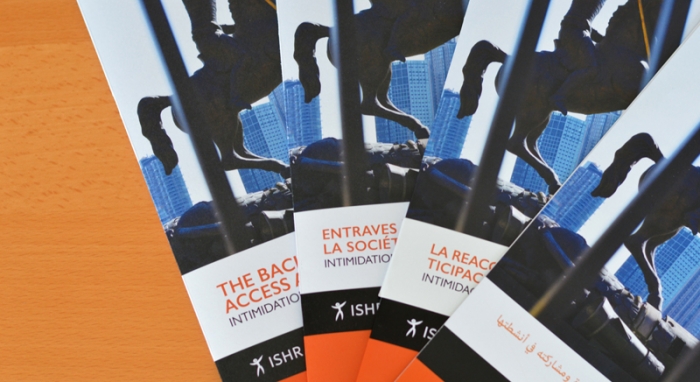
In a new report entitled “The Backlash Against Civil Society Access and Participation at the United Nations” the ISHR outlines the many different ways States employ to keep critical voices out of multilateral spaces. ISHR’s new report provides a road map for States and UN representatives to prevent and counter restrictions on civil society participation in UN processes.

Civil society has the right to ‘unhindered access to and communication with international bodies. However, that right is not being respected.  ISHR’s new report documents a broad range of obstacles faced by human rights defenders, from opaque bureaucracies and procedures to reprisals, physical threats and attacks. ‘States decide who gets through the door,’ said ISHR’s Eleanor Openshaw.  ‘States that fear calls for accountability and justice do what they can to prevent civil society access to and participation in UN spaces’.

Click on the video below to get an insight into the report:

Opaque practices and procedures provide covers for States seeking to block NGO entry.  An NGO seeking to participate in a UN high-level event can be a victim of the ‘no-objection’ procedure.  This is the means by which any State can veto their participation without being named or providing any justification. ‘The no-objection procedure is poorly defined, and provides no formal criteria for objections to NGO participation,’ said ISHR’s John Indergaard. ‘It’s carte blanche to exclude legitimate NGOs for illegitimate reasons.’

Even when civil society representatives make it into an actual UN building, they have been thrown out without explanation or asked to leave while events were ongoing. At some high-level events and committee meetings, NGO representatives have been barred from giving statements or bringing in documents related to their work. Physical attacks and intimidation against those seeking to cooperate with the UN are well documented.  ‘These restrictions and reprisals are all aimed at dissuading civil society participation,’ said Openshaw. ‘They need to be challenged in each and every case.’

For some of my earlier posts on reprisals: https://humanrightsdefenders.blog/tag/reprisals/

To say it again clearly: assaults on human rights defenders are incompatible with international human rights treaties

June 27, 2018
In a ground-breaking joint statement on 23 May 2018, the UN Special Rapporteur on human rights defenders and representatives from all of the UN human rights treaty bodies have affirmed that all forms of abuse or undue restrictions against human rights defenders constitute violations of States’ parties obligations towards the realisation of rights set out in the Treaties. The statement was adopted on the eve of the 30th annual meeting of Treaty Body chairs on the occasion of a consultation initiated by the UN Special Rapporteur on human rights defenders and ISHR in New York.

“This pronouncement constitutes a major step forward in the protection of human rights defenders and lays the ground for substantial enhancement of treaty body recommendations and jurisprudence in that area” says ISHR head of treaty body advocacy Vincent Ploton.

The statement reiterates the vital and central role played by human rights defenders to promote and support the application of the fundamental rights enshrined in the core international human rights treaties. It further contextualises the importance and relevance of the UN Declaration on human rights defenders which “reaffirms, is underpinned by, and elaborates binding human rights obligations, including rights set out in the Treaties, and is relevant to the interpretation and implementation of the Treaties”.

The Committee on economic, social and cultural rights (CESCR) was the first to adopt in 2016 a statement affirming that threats and violence against human rights defenders amount to violations of the Covenant. “We are delighted that fellow Treaty Bodies are now following suit with the adoption of this new joint statement”, says ISHR’s New York Director Madeleine Sinclair.

Marking the 20th anniversary of the UN Declaration on human rights defenders, the statement confirms that the core international human rights treaties and the Declaration prohibit discrimination against individuals and groups who champion such human rights norms and standards. It reaffirms that all individuals should be able to engage with treaty bodies free from all forms of interference, intimidation, abuse, threat, violence, reprisal, or undue restriction. It concludes with a series of practical measures that States ought to take to guarantee the protection of human rights defenders, including the adoption of specific legislation to protect and recognise defenders, and the revocation of legislation which restricts or hinders their work.

Read the full statement: http://www.ohchr.org/EN/NewsEvents/Pages/DisplayNews.aspx?NewsID=23154&LangID=E

[The statement was endorsed by the Committee on Enforced Disappearances, the Special Rapporteur on Human Rights Defenders, and the following Treaty Body members in their individual capacity: Virginia Brás-Gomes, CESCR Chair; Dalia Leinarte, CEDAW Chair; Noureddine Amir, CERD Chair; Ahmadou Tall, CMW Chair; Danlami Basharu, CRPD Vice-Chair; Felice Gaer, CAT Vice-Chair; Marcia Kran, HRCttee member; Olga Khazova, CRC Vice-Chair and Satyabhooshun Gut Domah, SPT member.]

https://www.ishr.ch/news/treaty-bodies-threats-and-assaults-human-rights-defenders-incompatible-core-international-human

Civil society and human rights: topic of side event in Geneva 25 June

June 21, 2018

“How to Respond to Challenges Facing Civil Society Organisations Working on Human Rights?” is the topic of a side event on Monday, 25 June 2018(12:30 – 14:00) at the Palais des Nations, Room XXIII.

Challenges to the work of civil society organisations exist in every part of the world and take a variety of forms. Based on recent reports on civil society space of the OHCHR and the EU Fundamental Rights Agency, this event gathers various stakeholders, including NGOs, governments, UN agencies and other intergovernmental organizations, to reinforce the importance of civil society engagement, and address the many challenges which hinder its effective functioning. This surely will include the question of reprisals against HRDs cooperating with the UN.
Questions to be addressed include: What are the major challenges facing civil society organisations? What are some examples of emerging good practices? How can we ensure that the needs of underrepresented parts of civil society are taken into account? What is the role of the Human Rights Council in ensuring a safe and enabling environment? Can we identify ways forward and concrete next steps?

SPEAKERS

  • Ambassador Michael Gaffey, Permanent Representative of Ireland to the UN in Geneva
  • Michael O’Flaherty, Director of the European Union Agency for Fundamental Rights (FRA)
  • Lopa Banerjee, Director of UN Women’s Civil Society Division
  • Peggy Hicks, Director of the Research and Right to Development Division of the Office of the High Commissioner for Human Rights (OHCHR)
  • Phil Lynch, Director of International Service for Human Rights (ISHR)

Moderator: Hilary Power, Amnesty International

For some of my earlier posts on this topic: https://humanrightsdefenders.blog/tag/civil-society-organisations/

https://drive.google.com/file/d/1FEf6ho01IE65f0u84nY7cmlYlSdgBziS/view

Guide to HRD issues at the 38th session of the UN Human Rights Council

June 15, 2018

The UN Human Rights Council will hold its 38th regular session at Palais des Nations in Geneva from 18 June to 6 July 2018. The International Service for Human Rights (ISHR) has – as usual – published an excellent alert full of substantive issues (see link at the bottom of this post). Here I just highlight some of the session’s features that are of special interest to human rights defenders;

Sexual orientation and gender identity. The first interactive dialogue with the new Independent Expert on protection against violence and discrimination based on sexual orientation and gender identity will be held between 9:00 and 12:00 on Monday 18 June. The Council will consider the new report of the mandate holder as well as the report of the country visit to Argentina.
In a joint written submission to the Independent Expert submitted in the lead-up to the presentation of his report to the Council, a group of 12 NGOs detail State obligations that if  implemented, would work towards ensuring that LGBTI defenders’ rights are protected (based in existing international human rights law and articulated in the Yogyakarta Principles (YP) and Yogyakarta Principles plus 10, (YP +10). ISHR and ILGA will organise a side-event that will build on this submission and discuss in more detail State obligations set out in the YP +10. The event will take place on 21 June 2018 from 15:00 to 16:30 in Room XXIII.

Reprisals. Reports of cases of intimidation and reprisal against those seeking to cooperate with the UN not only continue, but grow.  Item 5 of the Human Rights Council’s agenda provides a key opportunity for States to raise concerns about reprisals, and for governments involved in existing cases to provide an update to the Council on any investigation or action taken toward accountability to be carried out. [see recent: https://humanrightsdefenders.blog/2018/06/08/ishr-new-report-on-reprisals-and-restrictions-against-ngo-participation-in-the-un/]

Women human rights defenders and women’s rights. The Annual Full Day Discussion on the human rights of women will take place on Thursday 21 June from 16:00 to 18:00. It will focus on the specific impact of online violence on the work of women human rights defenders. It is crucial that the Council’s discussions and resolutions recognise the critical role of women human rights defenders (WHRDs) and organisations led by women and girls as rights holders and agents of change. The Council will hold an interactive dialogue with the Special Rapporteur on violence against women, its causes and consequences on 20 June between 09:00 and 12:00 and will consider her report including the report of her visit to Australia. The Council will also hold an interactive dialogue with the Working Group on the issue of discrimination against women in law and in practice and will consider their reports including a report on the country visit to Samoa and Chad.

Business and human rights. The Council consider the report of the Working Group on the issue of human rights and business. It examines the duty of States to protect against human rights abuses by business enterprises to whom they provide support for trade and investment promotion. It will also consider the Working Group’s report on its mission to Canada, Peru, and on the sixth session of the Forum on Business and Human Rights. Both country reports contain specific sections analysing the situation of human rights defenders, with the report on Peru raising serious concerns about the high level of threats, attacks and violence against local leaders and human rights defenders. The interactive dialogue will be an opportunity for States to follow-up to recommendations made in the UPR in that regard. The core group on the resolution on business and human rights (Argentina, Norway, Ghana and Russia) have announced that they will present a resolution at this Council session to request the OHCHR to continue with the accountability and remedy report with a focus on non-State based remedy mechanisms. The first informal consultation on the draft resolution will be held on 18 June at 16:30 in Room XXIV.

Other thematic reports

The Council will also hold an interactive dialogue and consider the report of the new Special Rapporteur on the rights to freedom of peaceful assembly and of association. Switzerland with Costa Rica also announced that they will be running the resolution on the protection and promotion of human rights in the context of peaceful protests. The first informal consultations will be held on 19 June from 11:30 to 12:30 in Room V.

The Council will also hold an interactive dialogue and consider the report of the Special Rapporteur on the promotion and protection of the right to freedom of opinion and expression, which examines regulation of user-generated content online. The Council will consider the report of the High Commissioner on procedures and practices in respect of civil society engagement with international and regional organisations. The core group on the civil society space resolution (Chile, Ireland, Japan, Sierra Leone and Tunisia) announced that they will present a resolution this session.

The Council will also consider the reports of and hold interactive dialogues with the Special Rapporteur on the independence of judges and lawyers, including the report of his mission to Poland, and with the Special Rapporteur on extrajudicial, summary or arbitrary executions, including reports of her missions to Iraq and El Salvador.

Country specific developments

Burundi During its 36th session, the Council passed two resolutions on Burundi. One resolution was led by the European Union and extended the mandate of the Commission of Inquiry. The second resolution was led by the African Group and requested OHCHR to urgently dispatch a team of three experts to engage with the Burundian authorities and all other stakeholders to “collect and preserve information, to determine the facts and circumstances in accordance with international standards and to forward to the judicial authorities of Burundi such information”. The aim was to establish the truth and ensure that the perpetrators are held accountable. Read here ISHR’s analysis of the two resolutions. At the 38th session, the Council will hear the oral briefing by the High Commissioner on the mission of OHCHR on 4 July between 15:00 and 18:00. The Council will also hear an oral briefing by the Commission of Inquiry on 27 June between 09:00 and 12:00. For more information on the situation of human rights defenders in Burundi, check ISHR Briefing Paper for the UPR here. [see also: https://humanrightsdefenders.blog/2016/10/26/enough-is-enough-ngos-call-for-burundi-suspension-from-un-human-rights-council/]

China. By any measure, the Chinese government is not living up to the commitments to protect and promote human rights inherent in its Human Rights Council membership. Since the twelve-country joint statement on the human rights situation in China in March 2016, there has been no concerted effort to use the Council space creatively to call for accountability and transparency related to violations in China. This, despite the fact that in July 2017, Chinese security authorities presided over the death in custody of Liu Xiaobo, the first Nobel Peace Prize winner to die in detention since Carl von Ossietzky died in Nazi Germany in 1938… In this context NGOs , incl. the iSHR, continue to call for the release of individuals arbitrarily detained and/or held incommunicado, including Wang Quanzhang, Gui Minhai, Tashi Wangchuk, Lee Ming-che, and Yu Wensheng. [see also: https://humanrightsdefenders.blog/2018/03/07/china-and-the-un-human-rights-council-really-win-win/]

Eritrea. The Council will hold an interactive dialogue with and consider the report of the Special Rapporteur on the situation of human rights in Eritrea on 25 June. A cross-re­gional group of non-governmental organisations urged the Council to support and co-sponsor at the 38th session a streamlined resolution that accurately reflects the gravity of the situation on the ground, renews the mandate of the Special Rapporteur under the Council’s agenda item 4, and sets out a framework for needed reforms to improve the human rights situation in the country and advance accountability.

Other country situations include: 

  • An interactive dialogue on the oral update by the High Commissioner on the situation of human rights of the minority Rohingya Muslim population and other minorities in Rakhine State of Myanmar, and the oral report of the Special Rapporteur on the situation of human rights in Myanmar
  • An enhanced interactive dialogue on the report of the High Commissioner on the findings of the team of international experts on the situation in the Kasai regions of the Democratic Republic of the Congo (DRC) and on the oral update by OHCHR on the situation of human rights in the DRC
  • An oral update by the High Commissioner on the situation of human rights in Ukraine
  • An oral update by the Independent Expert on the situation of human rights in the Central African Republic
  • An interactive dialogue with the Commission of Inquiry on Syria (oral update) and consideration of the summary report of OHCHR on the high-level panel discussion on violations of the human rights of children in Syria
  • An interactive dialogue with the Special Rapporteur on the situation of human rights in Belarus on his report
  • During this session, the Council will adopt the UPR working group reports as part of the 29th session of the UPR. These reports list recommendations the following States under review are expected to implement: France, Tonga, Romania, Mali, Botswana, the Bahamas, Burundi, Luxembourg, Barbados, Montenegro, the United Arab Emirates, Israel, Liechtenstein, and Serbia.

This session of the Council will provide an opportunity for Burundi, Mali and the United Arab Emirates to to accept recommendations made in relation to human rights defenders, as proposed in ISHR’s briefing papers on those countries.

The Council appointed new Bureau members due to the departure of the Ambassadors of Chile and Germany. The members of the Bureau for 2018 now comprises of the following Ambassadors:

  • Vojislav ŠUC (Slovenia), President of the Human Rights Council
  • Evan P. GARCIA (Philippines), Vice President
  • Cristobal Gonzalez-Aller Jurado (Spain), Vice President
  • Juan Eduardo EGUIGUREN (Chile), Vice President and Rapporteur
  • François Xavier NGARAMBÉ (Rwanda), Vice President

Panel discussions

During each Council session, panel discussions are held to provide member States and NGOs with opportunities to hear from subject-matter experts and raise questions. All panel discussions will be broadcast live and archived on http://webtv.un.org. Four panel discussions are scheduled for this upcoming session:

  • The Annual Full Day Discussion on the human rights of women will be held in two sessions. First, on 21 June from 16:00 to 18:00, the panel will focus on the impact of violence against women human rights defenders and women’s organisations in digital spaces. The concept note of the panel is available here.
  • The second panel will be held on 22 June from 10:00 to 12:00 and will focus on advancing women’s rights through access and participation in information and communication technologies (ICTs). The concept note of the panel is available here.
  • A panel discussion will be held on 26 June from 16:00 to 18:00 on the human rights of internally displaced persons in commemoration of the twentieth anniversary of the Guiding Principles on Internal Displacement. The concept note of the panel is available here.
  • The Annual Thematic Panel Discussion on technical cooperation in the promotion and protection of human rights will be held on 4 July from 10:00 to 12:00. The topic will be “Human rights and the Sustainable Development Goals: enhancing human rights technical cooperation and capacity-building to contribute to the effective and inclusive implementation of the 2030 Agenda for Sustainable Development”. The concept note of the panel is available here.

The ISHR and other NGOs will again organize quite a few side events on which I will report separately.

https://www.ishr.ch/news/hrc38-key-issues-agenda-june-2018-session

ISHR: new report on reprisals and restrictions against NGO participation in the UN

June 8, 2018

There are many different approaches States employ to keep critical voices out of multilateral spaces. ISHR’s new report of 30 May 2018 [The Backlash Against Civil Society Access and Participation at the United Nations] outlines what these are and provides a road map for States and UN representatives to prevent and counter reprisals and restrictions on civil society participation in UN processes.

Civil society has the right to ‘unhindered access to and communication with international bodies’. However, that right is not being respected.  ISHR’s new report, ‘The Backlash Against Civil Society Access and Participation at the United Nations‘ documents a broad range of obstacles faced by human rights defenders, from opaque bureaucracies and procedures to physical threats and attacks.

‘States decide who gets through the door,’ said ISHR’s Eleanor Openshaw.  ‘States that fear calls for accountability and justice do what they can to prevent civil society access to and participation in UN spaces’. Opaque practices and procedures provide covers for States seeking to block NGO entry.  An NGO seeking to participate in a UN high-level event can be a victim of the ‘no-objection’ procedure.  This is the means by which any State can veto their participation without being named or providing any justification. ‘The no-objection procedure is poorly defined, and provides no formal criteria for objections to NGO participation,’ said ISHR’s John Indergaard. ‘It’s carte blanche to exclude legitimate NGOs for illegitimate reasons.’

Even when civil society representatives make it into an actual UN building, they have been thrown out without explanation or asked to leave while events were ongoing. At some high-level events and committee meetings, NGO representatives have been barred from giving statements or bringing in documents related to their work. Physical attacks and intimidation against those seeking to coöperate with the UN are well documented.

‘These restrictions and reprisals are all aimed at dissuading civil society participation,’ said Openshaw. ‘They need to be challenged in each and every case.’

I have published many posts on the issue of reprisals [https://humanrightsdefenders.blog/tag/reprisals/] starting with https://humanrightsdefenders.blog/2014/03/13/zero-tolerance-for-states-that-take-reprisals-against-hrds-lets-up-the-ante/

Click on the video below to get an insight into the report: