Posts Tagged ‘repression’

EU’s Lorenzo Natali Media Prize 2023 to 3 Venezuelan journalists

October 21, 2023

The winners of this year’s edition of the Lorenzo Natali Media Prize, awarded by the European Commission, were announced on 11 October at a ceremony hosted at the Solvay Library in Brussels.

The winners of the International Prize are:

Three Venezuelan journalists Carmen Victoria Inojosa, Claudia Smolansky and a third whose name cannot be disclosed for security reasons, were awarded the International Prize for their compelling article ‘Así funcionan las casas clandestinas de la Dgcim en Caracas‘ published in Armando.info. Their work exposed the harrowing reality of systematic persecution in Venezuela, targeting political opponents and their families with alarming impunity.

For more on this award see: https://www.trueheroesfilms.org/thedigest/awards/D49ECF35-4B42-444D-B4FA-F7ACE2BF65BC

Lorenzo Natali Media Prize website

https://ec.europa.eu/commission/presscorner/detail/en/ip_23_4881

Iran: One year after uprising in Iran the international community must combat impunity says Amnesty

September 15, 2023

The international community must pursue pathways for justice at the international level to address systemic impunity for Iranian officials responsible for hundreds of unlawful killings of protesters and widespread torture, Amnesty International said on 13 September 2023, as Iran marks the one-year anniversary of the “Woman Life Freedom” uprising.

Over the past year, Iranian authorities have committed a litany of crimes under international law to eradicate any challenge to their iron grip on power. These include hundreds of unlawful killings; the arbitrary execution of seven protesters; tens of thousands of arbitrary arrests; widespread torture, including rape of detainees; widespread harassment of victims’ families who call for truth and justice; and reprisals against women and girls who defy discriminatory compulsory veiling laws.

The anniversary of the ‘Woman Life Freedom’ protests offers a stark reminder for countries around the world of the need to initiate criminal investigations into the heinous crimes committed by the Iranian authorities under universal jurisdiction. Government statements calling on the Iranian authorities to halt the unlawful use of firearms against protesters, stop torturing detainees, and release all individuals detained for peacefully exercising their human rights remain as crucial as ever. These actions show victims they are not alone in their darkest hour.

The anniversary of the ‘Woman Life Freedom’ protests offers a stark reminder for countries around the world of the need to initiate criminal investigations into the heinous crimes committed by the Iranian authorities under universal jurisdiction. Diana Eltahawy, Amnesty International’s Deputy Regional Director for the Middle East and North Africa

The Iranian authorities have waged an all-out assault on the human rights of women and girls over the past year. Despite months of protests against Iran’s compulsory veiling laws, triggered by the arbitrary arrest and death in custody of Mahsa/Zhina Amini, the authorities have reinstated “morality” policing and introduced a raft of other measures that deprive women and girls who defy compulsory veiling of their rights.

These include the confiscation of cars and denial of access to employment, education, healthcare, banking services and public transport. Simultaneously, they have prosecuted and sentenced women to imprisonment, fines and degrading punishments, such as washing corpses.

This assault on women’s rights is taking place amid a spate of hateful official statements referring to unveiling as a “virus”, “social illness” or “disorder” as well as equating the choice to appear without a headscarf to “sexual depravity.”

The authorities are also working on new legislation that will introduce even more severe penalties for defying compulsory veiling.

Mass arbitrary detentions and summons

During the uprising and in the months that followed, the authorities arbitrarily arrested tens of thousands of men, women and children, including protesters, human rights defenders and minority rights activists.  Those arrested include at least 90 journalists and other media workers and 60 lawyers, including those representing families of individuals unlawfully killed. Scores of other lawyers were summoned for interrogations. [see e.g. https://humanrightsdefenders.blog/2023/05/11/now-it-is-the-turn-of-the-iranian-journalists-who-reported-on-mahsa-amini/]

Ahead of the anniversary, the authorities have intensified their campaign of arbitrary arrests targeting, among others, family members of those unlawfully killed, and forcing thousands of university students to sign undertakings not to participate in anniversary protests.

Execution of protesters

Over the past year, the authorities have increasingly used the death penalty as a tool of political repression to instil fear among the public, arbitrarily executing seven men in relation to the uprising following grossly unfair sham trials. Some were executed for alleged crimes such as damage to public property and others in relation to the deaths of security forces during the protests. All were executed after Iran’s Supreme Court rubber stamped their unjust convictions and sentences despite a lack of evidence and without carrying out investigations into their allegations of torture. Dozens remain at risk of execution or being sentenced to death in connection with the protests.

A crisis of impunity

The authorities have refused to conduct any thorough, independent and impartial investigations into the human rights violations committed during and in the aftermath of the “Woman Life Freedom” uprising and have failed to take any steps to hold those suspected of criminal responsibility to account.

Instead, authorities have applauded the security forces for suppressing the unrest and shielded officials from accountability, including two officials who admitted raping women protesters in Tehran. They have also dismissed complaints from victims and/or their families, threatening them with death or other harm if they pursued their complaints.

Amnesty International welcomed the establishment of a Fact-Finding Mission on Iran by the UN Human Rights Council in November 2022, yet much more is needed to combat the crisis of impunity for serious crimes in Iran – and to deter further cycles of bloodshed.

Amnesty International urges all states to consider exercising universal and other extraterritorial jurisdiction in relation to crimes under international law and other serious human rights violations committed by Iranian authorities, irrespective of the absence or presence of the accused in their territory. This includes initiating adequately resourced criminal investigations aimed at disclosing the truth about the crimes, identifying those suspected of responsibility, including commanders and other superiors and issuing, when there is sufficient admissible evidence, international arrest warrants. States should also contribute to achieving reparations for the victims.

https://www.amnesty.org/en/latest/news/

https://www.hrw.org/news/2023/09/15/iran-crackdown-dissent-ahead-protest-anniversary

see also:

https://www.fidh.org/en/region/asia/iran/iran-statement-on-the-un-fact-finding-mission-s-oral-upda

https://news.un.org/en/story/2023/09/1141017

https://www.ohchr.org/en/press-releases/2023/09/iran-un-experts-denounce-crackdown-public-commemoration-jina-mahsa-aminis

Researcher puts bomb under ‘traditional’ protection of human rights defenders

July 7, 2023

On 6 July 2023 Janika Spannagel in Open Global Rights comes with a study of great importance to the work for human rights defenders. The researcher states that “focusing only on defenders’ physical integrity risks undermining the very idea of supporting agents of human rights change” and that there is a need to Rethink campaigns on human rights defenders

Spannnagel’s work featured in this blog before [see: https://humanrightsdefenders.blog/tag/janika-spannagel/] but this work questions more directly the core of HRD protection.

Instead of summarising I will provide large quotes:

,,,,The theory of change put forward by actors, including Front Line Defenders, International Service for Human Rights, and many others, claims that by protecting local human rights activists, international campaigns can support them in their work to advance human rights protection on the ground. This assumption appears plausible and aligns with prominent accounts in academic human rights literature, where domestic activists’ protection from repression is seen as a way to open spaces for them to challenge the regime and enact change.

That said, empirical evidence from UN casework and the experience of Tunisian defenders shows that this promise has not been fulfilled when it comes to human rights defenders in authoritarian regimes, as I show in my recent book. There, I argue that, while international attention can have important protective benefits, it does little to support individual human rights defenders as agents of change in repressive contexts. [Emphasis added]

The reason for this is that international casework on defenders, including urgent action–like campaigns or UN communications, maintain the traditional focus on physical integrity rights that has guided the long-standing casework on political imprisonment, torture, or enforced disappearances. In doing so, it overlooks the many administrative, discursive, and covert forms of repression that typically bypass international scrutiny more broadly but that often very effectively disrupt and thwart defenders’ work toward change.

The analysis of over 12,000 individual cases of human rights activists taken up by the UN special rapporteur on human rights defenders between 2000 and 2016 reveals that, in almost three-quarters of them, at least one of the violations described fell within the category of physical integrity violations. Detention cases alone made up 56% of all cases raised during that period. In contrast, only 4% of the cases dealt exclusively with softer types of repression, such as travel bans, bureaucratic issues, job dismissals, surveillance, or defamation.

This distribution far from represents the everyday experience of human rights defenders in authoritarian states—instead, it is reflective of a humanitarian instinct in human rights casework to privilege cases that are considered most severe. One could argue that UN communications, and perhaps attention-based campaigning more broadly, are inherently humanitarian, not transformative instruments. But one should ask: What, then, is the purpose of focusing on human rights defenders, as opposed to any victim of repression? [Emphasis added]

The priority given to physical integrity violations has two important adverse consequences. First, we can see that the data profoundly shape our understanding of what human rights defenders are struggling with. For example, on the basis of such data a CIVICUS report claims that in order to repress civic space, states resort “most often” to detention of activists, attacks against journalists, and excessive use of force against protesters. The human rights community’s own focus on violent repression thus paradoxically misleads us to believe that this is where most attention is needed.

Secondly, this focus reinforces a protection gap for violations that fall outside of the conventional notion of state repression as physically harmful and as undeniably politically motivated. Research on repression highlights that authoritarian states engage in repressive substitution, where they replace highly scrutinized coercive tactics—typically harder and overt types of repression—with softer and more covert measures. The case of Tunisia under Ben Ali aptly illustrates the strong impact of such tactics on defenders’ ability to carry out meaningful work.

When analyzing the further development of cases taken up by the UN, I also found that, while some positive effects of the UN’s attention could be identified for most of them, many did not see an actual improvement relative to the reported violations over the course of the next year; where they did, it was mostly an easing of harder repression. Ultimately, there is a real risk that governments continue to use hard repression to increase their bargaining power and then pass off a release from prison as a costly concession, while in reality imposing softer but equally effective measures against the activist in question.

With this problem in mind, what could be done differently? Casework that follows a transformative logic should not seek to maximize the reduction of physical harm—the humanitarian logic—but should define protection needs in terms of safeguarding a defender’s ability to do effective human rights work. 

Those engaging in casework and campaigns on human rights defenders should actively revisit their priorities in terms of the violations they tend to address. Far too often, softer repression remains unreported, unnoticed, and not acted upon, which effectively creates a twilight zone in which authoritarian states can comfortably stifle opposition voices without risking much pushback. We owe it to the countless number of human rights activists around the world to ensure that the label of “human rights defender” does not merely serve to laud their heroism and excite donors and the media, but that it is dedicated to fulfilling its promise of human rights change.

https://www.openglobalrights.org/rethinking-campaigns-human-rights-defenders/index.cfm

For the more traditional approach, see e.g. https://www.ipsnews.net/2023/07/recognising-human-rights-defenders-remarkable-agents-positive-change/

Kasparov and Khodorkovsky are now also foreign agents

May 21, 2022
Agence France-Presse

On 21 May 2022 Agence France-Presse reported that Russia on Friday added two high-profile Kremlin critics to its list of “foreign agents“: former chess champion Garry Kasparov and ex-tycoon Mikhail Khodorkovsky.

The infamous label, reminiscent of the “enemies of the people” of the Soviet period, is used extensively against opponents, journalists and human rights activists accused of conducting foreign-funded political activities. Such “foreign agents” are subject to numerous constraints and laborious procedures, under pain of severe sanctions. In particular, they must indicate this status in all their publications. See also: https://humanrightsdefenders.blog/2016/02/09/foreign-agent-law-in-russia-keeps-widening-its-net/ and https://humanrightsdefenders.blog/2021/12/29/russias-supreme-court-orders-closure-emblematic-memorial/

In its updated website list, the Russian justice ministry said that Khodorkovsky, 58, and Kasparov, 59, have “sources” in Ukraine to finance their activities.

Soviet-born former world chess champion Kasparov is a long-time opponent of President Vladimir Putin and has lived in the United States for almost a decade.

Khodorkovsky was one of Russia’s most powerful businessmen in the 1990s, before coming into conflict with the Kremlin when Putin came to power in 2000. He spent ten years, from 2003 to 2013, in prison and then went into exile. For years, he helped to finance the Russian opposition organisation Open Russia, which dissolved itself in May last year in the face of growing repression.

Since the start of Moscow’s military operation in Ukraine on 24 February, dozens of members of the Russian intellectual elite and journalists have left the country, as the authorities step up pressure against the last critical voices and media. See also: https://humanrightsdefenders.blog/2022/04/26/lev-ponomarev-human-rights-defender-leaves-russia/

https://www.thesouthafrican.com/news/world-news/kasparov-and-khodorkovsky-added-to-foreign-agents-list-russia/

Press Freedom Awards in Hong Kong cancelled

April 29, 2022

Oiwan Lam on 26 April 2022 reported that Hong Kong’s Foreign Correspondents’ Club has canceled its Human Rights Awards for fear of “legal risks”

Image created by Oiwan Lam.

The Foreign Correspondents’ Club, Hong Kong (FCC HK), a press freedom watchdog, announced they would cancel their 2022 Human Rights Press Awards (HRPA) on April 25.  Eight members of the Club’s Press Freedom Committee have resigned in protest over the decision. 

Many foreign correspondents were shocked by the decision. Launched in 1995,  the HRPA has been one of the most important platforms to celebrate and honour human rights journalism from around Asia. The Club normally announces the winners on May 3, World Press Freedom Day.

Hong Kong Free Press (HKFP) quoted sources from FCC HK that the cancellation was related to the legal risks in presenting awards to the now-defunct Stand News. Two former senior staff members of the independent news outlet have been charged with conspiring to publish “seditious publications” pending trial. 

Stand News was forced to shut down last December after security police raided its office. The police authorities accused the news site of publishing “seditious materials” with the intent to cause hatred towards the government and the judiciary. 

An FCC member told the HKFP that Stand News would receive four awards and five merits in this year’s award, but “certain items” would pose a legal risk. 

In a letter to the Club’s members, the president of FCC HK Keith Richburg said the decision was made in the organization’s board meeting on April 23:

Over the last two years, journalists in Hong Kong have been operating under new “red lines” on what is and is not permissible, but there remain significant areas of uncertainty and we do not wish unintentionally to violate the law. This is the context in which we decided to suspend the Awards.

The letter also says that “recent developments might also require changes to our [FCC HK’s] approach” in the promotion of press freedom.

As the city’s incoming Chief Executive John Lee has vowed to apply the “strictest measures” to clamp down on “anyone who tries to use journalistic work as a shield to engage in crimes endangering national security” in response to the crackdown on Apple Daily, FCC HK’s anticipation of legal risks is valid.

Yet, as a press freedom watchdog, many see the choice to ax the awards as an act of self-censorship antithetical to the organization’s purpose, as independent journalist Ilaria Maria Sala wrote on Twitter:

Eight members of the Club’s press freedom committee have resigned in protest over the decision. Shibani Mahtani, Washington Post’s Southeast Asia and Hong Kong Bureau Chief, is one of the resignees. As one of the winners of the Human Rights Press Awards in 2020, Shibani Mahtani expressed her regrets about the decision and explained, in a Twitter thread, the significance of the annual occasion in Asia: See also: https://humanrightsdefenders.blog/2016/12/01/rsfs-press-freedom-prize-2016-goes-to-the-64-tianwang-website-in-china/

For more on the real, unannounced winners: https://hongkongfp.com/2022/04/27/in-full-winners-of-the-axed-fcc-human-rights-press-awards-revealed/

see also for future editions:

https://www.scmp.com/news/hong-kong/politics/article/3176537/american-university-taking-over-hong-kong-press-groups

Amnesty joins debate on Apartheid versus Palestinians but reactions debase struggle against real antisemitism

February 4, 2022

In Newsweek of 3 February 2022 Omar Baddar, Director of the Arab American Institute, published an opinion piece entitled “Amnesty Settles It: It’s Time for U.S. Accountability on Israel”.

Amnesty International, issued on 1 February 2022 an extensive report titled “Israel’s Apartheid against Palestinians: Cruel System of Domination and Crime against Humanity.” As the report documents, “Israel has imposed a system of oppression and domination over Palestinians wherever it exercises control over the enjoyment of their right.” The report further found that Israel’s policies are part of a “systematic as well as widespread attack directed against the Palestinian population, and that the inhuman or inhumane acts committed within the context of this attack have been committed with the intention to maintain this system and amount to the crime against humanity of apartheid.

In recent years, some leading Israeli human rights organizations have started using the word apartheid to describe their government’s systems of oppression. Last year, Human Rights Watch, one of the best-known American human rights organization, similarly accused Israel of apartheid. Amnesty International following suit this week has solidified the human rights community’s emerging consensus on Israeli apartheid. See: https://humanrightsdefenders.blog/2021/01/18/israel-and-apartheid-israeli-human-rights-group-stirs-debate/ and https://humanrightsdefenders.blog/2021/07/09/israel-and-the-international-crime-of-apartheid-a-response-by-human-rights-watch-worth-studying-in-full/

Omar Baddar, states: The most important consequence of this consensus is that it lays to rest the false but popular notion of an “Israeli-Palestinian conflict” between two equal sides. The new consensus instead frames the issue more accurately as a struggle between an oppressor and an oppressed people. In the same way that Apartheid in South Africa and Jim Crow segregation in the American South denied people the ability to live in freedom with their full rights simply because of who they are, Israel also denies freedom to Palestinians and many basic rights to Palestinians just because they are Palestinians.

Like the Human Rights Watch report before it, what’s remarkable about the new Amnesty report is how extensive and detailed it is. Amnesty did its due diligence and made sure that its central claims are backed by a mountain of evidence, meticulously documenting unlawful killings, forced displacement and systemic discrimination on a massive scale. Unsurprisingly, the devastating and irreproachable nature of this report triggered a meltdown among Israel’s apologists. See for this also: https://yubanet.com/world/human-rights-organizations-from-israel-condemn-vicious-attacks-on-amnesty-international/

Unable to argue with the substance of the Amnesty report, pro-Israel groups have resorted either to blindly asserting—as AIPAC did—that Amnesty was lying, or baselessly claiming—as the ADL did—that the report would spark antisemitic attacks. The latter is nothing short of a cynical weaponization of antisemitism—which, in fact, is a serious and rising scourge in America and across the world—unscrupulously exploited in order to silence criticism of Israeli government policy.

We cannot have the open debate we need in a free society if speaking honestly about Israeli policy results in smears of bigotry. By misusing the charge of antisemitism in this fashion, Israel’s apologists aren’t just harming the human rights defenders being smeared by it; they’re also harming the real effort to eliminate antisemitism—a goal that we all have a moral obligation to come together and accomplish.

What this Amnesty report should have done is serve as a wake-up call to an American political establishment that prioritizes pandering over sensible policy, and that has turned a blind eye to a grave injustice for far too long. After all, it is U.S. military funding, to the unrivaled tune of $3.8 billion per year, which enables the Israeli military to maintain its suffocating grip on the occupied Palestinian population, and it is U.S. diplomatic protection, through more than 40 vetoes at the UN Security Council and beyond, that shields Israel from accountability for its crimes.

And yet, despite repeatedly claiming to prioritize human rights in its foreign policy, the Biden administration’s reaction to this report was utterly disappointing. The administration rejected it out of hand.

The Amnesty report bemoans the fact that, “for over seven decades, the international community has stood by as Israel has been given free rein to dispossess, segregate, control, oppress and dominate Palestinians.” It criticizes countries like ours that have “actively supported Israel’s violations by supplying it with arms, equipment and other tools to perpetrate crimes under international law and by providing diplomatic cover, including at the UN Security Council, to shield it from accountability.” The report also reiterated its call for “states to immediately suspend the direct and indirect supply, sale or transfer of all weapons, munitions and other military and security equipment.”

https://www.newsweek.com/amnesty-settles-it-its-time-us-accountability-israel-opinion-1675876

https://www.juancole.com/2022/02/prolonged-occupation-palestinians.html

https://www.thecitizen.in/index.php/en/NewsDetail/index/6/21449/Why-Is-Israel-Fearful-of-Amnestys-Apartheid-Report

Iranian Human rights defender Narges Mohammadi sentenced to another 8 years prison and more than 70 lashes

January 25, 2022

On 24 January 2022 the prominent rights defender Narges Mohammadi, already serving time at Iran’s notorious Gharchak Prison, has been sentenced to another eight years in prison and more than 70 lashes, according to a tweet by her Paris-based husband. [winner of 5 human rights awards, see: https://www.trueheroesfilms.org/thedigest/laureates/07C20809-99E2-BDC0-FDC3-E217FF91C126]

Mohammadi’s new conviction was after a 5-minute trial, her husband Taghi Rahmani wrote. He stated she also had a two–year ban on “communication,” but that she has not contacted the family and he did not know the details of the trial or the new sentence.

The prominent activist’s latest conviction comes as the authorities intensify their efforts to squash growing dissent in Iran by imprisoning activists and human rights attorneys after grossly unfair trials, shooting to kill protesters in the street, imposing death sentences on dissidents and protesters, and causing the death of political prisoners by egregiously neglecting their medical needs. See e.g. https://humanrightsdefenders.blog/2020/06/24/list-of-lawyers-imprisoned-in-iran-for-defending-human-rights/

One by one, the Iranian authorities are trying to silence the voices of dissent in Iran, through imprisonment, torture, and even death,” said Hadi Ghaemi, executive director of the Center for Human Rights in Iran (CHRI). “The Iranian government fears these brave individuals because they speak truth to power and their voices carry great authority in Iranian society,”

Outrage at the government’s actions—not only the unjust imprisonments but also the treatment of political prisoners—is growing both inside and outside Iran’s prisons.

Seven political prisoners in Evin Prison’s Ward 8 went on a hunger strike on January 16, 2022, to protest the death of Baktash Abtin, who died after contracting COVID-19 in Iran’s overcrowded and unhygienic prisons, where even the most rudimentary precautions against the spread of the virus are not followed. They include: Sadegh Omidi, Peyman Pourdad, Moin Hajizadeh, Mehdi Dareyni, Hamid Haj Jafar Kashani, Aliasghar Hassani-Rad, and Mahmoud Alinaghi. The latter three were transferred to an unknown prison on January 23. See: https://humanrightsdefenders.blog/2022/01/10/iranian-dissident-poet-baktash-abtin-dies-of-covid-in-arbitrary-detention/

In solidarity with the hunger strikers, Shakila Monfared began a hunger strike in Gharchak Prison for women on January 17; Sina Beheshti joined the hunger strike on January 17 in the Greater Tehran Central Penitentiary; and Mohammad Abdolhassani joined the hunger strike on January 17 in the Greater Tehran Central Penitentiary.

Meanwhile, British-Iranian dual national Anoosheh Ashoori, who is being held in Iran on unsubstantiated spying charges, began a hunger strike in Evin Prison on January 23, to bring “global attention to the plight” of those unfairly held by Iran.

Outside Iran, In Vienna, journalist Jamshid Barzegar, began a hunger strike on January 18 in solidarity with hunger strikers in Iran, in front of the hotel where the nuclear talks are being held in Vienna. He has been joined by more than a dozen Iranian activists abroad. Former American hostage Barry Rosen was on hunger strike from January 16-24 in Vienna “to demand the release of all hostages being held by Iran.” Nizar Zakka, a Lebanese former hostage in Iran, joined the hunger strikers in Vienna on January 21.

These names are only part of a larger, rapidly growing group. A list from January 24 was published on Twitter that included names of more than 40 activists hunger-striking outside prison to demonstrate solidarity with the hunger strikers and protest the government’s actions.

Iran’s Foreign Ministry Spokesman Saeed Khatibzadeh, responding to a question on hunger strikers in Vienna at January 24 press conference in Tehran, said: “These matters are not very important. What’s important is to reach a reliable and stable agreement that satisfies Iran’s interests.”

Mohammadi has proved to be a particular thorn in the authorities’ side, refusing to be silent either in prison or during her brief periods of release between convictions. She had already been serving a 30-month sentence at Gharchak Prison after she organized a sit-in at Evin Prison’s Women’s Ward to condemn the killing of hundreds of protesters by state security forces during the November 2019 protests, and the unjust execution of wrestler Navid Afkari.

“Narges Mohammadi is only one of many individuals behind bars in Iran because of their peaceful dissent and the willingness of a judiciary to do the bidding of a brutal and unlawful security state,” Ghaemi added.

https://www.usnews.com/news/world/articles/2022-01-25/husband-says-iran-sentenced-activist-wife-to-prison-lashes

The Arabic Network for Human Rights Information has shut down

January 11, 2022

On 10 Jan 2022 one of Egypt’s last independent human rights organisations has closed down, according to a statement by the group, citing government persecution. See: https://www.trueheroesfilms.org/thedigest/laureates/C6490073-ED93-793A-C5DB-3C931BB470D3

Egypt’s government has engaged in a widespread crackdown on dissent for years that has stifled many of the country’s civil society groups and jailed thousands

The Arabic Network for Human Rights Information [ANRI], an Egyptian organisation, was founded in 2003 by a team of lawyers and activists. It documented violations against citizens, journalists and political prisoners in Egypt and the region. It also followed the increasing government intimidation and targeting of human rights workers and others. But laws that made many of ANHRI’s operations illegal have forced the organisation to shut down, Executive Director Gamal Eid said in the statement on Monday. See e.g. https://humanrightsdefenders.blog/2019/12/31/egyptian-human-rights-defender-gamal-eid-assaulted/. As a lawyer, Eid represented some of the most prominent secular detainees. A court ordered his assets frozen and has banned him from travelling since 2016.

He said the group’s workers had been arrested, intimidated and physically assaulted by security forces.

We continue to be lawyers who have a conscience, and as individual, independent human rights defenders will work side by side with the few remaining independent human rights organisations, independent human rights defenders and the entire movement calling for democracy,” he wrote.

https://www.aljazeera.com/news/2022/1/10/egypt-leading-rights-group-closes-citing-government-persecution

https://www.washingtonpost.com/world/egyptian-rights-group-closes-cites-government-persecution/2022/01/10/7348be54-7226-11ec-a26d-1c21c16b1c93_story.html

It had to happen: Russian Authorities Move to Shut Down Memorial

November 12, 2021
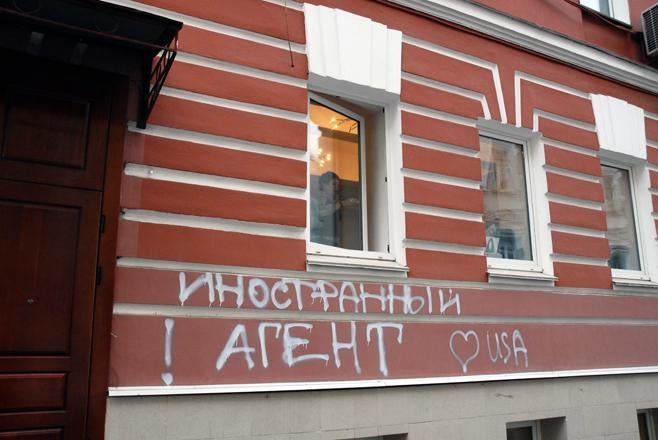
On the night before the infamous “foreign agents” law came into force back in 2012, unknown individuals sprayed graffiti reading, “Foreign Agent! ♥ USA” on the buildings hosting the offices of three prominent NGOs in Moscow, including Memorial. 
On the night before the infamous “foreign agents” law came into force back in 2012, unknown individuals sprayed graffiti reading, “Foreign Agent! ♥ USA” on the buildings hosting the offices of three prominent NGOs in Moscow, including Memorial.  © 2012 Yulia Klimova/Memorial

On 12 November 2021Tanya Lokshina, Associate Director, Europe and Central Asia Division Human RightsWatch, reported that the Russian authorities have moved to shut down Memorial, one of Russia’s oldest and most prominent rights organization, an outrageous assault on the jugular of Russia’s civil society.

Memorial, which defends human rights, works to commemorate victims of Soviet repression, and provides a platform for open debate, has two key entities: Memorial Human Rights Center and International Memorial Society.[ the winners of not less than 7 human rights awards, see : https://www.trueheroesfilms.org/thedigest/laureates/BD12D9CE-37AA-7A35-9A32-F37A0EA8C407]

On November 11, International Memorial received a letter from Russia’s Supreme Court stating that the Prosecutor General’s Office had filed a law suit seeking their liquidation over repeated violations of the country’s legislation on “foreign agents.”

A court date to hear the prosecutor’s case is set for November 25. According to Memorial, the alleged violations pertain to repeated fines against the organization for failure to mark some of its materials — including event announcements and social media posts — with the toxic and false “foreign agent” label, one of the pernicious requirements of the “foreign agents” law.

On November 12, Memorial Human Rights Center received information from the Moscow City Court that the Moscow City Prosecutor’s Office filed a similar suit against them and a court hearing was pending.  

For nearly a decade, Russian authorities have used the repressive legislation on “foreign agents” to restrict space for civic activity and penalize critics, including human rights groups. Last year parliament adopted new laws harshening the “foreign agent” law and expanding it in ways that could apply to just about any public critic or activist. The amendments were but a fraction of a slew of repressive laws adopted in the past year aimed at shutting down criticism and debate. See also: https://humanrightsdefenders.blog/tag/foreign-agent-law/

The number of groups and individuals authorities have designated as “foreign agents” has soared in recent months. This week the Justice Ministry included on the foreign agent registry the Russian LGBT Network, one of Russia’s leading lesbian, gay, bisexual, and transgender rights groups, which had worked to evacuate dozens of LGBT people from Chechnya. The ministry also listed Ivan Pavlov, a leading human rights lawyer, and four of his colleagues, as “foreign agent-foreign media.” See: https://humanrightsdefenders.blog/2021/11/10/ngo-lgbt-network-and-5-human-rights-lawyers-branded-foreign-agents-in-russia/

Even against this backdrop, to shut down Memorial, one of Russia’s human rights giants, is a new Rubicon crossed in the government’s campaign to stifle independent voices.

This move against Memorial is a political act of retaliation against human rights defenders. Russian authorities should withdraw the suits against Memorial immediately, and heed a long-standing call to repeal the legislation on “foreign agents” and end their crackdown on independent groups and activists.

https://www.hrw.org/news/2021/11/12/russian-authorities-move-shut-down-human-rights-giant#

https://www.themoscowtimes.com/2021/11/17/memory-and-memorial-will-prevail-a75588

69 NGOs address worsening situation in Eswatini

July 22, 2021

On 21 July 2021 FIDH and many other NGOs addressed an open letter to the Government of Eswatini and the international community:

We, the undersigned 69 civil society organisations, are deeply concerned about the eruption of state violence in Eswatini. We stand in solidarity with the people of Eswatini in condemning the government’s violent repression of mass protests demanding democracy and economic justice.

We support the UN Human Rights Commissioner’s call urging the authorities to fully adhere to human rights principles and reminding them that peaceful protests are protected under international human rights law. We call on the Government of Eswatini to immediately cease its brutal crackdown against civilians, restore and maintain internet access, and engage in inclusive dialogue with pro-democracy groups and politicians.

We call on the international community, including the United Nations, African Union, Southern African Development Community, and individual governments, to demand that the Government of Eswatini respect human rights, allow a thorough, independent investigation of who authorised violence against protesters, including shoot to kill orders, and support a peaceful transition to a democratic form of government.

Reports out of Eswatini indicate that, since late June, the army and police forces have killed dozens of unarmed civilians and injured around 1,000 people, including by shooting indiscriminately at and wounding protesters. The government has reportedly imprisoned hundreds of people, many of them young people, and shut down internet access across the country for several weeks, which Amnesty International calls “a brazen violation of the rights to freedom of expression and information.” Reports further indicate that security
forces have sought to intimidate human rights defenders and activists with unlawful surveillance, imposed a curfew, and restricted public gatherings and petition deliveries to the government. This political crisis caused by state-sponsored violence risks creating a humanitarian crisis, as hospitals struggle to treat the influx of people injured by security forces, food and fuel supplies become limited, and people’s movement and ability to conduct basic commerce is restricted.

Specifically, we lend our support to the demands of civil society organisations, political organisations, and people’s movements within Eswatini calling for a long-term resolution to the current political crisis through an inclusive political dialogue, the total unbanning of political parties, a transitional authority, new democratic Constitution, and a multiparty democratic dispensation.In the immediate term, we join democracy defenders in Eswatini in the following demands, calling for action from the Government of Eswatini to cease violence, restore and maintain communications services, and provide urgently needed humanitarian support:

● The immediate cessation of the killing of civilians and the return of the army to the
barracks;

● The immediate restoration of civic services such as the rapid issuing of death
certificates for those killed in the past days;

● Mandatory independent pathologists to conduct post-mortems on the deceased;

● Urgent humanitarian support to the affected families, workers and citizens who
need basic necessities such as food, sanitary towels, baby food, etc.

● The provision of direct financial support to resuscitate affected small and medium
enterprises;

● The full and permanent restoration of internet and communication services and
peoples’ right to freedom of expression; and

● The urgent availability of vaccines to all emaSwati and the end of unnecessary
lockdowns.

As the Government of Eswatini, Africa’s only remaining absolute monarchy, violates the human rights of residents, suppresses freedom of speech and assembly, and jails young people for demanding a brighter future, the international community cannot remain silent.

We call on partners in international civil society, regional governmental bodies, and diplomats to join us in amplifying the demands of the Eswatini people and seeking the protection of people’s human rights.

https://www.fidh.org/en/region/Africa/swaziland-eswatini-civilian-killings-must-stop-now