The Global Migration Centre‘s mission is to advance new solutions to address the structural challenges facing the global refugee system. It is forged by an independent group of individuals which include political leaders, policy advisers, academic experts and private sector and civil society representatives from around the world. The Council unveiled its report “A Call to Action: Transforming the Global Refugee System” in January 2019. It offers bold recommendations to transform the global refugee system with a focus on four key areas: political will, responsibility sharing, financing and accountability. It now hosts the Geneva Launch of the World Refugee Council’s Report.
Wednesday 17 April 2019, 18:30 – 20:00
Auditorium A2| Maison de la paix, Geneva
Speakers:
Her Excellency, Ms. Rosemary McCarney, Ambassador, Permanent Mission of Canada to the United Nations Office and other international organizations in Geneva
Lloyd Axworthy, Chair, World Refugee Council, former Canadian Foreign Minister
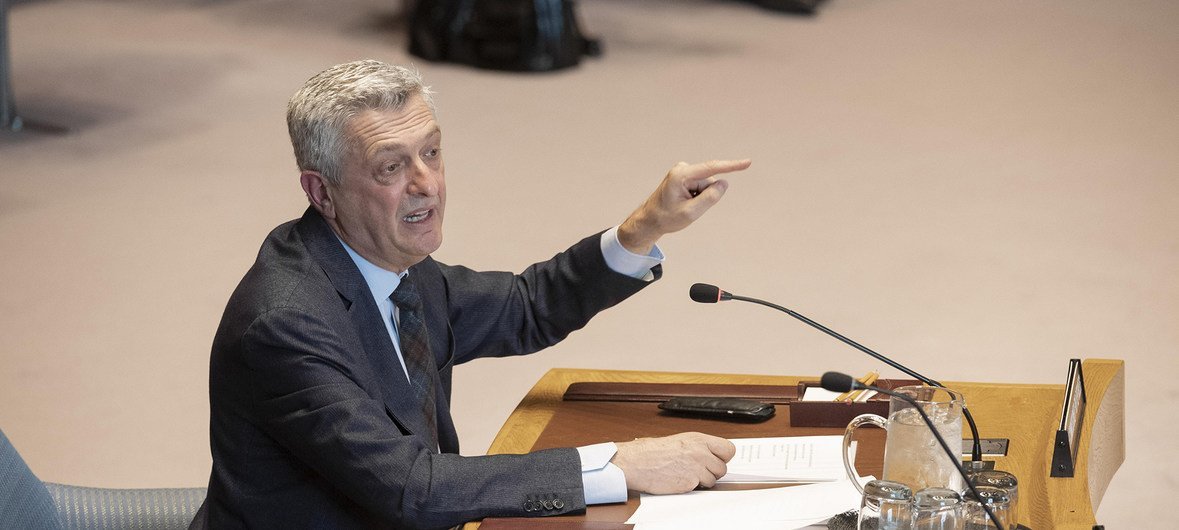
On 9 April 2019 UN News reports that in briefing to the Security Council on Tuesday, Filippo Grandi, United Nations High Commissioner for Refugees, said that, during his three and a half decades as an international civil servant, he has “never seen such toxicity, such poisonous language in politics, media and social media,” directed towards refugees, migrants and foreigners. At times – pointing his finger at Security Council members for emphasis – Mr. Grandi said that the stigmatization of refugees and migrants is “unprecedented,” and that traditional responses to refugee crises appear increasingly inadequate.
Dissecting the term “refugee crisis” itself, Mr. Grandi asked the Security Council to consider to whom, exactly, that applied: “It is a crisis for a mother with her children fleeing gang violence; it is a crisis for a teenager who wants to flee from war, human rights violations, forced conscription; it is crisis for governments in countries with few resources that, every day, open their borders to thousands. For them, it is a crisis.”
UN Photo/Evan Schneider. The United Nations High Commissioner for Refugees, Filippo Grandi, briefs the Security Council. (9 April 2019)
But it is wrong, he continued, to portray the situation as an unmanageable global crisis: with political will and improved responses, as enshrined by the Global Compact for Refugees, adopted last December, it can be addressed, and the Security Council has a critical role to play, particularly in terms of solving peace and security crises, supporting countries that are hosting refugees, and working to remove obstacles to solutions.
Conflicts, Mr. Grandi pointed out, are the main drivers of refugee flows: of the nearly 70 million people that are displaced, most are escaping deadly fighting. However, from the point of view of the UN High Commission for Refugees, approaches to peace-building are fragmented; addressing the symptoms, rather than the causes.
..[he goes into more detail on the Libyan situation]…
The UN refugee chief went on to exhort the Security council to step up support for the developing countries that host 85 per cent of the world’s refugees, to avoid leaving governments politically exposed, and refugees destitute. With regards to the return of refugees and migrants to their countries of origin, Mr. Grandi countered the misconception that UNHCR blocks returns: refugees have both a right to return, and also a right to not return, he said, in the absence of security and basic support. The informed choice of refugees must be respected, and returns must be dignified.
Mr. Grandi concluded by returning to the consequences of the toxic language surrounding refugees and migration, citing the example of the recent mosque shootings in Christchurch, New Zealand in March, which left 49 dead. The response of the New Zealand Government should, he said, be seen as an good example of effective leadership and how to respond to such toxicity, in a firm and organized manner, restating solidarity with refugees, and reaffirming the principle that our societies cannot be truly prosperous, stable and peaceful, if they do not include everyone.
Silvana Meixner is the head of the ORF minority editorial office (Minderheitenredaktion) and presenter of the magazine “Heimat Fremde Heimat”. In the spirit of the late Ari Rath, she is honoured as a journalist who has rendered outstanding service in her work to critical reporting on flight, expulsion and asylum, committed to the protection of human rights. Silvana Meixner was born on March 16, 1958 in Split, Croatia; she lives in Vienna since 1986. After graduating from high school, she studied sociology and pedagogy in Zadar. Since 1988 she has been working for the Austrian Broadcasting Corporation (Österreichischer Rundfunk), where she was involved in setting up the minority editorial office. On 3 December 1993 Silvana Meixner, who moderated the television programme Heimat, fremde Heimat together with Lakis Iordanopoulos, was injured by a letter bomb from Franz Fuchs. She continued her journalistic work for refugees, ethnic minorities and human rights.
The founder of a London human rights organisation (Making Herstory) has won the Waterstones Children’s Book Prize 2019 for her story about a Syrian child refugee. Onjali Q. Raúf won the award for her The Boy At The Back Of The Class, which tells the story of Ahmet, a nine-year-old Syrian boy who moves to a new school after fleeing his war-torn homeland, won best story.
The Boy At The Back Of The Class was inspired by the children she met while working in refugee camps. The story follows the arrival of Ahmet, separated from his family, in a strange new world. When none of the grown-ups seem to be able to help him, Ahmet’s new school friends “come up with a daring plan, embarking on a seemingly madcap adventure”. The Waterstones prize judges said: “Told with heart and humour, it’s a child’s perspective on the refugee crisis, highlighting the importance of friendship and kindness in a world that doesn’t always make sense”. James Daunt, Waterstones Managing Director, said: “It is, notwithstanding its urgent contemporary relevance, a book that is funny, generous and vivid. It is a joy to read, and we recommend it unreservedly.”
Each year, the Dutch municipality of Vlaardingen awards the so-called ‘Geuzenpenning’; a medal honouring human rights defenders around the world.
On 13 March Padre Alejandro Solalinde Guerra (73) received this year’s Geuzenpenning. He has dedicated his life to supporting migrants on dangerous journeys in search of a better life: a phenomenon of all time. During their flight, they have to deal with many ill-treatments that undermine their human dignity, such as rape, murder and human trafficking. Padre Solalinde has supported these people for over ten years and has often been lambasted by both governmental and clerical authorities for his efforts.
On 14 March an academic event will be organized, in collaboration with Erasmus School of Law and the Erasmus Initiative on Dynamics of Inclusive Prosperity, in honour of Padre Alejandro Solalinde’s work. Padre Solalinde will open the workshop with a speech. Following that, three scholars of Erasmus University from different disciplines will offer their reflections: Prof. Samer Abdelnour (Rotterdam School of Management), Prof. Kristin Henrard (Erasmus School of Law) and Prof. Gijs van Oenen (Erasmus School of Philosophy). Subsequently, the floor will be opened to a Q&A session with Padre Solalinde and the scholars of Erasmus University. [for last year’s award, see: https://humanrightsdefenders.blog/2018/03/13/girls-not-brides-winner-geuzenpenning-2018/%5D
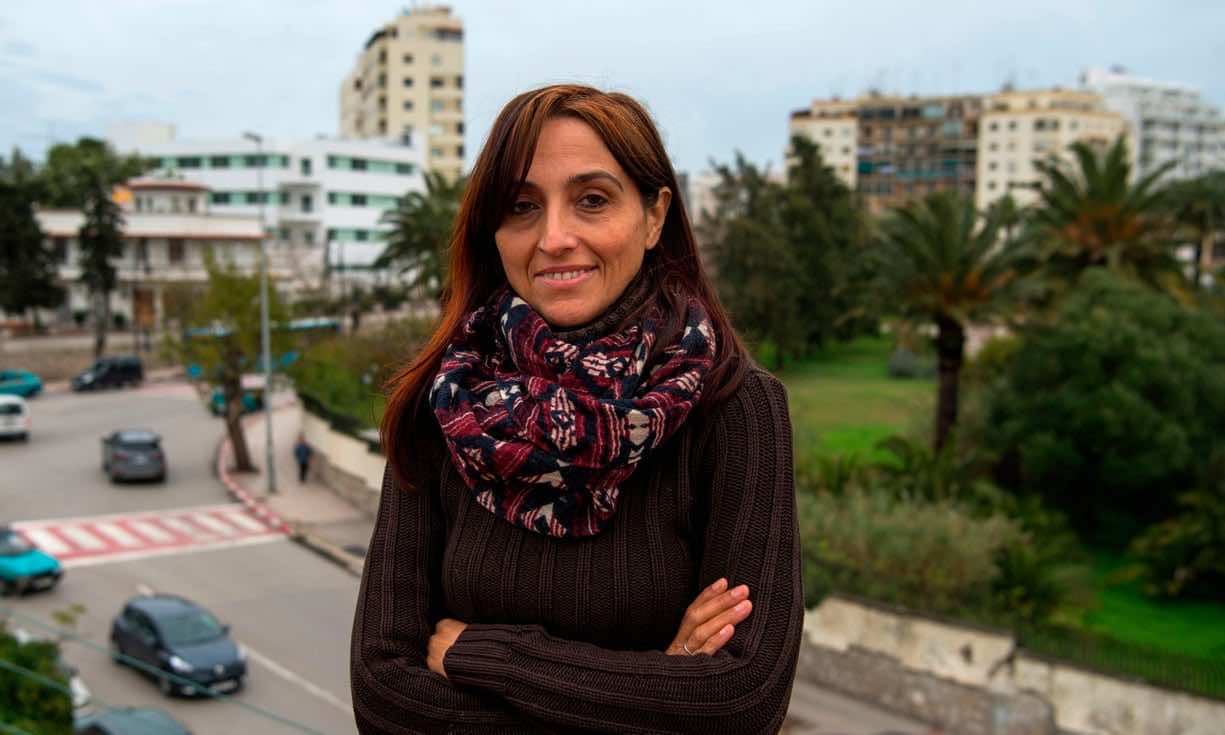
Helena Maleno – Credit: Fadel Senna (AFP), Getty Images
Sydney McCourt reported on 12 March 2019 on the case against Spanish migrant rights activist Helena Maleno:
The Court of Appeals in Tangier has dropped its charges against Spanish activist Helena Maleno. Morocco had charged Maleno, a spokesperson and activist for migrants, in 2017 with colluding with human traffickers to illegally move people across borders. However, the court confirmed on Monday that there was no evidence of a crime.
Based in Tangier for the last 16 years, Maleno leads the NGO Walking Borders, or Caminando Fronteras. Founded in 2002, the organization acts as a lifeline for migrants who are trying to reach Europe by crossing from Morocco to Spain. Walking Borders also documents human rights violations on both sides of the border and provides legal, social, and medical support to migrants. Maleno regularly receives calls from migrants in distress as they attempt the perilous Mediterranean crossing and then alerts maritime authorities in Spain, Morocco, and Algeria to the existence and location of the boats. In a speech earlier this year, the Spanish minister of interior development, Jose Luis Albalos Meco, said that 70 percent of calls to maritime authorities regarding boats at risk come from Maleno herself or her organization. The statement was backed up by Captain Miguel Zea, maritime rescue chief in Almeria, Spain, who has said that Maleno “is the person who has saved the most lives in the Strait – at least 10,000.”
UN human rights experts have denounced the case against Maleno, including the UN special rapporteur on the situation of human rights defenders in a report to the UN Human Rights Council in 2018.
The charges Morocco filed against Maleno have their origins in an investigation led by Spain’s Unit for Combating Immigration Networks and Document Counterfeiting (UCRIF) in 2012. The investigation was sparked by frequent calls made by Maleno to naval authorities regarding boats of migrants in the western Mediterranean waters. The calls, despite saving countless lives, also aided directly in the migrants’ transfer to the Spanish coast. In April 2017, Spain found insufficient grounds to pursue a criminal case but passed the investigation on to Morocco. The Moroccan courts first dismissed the case in December 2018, but Monday’s announcement, in response to an appeal filed with the Moroccan Prosecutor’s Office, stands as final..
Maleno responded to the news in a video she posted to her Twitter. In the video, she expresses that while she is “happy to be free,” the struggle does not end with the charges being dropped”. She said that “this is a very difficult time for human rights defenders as we are being persecuted and criminalized … To defend the right to life is not a crime.”
Maleno has won international recognitions with several awards, including the human rights award “Nacho de la Mata” (2015), the Human Rights Award of the Human Rights Association of Spain (2018), and the MacBride Peace Prize (2018).
Kate Allen, Director of Amnesty International UK, wrote a blog post on 7 February 2019 in the Huffington post about the ‘Stansted 15’:
After nearly two long years the news is that the Stansted 15 will not be going to jail. On Wednesday, the 15 arrived at Chelmsford Crown Court with their bags packed for their anticipated prison stints. Given that they were staring down the barrel of a possible life sentence, they were contemplating the worst. ..a happy ending? Well, not really. [see also the recent: https://www.theguardian.com/uk-news/2019/feb/25/stansted-15-ordered-back-to-court-on-aggravated-trespass-charge]
This group of human rights defenders remain convicted of a serious terrorism-related offence. They were tried in relation to their attempt to prevent the deportation of a group of people at Stansted Airport in 2017. Their actions – which at no point harmed anyone – prevented the flight from leaving. Of the 60 individuals due to have been deported, at least two have since been granted permission to remain in the UK, with others still pursuing their claims.
Initially, we should recall, the Stansted 15 were charged with aggravated trespass, a relatively minor charge of the type that has often been used to prosecute people who have undertaken similar protests. But four months in, this was changed to “endangering safety at aerodromes” – a very serious terrorism-related charge which came onto the books following the Lockerbie bombings – and one which has a maximum penalty of life in prison.
….The way the Stansted 15 have been treated should be a matter of grave concern for anyone who cares about human rights in the UK. This case is a canary in the coalmine and we should be alert for the chilling effect this trial could have on peaceful protest in the UK….It’s easy to see how what has happened to them might give pause to others seeking to stand up against perceived injustice.
Throughout this case it’s been clear these are human rights defenders, motivated by conscience and compassion for their fellow humans.
Emma Hughes grew up in Epsom and was one of 15 activists who helped block a charter flight at Heathrow airport in March 2017. Emma Hughes is a charity worker who recently gave birth to a son, Fen. In December last year before learning of her sentence, she told the Surrey Comet that the trial and subsequent conviction, which she might have faced up to life imprisonment, had severely impacted her pregnancy. Hughes said: “My partner faces not just me going to jail but his first child as well. It’s very scary for everyone’s families as well as us.” 12 of the activists, including Hughes, received community service sentences, while three others were given suspended prison sentences.
[On the night of 28 March 2017, in a corner of Stansted Airport they locked themselves on the runway around a Titan Airways Boeing 767 plane due to deport around 50 people to Nigeria and Ghana. Using arm tubes and tripods, they stayed there for over eight hours, stopping it from taking off. After a grueling trial which ran from 1 October until 10 December 2018, 15 members of the campaign group End Deportations were found guilty by a jury of “intentional disruption of services at an aerodrome”. The conviction, under the 1990 Aviation and Maritime Security Act – a law passed in response to the 1988 Lockerbie bombing – centred around the apparent danger posed by the Stansted 15. The 15 are appealing their conviction and have called for their terror convictions to be quashed and hostile environment dismantled. In a statement, the Stansted 15 said: “The convictions will drastically limit our ability to work, travel and take part in everyday life. Yet, people seeking asylum in this country face worse than this: they are placed in destitution and their lives in limbo, by the Home Office’s vicious system every single day.
Raj Chada, Partner from Hodge Jones & Allen, who represented all 15 of the defendants said: “While we are relieved that none of our clients face a custodial sentence, today is still a sad day for justice. Our clients prevented individuals being illegally removed from the UK and should never have been charged under counter terrorism legislation. We maintain that this was an abuse of power by the Attorney General and the CPS and will continue to fight in the appeal courts to get these wrongful convictions overturned.”
Eleven of the people on the halted March 2017 flight are still in the UK and have been able to keep fighting their cases. The Stansted 15 have been described as‘heroes’ by one of those people, a man who has lived in the UK for over a decade. As he sat on the flight, waiting for it to leave, his mother and two children were also in Britain, as well as his pregnant partner. The delay to the flight meant that he was able to successfully appeal against his deportation and be at his partner’s side while she gave birth to their daughter. He wrote for the Guardian: “Without the Stansted 15 I wouldn’t have been playing football with my three-year-old in the park this week. It’s that simple. We now have a chance to live together as a family in Britain – and that is thanks to the people who laid down in front of the plane.”
Behrouz Boochani in November, 2017. Picture: Jason Garman/Amnesty International
With one of the MEA 2019 final nominees being detained on Manus island in the same way [see: https://humanrightsdefenders.blog/2018/10/24/breaking-news-ennals-award-announces-its-3-finalists-for-2019/ ] it is relevant to note that another such detainee has won literary awards in Australia! Iranian-Kurdish journalist and poet Behrouz Boochaniwon the richest Australian Victorian Prize for Literature ($100,000) for his hellish first-hand account of life as a detainee on the island. His book, No Friend But The Mountains: Writing From Manus Prison, also won the $25,000 prize for nonfiction at Victorian Premier’s Literary Awards on 31 January 2019. (The eligibility criteria requiring that the authors be Australian citizens or permanent residents was overlooked to award the prize.
Mr Boochani told the Herald Sun from Manus Island, where he has been detained for more than five years, that the award was a victory for literature, resistance and humanity. But, he added: “I don’t want to celebrate this achievement while I still see many innocent people suffering around me.
No Friend But The Mountains.
“If I could be there to accept the award I would explain how this award is a morality failure for Australia,” Mr Boochani said. “It is not just a failure on the part of the Australian government but a historical and moral defeat for those parts of the society who have been silent in the face of a barbaric policy over these years…It’s a huge cause of shame for a government that did not recognise us as human beings and did not recognise our human rights. It’s a challenge against a system that has lied to the public over the past years.”.
On 1 February Keyvan Allahyari, University of Melbourne, followed up with a thoughtful piece on why “Behrouz Boochani’s literary prize cements his status as an Australian writer”
Other Australian authors have also used their voices to bring attention to the plight of asylum seekers. During her acceptance speech for her second Miles Franklin Award in August 2018, Michelle de Kretser chastised politicians for their treatment of refugees on Nauru and Manus Island. To illustrate her point, she read a list of names of asylum seekers who have died there in the past five years. It is tempting to dismiss such actions as gesture politics by an urban elite. But each individual action has served to raise awareness of the Australian government’s policy of “offshore processing” for asylum seekers, and to fuse artistic expression with political activism in a particularly forceful manner.
The author has been awarded the Anna Politkovskaya Award (for investigative journalism), the Amnesty International Award (Australian section) and Liberty Victoria’s Empty Chair Award. These humanitarian awards have confirmed Boochani’s rapidly acquired high profile in the literary field. Last night’s news topped all of that to make Boochani the first “non-Australian” author to win the Victorian Premier’s Literary Awards. The Victorian government established these awards in 1985 to honour Australian writing. The specific challenge this poses to the definition of “Australian writing” can be seen as an intervention by the literary community into the field of politics. If a non-citizen who has never set foot on mainland Australia can win, who counts as an Australian author?…
With no clear solution to the indefinite detention of asylum seekers on Manus and Nauru in sight, the paradox of Boochani’s award success can only contribute further to public debate over the tangled logic of indefinite detention. It shows how cultural practices and political activism can be reconfigured to correspond with the newly created literary currency associated with refugee writing. For now, at least, Boochani is an “Australian writer” because Australia is morally implicated in what he wrote and how he wrote it.
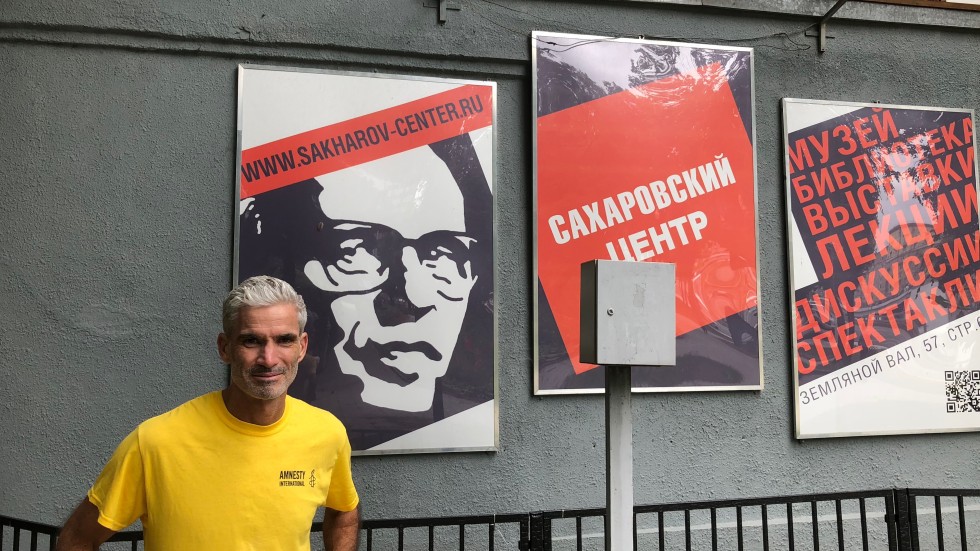
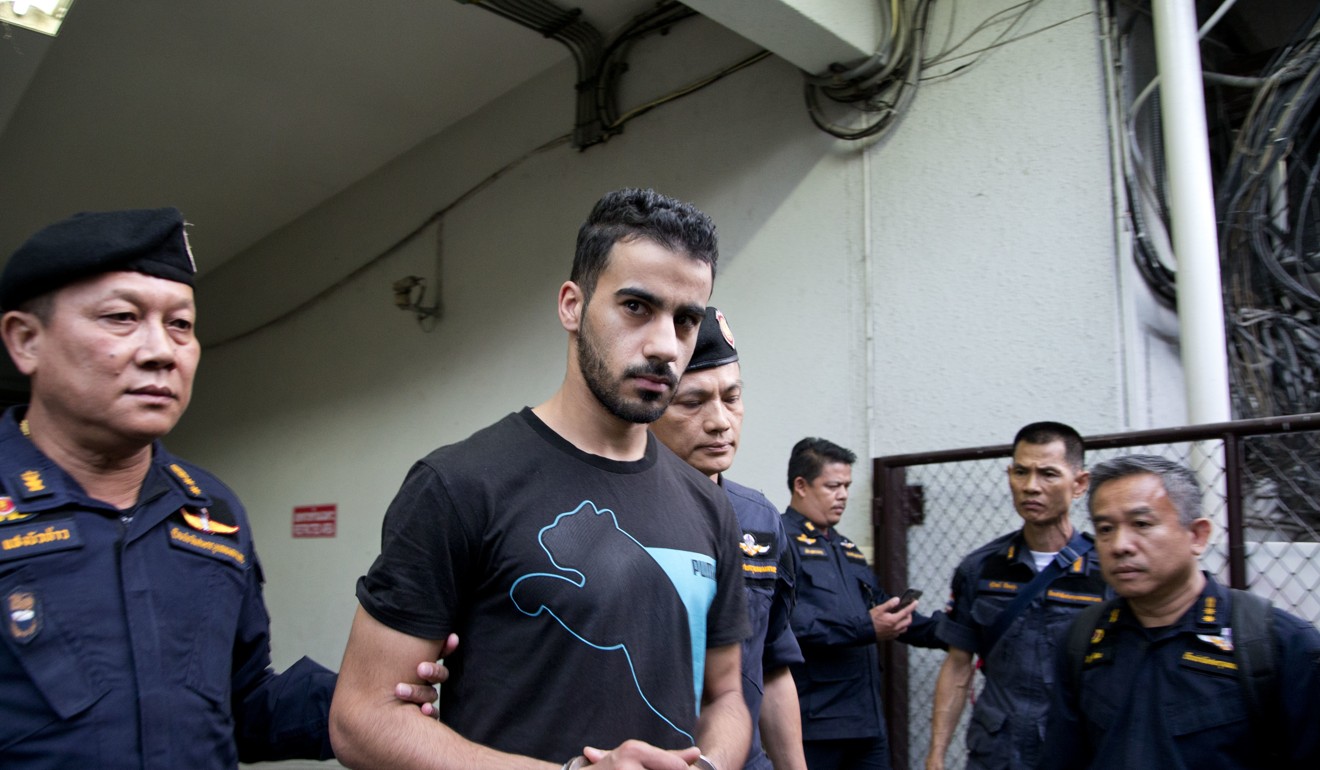
Football’s power to fight injustice motivates Craig Foster. The former Socceroos captain who played for Hong Kong’s Ernest Borel in the early ’90s is a broadcaster in Australia and also works for Amnesty International as a human rights and refugee ambassador. He is among the most vocal of activists in calling out human rights transgressions in football and sport and is one of the many prominent figures fighting for the release of Bahrain’s Hakeem al-Araibi, an Australia-based refugee footballer who is in a Thai jail awaiting extradition to his home country where he fears torture and persecution. [For some of my other posts on football and human rights, see: https://humanrightsdefenders.blog/tag/football/]
On Tuesday, 01 January, 2019, Nazvi Careem wrote a long piece about Craig Foster’s work and dedication:
And if he ever doubted just how powerful this sport can be, he only needs to recall the heartbreaking words of a young African refugee who had lost everything – fleeing his war-torn homeland after his parents, sibling and other members of his family were killed. “He was involved in a football programme over a period of time. He was very, very quiet and said very little,” said Foster. “He was in a new country and was experiencing psychological difficulties, which is totally understandable. “When he was asked why he liked the programme, he simply said: ‘The only thing that still exists in my life is football. It is the only thing that hasn’t been taken away from me’. And he was crying when he said it.
…Since retiring as a player in 2002, Foster became involved in social issues related to football, working with disadvantaged, minority and indigenous communities in a variety of programmes. “I’m just finishing my law degree, which has given me some further insight into the challenges of human rights and international refugee law. I feel strongly about these issues and in football, we are at an advantage because we are the most diverse, multicultural community in Australia.
…..Foster, who played for Portsmouth and Crystal Palace in England and also had a stint in Singapore, said he felt an obligation to give something back to the sport. As an ex-player and a broadcaster with the SBS organisation in Australia, Foster is in an ideal position to reach out to the masses. At the same time, he puts his contribution to social issues in perspective, admitting that he is in a position of comfort compared with activists whose lives are on the line in their efforts to effect change.
“Of course, you can’t fight every battle, but there are key ones which take a huge amount time. But the people I have immense respect for are the human rights defenders in their countries….In Australia we have serious human rights issues, with indigenous Australians and also in terms of refugees and arrivals.
(This article appeared in the South China Morning Post print edition as: using football to fight injustice)





 Hans Thoolen on Human Rights Defenders and their awards