The Philippines recorded the highest number of alleged abductions involving human rights defenders (HRDs) across Asia from 2023 to 2024, according to a biennial report released on 19 July 2025 by the Asian Forum for Human Rights and Development (Forum-Asia).
The country topped the list of 24 nations with 15 documented abduction cases, surpassing Bangladesh with nine, and both Afghanistan and Pakistan with seven each. The report accounted for at least 32 Filipino victims, though it did not specify how many remain missing.
These incidents were compiled through the Asian Human Rights Defenders Portal, a publicly accessible database maintained by Forum-Asia using verified reports from civil society, media, and UN sources. Only cases with clear identification of victims and a link to their human rights work are recorded.
One cited case involved indigenous activists Job David, Peter del Monte Jr., and Alia Encela, who were reportedly abducted by military forces in Bongabong, Oriental Mindoro in September 2023. The Philippine Army denied the allegations, asserting that the three were members of the New People’s Army captured during an operation and are currently detained. However, Forum-Asia noted that the case mirrored earlier incidents where so-called “Red-tagging” was used to justify human rights violations.
Red-tagging, the practice of labeling activists as communist rebels or terrorists, has long been criticized for exposing individuals to threats, violence, and in some cases, fatal attacks.
The report also revealed that abduction is only one of many repressive methods used to target HRDs. Judicial harassment emerged as the most widespread, with 868 cases across Asia. This includes arbitrary arrests, the use of oppressive laws, and denial of fair trials.
Threats, intimidation, and censorship were also rampant, totaling 376 incidents. The Philippines accounted for 41 of these, with 18 cases of vilification—all allegedly perpetrated or backed by state actors.
Environmental, indigenous, land, and community-based defenders were among the most targeted groups, with 60 harassment cases documented in the Philippines—second only to Indonesia. The country also ranked second in attacks on labor rights defenders, tallying 16 cases.
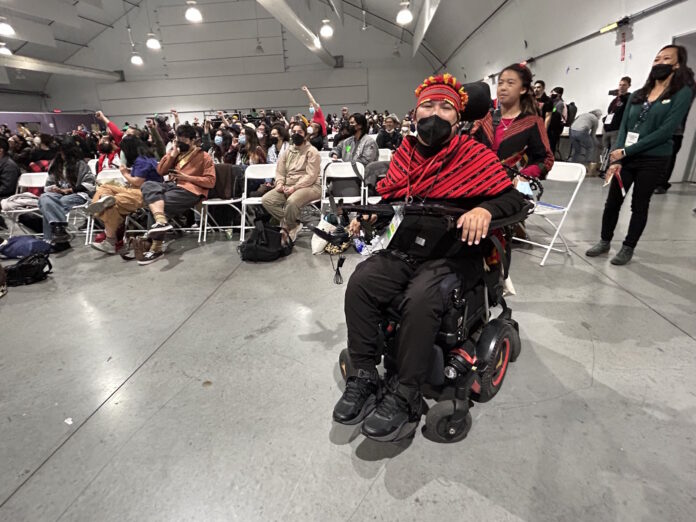
Brandon Lee and his daughter Jesse Jane at the People’s Counter Summit of the No To APEC Coalition, Nov. 11, 2023. Photo by Jia H. Jung
Jia Jung wrote on 20 November, 2023 about Chinese American Bay Area native Brandon Lee who gave the keynote speech at the No to APEC People’s Counter Summit, “People Over Profit and Plunder,” at San Francisco State University on Saturday, Nov. 11, 2023.
Lee was living with his wife and daughter in the Philippines and working as a human rights advocate, land defender, and journalist for the Northern Dispatch when he was shot by Philippine armed forces on Aug. 6, 2019. He survived – as a quadriplegic who remains steadfast in his international activism. Lee said, inter alia:
In high school, I was voted most shyest. I always preferred to work behind the scenes behind the camera, never in front. I was working security during rallies or painting posters the day before.
…In 2003, I transferred to this campus and joined the League of Filipino students at San Francisco State University. That’s where I learned that our country, the United States, continues to dominate and stagnate the Philippine economy, politics, and culture.
Around this time, I also started volunteering for the Chinese Progressive Association. That’s where I learned about the conditions and struggles of immigrant Chinese workers, and tenants. It was at that time I met Pam Tau Lee, the founder of the Chinese Progressive Association.
She was one of my mentors. And that’s where I learned that in the late nineties, San Francisco had 20,000 garment workers. But in less than 10 years, many of the immigrant monolinguistic women workers lost their jobs, with 88% of the workers being offshored to countries with weaker labor protection. It was during these years that I learned how interconnected our struggles are, and I became an internationalist and an anti-imperialist.
In 2007, I went on a life changing exposure trip to the Philippines. I met Youth and Students who are now movement leaders. I joined with workers boycotting Nestlé on their picket line. Ka Fort [Diasdado Fortuna], the chair of their union, was killed in cold blood by state agents. Ka Fort was dearly, dearly loved by the Nestlé workers for his leadership in building the union and his ultimate sacrifice.
So workers also launched a public campaign – “there’s blood in your coffee” – to draw international attention against Nestlé. Nestlé believes that water is a corporate right and not a human right. In this same trip, we visited many sectors, including the most oppressed majority and largest class – the peasants – as well as the Igorot Indigenous people in the northern part of the Philippines.
The Igorots, who live on resource-rich lands, are considered squatters on their own land because the Philippine government considers any land with a slope of 18 degrees Philippine land. The Igorots have been fighting against foreign occupation and colonization for hundreds of years.
And until now, they have continued their fight against government neglect and development aggression, militarization, and for the recognition for the right to ancestral land and self-determination.
On that exposure trip, our group also attended the one-year death anniversary of Alyce Claver, the wife of Chandu [Constancio]Claver, who was the provincial chair of the progressive party, Bayan Muna, and the president of the Red Cross. Chandu and Alyce were driving their kids to school when a motorcycle pulled up and shot at their car. Alyce shielded her husband and was riddled with two dozen bullets. Chandu made it out alive and is now in Canada with his kids after filing for political asylum, but the family today continues to be traumatized.
During this trip, we joined a medical and fact-finding mission to a remotevillage, and thankfully, the military had pulled out. The Indigenous peasants taught us about how the soldiers had blindfoldedthem and pointed a gun to their nape. The soldiers accused the farmers of supporting the land defenders and the resistance fighters known as the New People’s Army. The Philippine militarypretended to have a fake medical mission, giving out expired medicine to the local Indigenous people.
This trip, 16 years ago, changed the direction of my life.
I believe that we are shaped by our experiences, and this exposure program gave me new direction. It fortified my commitment to serving the fight for the Philippine liberation from U.S. imperialism. And to this day, the stories and sacrifices of Alyce Claver, Ka Fort, and so many others continue to fuel my commitment.
Two years later in 2009, I decided to deepen my commitment and decided to do a three-month integration in a remote area deep in the mountains. When I returned, I learned about Melissa Roxas, who was also from the U.S. and was abducted by the Armed Forces of the Philippines. She was conducting a medical mission. After a week, her captors released her as long as she promised to shut up.
She didn’t, though – she didn’t shut up. As she was she was released, she told the world what happened. As a health worker, Melissa diagnosed the Philippines’ societal problems and saw the illness of neoliberal policies from living among the poor. Melissa was brave. Her journey back from the trauma perpetuated by the Philippine military would soon follow for me.
The year following, 2010, I went all in and decided to live and serve the Igorot Indigenous people. I married my girlfriend, who is an Indigenous Ifugao, and we had a daughter, Jesse Jane, who is here with us today. I lived nine years with Indigenous people in the northern part of the Philippines, and I learned how they defended their land rights and lives in the resource-rich area known as the Cordillera region.
I saw firsthand how neoliberal policies promoted by APEC, such as the Philippine Mining Act of 1995, liberalize the mining industry, allowing foreign mining companies to reap 100% profit from the plundering of Indigenous people’s lands, unbridled large-scale destructive mining, dams, energy and other foreign projects, masquerading as development projects, and destroy the environment and forcibly displace Indigenous people who have been living there for generations.
Now, 13 years later, I’m speaking in front of you, a survivor of state violence and war that is spread by APEC and neoliberalism. They say APEC will promote sustainability. The Indigenous community say no. They are robbed of their life, land, culture, and worse, their future. Despite decades of people’s resistance, the plunder the natural resources, of indigenous – of ancestral – domains, continues. The region is blanketed with 176 large-scale mining and more than 100 energy projects, such as hydropower and geothermal projects awarded to private corporations.
One such energy project is the Chevron geothermal power project, which covers a large area in Kalinga. If left unchallenged and unopposed, all these could mean the ethnocide of the Igorots and the massive destruction of the ecosystem in the Cordillera region…
Indigenous communities were militarized, bombed, and strafed with artillery shelling, but they did not cower and they did not back down. They remained steadfast. They took care of each other. And they continued to hold the line.
They say APEC is innovative and will solve our problems. Hell, no.
Because I protested alongside the Indigenous communities, and, as a journalist, wrote about the daily attacks they face, I was also threatened and harassed. I was placed under surveillance. Tailed. Followed. They watched our office. They took pictures of us at our office and homes, as well as the tricycle, jeep, and bus terminal. I was red-tagged and politically vilified as a terrorist. I experienced death threats in the form of the burial blanket for the dead. I was detained and had my bag illegally searched at a military checkpoint the week before members of the 54th Infantry Battalion of the Philippine Army shot me in front of my daughter in front of my home on August 6th, 2018.
They had visited me at my house and office looking for me. They said they wanted to partner with my organization, the Ifugao Peasant Movement, but we refused. I told them two names – William Bugatti and Ricardo Mayumi – on why we do not want to partner with them.
While their assassination attempt against me was unsuccessful, I am permanently scarred and paralyzed. I am now quadriplegic, unable to use my hands and legs. I am considered one of the lucky ones. But I live with trauma every day. [see also: SF human rights activist fights for his life after being shot in the Philippines]
I know firsthand that the backdoor trade deals handled by APEC will not benefit the people; they only benefit the corporations and imperialist countries like the United States. That is why the United States sends its military around the world, finance schools, support fascist governments – to open up industries.
In fact, I have no doubt that the bullets lodged in my body today are paid by our taxpayer dollars.
Although I am paralyzed physically, they have failed to shut me up.
Today, I am proud to be standing with you, metaphorically speaking, in fighting back against APEC. Against state and political repression. Against corporate greed and power. Against the wealthy elite. Against the plunder of our planet. Against foreign domination of our peoples.
The Indigenous communities are resilient also. Like millions of people in the Global South, they are fighting back. They continue to protest despite being attacked. They have successfully barricaded several mines, rejecting countless mining and dam projects.
They have been on the frontlines of fighting the WTO [World Trade Organization], dismantling the Chico Dam equipment during the late dictator Marcos, which launched a coordinated people’s response that brought the Indigenous people to the national liberation struggle.
They are also on the frontlines of fighting APEC; a fight has led thousands to take up armed struggle as an appropriate response to defending their land, which is their life.
One of their martyr freedom fighter, Arnold “Ka Mando” Jaramillo, favorite expression ispayt latta! It means fight to the end, or continue to fight, and it’s today emulated by the Cordillera mass movement. Payt latta.
I will continue to fight as long as I breathe. Take a look around – my story is just one of many. There are a thousand people here today, diverse and multigenerational, coming from across the world, each with their own journey, own experiences, and reason for being here. But what unites us all is our opposition to APEC and neoliberal policies. We have so much in common – so much we can unite and rage against. A common enemy – APEC – and the neoliberal policies that prioritize profit and plunder over people and planet.
We will not go gently into that night. Rage. Rage! We will fight!
We will fight for a better future for all. Let us continue to talk, to build and work together, now and after APEC. For now, are you ready? Are you ready to shut down APEC?
On 8 March 2022 the Observatory for the Protection of Human Rights Defenders, a partnership of the World Organisation Against Torture (OMCT) and the International Federation for Human Rights (FIDH), requests an urgent intervention in the Philippines.
The Observatory has been informed by Karapatan Alliance Philippines (Karapatan) about the arbitrary detention and judicial harassment of Dr. Maria Natividad Marian “Naty” Castro, a public health practitioner and human rights defender. Ms. Castro has worked in the poorest and most marginalised areas in the Philippines as a community-based health worker. She has also worked for the defence of community rights of the indigenous Lumad and is a former National Council member of Karapatan.
In February 18, 2022, officials of the Philippine National Police (PNP) and the Philippine Army (PA) arbitrarily arrested Ms. Castro at her residence in San Juan City, Manila. The members of the PNP and PA presented an arrest warrant issued by the Regional Trial Court Branch 7 of Bayugan City, Agusan del Sur, in January 2020, on charges of “kidnapping” and “serious illegal detention” (Criminal Case No. 6527), filed by public prosecutor Genesis Efren in March 2019. Ms. Castro, together with 540 other individuals, is being accused of kidnapping and detaining an unknown individual in Barangay Kolambungan, Sibagat, Agusan del Sur Province, on December 29, 2018.
Following her arrest, Ms. Castro was taken to the San Juan City Police Station and then moved to the Quirino Memorial Medical Center in Quezon City to undergo medical examination. She was subsequently brought to the PNP’s headquarters in Camp Crame. However, neither her family members nor legal counsels were allowed to have contact with her, and their requests to bring her medicine for hypertension and diabetes were dismissed.
On the same day in the afternoon, Ms. Castro was flown to the island of Mindanao without her family or legal representatives being informed. On February 19, 2022, the authorities held Ms. Castro incommunicado. Only after multiple calls from her family and legal representatives, the PNP disclosed that Ms. Castro was being held at the Bayugan City Police Station in Agusan del Sur Province.
On the afternoon of February 20, 2022, Ms. Castro’s family and legal counsel were able to visit her and bring her medicines. On February 22, 2022, the Regional Trial Court Branch 7 of Bayugan City ordered her transfer to the Agusan del Sur Provincial Jail, where she was still being detained pending trial at the time of publication of this Urgent Appeal.
Ms. Castro’s lawyers filed a petition for bail and a motion to dismiss the charges against her. Both requests were pending before the court at the time of publication of this Urgent Appeal.
The Observatory for the Protection of Human Rights Defenders notes that since November of 2020, Ms. Castro has been a victim of red-tagging. Her name and picture have been circulated on social media platforms in Lianga, Surigao del Sur Province, falsely accusing her of being a “communist”, a “terrorist”, and a member of the New People’s Army (NPA).
Human rights defenders in the Philippines have been subjected to trumped-up charges and lengthy pre-trial arbitrary detention. Karapatan members have been subject to frequent harassment, criminalisation, and attacks, including the killing of Ms. Zara Alvarez and the arbitrary detention of Teresita Naul, Alexander Philip Abinguna, Nimfa Lanzas, and Renayn Tejero. Ms. Naul was released on October 28, 2021, after 18 months of arbitrary detention. Mr. Abinguna and Mses. Lanzas and Tejero remain detained. See also: https://humanrightsdefenders.blog/2021/05/27/william-zabel-human-rights-award-2021-to-philippines-ngo-karapatan/
Human rights groups called on the Philippine government to investigate what they said was the use of “lethal force” during police raids on Sunday that left at least nine activists dead. The raids in four provinces south of Manila resulted in the death of an environmental activist as well as a coordinator of left-wing group Bagong Alyansang Makabayan, among others, and resulted in the arrest of four others, activist groups said.
“These raids appear to be part of a coordinated plan by the authorities to raid, arrest, and even kill activists in their homes and offices,” Human Rights Watch Deputy Asia Director Phil Robertson said in a statement.
These incidents, he said, were “clearly part of the government’s increasingly brutal counter-insurgency campaign“. “The fundamental problem is (that) this campaign no longer makes any distinction between armed rebels and noncombatant activists, labour leaders, and rights defenders.” The United Nations has warned in a report that “red-tagging”, or labelling people and groups as communists or terrorists, and incitement to violence have been rife in the Southeast Asian nation.
“The Philippines government should act now to investigate the use of lethal force in these raids, stop the mayhem and killings that has gone hand in hand with the practice of red-tagging,” Robertson said.
Sunday’s raids, which human rights group Karapatan condemned, came two days after President Rodrigo Duterte ordered the police and military to “kill” communist rebels and “ignore human rights”.
“Nothing could be more apt than calling this day a ‘Bloody Sunday,’” Karapatan’s Cristina Palabay said.
Lieutenant General Antonio Parlade, head of an anti-rebel task force, told Reuters the raids were “legitimate law enforcement operations”, and authorities acted on the basis of search warrants for possession of firearms and explosives.
“As usual these groups are so quick in assuming that the subjects were activists and that they were killed. If (the) motive was to kill them they should all be dead but there were those who did not resist arrest so they were collared,” Parlade told Reuters in a phone message. — Reuters
In the meantime on 7 March 2021 Rappler.com reported that UK lawmakers called for release of jailed Duterte critic De Lima
Signatories include Rt Hon Dame Diana Johnson, MP (chair, All Party Parliamentary Human Rights Group), Tonia Antoniazzi MP, Harriett Baldwin MP, Paul Blomfield MP, Tracy Brabin MP, Lyn Brown MP, and Dawn Butler MP, according to the Office of Senator Leila de Lima.
“President Duterte’s self-styled ‘war on drugs’ has seen an estimated 30,000 extra-judicial killings – along with increased targeting of journalists and human rights defenders, and the undermining of judicial independence,” they added.
A Muntinlupa court on Friday, March 5, dismissed her second drug case appeal, even as she was earlier acquitted in another case. A third case against her is pending before another court.
Carla Gomez and Nestor P. Burgos Jr. wrote for the Philippine Daily Inquirer of 24 December, 2020 “Goodbye, ‘people’s doctor” about the burial of Guihulngan City health officer Mary Rose Sancelan and her husband, Edwin. White balloons were released during the couple’s burial.
“Our people’s doctor (Mary Rose) dedicated her life to end both the COVID-19 pandemic and the pandemic of injustice. [But] our beloved martyr took eight bullets on our behalf; and her husband, Edwin, took five. Sadly, their son, Red Emmanuel, bears all the pain of the violent demise of his parents. Together, we accompany him in his quest for justice,” San Carlos Bishop Gerardo Alminaza said during the funeral Mass at the Our Lady of Buensuceso Parish Church.
Mary Rose, Guihulngan’s health officer and chief of the city’s Inter-Agency Task Force Against Emerging Infectious Diseases, and her husband were on board a motorcycle on their way home to Carmeville on 15 Decemeer when they were shot by two men on board another motorcycle that drove alongside them.
The attack came about a year after Mary Rose expressed fears over her safety after she was red-tagged by a group called Kawsa Guihulnganon Batok Komunista (or “Kagubak,” loosely translated as Concerned Guihulnganons against Communists). She was the first on the list of Guihulngan residents whom the anti-communist vigilante group Kagubak accused of being supporters of the Communist Party of the Philippines and the New People’s Army (NPA).
The list, which was released in 2018, identified her as Ka JB Regalado, then spokesperson for the Apolinario Gatmaitan Command of the NPA.
Bishop Alminaza appealed to the faithful to wear white on Christmas Eve and Christmas Day and on New Year’s Eve and New Year’s Day “to express our desire for and commitment to peace, sanctity of life, human dignity and human rights, and our collective call to end the killings, the COVID-19 pandemic and the abuse of our common home.”
Alminaza said the International Criminal Court, the Office of the United Nations High Commissioner for Human Rights, Amnesty International, Human Rights Watch and other agencies have more reasons to demand from the Philippine government accountability for the rampant human rights violations and the absence of the rule of law.
“We can never speak of peace when the bloodbath continues. We are not Christians at all if we use violence in the name of enforced peace. Peace is real when we stop firing our guns, when we refuse to pull the trigger on a person’s life, and when we stop becoming enablers of injustice,” the bishop said. “It is sad that militarization defines our peace and order, not the security of our citizens. We call on our city to seriously work for justice among the citizens living in Guihulngan. We call upon our mayor and city officials to take to heart their utmost duty to protect the people in this city. We challenge our local government to not become a political hostage of this oppressive killing policy,” he added. The Sancelans’ relatives declined to issue any statement, saying they wanted to keep their mourning private.
In a pastoral message, Alminaza reiterated the need to end the killings in Negros. “Our island awaits the day when the blood from the pandemic of violence stops flowing. When will our priests in the diocese end burying victims of these orchestrated acts of terrorism?” he said. The killing of the Sancelan couple is among the 106 cases of extrajudicial killings recorded on Negros Island under the Duterte administration. [see also: https://humanrightsdefenders.blog/2020/08/22/the-killing-of-randy-echanis-and-zara-alvarez-put-the-philippines-under-more-pressure/]
“As your pastor, I am taking the mantle of the cause of their martyrdom. We stress that merely speaking about this senseless violence in our midst is not enough. Our collective outrage should move us to collectively act against it,” Alminaza said.
The Philippines government’s practice of ” red tagging” – i.e. labelling HRDs as communists or terrorists – has been repeatedy criticised by human rights defenders, NGOs, government and the UN. “We are saddened and appalled by the ongoing violence and threats against human rights defenders in the Philippines, including the killing of two human rights defenders over the past two weeks,” said Liz Throssell, a spokesperson for the Office of the UN High Commissioner for Human Rights (OHCHR). Randall “Randy” Echanis, an agrarian reform advocate and peace consultant, was killed in his home in Quezon City, located just outside capital Manila, on 10 August, added the OHCHR spokesperson, noting that reports indicated that he suffered brutal treatment before he died, including blunt force trauma to the head and stab wounds. On 17 August, the day that Mr. Echanis was buried, another long-standing human rights defender, Zara Alvarez, was shot dead in Bacolod City on Negros Island, some 490 kilometres south east of Manila. Investigations into both cases are underway.
According to OHCHR, both Mr. Echanis and Ms. Alvarez had been repeatedly “red-tagged” – labelled as communists or terrorists – in relation to their work. Ms. Alvarez’s name appeared, for example, on a list of 649 people that the Government sought to designate as terrorists on 28 March 2020. “While the list was later truncated, many who were removed from the list, including Ms. Alvarez, continued to report harassment and threats, as highlighted in the High Commissioner’s human rights report on the Philippines published in June this year,” added Ms. Throssell.
Ms. Alvarez’s photo also appeared in a publicly displayed poster purporting to depict terrorists. She was pictured alongside two other human rights defenders who had been killed – Benjamin Ramos Jr. and Bernardino Patigas, both of whose murder cases remain unsolved. She had also spent two years in prison on murder charges before she was acquitted in March for lack of evidence. Following the murder of Ms. Alvarez, her colleague Clarizza Singson, received a death threat on Facebook warning her that she would be next. “This is particularly worrying as Ms. Singson’s name also appeared on the abovementioned list of suspected terrorists and her photo is included in the same poster,” added Ms. Throssell.
“We have raised our concerns with the Government and the Commission on Human Rights on these cases, and look forward to continuing to engage with them,” said Ms. Throssell.
Eighty-nine cases involving the deaths of human rights activists from 2017 to 2019 are now being investigated by the Commission on Human Rights (CHR), an official said Friday. “The data that we have from 2017 to 2019, we have a total of 89, not to include the ones happening now. We call them human rights defenders,” CHR commissioner Leah Armamento said over ABS-CBN News Channel when asked about the number of killings of activists and members of progressive groups being investigated by the commission.
‘The endless killings of activists in the Philippines have become systematic in Duterte’s regime, and demonstrate the continuing impunity in the country. The government should end these killings immediately and take genuine steps towards ensuring justice for victims and their family members,’ said Shamini Darshni Kaliemuthu, Executive Director at FORUM-ASIA.
On 22 November 2019 the National Council of Churches (NCCP) issued a press release after the Department of National Defense of the Philippines has included the NCCP in the list of “front organizations of local communist terrorist groups”. In adition to the NCCP, a number of humanitarian and service-oriented organizations were placed on this list, which was presented by Major General Reuben Basiao, Armed Forces of the Philippines Deputy Chief of Staff for Intelligence, on 5 November. In the statement, the NCCP “decries the baseless and unfounded inclusion of its name in the list […] and respectfully call on the government to seriously review and revisit the accusations and engage in peace building instead”. “We recognize the clear threat that is now posed to the NCCP staff, member churches, associate members, and other ecumenical partners”, they said in a letter the NCCP sent to its partners last week. The NCCP also warned that “the red-tagging will delay, or even prevent, the delivery of much-needed services to marginalized communities in the midst of disasters. On a larger scale, this will further shrink the already limited civil space”.
In June 2019, the Philippine government rejected the United Nations call for an investigation into human rights violations for the government’s policies against drug trafficking, arguing that it was an “interference”. [see: https://humanrightsdefenders.blog/2019/07/11/un-council-agrees-action-on-philippines-in-spite-of-vehement-objection/]. According to official figures, 5,300 suspects have been killed by the police since 2016. But according to human rights defenders, the figure would be three times higher. The NCCP explained in the letter to its partners that “within the past few days, we have witnessed attacks against civil society organizations that are critical of the government’s policies and programs. There have been raids, illegal arrests, and vilification. Before this of course, there were even killings of activists and human rights defenders”. “The NCCP deems these moves as desperate attempts by the authorities to criminalize dissent and to weaponize the law against the people”, it said.
The government action has been widely condemned by several international Christian leaders. Rev. Olav Fyse Tveit, World Council of Churches General Secretary, said “red tagging in effect gives a green light to harassment and deadly attacks by security forces and militias against those listed”. Similar statements have been released by the Christian Conference of Asia, the Action of Churches Together Alliance, Christian Aid, and the Evangelical Lutheran Church in Northern Germany, among others. Founded in 1963, the NCCP is an ecumenical federation of churches of non-Roman Catholic denominations.

 Hans Thoolen on Human Rights Defenders and their awards