‘If we work together to make sure that issues are more visible, that happen in Africa, the civil society organisations, I think, will be achieving more.’
Odinakaonye ‘Odi’ Lagi is the programme director for the Network of University Legal Aid Institutions (NULAI), Nigeria, and she works on promoting access to justice and legal aid for Nigerians. Citing the example of the Nigerian social movement to protest against the actions of the Special Anti-Robbery Squad (known as the end #EndSars protests), which she says did not receive enough attention in the continent, she calls for civil society groups and activists across Africa to come together to shed more collective light on individual national struggles.
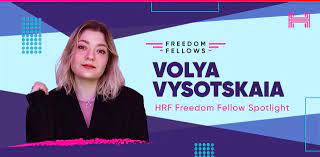
Meet HRF Freedom Fellow Volya Vysotskaia, a Belarusian human rights activist who exposes repression and torture by state officials.
Vysotskaia is currently part of the 2022 Freedom Fellowship, a programme of the Human Rights Foundation, a one-year program that provides hands-on, expert mentorship across seven critical areas: leadership, movement-building, organizing, fundraising, media, mental health, and digital security.
On September 27, the Investigative Committee of the Republic of Belarus announced that five people would be tried in absentia — Vysotskaia is one of them. She has since been denied information about the trial, and her request to appear virtually was rejected. Should she return to Belarus, a country where torture and inhuman treatment is routine, officials will likely detain her.
Learn more about Vysotskaia’s case.
Q: Can you tell us about your activism protecting democracy in Belarus?
A: From August 2020 to October 2021, I was an editor of the Telegram channel, the “Black Book of Belarus.” Our work “de-anonymized” or identified law enforcement officers and other government authorities who committed human rights violations, hiding behind their high-power statuses. We published the pictures and personal data of riot police officers, prosecutors, judges, and other officials to hold them accountable for their repression of Belarusian citizens demanding democracy and freedom.
Q: What led to the criminalization of the Black Book of Belarus’ editors and readers?
A: In October 2020, a special service agent infiltrated our team and leaked information about members. Previously, he was part of the special operation that hijacked a Ryanair flight in May 2021 to imprison Sofia Sapega, another team member. After we uncovered the agent, my team and I were chased down in Vilnius, and dozens of people in the Telegram group were also imprisoned.
Q: What is unique about your criminal case?
A: The case brought against my four colleagues and me is the first trial in absentia in the country’s history. We have been accused of “exasperation of enmity” and “social disagreement,” as well as illegal actions relating to private life and personal data. The Belarusian KGB has also added us to the list of individuals engaging in “extremist activities.” Belarusian courts recognize almost all civil society organizations as extremists, but we will be the first to be tried and sentenced without the opportunity to defend ourselves.
Belarusian authorities are undoubtedly denying us the right to a fair trial. Notably, I was denied access to information about my criminal case, and I never met the lawyer assigned to me, nor did the lawyer ever respond to my calls.
Q: What is the scope of legal harassment against Belarusian pro-democracy activists in exile?
A: The Lukashenko government changed the criminal procedural law back in July and invented a special proceeding for trying in absentia those who are engaged in “anti-state activities,” and living in exile. The addendum of this new procedural law provides that defendants are no longer aware of the content of their cases. It is sufficient for the legislative body to post this information on official websites, which clearly violates Article 14 of the International Covenant on Civil and Political Rights (ICCPR).
Q: What should the international community learn from your case?
A: The violations of the right to a fair trial, among other rights, didn’t start in Belarus with our case. It just brings back the attention of the international community to the fact that the repressions in Belarus haven’t stopped. They continue every day. The power, the judicial system, and the independence of Belarus with Lukashenko are fake. The regime represses and scares the Belarusians inside the country, and while the international community doesn’t react to the severe violations of human rights, the regime spreads its attention to those living in exile. Because silence allows them to do that.
The international community has to learn that there have to be efficient mechanisms for bringing perpetrators to trial until they destroy whole nations, as well as to guarantee the defense for the victims of violations. International justice can’t be built on the international ignorance of injustice. Being concerned doesn’t stop dictators.Repression in Belarus. HRF condemns the actions of Alexander Lukashenko’s regime and stands with Volya and all Belarusians who speak truth to power, even when their lives are at risk
The Freedom Fellowship is a one-year program that gives human rights advocates, social entrepreneurs, and nonprofit leaders from challenging political environments the opportunity to increase the impact of their work. Through mentorship and hands-on training sessions, fellows develop critical skills and join a growing community of human rights activists.
“I chose to be a human rights defender by, hopefully, protecting those who don’t know where to find a solution when there are human rights abuses happening to them.”
Soun Yuthyia is the advocacy director for The Cambodian Centre for Human Rights, an organisation that seeks to protect and promote respect for human rights throughout Cambodia. He shares his vision for the future of Cambodia and how his work has positively impacted the people of Cambodia.
Yuthyia also shares his experience with HRDAP and the ISHR Academy in the below video:
DefendDefenders’ regulary chooses a Defender of the Month. Here an example:
Fadia Khalaf was not meant to be an activist. By her own admission, she was born into a conservative Muslim family – the first of six siblings. In Saudi Arabia where she was born and raised, the ruling ideology in the Kingdom was wahabbism – a puritanical version of Islam in which women are strictly expected to stay in the background and not play any public role. Yet even in that conservative setting, she managed to nurture a political consciousness:
“I think reading at young age helped build my awareness on concepts like justice and rights in general. I was exposed to concepts around human freedom, and that nurtured the rebel in me,” she says. Fadia Khalaf Tweet
Now aged 25, Fadia is the Co-founder of Missing Initiative, a volunteer, youth organization dedicated to documenting all persons that are reported missing during Sudan’s ongoing political crisis. The initiative was started in the aftermath of the Khartoum massacre, when armed forces of the Sudanese Transitional Military Council attacked a protest outside the country’s military headquarters, killing at least 127 people.
“From the start of protests to remove Bashir (Sudan’s long-serving President deposed in April 2019), we would always report people who we would realize never returned home after the protests. This was our way of looking out for each other. But after 3 June 2021 (the day of the Khartoum massacre), the situation was terrible. People were killed, women were raped, while many others were disappeared. All of a sudden, because of our past work, I started getting tens of phone-calls of people letting me know that their persons were missing, asking me to do something about it. I had to post all these missing cases on my social media platforms(Twitter & Instagram via @SlayKaiii) in addition to reporting to police, to try to find them. It was from that crisis that I and five other friends decided to start Missing initiative to continue searching for these people,” Fadia Khalaf Tweet
The initiative helps document persons announced missing, liaises with the police to conduct a search process, follows up on those in police detention to ensure the progress of their cases and helps some of those arrested find legal representation. To date, Missing Initiative has documented over 100 cases of missing persons, and helped locate about 60, from prisons to hospitals. Among these, at least five were found dead in city morgues.
“It’s horrifying, the conditions in which we find some of these people, if we find them at all. Some are in urgent need of medical attention from all forms of torture, others are imprisoned without charge. Others, we find, have died. But at least, it gives closure to their families,” she says. Fadia Khalaf Tweet
As a result of their work, Fadia says that Sudanese now recognise forced disappearances as a state crime, and have gradually developed a consciousness and vigilance to look out for each other against state-inspired violence.
These efforts have not been without consequences. Fadia says she and her colleagues have been threatened together with their families, and that she continues to be randomly followed and her phones tapped. She says as women human rights defenders (WHRDs) in a deeply patriarchal society, they’re even more endangered because the society does not believe they should have any rights at all, much less a voice.
“The day women rise in Sudan, patriarchy will fall because it thrives on subjugating women. And that’s why those like us are harassed because the system fears that we will awaken and empower other women to rise up and refuse to be dominated,” she says. Fadia Khalaf Tweet
Nonetheless, Fadia is optimistic, the growing women and youth agitation is unstoppable: “This spirit and desire for change, I have never seen it before. Young people are willing to die for a better country every day! It is inspiring. All they need is to be empowered more,” she notes.
Dr. Maria Luisa Acosta is the coordinator of the Centro de Asistencia Legal a Pueblos Indígenas (CALPI), an organisation that supports and seeks to realise the rights of Indigenous and Afrodescendant peoples and communities in Nicaragua. She shares her vision for the future and how, despite the personal toll of her work, she remains steadfast in her convictions.
“States have the obligation to respect defenders, to provide them with security, to heed their calls and to consider that we are people who support the most vulnerable sectors of society, and that this is a contribution to democratic life.“
Mariam Atahi left Afghanistan for safe haven abroad in August 2021 with financial assistance from Journalists for Human Rights and the Daniel Pearl Foundation. However, her fight for women’s rights continues, uninterrupted.
As the Taliban began its ‘humanitarian talks’ last month in Oslo, Mariam called for the release of three fellow activists, allegedly detained for protesting against the closure of women’s universities. “It hurts me,” she said, “…to not have any information or hope to give their families asking questions about their whereabouts.”
As co-founder of the Feminine Perspectives Campaign, Mariam has been leading a fearless movement to demand accountability for the violation of women’s rights by the Taliban. In 2016, she and four colleagues interviewed women from different provinces to document “what women exactly want” and presented them during the 2016 talks with the Taliban in Qatar. They stressed that the freedom to study, work and participate in public life is important to women in urban Kabul and rural provinces alike.
This work put a target on her back. In late 2019, Mariam was working as a communications specialist at Save The Children and was informed by the National Directorate of Security in Afghanistan that she’s on the Taliban’s hit list. At the time, she was used to fielding multiple ‘mysterious calls’ a week. However, the NDS insisted she take the risk more seriously. Mariam applied for an emergency visa to India and relocated to Delhi for two months. When she returned in early 2020, the threats continued. She changed her look, her route to work and her schedule – but kept on working. In 2021, she took on a communications role with UNICEF.
“Fighting for women and children’s rights is in my blood. When I see women suffering, I feel responsible. I want to build a bridge for them to reach their dreams. I have to do this work for the rest of my life.”
After the Taliban takeover, Mariam decided to leave Afghanistan for a safer location where she can continue her work.
‘In Kabul, I always felt like someone is knocking at my door. I want to set myself in a better position, so I’m able to mobilize more resources to help my people. I hope to see the international community show their solidarity with Afghan women and make a solid, genuine commitment to safeguarding their rights.”
The long-time president of the Nicaraguan Center for Human Rights, doesn’t rule out the possibility of being jailed by the Ortega-Murillo regime. Re-published on 11 December in Havana Times:
Vilma Nuñez learned about Nicaraguan jails when she was just a child. She was eight years old when they took her to visit a political prisoner – her father. He had been imprisoned by Somoza’s National Guard, the same repressive body that years later would also jail and torture her.
In the course of over six decades of work, she’s become the veteran defender of Nicaraguans’ human rights. Founder and current president of the Nicaraguan Center for Human Rights (Cenidh), she confesses that she decided to study Law to fight against the outrages she’d experienced since childhood. Her law career has spanned 63 years, although she was very seldom the prosecutor, but almost always worked on the side of defense. See also: https://humanrightsdefenders.blog/2018/12/02/nicaragua-moves-against-women-human-rights-defenders/
Through Cenidh, Nuñez continues her struggle for the liberation of the Ortega regime’s political prisoners, just as she did in 1958, when she formed part of the Leon student movement. Through that organization, she became involved in the Committee for the Liberation of the Political Prisoners during the the Somoza regime. On one occasion, she recalls, they requested and received an audience with Luis Somoza Debayle, effectively Nicaragua’s dictator from 1956–1967. Together with university chancellor Mariano Fiallos Gil, she met with the man who had inherited the Somoza dynasty. The dictator became enraged when they demanded the release of the prisoners.
Twenty-one years after that meeting, Nuñez was jailed and tortured with electric shocks by order of the dynasty’s final successor, Anastasio Somoza Debayle. It’s not surprising, then, that the current situation of the political prisoners brings her back to the days of that other terrible dictatorship that – like the current regime – wouldn’t tolerate criticism.
In addition, Nuñez is a survivor of the student massacre of July 23, 1959. She has felt in her own flesh what it means to be jailed for false crimes because of having protested. At 83, it’s been her destiny to once more live under attack from a new dictatorship.
At the end of 2018, the Ortega regime ordered the Sandinista-dominated National Assembly to strip Cenidh of the non-profit status it had held since its founding in 1990. It also confiscated its offices.
“They’ve struck us a blow, but it doesn’t hurt us,” the Cenidh president declared defiantly. “A serious human rights organization can’t be dissolved by a resolution from a political organ with no autonomy or independence; nor can they dissolve our commitment and accompaniment of the Nicaraguan people,” she affirmed, in reference to the legislature’s decision…
According to Nuñez, all the attacks are because they won’t forgive her for having accompanied the case of Zoilamerica Narvaez, Daniel Ortega’s stepdaughter. In 1998, Narvaez filed formal accusations of 19-years of rape and sexual abuse and harassment against Ortega.
The issue most disturbs Dr. Nuñez at present is not being able to accompany the victims at the site where the human rights violations are occurring. She can’t even file an appeal, because the entire state apparatus is controlled by the Ortega regime.
“No one listens or does anything, which generates a situation of powerlessness. You can’t protest, or do anything, and for that reason I’ve said that I feel I’m a prisoner in Nicaragua,” she explains.
Nevertheless, she insists that she won’t cease in her struggle for the defense of human rights and the search for justice. “Fear has been one of the most powerful weapons wielded by the dictatorship, and I won’t let it dominate me,” she declares.
The human rights defender doesn’t rule out the fact that they may want to jail her. Every day, she says, she once again conquers that fear. “The authentic defense of human rights isn’t restricted to the use of the Law. Although the national and international statutes are always useful, they go hand in hand with less formal mechanisms, and one of the most effective of these is the public denunciation,” Nuñez notes.
“I’m going to continue on in Nicaragua. My commitment is to keep standing beside the people, denouncing and defending human rights as long as I can. It’s always been my lot to be standing on the sidewalk, right in the nose of the tyrants and human rights violators,” Vilma Nuñez says.
Antonia Urrejola, president of the Inter-American Commission on Human Rights: “Ever since I first met her, [Dr. Nuñez’] strength has impressed me (…) if there’s a person who’s always been present in the denunciations of human rights violations in Nicaragua, it’s her. She’s an example of strength and courage.”
Gonzalo Carrion, Nicaragua Nunca + Human Rights Collective: “The history of the human rights movement in the last sixty years in Nicaragua chronicles a people suffering and resisting two different dictatorial dynasties. Whoever writes [that story] will inevitably have to tell of Vilma Nuñez’ activism and commitment.”
Gioconda Belli, Nicaraguan writer: “Who hasn’t seen Doña Vilma traveling to the most remote places to accompany victims whose rights have been violated? No one, more than you knows how to be at the side of the Nicaraguan people.”
The International Service for Human Rights published on 30 September 2021 “Human rights defender’s story: Rosana Lezama Sanchez from Venezuela”.
“What is needed from the international community in general, and from within the UN, is a concrete, coherent and unified voice in favour of the protection of human rights defenders, the safeguard of the fundamental liberties, the civic space and human dignity,” says Rosana Lezama Sanchez, a law student in Venezuela working with three national human rights organisations.
Rosana Lezama is a law student in Venezuela working with three national human rights organisations: Centro para los Defensores y la Justicia (CDJ) / Observatorio Venezolano de Conflictividad Social (OVCS) / Centro de Derechos Humanos de la Universidad Católica Andrés Bello (CDH-UCAB). Her work includes the protection of human rights defenders, issues of transitional justice, rule of law, the right to peaceful assembly, and State repression. In this video, Rosana talks about her vision for the future and her work to achieve it.
Rosana was also a participant in ISHR’s Human Rights Defender Advocacy Programme (HRDAP) and ISHR Academy in 2021.
“The rights of migrant workers is a global problem, and actors in different jurisdictions have to come together to make a difference in this particular area,” says Barun Ghimire, a human rights lawyer based in Kathmandu, Nepal. “And we need to create a collective narrative that is based on a rights-based approach of migrant workers”.
Barun Ghimire is a human rights lawyer and programme manager at the Law and Policy Forum for Social Justice. Barun works for the protection and defence of the rights of migrant workers in Kathmandu, Nepal.
In this video, Barun explains his work in relation to the rights of migrants, as well as how Covid-19 has affected this group, which is facing even stronger vulnerability. He also calls the international community and other actors to come together and help improve the situation of migrants workers as well as their families. To achieve this goal, it is necessary to create a new narrative and defend and promote the rights of migrant people in vulnerable situations, especially during and after Covid-19.
Barun was also a participant in ISHR’s Human Rights Defender Advocacy Programme (HRDAP) in 2020.
The Oak Institute for Human Rights has named Olga Sadovskaya, a Russian human rights lawyer, as its 2021 Human Rights Fellow. Sadovskaya, vice chair of the Committee Against Torture, the largest and most notable anti-torture organization in Russia, has worked on issues surrounding torture for more than 18 years. In 2017 she was shortlisted for the Nobel Peace Prize.
Sadovskaya, who hails from the city of Nizhny Novgorod in western Russia, will join the Colby community in August and will engage with students, faculty, staff, and the greater community throughout the fall semester.
Olga Sadovskaya, the 2021 Oak Human Rights Fellow, will join the Colby community for the Fall 2021 semester and raise awareness on issues of torture and incarceration in Russia and around the world.
“The consistent violation of human rights in the carceral system is not only a major global problem but it is an urgent issue in the United States. There is a pressing need to confront and find better solutions to our current prison system,” said Valérie Dionne, director of the Oak Institute for Human Rights and associate professor of French. “We are lucky to have Olga Sadovskaya coming to campus to share her experience combating torture and to explore potential solutions with us that could replace the current carceral system.”
The Committee Against Torture (CAT), established in 2000 by Sadovskaya and three other activists, created accountability for torture previously missing in Russia. Torture was scarcely discussed, and victims were often scared, ashamed to speak out, or believed justice was unattainable. Even with CAT’s work, however, the practice of torture prevails, and investigations into torture are still inadequate. This problem is amplified in the Chechen Republic, where CAT is the sole organization working on cases of torture and abductions.
During her early years at the organization, Sadovskaya’s role as an investigator included collecting evidence of torture in prisons, penal colonies, police stations, and psychiatric institutions. Over time, she transitioned to analysis and international defense work with the European Court of Human Rights and various UN bodies. Sadovskaya also trains lawyers on how to work with the European Court of Human Rights. See also: https://humanrightsdefenders.blog/2015/12/02/russian-olga-sadovskaya-keeps-fighting-torture/
Drawing upon years of experience with torture cases, Sadovskaya and her team wrote and published a methodology for public investigations, widely used by human rights organizations in Russia. Sadovskaya has personally represented more than 300 victims of torture before the European Court of Justice. Two of the cases were included in the list of the 20 most important cases that changed Russia (Case-Law of the European Court of Human Rights, Special issue, 5, 2018).
While working against state-sanctioned torture, Sadovskaya has faced personal threats, including threats of murder, particularly for her work in Chechnya. The committee’s office has been burned down several times, and members’ cars have been destroyed. Sadovskaya is also periodically monitored and constantly at risk of being accused of baseless crimes.
The Oak Human Rights Fellowship will give Sadovskaya a much-needed respite to return to Russia with renewed energy. As the 2021 Oak Fellow, she will connect with Colby students and raise awareness on issues of torture and incarceration in Russia and around the world.

 Hans Thoolen on Human Rights Defenders and their awards
