Posts Tagged ‘Non-governmental organization’

13th of February will now be “World Radio Day”

January 9, 2013

Geneva-based NGO “Media and human rights” reports that the United Nations Educational, Scientific and Cultural Organization (UNESCO) has proclaimed the 13th of February “World Radio Day”. It is a moment to pay homage to one of the most important and resilient media. A  time also to remember that local radio journalists are often in the firing line, especially in regions where citizens do not have access, due to lack of infrastructure or resources, to other media like TV or the Internet.

For more information, go to the UNESCO World Radio Day page http://www.unesco.org/new/en/communication-and-information/events/prizes-and-celebrations/celebrations/world-radio-day/why-the-world-radio-day/ and to http://www.unesco.org/new/en/communication-and-information/events/prizes-and-celebrations/celebrations/world-radio-day/safety-of-radio-journalists/radio-in-the-line-of-fire/ for an overview of attacks against radio journalists.

 from: Media and human rights: February 13 World Radio Day.

Igor Kalyapin, the 2nd OMCT Portrait against Torture and Impunity

December 3, 2012

The second portrait in the series of 10 HRDs against Torture is: Igor Kalyapin, founder and chair of Russian NGO Committee Against Torture (CAT).

……………….

The main obstacle we have is the same to the reason of torture: lack of effective investigation and absolute lack of will to investigate. Every case is a challenge and we never know for how many years we have to commit ourselves to deal with each of them.

Do you feel threatened because of your activities? Do you face any interference in your work? If this is the case, can you kindly precise.

Recently, we have started to face threats: our lawyers are targeted, some of them are approached by state agents, some of them were arrested, some of them were insulted. I myself now am facing a real threat to be accused of a crime that I have never committed (speaking out of investigational secret).

………………………

Public campaigns (as illustrated in the picture), support of the victims of torture, write support letters, can play a very important role in the fight against torture.


http://www.omct.org/human-rights-defenders/events/2012/12/d22055/

HURIDOCS exists 30 years: my interview now on line

November 30, 2012

HURIDOCS

Hans Thoolen talks about the excitement of founding HURIDOCS, why the human rights community nowadays resembles a church with too many priests (and too few believers) and what made Latin American human rights defenders embrace technology before everyone else. Looking back at decades of involvement in human rights work, he also sketches out his idea of a multimedia platform that gives human rights defenders the space to inspire others. 

What was the most exciting idea about founding HURIDOCS?
It started for me and the others at this conference in 1979 near Paris. During this conference we sensed there was space for better cooperation among NGOs, especially with new technology. Mind you: this was 1979, well before the internet, and information technology was hardly used. Our idea was to somewhere, somehow seek some level of agreement among NGOs – or at least to create the tools with which working together would be possible in the future.

in 1982 Quito with Jose Antonio Viera de Gallo from Chile

Hans Thoolen (second from right) at the Quito conference in Spring 1982, the most important conference before HURIDOCS was officially founded a few months later.

How did you move on from there?
That idea survived the meeting and there was some money left over from the Ford Foundation and that was used to have informal consultations. So for a few years, Martin Ennals, who had just stepped down as secretary-general of Amnesty International, Friederike Knabe, Laurie Wiseberg, Bjorn Stormorken and myself (working for the International Commission of Jurists) were the people who worked on the follow-up. We had meetings in London, Brussels, Oslo and Geneva and we were asking NGOs what they thought of the potential of information technology and testing out ideas on information exchange.

That slowly lead to the first big conference, in Quito, Ecuador, in 1982, partly because the Latinos had taken to the use of technology well before the West – in the NGO world, not in the business world, of course. This maybe was surprising, but when you thought about it, not that strange.

Why not? And how did this lead to the founding of HURIDOCS?

…….

………

and the rest you have to read yourself on:

http://www.huridocs.org/2012/11/we-were-breaking-new-ground/


Kees Bleichrodt: 20 years the leader of UAF passes away

November 27, 2012
My posts tend to be about Human Rights Defenders at risk but this time I want to draw your attention to a great promoter of human rights in the Netherlands who recently passed away at the relatively young age of 60: Kees Bleichrodt.
This Dutchman started in the 70s as an AI volunteer and in 1978 he became their Coordinator for refugees and in 1986 deputy director.
As from 1989, for more than 20 years, he led the University Asylum Fund (UAF) which helps thousands of refugees to study and find jobs. He was a driven, hardworking man who modernised and developed the organisation enormously. He took great pride in the success of ‘his’ refugee students and described his own job as the ‘most beautiful job in the Netherlands’. He was a real networker who stayed active in other NGOs, including Scholars at Risk.  Condolences can be left at: http://www.uaf.nl

Kees Bleichrodt

Animated Introduction to Economic, Social and Cultural Rights (and NGOs) now out

November 23, 2012

This is the second part of the series “Focus Human Rights” that I referred to in an earlier post. It deals with the second dimension of the Human Rights system: The Economic, Social and Cultural Rights. Additionally, it explains women’s rights and shows how NGOs in the Human Rights sector work. Especially the latter part seems somewhat forced into this second volume as they operate in both areas to say the least. It has also a rather strange reference to the International Society for Human Rights which is listed with AI, HRW and HRF as an example of well-known NGOs, while it is in fact fairly small and – outside Germany – without much influence.

The clips are done by Jan Künzl and Jörn Barkemeyer, who welcome comments.

More information about the project:
http://www.edeos.org/en/projects.html

Stay in touch at:
http://www.facebook.com/edeos.org


Good news from the Gambia: judicial harassment of 2 HRDs ended

November 15, 2012

On November 14, 2012 The Observatory for the Protection of Human Rights Defenders, a joint programme of the International Federation for Human Rights (FIDH) and the World Organisation Against Torture (OMCT), announced and welcomed the vindication of two women human rights defenders in The Gambia following two years of judicial harassment.

On November 12, the Banjul Magistrates’ Court decided to drop all charges against Dr. Isatou Touray and Ms. Amie Bojang-Sissoho, respectively Executive Director and Programme Coordinator of The Gambia Committee on Traditional Practices Affecting the Health of Women and Children (GAMCOTRAP), an organisation working on sexual and reproductive health and rights of women and children. The two women human rights defenders had been prosecuted since October 2010 on charges of “theft” for the alleged embezzlement of 30,000 Euros received in 2009 from “Yolocamba Solidaridad”, a Spanish development NGO.

This landmark decision puts an end to an uninterrupted judicial harassment that had been going on for more than two years, since the police started interrogations of GAMCOTRAP staff in May 2010. Since the opening of their trial, Dr. Isatou Touray and Amie Bojang-Sissoho had been summoned to 66 hearings, which took place in a hostile atmosphere and on completely unlawful grounds. Indeed, the alleged victims had never filed a complaint and the Prosecution failed to present sufficient evidence that they had indeed committed a criminal offence. Furthermore, on January 31, 2011, Ms. Begoña Ballestros Sanchez, Director of Yolocamba Solidaridad, denied accusing anyone associated with GAMCOTRAP of theft and submitting a complaint in relation thereof during a hearing at Banjul Magistrate’s Court. During interrogation, Ms. Isatou Touray had to respond to very precise questions by the Prosecutor covering all aspects of GAMCOTRAP’s activities, staff and resources that are unrelated to the charges. In addition, the Prosecutor also repeatedly made depreciating comments about the work of GAMCOTRAP’s programme to eradicate female genital mutilation.

One can only hope that their acquittal marks a step forward in the respect of the rights of human rights defenders in the Gambia.

Death threats against Indian human rights defender Mr Azimuddin Sarkar

November 13, 2012

Front Line Defenders reports on 13 November that since 14 October 2012, the Indian human rights defender Mr. Azimuddin Sarkar and his family have been targeted with threats and intimidation on several occasions, which has been exacerbated by unwillingness on the part of the police to investigate the matter. Azimuddin Sarkar is the District Human Rights Monitor of MASUM, a non-governmental human rights organisation based in Howrah, Kolkata, West Bengal.

On 14 October 2012, a group of 20-25 people, of whom four were identified as locally known thugs, raided the house of Azimuddin Sarkar’s older brother, who was home with his family at the time, in Bardhanpur village, West Bengal state. The thugs reportedly issued threats to Azimuddin Sarkar, saying they would “teach him a lesson” as they threatened the family with weapons and looted the house. An hour after the incident, police appeared on the scene and advised the victims to make a complaint. When the human rights defender’s brother went to the local police station at Raninagar the next day, it is reported that the officer on duty refused to file the complaint, insisting instead to register it only as ‘information received’. A written complaint was sent to the Superintendent of Police at Murshidabad.

On 16 October, Azimuddin Sarkar asked a friend from a non-governmental organisation to make a request to the police to arrest the culprits. The Officer in Charge (OC) at Raninagar station responded that they should leave the matter be, as it was related to MASUM. The OC added that MASUM was not the State Human Rights Commission, and as such “had no right to pressurise the police”. The next day, around 11pm on 17 October, four of the same thugs assembled outside Azimuddin Sarkar’s family home armed with lethal weapons and went on to publicly threaten to kill the human rights defender and his family.

On 19 October, the human rights defender filed a written complaint on the incident with the OC and the Superintendent of police at Murshidabad, supported by multiple eye witnesses. On 5 November, after repeated attempts to call the OC at Raninagar police station, a call from a fellow District Human Rights Monitor at MASUM was returned. All the OC offered regarding police actions on the issue was that he could give no detail of whether any case had been initiated or not. The police have reportedly sent a number of messages to the complainants urging them to withdraw their complaints against the assailants.

Azimuddin Sarkar has been involved in campaigns against the use of torture by the police and Border Security Forces in the area. Currently he is unable to move freely and carry out his work due to the threats. It is believed he is being targeted solely for his legitimate and peaceful human rights activities.

Protection International announces its 2nd Online Course: Postgraduate Diploma on Integral Protection for Human Rights Defenders

November 13, 2012

Protection International announces the 2nd edition of its “Postgraduate Diploma on Integral Protection for Human Rights Defenders and Social Activists”.

It will begin in January 2013. It is organised jointly with the Universidad Pablo de Olavide.

This Diploma is the first of its kind, since it is the only international Postgraduate Diploma addressing the need to protect defenders.

The course addresses that protection in a comprehensive way, covering the existing national, international and regional laws and protection mechanisms; also studying security management, psychosocial support, the design of protection programs, etc. The course will also include an introduction to the protection of witnesses and victims.

The two institutions running it are:

– The Universidad Pablo de Olavide, Seville, Spain) which has been offering Post-graduate education in human rights for many years, and has introduced to the university the critical theory of human rights.

– Protection International (Brussels) which offers an extensive experience working directly for the protection of defenders in over fifteen countries in Africa, Asia, America and Europe.

Directors: Rosario Valpuesta Fernández and Luis Enrique Eguren
Dates: January 2013 – July 2013
Credits: 30 ECTS
Enrolment fees: 800 Euros (certificate fees not included)
Pre-registration and enrolment: Online
Languages used during the training process: Spanish or English

Online Course: Postgraduate Diploma on Integral Protection for Human Rights Defenders and Social Activists | | Protection InternationalProtection International.

Three Zimbabwean Human Rights Defenders in difficulty

November 12, 2012

On 8 November 2012 Amnesty International and other organizations (including Protection International) report on the situation of  three Zimbabwean human rights defenders (HRDs), who have been detained without charge since Monday 5 November. On 7 November, they were illegally transferred from Harare to Bulawayo, taking them far from their support networks and raising fears for their safety. They are prisoners of conscience.

Fidelis Mudimu, Zachariah Godi and Tafadzwa Geza are senior staff members of the Counselling Services Unit (CSU) a registered medical clinic which provides medical and counselling services to victims of organized violence and torture. They were arbitrarily arrested by police following a raid on the organisation’s office in Harare on Monday 5 November.

At around 11h30 on Monday 5 November about a dozen police officers arrived at the office of the CSU, without a search warrant. Around two hours later they were joined by a truck-load of anti-riot police who threatened to fire tear gas into the clinic, risking the lives of patients, staff and others in the building. Police later produced a search warrant stating that they were there to recover “offensive and subversive material” which “defaces any house, building, wall, fence, lamp-post, gate or elevator without the consent of the owner or occupier thereof”. Police entered the premises and conducted a search and illegally seized confidential medical records, a computer and documents which were not covered by the search warrant. The three HRDs were then arrested.

On Wednesday 7 November Fidelis Mudimu, Zachariah Godi and Tafadzwa Geza were illegally transferred more than 400km from Harare to Bulawayo, in an open pick up truck without protection from the sun, despite temperatures exceeding 30°C. Harare police handed them over to Bulawayo police in the town of Kwekwe, where they were immediately handcuffed. On arrival in Bulawayo they were immediately placed in detention without being interviewed. It is illegal to detain someone without charge for over 48 hours in Zimbabwe.

ADDITIONAL INFORMATION

The CSU is a highly respected organisation because of its work to support thousands of survivors of human right violations. Amnesty International believes that the arbitrary arrest, unlawful detention and illegal transfer of the three human rights defender is part of systematic harassment and intimidation of civil society in Zimbabwe as the country is heading for another election in 2013.

This is the second raid on the office of an NGO in Harare in less than three months. In August the office of Gays and Lesbians of Zimbabwe (GALZ) was raided by police twice and members were arrested and detained.

Go to original article

Luon Sovath speaks out on Radio Free Asia

November 10, 2012

On 7 November the activist monk Luon Sovath, MEA Laureate of 2012, spoke to Radio Free Asia about his work.

As the interview is quite interesting I copied here in in full:

Fresh from receiving the “Nobel Prize for Human Rights,” Cambodia’s technology-savvy activist monk Loun Sovath has called on authorities in his country to end the use of violence in land eviction cases, vowing to continue his struggle to protect victims of land grabs. He also said he would not be cowed by government harassment and called on his fellow monks, often respected as figures of moral authority in Cambodia, to join in the struggle to defend villagers who have become victims of forced evictions. Loun Sovath was the first Southeast Asian to be presented with the 2012 Martin Ennals Award for Human Rights Defenders as he was selected for documenting the struggle of land rights activists and ordinary citizens evicted from their homes in his impoverished country. The monk collected the award—viewed by many as the Nobel Prize for Human Rights—in Geneva last month.

“The Buddha advised people to do good deeds both physically and mentally,” he told RFA’s Khmer service during an interview in Washington on Wednesday. “Respecting human rights is a good deed which will lead to peace and prosperity for this world and in the next. So for monks to become rights defenders is nothing against Buddhism, but can lead to enlightenment and peace.” “Monks play a vital role in society. I appeal to monks to rise up to follow in the Buddha’s footsteps,” he said. Loun Sovath  said the Cambodian people must also rise up to demand their rights, highlighting land disputes as the one of the biggest issues facing the public in the country.

“The authorities must stop using violence against innocent villagers who are the victims of land grabbing,” he said. Research by Cambodian rights group LICADHO shows that some 2.1 million hectares of land has been given to private companies in the form of land concessions over the last two decades. The massive transfer has led to countless forced evictions and affected over 400,000 people in the 12 provinces that LICADHO monitors since 2003 alone, the group said.

Sovath is currently touring the U.S., meeting with the Cambodian community and addressing various nongovernmental organizations on the human rights situation in his country. He began his nearly two-month visit last week in New York, traveled to Washington, and arrived in Chicago Thursday. Sovath said he was honored to receive the Martin Ennals Award.

“I was given the award because I have worked as a rights defender and a protector of social justice involved with land issues, forced evictions, and the protection of natural resources and wildlife,” he said. In June 2011, the New York-based Human Rights Watch awarded Loun Sovath with the Hellman/Hammett grant for his work supporting communities facing forced evictions and land-grabbing in Cambodia.
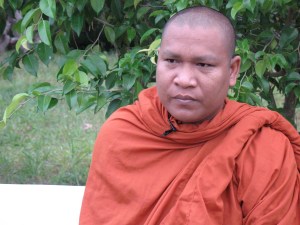
Luon Sovath by Dovana

Years of activism Sovath first became involved in human rights work in 2009, when members of his family were injured during a police shootout at unarmed villagers in a land eviction case. The monk’s brother and nephew were wounded in the standoff, which he documented in a video. He is known for his extensive use of video to inform the world about his confrontations with authorities, earning him the nickname “multimedia monk.” The monk is rarely seen without a mobile phone or tablet. He also uses songs and art to spread his non-violent message of defending human rights. Loun Sovath said he strove to protect human rights in the interest of his country. “I have a desire to help build Cambodia,” he said. In June, Loun Sovath was briefly detained by Cambodian authorities and accused of “causing instability” after he joined protests against the jailing of 13 women over a long-running forced land eviction case in the capital Phnom Penh. Municipal monk officials threatened to have him defrocked as a monk, but released him after he put his thumbprint on a statement assuring that he will not join future protests. Loun Sovath had been banned in April from entering pagodas in Phnom Penh after he participated in land protests.

Sovath, who has since participated in various protests, said he would not stop his activism even though he was concerned about his personal safety. “The authorities have tried to prevent me from doing good things and from helping the country and [the Buddhist] religion,” Sovath said. “I can’t accept this because I have done nothing wrong,” he said. “As long as human rights violations continue to exist in Cambodia, I will continue to do my work.”

Reported by Samean Yun for RFA’s Khmer service. Translated by Samean Yun. Written in English by Joshua Lipes.

Copyright © 1998-2011 Radio Free Asia. All rights reserved.