In the Huffington Post of 27 January 2017 David Tolbert, President of the International Center for Transitional Justice, wrote: “Human Rights Movement Must Come Together to Resist Trump’s Agenda”. In the piece he says many useful things especially that “it is clear that a coalition of forces must emerge in American civil society to provide the backbone of resistance to the Trump agenda.” Here some excerpts:
– Trump has rushed headlong into creating further divisions and has begun an assault on human rights and basic decency — including a de facto ban on many Muslim refugees from entering the United States and the resurrection of CIA “black sites“ — and promises more to come.
– The new president exalts torture, mocks the disabled, casts aspersions on those who defend human rights, appeals to racist sentiments through coded and not-so-coded language and denigrates women in both word and deed.
– He shows no regard for the Geneva Conventions or the painstaking work of generations of human rights activists, many of them American, to ensure that civilians are not abused in times of conflict and that the vulnerable are protected.
– For good measure, he seems to demean virtually every restraint that protects the citizen from the state. His first call as president to a foreign leader was to President Abdel Fattah al-Sisi of Egypt, who crushed the protests against army rule, devastated Egypt’s civil society with draconian laws targeting human rights defenders and turned Egypt’s legal institutions into “kangaroo courts.” A chilling signal indeed.
Say what you will, Trump has clearly laid down the gauntlet that places the most powerful of nations on the side of the privileged and signals that human rights will be honored only in the breach. This can hardly be a surprise, given his campaign rhetoric that called openly for torture and other serious crimes that violate international and domestic law.
…….
….. The whiff of McCarthyism is in the air for those of us who do not define ourselves as allegiant to Trump’s vision of America.
The inaugural speech and Trump’s first actions also send powerful messages regarding the struggle for human rights across the planet. The consequences of his dark vision will be dire. The record of the United States is patchy at best in terms of promoting human rights abroad, but it has played an important role in a number of areas, commencing with Eleanor Roosevelt’s work on the Universal Declaration of Human Rights.
While its record in Latin America and the Middle East has been particularly deplorable, this country has supported civil society groups in a number of countries and other international initiatives that have promoted accountability for human rights violations. It has worked with other countries and the United Nations to advance the normative agenda that has enshrined human rights in international law and broadly supported the human rights movement in areas such as individual liberties and women’s rights. Mr. Trump will end these efforts in an obvious return to the old adage: “Governments can boil their own people in oil for all we care, as long as they support us.”
This abdication of American support for human rights will not only undermine those countries that respect human rights but will also embolden those who seek to undermine the United Nations and other institutions that have advocated for and protected those rights. The emerging Trump-Putin partnership will mean that victims of human rights abuses around the world will have nowhere to turn to, as avenues to redress, accountability and acknowledgement of the violations close down.
The question is, what can we do? What is our responsibility as human rights defenders, but also as citizens of the United States and the world at large?
…..
While there is not a single “silver bullet” to take on what we will face ahead, we need to move past “conversations” and start organizing. It is hard to imagine — in this diverse and app-based world of today — that a single organization can take the lead in such a movement, like the Southern Christian Leadership Conference (with lots of allies and competition, of course) did for the Civil Rights Movement. However, it is clear that a coalition of forces must emerge in American civil society to provide the backbone of resistance to the Trump agenda.
We cannot afford atomization along the lines of our specific causes, be they accountability for human rights violations, racial injustice, inequality, LGBTI rights, indigenous rights or other human rights causes we support. If we are to have a chance to stop Trump’s destructive agenda, we must unite and act as a movement as strongly against the Dakota Access Pipeline as against a registry for Muslims or systemic police violence against African-Americans. Our goals in protecting human rights in the United States must be as clearly defined as our actions must be coordinated.
…..
The time for action and resistance is now. I and the organization that I lead, the International Center for Transitional Justice, have over the years had a great deal of experience in addressing the abuses of regimes across the world that disregard human rights and commit abuses. Once rights and the institutions built to protect them are pushed to the side and the strong man reigns, the path to violations becomes real and the difficulties of re-establishing the rule of law become very steep indeed. The warning signs here in the United States are now laid bare. They should be a call to action for us all.
Network World of 3 January 2017 carried an interesting piece on Claudio Guarnieri who launched Security Without Borders which offers free cybersecurity help to journalists, activists and human rights defenders.
Security researcher Claudio Guarnieri has experience working with journalists and human rights organizations that have exercised freedom of speech, reported on some form of corruption and wound up becoming targets because of it. Their computers may be compromised with spying malware such as those in the hands of the Hacking Team, FinFisher or NSA to name but a few. Their electronic communications also may be intercepted, and their messaging programs may be blocked.At 33rd Chaos Communication Congress, or 33C3, Guarnieri presented “Hacking the World,” which is actually not a technical talk; more about “security activism.”[see his 26-minute talk on You Tube:
For all the wonderful things that the internet has given us, the internet also has been turned into a tool for repression. Nation states have deep pockets and use the imbalance to their own advantage. Technology has been used “to curb dissent, to censor information, to identify and monitor people.” ..Billions of dollars have been poured into surveillance—both passive and active.”Sadly, electronic surveillance and censorship have become so commonplace that nowadays people can get arrested for a tweet. There are places were dissidents are hunted down, using crypto is illegal, where sites are blocked and even internet access can be cut off. “Those who face imprisonment and violence in the pursuit of justice and democracy cannot succeed if they don’t communicate securely as well as remain safe online.”
Security “is a precondition for privacy, which is the key enabler for freedom of expression.” He was not implying that the security should come from big firms, either, since big security businesses often need contracts with the government and are dependent on the national security sector. So, Guarnieri turned to the hacker community and launched Security Without Borders, which “is an open collective of hackers and cybersecurity professionals who volunteer with assisting journalists, human rights defenders, and non-profit organizations with cyber security issues.”
The website Security Without Borders has a big red button labeled “Request Assistance.” Activists, journalists and human rights defenders are encouraged to reach out for help. The group of “penetration testers, malware analysts, developers, engineers, system administrators and hackers” from all walks of life offer cybersecurity help. We can assist with web security assessments, conduct breach investigations and analysis, and generally act as an advisor in questions pertaining to cybersecurity. As security services are often expensive to come by, SWB offers these services free to organizations and people fighting against human rights abuse, racism, and other injustices.
When requesting help, you are asked to give your name or organization’s name, an email address, a description of the work you do and what kind of help you need. Hackers and computer security geeks who support freedom of speech are also encouraged to reach out and volunteer their skills.
The International Service for Human Rights (ISHR) is calling for applications for its flagship Human Rights Defenders Advocacy Program in 2017 – the extensive training programme for human rights defenders. The training will take place in Geneva between 29 May and 9 June 2017 and provides defenders with opportunities to put their advocacy skills directly into action at the 35th session of the UN Human Rights Council.
ISHR’s Human Rights Defender Advocacy Programme (HRDAP) equips defenders with the knowledge and skills to make strategic use of the international human rights system. It also provides an opportunity for participants to directly engage in lobbying and advocacy activities at the UN level to effect change on the ground back home. As well as receiving training modules on all the UN human rights mechanisms from a range of experts, participants will also have the opportunity to build networks in Geneva and around the world, carry out lobbying of UN member States and UN staff, and learn from peers from a range of regions working on a range of human rights issues.
Participants will take part in:
A short online learning component, prior to face-to-face training, to enable you to consolidate your existing knowledge and develop your advocacy objectives;
Intensive training in Geneva during June, to coincide with the 35th session of the Human Rights Council. The training will focus on ways to effectively use international human rights mechanisms and to influence outcomes;
Specific advocacy at Human Rights Council sessions and other relevant meetings, with regular feedback and peer education to learn from the experiences, including expert input from leading human rights advocates.
This programme is directed at experienced human rights defenders in non governmental organisations and national human rights institutions, with existing advocacy experience at the national level and some prior knowledge of the international human rights system. If you are interested in applying for ISHR’s training programme, please read the call for applications to check that you comply with the requirements. The link to the online application form can be found under point 5 of the call for applications.
The call for applicants can be found here. For more information, write to hrdap2017@ishr.ch.
The explanation is to be found in ‘about us’, where the agency says: Defending the Islamic Revolution against negative media propaganda campaign and providing our readers with realities on the ground about Iran and Islam, specially current wave of the Islamic Awakening in the region are top on our agenda in Tasnim News Agency. The Islamic nature of the developments in the region and similarities between the Islamic Awakening Movement, which swept the Middle East and North Africa since 2011, and Iran’s 1979 Islamic Revolution have unveiled Islamic Revolution’s inspiring role in the region. The development came despite efforts made by opponents and enemies of Iran to block the country’s growing influence in the region and in the world……Tasnim News Agency will do its best to bring to light the true aspects of events and developments in Iran and in the world, and will also cover the latest developments regarding the Islamic Awakening Movement.
15 major human rights rights groups have written a joint letter to the U.N. Human Rights Council urging an immediate halt to “excessive” use of force by Ethiopian security forces. The letter dated Thursday 8 September also calls for an independent investigation into the reported killings of hundreds of people in Ethiopia’s Amhara and Oromia states since November 2015 amid protests. “Authorities have also arbitrarily arrested thousands of people throughout Oromia and Amhara during and after protests, including journalists and human rights defenders,” the letter says. The Human Rights Council convenes next week in Geneva.
Uwazioffers powerful browsing & searching, ability to define your own document properties, create cross references between documents and mobile first development.
Uwazi is an open-source solution for building and sharing document collections, empowering NGOs and networks, universities, foundations, and courts to publish and share their knowledge
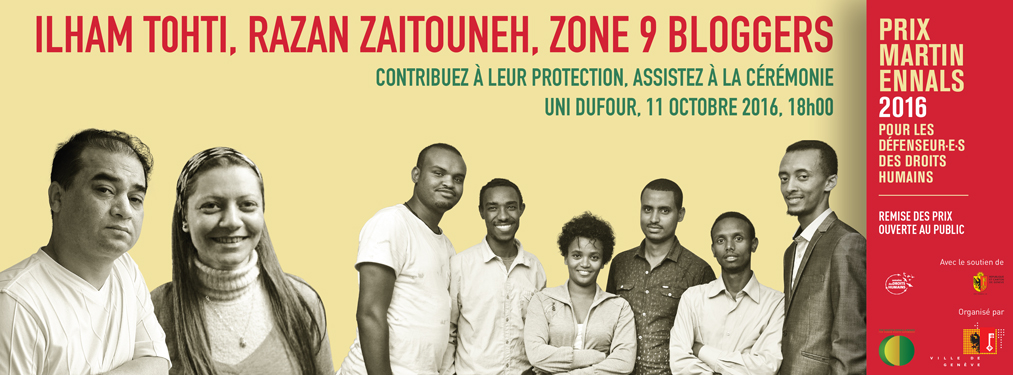
The 2016 Martin Ennals AwardCeremony, organized annually by the City of Geneva and the Martin Ennals Foundation, will this year take place on 11October, 6.00 pm, at Uni Dufour, Geneva, as thethe opening of the Human Rights Week hosted by the University of Geneva from October 11 to 14 and with the support of the Canton of Geneva.
The laureate will be selected from among three 2016 finalists:
Mr. Ilham Tohti (China) was sentenced to life imprisonment after working for two decades to foster dialogue and understanding between Uyghurs and Han Chinese.
Mrs. Razan Zaitouneh (Syria) was kidnapped after dedicating her life to defending political prisoners and documenting crimes against humanity in Syria.
Zone 9 Bloggers (Ethiopia) have been prosecuted for documenting human rights abuses in their country.
The finalists and laureate are selected by the Jury of the Martin Ennals Award, made up of ten of the world’s leading human rights organizations: Amnesty International, Human Rights Watch, Human Rights First, International Federation for Human Rights (FIDH), World Organisation Against Torture (OMCT), Frontline Defenders, the International Commission of Jurists, EWDE-Germany, the International Service for Human Rights, and HURIDOCS. The detailed programme of the ceremony will follow at the beginning of September.
Martin Ennals Award for Human Rights Defenders
For the conversation in the social media, use the hashtag: #Ennals2016.
Bahrain does everything it can to keep itself in the spotlight of human rights concern. A coalition of NGOs, as well as the UN and (reluctantly) the USA have recently come out with criticism over travel bans, reprisals, denationalization and other violations:
When the 32nd session of the United Nations Human Rights Council opened in Geneva on 13 June 2016, Nabeel Rajab, Bahrain’s best-known human rights defender, was arrested after dozens of police officers raided his home at around 5am and confiscated his electronic devices. The day before, Bahraini human rights defenders and victims of violations were prevented from flying to Geneva. On 16 June21 NGOs signed a statement of serious alarm by Bahrain’s restrictions civil society especially preventing them from engaging with the UN.
[Rajab, President of the Bahrain Center for Human Rights (BCHR – nominee of the MEA 2012), founding Director of the Gulf Centre for Human Rights (GCHR) and Deputy Secretary General of FIDH, was reportedly arrested under order from the Ministry of Interior’s Cybercrimes Unit. Bahraini officials had imposed a travel ban on Rajab a year ago, and since April 2015 have maintained charges against him for crimes related to freedom of expression online. Despite the submission of several appeals against the ban, authorities remained unresponsive. On 14 June 2016, Rajab was transferred to the public prosecution; and new charges were brought against him of allegedly ‘publishing and broadcasting false news that undermines the prestige of the state’. The public prosecution remanded him to seven days in detention pending investigation.]
In a new escalation of its crackdown against civil society, Bahraini authorities have now also banned other human rights defenders from leaving the country. The bans were imposed as the activists were attempting to travel to Geneva to participate in the Human Rights Council.
In light of this escalated attack on civil society in Bahrain, the 21 NGOs call for the immediate release of all human rights defenders in Bahrain, including Nabeel Rajab, and for the removal of the imposed travel bans which unfairly restrict activists’ freedom of movement. We also request that the President of the HRC, the UN High Commissioner for Human Rights, the Special Rapporteur on the Situation of Human Rights Defenders, the Special Rapporteur on Freedom of Opinion and Expression and the Special Rapporteur on the Rights to Freedom of Peaceful Assembly and Association call on the Bahraini authorities to immediately and unconditionally lift the travel ban imposed on Bahrain’s civil society activists and guarantee Bahraini human rights defenders are free from intimidation and restrictions on their work, including at the UN. We also call on the international community to hold the government of Bahrain to its commitments and obligations to foster a safe environment for the peaceful enjoyment of universal human rights. The government of Bahrain must immediately stop the ongoing reprisals against human rights defenders who are engaging with international mechanisms including the UN system. [21 signatories to be hound at the bottom of this post.]
On 21 June 2016, the Office of the UN High Commissioner for Human Rights stepped in with an expression of great concern over this intensification of a crackdown on free expression and association, and the right to a nationality: Read the rest of this entry »
While most attention on the issue of foreign funding of NGOs has gone to Russia, which for this purpose invented the ‘foreign agent’ law, [https://thoolen.wordpress.com/tag/foreign-agent-law/], another big country – India – has been stepping up its own version through a law restricting civil society access to foreign funding:
UN Special Rapporteur on the situation of human rights defenders Michel Forst. Photo: MINUSTAH
On 16 June 2016 three United Nations rapporteurs on human rights called on the Government of India to repeal a regulation that has been increasingly used to obstruct civil society’s access to foreign funding. The experts’ call comes as the Indian Ministry of Home Affairs suspended for six months the registration of the non-governmental organization Lawyers Collective, under the Foreign Contribution Regulation Act (FCRA), according to a news release from the Office of the UN High Commissioner for Human Rights (OHCHR) in Geneva. [see also my post form 2013: https://thoolen.wordpress.com/2013/11/05/india-should-end-funding-restraints-on-human-rights-defenders-says-hrw/]
The suspension was imposed on the basis of allegations that its founders, human rights lawyers Indira Jaising and Anand Grover, violated the act provisions by using foreign funding for purposes other than intended.
“We are alarmed that FCRA provisions are being used more and more to silence organisations involved in advocating civil, political, economic, social, environmental or cultural priorities, which may differ from those backed by the Government,” said UN Special Rapporteurs on human rights defenders, Michel Forst, on freedom of expression, David Kaye, and on freedom of association, Maina Kiai.
Despite detailed evidence provided by the non-governmental organization (NGO) to rebut all allegations and prove that all foreign contributions were spent and accounted for in line with FCRA, the suspension was still applied. “We are alarmed by reports that the suspension was politically motivated and was aimed at intimidating, delegitimising and silencing Lawyers Collective for their litigation and criticism of the Government’s policies,” the experts said noting that the NGO is known for its public interest litigation and advocacy in defence of the most vulnerable and marginalised members of Indian society.
Many civil society organizations in India now depend on FCRA accreditation to receive foreign funding, which is critical to their operations assisting millions of Indians in pursuing their political, cultural, economic and social rights. The ability to access foreign funding is vital to human rights work and is an integral part of the right to freedom of association. However, FCRA’s broad and vague terms such as ‘political nature’, ‘economic interest of the State’ or ‘public interest’ are overly broad, do not conform to a prescribed aim, and are not a proportionate responses to the purported goal of the restriction.
“Human rights defenders and civil society must have the ability to do their important job without being subjected to increased limitations on their access to foreign funding and the undue suspension of their registration on the basis of burdensome administrative requirements imposed to those organizations in receipt of foreign funds,” the UN human rights experts concluded.