Posts Tagged ‘MEA’
January 2, 2013
“The Cause of Progress” tells the story of the lives of three Cambodians caught up in the country’s chaotic and often violent economic progress, set against the backdrop of the shifting political, religious and familial landscapes of modern-day Cambodia. Shot over the course of three years, the film is a unique and intimate portrait of modern Cambodia. At times poignant and emotional, at others violent and chaotic, the film explores the impact of progress on modern society – from the corruption of the national religion, to the disintegration of the family, to the abusive power and kleptocracy of the ruling political elite.
What is happening in Cambodia is happening all over the developing world, from South America to Africa to Eastern Europe – land is being colonised by the developed world and the local elites, while the rightful owners are being displaced. This film addresses one of the most pressing issues of our time.
Each of the three personal narratives focuses on a different aspect of the story but forced evictions and land grabbing recur across all three. The Venerable Loun Sovath is a Human Rights Defender who uses video as part of his activist campaigning, all the while fighting against the corruption within his religious order. He is the 2012 Laureate of the MEA. Sopheap, facing eviction and waiting for a new home, is struggling to start a new business while she tries to cope with her slowly disintegrating family. And Srey Pov – at the front lines of a high profile forced eviction – comes face to face with a corrupt political elite and the sometimes difficult relationship between global institutions and the developing world.
This film will offer a unique insight into a country at a pivotal time in its development, finally shaking off the legacy of the past and the atrocities of the Khmer Rouge, Cambodia’s future direction is uncertain.
Those who want to keep up to date on future developments of this project should sign up to the film’s blog, join its facebook group, and mailing list and follow on twitter @chriskellyfilm
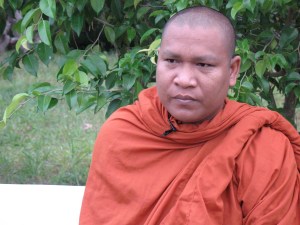
Luon Sovath by Dovona

Filmmaker Chris Kelly filming at Boeung Kak lake. Image © Nicolas Axelrod 2010.
Posted in films, human rights, Human Rights Defenders | Leave a Comment »
Tags: Africa, Cambodia, Chris Kelly, documentary, Eviction, film, Human rights defender, Human Rights Defenders, Khmer Rouge, land disputes, Loun Sovath, MEA, The Cause of Progress
December 18, 2012
Several NGOs on the Jury of the MEA (including Front Line Defenders and Human Rights First) have reported on the arrest and detention of Mr Sayed Yousif Al-Muhafdha, a human rights defender who spoke on behalf of Bahrain Centre for Human Rights at the MEA 2012 ceremony in Geneva on 2 October.
On 18 December 2012, the Public Prosecution Office ordered human rights defender Mr Sayed Yousif Al-Muhafdha to be detained for a period of seven days following his arrest the previous day after he attended a protest in Manama. He was arrested on charges of spreading false information over Twitter. He is currently being held in Hooth Al-Jaff prison in the Governorate of Muharraq.

The arrest took place on the eve of a visit to Bahrain by a delegation of Members of the European Parliament (MEPs) with a focus on human rights issues. This is the second time Sayed Yousif Al-Muhafdha has been arrested in the last two months. The previous occasion was on 2 November 2012 in the village of Diraz, where he was arrested on charges of rioting and participating in an illegal gathering. The charges related to a protest that took place in the village that day and in which the human rights defender denied having participated. He was released without charge on 14 November 2012.
http://www.humanrightsfirst.org/2012/12/17/prominent-bahraini-human-rights-defender-among-dozens-arrested-today-in-manama/
https://www.frontlinedefenders.org/node/20797
Bahrain: Free Human Rights Defender, Says HRW (eurasiareview.com)
Posted in human rights | 1 Comment »
Tags: Bahrain, Bahrain Centre for Human Rights, Front Line, Front Line Defenders, human rights, Human rights defender, Human Rights First, Manama, Martin Ennals Award for Human Rights Defenders, MEA, members of the european parliament
December 16, 2012
“Ales Bialiatski, Nabeel Rajab, Nasrin Sotoudeh… I dedicate this evening to them” With these words Souhayr Belhassen = the President of one of the oldest human rights NGOs in the world (the Anti-Slavery Society is older I think) – assigned the 90th anniversary of FIDH to its 26 activists currently in detention. Interesting to note that two of the three were nominees of the MEA tyhis year,
“These human rights activists are fighting for their freedom and their rights; they are fighting for our freedom and our rights. It is to them that I dedicate this gala evening. Your presence here this evening is a sign of your support for our fight. In their name, and in the name of FIDH, I thank you.”
read more on Human Rights Defenders : Souhayr Belhassen dedicates the 90th anniversary … – FIDH.
Posted in FIDH, human rights, Human Rights Defenders | Leave a Comment »
Tags: Ales Bialiatski, anniversary, detention, FIDH, Human Rights Defenders, MEA, Nabeel Rajab, Nasrin Sotoudeh, Souhayr Belhassen
December 7, 2012
While the debate is again raging in the Ugandan parliament and internationally on adopting an anti-homosexuality bill with extremely severe punishments, Stockholm-based Civil Rights Defenders as adopted as its HRD of the Month: Brian Nkoyooyo.
‘Fit in’, instead of standing out, is a general security advice for lesbian, gay, bisexual or transgender (LGBT) people in Uganda. “It is a matter of survival”, says Brian Nkoyooyo, Director of the grass root organisation Icebreakers that works with LGBT youth. Since he is a well-known gay activist in a country that is considered to be one of the worst countries for LGBT people, he is always on guard: “I live every day as it was my last”.
Icebreakers Uganda is a grass root organisation founded in 2004 that functions as a node for small networks, in both rural and urban Uganda. The discretely hidden office in Kampala is open throughout the week and plays an important part as a gathering point where people can meet and share experiences, use the library and get Internet access.
The interview gives considerable detail on the question and modalities of “coming out” linked to Brian’s own life experience.
The organisation strives to help people accept and be comfortable with their sexual orientation and gender identity, but calls for caution when coming out:
Interesting is that Brian states “Ironically, in 2009 the Anti Gay Bill actually led to a positive development for the LGBT movement in Uganda. Previously, only a few civil society organisations had included LGBT people’s rights in their work for human rights. With the tabling of the bill, a coalition of several civil society actors was formed to fight the Bill.” Kasha becoming the MEA Laureate in 2011 was another rallying point.

Foto: Ninke Liebert Photography
“As an activist, I can stand up and speak out. People may choose to listen and other may not. I can easily be made to shut up. But with art, it lasts for centuries and it reaches a wider audience. I prefer use of art and music because I know the biggest number of the community appreciates it compared to long boring speeches”.
Despite being constantly afraid, for his family’s sake, his gay and straight friends and himself, Brian continues to work because he has a vision for the LGBT community and Uganda at large. “A dream where people live harmoniously regardless of their differences: sexual orientation, race, gender and more. A society full of love”.
for full story go to : https://www.civilrightsdefenders.org/featured/human-rights-defender-of-the-month-brian-nkoyooyo/
Posted in human rights, Human Rights Defenders | 1 Comment »
Tags: anti-gay bill, Brian Nkoyooyo, Civil Rights Defenders, gay, Gender identity, Human rights defender, Kampala, Kasha, LGBT, MEA, Sexual orientation, Uganda
December 5, 2012
The LA Times and others report that jailed Iranian human rights lawyer Nasrin Sotoudeh, 2012 nominee of the MEA and winner of the Sacharov Award, has halted her hunger strike after the Iranian judiciary agreed to drop a travel ban against her daughter, her husband Reza Khandan said this Tuesday. Sotoudeh had endured nearly seven weeks without food, drinking salt and sugar solutions, to protest her 12-year-old daughter Mehrave being banned from leaving the country. The couple claimed their daughter was being punished for the alleged crimes of her mother, who has defended dissidents.
Khandan went with a group of female activists to the Iranian parliament on Tuesday, where they met with reformist lawmaker Mohammad Reza Tabesh, who in turn negotiated with the deputy speaker and speaker Ali Larijani to obtain an agreement from the head of the judiciary, Khandan said.

“They agreed to close the dossier of Mehrave and she is no longer banned from leaving the country and there are no charges against her,” Khandan said Tuesday.
The family reunited Tuesday evening in the administration department of Evin Prison, the husband said. Sotoudeh, who had earlier been restricted to talking to her children behind a glass partition, was allowed to hug her son and daughter.
“There she stopped her hunger strike and started eating in front of us,” he said.
The United Nations high commissioner for human rights called again Tuesday for Sotoudeh to be released along with other detained human rights activists. Iranian authorities often target the families of human rights defenders, “a disturbing trend apparently aimed at curbing the freedoms of expression, opinion and association,” spokesman Rupert Colville said in a Tuesday briefing.
via: http://shahriarshahabi.com/2012/12/04/nasrin-sotoudeh-breaks-49-day-hunger-strike/
Posted in Human Rights Defenders | Leave a Comment »
Tags: Ali Larijani, China Human Rights Defenders, Evin Prison, human rights, Human Rights Defenders, hungerstrike, Judicial system of Iran, Khandan, MEA, Nasrin Sotoudeh, Office of the United Nations High Commissioner for Human Rights, Sacharov
November 21, 2012
In various parts of the world human rights defenders brave legal harassment, arbitrary detention, ill treatment, torture and sometimes death, in seeking to secure freedom and dignity for all. In challenging serious abuses of State power, many such defenders find themselves behind bars;

FIDH works endlessly to secure the release of these (and other) human rights defenders, mainly through the Observatory for the Protection of Human Rights Defenders – its joint programme with OMCT.A recent summing up by FIDH of their (local affiliate) in
Bahrain,
Belarus,
Iran,
Turkey and
Uzbekistan makes sobering reading:
Check out the steps that led to their detention:
The Bahrain Centre or Human Rights is one the 2012 nominees of the Martin Ennals Award.
- In BELARUS :Ales Bialiatski, President of the Viasna Human Rights Centre and FIDH Vice President
Since his election in 1994, Belarusian President Alexander Lukashenko, has installed an authoritarian regime that represses freedom of expression, assembly and association. The human rights situation in Belarus markedly deteriorated on 19 December 2010 when riot police brutally dispersed demonstrators protesting against the unfair handling of the presidential election. This event marked the beginning of an unprecedented wave of repression, which continues to this day. Prominent human rights defender, Ales Bialiatski was arrested in Minsk on 4 August 2011 and sentenced to four-and-a-half years in prison on trumped up tax evasion charges. He remains in prison to this day.
- In IRAN :Mohammad Ali Dadkhah, founding member of Defenders of Human Rights Centre (DHRC) and human rights lawyer
Abdolfattah Soltani, founding member of DHRC and human rights lawyer
Mohammad Seifzadeh, member of the DHRC and human rights lawyer
Nasrin Sotoudeh, member of DHRC and prominent human rights lawyer known for defending juveniles facing death penalty, prisoners of conscience, human rights activists and child victims of abuse; she is lso a 2012 MEA nominee
- In TURKEY :Muharrem Erbey, IHD Vice Chairperson and former Chairperson of Diyarbakır branch
Arslan Özdemir, Executive, IHD Diyarbakır branch
Şerif Süren, Executive, IHD Aydın branch
Orhan Çiçek, Executive, IHD Aydın branch
Reşit Teymur, Executive, IHD Siirt branch
Abdulkadir Çurğatay, Executive, IHD Mardin branch
Veysi Parıltı, Executive, IHD Mardin branch
Şaziye Önder, representative IHD Doğubeyazıt (Ağrı)
Mensur Işık, former Chairperson, IHD Muş branch
Hikmet Tapancı, Executive, IHD Malatya branch
Ali Tanrıverdi, Chairperson IHD Mersin branch
Osman İşçi, IHD General Headquarters (Ankara) former worker and member of IHD
Hanim Koçygit, Executive, IHD Sakarya branch
Bekir Gürbüz, former Chairperson, IHD Adıyaman branch
FIDH notes in this respect: Despite Turkey’s considerable human rights progress since 2000, those expressing ideas on “sensitive” human rights related issues continue to be targeted and criminalised by the public authorities. So-called “sensitive” questions include the promotion of alternative identities to the Turkish mainstream (e.g. asserting the rights of ethnic and religious minorities, especially Kurds, as well as the rights of sexual minorities). It also encompasses any criticism of the State and its institutions, including institutional functioning, judicial independence, and impunity for human rights violations. Members of NGOs, lawyers, trade unionists, journalists, intellectuals, academics, conscientious objectors, the families of victims of serious human rights violations, and others have been targeted by State policies that consider their expression of their views to be a threat. Fourteen members of the Human Rights Association (IHD), a Turkish FIDH member organisation, are currently being held in preventive detention under an anti-terrorism law that criminalises legitimate expression of opinion.
- In UZBEKISTAN :Zafar Rakhimov, member of the Human Rights Society of Uzbekistan (HRSU) Kashkadarya regional branch
Nasim Isakov, member of the HRSU Djizak regional branch
Yuldosh Rasulov, member of the HRSU Kashkadarya regional branch
Azam Formonov, Head of the Sirdarya regional branch of the HRSU
Gaybullo Jalilov, member of the HRSU Karshi regional branch
Uzbekistan has the highest number of human rights defenders serving lengthy prison sentences in Eastern Europe/Central Asia. These sentences are usually served in penal colonies where the regime is extremely strict. Harsh conditions and ill treatment have caused the health of incarcerated defenders to deteriorate quickly. These inhumane and degrading conditions are currently the reality of several members of FIDH member organisation, the Human Rights Society of Uzbekistan.
Posted in FIDH, Human Rights Defenders | Leave a Comment »
Tags: Bahrain, Belarus, detention, FIDH, harassment, human rights, Human rights defender, International Federation for Human Rights, Iran, MEA, Observatory for the Protection of HRDs, OMCT, Turkey, Uzbekistan
November 17, 2012
The Economist in its print edition of Nov 10th 2012 carries an interesting review of a new documentary on David Kato (pictured here with caption: “His death was not in vain”
 In 2009 David Bahati, a backbench member of Parliament in deeply conservative Uganda, drew up a bill that proposed the death penalty for HIV-positive gay men and prison for anyone failing to turn in homosexuals. His proposals have been watered down, but not before prompting a surge in the homophobia and vigilantism that lie at the heart of an affecting new documentary, “Call Me Kuchu”.
When the film begins, a local tabloid newspaper, Rolling Stone, has printed the names and addresses of 100 kuchus (gay and transgender people) under such headlines as “Homo terror! We name and shame top gays in the city”. It is here that the viewer first meets David Kato (pictured), a sweet but resilient activist and Uganda’s first openly gay man. He is suing the newspaper. “If we keep on hiding,” he says, “they will say we’re not here.” Kato is joined by fellow kuchus: Stosh, who endured a “corrective” rape, and Naome, his best friend. Theirs is the human story behind the headlines. Meanwhile, the smarmy newspaper editor is almost unwatchable in his eagerness to harness the growing bigotry.
In exploring how much of this debate has been driven by religious leaders, the film-makers, Katherine Fairfax Wright and Malika Zouhali-Worrall, maintain a careful balance: footage of a visiting American evangelical group battling the “homosexual agenda” is interspersed with that of a staunch gay-rights supporter, a controversial Ugandan bishop, Christopher Senyonjo. Ubiquitous billboards quoting the Bible appear alternately ominous and benign. But it is Kato’s brutal murder, a year after the film started being made, that breaks the mood of polite even-handedness. Officially, his death is recorded as a burglary gone wrong. No one really believes that.
“Call Me Kuchu” is too raw and urgent to be called artful film-making. But its message rings loud and clear. Life for gay people in Uganda—as in much of Africa—is not just dangerous; it is deadly.
In the film on Kasha (MEA laureate 2011: http://www.martinennalsaward.org) there are also moving images of Kasha visiting David’s mother and his grave.
Posted in films, human rights, Human Rights Defenders | 3 Comments »
Tags: Africa, David Bahati, David Kato, Kasha, Katherine Fairfax Wright, LGBT, Malika Zouhali-Worrall, MEA, Rolling Stone, Uganda
November 16, 2012
According to Iranian blogger Arseh Sevom writing today the young children of detained lawyer Nasrin Sotoudeh, nominee of the 2012 MEA, were finally allowed to visit their mother in prison on Monday 12 November with security forces present. Referring to her mother’s health conditions as a result of the continuous hunger strike, Mehraveh said: “She has lost weight and is taken to the infirmary on occasion.”
Sotoudeh’s husband Reza Khandan wrote [in farsi]: “Today, right after he stepped out of the jail’s gate, Nima [their son] took away the kiss from his cheek and put it on mine saying that mom said keep this kiss and give it to daddy when you see him”. Two days before the visit, Khandan and his two children waited for three and a half hours to visit their wife and mother, but were denied access
Posted in human rights | Leave a Comment »
Tags: Evin Prison, family visit, Iran, MEA, Nasrin Sotoudeh, prison, Reza Khandan
November 10, 2012
 On 7 November the activist monk Luon Sovath, MEA Laureate of 2012, spoke to Radio Free Asia about his work.
As the interview is quite interesting I copied here in in full:
Fresh from receiving the “Nobel Prize for Human Rights,” Cambodia’s technology-savvy activist monk Loun Sovath has called on authorities in his country to end the use of violence in land eviction cases, vowing to continue his struggle to protect victims of land grabs. He also said he would not be cowed by government harassment and called on his fellow monks, often respected as figures of moral authority in Cambodia, to join in the struggle to defend villagers who have become victims of forced evictions. Loun Sovath was the first Southeast Asian to be presented with the 2012
Martin Ennals Award for Human Rights Defenders as he was selected for documenting the struggle of land rights activists and ordinary citizens evicted from their homes in his impoverished country. The monk collected the award—viewed by many as the Nobel Prize for Human Rights—in Geneva last month.
“The Buddha advised people to do good deeds both physically and mentally,” he told RFA’s Khmer service during an interview in Washington on Wednesday. “Respecting human rights is a good deed which will lead to peace and prosperity for this world and in the next. So for monks to become rights defenders is nothing against Buddhism, but can lead to enlightenment and peace.” “Monks play a vital role in society. I appeal to monks to rise up to follow in the Buddha’s footsteps,” he said. Loun Sovath said the Cambodian people must also rise up to demand their rights, highlighting land disputes as the one of the biggest issues facing the public in the country.
“The authorities must stop using violence against innocent villagers who are the victims of land grabbing,” he said. Research by Cambodian rights group LICADHO shows that some 2.1 million hectares of land has been given to private companies in the form of land concessions over the last two decades. The massive transfer has led to countless forced evictions and affected over 400,000 people in the 12 provinces that LICADHO monitors since 2003 alone, the group said.
Sovath is currently touring the U.S., meeting with the Cambodian community and addressing various nongovernmental organizations on the human rights situation in his country. He began his nearly two-month visit last week in New York, traveled to Washington, and arrived in Chicago Thursday. Sovath said he was honored to receive the Martin Ennals Award.
“I was given the award because I have worked as a rights defender and a protector of social justice involved with land issues, forced evictions, and the protection of natural resources and wildlife,” he said. In June 2011, the New York-based Human Rights Watch awarded Loun Sovath with the Hellman/Hammett grant for his work supporting communities facing forced evictions and land-grabbing in Cambodia.
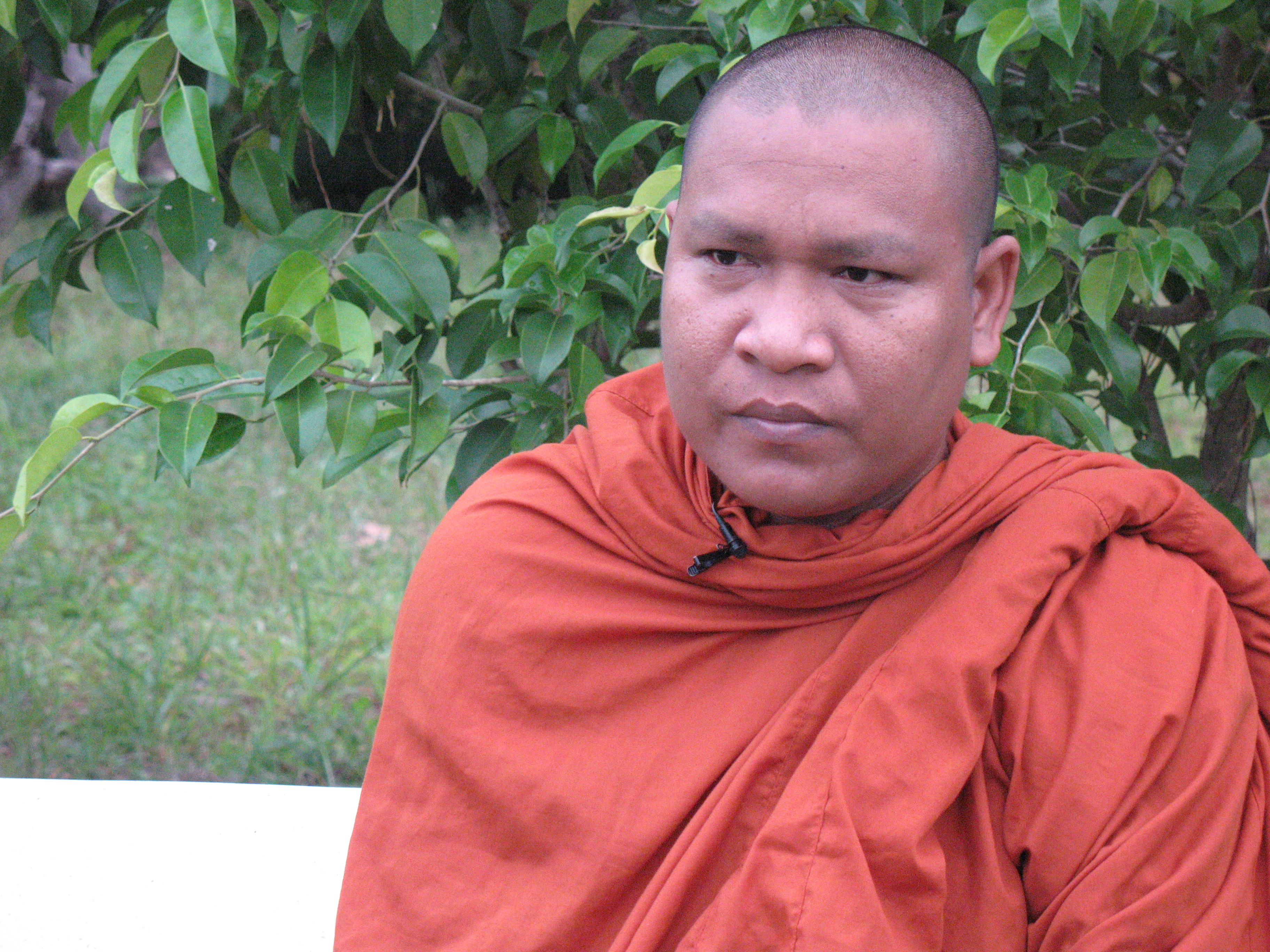
Luon Sovath by Dovana
Years of activism Sovath first became involved in human rights work in 2009, when members of his family were injured during a police shootout at unarmed villagers in a land eviction case. The monk’s brother and nephew were wounded in the standoff, which he documented in a video. He is known for his extensive use of video to inform the world about his confrontations with authorities, earning him the nickname “multimedia monk.” The monk is rarely seen without a mobile phone or tablet. He also uses songs and art to spread his non-violent message of defending human rights. Loun Sovath said he strove to protect human rights in the interest of his country. “I have a desire to help build Cambodia,” he said. In June, Loun Sovath was briefly detained by Cambodian authorities and accused of “causing instability” after he joined protests against the jailing of 13 women over a long-running forced land eviction case in the capital Phnom Penh. Municipal monk officials threatened to have him defrocked as a monk, but released him after he put his thumbprint on a statement assuring that he will not join future protests. Loun Sovath had been banned in April from entering pagodas in Phnom Penh after he participated in land protests.
Sovath, who has since participated in various protests, said he would not stop his activism even though he was concerned about his personal safety. “The authorities have tried to prevent me from doing good things and from helping the country and [the Buddhist] religion,” Sovath said. “I can’t accept this because I have done nothing wrong,” he said. “As long as human rights violations continue to exist in Cambodia, I will continue to do my work.”
Reported by Samean Yun for RFA’s Khmer service. Translated by Samean Yun. Written in English by Joshua Lipes.
Copyright © 1998-2011 Radio Free Asia. All rights reserved.
Posted in human rights, Human Rights Defenders, MEA | 1 Comment »
Tags: award, Buddhism, Cambodia, Eviction, Human Rights Defenders, Land issues, Loun Sovath, Luon Sovath, Martin Ennals Award for Human Rights Defenders, MEA, multimedia, Non-governmental organization, Phnom Penh, Radio Free Asia
November 8, 2012
Many organizations have called on the Bahraini authorities to immediately release the human rights activist Sayed Yusuf al-Muhafadha and drop all “illegal gathering” charges against him. On October 30, 2012, the government issued an indefinite ban on public protests. Security forces arrested al-Muhafadha, acting vice president of the Bahrain Center for Human Rights (BCHR), in al-Diraz, west of Manama, on November 2. Al-Muhafadha was taken into custody after he tried to photograph an injured protester at a protest against the ban. Earlier in the day he had tweeted photos of security forces attacking protesters with teargas in the village of Bilad al-Qadeem, the Washington Post reported. The day after he was arrested, the public prosecutor decided to hold him in detention for a week pending investigation on charges of “illegal gathering of more than five people.”
Sayed Yusuf al-Muhafadha is acting vice president of the Bahrain Center for Human Rights (BCHR) and represented them at the MEA ceremony on 2 October in Geneva. For images see the website: http://www.martinennalsaward.org, summary of the 2012 ceremony.
Posted in human rights | Leave a Comment »
Tags: Bahrain, Bahrain Centre for Human Rights, freedom of assembly, Human rights defender, Manama, MEA, Sayed Yusuf, Sayed Yusuf al-Muhafadha, tweet

 Hans Thoolen on Human Rights Defenders and their awards