On 16 February, 2024 Sandra Epal Ratjen & Nicolas Agostini in Global Rights reported on a UN consultation on law enforcement’s role in peaceful protests which brought together practitioners and human rights defenders.
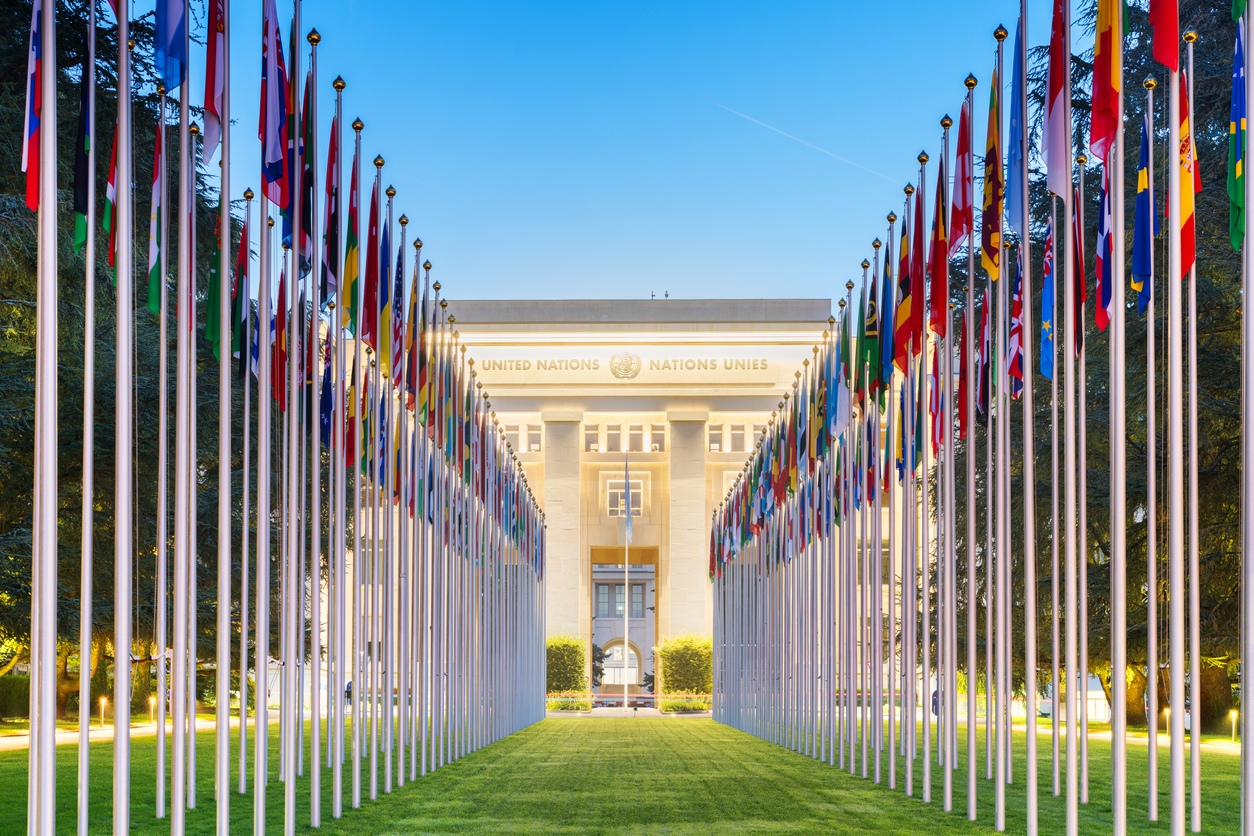
Over two days in Geneva, the UN special rapporteur on freedoms of peaceful assembly and association, Clément Voule, the UN Human Rights Office (OHCHR), and the UN Office on Drugs and Crime (UNODC) convened a consultation on the facilitation of peaceful protests by law enforcement. The event followed several regional workshops, organized in accordance with Human Rights Council resolution 50/21, which requested that the special rapporteur develop “technical and practical tools . . . to assist law enforcement officials in promoting and protecting human rights in the context of peaceful protests.” There was nothing unusual in this format—or in the event’s title. But despite its attractive feel (at least for human rights geeks), it ran the risk of turning into yet another academic discussion replete with theorizing but offering little in the way of practical solutions.
It turned out to be one of the most refreshing, engaging, and action-oriented human rights dialogues we’ve attended.
It’s about the makeup
What made the event rather unusual was its makeup. In addition to civil society members (public assembly, law enforcement, torture, and rule of law specialists attended), the consultation brought together practitioners from all over the world. By “practitioners,” we mean not just police watchdogs (oversight bodies and disciplinary authorities) but police officers and commanders, all on active duty.
While some activists would draw back with a wince, those human rights defenders and organizations who were present engaged with an open mind, as did law enforcement personnel. Participants weren’t going to talk amongst themselves or only preach to the converted. They were going to try to bring about an actionable outcome. After all, their aim was to devise how law enforcement can facilitate peaceful assemblies and protect rights in such contexts.
Peer pressure was minimal. On all sides, there was nothing to “prove”: no need to adopt an intransigent position, no need to show you’re smart, no need to cajole anyone—there were only incentives to share expertise and experience.
Sure, there were precedents. Recent workshops brought together practitioners and outlined best practices. For instance, the “Istanbul Process” meeting on promoting religious tolerance held in Singapore was practitioner-centric. Since then, however, the Istanbul Process has collapsed as the Organization of Islamic Cooperation (OIC) revived the “defamation of religions” agenda.
Without naïveté but considering the “real-world” nature of the outputs of this process, we’re confident that the work done under the auspices of Clément Voule, OHCHR, and UNODC will, to some extent, enhance human rights compliance in police practice and benefit both peaceful protesters and law enforcement officials. Notably, the outcome documents are less technical than most human rights documents.
It’s also about the substance
The consultation was also innovative because of its hands-on approach. In addition to the main working document, a “Model Protocol” for the law enforcement facilitation of peaceful protests, the project led by Clément Voule and his team, OHCHR, and UNODC will produce a “Handbook” and a “Checklist” for law enforcement professionals. The latter two will be practical documents guiding police practice.
The magnitude and diversity of experiences in the room meant that discussions were light-years away from sterile sloganeering or divisive debates—the kind we see on social media. On civil society’s side, no one advocated “defunding the police.” On the police side, no one advocated for qualified immunity. All participants created a fertile ground for dialogue on how to ensure human rights-compliant, competent, and respected law enforcement that is able to facilitate, not hinder, public assemblies.
Civil society participants recognized the need for well-funded, well-trained police. We kept in mind (and were reminded of) the realities of the job—what the average law enforcement officer faces daily. The challenges include understaffing, lack of adequate training, and, quite simply, fear (facing a crowd, even peaceful, will never feel like sitting on your sofa sipping a Whiskey Sour). Law enforcement participants, for their part, recognized the need for accountable police behavior and to confront discrimination and abuses of power. They kept in mind (and were reminded) that to be respectful is a sine qua non to be respected.
Also reviewed were “prior to protest,” “during protest,” and “after protest” issues, plus the situation of specific groups and accountability for violations. One section addressed police well-being, which is essential to human rights compliance, as strained police officers are much more likely to engage in misconduct. We didn’t shy away from addressing sensitive issues—police brutality, accountability, or budgeting.
It wasn’t an echo chamber, but participants agreed on key points. Among others: the role of police vs. the role of prosecution; the need for effective communication between protesters and police, de-escalation, and adequate training for police officers; or the fact that a clear distinction must always be made between peaceful and non-peaceful elements of an assembly.
It was a far cry from the way these conversations unfold online, and once again, one can see the toxicity of social media. Instead of fostering healthy discussions (differences aren’t that wide between most people), social media algorithms artificially promote simplistic views, entrench positions, and elevate the most divisive topics. This process distracts those seeking solutions from problem-solving. No one benefits from this situation—certainly not rights-holders.
Don’t forget political will
Assuredly, the outcomes of this consultation will go unheeded in many countries, where protests are rare or police have total impunity. Elsewhere, not much will happen without political will.
But the beauty of this consultation is that political will to facilitate assemblies won’t need to come from the highest level. Once publicly available, the outcome documents—particularly the Handbook and Checklist, with their guidelines on communication, de-escalation, and risk assessment regarding protests—will be available for law enforcement agencies and officers at all levels to use. The ideal scenario, of course, will be governments publicly committing to using the outcome documents.
The final documents will stem from a dialogue that brought together people with hands-on experience who tried to build bridges and maximize their chances of having an impact on the ground. This model should inform future human rights dialogues.
The Protocol, Handbook, and Checklist will be presented at the next session of the UN Human Rights Council, February 26–April 5, 2024. Clément Voule will make his last appearance as special rapporteur. For his successor—and for all people of goodwill who want to see peaceful protests proceed without hindrance, as well as rights-compliant law enforcement, joint work will be needed to popularize, operationalize, and implement the documents.
On 25 January 2022 important Research by Jon Vrushi and Roberto Martínez B. Kukutschka of Transparency International (which just published it 2021 Corruption Perceptions Index) shows a perhaps not surprising but undoubted link between human rights and corruption. They say: Corruption enables both human rights abuses and democratic decline. In turn, these factors lead to higher levels of corruption, setting off a vicious cycle.
…While all states have a responsibility to respect, protect and fulfil the human rights of all people, the presence of corruption can weaken a government’s ability to do so by undermining the overall functioning of the state – from the delivery of public services, to the dispensation of justice and the provision of safety for everyone.
More specifically, the duty to respect means that the state must not act in violation of human rights, for example, by using violence against peaceful demonstrators. Corruption can undermine this obligation when, for example, the government instrumentalises the police or judiciary to unfairly detain, arrest or intimidate opponents or dissidents. Corruption in law enforcement can jeopardise people’s safety and victims’ access to justice. On the one hand, corruption in law enforcement can drive human right violations such as ill-treatment or torture in the hands of officers including in detention settings or through police practices. In other cases, corruption might permeate the administration of justice including by slowing investigations into human rights violations and affecting due process.
What is more, corruption and impunity contribute to an unsafe climate for human rights defenders to operate in. Having examined the data collected by Frontline Defenders, we found that out of the 331 cases of murdered human rights defenders in 25 countries in 2020, 98 per cent of those deaths occurred in 23 countries with high levels of public sector corruption, or a CPI score below 45. Moreover, at least 20 of all cases were registered as killings of human rights defenders dealing with anti-corruption issues.
The second state obligation, to protect, means that governments should ensure that no one infringes the rights of its people. Corruption can also undermine this obligation. Organised criminal groups routinely murder journalists and human rights defenders and the state often fails to protect their safety. Similarly, private actors can rely on bribery and/or personal connections to ensure that the state turns a blind eye to human rights abuses. If the state fails to prevent a company, which has made a large campaign donation, from polluting a water source on which people depend on and puts their health at risk, the state is effectively failing in its obligation to protect.
Finally, corruption can directly undermine a government’s ability to fulfil its human rights obligations to take positive actions to guarantee the enjoyment of basic human rights. When states allow the embezzlement of public funds meant to be spent on providing healthcare or when rigged public procurement processes fail to deliver the necessary goods and services for education, states fail in their responsibility to fulfil the rights to health and education.
While all three obligations are equally important, state failure to respect human rights can lead to catastrophic consequences for democracy and the rule of law, as it can subvert fundamental rights which are critical for government accountability, such as freedom of expression, assembly and association. This, in turn, makes it harder to keep corruption in check and can lead to a vicious cycle of corruption, human rights abuses, and democratic decline.
The graph below shows how corruption and abuse of civil liberties go hand-in-hand. The civil liberties score, a dimension of the Democracy Index from the Economist Intelligence Unit, contains indicators on freedom of expression, association, assembly, personal safety and access to justice, among others. What we observe is that there is a strong and positive correlation between good governance and the respect of human rights and that very few countries have managed to establish effective control of corruption without also respecting human rights. This relationship holds even when controlling for the level of development (see Annex).
Keeping corruption out of the public eye is essential to ensure that those who participate in it face no consequences. Restricting freedoms of expression, association and assembly is thus a popular tactic to weaken societal checks on corruption, reducing the chances of being denounced for engaging in corruption and facing consequences. Simultaneously, this helps to perpetuate corrupt networks and practices. To ensure they face no legal consequences, in some cases corrupt officials also capture the judiciary and independent oversight institutions. To prevent loss of their privileges, corrupt and their cronies often resort to oppressive measures, curtailing civil liberties.
Take Nicaragua, for example, where President Daniel Ortega has ruled since 2007 and the country has experienced democratic decline, along with restrictions to fundamental freedoms and rampant corruption. Nicaragua is one of the significant decliners on the 2021 CPI, having dropped from a score of 29 in 2012 to 20 in 2021.
Nicaragua now ranks in the bottom 20 countries on the Index. At the same time, Nicaragua’s scores on V-Dem’s “Freedom of Expression”, “Freedom of Association” and “Access to Justice” indicators have dropped to record low levels. Corruption in the justice system and total capture of the courts by the executive means that human rights abuses go unchecked, providing no access to justice or remedy for victims in the country. At the same time, politically motivated corruption charges against opposition figures.
further impinge on political rights and liberties while government officials face virtually no accountability for acts of corruption. This climate of total impunity allows the government to further restrict fundamental rights, like freedom of expression, association and assembly. In some cases, they become direct attacks.
In 2019, one of the oldest newspapers in Nicaragua, El Nuevo Diario, reported that it was forced to close after authorities prevented it from obtaining newsprint and ink. Furthermore, between March and July 2020, Nicaragua’s Observatory of Aggressions on the Independent Press reported 351 attacks including unjust prosecutions, arbitrary detentions and harassment of media workers and their families. Human rights abuses continue, including bans on protests, attacks on freedom of expression, and the stigmatisation and persecution of journalists and human rights defenders.
Attacks on checks and balances as well as on civil liberties do not only occur in countries with systemic corruption and weak democratic institutions, but also in consolidated democracies. Hungary serves as a cautionary tale where following corruption and full capture of the state, the country has fallen to the lowest score in the Freedom in the World Index since the end of the communist regime in 1989. The abuse of media, civic space and the judiciary by democratic governments alleged to be involved in corruption has also been prevalent in Czechia, Slovenia and Brazil, among others.
What is more, not everyone is equally able to challenge corruption. Repressive officials or those seeking to silence anti-corruption campaigners are less likely to fear being held to account when they target individuals from marginalised groups. People from discriminated groups are therefore more exposed to potential backlashes and human rights abuses when they try to make their voices heard. The enhanced level of danger also applies to anti-corruption campaigners who champion the cause of discriminated groups, such as Transparency International’s chapter in Guatemala, which seeks to uncover and challenge acts of collusive corruption between state officials and mining companies that harm Indigenous Peoples.
Transnational corruption as enabler of human rights abuses
Various actors in the top-scoring countries are all too eager to help authoritarian and kleptocratic regimes clean their reputations – not just their money.
The case of Kazakhstan and the United Kingdom shows this corrupt backscratching at work. The heavy-handed response to protests in the country in early January made international headlines, echoing events of the Zhanaozen massacre from 10 years ago. Nursultan Nazarbayev, the country’s president at that time turned to the UK’s former prime minister Tony Blair to help him with his image. In a leaked letter Blair reportedly advised and provided Nazarbayev with talking points on how to handle critical questions about Zhanaozen. Months later, the government jailed an opposition leader for allegedly orchestrating the events. Blair continued to defend Kazakhstan’s regime on various occasions.
More international coordination is needed to ensure that foreign dictators and western enablers do not circumvent anti-money laundering and sanctions regimes.
Transnational corruption enables human rights abuses and exacerbates repression by allowing autocrats to:
Enjoy looted funds and reward cronies. Without the help of professional enablers like complicit bankers, lawyers, accountants, real-estate brokers etc, kleptocrats would not be able to enjoy their funds and pay off those who support them. In turn this means that they can stay in power by buying support and dispensing patronage to cronies.
Launder their reputation abroad. By employing western public relations firms, lobby professionals and even funding universities kleptocrats and autocrats ensure that little pressure will come to bear from the international community on their human rights abuses record.
Evade accountability. By hiding their financial transactions, autocrats make it almost impossible for law enforcement or judicial bodies, at home or abroad, to find traces of their malfeasance, ensuring they stay in power and unscathed. They can also bypass sanctions regimes, such as those aimed directly at human rights abusers through the Global Magnitsky Act or similar legislation.
In 2017, the Azerbaijani Laundromat investigations found how a network of slush funds financed Azerbaijan’s bribe-induced foreign policy and reputation. Three Spanish delegates to the Parliamentary Assembly of the Council of Europe (PACE) are suspected of benefiting from the Laundromat. In return, they allegedly watered down the human rights body’s criticism of events in Azerbaijan under the country’s repressive authoritarian regime. In 2021, authorities in Germany expanded their previous investigations into the Azerbaijani Laundromat. Another (now former) German parliamentarian is under investigation for similar reasons. Transnational corruption schemes allowed the Azerbaijani government to conduct a type of caviar diplomacy, bribing abroad and shoring up support from cronies at home.
Effects on democracy and corruption
Civil and political rights including freedom of expression, freedom of association and assembly, as well as access to justice are integral to healthy democracies. They guarantee the participation of citizens and groups in democratic and policy processes and can help keep corruption in check. The current wave of autocratisation is not primarily driven by coups and violence, but rather by efforts to undermine democracy gradually. The descent into authoritarianism usually begins with violations to people’s civil and political rights, attacks on civil and political rights, efforts to undermine the autonomy of oversight undermining election management bodies, and trying to control or directly attack the media to help disseminate the regime’s ideology while supressing criticism.
The case of Belarus, which this year fell 6 points in the CPI score this year, perfectly illustrates the limits of this top-down model and how the apparent successes in controlling corruption can quickly prove illusory where they are subject to the whims of a dictator or a regime that does not allow criticism, opposition or political competition. The country also serves as a cautionary tale for similar regimes.
While examples of successful top-down anti-corruption reforms exist in countries like China, Cuba and Singapore. These efforts are few and far apart. Furthermore, some of the most successful anti-corruption reforms that started with top-down interventions, eventually had to incorporate more bottom-up approaches to ensure their sustainability. Hence, sustainable anti-corruption strategies go hand in hand with the protection of universal human rights and fundamental freedoms.
For these reasons, in its Strategy 2030, Transparency International recognises that corruption cannot be countered without fundamental human freedoms to organise, associate, access information and speak up as well as a free and independent media.
To end the vicious cycle of corruption, human rights violations and democratic decline, people should demand that their governments:
Uphold the rights needed to hold power to account. Governments should roll back any disproportionate restrictions on freedoms of expression, association and assembly introduced since the onset of the pandemic. Ensuring justice for crimes against human rights defenders must also be an urgent priority.
Restore and strengthen institutional checks on power. Public oversight bodies such as anti-corruption agencies and supreme audit institutions need to be independent, well- resourced and empowered to detect and sanction wrongdoing. Parliaments and the courts should also be vigilant in preventing executive overreach.
Combat transnational forms of corruption. Governments in advanced economies need to fix the systemic weaknesses that allow cross-border corruption to go undetected or unsanctioned. They must close legal loopholes, regulate professional enablers of financial crime, and ensure that the corrupt and their accomplices cannot escape justice.
Uphold the right to information in government spending. As part of their COVID-19 recovery efforts, governments must make good on their pledge contained in the June 2021 UNGASS political declaration to include anti-corruption safeguards in public procurement. Maximum transparency in public spending protects lives and livelihoods.
The Berlin-based nongovernmental organisation surveys business leaders and experts to assign scores to 180 countries and territories on their perceived levels of public sector corruption. Using a scale from 0 to 100 (with 100 being very clean and 0 ranking as highly corrupt), the 10th annual report found that two-thirds of countries scored below 50. The average score was 43 out of 100. Overall, the fight against corruption is having mixed results – with some nations making gains and others falling behind. “Since 2012, 25 countries significantly improved their scores, but in the same period 23 countries significantly declined,” the report said.
It also found that despite increased momentum to end the abuse of anonymous shell companies, many high-scoring countries with relatively clean public sectors continue to enable corruption. A shell company does not have a physical location, employees, products or revenue. It is used to store money, help facilitate tax avoidance and, in some cases, deal in illegal activity such as money laundering. Some high-ranking countries such as Switzerland have been called tax havens in part due to their tolerance of shell companies.
In the Guardian of Nigeria of 21 September, Joseph Okoghenun writes that the American Bar Association [ABA] yesterday expressed their disappointments on the inability of the Nigerian Government to enforce rule of law and respect the rights of Nigerians, especially of those defending human rights in the country. In letter specifically addressed to the Attorney General of the Federation and Minister of Justice, Mr. Mohammed Bello Adoke, the Center for Human Rights of the ABA, said it was deeply “concerned at recent events in Nigeria that threaten the rights and activities of human rights defenders and undermine the rule of law.” The letter cited several reports it received from Nigerian NGO Civil Liberties Organisation [CLO] about conduct that “reflect a pattern of ongoing human rights abuses by security forces in Nigeria, including extrajudicial killings, torture, arbitrary arrests, and extortion”. The ABA strongly but respectfully urged the minister of justice to look into this matter.
The Observatory for the Protection of Human Rights Defenders (a joint programme of two reputed international NGOs: the FIDH andOMCT) has been informed by the Greek Helsinki Monitor (GHM) about the police harassment of Ms. Electra Koutra, GHM legal counsel, in the framework of police profiling operation against transgender persons in Thessaloniki. Read the rest of this entry »
This recent film is not directly about Human Rights Defenders (although they are certainly victims of it) nor about the treatment of ethnic minorities. Rather is demonstrates. through a large variety of interviews with victims, lawyers – including Basil Fernando of the Asian Human Rights Commission – and experts, how a lack of investigative skills and high-level condoning have led the Sri Lankan policy to use torture routinely. Most shockingly a former police officers confirms that this is what is expected from the police by the system. It has become a mindset at all levels, including most of the judiciary. It is a long film but worth it. The Danish film maker, Josefina Bergsten, manages to demonstrate the disconnect between international procedures (which are based on functioning institutions that have to address a few bad apples) and the reality on the ground in Sri Lanka where the good apples are the exception. See it and forward it: https://vimeo.com/41898677


 Hans Thoolen on Human Rights Defenders and their awards