Posts Tagged ‘Latin America’

Mexico and disappearances: special report by Human Rights Watch

February 21, 2013

Mexico’s security forces have participated in widespread enforced disappearances, Human Rights Watch said in a special report released on 20 February 2013.  Virtually none of the victims have been found or those responsible brought to justice, exacerbating the suffering of families of the disappeared, Human Rights Watch found. The 176-page report, “Mexico’s Disappeared: The Enduring Cost of a Crisis Ignored,” documents nearly 250 “disappearances” from December 2006 to December 2012. In 149 of those cases, Human Rights Watch found compelling evidence of enforced disappearances, involving the participation of state agents. HRW_logo
President Peña Nieto has inherited one of worst crises of disappearances in the history of Latin America,” said José Miguel Vivanco, Americas director at Human Rights Watch. “While his administration has announced some important measures to assist victims, it has yet to take the steps necessary to ensure that those responsible for these horrific crimes are brought to justice.

Human Rights Watch found evidence that members of all branches of the security forces carried out enforced disappearances: the Army, the Navy, and the federal and local police. In some cases, such as a series of more than 20 enforced disappearances by Navy personnel in June and July 2011 in Nuevo León and Tamaulipas, the common modus operandi of the crimes, the scale of the operations, and the inconsistent accounts by the Navy suggest the crimes may have been planned and coordinated. In over 60 cases, Human Rights Watch found evidence that state agents collaborated directly with organized crime groups to “disappear” people and extort payments from their families. For example, evidence indicates that local police in Pesquería, Nuevo León arbitrarily detained 19 construction workers in May 2011 and handed them over to an organized crime group. The men have not been seen since….. Read the rest of this entry »
A Canadian Human Rights Defender teaching in the USA put in the limelight

January 31, 2013
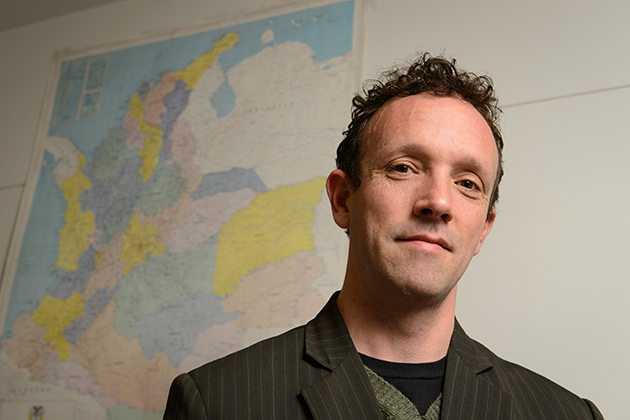
When writing about individual Human Rights Defenders the tendency is to give attention to those in the front line who are in immediate trouble. This time I want to refer to a HRD teaching at the University of Connecticut based on a blog post by Kenneth Best of 30 January 2013. It concerns Luis van Isschot, an assistant professor of history, who specializes in the study of human rights in Latin America ( photo by Peter Morenus/UConn Photo).

Luis van Isschot, assistant professor of history (Peter Morenus/UConn Photo)

Conversation around the dinner table in the van Isschot home in Montreal was a bit different than in most Canadian homes. Growing up with a Spanish, Peruvian, and Dutch family heritage, Luis van Isschot listened to discussions about Latin American history and politics led by his father, a physician who treated families in a clinic based in Montreal’s Latino community…….

…His path to a doctoral degree developed from his volunteer work in Guatemala and later in Colombia, where he served as a human rights observer. It was during his time in Colombia that a friend who was a university professor and a historian told him that one of the most important books of Colombian history was written by a professor from his hometown of Montreal, Catherine Le Grand at McGill University, and that he should look her up. He did, and it led to his enrollment in the doctoral program. “She made it seem that you could be a wonderful teacher, a cutting-edge scholar, and have a balanced life of engagement in your community, and that the Ph.D. was a way of doing that,” van Isschot says. “The university is central to the community, not apart from it. That makes sense to me.”

He later became involved with MEA Laureate 2001 Peace Brigades International, a nonpartisan organization that sends international volunteers to areas of conflict to provide protective accompaniment to human rights defenders threatened by political violence in 11 nations, including in Asia, Africa, and Latin America. In addition to serving as a human rights observer in Colombia, he also traveled to the Great Lakes Region of Africa, doing research in the Democratic Republic of Congo, Rwanda, and Burundi.

It was a really important experience for me to go somewhere where the language of human rights and social justice and the understanding of history really enriched my own understanding of what I was working on in Latin America,” he says. His experience in Colombia led him to focus his doctoral studies on human rights activities in that nation’s oil capital, Barrancabermeja, where he lived for a year. The city was the center of a major urban war between Colombian paramilitary groups and leftist guerillas. Between 1998 and 2002, in a city of 300,000 there were about 2,000 violent murders. “It was a devastating period. The relationships I made with Colombian human rights activists, teachers, and scholars convinced me that I needed to find some place to explore the issues,” he says.

His book, The Social Origins of Human Rights: Protesting Political Violence in Columbia’s Oil Capital, 1919-2010, is near completion, and scheduled to be published in early 2014. His new research project is titled “When the Courts Make History: the Impact of the Inter American Court of Human Rights in Latin America’s Conflict Zones,” and examines the historical changes set in motion by the pursuit of justice across borders.

http://today.uconn.edu/blog/2013/01/focusing-on-human-rights-with-a-latin-american-perspective/

Historic tribute to Human Rights Defenders by Uruguay

December 13, 2012

This blog – understandably – published a lot information critical of Governments. It is with pleasure to report something positive done by a State. On 12 December 2012, the Mission of Uruguay to the Organization of American States (OAS) hosted a public and ceremonial tribute to the Human Rights Defenders who took part in the struggle for human rights in the South American country during the military dictatorship that took place between 1973 and 1985. The public recognition – by name – of human rights defenders even 30 years later sets an example worth following by other countries with similar experience.

“We have some debts. Among them one of a moral order with the citizens of the United States as well as our Latin America. Today we want to express a heartfelt appreciation for the generous, lucid and courageous actions of solidarity in defense of human rights, in our country´s darkest hour,” said the Ambassador of Uruguay to the OAS, Milton Romani, who led the ceremony, held in the Patio Azteca of the hemispheric organization’s main building in Washington, DC.

The event was called “Teacher Elena Quinteros Day,” referring to the Uruguayan teacher who was abducted by the Uruguayan military inside the Embassy of Venezuela in Uruguay in June 1976 and whose arrest led to the severance of diplomatic relations between Montevideo and Caracas. The people honored by the Uruguayan mission to the OAS were: the Reverend Joe Eldridge, former Director of the Washington Office on Latin America (WOLA) and who lead the campaign by Julio Castro (first official case of a “disappeared” person presented before the OAS ); Doctor Robert Goldman and Jo Marie Griesgraber, who took part in the first humanitarian mission to Uruguay to confirm the allegations of human rights violations; Louise Popkin, who accompanied the former Uruguayan legislator Zelmar Michelini (murdered in Argentina in 1976) in his complaints and (former leader of the National Party of Uruguay) Wilson Ferreira Aldunate in his complaint to the U.S. Congress; Juan Mendez of Americas Watch (predecessor to Human Rights Watch); and Patricia “Polly” Pittman for their support of the exiles.

The Uruguayan mission to the OAS also paid tribute to the now deceased Julio Ramos, former Ambassador of Venezuela in Uruguay. The current Permanent Representative of Venezuela to the OAS, Roy Chaderton received the distinction on his behalf. In their addresses, Ambassador Chaderton and the rest of the honorees recalled their ties with Uruguay. http://www.flickr.com/photos/oasoea/8268180860/

“The lessons of this chapter are part of our guiding principles. These are not things of the past. They are present as a challenge to all of humanity facing injustice. Our ability to be outraged, to be supportive of one another, because inequalities are committed in the name of noble principles. In the name of peace, freedom and of democracy or revolution, or invoking reasons of state or religious reasons,” said Ambassador Romani. The Permanent Representative of Uruguay to the OAS said the victims’ perspective is “the only one that allows us to remember that “all human beings, born free and equal in dignity and rights and endowed as they are with reason and conscience, should act in a brotherly way toward one other.”

At the end of his speech, the Uruguayan diplomat said: “We have a strong commitment to the strengthening of the Inter-American Human Rights System. We affirm that making the system universal is urgent so that all states be equal before the law, that the autonomy and independence of all the organs are its fortresses.”

The video of the event is available on VIMEO: here.

For more information, please visit the OAS Website at www.oas.org

“Only washed wounds will heal”: HRDs from 39 countries discuss Transitional Justice in Latin America

October 24, 2012

Event at the Resistance Memorial, the site where political prisoners were held and tortured during the dictatorship. It was the stage of a debate attended by almost 100 activists and academics from around the world on October 18, 2012

More than 60 human rights defenders from 39 countries gathered at the Resistance Memorial, in São Paulo, to discuss issues related to “Transitional Justice” – in reference to the processes of transition from dictatorship to democracy. The debate was part of the 12th International Human Rights Colloquium, organized by Conectas and being held in São Paulo since Monday.

Two specialists on the subject – Paulo Vanucchi, former Brazilian Human Rights Minister under the Lula da Silva administration, and Gáston Chillier, of the Argentine organization CELS (Center for Legal and Social Studies), presented an overview of how Argentina and Brazil reached the stage of Transitional Justice.

…….Vanucchi defended punishing the military, while pointing out that punishment does not necessarily mean a prison sentence. Vannuchi ended with an expression borrowed from the Chilean President Michelle Bachelet: “Only washed wounds will heal”.

Argentines, Brazilians and human rights defenders from another 39 countries discuss Transitional Justice » Conectas – Human Rights.

HRDs in Latin America get attention from experts on 6 March

February 19, 2012

On 6 March 2012, the International Service for Human Rights (ISHR) will organise a side-event to United Nations Human Rights Council in Geneva, where UN and Latin American experts will come together to study and publicize the conditions of human rights defenders working in the Americas.

The Inter-American Commission on Human Rights’ (IACHR) has it own Special Rapporteur on the Situation of Human Rights Defenders, Mr José de Jesús Orozco. His report will highlights an increase in assassinations, extrajudicial executions and enforced disappearances of human rights defenders in the region since 2006, particularly in those countries where democratic rule is interrupted, where there is internal armed conflict, or where clashes occur between defenders and organised crime groups or powerful economic actors. In response, the IACHR has ordered many American States to take specific action to protect defenders. These protection measures have been issued primarily to Colombia (27 percent), Guatemala (24 percent), and Honduras (9 percent).

At the same event, the United Nations Special Rapporteur on human rights defenders, Ms Margaret Sekaggya will present ISHR’s report on the situation of defenders in Colombia. The findings are the result of research into whether recommendations made by the Special Rapporteur have been effectively implemented in Colombia, following her visit to the country in 2009. The report portrays a Colombian Government showing a more constructive attitude in its dealings with human rights defenders. However, it also identifies a failure to mainstream this attitude among local authorities, a worrying increase in attacks on human rights defenders in the past year, and the limited success of State authorities in investigating and addressing such attacks. Executive Director of the Colombian Commission of Jurists, Mr Gustavo Gallón will go on to provide a civil society view on the ISHR report and the situation of defenders in Colombia.

Further information about the event can be downloaded here.