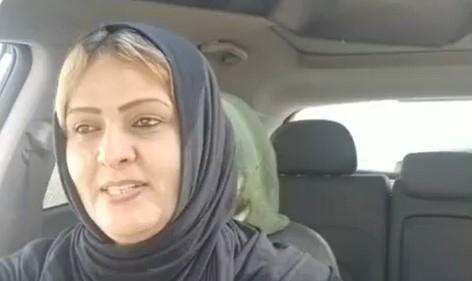
International media (here CNN) reported on 11 November 2020 on the killing of prominent Libyan lawyer and women’s rights activist Hanan al-Barassi, who was gunned down by armed men Tuesday in the eastern city of Benghazi. Her killing in Benghazi, which falls under the control of the Libyan National Army (LNA), came just a day after she shared comments on social media criticizing the son of renegade military general and LNA leader Khalifa Haftar. “The assassination of human rights defenders and opinion-holders and the silencing of voices is a heinous crime and a disgraceful form of tyranny and a desperate attempt to destroy hope for the establishment of a civil and democratic state,” Libya’s Interior Minister, Fathi Bashagha, tweeted Tuesday.
According to the United Nations Support Mission in Libya (UNSMIL), al-Barassi — whom the mission describes as a “vocal critic of corruption, abuse of power and human rights violations” — was shot “in broad daylight” by unidentified armed men. “Her tragic death illustrates the threats faced by Libyan women as they dare to speak out,” UNSMIL added. In videos posted publicly on her Facebook page, al-Barassi expressed criticism of figures loyal to the LNA. In a livestream shared on Monday, just a day before her killing, al-Barassi said she would not be silenced by threats. “I won’t surrender, only with bullets will I ever surrender — if I die, so be it. Only in death will I be silenced. Tomorrow I will have several surprises [to share], several surprises,” she told viewers. The LNA has not yet responded to a CNN request for comment on al-Barassi’s death.
Elham Saudi, the director of Lawyers for Justice in Libya, an organization which seeks to defend and promote human rights in the conflict-ridden country, called the attack an “appalling and painful reminder of the reality on the ground” for women in Libya. “With no accountability, violators will continue to get away with literal murder in broad daylight,” she added.Al-Barassi’s killing follows a series of attacks against those critical of forces aligned to the LNA.
“The killing of an outspoken lawyer in broad daylight in Benghazi will send chills through activists across the region,” said Hanan Salah, senior Libya researcher at Human Rights Watch. “This brutal killing smacks of a cold-blooded execution. The only way to end this cycle of violence is if authorities hold criminals to account for these terrible acts.”
In the Daily Maverick of 1 November 2020 Estelle Ellis tells the sad story of murdered land rights defender Fikile Ntshangase in South Africa
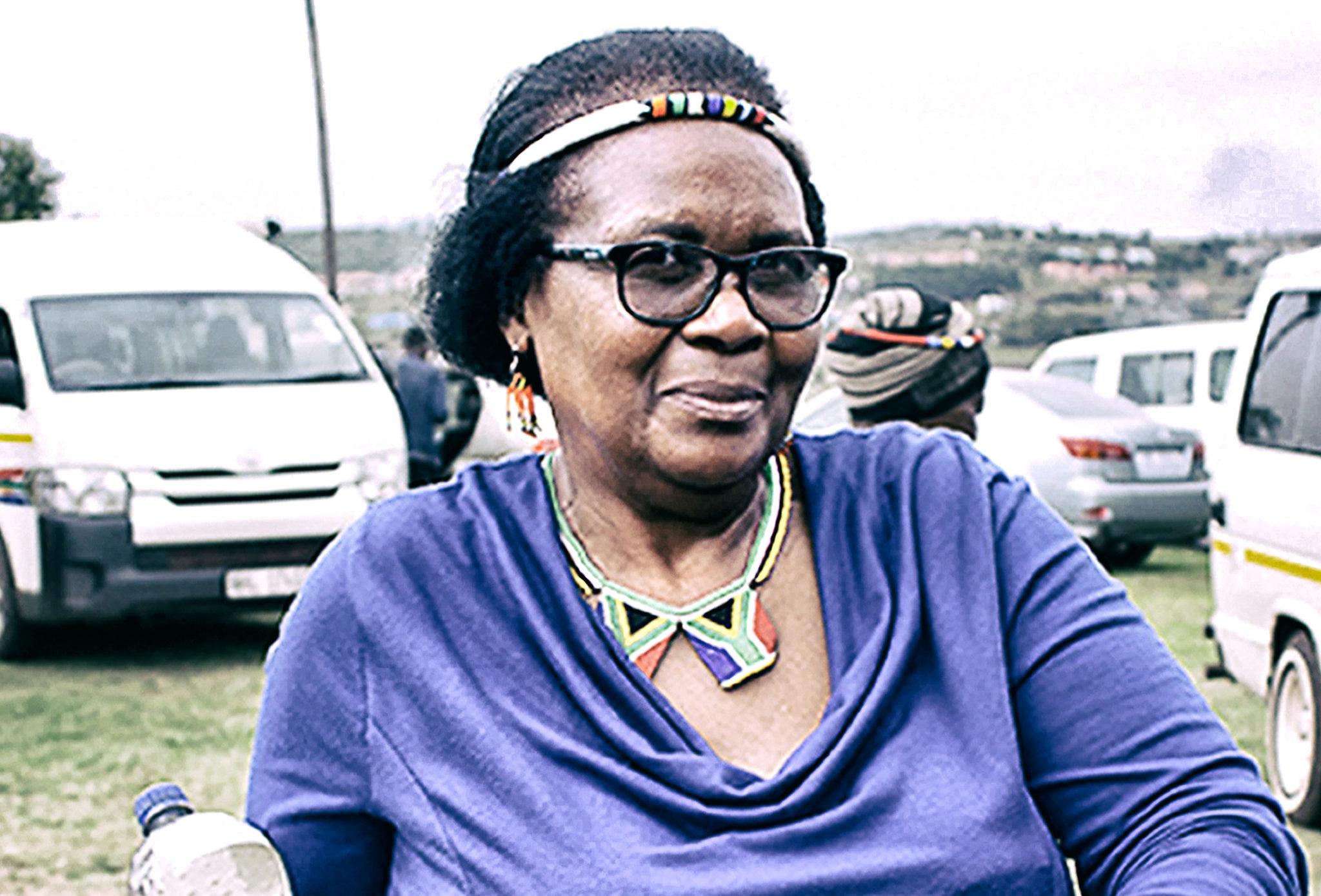
A strongly worded statement from a large number of civil society organisations in South Africa has condemned the death of KwaZulu-Natal community activist Fikile Ntshangashe who was gunned down in her home last week as lawyers were preparing for a groundbreaking appeal fighting an order that her community organisation and those who assisted them should pay for a failed attempt to stop further mining operations in the area.
“I refused to sign. I cannot sell out my people. And if need be, I will die for my people.” This was the quote that activists remembered Mama Fikile Nsthangashe by after she was gunned down in her home at Ophondweni near Mtubatuba on 22 October 2020.
As the vice-chairperson of a sub-committee of the Mfolozi Community Environmental Justice Organisation (MCEJO), she was deeply involved in the challenge against the further expansion of a large coal mine at Somkele in KwaZulu-Natal by Tendele Coal Mining (Pty) Ltd. She was described by her fellow activists as a strong, passionate and principled leader.
On Tuesday the Supreme Court of Appeal will hear one of Nsthangashe’s final stands – an appeal in the case brought by MCEJO to stop the mining operations in the area.
According to a joint statement issued by environmental rights NGO Groundworks; Earthlife Africa; Global Environmental Trust, Mining Affected Communities United in Action, the Mfolozi Community Environmental Justice Organisation, the Southern Africa Human Rights Defenders Network and Women Against Mining United in Action the South African Police were called on to act swiftly and arrest those responsible for her death.
The statement alleges that four gunmen arrived at Ntshangashe’s home on 22 October 2020 at about 18:30. Her 11-year-old grandson was with her. She was shot five times and died at the scene.
“Tendele’s coal mining operations have caused untold destruction of the environment and the homes and livelihoods of the residents of Somkhele,” the statement reads. “Over the past few months, tension has been rising in the community over the proposed expansion of Tendele’s operations, and [her organisation’s] opposition to that expansion … Recently, Tendele was pushing for an agreement to be signed between MCEJO and Tendele to the effect that MCEJO would withdraw its Court challenges of Tendele’s expansion of its coal mine at Somkhele. Mama Ntshangase refused to sign the agreement, which certain of her fellow sub-committee members signed, purportedly doing so on behalf of the organisation … She warned sub-committee members that they had no power to make decisions on behalf of MCEJO and that the agreement only benefited Tendele. She also refused to attend any of the secret meetings that other sub-committee members held with Tendele. Days before her brutal killing, Mama Ntshangase stated her intention to write an affidavit, revealing that sub-committee members had spoken to her of a payment of R350,000 in return for her signature,” she added.
According to the statement the expansion of the mine would require the relocation of 21 families (19 of them MCEJO members) from their ancestral land. Many of these families have lived on their land for generations.
“We mourn the senseless tragedy of Mama Ntshangase’s murder, and condemn her killing. We call on the South African Police Service to act swiftly to arrest and prosecute her murderers,” the statement concluded.
Martin Mosweu from the Southern Africa Resource Watch said he was deeply saddened and angered by the killing of Ntshangase.
“She was hailed as a courageous human rights defender by her community for standing against the Tendele Coal Mine expansion in violation of the right to a safe environment. The murder of Fikile Ntshangase is a cause of concern to the work of human rights defenders in South Africa and in the SADC region. Governments are failing in their international obligations to the Declaration of Human Rights by not protecting and supporting human rights defenders in the context of their work. In Southern Africa, people who live near mines continue to face threats of violence and intimidation from mining companies who blatantly disregard their socio-economic, land, and environmental rights. Human rights defenders continue to be threatened and killed for standing up against powerful mining companies that violate human rights, often with impunity and tacit support from governments. This is why many mining communities throughout the region are now taking a stand and demanding a new order, insisting on extractive projects that secure a beneficial win-win relationship, free and prior informed consent in involuntary displacements, and community engagement in all stages of the mining cycle for inter-generational sustainable livelihoods,” he added.
Papers filed at the Supreme Court of Appeal for a hearing on Tuesday, in one of the last battles that Ntshangase had been passionately fighting on behalf of her community, has painted a stark picture of the conflict in the area.
The appeal, brought by MCEJO and the Global Environmental Trust is against the refusal by the Pietermaritzburg High Court to issue an interdict to stop mining operations in the area.
The community claimed that the mine did not have the necessary environmental authorisation, lacked land use authorisation, had not removed or altered the traditional graves in the area according to law and had failed to comply with the Waste Act.
The mine, however, argued that it had all the valid mining rights and permissions to carry on with its operations. In papers filed at court, lawyers for Tendele, stressed that their operations were conducted in terms of valid Mining Rights and Environmental Management Programmes granted and approved by the Department of Mineral Resources in 2006 and that while the legislative framework had changed there were transitional measures put in place for mines like Tendele.
This, according to papers before court included the waste management at the mine.
According to papers filed at the Supreme Court of Appeal the Centre for Environmental Rights (CER), represented by advocate Max du Plessis SC; intervened in the matter because of its concerns that the judgment opened the door for mining companies to operate illegally. The CER also expressed its concern over a cost order made in the original case as this “would discourage communities from approaching the courts to defend their constitutional rights through the fear of being debilitated by having to pay the legal costs of industry and the state”.
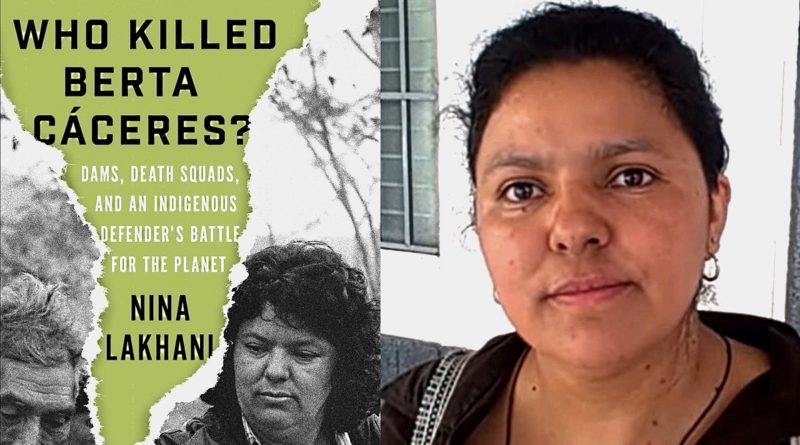
“They build dams and kill people.” These words, spoken by a witness when the murderers of environmental defender Berta Cáceres were brought to trial in Honduras, describe Desarrollos Energéticos SA (DESA), the company whose dam project Berta opposed. DESA was created in May 2009 solely to build the Agua Zarca hydroelectric scheme, using the waters of the Gualcarque River, regarded as sacred by the Lenca communities who live on its banks. As Nina Lakhani makes clear in her book Who Killed Berta Cáceres?, DESA was one of many companies to benefit from the 2009 coup d’état in Honduras, when the left-leaning President Manuel Zelaya was deposed and replaced by a sequence of corrupt administrations. The president of DESA and its head of security were both US-trained former Honduran military officers, schooled in counterinsurgency. By 2010, despite having no track record of building dams, DESA had already obtained the permits it needed to produce and sell electricity, and by 2011, with no local consultation, it had received its environmental licence.
..Lakhani quotes a high-ranking judge she spoke to, sacked for denouncing the 2009 coup, as saying that Zelaya was deposed precisely because he stood in the way of this economic model and the roll-out of extractive industries that it required. The coup “unleashed a tsunami of environmentally destructive ‘development’ projects as the new regime set about seizing resource-rich territories.” After the post-coup elections, the then president Porfirio Lobo declared Honduras open for business, …….
Lakhani’s book gives us an insight into the personal history that brought Berta Cáceres to this point. She came from a family of political activists. As a teenager she read books on Marxism and the Cuban revolution. But Honduras is unlike its three neighbouring countries where there were strong revolutionary movements in the 1970s and 1980s. The US had already been granted free rein in Honduras in exchange for “dollars, training in torture-based interrogation methods, and silence.”… At the age of only 18, looking for political inspiration and action, Berta left Honduras and went with her future husband Salvador Zúñiga to neighbouring El Salvador. She joined the FMLN guerrilla movement and spent months fighting against the US-supported right-wing government. Zúñiga describes her as having been “strong and fearless” even when the unit they were in came under attack. But in an important sense, her strong political convictions were tempered by the fighting: she resolved that “whatever we did in Honduras, it would be without guns.”
Inspired also by the Zapatista struggle in Mexico and by Guatemala’s feminist leader Rigoberta Menchú, Berta and Salvador created COPINH in 1993 to demand indigenous rights for the Lenca people, organising their first march on the capital Tegucigalpa in 1994. From this point Berta began to learn of the experiences of Honduras’s other indigenous groups, especially the Garífuna on its northern coast, and saw how they fitted within a pattern repeated across Latin America….
In Río Blanco, where the Lenca community voted 401 to 7 against the dam, COPINH’s struggle continued. By 2013, the community seemed close to winning, at the cost of activists being killed or injured by soldiers guarding the construction. They had blocked the access road to the site for a whole year and the Chinese engineering firm had given up its contract. The World Bank allegedly pulled its funding, although Lakhani shows that its money later went back into the project via a bank owned by the Atala Faraj family. In April 2015 Berta was awarded the Goldman Prize for her “grassroots campaign that successfully pressured the world’s largest dam builder to pull out of the Agua Zarca Dam.”
…….
The horrific events on the night of Wednesday March 2 are retold by Nina Lakhani. Armed men burst through the back door of Berta’s house and shot her. They also injured Gustavo Castro, who was visiting Berta; he waited until the men had left, found her, and she died in his arms. ,,,By the first anniversary of Berta’s death the stuttering investigation had led to eight arrests, but the people who ordered the murder were still enjoying impunity. Some of the accused were connected to the military, which was not surprising since Lakhani later revealed in a report for The Guardian that she had uncovered a military hit list with Berta’s name on it. In the book she reports that the ex-soldier who told her about it is still in hiding: he had seen not only the list but also one of the secret torture centers maintained by the military.
Nina Lakhani is a brave reporter. She had to be. Since the coup in Honduras, 83 journalists have been killed; 21 were thrown in prison during the period when Lakhani was writing her book. She poses the question “would we ever know who killed Berta Cáceres?” and sets out to answer it. Despite her diligent and often risky investigation, she can only give a partial answer. Those arrested and since convicted almost certainly include the hitmen who carried out the murder, but it is far from the clear that the intellectual authors of the crime have been caught. In 2017 Lakhani interviewed or attempted to interview all eight of those imprisoned and awaiting trial, casting a sometimes-sympathetic light on their likely involvement and why they took part.
….
In September 2018, the murder case finally went to trial, and Lakhani is at court to hear it, but the hearing is suspended. On the same day she starts to receive threats, reported in London’s Press Gazette and duly receiving international attention. Not surprisingly she sees this as an attempt to intimidate her into not covering the trial. Nevertheless, when it reopens on October 25, she is there. The trial reveals a weird mix of diligent police work and careful forensic evidence, together with the investigation’s obvious gaps. Not the least of these was the absence of Gustavo Castro, the only witness, whose return to Honduras was obstructed by the attorney general’s office. Castillo, though by then charged with masterminding the murder, was not part of the trial. Most of the evidence was not made public or even revealed to the accused. The Cáceres family’s lawyers were denied a part in the trial.
“The who did what, why and how was missing,” says Lakhani, “until we got the phone evidence which was the game changer.” The phone evidence benefitted from an expert witness who explained in detail how it implicated the accused. She revealed that an earlier plan to carry out the murder in February was postponed. She showed the positions of the accused on the night in the following month when Berta was killed. She also made clear that members of the Atala family were involved.
When the verdict was delivered on November 29 2018, seven of the eight accused were found guilty, but it wasn’t until December 2019 that they were given long sentences. That’s where Nina Lakhani’s story ends. By then Honduras had endured a fraudulent election, its president’s brother had been found guilty of drug running in the US, and tens of thousands of Hondurans were heading north in migrant caravans. David Castillo hasn’t yet been brought to trial, and last year was accused by the School of Americas Watch of involvement in a wider range of crimes. … Daniel Atala Midence, accused by COPINH of being a key intellectual author of the crime as DESA’s chief financial officer, has never been indicted.
...And a full answer to the question “Who Killed Berta Cáceres?” is still awaited.
With all eyes on the pandemic it is easy to forget that “violence as usual” continues against human rights defenders. Here one case:
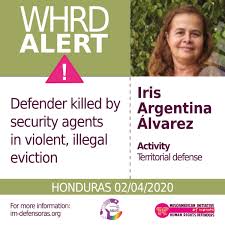
Human Rights Defender, Iris Argentina Álvarez, was killed on 2 April 2020, by private security agents from the company CRAE´S, employed by the La Grecia Sugar Mill. Her murder took place during a violent, illegal eviction in the Los Chanchos section of Marcovia, Choluteca in the South of Honduras. Community witnesses report that National Police officers were in the area when the aggressors opened fire against several families with many children. They affirm that the police did absolutely nothing to stop the violence that ended the life of the defender and left two other people wounded, including an underage child.
The Business and Human Rights Resource Centre attempted to contact La Grecia sugar mill but was not succesful and CRAE´S private security company did not respond.
Sister Dorothy Stang, a member of the Sisters of Notre Dame de Namur, is pictured in a 2004 file photo in Belem, northern Brazil. (CNS/Reuters)
12 February 2020 was the 15th anniversary of Sr. Dorothy Stang‘s assassination in the Amazon region of Brazil. The nun was 73 when she was murdered on 12 February, 2005, on an isolated road near the Brazilian town of Anapu. She had lived in the country for nearly four decades and was known as a fierce defender of a sustainable development project for the Amazon forest. The U.S.-born nun is remembered as a crusader for the poor and the landless and for her love of the land and the Amazon forest.
“She taught me how to be a missionary in Brazil; she was my mentor,” Sr. Rebeca Spires told Catholic News Service. Spires, who, like Stang, is a member of the Sisters of Notre Dame of Namur, said the first thing Stang gave her was Brazil’s land statute. “She was all about doing things within the law,” said Spires.
…She said that, in the early 2000s, Stang started to pressure public officials to combat land invasions by ranchers and large landowners, who wanted to take away areas occupied by smaller farms. The officials “became extremely irritated with her, with her persistence,” Spires said. “Although threatened with death, Dorothy never failed in her life’s mission, to fight for the poor of the land, so that they had their rights guaranteed and a dignified life,” read the statement issued by the Brazilian bishops’ Pastoral Land Commission to mark Stang’s death.Mary Cohen, a lawyer in Belem and a member of the Brazilian bishops’ justice and peace commission, was president of the human rights commission at Brazil’s lawyer association when Stang was in Anapu. Cohen remembered Stang’s determination, as the nun pushed and pressured government agencies into taking action. “She once slept on the steps of the INCRA (Institute for Agrarian Reform) so they would talk to her. She had a lot of determination, and that invigorated all of us,” said the lawyer. That determination made many people in the region angry. Trying to reduce the tension between landowners and peasants and their advocates, the lawyer’s association gave Stang a human rights award two months before she was killed.
“We thought that more media attention and recognition of her work would keep her safe, that they (landowners and ranchers) would be deterred. We were wrong,” said the lawyer. And although Stang’s assassination made international headlines and caused worldwide commotion, those who continue her work say the threats today to the landless and their advocates are even greater. “There are still a lot of people being threatened, and I wouldn’t want to jeopardize anyone’s life,” Sr. Jane Dwyer, a member of the Sisters of Notre Dame of Namur who worked closely with the murdered nun, told CNS.
Dwyer, who still lives in Anapu, told CNS she was uneasy about giving interviews over the telephone. She said that, since 2015, 19 landless, small-scale farmers had been assassinated over land conflicts in the area. “Nineteen in the last five years,” she said. “Of the 19 assassinations, in only one did authorities bring someone to justice,” added Spires, who works with the Brazilian bishops’ Indigenous Missionary Council in Belem. Cohen said those who speak out today against the rich and powerful in the region continue to be threatened. “Her successor, Father Amaro (Jose Amaro Lopes de Souza), continues to be threatened, and when they were unable to scare him off, they accused him of extortion and inciting violence among landless peasants,” she said…
“The synod document is titled ‘Querida Amazonia’ (Beloved Amazonia), which … embodies what Sister Dorothy spoke of her entire life: ‘Dear Amazon, we are here to defend you, to protect you. Dear people of the Amazon, we are here to help you in your fight, in your resistance, in the recognition of your rights.'”
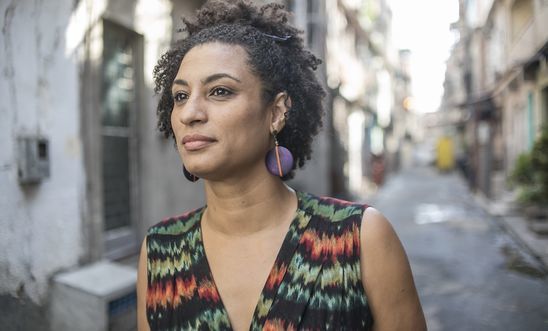
In response to the recent death of Adriano da Nóbrega, a former policeman suspected of involvement in the murder of human rights defender Marielle Franco and her driver Anderson Silva, Amnesty International Brazil’s Executive Director, Jurema Werneck, said:
“After almost two years of investigation into the death of Marielle and Anderson, we demand transparency from the authorities. It is essential for Brazilian society to have full confidence in the efforts to find out who carried out these cruel murders…The information circulating today, like many of the leaks that have occurred since October last year, just sends a public message that the authorities are trapped in doubt.
“Events related to the investigations raise more questions than answers. For almost two years now the whole world has been looking closely at Brazil, waiting for the truth. While we understand the need for confidentiality, this cannot be confused with a lack of transparency…To guarantee justice for Marielle is to guarantee the rights of all human rights defenders to do their work with dignity and security, defending a fairer society.”
Adriano da Nóbrega was killed on Sunday 9 February after he fired on police officers trying to arrest him in Northern Brazil. Nóbrega is thought to have led a paramilitary group suspected of ordering the murder of Marielle Franco.
Miroslava Breachlived under constant threat starting in March 2016, when she began to feel pressure over her publications regarding links between drug cartels and politics. She brought this to the attention of her old friend, the recently elected governor of Chihuahua state Javier Corral, as well as those in charge of the mechanisms at the federal level to protect journalists. The Colectivo 23 de Marzo is made up of Mexican journalists in collaboration with Forbidden Stories, Bellingcat and Centro Latinoamericano de Investigaciones Periodísticas (CLIP). We reconstructed the thread of threats linked to Miroslava’s work, the warnings that she raised about the danger she was in, and the clues that she let in her publications prior to her murder on March 23 2017 that the authorities did not fully investigate.
Miroslava Breach in the Tarahumara sierra. She investigated illegal logging, the effects of megaprojects, and narcopolitics. Source: Colectivo 23 de Marzo
Before her murder, a grey Malibu prowled down José María Mata street in the Granjas neighbourhood of Chihuahua. Security cameras captured the vehicle on the street six times between March 21 and 22 2017 as it passed in front of the two-story house now infamous for the murder: number 1609, with its brown gates and a small garden out front. On the morning of March 23, 2017, journalist Miroslava Breach Velducea was shot to death while waiting inside her car to take her son to school.…….
Mourners observe Kem Ley’s funeral procession in Phnom Penh, July 24, 2016.- AP Photo
Two dozen nongovernmental organizations on Tuesday 9 jult 2019 demanded that Cambodia’s government establish an independent and impartial commission to investigate the murder of prominent political commentator and rights campaigner Kem Ley, a day ahead of the third anniversary of his death. Kem Ley was shot to death in broad daylight on July 10, 2016 while having a morning coffee at a Caltex gas station in the capital Phnom Penh, days after publicly criticizing Prime Minister Hun Sen and his family for abuse of power.
Authorities charged a former soldier named Oeuth Ang with the murder and sentenced him to life in prison in March 2017, but many in Cambodia do not believe the government’s story that Kem Ley was killed by the man over a debt. In May, Cambodia’s Supreme Court rejected Oeuth Ang’s appeal for reduction of sentence and upheld his life imprisonment term. The day of Oeuth Ang’s sentencing, Geneva-based International Commission of Jurists (ICJ), New York-based Human Rights Watch and London-based Amnesty International highlighted multiple issues they said had not been adequately investigated during his trial and called for a probe into Kem Ley’s killing that adheres to international standards.
On Tuesday, 21 other groups joined the three NGOs in reiterating that call and questioning why the government had failed to take meaningful action in the case. “It has been three years since significant gaps were highlighted in the investigation and trial of Kem Ley’s case, which need to be remedied through an independent, impartial and effective investigation,” said Frederick Rawski, ICJ’s director for Asia and the Pacific.
The 24 NGOs noted in Tuesday’s statement that 164 organizations had signed a joint letter to Cambodia’s Deputy Prime Minister Sar Kheng calling for the creation of an independent Commission of Inquiry into Kem Ley’s case, citing the “flawed investigation” into his killing and “lack of progress in subsequent investigations” of suspected accomplices.
Soon after Kem Ley’s funeral, and fearing for their safety, his wife Bou Rachana—then pregnant—fled with her children from Cambodia to neighboring Thailand to seek asylum in a third country. They spent over a year and a half in Thailand before being granted permission to settle in Australia in February last year.
Debbie Stothard, the secretary-general of Paris-based International Federation for Human Rights (FIDH), said: “The Cambodian authorities’ ongoing failure to identify and prosecute the masterminds behind Kem Ley’s murder shows that an independent investigation is urgently needed to deliver justice to his family and to make progress towards ending impunity for the killing of human rights defenders in Cambodia,” she said.
Tuesday’s statement called Kem Ley’s killing “an alarming reminder of Cambodia’s culture of impunity” in cases of killings and harassment of rights defenders, labor leaders, journalists, members of the political opposition and others critical of Hun Sen’s regime.
Sok Ey San, spokesman of Hun Sen’s ruling Cambodian People’s Party (CPP), dismissed Tuesday’s statement as “politically motivated” and said it was “filled with groundless allegations.”
The call by the 24 NGOs came as police in Phnom Penh charged youth activist Kong Raiya and three of his family members with “incitement of social unrest” after arresting them for selling T-shirts bearing Kem Ley’s portrait and urging people to wear them on Wednesday to mark the anniversary of his murder. Am Sam Ath, deputy director of the Cambodian rights group LICADHO, told RFA’s Khmer Service that police arrested Kong Raiya, his wife and his parents-in-law on Tuesday along with his six-month-old baby, who was later released to family members.
The ink on the bill for the protection of human rights defenders [see: https://humanrightsdefenders.blog/2019/06/04/philippines-human-rights-defenders-protection-bill-adopted-in-parliament/] has hardly dried and the following is reported: on 2 June 2019 union organiser Dennis Sequeña was shot dead while meeting with workers. Sequeña was vice-chairperson of labour group Partido Manggagawa; group believes he was murdered for his trade union work. Civil society organisations condemn the killing & demand immediate investigation, as well as action to stop spate of attacks against labour activists.
Also on 7 June a group of UN human rights experts collectively called on the United Nations to establish an independent investigation into human rights violations in the Philippines, citing a sharp deterioration in the situation of human rights across the country, including sustained attacks on people and institutions defending human rights. “Given the scale and seriousness of the reported human rights violations we call on the Human Rights Council to establish an independent investigation into the human rights violations in the Philippines.”
“We have recorded a staggering number of unlawful deaths and police killings in the context of the so-called war on drugs, as well as killings of human rights defenders. Very few independent and effective investigations have taken place, independent media and journalists are threatened, the law has been weaponised to undermine press freedom, and the independence of the judiciary is undermined,” the experts said. [ndependent human rights experts appointed by the Human Rights Council have raised their concerns with the Government of the Philippines on 33 occasions over the last three years!]
In a statement of 8 May 2019 the ISHR and other NGOs had recalled that: the Philippines is one of the most dangerous countries for human rights defenders. They persevere under harsh conditions, fighting against repression and corruption to make a better society for all. They continue their work so the most vulnerable are protected and their voices are heard. ISHR – along with CIVICUS, Frontline Defenders, FORUM Asia, FIDH, and the World Organisation Against Torture– released a joint statement denouncing recent death threats addressed to Karapatan Secretary General, Cristina Palabay, and urging the Philippine Government to respond to the threats against human rights defenders by taking genuine and effective measures for their protection.
That the problems in Colombia are huge you wil all know. A good, lenghty report by Ted Piccone at Brookings from March 2019 gives an overview of the myriad issues including the continuing killing of human rights defenders: “..While these legal and political skirmishes play out, one critical element of the peace accords is tragically failing—the protection of human rights defenders, leaders of social movements, and political opposition figures. The official protection system, which is central to the non-recurrence features of the accord, is operating but unable to defend these leaders effectively from attacks perpetrated by a collection of armed groups (including remnants of paramilitary units demobilized in an earlier peace agreement), drug traffickers, and other violent actors intent on disrupting the peace process. The numbers are chilling: As of the end of 2018, the United Nations has received reports of the murder of 454 human rights defenders and social leaders since the signing of the peace agreement, and of the 163 murders they have verified, 110 occurred in 2018. The United Nations has also verified the murder of 85 former FARC-EP members. These ongoing attacks, and the relatively high rates of impunity, underscore the fearsome challenge of building peace in the midst of so much conflict and violence.” [See also: https://humanrightsdefenders.blog/2019/04/26/somos-defensores-in-colombia-publishes-annual-report-2018-worst-ever/]
All this is underlined by the recent killing of a human rights lawyer reported on 24 May 2019. Paula Andrea Rosero Ordóñez, 47, was shot dead at close range by two hitmen, according to a police report. What makes it even more shocking is that this has happened to a lawyer working as a representative of the public ministry in Nariño, a department in south-west Colombia, Rosero asked for extra protection from the government in 2016 after receiving death threats.




 Hans Thoolen on Human Rights Defenders and their awards