With a bit of delay, here is the good news that the Turkish Supreme Court – on 11 June – overturned the life sentence issued which was issued against sociologist Pınar Selek on January 24, 2014. The case will have to be re-tried before a lower court for the fifth time. On June 11, 2014, the Criminal Chamber No. 9 of the Supreme Court decided to overturn the decision of a lower court to sentence to life imprisonment Ms. Pınar Selek, an academic known for her commitment towards the rights of vulnerable communities in Turkey. The court argued that Istanbul Special Heavy Criminal Court No. 12 had violated procedural rules, by revoking its own decision of acquittal while the case had already been transferred for review to a higher court. Read the rest of this entry »
Posts Tagged ‘judicial harassment’
Pinar Selek case in Turkey: the Supreme Court overturns life sentence against Pınar Selek
July 9, 2014Situation of human rights defenders in Africa – Observatory on HRDs before African Commission
May 21, 2014FIDH and OMCT, in the framework of their Observatory for the Protection of Human Rights Defenders, express their grave concern about the situation of human rights defenders in Africa. They do so in a 7-page written statement before the 55th ordinary session of the African Commission on Human and Peoples Rights [ACHPR] on 20 May in Luanda. It can be read in full on: Situation of human rights defenders in Africa – Contribution to the 55th ordinary session of ACHPR Read the rest of this entry »
Let Ukraine not distract from ongoing repression of human rights defenders in Russia
May 18, 2014In an excellent piece written for CNN, Tanya Lokshina of Human Rights Watch, on 15 May gives an overview of the different measures that threaten human rights defenders in Russia. While attention is on Ukraine, a vicious crackdown on civil society in Russia itself also escalated with every week brings a new pernicious law or legislative proposal:
- The authorities have blocked or essentially took editorial control over a number of independent news portals and are pushing new laws to stifle freedom of expression.
- A week ago, President Vladimir Putin signed a law requiring Russian bloggers with significant followings to register with the authorities and comply with media regulations.
- The same law requires blogging services and social networks to store user activity for six months.
- Another legislative proposal would introduce administrative and criminal offenses for editors who publish “false anti-Russian” information or offer media support to “anti-Russian extremist and separatist forces.”
- Another new draft law introduces a ban on publishing negative information about the Russian government and military.
- Also, amendments presently under review by the State Duma, the lower house of parliament, would enable the authorities to throw people behind bars for up to five years for repeated participation in unauthorized public protests.
At the same time the infamous Russian law “on foreign agents”, Read the rest of this entry »
ALERT: MEA Laureate 2007 Pierre Claver Mbonimpa arrested in Burundi
May 16, 2014
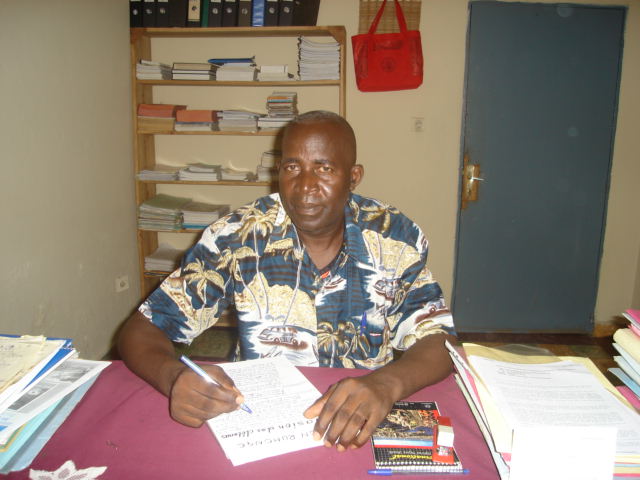
MEA Laureate 2007 Pierre-Claver Mbonimpa
MEA Laureate 2007, Pierre-Clavier Mbonimpa, was arrested this morning early. The latest information is that he is still detained at the Police-Judiciare. The background is rising tension in Burundi, where it is feared that President Pierre Nkurunziza is expected to campaign for a third term in office in 2015 despite a two-term constitutional limit. The Economist of 29 March 2014 already carried an article under the prescient title “Trouble Ahead” and on 17 April Paul Debbie, security chief at the UN office in Burundi, was ordered to leave the country in connection with a UN report disliked by the Government containing “allegations of weapons distribution to members of the youth league of the ruling party”. [http://www.aljazeera.com/news/africa/2014/04/burundi-expels-un-official-over-arms-report-2014417144546195161.html] It is feared that this youth wing, named the Imbonerakure, are being armed and trained in weapons use, raising fears of a return to civil war, even of genocide. No charges have been brought against Mbonimpa, but it is believed that the arrest is related to comments made on the radio regarding the above. Read the rest of this entry »
Berta Cáceres in Honduras continues to be harassed in spite of court order
January 28, 2014In my post of 17 January I related that there seemed to be some optimism in the case of Berta Cáceres in Honduras as the court had suspended her case (https://thoolen.wordpress.com/2014/01/17/justice-maybe-on-its-way-for-some-human-rights-defenders-in-honduras/), but the ink on the order was hardly dry when on 26 January 2014, she was again temporarily detained. Members of the criminal investigation unit showed her an order for her capture [the authorities had not communicated any counter-order to them, they stated]. According to sources of Front Line, only her knowledge of the law lead to her release an hour later. Judicial harassment of the first order.
Justice maybe on its way for some Human Rights Defenders in Honduras
January 17, 2014As reported by Front Line Defenders, on 9 January 2014, the Appeals Court of Comayagua provisionally suspended the case against Honduran human rights defenders Ms Berta Cáceres and Messrs Tomás Gómez and Aureliano Molina. They had been facing charges of usurpation of land, coercion, and causing more than $3 million in damages to DESA, a hydroelectric dam company. The Court further reversed a decision to displace the indigenous Lenca community from their ancestral lands, and revoked the arrest warrant which had been in place against the human rights defenders. No court date has been set for the final decision in the case. Berta Cáceres is the general co-ordinator of Consejo Cívico de Organizaciones Indígenas Populares – COPINH (Civic Council of Popular Indigenous Organisations). Tomás Gómez Membreño and Aureliano Molina are also members of COPINH which is working on land, environmental and indigenous rights, particularly in relation to large-scale development projects.
Front Line Defenders welcomes the provisional suspension but remains concerned that the case has not been permanently suspended. It notes that the case comes in the context large-scale development projects impinging on environmental rights and the rights of indigenous people, and that the principle of free, prior and informed consent is not being fully respected. [for earlier info: http://www.frontlinedefenders.org/node/22872]
Russian court declares ADC Memorial formally as “foreign agent” – others to follow
December 16, 2013
On December 12, 2013, the Anti-Discrimination Centre (ADC) “Memorial” was officially declared a “foreign agent” by the Leninsky District Court of St Petersburg, and was ordered to register as such with the Ministry of Justice, according to information received by the Observatory for the Protection of Human Rights Defenders. Today, the court unexpectedly established that all the activities of ADC “Memorial” fall under the definition of “performing the functions of a foreign agent”. Accordingly, for the first time, a court has directly labelled a human rights NGO a “foreign agent”, and did not just order it to register as such. This decision could pave the way to increased harassment of all human rights organisations in the Russian Federation. Read the rest of this entry »
Human rights defenders in Russia should be proud to be ‘Foreign Agents’
November 22, 2013
This blog has on several occasions made mention of the dangerous developments in Russia where the ‘foreign agents’ law is being used to delegitimize human rights defenders. Front Line just came with an update showing that the legal aspect of this issue (is the law legally permissible under the Russian Constitution or the European Convention Human Rights?) is coming under scrutiny. On 18 November 2013, the Zamoskvoretsky District Court in Moscow heard the cases of 3 NGOs – Human Rights Centre ‘Memorial’, GOLOS, and the Public Verdict Foundation – which challenge the ‘Foreign Agents’ law. Following the presentation of their arguments, the court accepted their request to postpone the hearings until 4 February 2014. Significant, as it was taken in order to await for the rulings of the European Court on Human Rights (ECtHR) or the Russian Constitutional Court, whichever comes first:
- On 6 February 2013, eleven Russian NGOs lodged a complaint with the ECtHR alleging that the ‘Foreign Agents’ law violates four articles of the European Convention on Human Rights, namely Article 10 (Freedom of Expression), Article 11 (Freedom of Association and Assembly), Article 14 (Prohibition of Discrimination), and Article 18 (Limitations on Rights).
- On 13 August 2013, Kostroma Centre for Civic Initiatives Support lodged a complaint with the Russian Constitutional Court arguing that the ‘Foreign Agent’ law violates five articles of the Russian Constitution, namely Article 19 (Equality before the law), Article 29 (Freedom of ideas and speech), Article 30 (Right of Association), Article 32 (Right to participate in managing state affairs), and Article 51 (right not to give incriminating evidence against oneself).
- On 30 August 2013, the Russian Human Rights Ombudsman, Vladimir Lukin, also lodged a complaint with the Constitutional Court against certain provisions of the ‘Foreign Agents’ law. In particular, the Ombudsman argued that the definition of terms ‘foreign agent’ and ‘political activities’, as provided by the law, are politically and legally incorrect.
Still, one wonders whether the battle should not be fought also in the public domain as the ‘foreign agent campaign’ by the authorities is clearly not about financial control (there is enough of that already to satisfy any suspicious prosecutor) or political control (in which case registration as simple lobbyist would suffice) but about ‘framing’ the human rights defenders as traitors, unpatriotic people. The requirement to identify oneself as foreign agent on every paper or poster is a clear indication of what the Government wants to achieve. This kind of action by governments (not just Russia) is a deliberate (mis)information effort that should be fought in the same arena of public perception. Admittedly far from easy and costly but there are things that COULD be done, I think:
- bumper stickers and T-shirts with “I am a foreign agent” (in Russian of course, but supporters abroad could have it in English)
- well-known Russian celebrities could make statements such as: “IF …is a foreign agent ,in that case I am also one!”
- production of video clips that poke fun at the idea, etc
As a concrete example: on 21 November 2013, a year after the law came into effect, Amnesty International Norway, LLH (the Norwegian LGBT Organisation) and the Norwegian Helsinki Committee called themselves for one day foreign agents in solidarity with Russian organisations who struggle to keep their work going (see also in Norwegian: http://www.amnesty.no/agent). Of course, people on the ground know best what will work, but I think some form of ‘counter-defamation’ should be tried. It would benefit Russia and could de-motivate the authorities in other countries watching what happens in Russia.
Related articles
- Civil proceedings against ‘Memorial’ under Russia’s Foreign Agents Law continue (thoolen.wordpress.com)
- We are Foreign Agents! (invisibilityproject.wordpress.com)
Civil proceedings against ‘Memorial’ under Russia’s Foreign Agents Law continue
November 17, 2013On 11 November the Prosecutor’s Office brought a civil lawsuit against Memorial before the Leninsky District Court of St Petersburg after administrative charges against the same organisation ‘ for failing to register as a ‘foreign agent‘ were dismissed by the same court. The Prosecutor’s Office initiated the civil suit on the basis that its failure to register as a ‘foreign agent’ would violate the interests ‘of an undefined group of persons’. Frontline Defenders follows this and other cases in which the ‘foreign agent’ harassment of NGOs in Russia continues. The details of the case are illuminating, including the involvement of a preposterous ‘expert“: Read the rest of this entry »
BANGLADESH: Human Rights Defender Elan of Odhikar now also arrested
November 7, 2013

The Asian Human Rights Commission condemns the detention of ASM Nasiruddin Elan and demands his immediate release. Mr. ASM Nasiruddin Elan, Director of Bangladeshi human rights organization, Odhikar, has been detained in prison by the Cyber Crimes Tribunal of Dhaka, today, November 6, 2013. This detention is part of the continued repression against the whistle-blowers exposing the ongoing State-sponsored gross violations of human rights in Bangladesh. Elan has been charged by the country’s police under the Information and Communications Technology (Amendment) Act, 2013, a draconian law, for publishing fact-finding report on governmental crackdown on the pro-Islamist demonstrators in the early morning of 6 May 2013 in Dhaka. Read the rest of this entry »
 Hans Thoolen on Human Rights Defenders and their awards