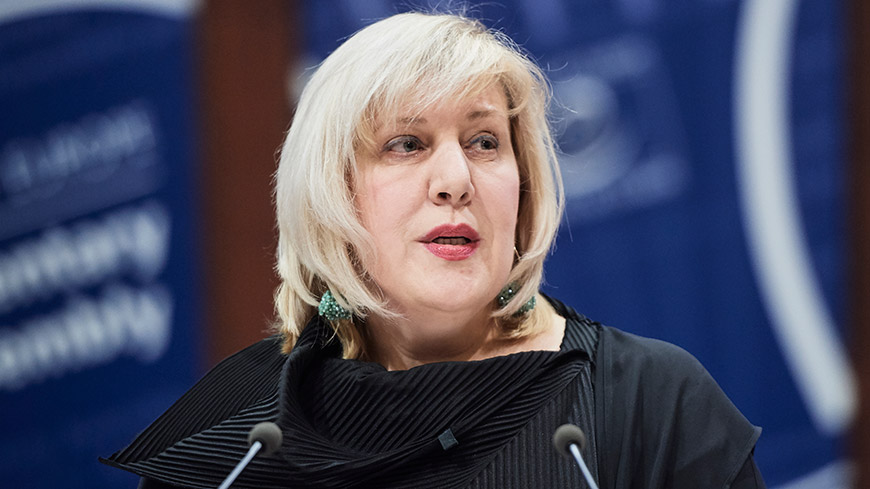
Silvana Meixner is the head of the ORF minority editorial office (Minderheitenredaktion) and presenter of the magazine “Heimat Fremde Heimat”. In the spirit of the late Ari Rath, she is honoured as a journalist who has rendered outstanding service in her work to critical reporting on flight, expulsion and asylum, committed to the protection of human rights. Silvana Meixner was born on March 16, 1958 in Split, Croatia; she lives in Vienna since 1986. After graduating from high school, she studied sociology and pedagogy in Zadar. Since 1988 she has been working for the Austrian Broadcasting Corporation (Österreichischer Rundfunk), where she was involved in setting up the minority editorial office. On 3 December 1993 Silvana Meixner, who moderated the television programme Heimat, fremde Heimat together with Lakis Iordanopoulos, was injured by a letter bomb from Franz Fuchs. She continued her journalistic work for refugees, ethnic minorities and human rights.
Press Emblem Campaign (PEC), a nongovernmental organization presented a statement on press freedom and journalist killings duringUnited Nations Human Rights Council 40th session in Geneva on 13 March 2019.
The Press Emblem Campaign (PEC) documented last year the killing of 117 journalists, an increase of 17 percent in media casualties compared to the previous year. In five countries journalists paid an unacceptable toll: Afghanistan with 17 killed, Mexico also with 17 killed, Syria with 11 killed, Yemen and India, with 8 journalists killed in each of those countries. The PEC urged the Members of the Human Rights Council to fight more firmly impunity and to bring the responsible of those crimes to justice.
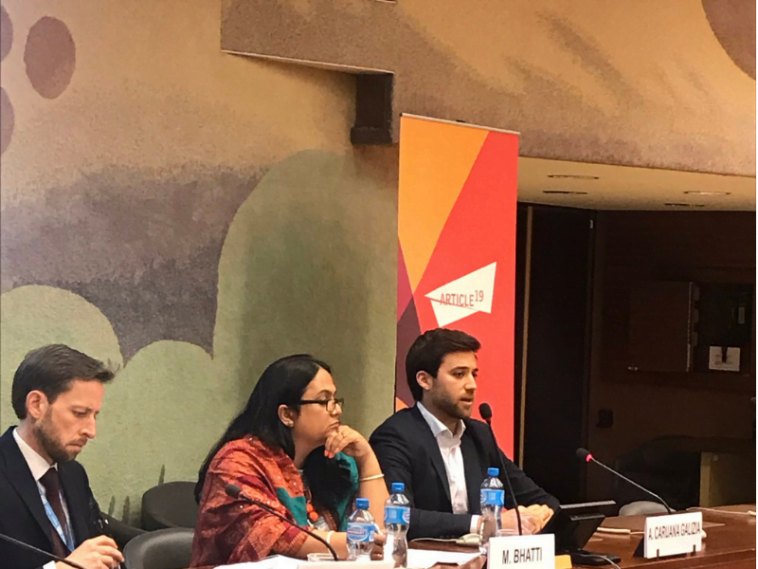
The PEC is also worried by the large number of arrests among journalists in the recent turmoilin Sudan, the repression of press freedom in Nicaragua and Venezuela, the statement reads. PEC expressed itsspecial concern with the continuous judicial harassment of journalists in Turkey in the statement.
PEC was one of the organizers of the panel discussion on human rights violations in Turkey, which the Turkish government mobilized its entire diplomatic corps to prevent during 40th Regular Session of the UN Human Rights Council on 5 March. The move prompted an outcry from human rights defenders.[see: https://stockholmcf.org/erdogan-govt-fails-to-cancel-un-human-rights-council-event-on-turkey/%5D
Turkey is the biggest jailer of journalists in the world. The most recent figures documented by SCF (Stockholm Centre for Freedom) show that 211 journalists and media workers were in jail as of March 11, 2019, most in pretrial detention. Of those in prison 134 were under arrest pending trial while only 77 journalists have been convicted and are serving their time. Detention warrants are outstanding for 167 journalists who are living in exile or remain at large in Turkey. The government also closed down some 200 media outlets.
To celebrate its 70th anniversary, the Geneva Association of United Nations Correspondents (ACANU) organised a public lecture, panel discussion and award presentation in partnership with the Graduate Institute and the Club Diplomatique de Genève on “Press Freedom and Journalists Under Attack” on 25 February 2019.
Photo credit: Magali Girardin
The lecture, delivered by António Guterres, Secretary-General of the United Nations, addressed issues on the physical attacks and growing number of assaults on the credibility of journalists and media organisations, which are taking a heavy toll on media freedom. It also sought to answer what is spurring the growing hostility and violence and what can be done to protect professional journalists.
“Journalists are on the front lines, sounding the first alarm, questioning official accounts, looking into difficult and dangerous issues and – at their best – asking questions that demand an answer and telling truths that must be heard. […] In the face of this sustained campaign of harassment, intimidation and lack of accountability, we – the international community – cannot remain silent. […] I call on Governments and the international community to protect journalists and media workers, and to create the conditions they need to do their essential work, and to investigate and prosecute the perpetrators of attacks on them.”
Nina Larson, President of ACANU, then moderated a panel discussion on the situation facing journalists, which included Peggy Hicks, Director Thematic Engagement, Special Procedures and Right to Development Division, UN High Commissioner for Human Rights; Christophe Deloire, Secretary-General, Reporters Without Borders and David Sylvan, Professor, International Relations/Political Science, the Graduate Institute.
During the discussion, Ms Hicks pointed out that “one of the [phenomena] that’s really important for us to look at in this context is the extent to which we have a whole new world of threats in terms of how some of these [attacks] happen online as opposed to offline”. Mr Deloire found that oligarchical control of the media and restrictive laws were like invisible prisons, where “there is no visible victim, there is no blood, no people in jail, but the information can be controlled”. Citing ways that state entities falsely present themselves as independent journalists, Professor Sylvan added that “there are so many alternatives – “fake” or otherwise – to regular news media that the problem now for many journalists is just to try to distinguish what they are doing from the hundreds and hundreds of things that appear similar but are not. So on the one hand, there are many more means – quite apart from physical violence […] of putting sharp restrictions on press freedom, but also there is a much greater demand for this.”
In the final segment of the event, ACANU presented two new international journalism awards, created for the 70th anniversary celebration and to recognise journalists for outstanding work in the face of growing hostility. Jennifer O’Mahony, a British freelancer, was awarded the prize for “Excellence in Reporting” for her article published in The Telegraph: “Algeria dumps thousands of migrants in the Sahara amid EU-funded crackdown”. The ACANU award for “Best Journalistic Coverage of Human Rights” was given to two Geneva journalists, Adrià Budry Carbó of Le Temps and Camille Pagella of L’illustré, for their article, “Piège en haute mer”, published in Le Temps.
In a blog post in Foreign Policy of 28 February JACOB MCHANGAMA (Executive director of Justitia, a Copenhagen based think tank) tackles the thorny issue of hate speech versus freedom of speech: “The U.N. Hates Hate Speech More Than It Loves Free Speech – The U.N. Secretary General is going soft on one of the most fundamental human rights“. It is an excellent read! Read the rest of this entry »
The NGO Article 19, which organised the panel, stressed that impunity for attacks against journalists must end. It listed worrying trends of human rights violations, all of which pose a major threat to freedom of expression globally:
Continued impunity for attacks against journalists;
Failures by States to combat religious intolerance, while also failing to secure the rights to freedom of religion or belief and freedom of expression;
The abuse of counter-terrorism laws to target civil society and dissenting voices;
Attacks against women human rights defenders and environmental and land defenders.
Jesus Eugenio Ramos Rodriguez was at breakfast Saturday morning 9 February 2019 when he became the second journalist murdered in Mexico this year. Rafael Murua, a community radio station director in the northern state of Baja California Sur who had received death threats for his work, was found dead in a ditch Sunday, 21 January 2019, after being reported missing. [see: https://humanrightsdefenders.blog/2019/01/22/first-mexican-journalist-killed-in-2019-protection-mechanism-failing/]
On 11 February 2019 Front Line Defenders and the Observatory for the Protection of Human Rights Defenders (OMCT/FIDH) – together with 2 other NGOs – brought out a joint statement in which they celebrate the release of human rights defenders Damián Gallardo and Enrique Guerrero, but urge Mexican authorities to include the end of criminalisation against human rights defenders as a central theme in the human rights agenda of this Presidential term.
[On 28 December 2018, Messrs. Damián Gallardo Martínez and Enrique Guerrero Aviña were released after a resolution in this regard by the Eighth District Court of Federal Criminal Proceedings in the State of Jalisco. Both human rights defenders had been arbitrarily imprisoned since May 2013 and had been victims of repeated violations of their human rights since their arrest, including acts of torture and ill-treatment and numerous violations of their due process rights.]
….In this regard, we once again urge [See Joint Open Letter to the President Elect of the United Mexican States, Mr. Andrés Manuel López Obrador, dated 27 August 2018, “To put an end on the criminalisation of human rights defenders must be a priority for the new Mexican] the Mexican Administration to include as a central theme in the human rights agenda the development, with the participation of civil society, of a State policy that puts an end to the criminalisation of human rights defenders in Mexico. Download the full Statement
Published every year since 2002 by Reporters Without Borders (RSF), the World Press Freedom Index is an advocacy tool. The Index is a point of reference that is quoted by media throughout the world and is used by diplomats and international entities such as the United Nations and the World Bank.
The Index ranks 180 countries and regions according to the level of freedom available to journalists. (It is a snapshot of the media freedom situation based on an evaluation of pluralism, independence of the media, quality of legislative framework and safety of journalists in each country and region. It does not rank public policies even if governments obviously have a major impact on their country’s ranking. Nor is it an indicator of the quality of journalism in each country or region.)
THE PRESS FREEDOM MAP, which is distributed in print and digital versions, offers a visual overview of the situation in each country and region in the Index. The colour categories are assigned as follows: good (white), fairly good (yellow), problematic (orange), bad (red) and very bad (black).
The German NGO Wahrheitskämper (TruthFighters) and Amnesty International set up a bus stall at the International Frankfurt book fair every year to educate people about threats to freedom of expression. Different sketch artists pay tribute to courageous human rights defenders.
In 2018 the stall included portraits of Shaheed Salmaan Taseer, the late publisher of Daily Times of Pakistan, made by the German artist Steff Murschetz. Illustrator from Oberursel Christine Krahe painted the portrait of the Turkish author Ahmet Altan, who is imprisoned since 2016. Susanne Köhler, a Frankfurt based illustrator and initiator of the memorial project Wahrheitskämpfer – Fighters for Truth – drew the portrait of the Journalist Kyaw Soe Oo who is imprisoned in Myanmar. Christian Scharfenberg also made a portrait of slain US journalist John McNamara, who was killed in a mass shooting at The Capital Gazette newspaper in June 2018. Deniz Yucel was imprisoned by Turkish government in February 2017 for almost a year while serving as a correspondent for Germany’s Die WeltN24 media group in Turkey.
Artist Steff Murschetz from U-Comix-Magazin drew a sketch of Salmaan Taseer Shaheed
Speaking to Daily Times, Steff Murschetz said that Salmaan Taseer’s sketch was his way of conveying his love and respect for the visionary man who gave up his life while protecting Pakistani society from intolerance and injustice. Known German lawyer of Pakistani origin Advocate Muzaffar Chaudhry also joined the Amnesty International event and told Daily Times that the Supreme Court’s decision in Aasia Bibi’s case was a recognition of Salmaan Taseer’s clarity of vision.
TRT World carries an interesting piece about Riyadh being celebrated as “capital of media”. The piece gives a detailed account of the Khashoggi affair and rightly wonders how this sits with having a media event.
People attend a symbolic funeral prayer for Saudi journalist Jamal Khashoggi at the courtyard of Fatih mosque in Istanbul, Turkey November 16, 2018 (Reuters)
The event, which will take place on December 19, almost three months after Khashoggi’s killing, comes following the Council of Arab Information Ministers’ decision to choose Riyadh as the Arab Media Capital last May, according to a statement by the Media and Communication sector of the Arab League.
….For years the Saudi Arabian government has been accused of human rights violations, including imprisoning human rights defenders and silencing its critics. However, human rights organisations have been increasingly expressing their concerns since the crown prince’s takeover in 2015, saying that the limited freedom of expression under his father King Salman has been completely shut down. Three Saudi princes living in the Europe, all critics of the Saudi government, disappeared between 2015 and 2017. Human Rights Watch reported in May 2018 that the kingdom arbitrarily detained thousands more people in a six-month period, without referring them to courts for criminal proceedings.
“[MBS] wants to control the whole scene: He’s a transformer, he wants to have a monopoly on the narrative, on the ideas that are being exchanged in Saudi Arabia. And right now he does have total control,” Khashoggi was quoted as saying in March 2018, in an article by the Columbia Journalism Review. “The American media should not see the cup half full—see only the reform. Yes, he’s fulfilling a promise to purge radicalism in Saudi Arabia. At the same time however, he’s not allowing any form of expression, except expression that supports him,” he said. [see also: https://humanrightsdefenders.blog/2018/10/19/novak-djokovic-and-rafael-nadal-have-a-chance-to-score-a-point-for-human-rights-defenders/]
On 6 November 2018, four UN Special Rapporteurs have strongly condemned the killing of Julián Carrillo, an indigenous rights defender from the state of Chihuahua, Mexico, who had worked tirelessly for over two decades to defend his community against the exploitation of Rarámuri ancestral lands.
On 23 October 23 2018, Julián Carrillo told a friend by phone that he believed he was being watched and said he would go into the forest in an attempt to hide. On the evening of 25 October, his body was found. He had multiple bullet wounds. “We urge the Mexican authorities to identify the perpetrators of this reprehensible crime and to bring them to justice in accordance with the law,” the experts said.
The experts also urged the Government to address the underlying causes of such violence. “The killing of Julián Carrillo highlights the serious situation in the Sierra Tarahumara where the lack of recognition of indigenous land rights is a root cause of the recurring violence against and displacements of indigenous communities.”… [The UN experts are: Mr. Michel Forst, Special Rapporteur on the situation of human rights defenders; Ms. Victoria Tauli Corpuz, Special Rapporteur on the rights of indigenous peoples; Ms. Agnès Callamard, Special Rapporteur on extrajudicial, summary or arbitrary executions; and Ms. Cecilia Jimenez-Damary, Special Rapporteur on the Human Rights of Internally Displaced Persons.]
Julián Carrillo’s murder is one of a spate of killings of human rights defenders in the country. According to official OHCHR figures, 21 human rights defenders have been killed so far this year, nine of them from indigenous communities. Four members of Julián Carrillo’s family – his son, son-in-law and two nephews – have been killed since February 2016.
This follows soon after the assassination on Wednesday 23 October of journalist Gabriel Soriano Kuri. Soriano had been covering Governor Héctor Astudillo Flores’ third annual report for the Radio y Televisión de Guerrero (RTG) broadcaster that evening. After the event, held in Acapulco, he was driving a company vehicle when he was attacked and killed by armed civilians. Following the murder, Astudillo offered his condolences to Soriano’s family via Twitter. But it didn’t go down very well. Soriano’s daughter replied with a blunt message: “My dad was assassinated doing his job. Covering your report to the state! Do your job and fix the situation the state is in. It’s not right,” she wrote. Her discontent was echoed in at least three demonstrations where journalists demanded that authorities solve the assassination of their colleague. A state journalists’ association reported that three members of the profession have been slain during Astudillo’s three years in office.