Posts Tagged ‘ISHR’

ISHR’s training for human rights defenders 2025:

November 27, 2024

Are you a human rights defender keen to use the UN to push for change at home? If so, apply for the 2025 edition of ISHR’s flagship training, the Human Rights Defender Advocacy Programme (HRDAP)!

After a successful edition in 2024, [https://humanrightsdefenders.blog/2023/11/07/human-rights-defender-advocacy-programme-2024-applications-now-open/] ISHR launches the call for applications for the 2025 Human Rights Defender Advocacy Programme (HRDAP25), which will take place both remotely and in Geneva! Below are some important dates to consider before applying:

  • Mandatory distance learning course: 14 April – 8 June 2025 (part time)
  • In-person course in Geneva: 10- 20 June 2025 (full time) 
  • Deadline to apply: 10 January 2025, midnight CET (Geneva Time)
  • Programme description with all the information can be downloaded here.
  • Application form can be found here. 

Learn more about why you should apply for HRDAP by watching this video!

What is the Human Rights Defender Advocacy Programme 2025 (HRDAP25)?

The course equips human rights defenders with the knowledge and skills to integrate the UN human rights system into their existing work at the national level in a strategic manner and provides an opportunity for participants to prepare for and engage in advocacy activities at the UN with the aim to effect change back home.  

Online course topics – ISHR

Defenders will complete a 10-week hybrid learning programme, online and offline, which will include: 

  • Accessing the HRDAP Platform, where they can complete e-learning courses on each key UN human rights mechanism and on advocacy strategies, and access interactive learning materials and case studies on the ISHR Academy 
  • Taking part in live Q&A sessions with human rights experts 
  • Receiving a continuous personalised advocacy support and coaching in order to develop concrete advocacy objectives to make strategic use of the international human rights system taking into account the local context
  • Building networks around the world, and learning from peers from a range of regions working on a range of human rights issues 
  • Applying their knowledge to case-studies scenarios and enhancing their advocacy toolbox according to their specific needs (elevator pitch, SMART recommendations…)
  • Receiving support and advocacy accompaniment to conduct activities during the 59th and 60th Human Rights Council sessions and other relevant opportunities. 

Participants will have the unique opportunity to apply their knowledge and skills while being in Geneva as well as to meet and share with their peers and experts (UN staff, diplomats, supporting NGOs…). The blended format of the course allows defenders to continue their vital work on the ground, while diving into the inner workings of each key UN human rights mechanism and gaining first-hand experience from advocates and UN staff on how civil society can strategically engage in the international human rights space.  The methodology we use is interactive and learner-centred and encourage participation of everyone.

By participating in HRDAP, defenders:

  1. Gain knowledge and tools, which they can use to ensure their voice is central in international human rights decision-making 
  2. Explore and compare the benefits of engagement with the Human Rights Council, the Special Procedures, the OHCHR, the Universal Periodic Review and the Treaty Bodies, and examine how they can use them to bolster their work at the national level 
  3. Develop strategies and advocacy techniques to increase the potential of their national and regional advocacy work 

This programme is directed at experienced human rights defenders working in non-governmental organisations, with existing advocacy experience at the national level and some prior knowledge of the international human rights system. 

ISHR supports, and promotes solidarity with and between, defenders working in the following areas or contexts, which we recognise as intersectional and interdependent: 

  1. Equality, dignity and non-discrimination
  2. Environmental justice and sustainability 
  3. International accountability for the repression of human rights defenders 
  4. Transparency and rule of law 

The hybrid programme will bring together around 16 committed human rights defenders from different backgrounds, who work on a wide range of areas that are linked with our programmes to ensure a sustainable collaboration. This can include, but is not limited to, defenders working on the following thematics: women rights; Indigenous people’s rights; the human rights of LGBTIQ+ persons; anti-racism; reclaiming civil society space and increasing protection of human rights defenders.  

What do former HRDAPers say? 

16 human rights defenders from 15 countries took part in the last edition, HRDAP24. At the end of the training, 98% of the participants were either extremely satisfied or very satisfied with the programme and felt that they would be able to apply what they learnt to their own day-to-day work. Find out more about the outcomes of HRDAP24 here. 

More testimonials from HRDAP Alumni here.  

How to apply?

First, download and read carefully the HRDAP 2025 Programme Description to find out more about modalities, requirements and funding. If you meet the criteria, take some time to apply using this online form before midnight Geneva time on Friday 10 January 2025! 

As only a limited number of human rights defenders are able to participate in HRDAP each year, in addition to our range of guides and handbooks, ISHR has developed an e-learning space in English, French and Spanish to help human rights defenders strengthen their advocacy skills with the UN for greater impact on the ground: the ISHR Academy. The learning modules demystify the UN human rights system and build capacity to push for change. Discover new tools, insider tips, defender stories, and more! 

For more information, please contact us: training@ishr.ch

https://ishr.ch/latest-updates/hrdap-2025-apply-now-for-ishrs-hybrid-training-for-human-rights-defenders

Indigenous human rights defender Victoria Maladaeva from Russia

November 6, 2024

Indigenous communities must have better political representations to ensure our rights are protected both constitutionally and in practice,‘ says Victoria Maladaeva, and Indigenous peoples’ rights defender from Russia. Victoria was also a participant in ISHR’s Women Rights Advocacy Week this year. She spoke to ISHR about her work and goals.

Hello Victoria, thanks for accepting to tell us your story. Can you briefly introduce yourself and your work?

Sure! I’m a Buryat anti-war decolonial activist, co-founder of the Indigenous of Russia Foundation.

What inspired you to become involved in the defence of human rights?

Since the full-scale Russian invasion of Ukraine, Indigenous peoples, particularly Buryat, have been hit the hardest. I wanted to help my people, fight the Russian propaganda and raise awareness about systemic colonial oppression and discrimination faced by Indigenous people and ethnic minorities in the Russian Federation.

What would Russia and your community look like in the future if you achieved your goals, if the future you are fighting for became a reality?

The country needs a large-scale transformation— political, economic, and cultural. Indigenous communities must have better political representations to ensure our rights are protected both constitutionally and in practice. Genuine democratic reforms involve fundamental rights for self-determination and autonomy where Indigenous peoples gain control of their land and resources. Putin’s constitution’s amendments to national Republics must be reversed, our languages must be mandatory in all schools, universities, and institutions where Indigenous communities live. 

How do you think your work is helping make that future come true?

I’m advocating for the rights of Indigenous peoples with international stakeholders and institutions to raise awareness about issues faced by our communities and spreading awareness, producing documentaries, and mobilising diasporas. 

Have you been the target of threats or attempts at reprisals because of your work?

Unfortunately, yes. There have been threats because of my anti-war activism and for shedding light on the disproportionate mobilisation in the Republic of Buryatia. For some reason, my colleagues and I were denied participation in the UN Permanent Forum on Indigenous Issues. I would like to believe this was a mistake and that there was no influence from the Russian delegation at the UN.

Do you have a message for the UN and the international community?

Russia needs decolonisation and de-imperialisation. Without revising the past and acknowledging colonial wars (not only in Ukraine) and discrimination, there can be no bright future for Russia—free and democratic. The international and anti-imperialist community should acknowledge that the Russian government is not for any anti-colonial movement. Stand in solidarity with independent Indigenous activists!

https://ishr.ch/defender-stories/human-rights-defenders-story-victoria-maladaeva-from-russia

Results of the 57th session of the Human Rights Council

October 19, 2024

At the 57th Human Rights Council session, civil society organisations share reflections on key outcomes and highlight gaps in addressing crucial issues and situations. Full written version below:

States continue to fail to meet their obligations under international law to put an end to decades of Israeli crimes committed against the Palestinian people, including the genocide in Gaza, and most recently Israel’s war on Lebanon. States that continue to provide military, economic and political support to Israel, while suppressing fundamental freedoms such as expression and assembly, as well as attacking independent courts and experts, and defunding humanitarian aid (UNRWA), are complicit in the commission of crimes. We urge the Council to address the root causes of the situation as identified by experts and the ICJ, including settler-colonialism and apartheid, and to address the obligations of third States in the context of the ICJ’s provisional measures stressing the plausible risk of genocide in Gaza and the ICJ advisory opinion recognising that ‘Israel’s legislation and measures constitute a breach of Article 3 of CERD’ pertaining to racial segregation and apartheid. The General Assembly adopted the resolution titled “The Crime of Genocide” in December 1946, which articulates that the denial of existence of entire human groups shocks the conscience of mankind. We remind you of our collective duty and moral responsibility to stop genocide.

States have an obligation to pay UN membership dues in full and in time. The failure of many States to do so, often for politically motivated reasons, is causing a financial liquidity crisis, meaning that resolutions and mandates of the Human Rights Council cannot be implemented. Pay your dues! The visa denials to civil society by host countries is a recurring obstacle to accessing the UN; and acts of intimidation and reprisals are fundamental attacks against the UN system itself. The right to access and communicate with international bodies is firmly grounded in international law and pivotal to the advancement of human rights. In this regard, we welcome the action taken by 11 States to call for investigation and accountability for reprisals against individually named human rights defenders. This sends an important message of solidarity to defenders, many of whom are arbitrarily detained for contributing to the work of the UN, as well as increasing the political costs for perpetrators of such acts. We welcome progress in Indigenous Peoples’ participation in the work of this Council as it is the first time that they could register on their own for specific dialogues.

We welcome the adoption of the resolution that renews the mandate of the Special Rapporteur on the promotion and protection of human rights in the context of climate change by consensus. 

We also welcome the adoption of the resolution on biodiversity sending a clear call to take more ambitious commitments at the sixteenth meeting of the Conference of the Parties to the Convention on Biological Diversity  and acknowledging the negative impact that the loss of biodiversity can have on the enjoyment of all human rights, including the right to a clean, healthy and sustainable environment. We welcome that these two resolutions recognize the critical and positive role that Environmental Human Right Defenders play. We also welcome the adoption by consensus of the resolutions on the rights on safe drinking water and sanitation; and the resolution on human rights and Indigenous Peoples. 

We welcome the adoption of the resolution on equal participation in political and public affairs which for the first time includes language on children and recognises their right to participation as well as the transformative role of civic education in supporting their participation. We also welcome the recognition that hate speech has a restrictive effect on children’s full, meaningful, inclusive and safe participation in political and public affairs.

We welcome the adoption of the resolution from rhetoric to reality: a global call for concrete action against racism, racial discrimination, xenophobia and related intolerance. The resolution contains important language on the implementation of the Durban Declaration and Programme of Action as well as the proclamation by the General Assembly of a second International Decade for People of African Descent commencing in 2025. We welcome the inclusion of a call to States to dispense reparatory justice, including finding ways to remedy historical racial injustices. This involves ensuring that the structures in society that perpetuate past injustices are transformed, including law enforcement and the administration of justice. 

We welcome the adoption of a new resolution on human rights on the internet, which recognises that universal and meaningful connectivity is essential for the enjoyment of human rights. The resolution takes a progressive step forward in specifically recommending diverse and human right-based technological solutions to advance connectivity, including through governments creating an enabling and inclusive regulatory environment for small, non-profit and community internet operators. These solutions are particularly essential in ensuring connectivity for remote or rural communities. The resolution also  unequivocally condemns internet shutdowns, online censorship, surveillance, and other measures that impede universal and meaningful connectivity. We now call on all Sates to fully implement the commitments in the resolution and ensure the same rights that people have offline are also protected online. 

Whilst we welcome the attention in the resolution on the human rights of migrants to dehumanising, harmful and racist narratives about migration, we are disappointed that the resolution falls short of the calls from civil society, supported by the Special Rapporteur on Human Rights of Migrants, for the Human Rights Council to set up an independent and international monitoring mechanism to address deaths, torture and other grave human rights violations at borders. Such a mechanism would not only support prevention and accountability – it would provide a platform for the people at the heart of these human rights violations and abuses to be heard. The study and intersessional mandated in this resolution must be used to enhance independent monitoring and increase access to justice.

We welcome the adoption of the resolution on Afghanistan renewing and strengthening the mandate of the Special Rapporteur. Crucially, the resolution recognises the need to ensure accountability in Afghanistan through “comprehensive, multidimensional, gender-responsive and victim-centred” processes applying a “comprehensive approach to transitional justice.” However, we are disappointed that the resolution once again failed to establish an independent accountability mechanism that can undertake comprehensive investigations and collect and preserve evidence and information of violations and abuses in line with these principles to assist future and ongoing accountability processes. This not only represents a failure by the Council to respond to the demands of many Afghan and international civil society organisations, but also a failure to fulfil its own mandate to ensure prompt, independent and impartial investigations which this and all previous resolutions have recognised as urgent.

We welcome the renewal of the Special Rapporteur on Burundi

We welcome the renewal of the Special Rapporteur’s mandate on the human rights situation in the Russian Federation. The human rights situation in Russia continues to deteriorate, with the alarming expansion of anti-extremism legislation now also targeting LGBT+ and Indigenous organisations being just the latest example of this trend. The Special Rapporteur has highlighted how such repression against civil society within Russia over many years has facilitated its external aggression. The mandate itself remains a vital lifeline for Russian civil society, connecting it with the Human Rights Council and the broader international community, despite the Russian authorities’ efforts to isolate their people.

We welcome the resolution on promoting reconciliation, accountability and human rights in Sri Lanka renewing for one year the mandate of the OHCHR Sri Lanka Accountability Project and of the High Commissioner to monitor and report on the situation. Its consensual adoption represents the broad recognition by the Council of the crucial need for continued international action to promote accountability and reconciliation in Sri Lanka and keeps the hopes of tens of thousands of victims, their families and survivors who, more than 15 years after the end of the war, continue to wait for justice and accountability. However, the resolution falls short in adequately responding to the calls by civil society. It fails to extend these mandates for two years which would have ensured that the Sri Lanka Accountability Project has the resources, capacity and stability to fulfill its mandate. 

We welcome the renewal of the Fact Fin­ding Mission on Sudan with broader support (23 votes in favor in comparison to 19 votes last year, and 12 votes against in comparison to 16 votes last year). This responds to the calls by 80 Sudanese, African, and other international NGOs for an extension of the man­date of the FFM for Sudan. We further reiterate our urgent calls for an immediate ceasefire and the prompt creation of safe corridors for humanitarian aid organisations and groups, and to guarantee the safety of their operations, as well as our call on the UN Security Council to extend the arms embargo on Darfur to all of Sudan and create effective monitoring and reporting mechanisms to ensure the implementation of the embargo. 

We welcome the renewal of the mandates of the Fact-Finding Mission on Venezuela (FFM) and of OHCHR for two more years. The deepening repression at the hands of government forces following the fraudulent Presidential elections in July has made evident the vital importance of continued independent documenting, monitoring and reporting by the FFM and its role in early warning of further human rights deterioration. We are pleased that OHCHR is mandated to provide an oral update (with an ID) at the end of this year. This will be key ahead of the end of the term of the current presidency on 10 January 2025. This resolution is an important recognition of and contribution to the demands of victims and civil society for accountability.  

We regret that the Council failed to take action on Bangladesh. We welcome Bangladesh’s cooperation with the Office of the High Commissioner for Human Rights including by inviting the Office to undertake investigations into allegations of serious violations and abuses in the context of youth-led protests in July and August, as well as positive steps by the interim government. However, we believe that a Council mandate would provide much needed support, stability and legitimacy to these positive initiatives at a time of serious political uncertainty in the country.

The Council’s persistent inaction and indifference in the face of Yemen’s escalating human rights crisis is deeply troubling. Since the dissolution of the Group of Eminent Experts, and despite years of mounting atrocities, we have yet to see the type of robust, independent international investigation that is desperately needed. Instead, the Council’s approach has been marked by half-measures and complacency, allowing widespread violations to continue unchecked. Despite the precarious humanitarian situation, the recent campaign of enforced disappearances and arbitrary detention by the de facto Houthi authorities and recent Israeli bombardments, Yemen has increasingly become a forgotten crisis. The current resolution on Yemen represents this failure. Technical assistance without reporting or discussion is an insufficient response. The decision to forgo an interactive dialogue on implementing this assistance is an oversight, undermining the principles of accountability and transparency. We welcome the inclusion of language in the resolution recognizing the vital role of NGO workers and humanitarian staff who the Houthis have arbitrarily detained. We call for the immediate and unconditional release of those who continue to be detained for nothing more than attempting to ensure the rule of law is respected and victims are protected. We urge this Council to act decisively, prioritize the creation of an independent international accountability mechanism, and place civilian protection at the forefront of its deliberations on Yemen. 

We continue to deplore this Council’s exceptionalism towards serious human rights violations in China committed by the government. On 17 August, the OHCHR stressed that ‘many problematic laws and policies’ documented in its Xinjiang report remain in place, that abuses remain to be investigated, and that reprisals and lack of information hinder human rights monitoring. We welcome the statement by the Xinjiang Core Group on the second anniversary of the OHCHR’s Xinjiang report, regretting the government’s lack of meaningful cooperation with UN bodies, the rejection of UPR recommendations, and urging China to engage meaningfully to implement the OHCHR’s recommendations, including releasing all those arbitrarily detained, clarifying the whereabouts of those disappeared, and facilitating family reunion. It is imperative that the Human Rights Council take action commensurate to the gravity of UN findings, such as by establishing a monitoring and reporting mechanism on China as repeatedly urged by over 40 UN experts since 2020. We urge China to genuinely engage with the UN human rights system to enact meaningful reform, and ensure all individuals and peoples enjoy their human rights. Recommendations from the OHCHR Xinjiang report, UN Treaty Bodies, and UN Special Procedures chart the way for this desperately needed change.

Finally, we welcome the outcome of elections to the Human Rights Council at the General Assembly. States that are responsible for atrocity crimes, the widespread repression of civil society, and patterns of reprisals are not qualified to be elected to this Council. The outcomes of the election demonstrate the importance of all regions fielding competitive slates that are comprised of appropriately qualified candidates.  

Signatories:

  1. International Service for Human Rights (ISHR)
  2. Asian Forum for Human Rights and Development (FORUM-ASIA)
  3. CIVICUS: World Alliance for Citizen Participation 
  4. FIDH 
  5. Cairo Institute for Human Rights Studies

https://ishr.ch/latest-updates/hrc57-civil-society-presents-key-takeaways-from-the-session

https://www.fidh.org/fr/plaidoyer-international/nations-unies/united-nations-human-rights-council-57th-session

see:

https://www.theguardian.com/commentisfree/2024/oct/11/us-un-human-rights-israel

https://www.theguardian.com/global-development/2024/oct/08/rights-activists-urge-un-reject-abusive-bid-saudi-arabia-bid-join-human-rights-council

Following a concerted campaign led by ISHR together with other civil society partners, Saudi Arabia was just defeated in its bid to be elected to the UN Human Rights Council!

Human rights defender’s profile: Óscar Calles from Venezuela

July 24, 2024

Óscar Calles is a journalist and human rights defender from Venezuela. Since 2019, he has been working for PROVEA, one of the country’s most prominent rights groups.

In an interview with ISHR, he recalled his experience of witnessing and broadcasting mass protests in his country in 2017, and how harshly these were repressed. This, he said, led him to take direct action in the defence of human rights and civil liberties.

Human rights organisations, activists and defenders only exist to ensure that all persons can live with dignity,’ says Oscar Calles. ‘Do not turn your backs on the hundreds of victims who are still awaiting justice to this day,’ he further urges States at the UN Human Rights Council, calling on to renew a key accountability mechanism for Venezuela.

In June 2024, Óscar was also one of 16 defenders who participated in ISHR’s Human Rights Defender Advocacy Programme (HRDAP)

https://ishr.ch/defender-stories/human-rights-defenders-story-oscar-calles-from-venezuela

Sara Nabil, a human rights defender, from Afghanistan

July 6, 2024

Sara Nabil is a human rights defender and artist from Afghanistan. She spoke to ISHR about her dream of one day seeing a ‘free democratic Afghanistan, where each human being [regardless of which] gender they are, man or woman, neutral or other genders, [would be] treated equally.’

Stand in solidarity with Sara and other women human rights defenders from Afghanistan: join us in our campaign to push for UN experts and States to explicitly and publicly recognise the situation in Afghanistan as a form of gender apartheid and the need for an accountability mechanism to address gross human rights violations against women.

Breaking news: UN Declaration protecting human rights defenders updated with the Declaration +25

June 20, 2024

19 June 2024: in a ground-breaking initiative, civil society organisations worldwide have united to produce an authoritative articulation of the international legal framework for the protection of human rights defenders.

Following a year-long project involving consultations with human rights defenders, a coalition of 18 international (full list below) and regional human rights organisations released the Declaration +25, a landmark document systematising relevant developments in regional and international human rights law and standards of the last 25 years.

The principles contained in the two documents together represent a baseline for the protection and promotion of human rights defenders while addressing their enduring and evolving needs.

https://ishr.ch/25-years-un-declaration-on-human-rights-defenders/

To download: https://ishr.ch/defenders-toolbox/resources/declaration-25

‘The 1998 Declaration was a turning point in human rights history,’ the coalition of 18 international and regional human rights groups said today, ‘it recognised the importance and legitimacy of human rights defenders, and the need to protect the right to defend human rights.’

However, the Declaration has never been fully implemented or enforced, and human rights defenders have had to adapt their work to rising issues such as the climate crisis, racism, discrimination, the backlash against sexual and reproductive rights, but also to new threats – including digital surveillance, and different forms of stigmatisation, and criminalisation.

‘With grassroots and frontline activists’ lived experiences and concerns at its heart, the Declaration + 25 will help tackle the current challenges faced by human rights defenders. It will also be a major step towards fulfilling the promise of the 1998 Declaration: enshrining in law the protection of human rights defenders around the world.’

The project commenced in 2023 with the coalition conducting online and in person consultations with defenders to identify the key issues they face in the defence of human rights that were not fully addressed by the 1998 Declaration, and analyse developments in international and regional contexts and jurisprudence.

Over 700 human rights defenders from all regions of the world took part in these consultations, which, along with inputs from legal and human rights experts and civil society organisations, fed into the Declaration + 25. The document was adopted unanimously at a two-day experts’ meeting in Bangkok, Thailand in April 2024. The result is a call to action to governments, multilateral organisations, businesses, and civil society to protect human rights defenders and their activities.

‘People everywhere have the right to defend human rights and unite to achieve justice for all, and States have an obligation under international law to protect those exercising that right, and ensure they can work freely and safely,’ the 18 rights groups emphasised.

‘The Declaration +25 is a powerful new tool and reminder of the existing standards and principles that States, corporations and society at large must implement to protect and enable human rights defenders across the world for the years to come.’

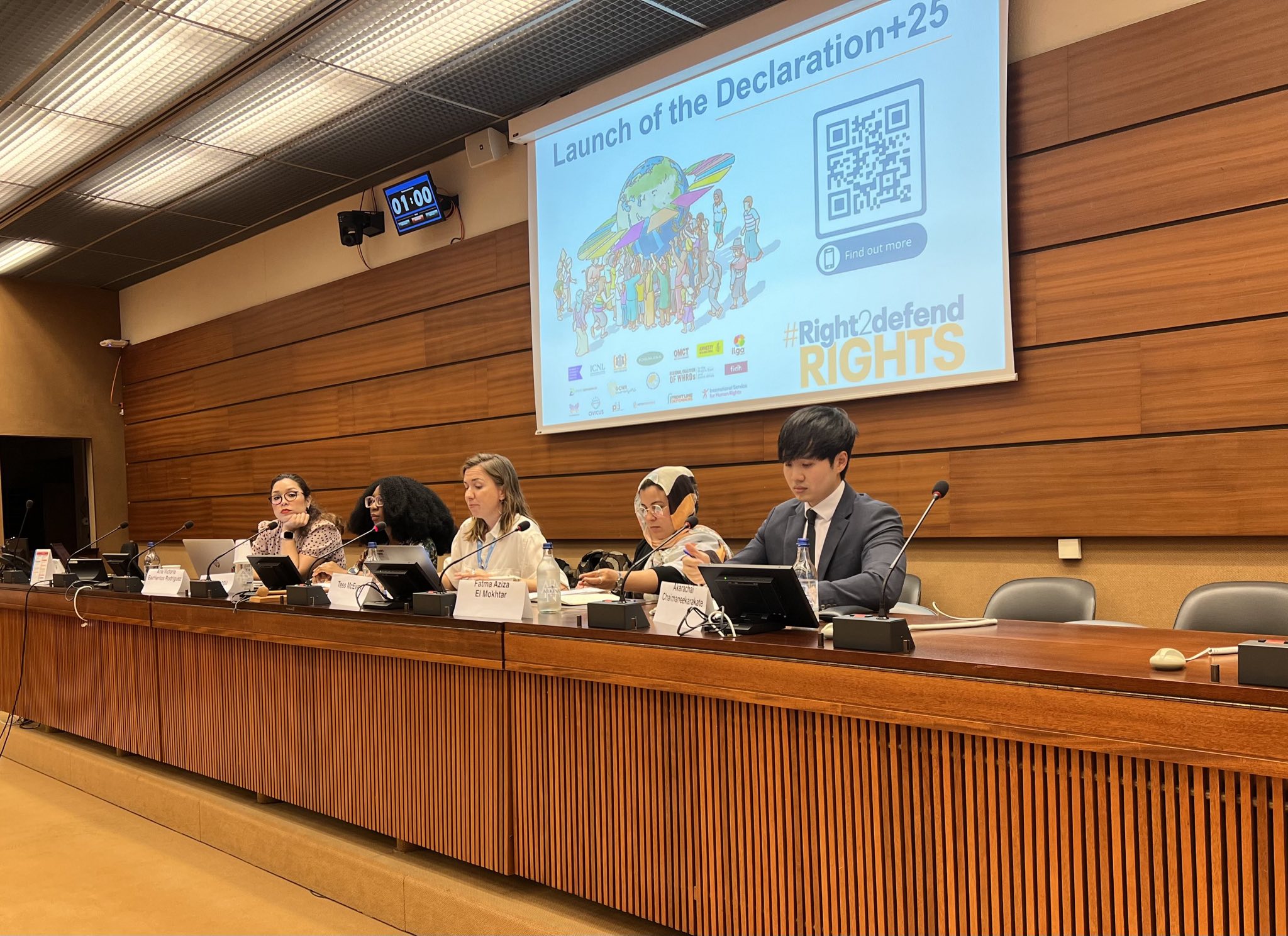
The Declaration+25 was formally launched on Wednesday 19 June at a side event in Geneva, on the margins of  the 56th session of the United Nations Human Rights Council. [https://humanrightsdefenders.blog/2024/06/08/launch-of-the-hrd-declaration25/]


List of participating organisations: 

  • Amnesty International 
  • Asia Pacific Forum on Women, Law and Development (APWLD) 
  • CIVICUS 
  • Defend Defenders 
  • FIDH 
  • FORUM-ASIA 
  • Front Line Defenders 
  • Gulf Centre for Human Rights 
  • ICNL 
  • ILGA World 
  • IM Defensoras 
  • International Service for Human Rights (ISHR) 
  • OMCT 
  • Peace Brigades International 
  • Protect Defenders 
  • Protection International 
  • The Regional Coalition for WHRDs in South-West Asia and North Africa (known as WHRDMENA) 
  • Robert F. Kennedy Human Rights

https://ishr.ch/latest-updates/civil-society-unveils-new-supplement-of-un-declaration-protecting-human-rights-defenders

ISHR’s 40th anniversary – help celebrate

June 18, 2024

ISHR are celebrating longstanding and collective efforts in supporting human rights defenders. Join and find out more! ISHR’s journey began in 1984, inspired by the courageous actions of human rights defenders who dared to challenge injustices and advocate for a fairer world.

We’ve created a list of 40 things you can do to shed light on our mission and the vital work of human rights defenders and advocates who tirelessly strive to make our world a better and more equal place for all.

Twice a week, we will suggest an action that you can do to support ISHR’s work until we reach 40 actions, representing our 40 years of engagement. These actions are designed to be simple yet impactful, allowing everyone to actively participate in the celebration and contribute to the advancement of human rights. Whether you are a long-time supporter or new to our mission, each action will provide a tangible way to support and promote human rights defenders and advocates around the world.

The actions will be published on this page as well as on our social media feeds. From sharing a resource that inspires you, to watching a defender story and sharing what you love about ISHR, every action counts and helps amplify the voices of those who are fighting for justice, equality and freedom.

You can follow the mobilisation here:

Please share these links with your network. The success of our mobilisation relies on the collective effort of our community, so we encourage you to spread the word and invite others to join us. By participating, you are not only celebrating our anniversary but also reinforcing the importance of human rights and the tireless work of those who defend them. We are looking forward to your participation and can’t wait to see the creative ways in which you will engage!

Actions published so far:

https://ishr.ch/latest-updates/40-actions-to-celebrate-ishrs-40th-anniversary/

Human rights defender’s profile: Sayed Ahmed AlWadaei from Bahrain

June 18, 2024

Sayed Ahmed AlWadaei is a human rights defender from Bahrain and the director of advocacy at the Bahrain Institute for Rights and Democracy (BIRD).

All we are asking for are the most basic rights. We hope to see Bahrain healing from over a decade of ordeal, of repression, of imprisonment, of torture, into a State where individuals can challenge their State without fear.’

He spoke to ISHR about how the 2011 Arab Spring uprising in Bahrain led him into activism and shared his hopes for a free, democratic future for his country despite the regime’s efforts to silence him and all those it perceives as opponents.

Learn more about Sayed and other human rights defenders like him here: https://ishr.ch/defender-stories/

Human Rights Defenders issues at the 56th session of the UN Human Rights Council

June 12, 2024

The UN Human Rights Council will hold its 56th regular session at Palais des Nations in Geneva from 18 June and 12 July 2024. And as always the excellent Alert of the International Service for Human Rights permits me to hightlight what concerns HRDs most. To stay up-to-date you can follow @ISHRglobal and #HRC56 on X, and look out for the Human Rights Council Monitor.

Civil Society Access and Participation The UN is facing a severe liquidity crisis due to member states not paying their membership dues in full and on time. This shortfall is impacting victims and survivors of human rights violations. The crisis risks being used to impose restrictions on civil society participation, although online and hybrid modalities offer cost-effective and environmentally friendly solutions. Over 100 human rights organisations have called on all states to promptly pay their dues to address the liquidity crisis. Additionally, this session States have the opportunity to continue to build on the good practices adopted in the past years and allow for a broader, more inclusive, effective and climate-friendly human rights system, including by providing remote access to informal consultations on HRC resolutions that can greatly benefit from the analysis and lived experiences of human rights defenders.

Thematic issues Issues on the agenda At this 56th session, the Council will discuss a range of civil, political, economic, social and cultural rights through dedicated debates with the mandate holders and the High Commissioner, including with the Special Rapporteur on extrajudicial, summary or arbitrary executions, the Special Rapporteur on the right to freedom of expression, the Special Rapporteur on the rights to freedom of peaceful assembly and of association, the Special Rapporteur on promotion and protection of human rights in the context of climate change, the Special Rapporteur on contemporary forms of racism, racial discrimination, xenophobia and related intolerance In addition, the Council will hold dedicated debates on the rights of specific groups including with: The Independent Expert on protection against violence and discrimination based on sexual orientation and gender identity, the Special Rapporteur on the rights of Internally Displaced Persons, the Special Rapporteur on violence against women and girls, the Special Rapporteur on independence of judges and lawyers

The Council will also hold debates on interrelation of human rights and thematic issues including with: The High Commissioner on new and emerging technologies.

The new incoming Independent Expert on violence and discrimination on the basis of sexual orientation and gender identity, Graeme Reid, will present his first report focusing on freedom of expression, assembly and association.

Environment and Climate Justice The Special Rapporteur on Internally Displaced Persons will present her report on planned relocations of people in the context of the adverse effects of climate change and disasters. This report is building up on previous reports by other mandates and will also look at laws and policies at the national, regional, and international levels. The newly appointed Special Rapporteur on Climate Change will also present her first report looking at the upcoming priorities and some reflections of the progress achieved on some issues in the last 5 years. The report will also provide a snapshot of some other key topics and the impacts on some particular groups. The Special Rapporteur will also present two country visits reports: Honduras and the Philippines. There is currently a call for inputs for her upcoming General Assembly report on access to information on climate change and human rights. The Working Group on Business and Human Rights will present its report on investors, Environmental, Social, and Governance (ESG) approaches and human rights. The report will raise awareness of the responsibilities of investors and will clarify responsibilities on how to align their ESG approaches to human rights. On Thursday 20 June, the President of the Human Rights Council is organising a high-level informal Presidential discussion on ‘The important link between climate change, food security and health security’. The discussion should address the important role of environmental human right defenders in promoting and securing the full realisation of the right to a clean, healthy and sustainable environment; and recognition of the obligation of States to prevent, protect and promote their work in an enabling environment.

International Solidarity Civil society and international experts have continued to raise grave concern at the attacks on fundamental freedoms when advocating for the human rights of Palestinians by authorities in Western countries, including in universities. The High Commissioner deplored the ‘sharp rise in hatred globally – including anti-Semitism and Islamophobia’. In her report to the Council, the Independent Expert on International Solidarity called on States to ‘eliminate the criminalization of international solidarity expressions and symbols and calls for accountability for violations of public international law norms, such as calls for peace, self-determination or decolonization and the ending of apartheid or genocide […] stressing that States ‘should not conflate them with ‘manifest support of terrorism’ or antisemitism in relevant legislation or regulations’. The Special Rapporteur on racism also raised concern at ‘accusations of antisemitism on the basis of legitimate criticism of treatment of Palestinians by Israel’ in her report following her visit to the United States.

The Special Rapporteur on Education, following her visit to the United States, stressed that the International Holocaust Remembrance Alliance (IHRA) definition conflating criticism of Israel with antisemitism is being used to crackdown against pro-Palestinian protesters, including individuals who ‘self-identify as belonging to the Jewish community or represent Jewish student associations’. The Rapporteur addressed violations against students following the organisation of ‘mass encampments at nearly 40 universities in more than 25 states across the country’, including the detention of more than 2000 individuals, raids by fully armed police on university campuses requested by educational institutions to ‘disperse demonstrators and dismantle encampments’.   During the session, and especially in the ID with the experts on International Solidarity, Education, Freedom of Expression, Freedom of Assembly and Association, we urge States to call for an end to the repression and criminalisation of groups and individuals advocating for the human rights of the Palestinian people, including through the instrumentalization of anti-Semitism (IHRA definition) and anti-terrorism policies, including in universities, and especially in the West (including in Austria, France, Germany,  Italy, United States, United Kingdom).

Reprisals
HRC56 is a key opportunity for States to raise concerns about specific cases of reprisals and demand that governments provide an update on any investigation or action taken toward accountability. This month ISHR launched a new campaign regarding cases. ISHR urges States to raise these cases in their statements:

Cao Shunli was a prominent Chinese human rights defender, who sought to share information on the human rights situation in China with the United Nations in Geneva. Cao was arbitrarily detained and died in prison 10 years ago. [for more saee: https://humanrightsdefenders.blog/tag/cao-shunli/]

Abdulhadi Al-Khawaja is a Bahraini-Danish advocate known for his unwavering commitment to freedom and democracy. In April 2011 during the Bahrain chapter of what is known as the ‘Arab Spring’ uprisings, while he was leading peaceful demonstrations, Abdulhadi was violently arrested. He went missing for two months and, in June 2011, after a military trial, he was condemned to life-imprisonment on terrorism-related charges, despite grave concerns from the international community about unfair trials. [s`eae also: https://humanrightsdefenders.blog/2022/11/29/mea-laureate-abdulhadi-al-khawaja-facing-new-charges-for-protesting-injustice-in-jau-prison/ and https://www.trueheroesfilms.org/thedigest/laureates/4d45e316-c636-4d02-852d-7bfc2b08b78d]

Pham Doan Trang is an author, blogger, journalist and pro-democracy activist from Viet Nam. Trang was prosecuted for her articles and reports on the human rights situation in Viet Nam, including an analysis of a 2016 report on the Formosa Ha Tinh Steel Plant environmental disaster that was shared with the United Nations. See also: https://www.trueheroesfilms.org/thedigest/laureates/fe8bf320-1d78-11e8-aacf-35c4dd34b7ba and https://humanrightsdefenders.blog/tag/pham-doan-trang/].

Khurram Parvez and Irfan Mehraj are two Kashmiri human rights defenders. They have conducted ground-breaking and extensive human rights documentation in the Indian-administered Jammu and Kashmir, including through their work within the Jammu Kashmir Coalition of Civil Society (JKCCS). In 2016, Indian authorities arrested Khurram a day after he was barred from traveling to Geneva to attend the 33rd session of the Human Rights Council. See also: https://www.trueheroesfilms.org/thedigest/laureates/81468931-79AA-24FF-58F7-10351638AFE3 and https://humanrightsdefenders.blog/tag/khurram-parvez/. Meanwhile, on 20 March 2023, Irfan was summoned for questioning and arbitrarily detained by the NIA in Srinagar also under provisions of the UAPA and other laws. The NIA targeted Irfan for being ‘a close associate of Khurram Parvez.’ Both Khurram and Irfan are presently in pre-trial detention in the maximum-security Rohini prison in New Delhi, India.

See also: https://menarights.org/en/articles/egypt-un-experts-call-government-stop-targeting-and-retaliating-against-human-rights

Country-specific issues on the agenda

The Council will consider updates, reports on and is expected to consider resolutions addressing a range of country situations, in some instances involving the renewal of the relevant expert mandates. These include: Interactive Dialogues with the High Commissioner and the Special Rapporteur on Myanmar Enhanced Interactive Dialogue with the Special Rapporteur on Afghanistan Interactive Dialogue with the Independent international fact-finding mission for the Sudan Interactive Dialogue with the Commission of Inquiry on the Occupied Palestinian Territory and Israel Interactive Dialogue with the Special Rapporteur on Eritrea Interactive Dialogue with the Special Rapporteur on Belarus Interactive Dialogue with the Commission of Inquiry on Syria Interactive Dialogue with the Special Rapporteur on Burundi Interactive Dialogue with the High Commissioner on Venezuela Interactive Dialogue with the High Commissioner on Libya Interactive Dialogue with the Independent Expert on Central African Republic Interactive Dialogue with the High Commissioner on Ukraine and interim report of SG on Crimea Interactive Dialogue with the High Commissioner on Colombia

Afghanistan On 18 June, Richard Bennett, Special Rapporteur on Afghanistan will present his most recent report on the ‘phenomenon of an institutionalized system of discrimination, segregation, disrespect for human dignity and exclusion of women and girls’ (HRC res. 54/1). The report provides a multidimensional understanding of the design, commission and impact of the harms resulting from the Taliban’s institutionalized system of gender-based oppression. We welcome the Special Rapporteur’s view expressed in the report that the framing of gender apartheid most fully encapsulates the institutionalized and ideological nature of the abuses in the country. We note that the report of the Working Group on Discrimination Against Women to be presented at this session also noted the pattern of large-scale systematic violations of women’s and girls’ fundamental rights in Afghanistan ‘constitutes an institutionalized framework of apartheid based on gender and merits an unequivocal response.’ ISHR considers that the pursuit of justice for Afghan women and girls demands a multifaceted approach harnessing the strengths of various accountability mechanisms, including the establishment of an accountability mechanism for crimes against humanity; with strategic coordination exerting heightened pressure on the Taliban. See also: https://www.afintl.com/en/202406121393

Sudan On 18 June, the Fact-Finding Mission on Sudan will provide its first oral update to the HRC. Since the conflict erupted between the Sudanese Armed Forces and the Rapid Support Forces (RSF) on 15 April 2023, more than 30 thousand people have been killed while 10 million and a half have been displaced, a majority of which are women and children. Half of the population is now on the verge of famine, and 2.5 million could die of starvation by September. The continued fighting in El Fashir portends a repeated massacre and ethnic cleansing of the Masalit in El Geneina last year. In Aljazeera at least one hundred people were killed by RSF on 5 June, the area is facing grave human rights violations since last December.  Meanwhile, the attacks on women’s rights groups and local response initiatives continue unabated.bHumanitarian responders get arbitrarily arrested, and smeared as traitors by the warring parties, some sentenced for up to 2 years and even killed. States should call for an immediate ceasefire, protection of civilians and adherence to international law by all parties in the conflict. 

Occupied Palestinian Territory and Israel On 19 June, the Independent International Commission of Inquiry on the Occupied Palestinian Territory, including East Jerusalem, and Israel will present its report addressing the 7 October attacks by Palestinian armed groups and the commencement of Israel’s war on Gaza.

Venezuela The High Commissioner will present his report on 3 July with his Office staff still operating from Panama. The Maduro government has still not permitted the return of the Office on the terms of its original mandate. With Presidential elections to be held on 28 July, concerns increase about the safety of human rights defenders and opposition figures. Uncertainty has recently been increased by the re-introduction (and then rapid postponement of adoption) of the NGO Law. HRDs Javier Tarazona and Rocío San Miguel remain wholly unjustifiably detained. States must engage actively in the dialogue with the High Commissioner to make clear their support of the essential work of human rights defenders and of the UN’s essential, multifaceted regime scrutinising the human rights situation in the country. Situations of concern that are not on the Council’s agenda

Algeria The sustained repression against the pro-democracy movement and human rights defenders in Algeria was addressed in the end-of-session statements of the Special Rapporteur on freedom of association and assembly as well as the Special Rapporteur on human rights defenders who conducted official visits to Algeria in 2023. These were the first visits since 2016 by UN mandate holders to the country. The Special Rapporteur on Freedom of Assembly and Association addressed the ‘criminalisation of civil society work‘, and the ‘suspension or dissolution of political parties and associations, including prominent human rights advocacy organisations’ (including RAJ and LADDH), as well as ‘overly restrictive laws and regulations’ hindering their work.


Bahrain Thirty-three civil society organisations reiterated that thirteen years since Bahrain’s popular uprising, systemic injustice has intensified and political repression targeting dissidents, human rights defenders, clerics and independent civil society has effectively shut any space for the peaceful exercise of the right to freedom of expression or peaceful activism in the country. Despite the recent royal pardon issued on 8 April 2024, which included the release of more than 650 political prisoners, marking a change in State policy from previous royal pardons, the pardon excluded many individuals who played significant roles in the 2011 pro-democracy uprising, with an estimated 550 political prisoners remaining behind bars. HRC56 provides an important opportunity to address these developments in States’ national and joint statements, including during the Interactive Dialogues with the Special Rapporteurs and Independent Expert on Health, Freedom of Expression, Peaceful Assembly and Association, Independence of Judges and Lawyers and International Solidarity. We urge States to call for the release of all those arbitrarily, including human rights defenders and opposition activists Abdulhadi Al-Khawaja, Abduljalil Al-Singace, Hassan Mushaima and Sheikh Ali Salman as well as death row inmates Mohammed Ramadhan and Husain Moosa, who have now spent over a decade unlawfully detained following torture and unfair trials and remain at immanent risk of execution.

China The adoption on 4 July of the outcome of China’s fourth UPR review, which exposed strong international condemnation over grave abuses in January, is a key opportunity for States to urge China to fully implement recommendations emanating from existing findings by UN bodies. Any rejection by the Chinese government of UPR recommendations referring to UN expert mechanisms or to constructive cooperation with the UN system should be promptly condemned. Ahead of the second anniversary of the publication of the damning OHCHR Xinjiang report, and its authoritative findings of possible crimes against humanity in the Uyghur region, States should request updates on the implementation of the report’s recommendations. To uphold the integrity of its mandate and put an end to China’s exceptionalism, the HRC must also establish a monitoring and reporting mechanism on the country, as repeatedly called for by over 40 UN experts and hundreds of human rights groups globally. States should further urge the UN High Commissioner to strengthen follow-up action on his Office’s Xinjiang report, including through public calls for implementation, through translation of the report, and through an assessment of its implementation. States should raise serious concerns at the repression of peaceful protests by over 100 Tibetans who opposed a hydropower project in Derge County, affecting villages and monasteries. States should unequivocally call out the adoption of yet-another national security law further criminalising dissent and human rights promotion in Hong Kong, considered a ‘regressive step’ by High Commissioner Türk. States should echo the latter’s call to ‘release immediately and unconditionally all those arbitrarily arrested and detained under these laws.’ States should further ask for the prompt release of human rights defenders arbitrarily detained or disappeared, including feminist activist Huang Xueqin, human rights lawyers Ding Jiaxi, Yu Wensheng and his wife Xu Yan, legal scholar Xu Zhiyong, Uyghur doctor Gulshan Abbas, Hong Kong lawyer Chow Hang-tung, and Tibetan climate activist A-nya Sengdra.

Occupied Western Sahara ISHR is concerned over the situation of Saharawi human rights defenders, including lawyer M`hamed Hali, who has been arbitrarily deprived of his right to practice in the Moroccan judicial system due to opinions expressed in support of the right to self-determination for the people of Western Sahara. His hearing is scheduled on 27 June in front of Morocco´s highest court. We urge States to address  the crackdown on Sahrawi civil society including: during the Interactive Dialogues with the Special Rapporteurs on Freedom of Expression, Peaceful Assembly and Association, to call on Morocco to immediately put an end to ‘the systematic and relentless targeting of human rights defenders in retaliation for exercising their rights to freedom of association and expression to promote human rights in Western Sahara’; during the Interactive Dialogue with the Special Rapporteur on the Independence of Judges and Lawyers to call on Morocco to reinstate M’hamed Hali’s right to practice as a lawyer, stressing that this case sets a dangerous precedent for the independence of lawyers; and during the Interactive Dialogue with the Independent Expert on International Solidarity  to reiterate the recommendation of the expert that ‘States should eliminate the criminalization of international solidarity expressions and symbols and calls for accountability for violations of public international law norms, such as calls for peace, self-determination or decolonization […]’ in the case of Western Sahara.  

Saudi Arabia On 4 July, the Council will consider Saudi Arabia’s fourth UPR outcome, as the authorities announce whether they have accepted or rejected recommendations issued by States in January. The recommendations address widespread and systematic rights violations in the Kingdom, and have the potential to bring about significant change. They include, but are not limited to: calls for the release of prisoners of conscience, many of whom are serving decades-long prison sentences for peacefully exercising their basic rights, and the repealing of travel bans imposed on human rights defenders following their release; the abolition of the death penalty for child defendants, with several young men at imminent risk of execution for alleged crimes committed as minors; and a raft of legislative measures, including ratifying key international human rights treaties and revising repressive laws. States should use this key opportunity to urge Saudi Arabia to accept them in good faith, and crucially implement them.

Tunisia In May 2024, Tunisian authorities waged an unprecedented crackdown against Black migrants and refugees, and civil society organisations defending their rights. On 6 May, in the opening address to a National Security Council meeting, Tunisian President Kais Saied reiterated discriminatory and hateful remarks against Sub-Saharan migrants and refugees while inciting against civil society organisations, describing them as ‘traitors and [foreign] agents’ and ‘rabid trumpets driven by foreign wages’, because of their receipt of foreign funding and their ‘insulting’ of the state. The president questioned the sheltering of asylum seekers and refugees by the Tunisian Council for Refugees (CTR) – a nongovernmental organization, partner of the UNHCR, which supports the registration of asylum claims – and described asylum seekers and refugees residing in Tunisia as illegal. President Saied suggested that CSOs should only work with the state and under its instructions. Since 3 May, Tunisian authorities have arrested and opened investigations against the heads or members of at least six organisations working on migrant and refugee rights and against racial discrimination, including the CTR. Five people, including WHRD Saadia Mosbah, President of Mnemty, have remained in pre-trial detention, under unfounded accusations of financial crimes. On 14 May, the Prime Minister announced that a new association law is being finalized, which would replace Decree-Law 88, an internationally lauded legislation that that safeguards Tunisia’s right to the freedom of association. During the interactive dialogues with the Special Rapporteurs on Freedom of Assembly and Association, and Freedom of Expression, we urge States to call on Tunisia to put an end to the crackdown on civil society, immediately release all those arbitrarily detained, including individuals providing support or advocating for the rights of migrants and refugees, and to firmly condemn the escalating smear campaign and stigmatisation of human rights and humanitarian organisations receiving foreign funding and working with migrants and refugees, supported by the president’s speeches, often making use of discriminatory and racist language against Black migrants and Black people.

Adoption of Universal Periodic Review (UPR) reports During this session, the Council will adopt the UPR working group reports on Belize, Central African Republic, Chad, China, Congo, Jordan, Malaysia, Malta, Mauritius, Mexico, Monaco, Nigeria, Saudi Arabia, Senegal. ISHR supports human rights defenders in their interaction with the UPR. This session of the Council will provide an opportunity for Chad, China, Congo, Mauritius, Nigeria to accept recommendations made in relation to human rights defenders, as proposed in ISHR’s briefing papers.

Side events

19 June at 13:00 (room XXV): ISHR will hold a side event to launch the Declaration +25: A supplement to the UN Declaration on human rights defenders. See https://humanrightsdefenders.blog/2024/06/08/launch-of-the-hrd-declaration25/.

Open Society Institute will hold a side event on human rights in Afghanistan 19 June at 15:00:

American Civil Liberties Union will hold a side event on human rights in the United States of America

On 25 June at 16:00: Center for Justice and International Law will hold a side event on human rights in Guatemala

26 June at 14:00: Amnesty International will hold a side event on the protection of freedom of expression and assembly

On 27 June at 14:00: International Bar Association will hold a side event on gender apartheid: Case studies

On 3 July at 12:00: Friedrich Ebert Stiftung will hold a side event on climate change and human mobility

On 3 July at 17:00: Third World Network will hold a side event on business accountability in the context of armed conflict

On 4 July at 15:00: Earthjustice will hold a side event on Protection of Environmental Human Rights Defenders #HRC55:

Alert to the Human Rights Council’s 56th session

Launch of the HRD Declaration+25

June 8, 2024

Wednesday 19 June 2024 from 1:00 pm- 2:00 pm CEST there will be a HRC56 Side Event for the launch of the Declaration+25, a civil society-led authoritative document endorsed by experts that supplements the UN Declaration on Human Rights Defenders and sets standards to protect them.

Palais des Nations Room XXV Geneva. This in-person event will be moderated by ISHR on behalf of a Secretariat of 18 organisations, and include a panel of exceptional human rights defenders.