Posts Tagged ‘international jurisdiction’

Iran: One year after uprising in Iran the international community must combat impunity says Amnesty

September 15, 2023

The international community must pursue pathways for justice at the international level to address systemic impunity for Iranian officials responsible for hundreds of unlawful killings of protesters and widespread torture, Amnesty International said on 13 September 2023, as Iran marks the one-year anniversary of the “Woman Life Freedom” uprising.

Over the past year, Iranian authorities have committed a litany of crimes under international law to eradicate any challenge to their iron grip on power. These include hundreds of unlawful killings; the arbitrary execution of seven protesters; tens of thousands of arbitrary arrests; widespread torture, including rape of detainees; widespread harassment of victims’ families who call for truth and justice; and reprisals against women and girls who defy discriminatory compulsory veiling laws.

The anniversary of the ‘Woman Life Freedom’ protests offers a stark reminder for countries around the world of the need to initiate criminal investigations into the heinous crimes committed by the Iranian authorities under universal jurisdiction. Government statements calling on the Iranian authorities to halt the unlawful use of firearms against protesters, stop torturing detainees, and release all individuals detained for peacefully exercising their human rights remain as crucial as ever. These actions show victims they are not alone in their darkest hour.

The anniversary of the ‘Woman Life Freedom’ protests offers a stark reminder for countries around the world of the need to initiate criminal investigations into the heinous crimes committed by the Iranian authorities under universal jurisdiction. Diana Eltahawy, Amnesty International’s Deputy Regional Director for the Middle East and North Africa

The Iranian authorities have waged an all-out assault on the human rights of women and girls over the past year. Despite months of protests against Iran’s compulsory veiling laws, triggered by the arbitrary arrest and death in custody of Mahsa/Zhina Amini, the authorities have reinstated “morality” policing and introduced a raft of other measures that deprive women and girls who defy compulsory veiling of their rights.

These include the confiscation of cars and denial of access to employment, education, healthcare, banking services and public transport. Simultaneously, they have prosecuted and sentenced women to imprisonment, fines and degrading punishments, such as washing corpses.

This assault on women’s rights is taking place amid a spate of hateful official statements referring to unveiling as a “virus”, “social illness” or “disorder” as well as equating the choice to appear without a headscarf to “sexual depravity.”

The authorities are also working on new legislation that will introduce even more severe penalties for defying compulsory veiling.

Mass arbitrary detentions and summons

During the uprising and in the months that followed, the authorities arbitrarily arrested tens of thousands of men, women and children, including protesters, human rights defenders and minority rights activists.  Those arrested include at least 90 journalists and other media workers and 60 lawyers, including those representing families of individuals unlawfully killed. Scores of other lawyers were summoned for interrogations. [see e.g. https://humanrightsdefenders.blog/2023/05/11/now-it-is-the-turn-of-the-iranian-journalists-who-reported-on-mahsa-amini/]

Ahead of the anniversary, the authorities have intensified their campaign of arbitrary arrests targeting, among others, family members of those unlawfully killed, and forcing thousands of university students to sign undertakings not to participate in anniversary protests.

Execution of protesters

Over the past year, the authorities have increasingly used the death penalty as a tool of political repression to instil fear among the public, arbitrarily executing seven men in relation to the uprising following grossly unfair sham trials. Some were executed for alleged crimes such as damage to public property and others in relation to the deaths of security forces during the protests. All were executed after Iran’s Supreme Court rubber stamped their unjust convictions and sentences despite a lack of evidence and without carrying out investigations into their allegations of torture. Dozens remain at risk of execution or being sentenced to death in connection with the protests.

A crisis of impunity

The authorities have refused to conduct any thorough, independent and impartial investigations into the human rights violations committed during and in the aftermath of the “Woman Life Freedom” uprising and have failed to take any steps to hold those suspected of criminal responsibility to account.

Instead, authorities have applauded the security forces for suppressing the unrest and shielded officials from accountability, including two officials who admitted raping women protesters in Tehran. They have also dismissed complaints from victims and/or their families, threatening them with death or other harm if they pursued their complaints.

Amnesty International welcomed the establishment of a Fact-Finding Mission on Iran by the UN Human Rights Council in November 2022, yet much more is needed to combat the crisis of impunity for serious crimes in Iran – and to deter further cycles of bloodshed.

Amnesty International urges all states to consider exercising universal and other extraterritorial jurisdiction in relation to crimes under international law and other serious human rights violations committed by Iranian authorities, irrespective of the absence or presence of the accused in their territory. This includes initiating adequately resourced criminal investigations aimed at disclosing the truth about the crimes, identifying those suspected of responsibility, including commanders and other superiors and issuing, when there is sufficient admissible evidence, international arrest warrants. States should also contribute to achieving reparations for the victims.

https://www.amnesty.org/en/latest/news/

https://www.hrw.org/news/2023/09/15/iran-crackdown-dissent-ahead-protest-anniversary

see also:

https://www.fidh.org/en/region/asia/iran/iran-statement-on-the-un-fact-finding-mission-s-oral-upda

https://news.un.org/en/story/2023/09/1141017
https://www.ohchr.org/en/press-releases/2023/09/iran-un-experts-denounce-crackdown-public-commemoration-jina-mahsa-aminis

Iranian human rights defender charged with “dancing in prison” and alleged torturer may escape justice

June 17, 2020
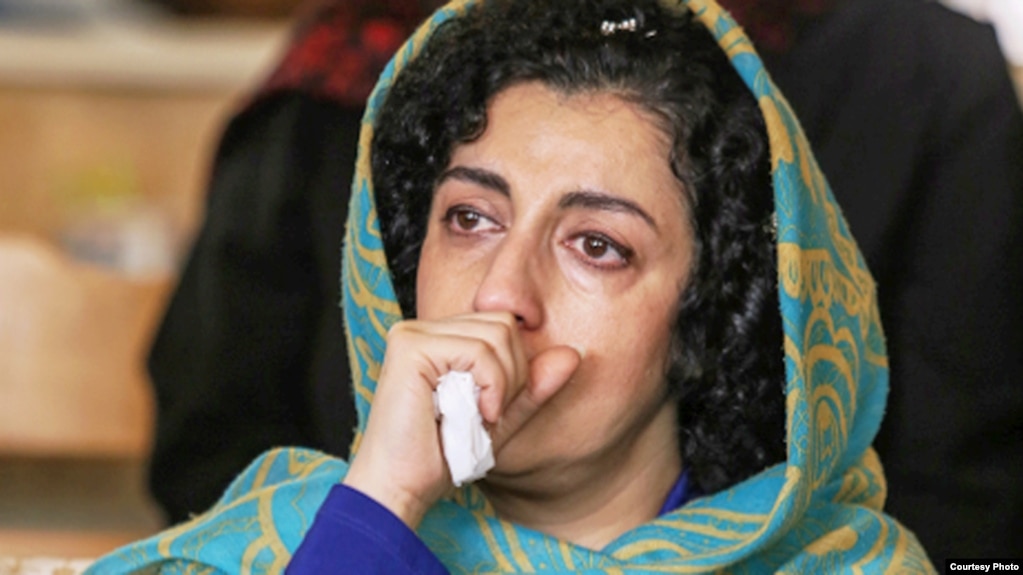
Narges Mohammadi has "serious health problems," her brother says, but is not allowed out of prison to see a doctor.
Narges Mohammadi has “serious health problems,” her brother says, but is not allowed out of prison to see a doctor.

Reporters Without Borders (RSF) has condemned the latest “absurd charge” brought against jailed Iranian journalist and human rights advocate Narges Mohammadi, who has been imprisoned since 2015. On 12 June 2020 RSF urged the UN special rapporteur on the human rights situation in Iran, Javaid Rehman, to “intervene quickly and do everything possible to obtain the release of Iran’s longest-held woman journalist.

In a recent open letter to the Iranian judicial authorities, her brother revealed that she was now accused of “dancing in prison during the days of mourning” commemorating the seventh-century killing of Imam Hussein, a revered figure in Shi’ite Islam. Mehdi Mohammadi, now a refugee in Norway, also wrote that his sister had serious health problems but “was not allowed out of prison to see a doctor, who went to her cell.” “This persecution of Narges Mohammadi is evidence of judicial discrimination at the behest of the Intelligence Ministry and senior justice system officials,” said Reza Moini, the head of RSF’s Iran-Afghanistan desk.

Mohammadi, 47, has been awarded several prestigious prizes, including the Per Anger Prize in 2011 and the APS Sakharov prize in 2017 [see: https://humanrightsdefenders.blog/2017/10/28/imprisoned-human-rights-defender-narges-mohammadi-awarded-aps-sakharov-prize-2018/]. For more information on these and other awards see: http://www.trueheroesfilms.org/thedigest

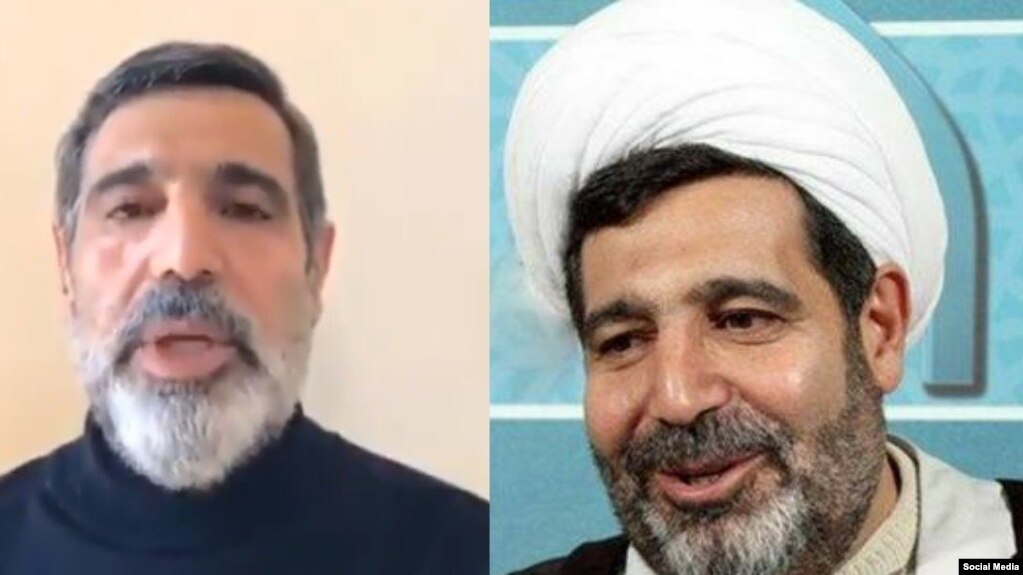
In the meantime there is also an interesting case of an Iranian judge and former prosecutor who was arrested in Romania by Interpol for rights violations (13 June 2020 Radio Farda)

Gholamreza Mansouri, Iranian judge and former prosecutor.

Iran’s Judiciary Spokesman confirmed that Interpol has detained Gholamreza Mansouri in Romania. He is accused of human rights violations by rights defenders, but he is also one of the defendants in a recent sensational corruption case in Iran who fled to Europe. Judiciary spokesman Gholam-Hossein Esmaili said Mansouri’s extradition is not possible now due to coronavirus restrictions but he will be returned to Iran and put on trial for corruption. He also told a local news network that Iran requested the arrest through the Interpol.

Iranian journalists and human rights activists want Mansouri to be put on trial in Germany or another European country for his grave human rights violations including the arrest and torture of journalists. SEE ALSO: Fearsome Prosecutor Of Journalists Accused Of Taking Bribes, Flees Iran

In a tweet on June 11, the Secretary-General of Reporters without Borders urged German authorities not to let him escape justice. Reporters without Borders (RSF) has supported the call of Iranian activists and filed a complaint with Germany’s Federal Public Prosecutor against Mansouri for the arrest and torture of at least 20 journalists in 2013….Mansouri is a highly influential prosecutor and judge notoriously famous for prosecuting journalists and putting them behind bars. In one instance in 2013 he ordered the simultaneous arrest of 20 journalists in one day.

Mansouri’s name came up as one of the recipients of bribes in the first trial session of Akbar Tabari, a former Judiciary deputy. The former judge allegedly received 500,000 euro in bribes from Tabari.

In a video published on social media on June 9, Mansouri claimed that he was abroad for treatment of a serious medical condition and could not return due to the restrictions introduced after the breakout of coronavirus. He did not reveal where he was but said he would go to an Iranian embassy to arrange for his return to defend himself against the corruption charges.

See also; https://iranian.com/2018/02/08/1000-days-counting/

https://www.rferl.org/a/jailed-iranian-journalist-faces-new-absurd-charge/30667834.html

https://en.radiofarda.com/a/iran-prosecutor-wanted-for-corruption-and-rights-violations-arrested-by-interpol/30668621.html

https://www.arabnews.com/node/1689336/middle-east

Indictment in Senegal a breakthrough in the Congolese Chebeya-Bazana case?

January 13, 2015
Paul Mwilambwe, a major suspect in the Congolese Chebeya-Bazana case was indicted by a Senegalese court and placed under judicial supervision in Dakar on 8 January 2015. This decision was taken following a criminal complaint based on universal jurisdiction filed on 2 June 2014 by lawyers of the FIDH Litigation Action Group (LAG) and the families of Floribert Chebeya and Fidèle Bazana, the two Congolese human rights defenders who were assassinated in June 2010. FIDH hopes that these efforts of the Senegalese judicial authorities contribute to identifying the persons responsible for these assassinations and the disappearance of these two human rights defenders.logo FIDH_seul

That Paul Mwilanbwe has been indicted and heard by an independent investigative judge is a fundamental step on the road to truth and, we hope, to the justice which has not been available to the victims’ families in DRC” , said Patrick Baudouin, FIDH Honorary President. “This is the first time since the Hissène Habré case that a case based on extra-territorial jurisdiction is being tried in Senegal, a step which sends a strong, positive signal showing that the Senegalese judiciary intends to play an active role in the fight against impunity for the most serious crimes committed in Africa”.

Since the Democratic Republic of Congo did not provide for equitable judicial proceedings, we initiated the proceedings in Senegal to ensure that an impartial and independent investigation would be carried out and that full information would be obtained on the murder and the enforced disappearance of the victims, Floribert Chebeya and Fidèle Bazana. We wanted an independent judge to hear Paul Mwilambe, an actor in this tragedy, and this has happened today,” said Assane Dioma Ndiaye, a lawyer for the FIDH LAG and for the Chebeya and Bazana families.

Paul Mwilambwe, a major in the Congolese National Police force (PNC), was in charge of security for the office of General John Numbi, Head of the PNC at the time of the events, in the premises where Floribert Chebeya and Fidèle Bazana were killed. Shortly after these killings, Paul Mwilambwe fled to a country somewhere in Africa before going to Senegal. In a filmed interview with France 24 (in French), whilst still on the run, Mwilambwe testified and denounced his own participation and the role and involvement of senior members of the Congolese police, including General John Numbi in the enforced disappearance and murder of the two human rights defenders.

“For us, this indictment gives us great hope to obtain the truth and justice that was refused to us in Congo where the justice system is bogged down. I want to know where my husband was buried. I want someone to tell me where he is. And I want to be able to bury him with dignity” , said Marie-José Bazana, the wife of Fidèle Bazana whose body has still not been found.

https://thoolen.wordpress.com/2013/06/10/death-of-floribert-chebeya-and-fidele-bazana-in-drc-still-unresolved-after-3-years/

[Background: On 2 June 2010, Floribert Chebeya, Executive Director of the NGO Voix des sans Voix (Voice of the Voiceless – VSV), was found dead in his car in a suburb of Kinshasa. His close associate Fidele Bazana was reported missing. The day before, the two human rights defenders had shown up at PNC headquarters to meet with its Director, the Inspector-General, and General John Numbi. They did not emerge from this meeting alive. Faced with the public outcry triggered by the murder of Mr. Chebeya and disappearance of Mr. Bazana, the Congolese authorities were obliged to open an investigation. This investigation culminated in the precautionary suspension of General John Numbi and the imposition of murder indictments for eight police officers, including Paul Mwilambwe, who fled.

On 23 June 2011, following a trial marked by numerous incidents the military court on 23 June 2011 in Kinshasa acknowledged the civil responsibility of the Congolese state for the murder of Mr. Chebeya, as well as in the abduction and illegal detention of Mr. Bazana by several of its officers. The court convicted five of the eight police officers accused. Four were sentenced to death and one to life imprisonment. Three of those condemned to death are still on the run, and three of the police officers found to have played a role in the disappearance of Mr. Bazana, have since been acquitted. On 7 May 2013, the Military High Court, sitting as a court of appeal, declared itself incompetent to investigate the procedural issues in the case and decided to turn the proceedings over to the Supreme Court, operating as a constitutional court. In practice, this decision suspended the appeal proceedings, which remain deadlocked in DRC to date. In addition, Congolese authorities have never instituted proceedings to investigate the role played by General John Numbi, who has since been replaced as Head of the PNC, despite evidence and the complaints filed by the families of the two human rights defenders.]

The Chebeya-Bazana case: indictment of Paul Mwilambwe in (…).