Posts Tagged ‘indigenous peoples’

Story of human rights defender Marcela de Jesus Natalia

November 19, 2024

In June 2017, Indigenous Ñomndaa’ journalist Marcela de Jesus Natalia found herself fighting for her life. A gunman waited for her outside the radio station where she worked and shot her three times.

“I didn’t think he wanted to kill me,” she said. “I turned around. The first bullet went to my forehead. I put my hand up, [and] the bullet went in and came out. The second one shattered my jaw. Then this guy held me, dragged me, gave me a final shot in my head and laid me on the pavement.”

Though at first presumed dead, Marcela de Jesús survived the attack and, with the support of lawyers and advocates, as well as of UN Human Rights, continues to fight for justice for the crime perpetrated against her. Marcela de Jesús was attacked because she angered powerful people by informing Indigenous Peoples about their rights, such as the importance of education, justice, and in particular, violence against women, thus empowering them to fight against historical discrimination against them.

Journalists who expose wrongdoing and show us the horrific reality of conflict are human rights defenders,” said Volker Türk, UN Human Rights Chief, in a statement commemorating the International Day to End Impunity for Crimes against Journalists, observed every year on November 2. “Attacks against them affect everyone’s right to freedom of expression and access to information, leaving us all less well informed.”

In 2023, 71 journalists and media workers were killed and over 300 imprisoned around the globe, Türk said.

Marcela de Jesús is an Indigenous Ñomndaa’ woman born in Xochistlahuaca, in the state of Guerrero, on Mexico’s Pacific coast. From a young age, Marcela de Jesús witnessed violence and attacks by men in positions of power and even the military. It was there that her desire to defend her people was born and she realised that to confront abusers she needed to learn Spanish.

Marcela de Jesús migrated to the state of Oaxaca, and by her own efforts, she managed to continue studying and encountered a radio station that was looking for an Indigenous person from Guerrero who spoke Ñomndaa’ and Spanish and had completed middle school.

“I went behind my husband’s back, took the exam and passed,” she said. “I remember that the director [of the radio station] said to me, ‘Why do you want to be an announcer?’ ‘I always wanted to be the voice of my people,’ I answered.” Later, she returned to the state of Guerrero and got a precarious job as a radio announcer, but with patience and hard work she managed to become the radio manager.

It was after her return to her home state that she began to encounter opposition to her “voice.” Marcela de Jesús was told by powerful people in her town that she was not supposed to inform Indigenous Peoples; that the only thing they were interested in was whether a goat or a cow was lost, and not to get into trouble. She fought against and won lawsuits filed against her for giving Indigenous Peoples news.

It is my conviction that my people should be guaranteed the right that is enshrined in the Constitution and in international treaties, that we have the right to information.

“They couldn’t [silence me] because what is legal is legal. What is morally good is morally good. And that is the reason for the attack against me,” said Marcela de Jesús.

According to UN Human Rights in Mexico, at least five journalists and one media worker have been killed and one more media worker was disappeared this year because of their work. This continuous danger in which journalists have had to operate for years, led universal and regional human rights mechanisms to recommend to the Mexican State the creation of a Mechanism for the Protection of Human Rights Defenders and Journalists.

…The gunman who shot Marcela de Jesus has been arrested and sentenced for his crime, but the ones who called for her shooting are still out there. She is hopeful for them to be brought to justice.

I have a lot of faith that the alleged intellectual author will forget about me. I have faith that nothing is forever,” said Marcela de Jesús. She added: “Nothing and no one, not jail, not this attack with three bullets, takes away my desire to continue being the voice of my people, to continue with my activism, my defence of human rights. I am fulfilling my dream of being the voice of my people at the national and international level.

https://www.ohchr.org/en/stories/2024/11/i-always-wanted-be-voice-my-people

Indigenous human rights defender Victoria Maladaeva from Russia

November 6, 2024

Indigenous communities must have better political representations to ensure our rights are protected both constitutionally and in practice,‘ says Victoria Maladaeva, and Indigenous peoples’ rights defender from Russia. Victoria was also a participant in ISHR’s Women Rights Advocacy Week this year. She spoke to ISHR about her work and goals.

Hello Victoria, thanks for accepting to tell us your story. Can you briefly introduce yourself and your work?

Sure! I’m a Buryat anti-war decolonial activist, co-founder of the Indigenous of Russia Foundation.

What inspired you to become involved in the defence of human rights?

Since the full-scale Russian invasion of Ukraine, Indigenous peoples, particularly Buryat, have been hit the hardest. I wanted to help my people, fight the Russian propaganda and raise awareness about systemic colonial oppression and discrimination faced by Indigenous people and ethnic minorities in the Russian Federation.

What would Russia and your community look like in the future if you achieved your goals, if the future you are fighting for became a reality?

The country needs a large-scale transformation— political, economic, and cultural. Indigenous communities must have better political representations to ensure our rights are protected both constitutionally and in practice. Genuine democratic reforms involve fundamental rights for self-determination and autonomy where Indigenous peoples gain control of their land and resources. Putin’s constitution’s amendments to national Republics must be reversed, our languages must be mandatory in all schools, universities, and institutions where Indigenous communities live. 

How do you think your work is helping make that future come true?

I’m advocating for the rights of Indigenous peoples with international stakeholders and institutions to raise awareness about issues faced by our communities and spreading awareness, producing documentaries, and mobilising diasporas. 

Have you been the target of threats or attempts at reprisals because of your work?

Unfortunately, yes. There have been threats because of my anti-war activism and for shedding light on the disproportionate mobilisation in the Republic of Buryatia. For some reason, my colleagues and I were denied participation in the UN Permanent Forum on Indigenous Issues. I would like to believe this was a mistake and that there was no influence from the Russian delegation at the UN.

Do you have a message for the UN and the international community?

Russia needs decolonisation and de-imperialisation. Without revising the past and acknowledging colonial wars (not only in Ukraine) and discrimination, there can be no bright future for Russia—free and democratic. The international and anti-imperialist community should acknowledge that the Russian government is not for any anti-colonial movement. Stand in solidarity with independent Indigenous activists!

https://ishr.ch/defender-stories/human-rights-defenders-story-victoria-maladaeva-from-russia

Human rights defender’s profile: Lourdes Gómez from Guatemala

April 3, 2024

‘My passion is the defence of the right to land and territory,’ says Lourdes Gómez, a land rights defender and professor working on issues affecting Indigenous women defenders and the impacts of palm oil production.

The ISHR had the chance to meet Lourdes Gómez during her Geneva visit to attend the Human Rights Council’s 55th session. Lourdes, a land right defender and professor working on issues of Indigenous women defenders and the impacts of oil palm production, delivered a powerful statement during the session. She was also one of the speakers at a side event about the human rights situation in Guatemala.

Lourdes recently participated into the ‘artivism’ project by journalist and photographer Teresa Ordás, ‘Paisojos de mujeres defensoras de derechos humanos de Guatemala‘ (‘Landscapes of women human rights defenders from Guatemala’). The project is a collection of beautiful photographs of the real reflections of the subjects’ eyes, where Teresa Ordás highlights ‘the world in people’s eyes.’ [Website: https://www.paisojos.com]

Here is how Lourdes introduces herself in the frame of ‘Paisojos’:

‘I am a Q’eqchi’ Mayan woman of African descent. I inherited my path of defending human rights from my mother Lucia Willis Paau, who since my childhood had joined the movement to defend the rights of Mayan women in the north of Guatemala. My passion is the defense of the right to land and territory. I have dedicated myself to denouncing the violence that the State of Guatemala exerts at the community level on Indigenous, rural and peasant women while they fight for access, use, control and protection of their land. These communities face racism, discrimination and machismo. I have dedicated myself to the defense of land rights, contributing through historical registry and communal research, to the restitution of land rights’.

https://ishr.ch/defender-stories/human-rights-defenders-story-lourdes-gomez-willis-from-guatemala

Death threats against Ecuadorian human rights defender Javier Medardo Feijoo Villa

October 22, 2023

On 20 October 2023 Front Line Defenders wrote that between 2 October 2023 and 16 October 2023, human rights defender Javier Medardo Feijoo Villa received several death threats via phone calls and voice messages towards both him and his family. The unidentified perpetrators claimed that they were keeping the human rights defender under surveillance, and maintained that they had access to his data and aware of all his moves within the community.l

Javier Medardo Feijoo Villa is the president of the Estero Piedras community, located in the coastal area of the Molleturo on Azuay province. This community is also part of the San Felipe de Molleturo Commune, an ancestral territory that has been of great importance to the region, given that it has fought to defend against attempts by transnational mining companies to dispossess the people in the region of their land and water sources. He is also president of the North Zone Road Committee, which represents 15 communities in the region. As a community leader, the human rights defender has sought support from the competent authorities to stop criminal acts and illicit activities, mainly assaults and robberies caused by criminal groups that threaten the area. Javier has played an important role in the defence of water, nature and the territories belonging to the communities who he represents.

Since 2 October 2023, human rights defender Javier Medardo Feijoo Villa has been the target of several death threats. Over the course of two weeks, he has received calls and voice messages threatening to kill him and his family. The callers claimed to be keeping the human rights defender under surveillance, and maintained that they had access to his data, as well as all his moves. The level of violence articulated in these threats increased over the weeks, causing the human rights defender to stop responding to messages or calls altogether, and provoking him to block the numbers of those who called him. The threats continued up until 16 October 2023. The human rights defender has been filing relevant complaints with the Prosecutor’s Office about the recent threats and has requested that the Police Commander of Zone 6 take the necessary measures protect him and his family.

Violence against human rights defenders working on indigenous, land and environmental rights has been on the rise in Ecuador; human rights defenders Andrés Durazno and Alba Bermeo were murdered in 2021 and 2022 respectively. Still to this day no one has been charged with their murder.

https://www.frontlinedefenders.org/en/case/ecuador-death-threats-against-human-rights-defender-and-community-leader-javier-medardo-feijoo

Winners of 2023 UN Human Rights Prize Announced

July 22, 2023
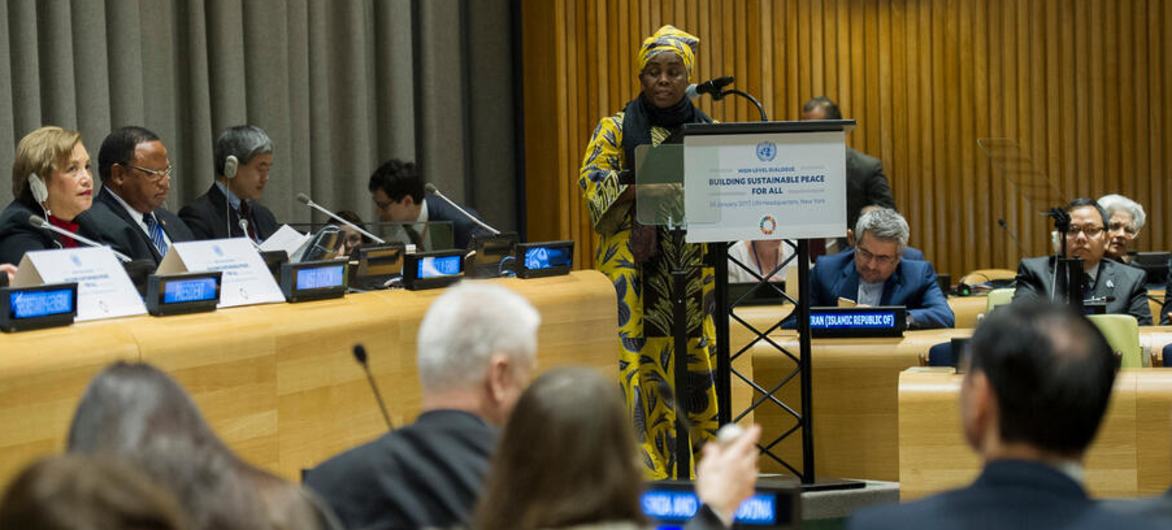
Julienne Lusenge, one of the 2023 UN Human Rights Prize winners speaking at the General Assembly high-level dialogue on “Building Sustainable Peace for All” earlier this year.

Julienne Lusenge, one of the 2023 UN Human Rights Prize winners, speaking at the General Assembly high-level dialogue on “Building Sustainable Peace for All” earlier this year. UN Photo/Manuel Elías

On 20 July 2023 the President of the General Assembly Csaba Kőrösi announced the winners of the United Nations Prize in the Field of Human Rights for 2023. 

For more on this prize which is awarded every five see: https://trueheroesfilms.org/thedigest/awards/74A3B502-F3DF-4DDB-8D6F-672C03B4A008

This year’s winners were the Human Rights Center “Viasna”, based in Belarus, Julienne Lusenge from the Democratic Republic of the Congo [see also: https://humanrightsdefenders.blog/2021/10/11/congolese-julienne-lusenge-wins-1-million-2021-aurora-prize/], Amman Center for Human Rights Studies from Jordan, Julio Pereyra from Uruguay and the Global Coalition of civil society organizations, Indigenous Peoples, social movements and local communities.

The recipients of the Prize were chosen by a Special Committee from more than 400 nominations received from Member States, the UN system, and civil society. 

The Committee is chaired by the President of the General Assembly, and its members include the President of the Economic and Social Council, the President of the Human Rights Council, the Chair of the Commission on the Status of Women, and the Chair of the Advisory Committee of the Human Rights Council

The Office of the UN High Commissioner for Human Rights (OHCHR) provided support to the special committee.  The award ceremony for the 2023 Prize will take place at UN Headquarters in New York in December 2023, as part of activities to commemorate Human Rights Day. 

The members of the Special Committee also acknowledged the important role played by human rights defenders and activists, praising them for their courage and dedication while strongly condemning any attempts to “silence and intimidate” them.

They expressed solidarity with those who are detained in retaliation for their work in defending human rights and pursuing the implementation of all the provisions of the Universal Declaration of Human Rights, marking it’s 75th birthday this year.

https://news.un.org/en/story/2023/07/1138957

https://www.ohchr.org/en/about-us/what-we-do/un-human-rights-prize/2023-recipients

Karen activist Porlajee ‘Billy’ Rakchongcharoen’s murder: finally an indictment

August 22, 2022

The Thai authorities should fully and fairly prosecute all those responsible for the murder of a prominent ethnic Karen environmental activist, Porlajee ‘Billy’ Rakchongcharoen, in 2014, Human Rights Watch said on 16 August 2022. See also: https://humanrightsdefenders.blog/2014/05/06/un-high-commissioner-condemns-disappearance-of-billy-in-context-of-retaliation-against-environmentalist-in-south-east-asia/

Porlajee “Billy” Rakchongcharoen
Porlajee “Billy” Rakchongcharoen, a prominent ethnic Karen community and environmental activist, was allegedly murdered in the custody of the Kaeng Krachan National Park officials in Phetchaburi province, Thailand, in April 2014. © 2014 Private

On August 15, 2022, the Attorney General’s Office formally notified the Justice Ministry’s Department of Special Investigation (DSI) of its decision to indict four park officials accused of abducting and murdering Porlajee “Billy” Rakchongcharoen in April 2014. The charges include illegal confinement, premeditated murder, and concealing the victim’s body.

“Thai officials have long hindered justice for Billy through cover-ups and exploitation of legal loopholes,” said Elaine Pearson, acting Asia director at Human Rights Watch. “The authorities can right this wrong by ensuring that the attorney general’s decision to indict four officials moves promptly to an effective and fair prosecution.”

Billy was last seen on April 17, 2014, in the custody of Chaiwat Limlikitaksorn, then-head of Kaeng Krachan National Park in Phetchaburi province, and his staff. The park officials said they released him after questioning him briefly and had no information regarding his whereabouts. On September 3, 2019, DSI officials announced that his remains had been found in Kaeng Krachan National Park. Chaiwit was among the four indicted.

Pinnapa Prueksapan, Billy’s wife, told Human Rights Watch that she hoped there would be answers to basic questions, such as who had abducted and killed her husband, and who had obstructed justice.

Thailand is obligated under international human rights treaties to which it is a party to investigate and appropriately prosecute enforced disappearance, torture, custodial deaths, and other alleged human rights violations. In addition, in September 2019, Prime Minister Gen. Prayut Chan-ocha ordered the Department of Special Investigation to ensure that the case was watertight so the culprits could be brought to justice, regardless of their rank or position.

However, the investigation has suffered from a cover-up, Human Rights Watch said. Despite a long list of allegations against Chaiwat for serious abuses and misconduct during his tenure as head of Kaeng Krachan National Park, he has never been held to account.

In addition, Thai law does yet not recognize enforced disappearances as a crime. Human Rights Watch has repeatedly urged Prime Minister Prayut and his government to ratify the International Convention for the Protection of All Persons from Enforced Disappearance, which Thailand signed in 2012, and make enforced disappearance a criminal offense.

Chaiwat and his staff arrested Billy on April 17, 2014, for alleged illegal possession of a wild bee honeycomb and six bottles of honey.

At the time of his enforced disappearance, he was traveling to meet with ethnic Karen villagers and activists in preparation for an upcoming court hearing in the villagers’ lawsuit against Chaiwat and the National Park, Wildlife, and Plant Conservation Department of the Ministry of Natural Resources and Environment.

The villagers alleged in the lawsuit that, in July 2011, park authorities had burned and destroyed the houses and property of more than 20 Karen families in the Bangkloy Bon village. Billy was also preparing to submit a petition about this case to Thailand’s monarch. When he was arrested, he was carrying case files and related documents with him. Those files have never been recovered.

In September 2014, Police Region 7 officers filed malfeasance charges under article 157 of the penal code against Chaiwat and three other park officials for unlawfully detaining him. The other suspects named in the case are Boontaen Bussarakham, Thanaseth or Pitoon Chaemthes, and Krissanapong Jitthes. The DSI found traces of human blood in a vehicle belonging to the park office, but was not able to verify if the blood belonged to Billy because the vehicle was cleaned before forensic experts could examine it.

On September 3, 2019, the DSI announced that his remains had been found in Kaeng Krachan National Park, where he was last seen in custody of the park officials. The investigation team found an oil barrel, its lid, two steel rods, a burned wooden piece, and two bones at the bottom of the reservoir on April 26, 2019.

The Central Institute of Forensic Science subsequently confirmed the genetic trace of one of the bones found inside the barrel matched Billy’s mother. The investigation team then concluded it was part of his remains. The condition of this piece of human skull, which was burned, cracked, and shrunk due to exposure to heat of 200 to 300 degrees Celsius, suggests the killers burned his body to conceal the crime.

“The indictment of Chaiwat and other park officials is an important step for justice for Billy and all those whom Thai government officials have forcibly disappeared and killed,” Pearson said. “Thai authorities should recognize that they can’t escape being held accountable for the most heinous crimes.”

https://www.hrw.org/news/2022/08/16/thailand-officials-indicted-karen-activists-murder

AFD: How to link human rights and development

July 13, 2022

The French Development Agency (AFD) organised an international conference to consider new ideas and approaches to linking human rights and development

Report by Marc Limon, Executive Director of the Universal Rights Group on July 8, 2022

Against a background of the retreat of human rights worldwide, growing doubts about the ability of the international community to achieve the Sustainable Development Goals (SDGs) by 2030, growing inequalities, and the ecological and climate crises, on Human Rights Day 2021 (10 December) the French Development Agency (AFD) organised an international conference on ‘Human Rights and Development.’ It brought together 500 actors from the development community, covering both the global North and South, and considered how development actors can play a key role in securing improvements in the enjoyment of human rights while at the same time recharging progress towards the achievement of the SDGs ‘leaving no one behind.’

Key conclusions

Warning of the risk of failure of the 2030 Agenda if development actors do not promote a development model based on human rights, participants unanimously recommended moving away from both a solely economic vision of development and a purely normative approach to human rights. In that regard, they called for more concerted action to enhance development actors’ contribution to the realisation of human rights on the ground, and to develop more robust indicators for measuring the impact of the human rights based approaches (HRBA).

Notwithstanding, several recalled the challenges involved in convincing partners of the value-added of integrating human rights with the development agenda, and recommended undertaking research actions to provide evidence.

Panellists further emphasised that human rights constitute a universal framework that goes beyond the North/South divide and is applicable to all. They noted a strong demand for improvements in the enjoyment of human rights in the global South as evidenced by growing social movements often led by young people. The universal nature of human rights makes it possible to fight against arbitrariness by guaranteeing a minimum essential base for everyone without discrimination. The international corpus of human rights contributes, in this sense, to reducing inequalities, so that everyone can lead a decent and dignified life. This must be reflected in the fiscal resource mobilisation policies of States, but also in their budgetary policies for social investment in health, education and social protection. States and development actors must also address the structural causes of inequality, which include discrimination based on gender, sexual orientation, economic status, and minority status, all of which are prohibited under international human rights law. For this reason, development actors are invited to contribute to the collection of reliable data on vulnerable population groups, in order to design projects with a non-discriminatory and inclusive approach.

Speakers also agreed on the need to support civil society and preserve its space. Its role in observing, documenting, and monitoring the implementation of States’ human rights obligations is essential. It is therefore crucial to establish a culture of dialogue between a State/government and civil society when elaborating public policies, and to strengthen the capacity of CSOs to participate effectively. ‘Power should be fluid, distributed throughout society, shared and exercised collectively,’ argued one speaker.

In terms of business and human rights, participants recalled companies’ duty of care to prevent and remedy human rights violations in the course of their activities. At the international level, this duty is based on a voluntary approach which, it was argued, showing signs of strain – few companies actually mobilise vigilance mechanisms in their value chains. Nevertheless, there is a progressive movement towards the adoption of national legislation in countries where multinational companies are headquartered to make it compulsory to draw up and implement vigilance plans that cover the impact of their activities, and those of the actors integrated into their supply or value chains, and covering both human rights and the environment. In this way, the objective is to spread human rights throughout the value chain, starting ‘from the top,’ and to contribute to guaranteeing the enjoyment of human rights of those affected by business activities. However, this raises the challenge of the cost and capacity to implement the principles of the duty of care by all actors in the value chain, in particular those in the Global South. Development actors have a role to play in supporting them. A need was also identified to strengthen the dialogue between legislators in the countries where companies are headquartered and those in which they operate in order to build coherent and complementary legislative frameworks.

Beyond companies’ duty of care, the private sector also plays a key role in contributing to development. Speakers called for multinational companies to be held accountable so that, in addition to respecting human rights, they contribute more directly to reducing inequalities and poverty.

Throughout the conference, the discussions have also highlighted the inseparable links between the realisation of human rights and the protection of the environment. These two goals are not mutually exclusive, as the rights of nature guarantee the enjoyment of human rights. It is thus crucial to promote an approach to development that is not based solely on human rights, but include the rights of all living things. This is especially important, it was noted, for young people and future generations.

In this context, the panellists made several recommendations, including the need to develop and disseminate knowledge about human mobility due to climate change. They recommended supporting climate change mitigation and adaptation projects, and called for investment in social protection and parametric insurance mechanisms to mitigate shocks from loss and damage that are already unavoidable. Development actors were also called upon to finance restoration and rehabilitation mechanisms to remedy non-economic damages such as the loss of cultural heritage or biodiversity.

Finally, participants unanimously agreed that indigenous peoples are key actors in sustainable development. They represent 5% of the world’s population but are the custodians of 80% of the world’s biodiversity. They play a vital role on all continents – in the Amazon alone, they directly influence 48% of the land surface. The protection of the environment cannot and must not be done without them. They should be treated as true co-decision-makers in the management of these spaces and resources, in order to fully respect their free, prior and informed consent, as required under international law. Development actors should therefore seek to empower indigenous peoples by supporting the full enjoyment of their rights.


Synthesis: Conference: “Human Rights and Development” | AFD – Agence Française de Développement

The conference proceedings from the meeting were recently released in both French and English

Human Rights High Commissioner Bachelet urges support for environmental defenders

March 2, 2022
United Nations
Protect the defenders of the planet, UN rights chief urges
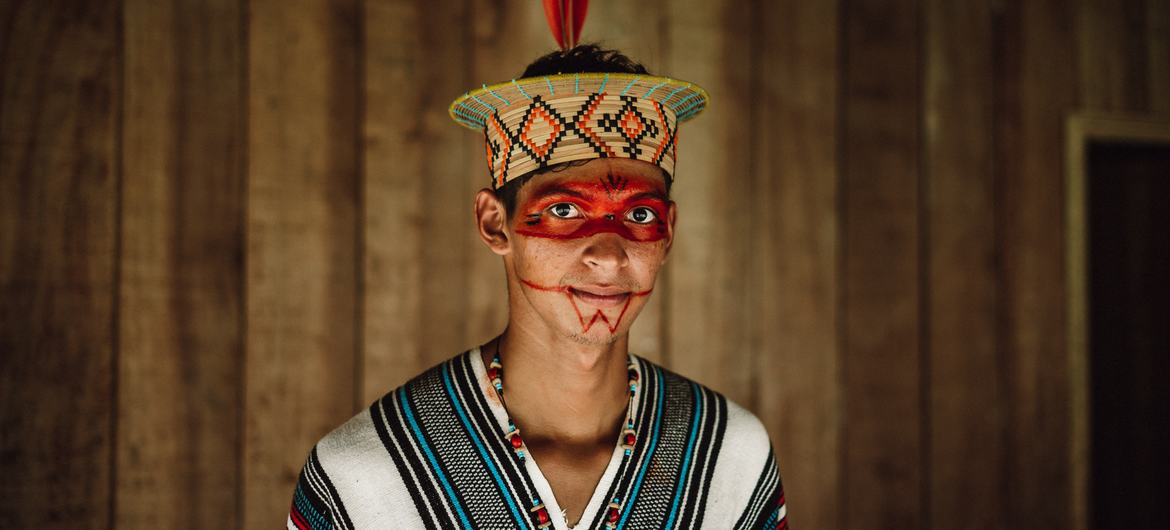
Poyowari Piyãko, a young activist, poses in his home in the Apiwtxa village, which belongs to the Ashaninka indigenous people, in northern Brazil.

Poyowari Piyãko, a young activist, poses in his home in the Apiwtxa village, which belongs to the Ashaninka indigenous people, in northern Brazil. © UNICEF/Alécio Cézar

The world must be made a safer place for people working to protect the planet, who sometimes pay with their own lives for their activism, UN Human Rights High Commissioner Michelle Bachelet said on Tuesday 1 March 2022.  Protecting the environment goes hand-in-hand with protecting the rights of those who defend it, she told the UN Human Rights Council in Geneva, which is holding its annual month-long session. 

Ms. Bachelet revealed how speaking out and standing up for environmental rights can come at enormous cost as activists have been killed or subjected to abuse, threats and harassment.   

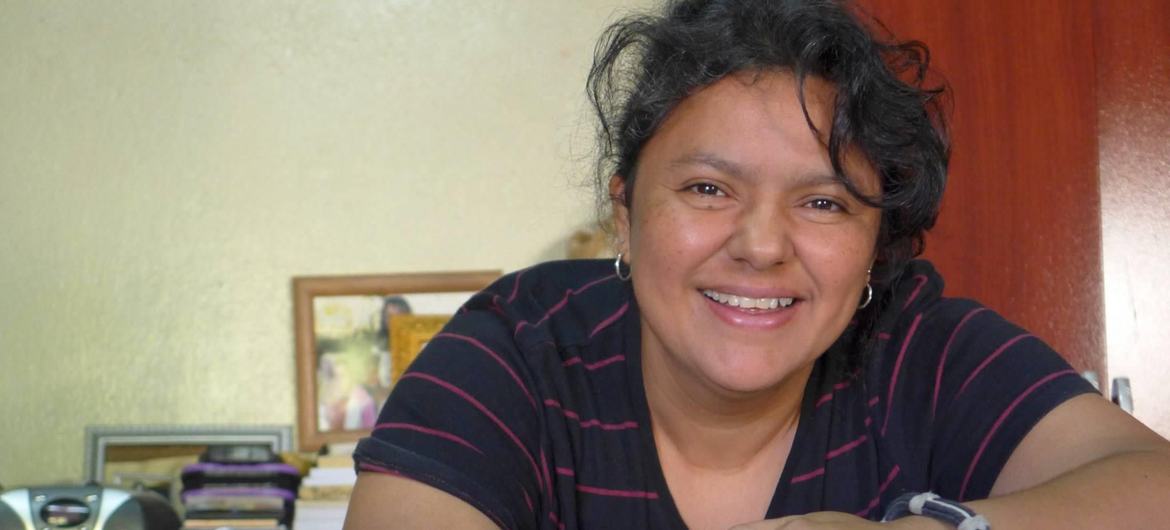
At particular risk are people who speak out against deforestation, extractives, loss of cultural heritage or identity, or large scale-agribusinesses and development projects – including those intended to produce clean energy, such as mega dams,she said.  Many environmental human rights defenders are also indigenous peoples, or members of local communities or minority groups – or those representing them.   Berta Caceres, an environmental activist from Honduras, was assassinated in March 2016.  She was recognized posthumously as a UN Champion of the Earth laureate for her tireless campaign for the rights of indigenous people.

Berta Caceres, an environmental activist from Honduras, was assassinated in March 2016. She was recognized posthumously as a UN Champion of the Earth laureate for her tireless campaign for the rights of indigenous people. © UNEP

She said entire communities may face threats and intimidation when someone speaks out on their behalf.  Ms. Bachelet underlined that States have an obligation to respect and protect the rights of environmental human rights defenders, and the communities they represent.  Authorities must also prevent and ensure accountability for attacks.  These actions are in line with a Council resolution adopted last year which upholds the right to a healthy environment, she said.  See also: https://humanrightsdefenders.blog/2021/10/26/aarhus-convention-gets-new-mechanism-to-protect-environmental-defenders/ and

“In addition, it is critical that States effectively regulate businesses and hold them accountable for human rights violations,” she said, while corporations also have a similar duty, as outlined in the UN Guiding Principles on Business and Human Rights

Ms. Bachelet advised that prior to undertaking any climate project, both governments and businesses must carry out human rights risk assessments.  

If indigenous peoples’ rights are at risk of being adversely affected by such projects, it is crucial that their free, prior and informed consent is obtained,” she said. 

The UN rights chief also reported on some of the global work of her staff.  “All around the world, my Office is committed to supporting States, businesses and environmental human rights defenders in all of their efforts to protect our planet,” she said. 

For example, over 200 human rights defenders in the Pacific region have been trained to help boost sustainable development, business and human rights in the context of climate change.  

In Southeast Asia, OHCHR is monitoring cases of harassment, arrest, killings and disappearances of environmental human rights defenders, while

https://yubanet.com/world/protect-the-defenders-of-the-planet-un-rights-chief-urges/working with governments towards ending punitive measures levelled against activists. 

https://news.un.org/en/story/2022/03/1113022

“Uluru Statement from the Heart” winner of the 2021 Sydney Peace Prize

May 26, 2021

On 26 May 2021 the ongoing campaign for First Nations recognition in the Constitution has been awarded Australia’s Sydney Peace Prize.

Proud First Nations leaders and drivers of the Uluru Statement from the Heart, Professor Megan Davis, a Cobble Cobble woman from the Barunggam Nation in South East Queensland; Pat Anderson AO, an Alyawarre woman from the Northern Territory; and Noel Pearson, a Guugu Yimidhirr man from Hopevale on the Cape York Peninsula, jointly welcomed the announcement and will receive the prize together at an official event later in the year.

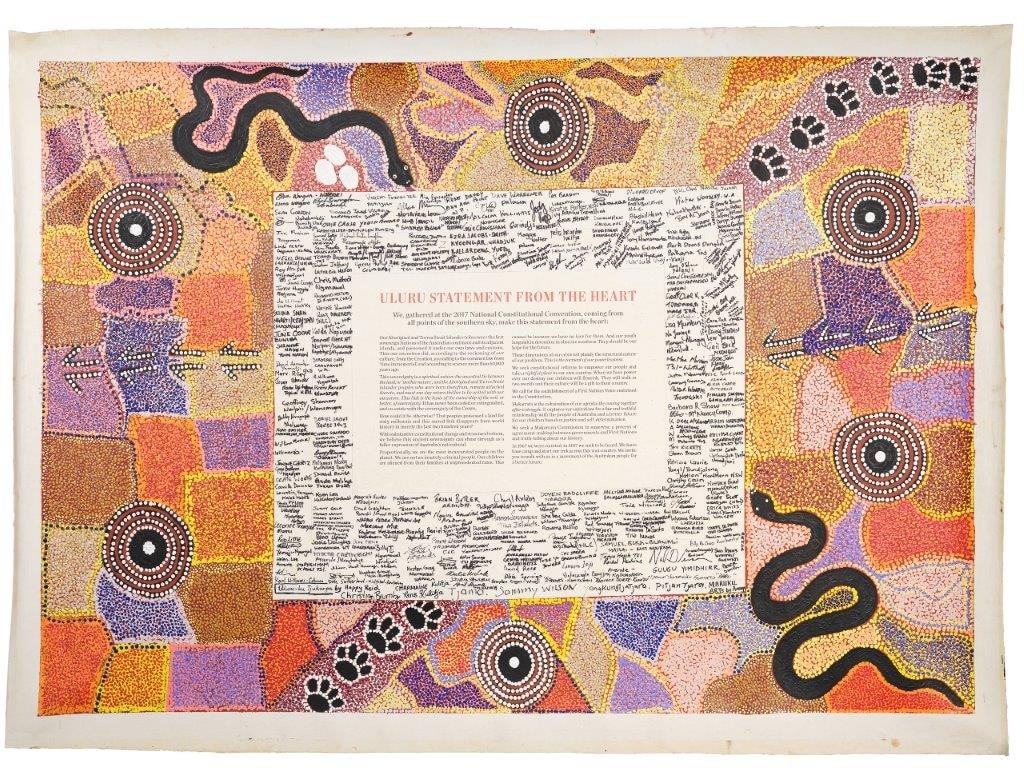
Delivered in May 2017 at the National Constitutional Convention, the Uluru Statement from the Heart is a ‘historic offering of peace’ that calls for the establishment of a ‘First Nations Voice’ in the Australian Constitution.

Professor Davis, Ms Anderson and Mr Pearson worked tirelessly to deliver the statement in 2017 and have spent the past four years leading the campaign for a referendum to change the constitution. The announcement of their win coincides with National Sorry Day, and marks four years since the Uluru Statement was originally endorsed by First Nations people from across Australia.

The Uluru Statement was the culmination of a dialogue process designed to take agreement and disagreement and elicit a pathway forward on the vital question of recognition,” Professor Davis said.

This is a tribute to the men and women of the dialogues who crafted a roadmap to peace for the nation. We are accepting this prize on behalf of all of the First Nations that participated in the Uluru Dialogues and the National Constitutional Convention at Uluru in 2017.”

Uluru Statement
The Uluru Statement from the Heart.

For more on the Syney Peace Prize and its laureates see: https://www.trueheroesfilms.org/thedigest/awards/7E938842-91DB-A3FD-EDF6-7143BA02216B

https://www.sydney.edu.au/news-opinion/news/2021/05/26/uluru-statement-from-the-heart-wins-2021-sydney-peace-prize.html

https://ulurustatement.org/

UNPO: reprisals on the rise

April 22, 2021

On 20 April 2021, the Unrepresented Nations and Peoples Organization (UNPO) has told the United Nations that “threats to participation at and cooperation with the United Nations which minority and indigenous communities are presently facing, represent not only matters of individual concern, but also raise concern about whether the United Nations itself will be able to achieve its responsibilities under Article 1 of the UN Charter to ‘respect for the principle of equal rights and self-determination of peoples, and to take other appropriate measures to strengthen universal peace.’”

In a submission to the United Nations Reprisals Office, the unit within the UN’s human rights infrastructure that deals with instances where UN Member States have targeted or threatened human rights defenders for their work with the United Nations, the UNPO provided information to inform an upcoming UN Secretary General report on reprisals. Sewe also my ‘old’ post: https://humanrightsdefenders.blog/2014/03/13/zero-tolerance-for-states-that-take-reprisals-against-hrds-lets-up-the-ante/

The UNPO submission highlighted how cooperation with the United Nations is becoming increasingly difficult for minority and indigenous rights defenders given the extent of reprisals that such activists face from authoritarian states and the general closing off of space at the United Nations for these activists, compounded by the COVID-19 pandemic. 

The submission included a selection of individuals cases of threats and reprisals that have occurred in the year between April 2020 and April 2021 as a result of UN-related work of people associated with members of the UNPO, noting however that there are many more such cases that the UNPO was asked not to disclose. The cases included:

  • Family members of disappeared Hmong children in Laos who have been threatened by local authorities because of a case at the UN trying to push the government to find the children;
  • A Khmer Krom activist whose efforts to seek review of his unlawful detention in Vietnam were stymied by the strong possibility that the government would increase the severity of charges against him related to his unlawful arrest;
  • A Iranian Baluch refugee in Turkey, whose family members are repeatedly interrogated and coerced by the security forces in Iran whenever he engages with the United Nations; and
  • A Khmer Krom activist who was recently arrested for doing little more than distribute the UN Declaration on the Rights of Indigenous Peoples in Vietnam, a country that refuses to recognize the existence of indigenous popualtions.

The submission further highlighted that these individual cases were indicative of a broader and growing trend for UN Member States to target those who seek to engage with the UN system; a trend which is exacerbated by the failure of states in UN cost countries to adequately protect diaspora communities and other human rights defenders.