Posts Tagged ‘Independence of Lawyers’

Turkey should drop charges against Istanbul Bar Association

January 8, 2026

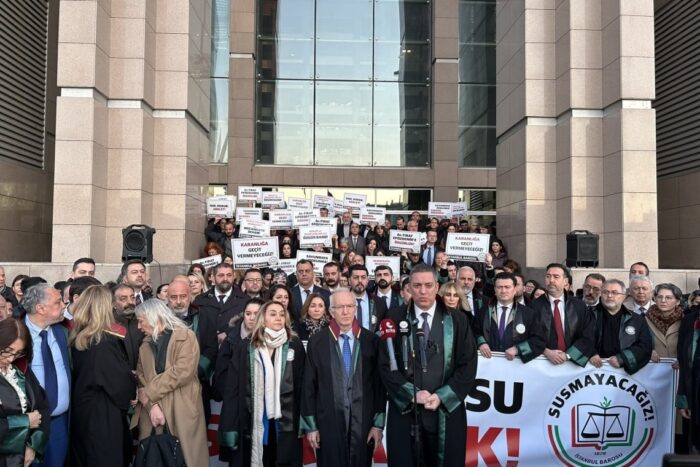
On 5 January 2026 the International Commission of Jurists and many other NGOs issued a joint statement calling on the authorities to immediately terminate the abusive criminal proceedings and drop charges ahead of the 26 Istanbul Heavy Penal Court’s expected final hearing scheduled for 5 to 9 January 2026.

photo_2025-09-10_13-41-27-700×467

The continued prosecution of the president and 10 executive board members of the Istanbul Bar Association, and the prosecutor’s request for their conviction on terrorism charges are a damning reflection of the troubled state of the rule of law and democratic norms in Turkey.

The prosecutor seeks the criminal conviction of all eleven members of the Bar’s elected leadership – President Prof. İbrahim Özden Kaboğlu, Ahmet Ergin, Bengisu Kadı Çavdar, Ekim Bilen Selimoğlu, Ezgi Şahin Yalvarici, Fırat Epözdemir, Hürrem Sönmez, Mehmedali Barış Beşli, Metin İriz, Rukiye Leyla Süren, and Yelde Koçak Urfa – on the charge of “spreading terrorist propaganda” under Article 7/2 of the Anti-Terrorism Law,  solely for issuing a public statement on 21 December 2024 concerning the killing of two journalists in northern Syria and the arrest of journalists and lawyers at a related peaceful protest in Istanbul the day before.

The trial prosecutor’s final opinion confirms and deepens the concerns raised by 56 international organisations in the joint statement of January 2025, condemning the initiation of criminal and civil proceedings against the Bar’s leadership, and in the April 2025 joint statement, which deplored the removal of the elected board and the escalating attacks on lawyers across Turkey. A group of the organisations also submitted a joint amicus curiae brief in which they concluded that the proceedings violate Turkey’s obligations under international human rights law and constitute an unjustified interference with the independence of the legal profession.

A clear misuse of criminal law

In his final opinion, the prosecutor alleges that by referring to the two individuals killed in Syria as journalists and by citing international humanitarian law applicable to the protection of civilians and media workers in conflict zones, the Bar leadership “treated as a war crime” an operation carried out by security forces, thereby intentionally legitimising and disseminating the ultimate separatist aims of the Kurdistan Workers’ Party (PKK). The prosecutor further asserts that describing those killed as journalists “encouraged” membership of the PKK and “made its methods appear legitimate”, amounting to “press and media–based terrorist propaganda” under Article 7/2 of the Anti-Terrorism Law.  These allegations, which claim that a lawful, rights-based statement consciously advanced the objectives of an armed organisation, are wholly unfounded and legally unsustainable.

As emphasised in both joint statements in January and April 2025 and the amicus curiae brief in September 2025, the Istanbul Bar Association has a statutory and ethical duty to speak out on violations of human rights and the rule of law. The prosecutor’s position effectively criminalises the Bar Association’s discharge of this duty protected under both domestic law and international human rights law and standards. The prosecutor’s construal of a legitimate exercise of the right to freedom of expression as a terrorism offence amounts to a misuse of criminal law and judicial harassment.

Violations of international standards and the Bar’s statutory mandate

International and regional human rights standards, including the UN Basic Principles on the Role of Lawyers, the Council of Europe Convention for the Protection of the Profession of Lawyer, and consistent jurisprudence of the European Court of Human Rights, affirm that lawyers and their associations must be able to engage in public debate on matters of justice and human rights without fear of reprisals.

Criminalising their exercise of the rights to freedom of expression and association contravenes the provisions of these instruments safeguarding the rights and role  of lawyers and their professional organisations, as well as Articles 10 and 11 of the European Convention on Human Rights, Articles 19 and 22 of the International Covenant on Civil and Political Rights, and Articles 26, 27 and 33 of the Constitution of Türkiye.

The criminal proceedings strike at the heart of the independence of the legal profession and amount to a misuse of counter-terrorism laws to silence criticism, suppress human rights monitoring, and undermine self-governance of bar associations.

Signatories (in alphabetical order):

Amnesty International

Center of Elaboration and Research on Democracy (CRED)

Council of Bars and Law Societies of Europe (Le Conseil des barreaux européens, CCBE)

Defense Commission of the Barcelona Bar Association (Spain)

Deutscher Anwaltverein (German Bar Association, Germany)

Eşit Haklar İçin İzleme Derneği (Association for Monitoring Equal Rights, Türkiye)

European Association of Lawyers for Democracy and World Human Rights (ELDH)

The European Criminal Bar Association (ECBA)

Fédération des Barreaux d’Europe (European Bars Federation, FBE)

Foundation Day of the Endangered Lawyer

Hak İnsiyatifi Derneği (Rights Initiative Association, Türkiye)

Hakikat Adalet Hafıza Merkezi (Truth Justice Memory Center, Türkiye)

Haldane Society of Socialist Lawyers (UK)

Human Rights Institute of the Brussels Bar (Belgium)

Human Rights Watch

İnsan Hakları Derneği (Human Rights Association, Türkiye)

The International Association of Democratic Lawyers (IADL)

International Bar Association’s Human Rights Institute (IBAHRI)

The International Commission of Jurists (ICJ)

International Federation for Human Rights (FIDH), within the framework of the Observatory for the Protection of Human Rights Defenders

Kaos GL Derneği (Kaos GL Association, Türkiye)

The Law Society of England and Wales (LSEW, UK)

Lawyers for Lawyers (Netherlands)

Lawyers’ Rights Watch Canada (LRWC, Canada)

Lyon Bar Association (France)

National Union of Peoples Lawyers (NUPL, Philippines)

PEN Norway (Norway)

Turkey Litigation Support Project (TLSP, UK)

Türkiye İnsan Hakları Vakfı (Human Rights Foundation of Turkey, Türkiye)

Vereinigung Demokratischer Jurist:innen VDJ (Association of Democratic Jurists, Germany)

World Organisation Against Torture (OMCT), within the framework of the Observatory for the Protection of Human Rights Defenders

Yurttaşlık Derneği (Citizens Assembly, Türkiye)

https://www.icj.org/turkey-drop-bogus-charges-against-istanbul-bar-association-leadership/

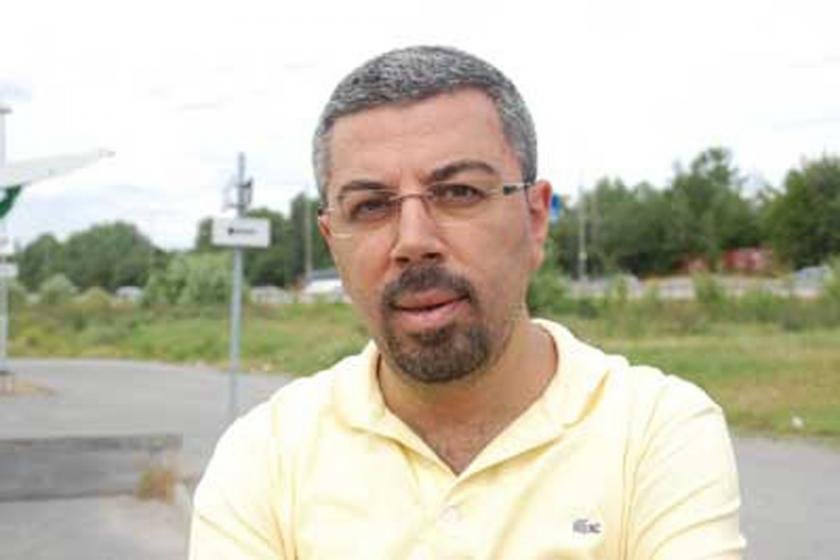
23 rights groups call for release of Istanbul Bar board member Fırat Epözdemir

February 7, 2025
Photo: Evrensel

Twenty-three human rights organizations have called for the immediate release of İstanbul Bar Association executive board member Fırat Epözdemir, who was arrested last week over alleged ties to the outlawed Kurdistan Workers’ Party (PKK), the Media and Law Studies Association reported February 3, 2025,

Advocacy groups condemned his detention as unlawful and part of a broader crackdown on human rights defenders and legal professionals in Turkey.

The Human Rights Defenders Solidarity Network (İHSDA) issued a statement denouncing Epözdemir’s arrest and urging authorities to drop the charges. The statement, signed by multiple rights organizations, emphasized that targeting lawyers and human rights advocates with judicial harassment is unacceptable.

Epözdemir was arrested Saturday by an İstanbul court on charges of “membership in an armed terrorist group” and “disseminating terrorist propaganda.”

Prosecutors in İstanbul accuse Epözdemir of joining a PKK-linked WhatsApp group in 2015, during the peak of clashes between Kurdish militants and Turkish security forces in the country’s predominantly Kurdish southeast.

The PKK has waged an armed insurgency against the Turkish state since 1984, a conflict that has left more than 40,000 people dead. 

Epözdemir’s legal team has faced severe restrictions in accessing case files due to a confidentiality order, preventing them from reviewing the evidence against him. Authorities also imposed a 24-hour ban on lawyer visits without providing a clear justification, raising concerns of due process violations.

The joint statement criticized the prosecution’s reliance on a decade-old public event and phone conversations as grounds for Epözdemir’s arrest, calling the charges baseless and politically motivated.

His detention, rights groups argue, is an attack on the legal profession and human rights advocacy in Turkey. They linked his arrest to broader efforts to suppress dissent, noting that members of the İstanbul Bar Association have faced mounting pressure after issuing a statement regarding two journalists killed in Syria.

“Lawyers and bar associations must not be criminalized for their advocacy and defense of fundamental rights,” the statement said. “We reject all attempts to silence human rights defenders and demand the immediate and unconditional release of Fırat Epözdemir.”

Among the signatories were the MLSA, the Human Rights Association (İHD), Civil Rights Defenders, the Turkish Human Rights Foundation (TİHV) and numerous other civil society organizations.

American Bar Association on the Day of the Endangered Lawyer

February 3, 2025

24 January 2025 was the Day of the Endangered Lawyer.  Its purpose is to call attention to threatened human rights lawyers who work to advance the rule of law and promote human rights under governmental harassment and intimidation, often at great personal risk.  Each year the focus is on those lawyers working in one designated country.

In 2025, the Day of the Endangered Lawyer spotlights the persecution of lawyers in Belarus. Since 2020, a crackdown by the Belarus government has resulted in the targeting of lawyers and human rights defenders. Legal practitioners face increasing criminal sanctions, arbitrary detention and systemic interference in their abilities to practice law. Constitutional and legislative changes have eroded the independence of the judiciary and professional legal bodies and given the executive branch unwarranted control over the judiciary and legal profession.

Today, the ABA recognizes these human rights lawyers who champion justice and fight for the rule of law.

see also: https://humanrightsdefenders.blog/2024/11/06/new-study-lawyers-protecting-journalists-increasingly-threatened/

and

https://www.americanbar.org/news/abanews/aba-news-archives/2025/01/aba-statement-re-day-endangered-lawyer/

Three Navalny lawyers sentenced to years in Russian penal colony

January 20, 2025

On 17 January, 2025 Mark Trevelyan for Reuters reported that three lawyers for the late opposition leader Alexei Navalny were found guilty by a Russian court of belonging to an extremist group and sentenced to years in a penal colony.

Igor Sergunin, Alexei Liptser and Vadim Kobzev were arrested in October 2023 and added the following month to an official list of “terrorists and extremists”. They were sentenced respectively to 3-1/2, 5 and 5-1/2 years after a trial held behind closed doors in the Vladimir region, east of Moscow.

Vadim, Alexei and Igor are political prisoners and must be released immediately,” Yulia Navalnaya, the widow of the late politician, posted on X.

Human rights activists say the prosecution of lawyers who defend people speaking out against the authorities and the war in Ukraine crosses a new threshold in the repression of dissent under President Vladimir Putin.

“Lawyers cannot be persecuted for their work. Pressure on defence lawyers risks destroying the little that remains of the rule of law, whose appearance the Russian authorities are still trying to maintain,” rights group OVD-Info said in a statement.

It said Navalny’s lawyers were being prosecuted “only because the letter of the law still matters to them and they did not leave the man alone with the repressive machine”.

The Kremlin says it does not comment on individual court cases. Authorities have long cast Navalny and his supporters as Western-backed traitors seeking to destabilise Russia. Despite his imprisonment, Navalny was able via his lawyers to post on social media and file frequent lawsuits over his treatment in prison, using the resulting legal hearings as a chance to keep speaking out against the government and the war. The lawyers were accused of enabling him to continue to function as the leader of an “extremist group”, even from behind bars, by passing his messages to the outside world.

In court, a woman shouted “Boys, you are heroes” and supporters applauded the three men, standing together in a barred cage for the defendants, after their sentencing.

Yulia Navalnaya last month published video of secretly recorded meetings between Navalny and the lawyers in prison, something she said was illegal because an accused person has the right to confer privately with a lawyer. Russia’s federal prison service did not reply to a request for comment.

Navalnaya said the recordings were made by the authorities and handed to her team after it offered a reward for people to come forward with information about Navalny’s death.

She alleges her husband was murdered on Putin’s orders, an accusation that the Kremlin has strongly denied. Navalnaya herself is wanted in Russia for alleged extremist activity but has said she hopes to return to the country one day and run for president.

On 21 January 2025 the UN Special Rapporteur on the situation of human rights in the Russian Federation, Mariana Katzarova, urged authorities to end the severe crackdown on the legal profession in Russia and stop endangering the lives and safety of lawyers.

https://www.reuters.com/world/europe/three-navalny-lawyers-jailed-belonging-extremist-organisation-mediazona-news-2025-01-17/

https://www.ohchr.org/en/press-releases/2025/01/russia-special-rapporteur-appalled-prison-sentences-punish-navalny-lawyers

Day of the Endangered Lawyer (24 January 2024)

January 30, 2024

To mark the Day of the Endangered Lawyer, the Law Society of England and Wales issued a press release on 24 January honouring legal professionals who are targeted for upholding the rule of law and defending a strong justice system.

The Law Society has published its annual intervention tracker which shows that the Society took 40 actions relating to 17 countries in 2023. Most of these actions were initiated by concerns relating to arbitrary arrest or detention (58%) followed by harassment, threats and violence (27%).

Law Society president Nick Emmerson said: “Across the world, lawyers continue to face harassment, surveillance, detention, torture, enforced disappearance and arbitrary arrest and conviction...

We use this day to draw attention to the plight faced by countless lawyers across the globe, as they fight for their right to freely exercise their profession and uphold the rule of law.

Our intervention tracker reflects where the Law Society has acted on behalf of lawyers and human rights defenders in 2023. The intervention tracker is part of our Lawyers at Risk programme to support those who are prevented from carrying out their professional duties. See: https://www.lawsociety.org.uk/campaigns/international-rule-of-law/whats-changing/lawyers-at-risk.

A recent example comes from Amnesty International on 25 January 2024: On 31 October 2023, human rights lawyer, Hoda Abdelmoniem, was due to be released after serving her unjust five-year prison sentence stemming solely from the exercise of her human rights. Instead, the Supreme State Security Prosecution (SSSP) ordered her pretrial detention pending investigations into similar bogus terrorism-related charges in a separate case No. 730 of 2020. During a rare visit to 10th of Ramadan prison on 4 January, her family learned that her health continues to deteriorate and that she developed an ear infection, affecting her balance and sight. She must be immediately and unconditionally released. [see also: https://humanrightsdefenders.blog/2020/11/29/2020-award-of-european-bars-associations-ccbe-goes-to-seven-egyptian-lawyers-who-are-in-prison/]

The Geneva newspaper le Temps [https://www.letemps.ch/monde/moyenorient/chaque-minuscule-resultat-est-une-victoire-immense-en-iran-les-avocats-face-au-simulacre-de-justice] carries the story of Leila Alikarami, “avocate iranienne et défenseuse des droits humains, a représenté plus de 50 femmes devant les juges religieux des tribunaux révolutionnaires”.

See also: https://humanrightsdefenders.blog/2020/01/28/law-society-of-ontario-reflects-on-how-to-support-human-rights-lawyers-abroad/

https://www.lawsociety.org.uk/contact-or-visit-us/press-office/press-releases/honour-those-who-defend-our-human-rights

Lawyers are the frontline warriors and defenders of the rule of law

September 15, 2020

Thanks to student Amrita Nair in the Leaflet of 14 September 2020 we have a good report of Indira Jaising‘s webinar: “The nature of the Legal Profession: Its role, challenges and limitations

She referred to the courts as the conflict zones and lawyers being people who resolve conflicts.

Quoting Atticus Finch, Jaising stated that the courts are to be great levelers where all men must be treated equally, but alas, this is ideal, but not necessarily the situation. Bias, blind prejudice, and lack of access to legal services have created huge gaps between people, making them less equal from one another. People come to the courts for all sorts of reasons. But the largest litigant in the court of law is the State, being respondent in a plethora of cases relating to fundamental rights violations and enjoying the monopoly for prosecuting crimes, among other things. While the state has the privilege to prosecute crimes, several individuals find themselves arrayed as accused persons in these cases, warranting the help of legal representation to prevent being stripped off of their right to life and liberty. The fight of an individual against the might of the state is unequal in criminal cases, making the system intrinsically unequal and discriminatory. Not every individual has the resources to hire a lawyer who could represent their case to the best of their capabilities. It is during such times that lawyers must come to the rescue of the unfortunate and underprivileged, to help restore balance in the system.

Jaising traced back the history of the evolution of the legal profession, stating that India got it from the British and emphasised how important it is to study the history of courts to understand how and why they function the way they do, today.

She spoke about the concept of the Star Chambers where the proceedings went on in closed chambers with only the judge, the jury, and the executioner present. Emphasis was laid on how there was no legal representation allowed and everything depended on how a person defended his own case, making it highly arbitrary as not everyone possessed the skills to defend themselves.

The emergence of the legal profession came with the modern judges having local experience and the position of the Barrister being created, with wide powers including the power to remove other advocates. The judicial system has come a long way since then, with modern-day High Courts and the Supreme Court making their own rules and the monopoly of Barristers being removed.

The Indian Bar Council Act was enforced with the objective of unifying various practicing advocates under the banner of lawyers or the members of the Bar. The Bar Councils were given more powers with regard to the decisions in matters of education, regulation and appointment. The Advocates Act of 1961 established an All India Bar which had wide powers and duties in regard to the legal profession.

Jaising remarked that the rejection of the Star Chambers and the need to protect the life and liberty of the people is what our system is based on. Lawyers are the frontline warriors and defenders of rule of law, which is a basic feature of the Constitution.

She said it was the duty of the lawyers in defending and upholding the values of the 73-year-old Constitution of India.

While speaking about the Parliamentary form of government, Jaising observed that the government does may claim to represent the will of the people, but their decisions and laws are subject to judicial review and even a majoritarian government cannot violate the basic features of the Constitution. It was the duty of the lawyers to question them when they seemed to deviate from the constitutional principles and mandate.

Addressing the issues surrounding the independence of the judiciary, Jaising stated that there cannot be an independent judiciary without the independence of the legal profession. Just as there exists the separation of powers between the three branches of the government, lawyers must be independent of judges. They must be allowed to make bona fide criticism of judges and the judgements or else the system gets reduced to the archaic Star Chambers, without any voice of opposition.

She explained that being charged with contempt of court charge by the judiciary threatened the independence of the legal profession. Prashant Bhushan’s case being a recent example. In Bhushan’s case, the court exercised powers to convict him dehors the Contempt of Courts Act, 1971.  Fundamental rights can only be restricted by law and not by relying on the inherent powers to convict, the court threatened the freedom of speech and the independence of the legal system by bypassing the Act.

“Lawyers need to be respectful of judges, but not sycophants. Lawyers who bend over backward for judges pose a threat to the independence of the legal system,” she said.

According to her, an attack on one lawyer is an attack against the entire profession. The ability of lawyers to speak truth to power must be defended collectively through Bar Associations and Bar Councils. The need of the hour is more Bar Associations that speak out on issues of Human Rights, she said.

Jaising explained how the police were often the biggest lawbreakers, relying on the media to defame the innocent. Press conferences being held by the police while the case is sub judice brings prejudice into the matter and amounts to contempt of court. It is the lawyers that step in to defend the individuals against the might of the State and a prejudiced media, she said.

She pointed out that the right to legal representation itself is under attack. She spoke of how the State had the time and again targeted various lawyers defending the foundations of the Indian Constitution by standing against CAA, defending human rights, criticizing the State among other things. As lawyers and members of the legal community, despite all attacks, the only way to live is to stand up for our rights.

When asked about the pay gap between a corporate job and litigation and whether one would have enough to fend for themselves if they take up the litigation route, Jaising made an observation that the ones who chose the corporate path realised soon that the pursuit of wealth is not giving them any satisfaction. She responded by saying that all law students must come together and demand that all juniors working with a senior advocate must be paid a minimum amount of salary that is pre-decided and equal for all. It must be taken up at an institutional level and the Bar Council must come up with a rule to tackle this problem. Like in the US, ones engaging in pro bono work must have their loans waived and must do a mandatory 2-3 years of pro bono with law firms. She encouraged students to engage in work that they’re passionate about and not be driven by the quest for money. The satisfaction derived out of the work is priceless and one will never feel the lack of money when they engage in the work that they love and are passionate about.

In response to a question regarding the emotional connect of a lawyer with a client and the righteousness of the law and how it might prove to be an impediment, Jaising said that it is always possible to have an emotional connection with the client while also being dispassionate about the case. It is important to not make a conflict out of the two. One must not lie or manipulate the record but make the judge see the law as they see it or how the law ought to be seen.

“Get up, stand up and stand up for your rights!” said Jaising. She urged law students and lawyers to become human rights defenders and fight for principles they believed in.

The ability of lawyers to speak truth to power must be defended collectively by the Bar: Indira Jaising

Turkey: assault on lawyers goes in overdrive

September 14, 2020

The lawyers followed up on “the cases of Gülen-affiliated defendants,” and “tried to manipulate the trials to the benefit of the terrorist organization under the guise of the practice of law,” the prosecutor’s statement read.

Rights groups and lawyers criticized the detention warrants and claimed that the latest move was part of a broader strategy to obliterate the right to a defense for many who are jailed on terror charges.

An assault on lawyers in Turkey was launched after the failed 2016 coup. This assault started with the arrest of the chair of the Konya Bar Association and 20 lawyers and has been ongoing since then,” said Barış Çelik, a lawyer who spoke to Turkish Minute. “Up until the present day, nearly 1,600 lawyers have been detained, more than 600 have been arrested and 441 have been convicted over activities related to the practice of law.”

Another law practitioner, Ömer Turanlı, told Turkish Minute that even though lawyers visited the courthouse regularly, they were rounded up by 1,500 police officers.

Due process was ignored, case files the lawyers had worked on were gathered as evidence and the lawyers were denied the right to choose their legal representatives, restricted instead to a special lawyer assigned by the prosecution,” Turanlı said. “All this unlawfulness aims to silence lawyers.”

The detentions come in the aftermath of the news that Turkey’s governing party has started working on an amendment to the law on lawyers following Erdoğan’s call on September 1 for the suspension of lawyers accused of links to terrorism

We should be discussing whether methods such as expulsion from the profession should be introduced for lawyers,” Erdoğan had told judges and prosecutors at a ceremony in Ankara.

Just as thieves should not be called on to defend burglars, “a lawyer who defends terrorists should not be a terrorist,” he had said.

President Erdoğan’s call had come after protests over the death of lawyer Ebru Timtik last month in an İstanbul hospital after a 238-day hunger strike in support of a fair trial. [https://humanrightsdefenders.blog/2020/08/29/human-rights-defender-ebru-timtik-dies-in-istanbul-hospital-after-238-days-hungerstrike/] Timtik was a member of the Contemporary Lawyers’ Association (ÇHD), a leftist group accused of having close ties to the outlawed Revolutionary People’s Liberation Party/Front (DHKP/C), a militant Marxist group recognized as a terrorist organization by Turkey, the US and the EU.

Following her death, the İstanbul Bar Association hung a picture of Timtik outside its headquarters, in a protest dismissed by Erdoğan.

In a press statement on Saturday the ÇHD condemned the detentions and stated that the lawyers were being questioned on their legal work.

Turkey issues detention warrants for 60 lawyers following Erdoğan’s call to suspend attorneys accused of terrorist links

China: Five years after major crackdown, international community must support to human rights lawyers

July 12, 2020

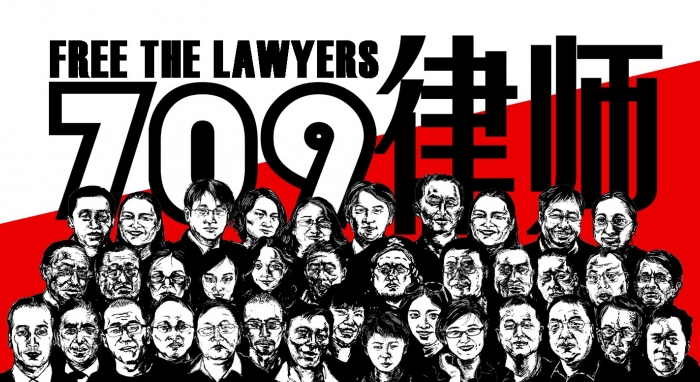
On 9 july 2020 the International Service of Human Rights came out with a good overview of what has happened to the Chinese lawyers since the crackdown five year ago [see: https://humanrightsdefenders.blog/2015/07/29/the-remarkable-crackdown-on-lawyers-in-china-in-july-2015/]. Human rights lawyers are a cornerstone of China’s human rights movement: they represent victims of abuses, promote compliance with international law, and strive for human rights change inside the system.

In the weeks following 9 July 2015, over 300 Chinese weiquan (‘rights defence’) lawyers and legal activists were harassed, detained and disappeared, in a nationwide police sweep that came to be known as the ‘709 Crackdown’. Five years later, these lawyers and their families still face a range of restrictions and rights violations aimed at silencing their efforts for a more just and rights-compliant society.

Disbarment, secret detention, disappearances, harassment of relatives, stigmatisation: the ‘systematic crackdown on lawyers’ denounced by UN experts has changed in form but not in its scale or scope.

Despite the risks, they strive to uphold the fundamental rights of all Chinese citizens, guaranteed under China’s Constitution and international treaties. They represent the most vulnerable and unjustly accused: those who have been evicted from their land or are victims of police abuse; minorities criminalised for their religious belief or ethnicity; human rights defenders and those expressing opinions different from the official Party line.

Without independent lawyers, there can be no rule of law,’ says Sarah M Brooks, ISHR Asia Advocate.

And when the rule of law is weaponised – as we saw last week with the imposition of the National Security Law in Hong Kong – lawyers are on the front lines of defending rights and freedoms. The least we can do – as individuals and as a global community – is to stand with them.

In a defiant act of reclaiming, 9 July is now recognised by the human rights movement as ‘China Human Rights Lawyers Day’. To highlight this important day, ISHR has produced a bilingual information flyer on the patterns of repression against Chinese human rights lawyers, and action by the international community. The information flyer is available in English and Chinese.
请点击此处下载中文版
For more information, please contact Raphael Viana David at r.vianadavid@ishr.ch or on Twitter at @vdraphael.

See also: https://humanrightsdefenders.blog/tag/china-change/

https://mailchi.mp/ishr/alert-to-the-human-rights-councils-35th-session-32794?e=d1945ebb90

Will long-running saga of trial against the Istanbul 10 end on Friday 3 July?

July 3, 2020

From the start, this has been a politically-motivated trial’Idil Eser© Amnesty International (Foto: Jordi Huisman)

The verdict in the trial of Amnesty Turkey’s chair, the organisation’s former Turkey director and nine other human rights defenders, is expected tomorrow. The key hearing will begin at 8.00am BST (10.00am local time) on Friday 3 July at Istanbul Heavy Penal Court, No 35.

Taner Kılıç, Idil Eser, Özlem Dalkıran, Günal Kurşun, Veli Acu, Nejat Taştan, Nalan Erkem, İlknur Üstün, Şeyhmus Özbekli, Ali Gharavi and Peter Steudtner are all on trial for baseless terrorism charges.

Over the course of 11 earlier hearings spread over nearly three years, ‘terrorism’ allegations against all 11 defendants have been repeatedly and categorically disproven, including – ironically – by the state’s own evidence. The prosecution’s attempt to present legitimate human rights activities as unlawful acts has comprehensively failed, said Amnesty. [see also: https://humanrightsdefenders.blog/2020/02/16/turkey-who-will-defend-the-human-rights-defenders/.]

In August 2018, after more than 14 months in prison, former Amnesty Turkey Chair Taner Kılıç was released on bail. Eight of the others spent almost four months each behind bars before they were released in October 2017.

At the tenth hearing in November 2019, the prosecutor requested acquittal for five of the 11, and convictions for the remaining six.

See: https://humanrightsdefenders.blog/2020/05/06/ali-gharavi-of-the-istanbul10-speaks-about-his-experience-and-his-hope/.

In the meantime, on 2 June 2020, the Council of Europe’s Commissioner for Human Rights spoke out on the independence of lawyers in Turkey: “I have taken note with concern of a bill recently submitted to the Turkish Parliament containing amendments to the Turkish Law No. 1136, which affect lawyers and their professional associations. The proposed changes would notably allow for a plurality of bar associations in provinces with large numbers of lawyers and modify the election procedures of bar associations and their Union. These changes raise particular concerns when seen against the background of the serious problems I identified in my latest report on Turkey published in February 2020. These problems include a hostile and repressive atmosphere affecting civil society in Turkey, of which professional associations, such as bar associations, are a very important part; the glaring lack of consultation and involvement of civil society in policy-making and legislation; and the very difficult situation, including undue judicial pressure, faced by lawyers in Turkey both as  human rights defenders and as a fundamental part of an increasingly hostile judicial system.

https://www.amnesty.org.uk/press-releases/turkey-verdict-expected-long-running-trial-amnesty-chair-and-ten-others

https://www.coe.int/en/web/commissioner/-/commissioner-s-concerns-about-proposed-changes-affecting-the-legal-profession-in-turkey

Lawyers for Lawyers: award to Turkish human rights defender Selçuk Kozağaçlı on 23 May

May 21, 2019

On 23 May 2019, L4L will be presenting the 2019 Lawyers for Lawyers Award to Selçuk Kozağaçlı, a human rights lawyer from Turkey. Selçuk Kozağaçlı is a lawyer, human rights defender and member of the People’s Law Office. He is well known for working on the “Soma Mine” disaster, the worst mine disaster in Turkey’s history, in which 301 miners were killed. He is also the chair of the Progressive Lawyers’ Association (ÇHD), an association which focuses on the right to life and advocates for the prevention of all types of attack on fundamental rights and human dignity. The Progressive Lawyers’ Association was closed on 22 November 2016 by Statutory Decree No. 677 issued under the State of Emergency.

Fore more on this award and other awards for human rights lawyers, see: http://www.trueheroesfilms.org/thedigest/awards/lawyers-for-lawyers.

The Award Ceremony will take place in Amsterdam. Prior to this ceremony an interesting seminar will be held in collaboration with the Amsterdam Bar Association and the Justitia Commission of the Young Lawyers Association Amsterdam. The main topic of the seminar will concern the developments surrounding the proposed European Convention on the Profession of Lawyers. Two panel discussions will be organized around this topic. Speakers include François Moyse (Vice-Chair of the CCBE European Convention Working Group), Mikolaj Pietrzak (president of the Warsaw Bar Association) and former Award winners and lawyers Sirikan ‘June’ Charoensiri (Thailand), Magamed Abubakarov (the Russian Federation) and Alec Muchadehama (Zimbabwe).

From 2:30 PM until 5:00 PM CEST L4L will livestream PART I with the seminar ‘Lawyers at risk! Do we need a European Convention?’ It will continue the broadcast with PART II from 5:00 PM until 5:30 PM CEST with the Award CeremonyTo watch online, please click on the following link: https://www.youtube.com/user/LawyersforLawyersL4L/live


Invitation Lawyers for Lawyers Award Ceremony 2019

https://www.frontlinedefenders.org/en/case/selcuk-kozagacli-detained