Posts Tagged ‘Human Rights Defenders’

Write for Rights: Global letter writing campaign 2023 started

November 2, 2023

Amnesty International launched its flagship Write for Rights campaign to help people facing human rights abuses around the world. Millions of letters and emails will be sent to support these individuals and urge authorities to end injustices. While sending a letter may seem like a small gesture for any single one of us, the collective action of many of us has the potential to transform lives’ said Sacha Deshmukh, Chief Executive of Amnesty International UK.

Taking place across November and December, Write for Rights will see people around the world send millions of cards, emails and social media posts of solidarity to individuals whose fundamental rights are being threatened or denied, while urging those in power to put a halt to the abuses.

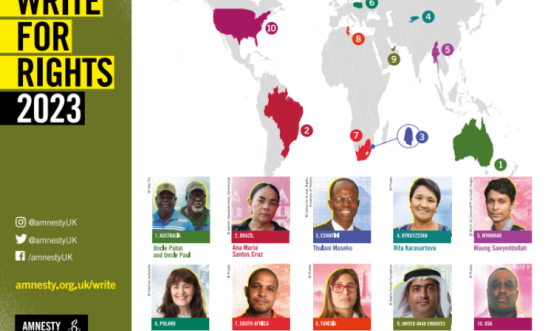
This year, the global Write for Rights campaign will focus on 10 cases of individuals and communities from across the world who are facing human rights violations, including:

  • Rocky Myers, a Black man, has been on death row in Alabama, USA, since 1994. A nearly all-white jury convicted and sentenced him to life without the possibility of parole for the murder of his white neighbour. The trial judge overrode their decision and imposed a death sentence – a practice now outlawed in Alabama. No evidence linked Rocky to the murder, except for a VCR stolen from the victim, which he maintains he had found abandoned in the street. In 2018, Rocky and others on death row were given 30 days to choose if they wanted to die by nitrogen gas asphyxiation or by amended lethal injection protocols. Rocky chose the former, and his execution could be reset as soon as the new protocol for execution by nitrogen gas asphyxiation is finalised and ready to be implemented, which is expected by the end of this year.
  • Rita Karasartova, a Kyrgyzstan-based human rights defender who works for the Institute of Civic Analysis – a human rights organisation and think-tank. Rita was arrested in October 2022 for joining group of activists who objected to a border demarcation agreement with Uzbekistan. After the group called for a public assembly and formed a committee to oppose the agreement, Rita and others were charged with attempting to violently overthrow the government, which carries a maximum sentence of 15 years imprisonment. Rita is now under house arrest and a strict curfew.
  • Ahmed Mansoor is a human rights defender and previously won the prestigious Martin Ennals Award for Human Rights Defenders in 2015. Ahmed has documented human rights abuses in the UAE since 2006, until he was arrested in early 2011 and March 2017, he was given a 10-year prison sentence. He has been held in solitary confinement since the beginning of his detention, and continues to be denied a mattress, access to books, and to be permitted to go out in a yard. See: https://humanrightsdefenders.blog/tag/ahmed-mansoor/ and https://www.trueheroesfilms.org/thedigest/laureates/074ACCD4-A327-4A21-B056-440C4C378A1A]
  • Justyna Wydrzyńska is a reproductive rights defender in Poland and is one of the co-founders of the Abortion Dream Team, an activist collective campaigning against abortion stigma and offering advice on accessing safe abortion in Poland, where abortion laws are among the most restrictive in Europe. In March 2023 Justyna was convicted to 8 months’ community service for helping a pregnant woman to access abortion pills in Poland, setting a dangerous precedent in a country where abortion is almost completely banned.

Amnesty International’s Write for Rights campaign dates back to the origins of Amnesty International in 1961. In the organisation’s early days, Amnesty campaigners wrote letters of support to individuals facing human rights violations. Now, Write for Rights is Amnesty’s flagship campaign, running every year to raise awareness about individuals whose rights are being seriously threatened.

Last year’s Write for Rights saw:

  • Over 5.3 million actions worldwide – of which at least 234,801 letters and cards were solidarity actions.
  • Letters were sent from around the world, from Zimbabwe to Hong Kong.
  • Amnesty’s International Secretariat digitally collected almost double the number of digital actions from 2021.

For 2021 see: https://humanrightsdefenders.blog/2021/11/08/write-for-rights-2021-launched/

https://www.amnesty.org.uk/press-releases/write-rights-global-letter-writing-movement-stands-victims-human-rights-abuses

Call for nominations of the 2024 Front Line Defenders Award for human rights defenders

November 2, 2023

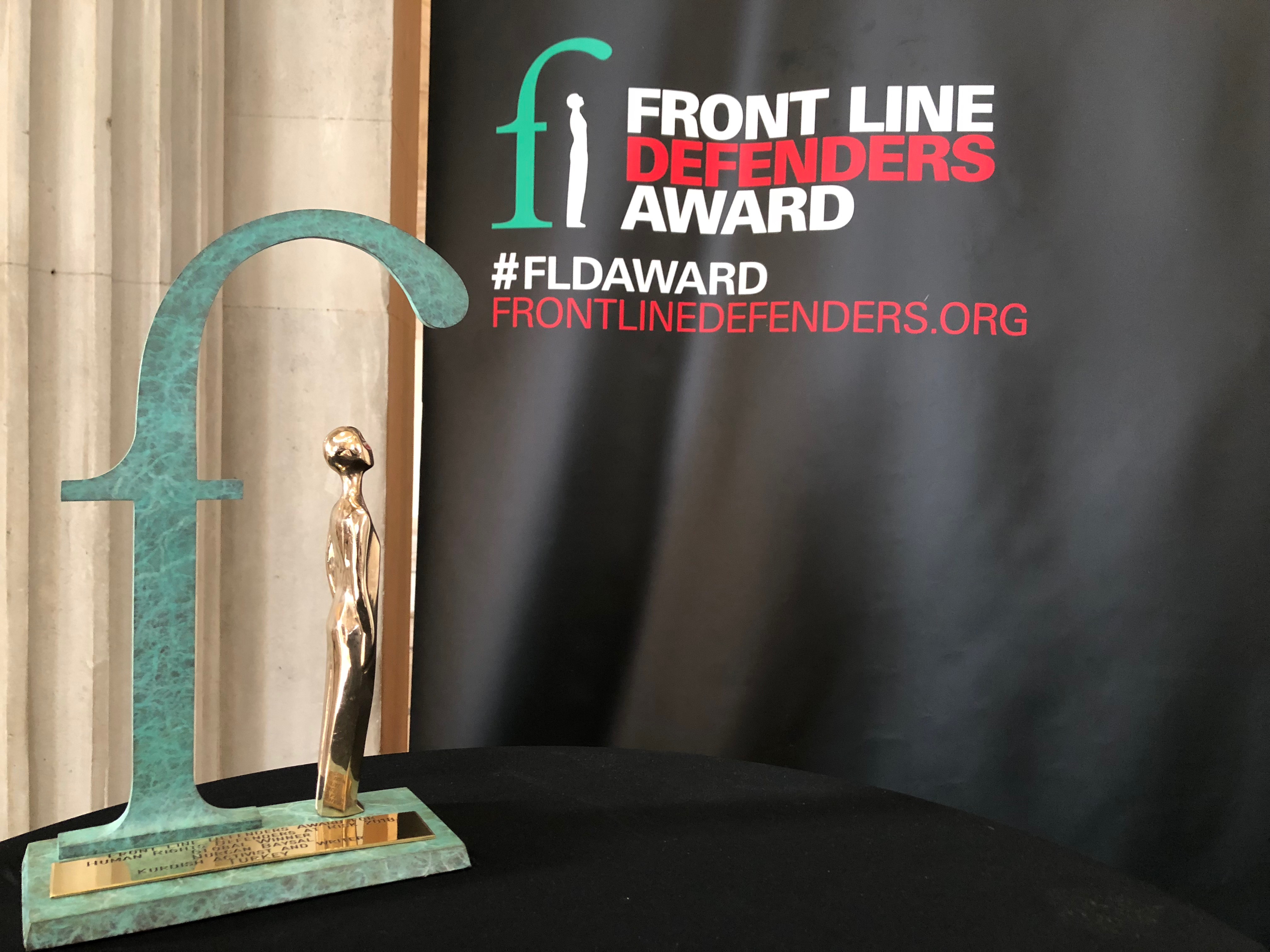
Front Line Defenders is currently accepting nominations for the 2024 Front Line Defenders Award for Human Rights Defenders at Risk:

award banner

For more on the annual Front Line Defenders Award and its laureates see: https://www.trueheroesfilms.org/thedigest/awards/2E90A0F4-6DFE-497B-8C08-56F4E831B47D

For each region of the world (Africa; Americas; Asia-Pacific; Europe & Central Asia; and Middle East & North Africa) there will be one winner selected and Front Line Defenders will recognize all five as the 2024 Front Line Defenders Award Laureates.

The nomination process is open for anyone to submit a nomination of a human rights defender, collective, organisation or community working on any human rights issue and facing significant risk due to their work or operating in an environment that itself is characterised as insecure. The purpose of the Award is to give visibility to HRDs who are not normally acknowledged or recognised at the international level. At the same time, the Award should not bring additional risk for which the HRD is not prepared. In addition to the Award, winners will receive:

  • a modest financial prize;
  • a security grant to improve their security measures;
  • collaboration with Front Line Defenders for media work in recognition of the Award;
  • advocacy by Front Line Defenders related to the Award and the work of the winners;
  • an event co-organized by the HRD, local partners and Front Line Defenders to give visibility to the Award in the winners’ countries (as determined and guided by the winners);
  • the Global Laureates will attend a ceremony in Dublin at a date to be determined;
  • ongoing security consultation with Front Line Defenders

For last year’s see:https://humanrightsdefenders.blog/2023/06/05/front-line-defenders-award-2023-goes-to-front-line-defenders/

If you would like to nominate a HRD for the 2024 Front Line Defenders Award for Human Rights Defenders at Risk, please follow this link to the secure online nomination form.

2024 Front Line Defenders Award – Nomination Form

https://www.frontlinedefenders.org/en/call-nominations-2024-front-line-defenders-award-human-rights-defenders-risk

EU’s Lorenzo Natali Media Prize 2023 to 3 Venezuelan journalists

October 21, 2023

The winners of this year’s edition of the Lorenzo Natali Media Prize, awarded by the European Commission, were announced on 11 October at a ceremony hosted at the Solvay Library in Brussels.

The winners of the International Prize are:

Three Venezuelan journalists Carmen Victoria Inojosa, Claudia Smolansky and a third whose name cannot be disclosed for security reasons, were awarded the International Prize for their compelling article ‘Así funcionan las casas clandestinas de la Dgcim en Caracas‘ published in Armando.info. Their work exposed the harrowing reality of systematic persecution in Venezuela, targeting political opponents and their families with alarming impunity.

For more on this award see: https://www.trueheroesfilms.org/thedigest/awards/D49ECF35-4B42-444D-B4FA-F7ACE2BF65BC

Lorenzo Natali Media Prize website

https://ec.europa.eu/commission/presscorner/detail/en/ip_23_4881

Mahsa Amini and Woman, Life and Freedom Movement in Iran awarded EU’S Sakharov Prize

October 19, 2023
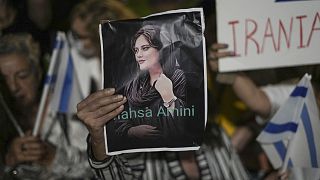
Women attend a protest against the death of Mahsa Amini, a woman who died while in police custody in Iran, during a rally in Tel Aviv, Oct. 29, 2022.

 Euronews reported on 19 October 2023 that Mahsa Amini and the Woman, Life and Freedom Movement in Iran were awarded the European Parliament’s Sakharov Prize for Freedom of Thought.

The 16 September 2022 is a date that will live in infamy and the brutal murder of 22-year-old Jina Mahsa Amini marked a turning point. It has triggered a women-led movement that is making history,” European Parliament President Roberta Metsola said after announcing the winner. 

Two other nominees made it on the finalist shortlist: Women rights’ defenders and Nicaraguan activists. See: https://humanrightsdefenders.blog/2023/10/18/sakharov-prize-2023-finalists-announced/

Results of the 54th session of the UN Human Rights Council

October 15, 2023

On 13 October 2023 the ISHR and other NGOs shared their reflections on the key outcomes of the 54th session of the UN Human Rights Council [see: https://humanrightsdefenders.blog/2023/09/11/human-rights-defenders-at-the-54th-session-of-the-un-human-rights-council/:

…We firmly condemn all crimes and other grave violations under international law committed by both Israel and Palestinian armed groups. Targeted and indiscriminate attacks against civilians can never be justified. We call on the ICC Office of the Prosecutor to accelerate its investigation into serious crimes committed by all parties in Palestine and Israel. We call on Israel to ratify the Rome Statute, and for the ICC to hold both State and non-State perpetrators of international crimes accountable. We call on the Commission of Inquiry to address the situation within the context of its root causes: settler colonialism, apartheid, and denial of the fundamental rights to self-determination and return of the Palestinian people, all amounting to grave violations of international law. We call on governments to immediately stop providing political and military support to Israel, while Ministers manifest a genocidal intent against Palestinians. On 9 October 2023, Yoav Gallant, Israel’s Minister of Defense, stated: “We are imposing a complete siege on [Gaza]. No electricity, no food, no water, no fuel – everything is closed. We are fighting human animals, and we act accordingly”. We deplore the dehumanization of all people, including not mentioning  Palestinian civilians’ killings in statements in this Council. As we gear up to celebrate the 75th anniversary of the UDHR, we remind this Council that for 75 years, generations of people in Gaza and historic Palestine have not been born free and equal in dignity and rights. Until this is addressed, the cycles of violence will not end. As Israel continues to bomb the Rafah crossing, the international community has a duty to guarantee immediate humanitarian access to besieged Gaza. We call on States to establish an international protective presence in the OPT, as called for by UN Special Procedures.  For 75 years, the international community has enabled impunity and failed to fulfill the right to self-determination of Palestinian people, including through their legitimate right to resist colonialism.

The Council has shown that it does have an important role to play in addressing violations amidst multiple human rights crises. We welcome the establishment of the mechanism on Sudan and the extension of the Special Rapporteur on Russia, inter alia, in this regard. But these stand in stark contrast to its failure to renew the critical mandate on Ethiopia, particularly in light of the expert finding of the acute risk of ongoing and further atrocity crimes, as well as other Council blind spots where mounting human rights violations remain ignored. We stress the need for the Council to take a principled approach and to address situations on their merits. 

We remain deeply concerned about reprisals against civil society actors who engage or seek to engage with UN bodies and mechanisms. We call on all States and the Council to do more to address the situation, including raise concerns about specific cases of reprisals and demand that governments provide an update on any investigation or action taken toward accountability. We welcome the adoption of the resolution on cooperation with the UN, including the reference to adequately resourced dedicated civil society focal points, however we are disappointed that several proposals by States and civil society to strengthen the text were not taken on board. The Secretary General’s most recent report on reprisals notes increased physical and digital surveillance of those cooperating with the UN and application of laws aimed at punishing or deterring cooperation. While the resolution takes notes of these trends we regret that the resolution does not fully address how these should be addressed. We welcome the strong focus on prevention and emphasis given to accountability. Nonetheless, the preventative role the Council could play in regard to reprisals, as signs of deterioration in civic space conditions, is overlooked. In addition, States’ monitoring and reporting responsibilities in relation to allegations of acts of intimidation or reprisal could be addressed more fully. Also, we welcome the call to the SG for adequate resources to be allocated to OHCHR to prevent and address allegations.

We welcome the resolution on preventable maternal mortality and morbidity, which reiterates that PMMM is a human rights issue that requires a human rights-based approach response, centering inter alia the principles of accountability, meaningful participation of primarily affected people, non-discrimination and equality and transparency. The resolution aims at garnering political will to curb maternal mortality and morbidity rates that have been stagnating and failing to meet SDGs targets. The resolution rightly highlights the full realization of the right to sexual and reproductive health and the provision of comprehensive sexual and reproductive health information and services, including comprehensive sexuality education and safe abortion (with the caveat of not when against national law), as pre-conditions to lower PMMM. We welcome the call to update the technical guidance on a HRBA to PMMM. We however deplore the amendments put forward seeking to weaken the text and apply a protectionist lens to women’s rights to bodily autonomy, taking away their agency and their status of full rights holders under IHRL.

We express our support for a new resolution on the right to privacy in the digital age, which contains strong new standards under the theme of data protection. The resolution also contains stronger language on remote biometric surveillance systems, such as facial recognition, stressing that they raise serious concerns with regard to their proportionality. While we applaud that the resolution acknowledges that some applications of new and emerging technologies may not be compatible with international human rights law, we call for future iterations to take a step further in establishing “red lines” and to call for bans of such technologies. We also urge the core group to address other emerging issues for the right to privacy in the future, such as social media monitoring.

We welcome the adoption of the resolution on the question of the death penalty aimed at ensuring that criminal justice systems are consistent with international human rights obligations in relation to capital punishment, with a focus on the relation between Art 6 and Art 14 of the ICCPR, particularly on the right to seek pardon or commutation of the sentence, and the right to have one’s conviction reviewed by a higher tribunal according to law. In accordance with the safeguards guaranteeing the protection of the rights of those facing the death penalty, as set out in the annex to Economic and Social Council Resolution 1984/50. We welcome that any attempt by a number of States to undermine the aim of the resolution through a number of amendments, have been rejected.           

We welcome the adoption of the resolution from rhetoric to reality: a global call for concrete action against racism, racial discrimination, xenophobia and related intolerance’ and the mandate renewal of the Working Group of Experts of People of African Descent (WGEPAD). We welcome that the rhetoric to reality resolution, interalia, strongly condemns the discriminatory treatment, unlawful deportations, excessive use of force and deaths of African migrants and migrants of African descent, including refugees and asylum-seekers, at the hands of law enforcement officials engaged in migration and border governance. It calls on States to ensure accountability and reparations for human rights violations at borders and to adopt a racial justice approach, including by adopting policies to address structural racism in the management of international migration. However, we regret that it did not reiterate that the transatlantic trade in enslaved Africans and colonialism were grave violations of international law that require States to make reparations proportionate to the harms committed and to ensure that structures in the society that are perpetuating the injustices of the past are transformed, including law enforcement and the administration of justice. We urge all States to fully implement the Durban Declaration and Programme of Action (DDPA). We also call on States to fully cooperate with the WGEPAD and EMLER including by accepting country visits, and implementing their recommendations as well as those from the Permanent Forum and the High Commissioner’s Agenda towards Transformative Change for Racial Justice and Equality.

We welcome the adoption of the resolution on the human rights situation in the Russian Federation, and the re-mandating of the Special Rapporteur. The human rights situation in Russia has drastically deteriorated in the past year, and the Special Rapporteur needs more time to report on the general situation in the country and the Council to equally be able to scrutinize the situation.

We welcome the adoption of the resolution on a Working Group on the rights of Peasants and Other People Working in Rural Areas. The resolution recognizes the contributions of peasants and other people working in rural areas in ensuring the right to adequate food and nutrition, a clean, healthy and sustainable environment, as well as to conserving and improving biodiversity. It calls upon all States and all stakeholders to cooperate fully with the Working Group on the Rights of Peasants and Other People Working in Rural Areas. The establishment of an interdisciplinary WG with balanced geographical representation will promote the effective and comprehensive implementation of the UNDROP and provide opportunities to share and promote good practices and lessons learned on the implementation of the UNDROP.

We welcome the adoption of the resolution on Afghanistan, which extends and strengthens the mandate of the Special Rapporteur. However, we are dismayed that the HRC once again failed to establish an independent investigative mechanism, despite compelling evidence for its need. This risks the entrenchment of impunity for crimes against humanity. This body must center rights holders and survivors, and heed the call of Afghan civil society, who have consistently asked for such a mechanism. We urge States to recognise the situation of women and girls in the country as amounting to gender apartheid, and to support the codification of this crime in the draft Articles on Crimes against Humanity.

We regret that the item 10 resolution on Yemen, again fails to respond to the urgent need for accountability for past and on-going violations and abuses in Yemen.

We welcome the adoption of the resolution on the enhancement of technical cooperation and capacity-building in the field of human rights and its focus on the Universal Periodic Review. The resolution contains a number of key references to the positive role civil society plays in technical assistance, and the possible role multi-stakeholder partnerships between States, UN agencies and civil society can play in supporting the implementation of international human rights obligations by UN Member States. The establishment of an online repository of technical cooperation and capacity-building activities could help civil society identify advocacy opportunities in regards to country-specific situations, in collaboration with UN agencies, as well as opportunities to share best practices and capitalize on lessons learned in regard to technical assistance.

We welcome the renewal of the mandate of the Special Rapporteur on the situation of human rights in Cambodia. In a context defined by systematic targeting and silencing of human rights defenders, critics and political opponents, the Special Rapporteur’s independent and objective assessment of the situation is more important than ever. However, we regret that the resolution once again failed to adequately reflect the reality of the situation and attempted to justify continuing restrictions on civil and political space on the basis of the country’s political and historical particularities as well as national legislation that contradict its international obligations.

We welcome the resolution on the rights of older persons and its important focus on the right of older persons to live free from violence, abuse, and neglect. Now, more needs to be done to ensure that older persons’ rights are protected in reality, including by establishing an international treaty on the rights of older persons.

We welcome the allocation of additional resources to the OHCHR in the area of economic, social and cultural rights, with the adoption of the resolution on ESCR and inequalities.

One year after the release of the OHCHR report finding possible crimes against humanity committed by China against Uyghurs and Muslim minorities, we deplore the sustained failure of this Council to engage in dialogue on the matter, let alone prevent the continuation of abuses. We regret the absence of a joint statement on China at the Council in 2023. The CESCR, the CEDAW, the CERD, the OHCHR, the ILO, as well as Special Procedures through three joint statements, nearly 30 press releases and over 100 letters to the government since 2018, have provided overwhelming evidence pointing to systematic and widespread human rights violations across the country. So long as the Council is not able to take principled action on the basis of objective criteria, other powerful perpetrators will feel empowered to continue committing atrocity crimes, relying on the Council’s silence. We reiterate our pressing call for all Council Members to support the adoption of a resolution establishing a UN mandate to monitor and report on the human rights situation in China.

Finally, we note the outcomes of the Human Rights Council elections. We welcome that Russia’s candidacy was defeated but regret the election of other members responsible for atrocity crimes, widespread civil society repression, and patterns of reprisals.

Signatories: International Service for Human Rights (ISHR), International Federation for Human Rights (FIDH), GIN SSOGIE NPC, Cairo Institute for Human Rights Studies, FIAN International, Asian Forum for Human Rights and Development (FORUM-ASIA).

See also: https://www.jurist.org/news/2023/10/un-human-rights-council-adopts-5-new-resolutions-including-renewal-of-un-mandate-in-burundi/ 

https://ishr.ch/latest-updates/hrc54-civil-society-presents-key-takeaways-from-human-rights-council/

https://rightlivelihood.org/news/54th-un-human-rights-council-we-shed-light-on-activist-repression-indigenous-peoples-plight-in-nicaragua-environmental-degradation/
Climate Human Rights Defenders increasingly seen as eco-terrorists

October 15, 2023

Damien Gayle, Matthew Taylor and Ajit Niranjan in the Guardian of 12 October 2023 published the result of their research in Europe into using repressive measures to silence climate activists[see: https://humanrightsdefenders.blog/2023/10/04/human-rights-platform-at-the-gulbenkian-foundation-hears-michel-forst-worries-about-treatment-of-climate-defenders/]

In Germany, France, Italy, Sweden, the Netherlands and the UK, authorities have responded to climate protests with mass arrests, the passing of draconian new laws, the imposing of severe sentences for non-violent protests and the labelling of activists as hooligans, saboteurs or eco-terrorists. The crackdowns have come in spite of calls by senior human rights advocates and environmental campaigners to allow civic space for the right to non-violent protest, after a summer of record-breaking heat in southern Europe that is attributed to the effects of climate breakdown.

The UK has led the way in the crackdown, experts say, with judges recently refusing an appeal against multi-year sentences for climate activists who blocked a motorway bridge in east London. The three-year jail terms for Marcus Decker and Morgan Trowland earlier this year are thought to be the longest handed out by a British judge for non-violent protest.

Michel Forst, the UN rapporteur on environmental defenders since June last year [not really, for his correct title is the “Special Rapporteur on Environmental Defenders under the Aarhus Convention, Mr. Michel Forst” [see: https://humanrightsdefenders.blog/2022/07/22/aarhus-convention-on-environmental-information-gets-especially-experienced-rapporteur/], described the situation in the UK as “terrifying”. He added that other countries were “looking at the UK examples with a view to passing similar laws in their own countries, which will have a devastating effect for Europe”.

“Since my appointment I have been travelling to many countries in Europe and there is a clear trend,” Forst told the Guardian. “We can see an increasing number of cases by which these climate activists are brought to court more and more often and more and more severe laws being passed to facilitate these attacks on defenders.”

He added: “I’m sure that there is European cooperation among the police forces against these kinds of activities. My concern is that when [governments] are calling these people eco-terrorists, or are using new forms of vilifications and defamation … it has a huge impact on how the population may perceive them and the cause for which these people are fighting. It is a huge concern for me.”

Amnesty International said it was investigating a continent-wide crackdown on protest. Catrinel Motoc, the organisation’s senior campaigner on civil space and right to protest in Europe, said: “People all around the world are bravely raising their voices to call for urgent actions on the climate crisis but many face dire consequences for their peaceful activism.

“Peaceful protesters are left with no choice but to stage public protests and non-violent direct actions because European countries are not doing enough to tackle the climate crisis.

“There’s alarming evidence of criminalisation, harassment, stigmatisation and negative rhetoric towards environmental defenders.”

In June, Dunja Mijatović, the Council of Europe’s commissioner for human rights, also called for an end to crackdowns on environmental activists. Last December, Volker Türk, the UN’s high commissioner for human rights, appealed to governments to protect the “civic space” for young environmental activists, and “not crack down in a way that we have seen in many parts of the world”.

There was widespread outrage this summer when France’s interior minister, Gérald Darmanin, used one of the state’s most-powerful tools to order the banning of one of the country’s leading environmental protest groups. Les Soulévements de la Terre, a collective of local environmental campaigns, had staged a series of protests, with tactics including sabotage, that ended with violent confrontations with police, and Darmanin denouncing the activists as “far left” and “ecoterrorists”.

In the Netherlands, one of a series of roadblock protests on the A12 highway in The Hague in May was dispersed by police using water cannon, with more than 1,500 arrested. Seven climate activists were convicted of sedition – a charge that had never before been levelled against climate protesters – in relation to online posts calling for people to join an earlier demonstration.

In Sweden, about two dozen members of the Återställ Våtmarker [Restore Wetlands] group were convicted of sabotage for blocking highways in the capital, Stockholm. Others were held on remand for up to four weeks for taking part in protests.

In Germany in May, police staged nationwide raids against the Letzte Generation (Last Generation) group, whose supporters had glued themselves to roads on a near-weekly basis for months, as well as targeting art galleries and other cultural spaces. On a police directive, the homepage of the group was shut down and possessions belonging to members were seized.

At the most recent count, supplied by the activists, police had made more than 4,000 arrests of supporters of Last Generation taking part in road blocks in Berlin alone.

Authorities in Italy have used anti-organised crime laws to crack down on protests, where the Ultima Generazione (also Last Generation) group has staged road blocks since last year. The Digos police unit, which specialises in counter-terrorism, in April justified the use of anti-Mafia laws to target the group by saying its civil disobedience actions had not taken place spontaneously, but were organised, discussed and weighed up by an internal hierarchy. This came along with new, stiffer penalties for protests, with activists facing fines of up to €40,000 for actions targeting artworks and other cultural heritage.

Richard Pearshouse, director of the environment division at Human Rights Watch, said: “These restrictions on environmental protest across Europe and the UK are incredibly short-sighted. These governments haven’t grasped that we all have a huge interest in more people taking to the streets to demand better environmental protection and more climate action.

“Governments need to respect the rights to assembly and expression, and ramp up their own environmental protections and climate ambitions. That’s the only way we have a chance to get out of this climate crisis with our democratic institutions intact.”

A spokesperson for the UK Home Office said: “The right to protest is a fundamental part of our democracy but we must also protect the law-abiding majority’s right to go about their daily lives.

“The Public Order Act brings in new criminal offences and proper penalties for selfish, guerrilla protest tactics.”

The French interior ministry said local officials had the right to ban demonstrations with a serious risk of disturbing public order. “These one-off bans, of which there are very few in absolute terms, are not imposed because of the reason for the demonstration.”

The Italian interior ministry referred to a statement from the culture minister Gennaro Sangiuliano in April, who said attacks on monuments cause economic damage to the community that is is expensive to clean up. “Those who cause damage must pay personally.”

The German interior ministry declined to comment. The Bavarian interior ministry referred the Guardian to the public prosecutor’s office in Munich, which provided a statement from June in which it confirmed it had authorised the tapping of phones for six of seven Last Generation members under criminal investigation.

The Swedish interior ministry declined to comment. The Dutch ministry of justice did not respond to requests for comment.

https://www.theguardian.com/environment/2023/oct/12/human-rights-experts-warn-against-european-crackdown-on-climate-protesters

and later followed by:

https://globeecho.com/politics/climate-protesters-in-europe-face-a-massive-crackdown/

https://www.ohchr.org/en/statements-and-speeches/2023/10/environmental-rights-are-key-all-human-rights-turk-says

5th Dublin Arts and Human Rights Festival in October 2023

October 12, 2023
Dublin Arts and Human Rights Festival marks 5th anniversary

Dublin’s only annual festival dedicated to celebrating the intersection of the arts and human rights marks its fifth anniversary this year as it hosts 10 days of events in the capital, around Ireland and online this October.

Dozens of events promoting equality, human rights and diversity through the arts will be coming to Dublin between October 13 and October 22. Front Line Defenders’ Laura O’Leary said the festival will feature “a range of innovative and thought-provoking events exploring how art and human rights interact in our world today“.

by Taboola

The Dublin Arts and Human Rights Festival is an annual, international festival organised by Smashing Times International Centre for the Arts and Equality and Front Line Defenders, a Dublin-based international organisation working to improve the security and protection of human rights defenders at risk, in partnership with Amnesty International, National Women’s Council of Ireland, as well as other arts and human rights partners.

It takes place in Dublin, Kerry, Donegal, and Cork, with artists and speakers in attendance from multiple countries. Events are taking place across 17 different venues, involving 29 different organisations nationwide.

The festival comprises 21 live performances, six exhibitions, nine talks or panel discussions, four installations, three workshops, three film screenings, two partner exchanges, one podcast, and one radio documentary. Some of the events include:

https://www.dublinlive.ie/whats-on/dublin-arts-human-rights-festival-27884655

ODIHR: human rights defenders in exile should be allowed to continue their work

October 8, 2023

Experts and representatives of civil society shared their assessments of the needs of human rights defenders in exile at an ODIHR event that took place in the margins of the 2023 Warsaw Human Dimension Conference. 6 October 2023. (OSCE/Piotr Dziubak) Photo details

The situation of human rights defenders forced to work outside their countries to avoid danger or persecution at home was the topic of an event organized by the OSCE Office for Democratic Institutions and Human rights (ODIHR) on 5 October 2023 in the margins of the Warsaw Human Dimension Conference.[see:https://humanrightsdefenders.blog/2023/10/03/osce-leaders-speak-the-right-language-about-hrds/ ]

Human rights defenders play a legitimate and important role in our societies,” said Andrew Gardner, ODIHR’s Deputy Head of the Human Rights Department. “It is essential that they can operate in a free and safe environment when this does not exist in their own countries.”

Experts and representatives of civil society, some who had themselves relocated to safer countries, shared their assessments of the needs of human rights defenders in exile, including rapid access to safe third countries, overall safety and a secure legal status, and their ability to continue their human rights work.

Participants stressed the importance of being able to form associations, seek and receive funding and travel as part of their human rights work. They also discussed the impact of being uprooted on human rights defenders’ well-being.

Defenders are determined to continue their human rights work,” said Tamar Beria of the International Partnership for Human Rights (IPHR). “But states and donor organizations must do more to make this work viable in the long term by tackling pervasive issues such as visa access, inflexible funding and a lack of institutional support.”   

Participants stressed that decision-makers must address protection gaps which exist for exiled human rights defenders and ensure the fulfilment of their fundamental rights and freedoms.

https://www.osce.org/odihr/554482

Jailed Iranian human rights defender Narges Mohammadi wins Nobel Peace Prize 2023

October 6, 2023

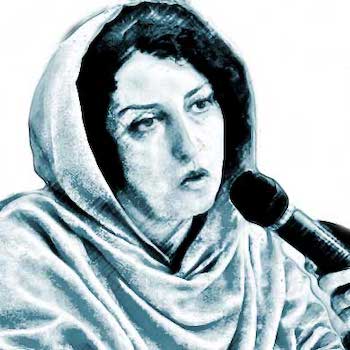
On 6 October, 2023, it was announced that imprisoned HRD Narges Mohammadi, who has campaigned for women’s rights, democracy and against the death penalty in Iran for years, has won the Nobel Peace Prize this year.

Mohammadi, 51, is one of the most recognised Human Rights Defenders in the world. She has received 8 major human rights awards according to THF’s digest of human rights awards [see: https://www.trueheroesfilms.org/thedigest/laureates/07C20809-99E2-BDC0-FDC3-E217FF91C126], but no media outlets got it right.

This prize is first and foremost a recognition of the very important work of a whole movement in Iran with with its undisputed leader, Nargis Mohammadi,” said Berit Reiss-Andersen, the chair of the Norwegian Nobel Committee who announced the prize in Oslo.

Mohammadi’s most recent incarceration began when she was detained in 2021 after she attended a memorial for a person killed in nationwide 2019 protests sparked by an increase in gasoline prices. She’s been held at Tehran’s notorious Evin Prison, whose inmates include those with Western ties and political prisoners. See also: https://humanrightsdefenders.blog/2016/09/30/iran-shameful-sentences-for-narges-mohammadi-issa-saharkhiz-arash-sadeghi-no-detente-in-human-rights/

Reiss-Andersen said Mohammadi has been imprisoned 13 times and convicted five times. In total, she has been sentenced to 31 years in prison.

She is the 19th woman to win the Nobel Peace Prize and the second Iranian woman, after human rights activist Shirin Ebadi won the award in 2003. [see: https://www.trueheroesfilms.org/thedigest/laureates/DCF78E6F-7015-4794-B6D9-1192BB84568C]

From behind bars, Mohammadi contributed an opinion piece for The New York Times. “What the government may not understand is that the more of us they lock up, the stronger we become,” she wrote.

https://apnews.com/article/nobel-peace-prize-oslo-776ca1bcf0fde827ad90af8a069907eb

https://www.abc.net.au/news/2023-10-06/nobel-peace-prize-2023-awarded-to-narges-mohammadi/102946290

https://www.cbc.ca/news/world/2023-nobel-peace-prize-1.6984334

https://edition.cnn.com/2023/10/06/middleeast/iran-narges-mohammadi-womens-rights-mime-intl-cmd/index.html

https://www.frontlinedefenders.org/en/profile/narges-mohammadi

https://www.usnews.com/news/us/articles/2023-10-06/un-expert-iran-is-unlawfully-detaining-human-rights-activists-including-new-nobel-peace-laureate

https://www.france24.com/en/live-news/20231007-nobel-winner-mohammadi-celebrates-prize-in-her-cell-family

and of course: https://www.iranintl.com/en/202310071010,

“The worthiest symbol of world peace was Qassem Soleimani,” declared the Foreign Minister of the Islamic Republic. Soleimani was a notorious military and intelligence operative who created and nursed various militant groups in the Middle East until he was killed in a US drone strike in 2020.

OSCE leaders speak the right language about HRDs

October 3, 2023

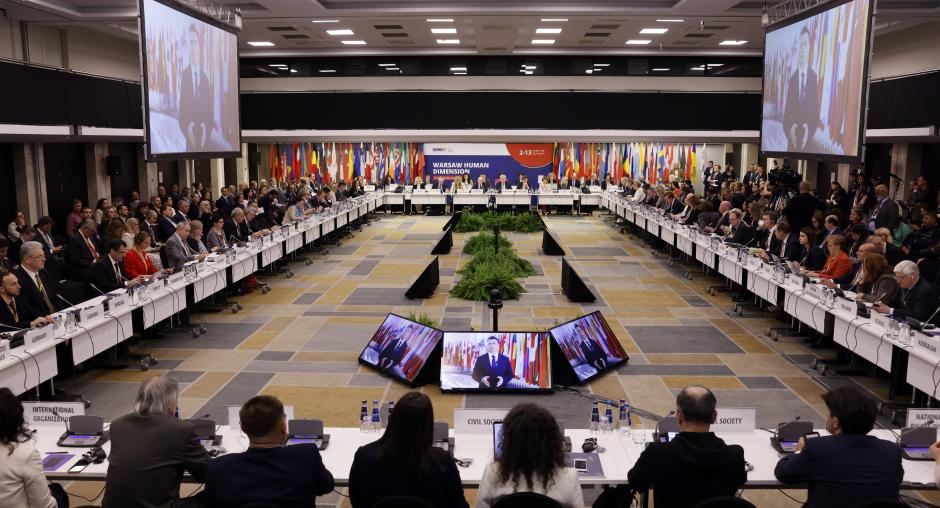
Warsaw Human Dimension Conference, Opening Plenary. 2 October 2023. (OSCE/Piotr Dziubak)

On 2 October 2023 the main message from OSCE leaders at the opening of the ten-day Warsaw Human Dimension Conference was that “at the heart of any human rights movement is the fundamental belief that every individual, regardless of their background or circumstances, possesses inherent rights and dignity.”

The OSCE’s work to achieve sustainable security throughout the 57 states of the region is only possible on the basis of democracy, human rights, and the rule of law, and in co-operation with civil society. But the work of civil society activists, whose determination to shed light on human rights abuses is so important for their societies to develop and flourish, is becoming more dangerous in the many places in which they are treated not as partners but as a political and security risk.

“The brave work of civil society activists and human rights defenders lies at the very heart of our democracies,” said ODIHR Director Matteo Mecacci. “At the OSCE we are deeply grateful for their courageous work, especially in fragile humanitarian situations resulting from conflicts across our region. We continue to learn from their experience, and we look forward to hearing proposals to improve respect for human rights, as well as their ideas for a better future. In this way, we create a unique platform for genuine dialogue between national authorities and civil society across the entire region.”

In every region of the OSCE I have heard civil society views on how to respond to the challenges we face. Your views have helped to inform our approach in Vienna, and to guide the work of our field missions. All of our work in the Secretariat and field missions is done based on a human rights centred approach, and the OSCE is committed to working with civil society every step of the way as we advance our efforts in the human dimension. The human dimension is fundamental to the OSCE comprehensive concept of security,” OSCE Secretary General Helga Maria Schmid said.

“Media freedom is deeply rooted in the concept and principles of democracy. It is what enables and sustains democratic societies – by providing people with the information they need to be free and self-determined. Quality information and a shared sense of reality are a prerequisite for all citizens to be able to express their will and positions, to take control of their lives, to be part of the glue that holds our societies together. There can be no democracy without media freedom, as much as there can be no security without media freedom,” said Teresa Ribeiro, OSCE Representative on Freedom of the Media.

The full programme and other information about the Warsaw Human Dimension Conference are available here.

https://www.osce.org/chairpersonship/554095