Posts Tagged ‘Human Rights Defenders’

Egyptian National Council for Human Rights not a place for Human Rights Defenders

January 7, 2013


Ragab Saad, a researcher at the Rowaq Arabi Journal of the Cairo Institute for Human Rights Studies (CIHRS) just published an sharp piece criticizing the latest developments at Egypt’s National Council for Human Rights, which make the Council a lot less independent and cast doubt on whether it should be recognized as such by the UN.  Good read!

The National Council for Human Rights, Lacking Human Rights Defenders | Cairo Institute for Human Rights Studies.

Number of human rights defenders in detention in Emirates reaches 77

January 7, 2013

On 26 October 2012 I referred in this blog to the controversy raised by a Arab blogger about the status of Human Rights Defenders in the Emirates (UAE) who were described as being in fact intolerant islamists. No enlightening comments were received, so I have to concluded that the attack was a politically motivated defense of government policy. That is this policy is far from HRD friendly is brought home again by a recent press release from the Gulf Centre for Human Rights (GCHR) which claims that the number of human rights defenders and activists in detention has now reached 77 as the crackdown continues.

On 14 December 2012 an Egyptian journalist was arrested and three Egyptian doctors were arrested four days later (reportedly bringing the total number of Egyptian activists in detention in the UAE to 11).

The Gulf Centre for Human Rights GCHR has issued previous appeals concerning the deteriorating situation in the UAE  (http://gc4hr.org/news/index/country/2). It is reported that approximately 200 people who are supporters or relatives of human rights defenders and activists are being prohibited from travelling.  For many of them it is only when they have attempted to leave the UAE, often having purchased tickets in advance, that they are informed of this restriction on their freedom of movement.

It is feared that more interrogations and arrest will take place in the near future.Some of the detained human rights defenders have had their detention extended, including prominent human rights lawyers Dr. Mohamed Al-Mansoori and Dr. Mohamed Al-Roken, who had their detention extended on 2 January 2013. It is reported that these extensions are granted as officials have, to date, failed to gather evidence to prosecute those detained. The GCHR call for urgent action, see:

Urgent Action: UAE- Number of human rights defenders & activists in detention reaches 77 as brutal crackdown continues.

Human Rights First job opportunity in its Human Rights Defenders Program

January 6, 2013

HRF in Washington DC is looking for a Senior Associate responsible for devising, planning, coordinating, and executing strategies for influencing U.S. human rights policy on the range of issues covered by Human Rights First’s Human Rights Defenders HRD program. Deadline 25 January 2013!

via Senior Associate – Human Rights Defenders Program Washington,  DC.

Arbitrary detention of Vietnamese HRDs such as Le Quoc Quan

January 4, 2013

The Observatory for the Protection of Human Rights Defenders, a joint programme of the International Federation for Human Rights (FIDH) and the World Organisation Against Torture (OMCT), reports the arbitrary detention of Mr. Le Quoc Quan, a human rights lawyer and blogger.

On December 27, 2012, Mr. Le Quoc Quan was arrested by the police in Hanoi while dropping off his daughter at school. The police also searched his office and home and confiscated some documents. The police told his family that he would be charged under Article 161 of the Criminal Code, which relates to tax evasion. If condemned, he risks three years in prison and a heavy fine. Mr. Le Quoc Quan, who began a hunger strike on December 28, is currently detained incommunicado in Hoa Lo Prison No. 1. Neither his lawyer nor his family have been able to visit him to date.

Mr. Le Quoc Quan’s arrest follows a recent order by Prime Minister Nguyen Tan Dung that authorities renew the fight against anyone using the Internet to “defame and spread propaganda against the State”.Mr. Le Quoc Quan has been harassed constantly since 2007 by the Vietnamese authorities because of his human rights activities. On October 3, 2012, some 50 security police and plain-clothed militia forced entry into the head office of VietNam Credit in Hanoi and its branch office in Saigon. The firm belongs to Mr. Le Quoc Quan and his two brothers. Police seized files and documents belonging to the firm, assaulted the staff and detained the brothers for interrogation. In addition, on August 18, 2012, Mr. Le Quoc Quan was brutally beaten by two unidentified men with iron bars outside his home in Hanoi.

The Observatory recalls that allegations of tax evasion have previously been levelled against human rights defenders. Blogger Nguyen Van Hai, alias Dieu Cay, founding member of the Club of Free Journalists, was initially jailed for tax evasion but then sentenced in September 2012 to 12 years in jail for spreading anti-State propaganda under Article 88 of the Criminal Code, along with two other bloggers and members of the Club of Free Journalists.

via Viet Nam: Arbitrary detention of Mr. Le Quoc Quan / January 4, 2013 / Urgent Interventions / Human rights defenders / OMCT.

Three international Human Rights Groups Urge Gambia to Stop Crackdown on HRDs

January 2, 2013

The Gambian Government must stop immediately intimidation and harassment of HRDs, journalists, lawyers and government critics generally says a joint statement by ARTICLE 19, the Commonwealth Human Rights Initiative and Amnesty International. Since the beginning of December, at least nine cases of arbitrary arrest and illegal detention have been documented.

via Human Rights Groups Urge Gambia Govt to Stop Crackdown on Critics.

Cambodia’s land dispute takes centre stage in future documentary “Cause of Progress”

January 2, 2013

The Cause of Progress” tells the story of the lives of three Cambodians caught up in the country’s chaotic and often violent economic progress, set against the backdrop of the shifting political, religious and familial landscapes of modern-day Cambodia. Shot over the course of three years, the film is a unique and intimate portrait of modern Cambodia. At times poignant and emotional, at others violent and chaotic, the film explores the impact of progress on modern society – from the corruption of the national religion, to the disintegration of the family, to the abusive power and kleptocracy of the ruling political elite.

What is happening in Cambodia is happening all over the developing world, from South America to Africa to Eastern Europe – land is being colonised by the developed world and the local elites, while the rightful owners are being displaced. This film addresses one of the most pressing issues of our time.

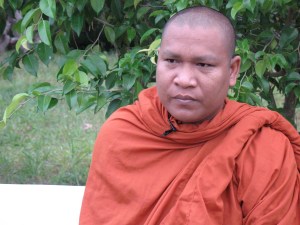
Each of the three personal narratives focuses on a different aspect of the story but forced evictions and land grabbing recur across all three. The Venerable Loun Sovath is a Human Rights Defender who uses video as part of his activist campaigning, all the while fighting against the corruption within his religious order. He is the 2012 Laureate of the MEA. Sopheap, facing eviction and waiting for a new home, is struggling to start a new business while she tries to cope with her slowly disintegrating family. And Srey Pov – at the front lines of a high profile forced eviction – comes face to face with a corrupt political elite and the sometimes difficult relationship between global institutions and the developing world.

This film will offer a unique insight into a country at a pivotal time in its development, finally shaking off the legacy of the past and the atrocities of the Khmer Rouge, Cambodia’s future direction is uncertain.

Those who want to keep up to date on future developments of this project should sign up to the film’s blog, join its facebook group, and mailing list and follow on twitter @chriskellyfilm

Luon Sovath by Dovona

Luon Sovath by Dovona

Filmmaker Chris Kelly filming at Boeung Kak lake. Image © Nicolas Axelrod 2010.

Sudan sets tone for ‘legal’ repression of Human Rights Defenders in 2013

January 2, 2013

The new year starts with a report on Sudan where the Government is confirming a worrying trend – observed already in 2012 by several NGOs in a growing number of countries including recently Russia  – of hitting dissident voices and Human Rights Defenders with more sophisticated but equally effective measures such as stopping foreign funding or using this kind of funding as a reason to simply close the institution or revoke its license.

Based on information in the Sudan Tribune of 25 and 31 December, and Bakhita Radio of 1 January 2013 this is what happened to the Sudanese Studies Center (SSC) on Monday 25 December and hardly a week later the Al Khatim Adlan Center for Enlightenment and Human Development (KACE), which were forced to close.

Sudan’s ministry of information cites activities aiming to overthrow the regime and financial support from outside the country. Aiming to promote peace, democracy and diversity, KACE organized workshops on the Darfur and South Kordofan crises, elections, and South Sudan and Abyei referendums as well as projects on violence against women and youth. Many of its different activities are indeed funded by foreign embassies in Khartoum, and international foundations. KACE is also working on a project about the reform of school curriculum funded by the National Endowment for Democracy and another one related to the civil society participation in public affairs supported by the Open Society Institute.

Albaqir Alafif (director of KACE) and Haydar Ibrahim Ali  and Abdallah Abu Al-Reesh (respectively the founder and director of the SSC) have denied the government accusations against their centers saying this support is free of any political agenda and aims to promote the different activities of the organizations.

To show that the ‘old’, crude methods of repression are still functioning, Sudanese security on Monday arrested the executive director of Sudanese Studies Center Abdallah Abu Al-Reesh, following a gathering of Sudanese activists outside the National Human Rights Commission in Khartoum to deliver a memo against its closure. Abdallah’s family said security agents came in the early morning of Monday and conducted him to unknown destination. His family members said they are concerned for his health as they refused to allow him to bring his medications.

Study on Women Human Rights Defenders and Urgent Response methods

December 22, 2012

The wicked never sleep but we are still going to have a short break around Christmas and will not bother you unless it is extremely urgent and pertinent. For those who want some more serious reading over the holidays I refer to the

interesting study on the state of affairs with regard to the protection of women human rights defenders made public by :

Hem

on  http://urgent-responses.awid.org/index.php/Home

A concrete overview of its work is on behalf of women human rights defenders is included in: study on women HRDs and urgent responses

With this I wish you a pleasant holiday

Voices from the Front Line: impressive show in Dublin

December 17, 2012

On December 9, Front Line Defenders held a one-off production called Voices from the Front Line. The event, which took place at Vicar Street Theatre in Dublin, celebrated the inspirational courage of 11 human rights defenders from around the world through an evening of stories and song. Among the performers were leading actors and musicians Martin Sheen, Andrea Corr, Robert Sheehan, Amy Huberman, Paul Brady, Hazel O’Connor, Cara O’ Sullivan, Liam Ó’ Maonlaí and Finbar Furey.

The show was attended by over 800 people and streamed live on Irish broadcaster RTE’s youtube channel. Through telling the stories of human rights defenders in their own words, the evening sought to raise public awareness of who human rights defenders are and the many risks they face. The selected human rights defenders provided an illustrative sample of the thousands more that Front Line Defenders works to protect and support on a daily basis.

• To watch Voices from the Front Line:  http://youtu.be/mQ4hzaiHlLk


Deutsche Welle reflects on Germany’s human rights policy

December 17, 2012

In this piece there are some interesting reflections on Germany’s human rights policy, which the broadcaster says is quite successful, but not very influential.

The program talks to some persons directly involved in the policy making and addresses an interesting question: “Apart from ethical considerations, human rights defenders face another, more practical key question: how to convince politicians in countries with difficult human rights track records to respect them more closely in the future? Put differently, does respecting human rights lead to a concrete political, social, or economic advantage?”

In its policy, Germany feels bound by ethical concerns as well as its free and democratic order, says Markus Löning, the German government special representative for human rights. Germany emphasises the benefits to strengthening human rights, Löning says. Establishing democracy and the rule of law improve a country’s standing in international relations. Germany’s relationship with eastern European countries after 1989 is a good example, Löning says. “Consider the relationship with Poland 25 years ago,” he says. “Today, Poland is one of our closest friends. The fact alone that a country is democratic makes establishing close, trusting relations so much easier.”

Human rights and the economy. First and foremost, human rights are based on ethics, Imke Dierßen, an advisor on Europe for Amnesty International, agrees. But adhering to human rights does have many advantages, she told Deutsche Welle – including better economic ties. Businesses need a reliable framework, so they usually set up in countries that offer these basic requirements, Dierßen says: countries with “sound legal systems and courts.” Both are prerequisites for long-term investment. Hence, Dierßen is convinced, businesses should have an interest in human rights. The West has a vested interest in standing up for human rights, Imke Dierßen from Amnesty International says. When human rights are neglected for a longer period, pressures build up that can erupt in violence. She points to Syria and Egypt, two countries which have yet to be pacified. “Of course, that also affects the EU,” the human rights expert says, pointing out their geographic proximity. “From a security policy and a geostrategic point of view, it is important to take a preventive approach. That’s where human rights play a great role.”

Eberhard Sandschneider, research director at the German Council on Foreign Relations, is convinced that human rights speak for themselves. While the West tends to underestimate the attractiveness of its own values, he says, other countries are closely watching the consequences of adhering to human rights. “If you make clear that human rights policies in Europe resulted in significant political stabilization, human rights acquire a completely new function and weight in the target countries,” he says.

Dierßen is confident that human rights concerns voiced by the German government are in fact taken seriously by governments. They also send encouraging signals to people suffering from human rights abuses. “Dissidents, mainly in China and East Europe, are always telling me how important the criticism is,” Dierßen says. “Again and again, they tell me: it is very good that you clearly address the issues. The fact alone that you make statements benefits and protects us.” Eberhard Sandschneider, however, believes that Germany’s human rights policies face a dilemma: Germany deals with states whose governments take an opposed stance when it comes to human rights. Dealing with these countries requires good diplomatic skill, the political scientist says. Dealings with them can taint Germany’s credibility, but that makes those relationships all the more important, he says. “Whether we want to or not, we have to work with the bad guys,” Sandschneider says. “Without that cooperation, stabilizing certain regions would not be possible.”

Creativity is called for. German special representative Markus Löning notes that people living in “bad guys” regimes have high expectations of Western human rights policies – which can’t always be implemented. These expectations are also voiced in the respective country’s media, Löning says – where they can take on accusatory or polemic forms. Western human rights policies can be influential, but the potential is limited. They can not perform miracles, which makes the challenge even greater to find creative ways to give human rights a better chance of a breakthrough.