Posts Tagged ‘Human rights defender’

Bahrain: arbitrary arrest of Nabeel Rajab

May 8, 2012

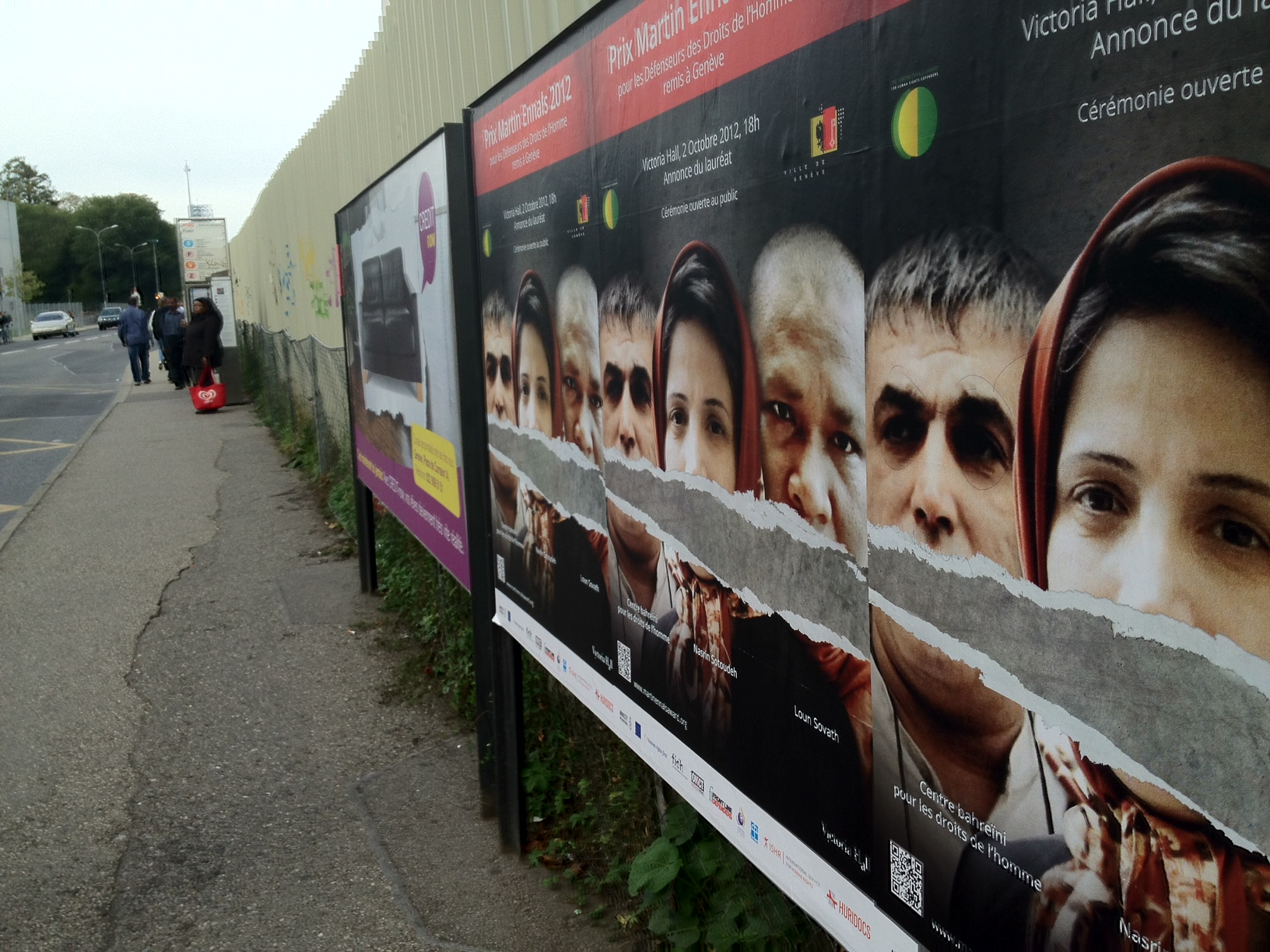
On May 7, 2012, the Observatory for the Protection of Human Rights Defenders, a joint programme of the International Federation for Human Rights (FIDH) and the World Organisation Against Torture (OMCT), reports and protests the arbitrary arrest and judicial harassment of Mr. Nabeel Rajab, President of the Bahrain Centre for Human Rights (BCHR) and FIDH Deputy Secretary General. The Centre was announced only two weeks ago as one of the nominees of the Martin Ennals Award for Human Rights Defenders (for a short film on their work see http://www.martinennalsaward.org)

On May 5, 2012, Mr. Nabeel Rajab was arrested by plain clothes police officers upon arrival at Manama airport from Lebanon and transferred to Al Hawra police station. The police officers who proceeded to the arrest stated that they were following orders by the Public Prosecutor, however neither Mr. Rajab nor his lawyers were then informed of the reasons for his arrest. 

Mr. Rajab had returned to Bahrain in order to attend a hearing for charges of “participating in an illegal assembly” and “calling others to join”, relating to a protest organised on March 31, 2012 in Manama to denounce the detention of human rights defender Abdulhadi Al Khawaja, former BCHR President and former MENA Director at Front Line.On May 6, Mr. Rajab was accordingly taken to court, where he denied the charges against him. The trial was postponed to May 22, 2012.

Later the same day, Mr. Rajab was presented before the Public Prosecutor, who informed him of the reasons for his arrest. According to Mr. Rajab’s lawyers, charges of “insulting the statutory bodies”, pursuant to Article 216 of the Penal Code, which carry an imprisonment for a term of up to three years and a fine, are pressed against him in relation to tweets he posted deemed “insulting” to the Ministry of Interior. Mr. Rajab replied that he was the author of tweets posted through his account and that he did not recognise the jurisdiction of the Court and the Prosecution due to their lack of independence from the Executive. The Public Prosecutor remanded Mr. Rajab to detention for seven days.

The Observatory firmly denounces the arbitrary detention as well as the judicial harassment of Mr. Nabeel Rajab, which seem to merely aim at sanctioning his legitimate human rights activities. It recalls that according to international standards pre-trial detention should only be used where other measures of restraint are not possible.

The Observatory recalls that these events occur within the context of an intensified crackdown against activists, including human rights defenders, who have supported or are alleged to have supported the protest movement which started in Bahrain in February 2011.

Bahrain: Arbitrary arrest and judicial harassment … – FIDH.

Iran continues its persecution of Human Rights Defenders: Narges Mohammadi detained

May 3, 2012

Prominent human rights defender Narges Mohammadi was arrested last month. On Wednesday 26 April Reporters Without Borders (RSF) in Paris said the group “strongly condemns” her jailing. Narges Mohammadi was a spokeswoman for Ebadi’s now-banned Center for Human Rights Defenders.

She was reportedly detained on Saturday 21 April and brought to Tehran’s Evin prison to begin serving a six-year sentence following a conviction in 2010 after she was accused of anti-government crimes. Mohammadi had remained free pending appeals. Ebadi left Iran after the disputed re-election of President Mahmoud Ahmadinejad in 2009, which touched off unprecedented protests and harsh crackdowns by authorities. Several of her co-workers have been arrested and harassed, such as Nasrin Sotoudeh, recently announced as a 2012 nominee of the Martin Ennals Award for Human Rights Defenders (www.martinennalsaward.org).

For more details on her case see: http://www.iranhumanrights.org/2012/04/narges-arrest/

Reporters Without Borders is concerned by the case because Narges is a journalist and author. In its recently released report on press freedom in 2011, the organisation ranks Iran number 175 outr of 179 countries surveyed. I states inter alia: “It is no surprise that the same trio of countries, Eritrea, Turkmenistan and North Korea, absolute dictatorships that permit no civil liberties, again occupy the last three places in the index. This year, they are immediately preceded at the bottom by Syria, Iran and China, three countries that seem to have lost contact with reality as they have been sucked into an insane spiral of terror, and by Bahrain and Vietnam, quintessential oppressive regimes. Other countries such as Uganda and Belarus have also become much more repressive.”

For the full report go to:

http://en.rsf.org/press-freedom-index-2011-2012,1043.html

Breaking news: the venerable Luon Sovath from Cambodia – MEA 2012 nominee

April 24, 2012

Today the nominees of the Martin Ennals Award for Human Rights Defenders 2012 are announced in Geneva. The ann0uncement was made by the new Chair of the Martin Ennals Foundation, Mrs Micheline Calmy Rey, until last year the President of and Minister of Foreign Affairs of Switzerland.  Each nominee deserves its own post!

One of the 3 nominees is the venerable Luon Sovath from Cambodia. In Cambodia forced evictions remove families from their homes and lands with little or no notice, without genuine consultation, and often without compensation. Despite threats of violence, arrest and disrobing, the venerable Luon Sovath, a non-violent, innovative human rights defender, firmly supports and documents at-risk rural and urban communities, mainly by advocating to stop forced evictions, documenting their struggles with videos (the venerable Sovath  is also known as the ‘Multimedia Monk’ as he is never without his camera, his mobile phone and his laptop), poems and songs, defending their right to housing, as well as for adequate compensation and alternative housing, organizing public forums to educate communities on how Buddhism, human rights and democracy are in the same line. His peaceful, non-violent approach (the venerable Sovath also composes songs to unite and inspire – regularly distributing the songs on CDs to the communities) is crucial in the nascent grassroots mobilization of affected communities nationwide; his increasingly prominent role has drawn the reaction of the authorities, and his advocacy against forced evictions touches powerful economic interests. The threats against the venerable Sovath are very real, from powerful businessmen, from the authorities and even from some of the conservative clergy.

HRD Nasrin Sotoudeh Denied Furlough for Iranian New Year

April 7, 2012

This piece by the International Campaign for Human Rights in Iran speaks for itself. The courageous husband also deserve a lot of praise:

International Campaign for Human Rights in Iran – Nasrin Sotoudeh Denied Furlough, Telephone Contact.

Bahrain again: Court postpones decision – Al-Khawaja in critical condition

April 3, 2012

In my post of 1 April I wondered whether the would be justice for the Bahraini HRD on hunger strike, Abdulhadi Al-Khawaja. Now we know that the Court of Cassation on Monday did not order the requested release but announced that the decision will be read on April 23. His deteriorating health condition simply cannot wait until that date. The Government remains responsible for the consequences.

Will Bahrain’s highest court do justice tomorrow for HRD Al-Khawaja?

April 1, 2012

A leading Bahraini human rights defender, Al-Khawaja’s appeal is set to be heard in Bahrain’s Court of Cassation on 2 April. He is currently serving a life sentence for his role in anti-government protests last year. The activist is at risk of death after 50 days on hunger strike (according to his lawyer, he has lost 16 kg since his hunger strike began on 8 February). Abdulhadi Al-Khawaja, 52, is a former protection co-ordinator with Frontline, an NGO on the Jury of the MEA. He was arrested in April last year for being one of the leaders of anti-government protests and was sentenced to life imprisonment in a grossly unfair trial by a military court last June.  “Bahrain must ensure that Al-Khawaja is released immediately and unconditionally,” said Philip Luther of  Amnesty International, another member of the MEA Jury. He added: “The continued imprisonment of Al-Khawaja demonstrates that the Bahraini authorities are not serious about fulfilling their promises to release people imprisoned for exercising their right to free spHe has not used or advocated violence in his participation in the anti-government protests, and no such evidence was shown by the authorities during the trial.

Activists in Bahrain have repeatedly called for ’s release. Demonstrators in Manama attempted to stage a sit-in at a main highway on Monday, but were quickly dispersed by riot police.  Al-Khawaja, who is married with four daughters, is also a citizen of Denmark, where he lived in exile for decades. He returned to Bahrain after the government announced a general amnesty in 2001. Danish diplomats have visited him in prison several times and confirmed his deteriorating health.

UN High Commissioner Pillay speaks out against harassment of Sri Lankan HRDs during Council in Geneva

March 23, 2012

The man pictured here is Rupert Colville, spokesperson for the UN High Commissioner for Human Rights, who has tremendous helped the OHCHR during the last years to have a more penetrating presence in the media. On this occasion on 23 March 2012, it was to  warn that there must be no reprisals against Sri Lankan human rights defenders in the wake of a resolution calling on its Government to probe alleged abuses during the country’s civil war. The warning from the UN High Commissioner for Human Rights, Navi Pillay, follows the adoption of a resolution yesterday by the UN Human Rights Council in Geneva, calling on Sri Lanka to take “credible” steps to ensure accountability for alleged serious violations committed in 2009 during the final stages of the conflict between the Government and the rebel Liberation Tigers of Tamil Eelam (LTTE) and to ensure accountability.

“During this Human Rights Council session, there has been an unprecedented and totally unacceptable level of threats, harassment and intimidation directed at Sri Lankan activists who had travelled to Geneva to engage in the debate, including by members of the 71-member official Sri Lankan government delegation,” said Rupert Colville, at a press briefing in Geneva. Mr. Colville said that intimidation and harassment of Sri Lankan civil society activists have also been reported in other locations around Geneva. Also, the Sri Lankan ambassador in Geneva received an anonymous threatening letter which is being followed up by the police and UN security.

At the same time, newspapers, news websites and TV and radio stations in Sri Lanka have been running, since January, a “continuous campaign of vilification,” including naming and in many cases showing images of activists, describing them as an ‘NGO gang’ and repeatedly accusing them of treason, mercenary activities and association with terrorism. “Some of these reports have contained barely veiled incitement and threats of retaliation,” Mr. Colville said. “At least two comments posted by readers of articles of this type have called for burning down of the houses of the civil society activists named in the articles, and at least one such comment called openly for them to be killed.”

The spokesperson said the High Commissioner had noted that some of the attacks on human rights defenders were carried in Sri Lankan state media and Government websites or were filed by journalists who had been officially accredited to the Council session by the Sri Lankan permanent mission.  “She is calling on the Government to ensure the protection of human rights defenders, to publicly disassociate itself from such statements, and to clearly uphold the right of Sri Lankan citizens to freely engage in international debate of this kind,” Mr. Colville said.

from: http://www.un.org/apps/news/story.asp?NewsID=41617&Cr=Sri%20Lanka&Cr1=

Preposterous conviction of HRDs in Zimbabwe for watching videos of the Arab spring

March 19, 2012

The newspaper the Zimbabwean comes with the following story:  the MDC – although technically part of a unity government – denounces today’s conviction of human rights activist, Munyaradzi Gwisai and five others of conspiracy to commit crime by plotting to topple the government of Zimbabwe. The MDC dissociates itself from claims by the State that the six human rights defenders wanted to topple the government of Zimbabwe through watching video clips.

“We totally condemn the persecution through prosecution of the six in the first place and their conviction today at the Harare Magistrates’ Courts is another assault on democracy and human rights. All the six are innocent victims of a barbaric and senseless Zanu PF dictatorship.”

Gwisai, a former MP for Highfield, is the general coordinator of International Socialist Organisation (ISO). The others who were found guilty today are; Antoinette Choto, Tatenda Mombeyarara, Edson Chakuma, Hopewell Gumbo and Welcome Zimuto. The MDC quite rightly calls it “beyond belief” to assume that people can topple a government by simply viewing old video footage of events from Tunisia and Egypt.

How can anyone be convicted for watching video material that is already in the public domain and can be accessed by anyone from anywhere in the world?

Ethiopia’s restrictions on HRDs just the tip of the iceberg: repression becomes more sophisticated worldwide

March 13, 2012

Governments are becoming increasingly ‘sophisticated’ in their repression of human rights defenders. Probably as a result of the remarkable worldwide acceptance of human rights as a universal set of standards, Governments that want to continue to suppress criticism are resorting to more and more indirect methods of repression.

The basic universality of human rights is nowadays accepted by the quasi-totality of mankind.  In the words of Normand and Zaidi, ‘the speed by which human rights has penetrated every corner of the globe is astounding. Compared to human rights, no other system of universal values spread so fast’. This has not stopped a small number of governments (e.g. Iran, Zimbabwe, North Korea) to continue to oppose the idea and depict human rights as a ‘western’ or ‘foreign’ product, alien to their culture. But the big majority seems to have accepted that there is a crucial distinction between the universality of human rights and its universalisation (or universal application). The first is the moral and legal principle that a core of human rights exists and applies to every person in the world irrespective of his or her culture, country, etc.  The second is the process by which these universal standards become a reality. Here one cannot make the same optimistic observation about the speed by which human rights are spreading, but this is not only due to the ever-present gap between rhetoric and reality. The international system itself allows for differing interpretations by giving a margin of appreciation at the regional and national level and by permitting States to make reservations to international agreements. The big question is then, to what extent local cultural, legal and religious practices can be accommodated by the international system without losing its coherence.

In this context one sees increasingly that Governments use ‘tricks’ or at least more roundabout ways to tackle those they want to silence. Recent examples are the disbarment of lawyer Intigam Aliyev in Azerbijan (continuing legal work without license), financial fraud charges against Ales Bialiatski in Belarus (NGO refused recognition, therefore no bank account in Belarus, thus acceptance of grants in neighboring countries illegal), withdrawal of recognition of the Bahrain Center for Human Rights. Now Amnesty International has come with a report on Ethiopia ‘Stifling human rights work: The impact of civil society legislation in Ethiopia’ (PDF).  It describes in detail how the 2009 Charities and Societies Proclamation imposes heavy restrictions on human rights groups operating in the east African country, and allows for excessive government interference. The result is that Ethiopians have less access to independent human rights assistance. Amnesty International’s Deputy Africa Director Michelle Kagari said: ‘Rather than creating an enabling environment for human rights defenders to work in, the government has implemented a law which has crippled human rights work in Ethiopia. The space to make legitimate criticism is more restricted than ever.’ Human rights defenders risk imprisonment if they violate vaguely defined provisions within the 2009 law, making them afraid to speak out, and often resort to self-censorship, in order to avoid repercussions.

There are surely many other examples and it goes to show that those of us who want to assist HRDs in their work have to become also more sophisticated and cut through the maze of legalistic and bureaucratic measures to unearth the truth about the situation of HRDs. We have our work cut out!

Human Rights Defenders Report in the UN Human Rights Council

March 1, 2012

The UN Human Rights Council is in session and in addition to highly topical questions such as Syria there is also the annual report by the Special Rapporteur on Human Rights Defenders, Mrs. Margaret Sekaggya. Her report is clustered with that of the Special Rapporteur on Torture. The debate should take place on Monday 5 March in the morning. There are several side events organized by NGOs.

for the text of her report:  annual report of the Special Rapporteur to the Council