Posts Tagged ‘human rights award’

Gwangju award for human rights defender Pai Dao Din upsets Thai government

May 10, 2017
The Thai Ministry of Foreign Affairs gets upset easily as shown by the reaction to the granting of the 2017 Gwangju Prize for Human Rights (South Korea) to detained student activist Jatupat Boonpattararaksa, better known as Pai Dao Din. He has been in prison in Khon Kaen on lese majeste and computer crime charges since 22 December 2015, when 10 Khon Kaen University’s students from “Dao Din” group were arrested at the Khon Kaen Democracy Monument.

Pai Dao Din a day after the Khon Kaen court denied him bail again (FB/Jom Petchpradab)
Now the Thai ambassador to Seoul has written to the human rights award giver in South Korea asking it to ‘reconsider ‘ honouring jailed activist Jatupat Boonpattararaksa.

In a copy of the letter was acquired by the Bangkok Post (copy below):

The detained defender had been hoping to make bail so he could attend the award presentation ceremony in person, but his request was denied. In refusing Mr Jatupat’s bail requests, the Region 4 court and Khon Kaen Provincial Court described him as a flight risk who could tamper with evidence. The laureate is thus unlikely to be abel to travel on 18 May to the award ceremony in Gwangju and Mr Jatupat’s mother Prim Boonpattararaksa and her husband Viboon will represent their son and receive the award on his behalf.

National Human Rights commissioner Angkhana Neelapaijit, who won the Gwangju Award for Human Rights in 2006, described it as a prestigious accolade.

Source: Envoy queries Korea award for Jatupat | Bangkok Post: news

Havel Prize for Creative Dissent recognizes Human Rights Defenders in Bahrain, Venezuela and Zimbabwe

May 7, 2017

On 5 May 2017 the Human Rights Foundation in New York announced as the recipients of the 2017 Václav Havel International Prize for Creative Dissent the Zimbabwean activist and playwright Silvanos Mudzvova, Venezuelan satirical media project El Chigüire Bipolar, and Bahraini poet and activist Aayat Alqormozi.

the “Goddess of Democracy,” the iconic statue erected by Chinese students during the Tiananmen Square protests of June 1989.

Silvanos Mudzvova is a Zimbabwean actor, playwright, and activist known for challenging the country’s dictator, Robert Mugabe, in daring theatrical productions. Silvanos works with the protest group Tajamuka (“We are rising up”) and serves as the director of Vhitori Entertainment Trust, a theater group created to protest Zimbabwe’s democracy crisis, human rights abuses, and poor governance. Silvanos has directed several controversial performances including “The Final Push,” a political satire; “Missing Diamonds, I Need My Share;” a play on corruption in the diamond industry; and “Protest Revolutionaries,” a play that encourages Zimbabweans to plan their own Arab Spring. Silvanos has been detained and arrested several times. To avoid government persecution, Silvanos now performs what he calls “hit-and-run” performances in public spaces. Silvanos has been awarded an Artist Protection Fund (APF) Fellowship and is currently in-residence for this at The University of Manchester. “Silvanos Mudzvova’s persistence in using art and performance to challenge dictatorship is an inspiration. The persecution of Silvanos illustrates Robert Mugabe’s cruelty, intolerance, and cowardice,” said Havel Prize Committee Chairman Thor Halvorssen.

El Chigüire Bipolar is a Venezuelan satirical media project created in 2008 by Elio Casale, Oswaldo Graziani, and Juan Andrés Ravell. The website, most famous for mocking former Venezuelan president Hugo Chávez, is often described as a mix of the Onion and John Oliver’s Last Week Tonight. El Chigüire Bipolar’s popularity in Venezuela grows as the government increases pressure on independent news outlets. “El Chigüire Bipolar is playing an increasingly crucial role in resisting Maduro’s campaign to stifle free speech. Its raw humor and exacting analysis demonstrates the great power that satire has in criticizing authoritarian regimes,” said Havel Prize Committee member Garry Kasparov.

 Aayat Alqormozi is a Bahraini poet who uses her craft to advocate for the equal rights of Shi’ite and Sunni Muslims, and to express her opposition to Bahrain’s monarchy. In 2011, Aayat recited poetry during a protest at Pearl Square as a part of the Bahraini uprising. In response, she was expelled from university and imprisoned for “insulting the King and encouraging hatred of the ruling regime.” Nevertheless, Aayat’s poetry and peaceful defiance have made her a symbol of resistance against the al-Khalifa regime. “Aayat’s methods for peaceful resistance are motivating the next generation of artists and political dissidents in Bahrain. Her commitment to poetry as a vehicle for social and political change is worthy of recognition and encouragement,” said Havel Prize Committee member Amir Ahmad Nasr.

Past laureates include Chinese artist Ai Weiwei, Russian punk protest group Pussy Riot, North Korean democracy activist Park Sang Hak, Saudi women’s rights advocate Manal al-Sharif, and Cuban graffiti artist El Sexto. [https://humanrightsdefenders.blog/2014/05/05/2014-havel-prize-for-creative-dissent-awarded-to-erdem-gunduz-pussy-riot-and-dhondup-wangchen/]The Havel Prize ceremony will be broadcast live at oslofreedomforum.com beginning at10:00 a.m. Central European Time on Wednesday, May 24. The event will take place at the Oslo Nye Theater. Contact: Prachi Vidwans, (212) 246-8486, prachi@hrf.org.

Source: Havel Prize for Creative Dissent Recognizes Efforts in Bahrain, Venezuela, and Zimbabwe | Human Rights Foundation Home Page

Eritrean-born journalist Dawit Isaak awarded 2017 UNESCO’s Guillermo Cano World Press Freedom Prize

May 4, 2017

Dawit Isaak in Sweden circa 1987-88 © Kalle Ahlsén
Dawit Isaak, an imprisoned Eritrean-Swedish journalist, has been chosen to receive the 2017 UNESCO/Guillermo Cano World Press Freedom Prize. Mr. Isaak was arrested in a crackdown on the media that occurred in September 2001. The last time he was heard from was in 2005. His present location is unknown.  An independent international jury of media professionals recommended unanimously Mr. Isaak in recognition of his courage, resistance and commitment to freedom of expression, and the recommendation was endorsed by the UNESCO Director-General Irina Bokova.

Defending fundamental freedoms calls for determination and courage – it calls for fearless advocates,” said Irina Bokova. “This is the legacy of Guillermo Cano, and the message we send today with this decision to highlight the work of Dawit Isaak.” Dawit Isaak joins a long list of courageous journalists who have persevered to shed light in the dark spaces; keeping their communities informed against all odds,” said Cilla Benkö, President of the UNESCO/Guillermo Cano World Press Freedom Prize 2017 Jury. “Some have given their lives in the pursuit of truth. Many have been imprisoned. Dawit Isaak has spent nearly 16 years in jail, without charge or trial. I sincerely hope that with this award the world will say, ‘Free Dawit Isaak Now.’”

Dawit Isaak, a playwright, journalist and writer, moved to Sweden in 1987, where he later became a citizen. After the independence of Eritrea, he returned to his homeland to become one of the founders and reporters of Setit, the first independent newspaper in the country. He was known for his critical and insightful reporting. Mr. Isaak was arrested in September 2001 during a political crackdown on the so-called G-15, a group of politicians, and journalists critical of Government policies. Some were detained and tortured, others disappeared. The last known sighting of Mr. Isaak was in 2005. His whereabouts now are unknown.

The UN Special Rapporteur on the situation of human rights in Eritrea, Sheila B. Keetharuth, said: “The Eritrean authorities should stop the practice of arrests and detention carried out without legal basis instantly,” welcoming the award of the UNESCO/Guillermo Cano World Press Freedom Prize 2017 to Mr. Isaak.

The Prize was awarded during the celebration of World Press Freedom Day, 3 May, hosted in Jakarta, Indonesia this year in the presence of the Director General of UNESCO, Irina Bokova, and the President of Indonesia, Joko Widodo.

Created by UNESCO’s Executive Board in 1997, the annual UNESCO/Guillermo Cano World Press Freedom Prize honours a person, organization or institution that has made an outstanding contribution to the defence and, or promotion of press freedom anywhere in the world, and especially when this has been achieved in the face of danger.

The $25,000 Prize is named in honour of Guillermo Cano Isaza, a Colombian journalist who was assassinated in front of the offices of his newspaper, El Espectador, in Bogotá, on 17 December 1986. It is funded by the Cano Foundation (Colombia) and the Helsingin Sanomat Foundation (Finland).

see also: https://humanrightsdefenders.blog/2015/02/14/reporters-without-borders-published-its-2014-world-press-freedom-index/

Sources:

Eritrean-born journalist Dawit Isaak awarded UNESCO/Guillermo Cano World Press Freedom Prize 2017

http://mareeg.com/eritrea-must-free-prize-winning-journalist-says-un-human-rights-expert/

Breaking news: three Human Rights Defenders selected as Finalists for the 2017 Martin Ennals Award.

April 26, 2017

Today, 26 April 2017, the Martin Ennals Foundation announced that the following 3 human rights defenders have been selected as the Finalists for the  2017 Martin Ennals Award. This award is considered to be the main of award of the whole international human rights movement as the Jury (see below) is composed of leading human rights NGOs.
FreeThe5KH (Cambodia)

FreeThe5KH are five Human Rights Defenders who have been in pre-trial detention for almost one year. This is linked to their work with the Cambodian Human Rights and Development Association (ADHOC). International bodies like the UN Working Group on Arbitrary Detention and UN Special Rapporteurs have repeatedly called for their immediate and unconditional release, and a stop to judicial harassment of human rights defenders in Cambodia based on their legitimate human rights work. This comes in the context of an increasingly severe crackdown on civil society and the political opposition in Cambodia.

On behalf of the Khmer Five, Thun Saray, President of (ADHOC) comments: “It is an immense honour for the five HRDs to be selected as finalists. 28 April will mark their one year in arbitrary detention on the basis of their legitimate human rights work. The increased attacks against HRDs and activists has had a tremendous impact on those working to promote and protect human rights in Cambodia. This Award is symbol of encouragement for every courageous Cambodian, who continues to speak out against injustices and human rights violations. I would like to express my deepest gratitude to everyone that has supported the nomination.

Karla Avelar (El Salvador)

Karla Avelar, a transgender woman in El Salvador, grew up on the streets of San Salvador, suffering discrimination, violence, exploitation, and rape. She was imprisoned when she defended herself, and then regularly abused by fellow prisoners with the knowledge and even participation of the prison authorities. These terrible experiences have forged her into a powerful advocate. With three others, she founded COMCAVIS TRANS, which was created to represent, defend, and promote the human rights of LGBTI persons, with a focus on those living with HIV, as she does. She works to change legislation and the authorities’ practices, by holding them publicly to account. Notably her advocacy helped prompt the authorities to segregate LGBTI prisoners for their own safety, and allow for the standard HIV treatments provided by the Ministry of Health.

She said,” I want to thank Martin Ennals, the jury, and those who nominated me for this important award. Although today I am in danger, and sure that my struggle is risky, my eagerness for justice and equity motivates me. I will continue to push the State to accept reforms and legislation proposed by civil society to allow the LGBTI community to fully enjoy their human rights.”

Mohamed Zaree (Egypt)

Mohamed Zaree is the Egypt Country Director for the Cairo Institute for Human Rights Studies (CIHRS), responsible for CIHRS’s legal research, media outreach and national advocacy. CIHRS’s work was influential in the Arab world particularly Egypt, which resulted in death threats to its director. This forced the CIHRS executive director and regional staff to move abroad to continue their work. Mohamed chose to stay and is now banned from travel. He is a legal scholar coordinating research to challenge laws designed to limit NGOs activities working on human rights, such as freedom of expression and assembly. He is widely seen a unifying figure bringing together the human rights community in Egypt to advocate with a common approach.

He stated “Our hopes were high following the Egyptian revolution in 2011; we don’t know how the situation has instead deteriorated to such an extent. Today, we are battling human rights violations that are worse than before 2011, and challenging the normalization and acceptance of these atrocities. Killing almost 1000 citizens in few hours, arresting almost 40,000 others, innocents dying in Egyptian prisons; is not the norm and we will not allow it to become so. We human rights defenders are fighting these abuses at risk of indefinite imprisonment. 

The Martin Ennals Award for Human Rights Defenders (MEA) is a unique collaboration among ten of the world’s leading human rights organizations to give protection to human rights defenders worldwide. The Jury is composed of the following NGOs:

  • Amnesty International,
  • Human Rights Watch,
  • Human Rights First,
  • FIDH – Int’l Federation for Human Rights,
  • World Organisation Against Torture,
  • Front Line Defenders,
  • International Commission of Jurists,
  • EWDE Germany,
  • International Service for Human Rights,
  • HURIDOCS

The Award will be presented on October 10th 2017 at a ceremony hosted by the City of Geneva.
For further information, please contact: Michael Khambatta +41 79 474 8208 khambatta[at]martinennalsaward.org or visit www.martinennalsaward.org

Tomorrow, 26 April, MEA will announce its three Finalist for 2017

April 25, 2017

The Martin Ennals Award for Human Rights Defenders (MEA) will announce its three Finalists for 2017 on Wednesday 26 April at 11:00 Geneva time. If you want to find out while on the go see: Social media
@martinennals
#Ennals 2017
https://www.facebook.com/MartinEnnals/

Please share this widely.

For last yea’s announcement see: https://humanrightsdefenders.blog/2016/04/27/breaking-news-final-nominees-2016-martin-ennals-award-tohti-zone-9-bloggers-razan-zaitouneh-annoucement/

Cataloger of Khmer Rouge Atrocities wins Judith Lee Stronach Award

April 8, 2017
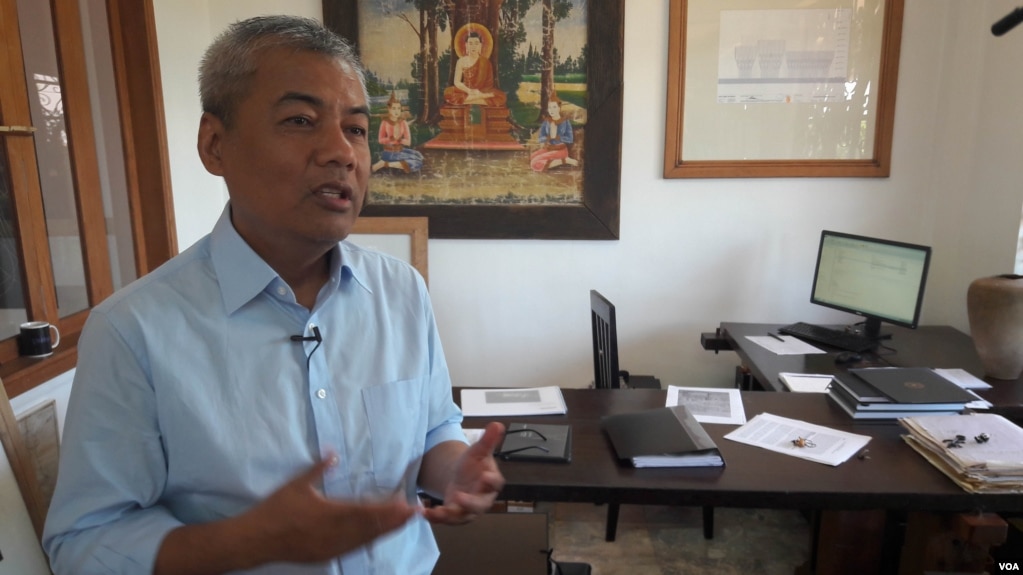
Chang Youk, director of DC-Cam, talks to VOA Khmer about national reconciliation at his office in Phnom Penh, Cambodia, August 08th, 2016. (Neou Vannarin/VOA Khmer)
Chhang Youk, director of DC-Cam, talks to VOA Khmer about national reconciliation at his office in Phnom Penh, Cambodia, August 08th, 2016. (Neou Vannarin/VOA Khmer)

Chhang was a survivor of the Khmer Rouge regime. He fled to the United States as a refugee, but memories of the suffering he endured brought him back to his homeland in the early 1990s. He founded DC-Cam and has led the organization since 1995, creating a national genocide education program. Nushin Sarkarati, a senior attorney at CJA, said that without Chhang’s dedication there would be little justice for the victims and survivors.

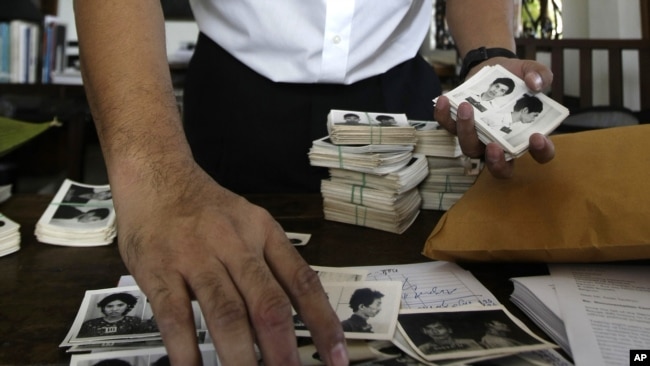
In this photo taken on Aug. 20, 2012, Director of Documentation Center of Cambodia, Youk Chhang arranges photos, a part of about a thousand of newly-discovered photo collection of detainees at the former Khmer Rouge main prison S-21, in his office in Phnom Penh, Cambodia.

In this photo taken on Aug. 20, 2012, Director of Documentation Center of Cambodia, Youk Chhang arranges photos, a part of about a thousand of newly-discovered photo collection of detainees at the former Khmer Rouge main prison S-21, in his office in Phnom Penh, Cambodia.

Beth Van Schaack, a Stanford law professor who advises DC-Cam, said the group’s orientation towards victims made Chhang a natural choice for the award. “What CJA really admires about DC-Cam is it also has a very victim centered approach, working-hard to help Cambodian victims, experience justice before the ECCC [Extraordinary Chambers in the Courts of Cambodia] and DC-Cam has become in many ways a model for other documentation centers around the world that are collecting information that can be submitted to justice processes where human rights are concerned,” she said.

Nate Thayer, a journalist who has reported on Cambodia for some three decades, said without Chhang’s work, the Khmer Rouge perpetrators would have gotten away with their crimes. “Youk Chhang was a one-man army fighting for justice for those who suffered in Cambodia and his personal passion and devotion bringing those who responsible for mass murder to justice, to face the music, to answer for their crime.

Peter Maguire, a law professor and an author of “Facing Death in Cambodia,” called Chhang a “Cambodian national treasure” whose efforts bring more truth and reconciliation to the Cambodian people than the combined efforts of the United Nations and ECCC.

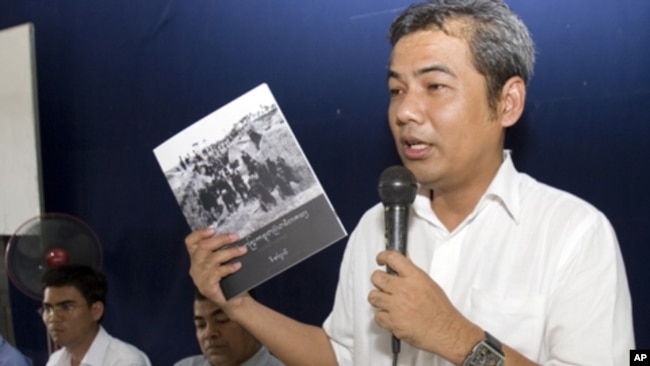
Youk Chhang, a leading Cambodian genocide researcher, shows a copy of the Cambodian version of a Khmer Rouge history textbook to teachers in Takeo province, July 3, 2012.

Youk Chhang, a leading Cambodian genocide researcher, shows a copy of the Cambodian version of a Khmer Rouge history textbook to teachers in Takeo province, July 3, 2012.

Neth Pheaktra, ECCC spokesman, told VOA Khmer that DC-Cam deserved the award as it had uncovered valuable evidence that could be used at the court. “The work that DC-Cam has done helps the ECCC save time in finding evidence by ourselves, and it shows us the way, brings us information as well as some historical documents we needed for the trials.”

Chhang is currently working on developing the Sleuk Rith Institute, a permanent hub for genocide studies in Asia based in Phnom Penh.

Source: Cataloger of Khmer Rouge Crimes Wins Prestigious Human Rights Award

“Breaking the Silence” received Danish Poul Lauritzen award

March 2, 2017

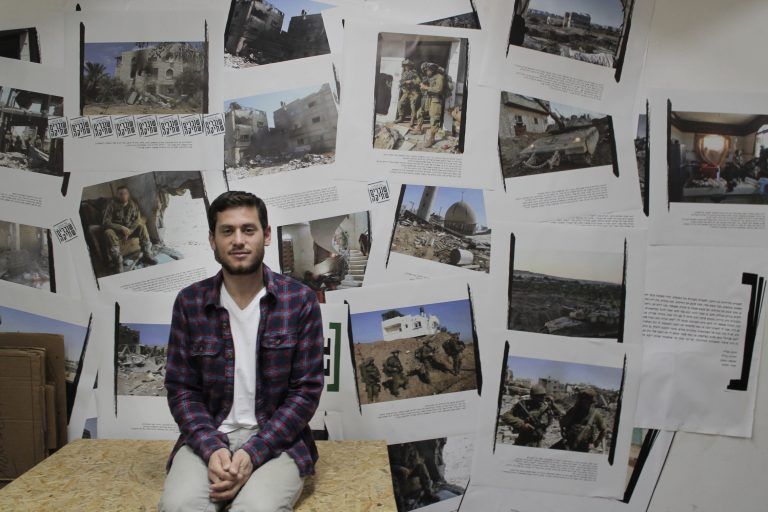
The banquet hall at the National Museum in Copenhagen played host to the presentation of the PL Foundation Freedom Award on 12 December 2016, an annual prize given in honour of a Danish resistance fighter that recognises the exercise of human rights in an extraordinary manner. The winner was Breaking the Silence, an Israeli organisation that collects and shares testimonies (some anonymous) from soldiers who have served in the West Bank and Gaza – over a thousand at the last count. “Breaking the Silence shows great personal courage to talk about their own experience in the West Bank” commented the PL Foundation, named after the Danish resistance fighter Poul Lauritzen. Previous winners include Turkish publisher Ragıp Zarakolu and Turkish playwright Ali Tuygan. One of Breaking the Silence’s co founders, Yehuda Shaul, 33, along with spokesperson Achiya Schatz, appeared in person to receive the award, which included a prize of 100,000 kroner, from Poul Søgaard, a leading judge at the Supreme Court.

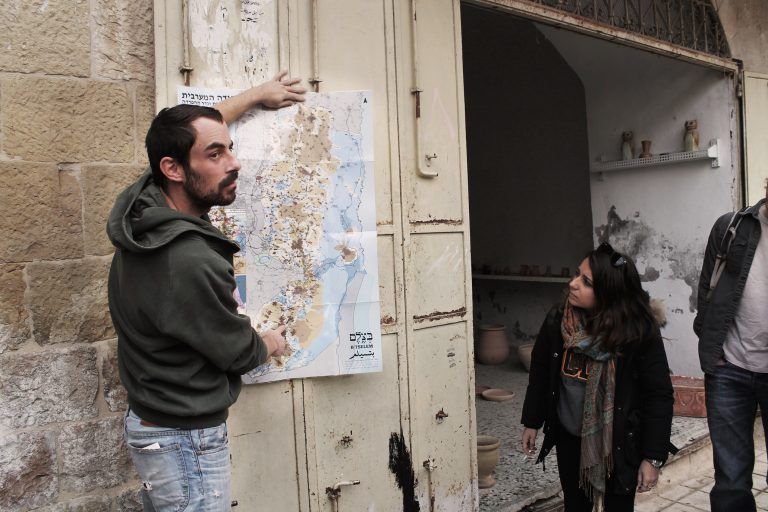
Founded in 2004, Breaking the Silence initially published the testimonies of the soldiers in an art gallery in Tel Aviv. Today, it publishes them in booklets and articles and shares them in lectures and guided tours of cities like Hebron in the West Bank.

israel1
Achiya Schatz in front of the testimonies at the Breaking the Silence office in Tel Aviv. (all photos: Cornelia Mikaelsson)

Banned by the Israeli authorities from speaking to soldiers or schoolchildren, Breaking the Silence has been accused of spreading mistruths and of betraying the Israeli military. Threats are an occupational hazard. “To remain silent is no longer an option,” explains Achiya Schatz, 31, who did his national service in the Israeli army from 2005-08. Schatz recalls that many of his missions to search Palestinian residences were pointless – commanding officers would throw away the gathered intelligence without reading it. “After completing my service I got time to think. One question led to another and all of a sudden I asked myself: how can you ever occupy morally?”
Over half of Breaking the Silence’s funding comes from abroad (7 million kroner in 2014 alone) and one of its biggest supporters is Danish – Dan Church Aid, the humanitarian NGO. And this has led to extra suspicion in Israel. Earlier this year, the Israeli government passed a transparency bill forcing NGOs that receive more than half of their funding from foreign sources to declare them openly. Those who voted for the bill claimed that it served a democratic purpose. Critics, however, argued that it only was an attempt to target NGOs critical of Israel’s governmental policies. Israeli PM Benjamin Netanyahu wrote a statement on his Facebook page, claiming that the bill aims to “prevent an absurd situation, in which foreign states meddle in Israel’s internal affairs by funding NGOs, without the Israeli public being aware of it”. [see also: https://humanrightsdefenders.blog/2016/01/05/michael-sfardjan-israels-human-rights-activists-arent-traitors/]

israel3
Ido Even-Paz, one of the guides on the Breaking the Silence tour of Hebron

Source: Former Israeli soldiers pick up Danish freedom award in Copenhagen – The Post

Collecting human rights prize, Yazidi lawmaker calls Trump’s travel ban ‘unfair’

February 9, 2017
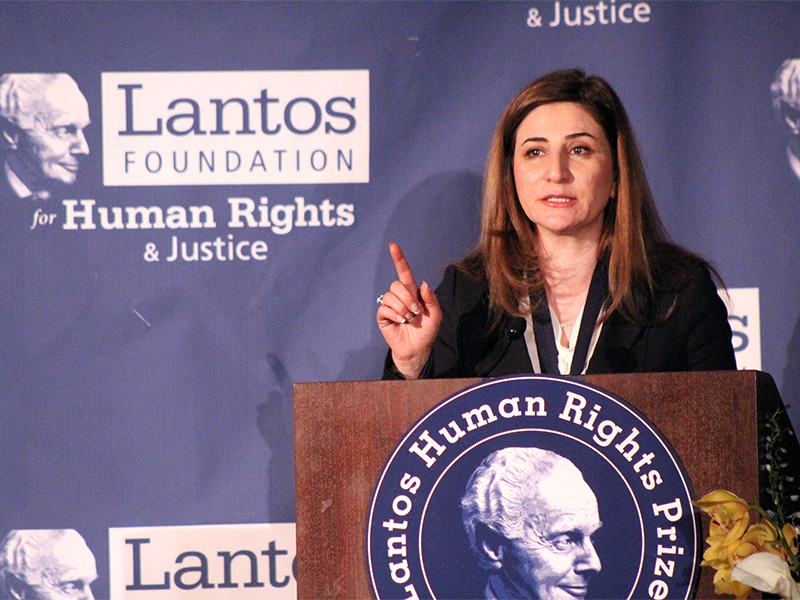
Iraqi lawmaker Vian Dakhil speaks after receiving the Lantos Human Rights Prize at a Capitol Hill ceremony on Feb. 8, 2017. RNS photo Adelle M. Banks

Iraqi lawmaker Vian Dakhil at the Lantos Human Rights Prize ceremony, 8 February  2017 – RNS photo


Last week I wrote about an award-winning human rights defender not being able to come and collect her award in the USA [https://humanrightsdefenders.blog/2017/02/01/yazidi-human-rights-laureate-may-be-banned-from-coming-to-washington-to-accept-award/].  Vian Dakhil made it to Washington in the end. She had already received a visa to come to Washington to accept an award from the Tom Lantos Foundation when President Donald Trump’s executive order pausing immigration from seven Muslim-majority countries, including Iraq, was issued. After an arduous process involving the State Department and the Iraqi Embassy, she was granted an exemption to the travel ban so she could attend the award ceremony on 8 February. Her sister and translator was able to get a visa after a federal judge temporarily halted the implementation of the executive order. Read the rest of this entry »

Physicians for Human Rights gets Dodd human rights award

February 4, 2017

Physicians for Human Rights, an organization that for decades has documented war crimes and atrocities, will be awarded the Thomas J. Dodd Prize in International Justice and Human Rights, the University of Connecticut announced on 2 February 2017. “Physicians for Human Rights exemplifies the kind of work the Dodd Prize was created to honor,” former U.S. Sen. Christopher J. Dodd, the son of the Nuremberg prosecutor and senator for whom the awarded is named, said in a statement.”My father would recognize in PHR the same spirit that animated the Nuremberg Tribunals, but also would be amazed at PHR’s innovation and courage in seeking justice and accountability for the perpetrators of atrocities,”

Using forensic science, medicine and public health research, Physicians for Human Rights documents crimes against humanity in places across the world, including past issues in Bosnia and the Democratic Republic of the Congo, UConn said in announcing the award. The group also trains professionals worldwide to do the similar investigations and prevention, the announcement said. PHR shared the 1997 Nobel Peace Prize for work on the International Campaign to Ban Landmines.

PHR will be presented the award, which comes with a $100,000 prize, in November this year.

Source: Physicians For Human Rights To Receive Dodd Prize – Hartford Courant

Right Livelihood has to go to Egypt to hand Mozn Hassan her 2016 award

February 2, 2017

Right Livelihood Award Logo


Egyptian human rights defender Mozn Hassan, who shared the 2016 Right Livelihood Award with her organisation Nazra for Feminist Studies, will receive her award in Cairo on 25-26 March 2017. Hassan was unable to attend the award ceremony in Stockholm on 25 November 2016 due to a travel ban imposed on her by the Egyptian authorities. Since then, the judiciary has initiated a move to freeze Hassan’s and Nazra’s assets, which five UN experts have condemned.

Monika Griefahn, the Foundation’s Board Chair, said: “In a show of solidarity with Hassan and other Egyptian civil society activists who have been prevented from travelling freely abroad, the Foundation will send a high-level delegation to Cairo to present her with the Right Livelihood Award instead.” The delegation will include European Parliamentarians, fellow Laureates and the Foundation’s Board members.

https://humanrightsdefenders.blog/2016/11/10/travel-bans-against-human-rights-defenders-remain-popular-in-the-middle-east/

https://humanrightsdefenders.blog/2016/09/22/right-livelihood-awards-2016-to-syrian-egyptian-russian-and-turkish-human-rights-defenders/

This is also a reminder of the nominations deadline for the 2017 Right Livelihood Award which is 1 March 2017! The Right Livelihood Award accepts proposals from everyone through an open nomination process.

Source: February 2017The Right Livelihood Award