Enforced disappearance refers to the arrest, detention or abduction of persons by agents of the State, or those acting with State authorization or support, whose whereabouts are unknown.
Once largely the product of military dictatorships, it has become a global problem, according to the UN, with hundreds of thousands of people “disappeared” in more than 80 countries. Impunity remains widespread.
While strictly prohibited under international human rights law, the SG, Mr. Guterres said enforced disappearance continues to be used across the world as a method of repression, terror, and stifling dissent.
“Paradoxically, it is sometimes used under the pretext of countering crime or terrorism. Lawyers, witnesses, political opposition, and human rights defenders are particularly at risk,” he added.
Having been removed from the protection of the law, victims, who can include children, are deprived of all their rights and are at the mercy of their captors.
They are frequently tortured and know that it is unlikely anyone will come to their aid. Some are even killed.
“Enforced disappearance deprives families and communities of the right to know the truth about their loved ones, of accountability, justice and reparation,” the Secretary-General said.
“The COVID-19 pandemic has added to the agony and anguish of enforced disappearance, by limiting capacities to search for missing persons and investigate alleged enforced disappearance.”
It was established by the UN General Assembly, which adopted a resolution in December 2010 expressing deep concern about the rise in incidents in various regions, and increasing reports of harassment, ill-treatment and intimidation of witnesses of disappearances, or relatives of people who were disappeared.
“The Convention for the Protection of all Persons against Enforced Disappearances is indispensable in helping to tackle this cowardly practice. But it requires the will and commitment of those with the power to do so,” the Secretary-General said. “States must fulfil their obligations to prevent enforced disappearance, to search for the victims, and to investigate, prosecute and punish the perpetrators.”
Mr. Guterres reiterated his call for countries to ratify the Convention, and to work with the UN Committee that monitors its implementation, as well as the Working Group on Enforced Disappearances, which assists families in determining the fate of their loved ones.
On this day Amnesty International, Human Rights Watch and the International Commission of Jurists (ICJ) issued a statement that the government of Nepal should promptly enforce Supreme Court rulings and permit the regular courts to try cases of enforced disappearance and other grave international crimes. On the International Day of the Victims of Enforced Disappearances, August 30, 2021, thousands of Nepali families are no closer to knowing the truth of what happened to their missing loved ones than they were when the country’s armed conflict ended 15 years ago.
Nepal’s Supreme Court has repeatedly ordered the government to investigate gross violations of human rights and international humanitarian law during the conflict from 1996 to 2006, and to conduct a meaningful, effective transitional justice process to establish the truth and provide justice for thousands of cases of serious abuses.
“The Nepali government stands in blatant violation of express orders of the Supreme Court by failing to conduct a credible, timely transitional justice process,” said Mandira Sharma, senior legal adviser for South Asia at the ICJ.
The Cambodian government should immediately drop baseless conspiracy and “insulting the king” charges against four environmental activists affiliated with the Mother Nature Cambodia environmental group and release the three in pretrial detention, Human Rights Watch said today.
On June 16, 2021, the police arrested Sun Ratha, 26, Ly Chandaravuth, 22, and Seth Chhivlimeng, 25, in Phnom Penh, and Yim Leanghy, 32, in Kandal province, apparently for their documentation that raw sewage has entered the Tonle Sap River near the Royal Palace. On June 20, the court charged Ratha and Leanghy with “conspiracy” and lese majeste (“insulting the king”) under articles 453 and 437 bis of Cambodia’s penal code, and Chandaravuth with “conspiracy.” If convicted, they face between 5 and 10 years in prison, and fines of up to 10 million riels (US$2,500). The authorities also charged in absentia aSpanish national, Alejandro Gonzalez-Davidson, the founder of Mother Nature Cambodia, who had been deported in 2015. Chhivlimeng was released without charge.
“The Cambodian government has stepped up its campaign to silence activists peacefully advocating to protect the environment,” said Phil Robertson, deputy Asia director. “Foreign governments, the United Nations country team, and international donors should call on the Cambodian authorities to drop their absurd charges against the environmental activists and publicly condemn any further clampdown on peaceful activism.”
An Interior Ministry spokesperson alleged that the authorities had proof that “rebellious” Mother Nature Cambodia had used foreign funding to try to topple the government, but did not make any evidence public.
This case followed earlier harassment of five Mother Nature Cambodia activists. On May 5, the Phnom Penh court convicted three environmental activists – Long Kunthea, 22, Phuon Keoraksmey, 19, and Thun Ratha, 29 – of “incitement to commit a felony or disturb social order,” articles 494 and 495 of Cambodia’s penal code. The judge sentenced them to between 18 and 20 months in prison as well as a fine of 4 million riels ($1,000) for their peaceful activism protesting the authorities’ filling-in Phnom Penh’s Boeung Tamok lake.
Amid the Covid-19 pandemic, the Cambodian authorities have stepped up their crackdown on youth and environmental activists engaged in peaceful activism and protest. The government has often used draconian new laws to arrest and prosecute activists in an apparent attempt to silence their voices and shut down their activism.
In March 2020 and early 2021, the authorities arrested environmental activists affiliated with the Prey Lang Community Network along with a prominent environmentalist and lawyer, Ouch Leng, to stop their efforts to document illegal logging and deforestation within the Prey Lang forest.
Human Rights Watch has documented cases of nearly 70 current political prisoners, including members of the political opposition, youth and environmental activists, trade union leaders, and journalists who are awaiting trial or are serving prison sentences. Many other activists have fled Cambodia to seek refuge abroad.
“Cambodia’s highly politicized courts mean that the environmental activists charged have no chance of getting a fair trial,” Robertson said. “Only international pressure on the Cambodian government holds out the possibility of saving these activists from unjust prison sentences.”
Mirage news of 8 June 8, 2021 tells the sad story of Artur Ligęska, a 40-year-old Polish citizen who has spoken out widely about torture and ill-treatment in Emirati prisons. He was found dead in his apartment in Amsterdam, the Netherlands on May 26, 2021. The Gulf Centre for Human Rights and Human Rights Watch are deeply saddened by the news of his death and extend their sincere condolences to his friends and family.
Following his release from al-Sadr prison in May 2019, Artur dedicated himself to seeking justice for the abuse he and other prisoners suffered in prison, especially Ahmed Mansoor, an award-winning human rights defender who is on the advisory boards of GCHR and Human Rights Watch. [see: https://www.trueheroesfilms.org/thedigest/laureates/074ACCD4-A327-4A21-B056-440C4C378A1A]Artur was a uniquely valuable source of information on prison conditions in the United Arab Emirates (UAE).
He was an activist, author, and fitness expert and had recently celebrated the second anniversary of his acquittal on May 9. He had been sentenced to life in prison in the UAE following a deeply flawed trial on drug charges despite the absence of any evidence of drugs in his possession.
In a voice message to a friend at GCHR on May 9, Artur said, “My main wish for this new-life birthday is freedom for Ahmed Mansoor. I really do hope that this year will be special for him. I was thinking all day about him. I remember our last talk, and I was thinking about his wife and kids. …In the last days, Ahmed told me ‘Don’t forget about me.’”
Artur said he was planning to organize a protest in The Hague soon to call for Ahmed’s release. Artur’s many actions to help Ahmed included advocacy with Polish and EU officials, providing human rights groups with information, taking part in human rights events, documentary films and TV appearances, and writing about Ahmed in his two books.
Artur first phoned GCHR staff in April 2019 to tell them that Ahmed was on a hunger strike and told them that he was worried that Ahmed might die because his health had deteriorated greatly. He told GCHR that Ahmed was being held in “terrible conditions” in a cell with no bed, no water, and no access to a shower. Ahmed today remains in a 2-by-2 meter isolation cell with no bed or mattress, serving a 10-year prison sentence for his human rights activities.
Despite suffering serious trauma after suffering abuse as a prisoner in the UAE, Artur again phoned GCHR to share the good news that human rights groups’ advocacy had been successful. Ahmed had ended his hunger strike after being allowed to phone his ill mother and to go outside to see the sun for the first time in two years. Artur sacrificed phone calls to his own family to make calls on behalf of Ahmed, referring to him as a brother.
Following his release, Artur was able to provide GCHR with more details about what he called the “medieval prison conditions” in al-Sadr prison, including periods when there was no running water despite extreme heat.
Artur told GCHR that after he left the UAE, he had undergone surgery and therapy to treat the damage done by the rape and psychological torture that he said he was subjected to but he was recovering well and taking classes to become a journalist and human rights professional.
On April 13, 17 European Parliament members wrote to the EU’s High Representative Josep Borrell to express their “deepest concern over the ongoing human rights violations in the United Arab Emirates, particularly with regards to the systematic crackdown on freedom of speech and expression and the subsequent retaliation received during detention.” The letter mentions Ahmed, and also refers to Artur, noting, “The use of torture has not been limited to Emirati nationals, as there have also been instances of EU citizens that have reported facing brutal torture at the hands of prison authorities.”
On October 22, 2020, Amnesty Westminster Bayswater and GCHR held an online event, The Prisoner and the Pen, featuring the writing, songs and poetry of prisoners who are human rights defenders and the work of writers and artists from the Middle East and North Africa region. The event, held on Ahmed ‘s birthday, included his poems. Artur read from his memoir, “The Sheikh’s Different Love,” published in 2019 in Polish. He has also written a second bestselling book in Poland, “Prison Diary.” His story is documented in a film by Hossam Meneai, Isolation Cell 32, which debuted at the Polish Film Festival in America in November. Artur also appears in an upcoming documentary about Ahmed Mansoor made by Manu Luksch.
Artur’s untimely and unexpected death comes as a great shock to those who knew him. The Dutch police are investigating the circumstances of his death.
Philippe Dam, Advocacy Director, Europe and Central Asia Division of Human Rights Watch, on 2 June 2O21, writes aavout Azimjon Askarov, a 69-year-old human rights defender from Kyrgyzstan, who died in prison after contracting pneumonia. Askarov had been in prison for 10 years, having been given a life sentence following an unjust and unfair trial in 2010, in retaliation for his investigations into the tragic wave of inter-ethnic violence that year in southern Kyrgyzstan. [see: https://www.trueheroesfilms.org/thedigest/laureates/D8B31FA3-E648-4F92-81B9-8C3A4270F80E]
Askarov’s trial in 2010 was marred by serious procedural violations and allegations of torture that were never investigated. A United Nations human rights body ruled in 2016 his detention was illegal and called for his immediate release, but Kyrgyz authorities looked the other way.
Since his death, many have called for a full inquiry into the causes and responsibilities for his death. A toothless internal inquiry ordered by Kyrgyzstan has gone nowhere. The documentary “Last Chance for Justice,” by filmmaker Marina Shupac, is a touching portrayal of the fight by Khadicha Askarova, Askarov’s wife, for justice and his release from prison.
The screening is on June 4 as part of the One World Film Festival in Brussels. The panel discussion of the film will be joined by Eamon Gilmore, the EU’s top human rights envoy; Heidi Hautala, a European Parliament vice-president; and a representative of the Office of the EU’s Special Representative to Central Asia.
On the same day as the screening, the EU is set to hold its highest-level annual meeting with Kyrgyz officials. This is a crucial opportunity for the EU to make it clear that closer ties with Kyrgyzstan will depend on the resolve of Kyrgyzstan President Japarov’s administration to investigate Askarov’s death, clean up his judicial record, and grant compensation to his family.
This week’s high-profile screening makes clear: Kyrgyzstan will continue to be in the international spotlight on Askarov until it fulfils its human rights obligations to account for his death.
The Hill of 26 May 2021 reports that a coalition of more than 30 human rights and digital privacy rights groups called on Google to abandon its plans to establish a Google Cloud region in Saudi Arabia over concerns about human rights violations.
The groups, which include Amnesty International, Human Rights Watch and PEN America, wrote in their letter that Saudi Arabia’s record of tamping down on public dissent and its justice system that “flagrantly violates due process” made it unsafe for Google to set up a “cloud region” in the kingdom.
“While Google publishes how it handles government requests for customer information and reports when requests are made through formal channels, there are numerous potential human rights risks of establishing a Google Cloud region in Saudi Arabia that include violations of the rights to privacy, freedom of expression and association, non-discrimination, and due process,” the groups said. See also: https://humanrightsdefenders.blog/2019/03/08/saudi-arabia-for-first-time-openly-criticized-in-un-human-rights-council/
The letter also pointed to Saudi authorities who have routinely sought to identify anonymous online dissenters and spy on Saudi citizens through digital surveillance. The groups also pointed to how they themselves are believed to have been put under surveillance by the Saudi government.
“Google has a responsibility to respect human rights, regardless of any state’s willingness to fulfill its own human rights obligations,” the letter continued, pointing to Google’s statement in which it expressed its commitment to human rights and to “improve the lives of as many people as possible.”
In order to address these concerns, the groups called on Google to conduct a “robust, thorough human rights due diligence process” and to “draw red lines around what types of government requests concerning Cloud regions it will not comply with” due to human rights concerns.
“The Saudi government has demonstrated time and again a flagrant disregard for human rights, both through its own direct actions against human rights defenders and its spying on corporate digital platforms to do the same,” the letter read. “We fear that in partnering with the Saudi government, Google will become complicit in future human rights violations affecting people in Saudi Arabia and the Middle East region.”
Chinese foreign ministry spokesman Zhao Lijian said Beijing’s sanctions were a ‘necessary and justified response’ GREG BAKER AFP
As earlier reported human rights defenders objected to the proposed EU-China investment deal {https://humanrightsdefenders.blog/2021/01/06/china-eu-deal-what-about-human-rights], now the European Parliament has rejected it. HRW said: “On May 21, only a few months after the conclusion of the Comprehensive Agreement on Investment (CAI), a trade deal between the EU and China, the European Parliament adopted a resolution to freeze its ratification. The deal has been controversial in the Parliament given concerns about forced labor in China, its rushed conclusion, and its lack of human rights protections and redress mechanisms. Beijing’s counter-sanctions against several European lawmakers and institutions managed to unite the European Parliament on CAI like nothing else has, and will now prevent any movement on ratification as long as they remain in place“.
But the European Parliament voted overwhelmingly Thursday to refuse any consideration of the EU-China investment deal as long as Chinese sanctions against MEPs and scholars were in place. France24 on 212 May gives China’s expected angry reaction:
China slammed the European Union’s “confrontational approach” after MEPs voted to block a landmark investment deal over Beijing’s tit-for-tat sanctions against EU lawmakers. Foreign ministry spokesman Zhao Lijian said Beijing’s sanctions were a “necessary and justified response” to previous EU measures against Chinese officials over human rights concerns in Xinjiang.
“China has imposed sanctions on relevant institutions and personnel of the EU who spread Xinjiang-related lies and false information and who have seriously damaged China’s sovereignty and interests,” Zhao said at a regular press briefing.
He urged the EU to “immediately stop interfering in China’s internal affairs, abandon its confrontational approach” and push EU-China relations “back to the right track of dialogue and cooperation”.
Defenders of the pact see it as a much-needed opening of China’s economy to European companies, but it is set to face a difficult ratification process among the 27 member states and European Parliament.
The investment deal aims to open China’s market and eliminate discriminatory laws and practices preventing European companies from competing on an equal footing, according to the European Commission.
EU foreign direct investment in China since 2000 — excluding Britain — amounted to $181 billion. The corresponding sum from China is $138 billion.
Ties between the EU and China soured suddenly in March after an angry exchange of sanctions over human rights concerns.
The EU sanctioned four Chinese officials over suspected human rights violations in China’s far northwestern region of Xinjiang.
Beijing responded by imposing its own sanctions against European politicians, scholars and research groups.
Adding to the pressure, about 50 human rights defenders from China who have gone into exile in Europe — including the artist Ai Weiwei — asked the EU on Thursday to suspend extradition treaties with Beijing.
In an open letter to EU leaders, they asked Brussels to freeze or revoke arrangements made by 10 EU member states, including France, Belgium and Spain.
These bilateral treaties “not only present a potential threat to our freedom of movement within the European Union, but to our freedom of association and freedom of expression, as Beijing may seek our extradition for statements we make in Europe”, it said.
Alan Macleod in Mint-press News of 7 May 2021 studies in quite some detail the way in which the recently released Human Rights Watch (HRW) report has made waves around the world and the organised backlash that followed.
The 213-page study goes into detail about a range of racist laws and policies carried out by successive administrations, concluding that there is an “overarching Israeli government policy to maintain the domination by Jewish Israelis over Palestinians and grave abuses committed against Palestinians living in the occupied territory, including East Jerusalem.” The report accuses the state of Israel of widespread “institutional discrimination” and of “denying millions of Palestinians their fundamental rights…solely because they are Palestinian and not Jewish.” It further notes that, across Israel and the Occupied Palestinian Territories, it has “sought to maximize the land available for Jewish communities and to concentrate most Palestinians in dense population centers.”
“Prominent voices have warned for years that apartheid lurks just around the corner if the trajectory of Israel’s rule over Palestinians does not change,” said the organization’s executive director, Kenneth Roth. “This detailed study shows that Israeli authorities have already turned that corner and today are committing the crimes against humanity of apartheid and persecution.
Perhaps most importantly, Human Rights Watch is now openly calling for global action to end the repression. The report asks the International Criminal Court to investigate and prosecute those involved in Palestinian persecution. While not explicitly endorsing the Boycott, Divestment and Sactions (BDS) movement, Human Rights Watch directly advocates that “[s]tates should impose individual sanctions, including travel bans and asset freezes, against officials and individuals responsible for the continued commission of these serious crimes,” and for businesses to “cease business activities that directly contribute to the crimes of apartheid and persecution.”
A big splash
The report was widely covered across the world and has been heralded by Palestine solidarity activists, with experts seeing it as a potential turning point in the struggle for Palestinian sovereignty. “It was inevitable that Human Rights Watch would have to declare Israel an Apartheid state and, from what I hear, Amnesty International is going to be next to say it,” Asa Winstanley of the Electronic Intifada told MintPress. “It puts Israel’s backers in a difficult spot because Human Rights Watch is really part of the establishment so they cannot just dismiss it and it makes it impossible to ignore… It is harder for them to say Human Rights Watch is anti-Semitic, but they’re trying it anyway,” he added.
Trying indeed. Michigan Congresswoman Lisa McClain tweeted that “Human Rights Watch has shown again how they have an anti-Israel agenda,” suggesting they instead focus their attention on China or Iran’s repressive governments. “Hostility and hypocrisy are HRW’s hallmarks when it comes to Israel,” wrote the American Jewish Committee. The Jerusalem Post’s editorial board was equally condemnatory, denouncing what they saw as the “cynical appropriation of the suffering of the victims of the actual apartheid regime.” Other Israeli journalists described the report as “a disgrace to the memory of the millions who suffered under that policy [apartheid] in South Africa.” The news even made enough waves to force a response from the White House. Press Secretary Jen Psaki replied that “[a]s to the question of whether Israel’s actions constitute apartheid, that is not the view of this administration.”
Organized spontaneity
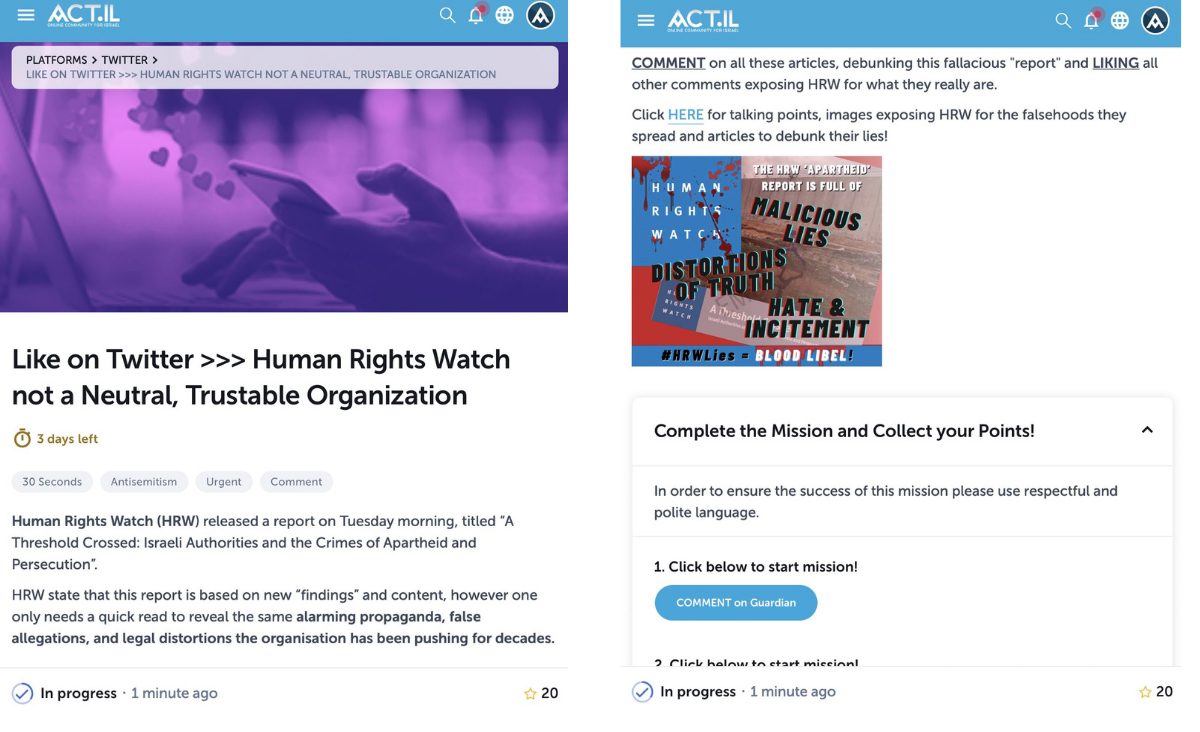
Yet much of the online anger at the report was actually manufactured by an Israeli government-sponsored app, Act.IL, which organized supporters of the Jewish state to act in sync to create an artificial groundswell of opposition to it. The app, which reportedly has a budget of over $1 million per year, instructed users to leave combative comments on Facebook, Twitter, and popular news outlets, and to like and promote others who did the same.
Human Rights Watch’s Facebook post announcing the report’s release has received over 1,400 comments, hundreds of them written in a similar, scathingly negative tone. One that the app directly told users to signal boost, for instance, described Palestinians as a people “indoctrinated with hate for Israel and Jews for over 100 years,” and claimed they were paid salaries to murder Israelis. It also presented the 1967 war and occupation as a humanitarian effort to bring electricity and other infrastructure to Arabs.
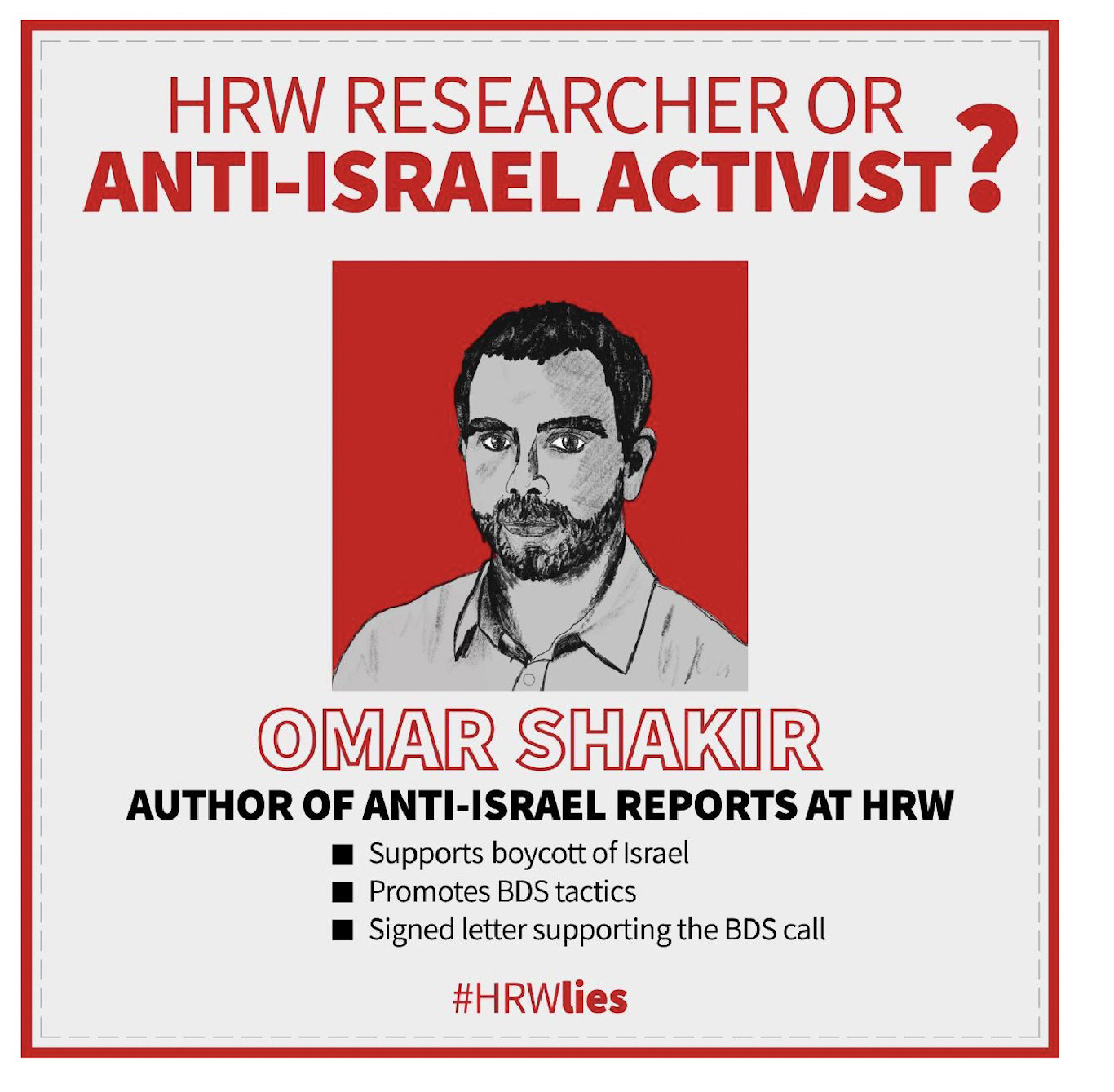
Another “mission” Act.IL gave its users was to promote a Facebook comment attacking the report as “nothing more than hate speech” and calling its lead author a “rabid anti-Zionist and Israel hater.”
One of the many images provided to Act.IL users for their astroturfing campaign against HRW
Act.IL is one of the chief tools in Israel’s online public relations enterprise. The app debuted in 2017 and is part of what Israeli Minister of Strategic Affairs Gilad Erdan called an “Iron Dome of Truth.” “Our cell phones are the number one weapon against us,” he explained, noting that public opinion in the U.S. was beginning to turn against them. While most of the app’s nearly 20,000 users are volunteers, a core of them are paid operatives, with many students receiving scholarships as a reward for their work.
The app has been designed to feel like a game, with points assigned for completing “missions” such as sharing pro-Israel videos, reporting anti-Israel content, signing petitions, or attending online seminars. Users can track their progress on leaderboards, earn badges and prizes, and chat with other members of the community. While it might feel like Animal Crossing or World of Warcraft for some, its creators see this very much as a new front in the war against Palestine. Israeli Justice Minister Ayelet Shaked categorizes BDS as “another branch of terrorism in the modern age,” and has been an important voice in taking the fight to a new front.
An Act.IL mission encouraging astroturfing of online discussions. Source | @AntiBDSApp
There is also an online toolkit full of folders of responses to typical questions and issues that arise. Users can, for instance, go to the BDS folder to find stock replies to their arguments. Or they can go to a specific folder to find articles, images and videos they can use to demonize Hamas.
The missions are organized by outlet, so users can, for instance, target only Facebook, Telegram, or other platforms they are most familiar with. At the time of writing, there are 10 missions each to complete on Facebook and YouTube, 30 on Instagram, 25 on Twitter.
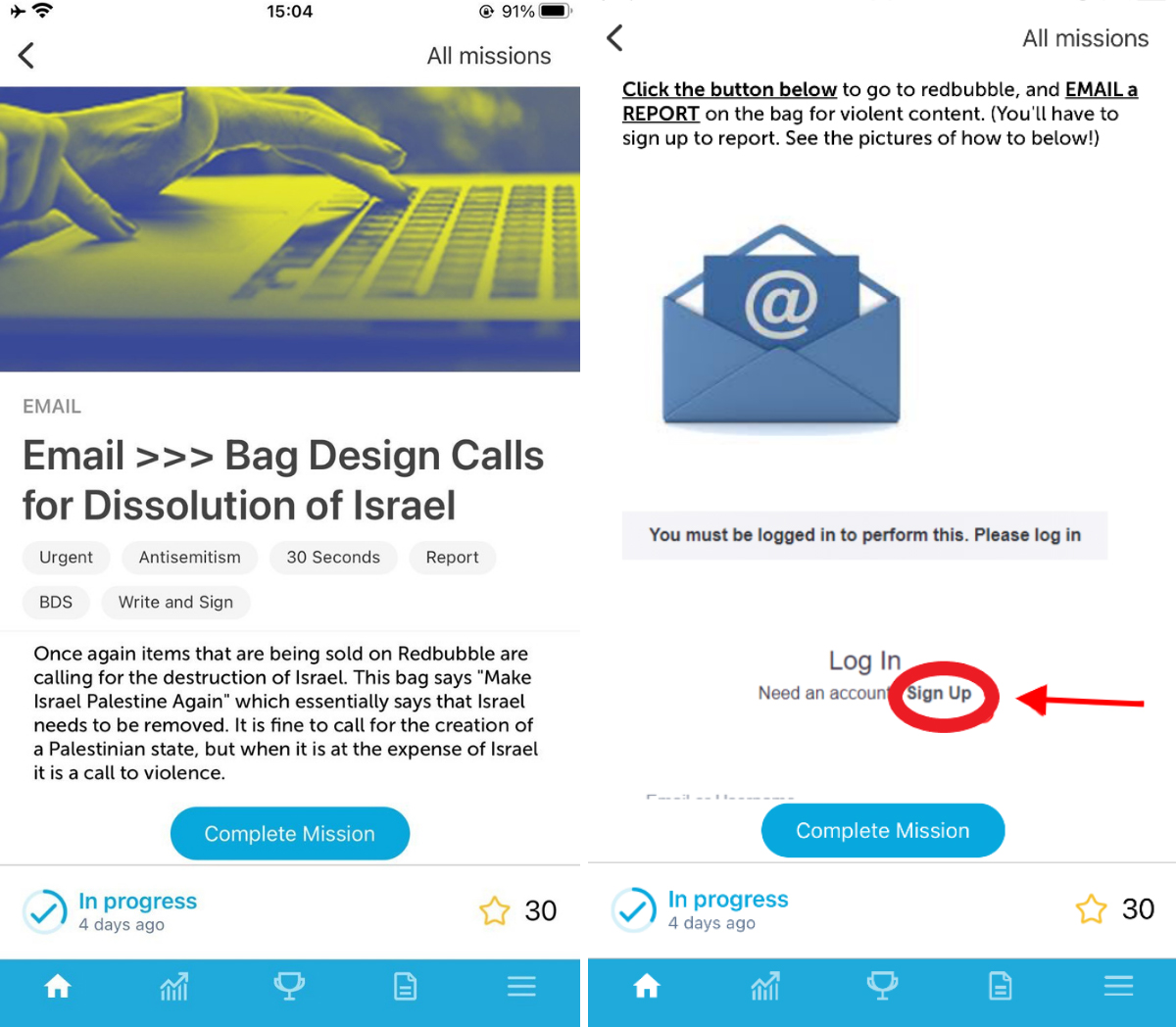
One current challenge is to upvote an answer to a question on Quora that asks about the validity and purpose of checkpoints in the West Bank. The answer claims they are purely about protection from terror attacks, and claims that Red Crescent ambulances are used to ferry bombs around the area. Other missions include pressuring an online store to remove a bag with a message stating “Make Israel Palestine Again.”
An Act.IL “mission” encouraging users to demand the removal of products with pro-Palestinian messaging
“It is quite astounding how openly they do it. But, of course, when you see a comment online, you wouldn’t necessarily think that it was coming from the Israeli government, but this is essentially what is happening,” Winstanley said. “Israel is not the only state to do this, but they do it fairly successfully.”
For all this, however, it is clear that Act.IL has a serious problem with user retention and lacks the volunteer numbers for it to be truly game changing.
Controlling the message
In a time of heightened awareness about foreign government interference online, it is particularly surprising that these operations can be openly carried out across virtually every major platform. Big tech companies like Twitter, YouTube and Facebook are constantly deleting tens of thousands of Russian, Chinese, Iranian and Cuban accounts belonging to what they claim are organized, state-sponsored disinformation campaigns.
In an effort to gauge the legality of its operations, MintPress reached out to Facebook, YouTube, Quora, and other big platforms used by Act.IL. We received no response from any of them. While this is particularly noteworthy — as these companies have teams of public relations representatives and are extremely forthright and timely with responses on other issues — it is perhaps not surprising. Facebook especially has long been working closely with the Israeli government in deciding which voices to censor. As far back as 2016, Ayelet Shaked boasted that Facebook removed 95% of the posts her office asked them to. Yet when Shaked herself called for a genocidal war against Palestine and its women, who give birth to “little snakes,” not only did the post remain online, it received thousands of likes and was widely circulated.
“The concern is that Facebook is adopting Israeli policy and terminology when it comes to defining what incitement is,” said Nadim Nashif, co-founder of 7amleh, the Arab Centre for the Advancement of Social Media. 7amleh was therefore dismayed when last year, Facebook appointed former Israeli Minister of Justice Emi Palmor to its Oversight Board, the council having the final say in the moderation of content on the platform used by 2.6 billion people worldwide. In her role as justice minister, Palmor was directly implicated in the persecution and subjugation of Palestinians.
Earlier this year, an Israeli Defense Forces soldier attempted to sue a Palestinian-American activist living in California over an allegedly slanderous Facebook post condemning her for participating in ethnic cleansing. Remarkably, the plaintiff attempted to convince a California judge to apply Israeli law to the incident, despite the fact that both she and the defendant are American citizens. https://cdn.iframe.ly/r7H7ueP?iframe=card-small&v=1&app=1
Inside the world of academia, professors critical of Israel have found themselves pushed out of the profession. In 2007, prominent critic of Israel Norman Finkelstein was denied tenure at DePaul University for political reasons. Seven years later, the University of Illinois “unhired” Steven Sailata for his comments denouncing Operation Protective Edge, the 2014 Israeli attack on Gaza. Emails showed that wealthy donors put significant pressure on the university to pull the plug on him. More recently, Cornel West was blocked from a tenured job at Harvard this year, despite having previously held tenure at Harvard, Princeton, and Yale. “Being the faculty advisor for the Palestinian student group was the one that probably went outside of the line for many Harvard staff,” West told Krystal Ball and Kyle Kulinski. “It’s a joke. It’s ridiculous. It’s ludicrous. It’s preposterous that it wouldn’t have something to do with politics.”
Top media figures have also paid the price for their support of BDS. CNN fired commentator Marc Lamont Hill after he made a speech at the United Nations calling for a free Palestine. Meanwhile, journalist Abby Martin was blocked from speaking at a conference at Georgia Southern University last year after she refused to sign a contract promising to renounce BDS. Georgia is one of dozens of U.S. states to have anti-BDS legislation, essentially forcing any would-be recipient of public contracts or funds, including government employees, to sign a pledge not to boycott Israel. Martin is currently suing the state of Georgia. MintCast Interviews Abby Martin About Her Anti-BDS Lawsuit & The Israel Lobby…
While Human Rights Watch’s report is new, the charge of apartheid is not. In 2017, a United Nations report “clearly and frankly concludes” that Israel is “a racist state that has established an apartheid system that persecutes the Palestinian people.” Earlier this year, Israeli human rights organization B’TSelem also used the word “apartheid,” claiming that Israel had established “a regime of Jewish supremacy from the Jordan River to the Mediterranean Sea.”…
Advocates for Palestine hailed Human Rights Watch’s study. Phyllis Bennis of the Institute for Policy Studies wrote:
There can be little doubt that much of HRW’s decision to issue this report now was based on the recognition that not only is it no longer political suicide to call Israeli apartheid what it is, but that we are now at a tipping point whereby failing to call out apartheid risks losing credibility for a human rights organization. It’s a huge victory for our movement.”
The battle, however, is far from won, and it is clear that the Israel lobby will continue to fight to hold back the tide until it is insurmountable.
.On 15 March 2021 Katharina Rall, Senior Researcher, Environment and Human Rights at Human Rights Watch, wrote about Mama Fikile’s murder, It is almost five months since an environmental activist, Mama Fikile Ntshangase, was gunned down in her home in Somkhele in KwaZulu-Natal province, after raising concerns about a coal mine in the area. No arrests have been made. Mama Fikile had received threats to her life but carried on with what she perceived to be the only way to protect her community’s health and livelihood.
On March 3, the UN expert on human rights defenders used Mama Fikele’s story to begin a new report to the Human Rights Council in Geneva that highlights the risks many environmental defenders operate under, and the widespread attempts to silence their voices.
South African environmental justice groups have urged the government to carry out a prompt, thorough, and impartial investigation into Mama Fikile Ntshangase’s killing and ensure that those found responsible are held to account. But her family is still waiting for justice.
Beyond the individual tragedy and injustice, there is another reason the UN expert, Mary Lawlor, highlights the South African case in her global report. Killings of activists create an environment of fear and can have a chilling effect on the people around them. Or, as the UN expert frames it, “[t]here is no more direct attack on civil society space than the killing of human rights defenders.”
As a community rights defender opposing coal mining in Fuleni, a small rural village not far from the place where Mama Fikile was killed, Billy Mnqondo once heard gunshots at the gate of his house and was warned by community members that he and his family will be in trouble if he continues to oppose mining. When, in 2018, Human Rights Watch visited Somkhele, Fuleni, and other communities affected by mining, some activists confirmed they were afraid to speak out about the impact of mining in their community, especially after Sikhosiphi “Bazooka” Rhadebe, another prominent environmental rights defender, was killed in Xolobeni in 2016.
Violence and intimidation against those who raise their voices to defend their right to a healthy environment is endemic in South Africa. Human Rights Watch, in its 2019 report, published jointly with groundWork, the Centre for Environmental Rights, and Earthjustice, documented how activists in mining-affected communities across the country have experienced threats, physical attacks, or property damage that they believe is retaliation for their activism. Most of these cases are not widely known and have not made headlines like the killings of Sikhosiphi “Bazooka” Rhadebe and Mama Fikile. Yet, investigations into these killings or other attacks are moving very slowly, if at all.
Other, less brutal ways to silence the voices of environmental rights defenders are nuisance lawsuits, known as “strategic lawsuits against public participation” (SLAPPs) – baseless cases brought forward by companies to intimidate and burden activists with the onerous costs of mounting a legal defense.
South African courts are beginning to take a stance against these tactics. In February, the High Court in Cape Town issued a ruling that strengthens the constitutional right to freedom of expression. The court held that a defamation suit brought by an Australian mining company, Mineral Commodities Ltd (MRC), and its local subsidiary against three attorneys, two activists, and a social worker in relation to their statements about its operations is an abuse of legal process. The defamation trial may still proceed, but activists can now defend themselves by arguing that the Court should assess the SLAPP nature of the case.
Following this ruling it will be harder for corporations to use South Africa’s legal system against citizens and activists to silence and intimidate them when they raise human rights concerns or seek accountability for past abuses. The government should now do its part to follow the recommendations of the UN expert by bringing those responsible for killings of environmental defenders to justice. Unless there are prompt, effective, and impartial investigations into the killings—and those responsible are brought to justice— human rights defenders will continue to live in an environment of fear.
There’s a saying in show business that you can spend 20 years becoming an overnight star. In politics, the same is true in reverse, as the sad case of Mary Robinson and Princess Latifa of Dubai shows. Mary Robinson as former UN High Commissioner for Human Rights and a widely-honored human rights defender [with 9 awards to her name, see: https://www.trueheroesfilms.org/thedigest/laureates/4E44A265-DF1A-45E2-8C6A-3294577EA211] was a much admired personality. For that reason I was reluctant to highlight her role in the sad case back in December 2018, although many human rights NGOs (including AI and HRW) did criticise her.
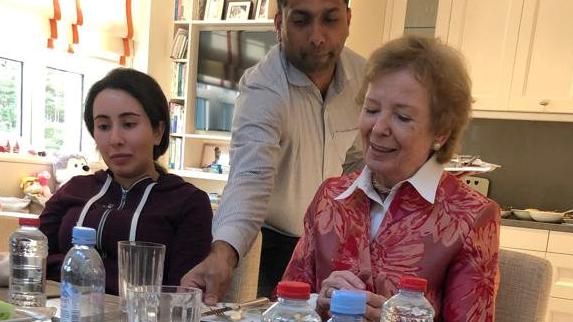
The former UN human rights Commissioner has been criticised for describing the daughter of Dubai’s ruler as “troubled” after she was reportedly forcibly returned to the kingdom after fleeing months earlier. Mary Robinson met with Sheikha Latifa on 15 December and photos released showed the two women smiling together in what appears to be a home. Ms Robinson, the former president of Ireland, told BBC’s Radio 4 the princess was a “vulnerable” woman with a “serious medical situation” for which she was receiving psychiatric care.
Immediately the highly publicised and bizarre meeting in December was panned by rights groups for being stage-managed by the Emirati ruling family (Ms Robinson is a personal friend of Sheikha Haya, a wife of the Dubai ruler.) Defending her comments, Ms Robinson released a statement saying: “I am dismayed at some of the media comments on my visit and I would like to say I undertook the visit and made an assessment, not a judgement, based on personal witness, in good faith and to the best of my ability.”
Toby Cadman, a barrister instructed by Detained in Dubai to act on behalf of the princess, told Review: “I am extremely disappointed that she would lend herself to what has been interpreted as a whitewash. “We have requested an independent assessment of [Princess Latifa’s] state of mind and her physical well-being. It’s up to the United Nations to be satisfied that she is not being detained against her will.” Then in January 2019 Mrs Robinson stated that she contacted Michelle Bachelet, UN high commissioner for human rights. On 18/02/2019 Former Irish president Mary Robinson said she has no regrets over getting involved in the case of a Dubai princess who had tried to flee the UAE.
Exactly one year on from Latifa’s dramatic capture at sea, rights groups told The Independent they were deeply concerned about her welfare and still had no knowledge of what happened to her between her March 2018 capture and December when she reappeared in Dubai. Pleas to the UAE for an independent delegation to be granted access to the royal to assess her, have gone unanswered. “Human Rights Watch is still calling for her to be able to travel to a third country where we and other monitors can be assured she is able to speak freely and independently without fear of retaliation,” Hiba Zayadin of HRW told The Independent. “Ms Robinson is not equipped to make an evaluation of Latifa, who was in the presence of people who allegedly forcibly disappeared her,” she added.
Amnesty International put out a similar call. “There has been no reply from the UAE, which has never responded to anything regarding domestic human-rights abuses that Amnesty International has attempted to raise with them,” said Amnesty’s Devin Kenney.
Now, 16 February 2021, after new footage was shared by BBC Panorama, in which the 35-year-old daughter of the ruler of Dubai has confirmed that commandos drugged her as she tried to flee by boat and flew her back to detention and accused her father, Sheikh Mohammed bin Rashid Al Maktoum, of holding her “hostage”, Mrs Robinson has stated that she feels “horribly tricked” by the family of Princess Latifa Al Maktoum, and has joined in calls for immediate international action in order to establish Princess Latifa’s current condition and whereabouts
Robinson is rightly revered for her life’s work, and that work is not invalidated by her unacceptable interference in the case of Princess Latifa. But her reputation has been tarnished by this.
On 11 February 2021 Human Rights Watch stated that The Democratic Republic of Congo government should reopen its investigation into the 2010 double murder of the leading human rights defender Floribert Chebeya and his driver, Fidèle Bazana, following new revelations about the case. Amid allegations reported by international media outlets that the murders were carried out on the orders of the police chief at that time, Gen. John Numbi, Human Rights Watch called for a credible, impartial, and independent inquiry.
On February 8, 2021, in radio interviews with Radio France Internationale (RFI) and Deutsche Welle, two Congolese police officers in exile admitted to taking part in the murders of Chebeya and Bazana on the premises of police headquarters on June 1, 2010 and provided a detailed account of the murder. At a meeting in April 2019, President Felix Tshisekedi personally told Chebeya’s wife and human rights groups that he was committed to conducting an impartial investigation into the murder.
“President Tshisekedi should put his words about investigating the Chebeya murder into action,” said Thomas Fessy, senior Congo researcher at Human Rights Watch. “The latest revelations show the need for a new inquiry and present the best chance to see that justice is done.”
On June 1, 2010, Chebeya received a telephone call asking him to attend a meeting at General Numbi’s office. The next day, the police said that Chebeya had been found dead in his car in the Mont Ngafula area of Kinshasa, the capital. The body of his driver, Bazana, is still missing.
Speaking to RFI and Deutsche Welle from an undisclosed location abroad, the former police drivers Hergil Ilunga and Alain Kayeye revealed details about the plan to kill Chebeya and how it was carried out. They alleged that police officers asphyxiated Chebeya and Bazana, one after the other, in different police vehicles at the police headquarters.
They admitted to taking part in the murders and covering them up on the orders of Col. Daniel Mukalay, then the police intelligence chief, and Christian Ngoy, then the commander of the feared Simba battalion. The two former drivers said that both senior officers were acting upon Numbi’s instructions.
Ilunga and Kayeye said they would be ready to face justice if their safety were guaranteed. They claimed to have fled Congo in late 2020 for fear of their lives as Numbi was allegedly looking to kill them.
Chebeya was among Congo’s most vocal human rights defenders, regularly exposing abuses by the country’s security services and successive governments over many years. He was threatened and intimidated repeatedly by Congolese authorities because of his work. He received the now defunct Reebok award: https://www.trueheroesfilms.org/thedigest/laureates/BA601D45-292F-61CB-530A-17FE52D5F974
Following a widely criticized trial by a military court – with a first verdict in June 2011 and an appeal decision in September 2015 – four police officers were found guilty of murdering Chebeya and Bazana. Ngoy, along with Paul Mwilambwe and Jacques Mugabo, were tried in absentia and sentenced to death. Mukalay, the highest-ranking officer on trial, was sentenced to 15 years in prison and is currently serving his sentence at Kinshasa’s central prison. The military court also found the Congolese government at fault and ordered it to pay damages to the families of both victims.
When the trial began in November 2010, Numbi, then police inspector general, was presented to the court as a witness even though he was widely suspected to be behind the murders. In 2014, one of the fugitives, Mwilambwe, resurfaced in Senegal, where he accused Numbi of orchestrating the murders. Senegalese authorities opened an investigation and Mwilambwe was indicted in January 2015. But the proceedings stalled, and the investigation is ongoing in Senegal. Mwilambwe, a presumed key witness, has since moved to Belgium and has also said he was ready to stand trial. [https://humanrightsdefenders.blog/2015/01/13/indictment-in-senegal-a-breakthrough-in-the-congolese-chebeya-bazana-case/]
On September 3, 2020, Ngoy was arrested in Lubumbashi and immediately transferred to Ndolo military prison in Kinshasa for possession of illegal weapons. Following his arrest, Congolese human rights organizations said that the authorities should reopen the Chebeya case.
Following these new revelations, over 100 Congolese human rights groups called for the immediate arrest of Gen. Numbi and the reopening of Chebeya’s case. Ambassadors in Congo from the EU, Belgium, and the US have also all publicly backed reopening the inquiry. The United Nations Joint Human Rights Office said it was “available to assist the judiciary in shedding light on the despicable murder of Chebeya and Bazana.”
“The Chebeya and Bazana families have yet to learn the full truth and obtain justice for the gruesome killings of their loved ones,” Fessy said. “With these new revelations, the Congolese government needs to act. The judiciary should provide safe conditions to hear those who have come forward while General Numbi and other senior officials implicated in the murders should be fully and fairly investigated.”