 The announcement of the three nominees of the Martin Ennals Award for Human Rights Defenders 2012 will take place on Tuesday 24 April 2012, from 11h00 to 11h30 in Geneva (that is 09h00 – 09h30 GMT). For the first time this short event is being ‘broadcast’ live on the internet (www.martinennalsaward.org). There will be brief film images shown of the 3 nominees. The event also includes the announcement of the new Chairperson of the Martin Ennals Foundation.
Posts Tagged ‘Geneva’
Announcement of nominees MEA 2012 streamed on internet: 24 April
April 21, 2012UN High Commissioner Pillay speaks out against harassment of Sri Lankan HRDs during Council in Geneva
March 23, 2012 The man pictured here is Rupert Colville, spokesperson for the UN High Commissioner for Human Rights, who has tremendous helped the OHCHR during the last years to have a more penetrating presence in the media. On this occasion on 23 March 2012, it was to warn that there must be no reprisals against Sri Lankan human rights defenders in the wake of a resolution calling on its Government to probe alleged abuses during the country’s civil war. The warning from the UN High Commissioner for Human Rights, Navi Pillay, follows the adoption of a resolution yesterday by the UN Human Rights Council in Geneva, calling on Sri Lanka to take “credible” steps to ensure accountability for alleged serious violations committed in 2009 during the final stages of the conflict between the Government and the rebel Liberation Tigers of Tamil Eelam (LTTE) and to ensure accountability.
“During this Human Rights Council session, there has been an unprecedented and totally unacceptable level of threats, harassment and intimidation directed at Sri Lankan activists who had travelled to Geneva to engage in the debate, including by members of the 71-member official Sri Lankan government delegation,” said Rupert Colville, at a press briefing in Geneva. Mr. Colville said that intimidation and harassment of Sri Lankan civil society activists have also been reported in other locations around Geneva. Also, the Sri Lankan ambassador in Geneva received an anonymous threatening letter which is being followed up by the police and UN security.
At the same time, newspapers, news websites and TV and radio stations in Sri Lanka have been running, since January, a “continuous campaign of vilification,” including naming and in many cases showing images of activists, describing them as an ‘NGO gang’ and repeatedly accusing them of treason, mercenary activities and association with terrorism. “Some of these reports have contained barely veiled incitement and threats of retaliation,” Mr. Colville said. “At least two comments posted by readers of articles of this type have called for burning down of the houses of the civil society activists named in the articles, and at least one such comment called openly for them to be killed.”
The spokesperson said the High Commissioner had noted that some of the attacks on human rights defenders were carried in Sri Lankan state media and Government websites or were filed by journalists who had been officially accredited to the Council session by the Sri Lankan permanent mission. “She is calling on the Government to ensure the protection of human rights defenders, to publicly disassociate itself from such statements, and to clearly uphold the right of Sri Lankan citizens to freely engage in international debate of this kind,” Mr. Colville said.
from: http://www.un.org/apps/news/story.asp?NewsID=41617&Cr=Sri%20Lanka&Cr1=
Related articles
- A balanced post on how the US should balance its human rights record (thoolen.wordpress.com)
- JOINT STATEMENT of Srilankan Human Rights Defenders (kractivist.wordpress.com)
- Sri Lankan protesters decry UN call for wartime abuses probe (ctv.ca)
Reprisals against Human Rights Defenders must stop, also in UN!
March 20, 2012
|
Related articles
- HRDs in Latin America get attention from experts on 6 March (thoolen.wordpress.com)
MEA Jury to meet on 7 March in Geneva to select the nominees for 2012
March 2, 2012On Wednesday 7 March, I have honor to preside over the Jury meeting of the Martin Ennals Award for Human Rights Defenders (MEA). The Jury is composed of ten leading international human rights NGOs and comes together in Geneva in the Palais Eynard (put at our disposal by our main partner the City of Geneva) to select from a shortlist of 10 candidates the 3 nominees. The names of the nominees will be made public on 24 April 2012 at a press conference in Geneva. All three nominees will be invited to the MEA ceremony on 2 October in Geneva, where they will be honored and a film on their work shown. The Jury meets again on 2 october to select the final Laureate of 2012 whose name will be announced at the ceremony.
Geneva event: Human Rights Defenders combating impunity in the Philippines
February 29, 2012
“Human Rights Defenders Combating Impunity in the Philippines” will be the discussion topic of a parallel event on 6 March 2012 from 13h00 to 15h00 during the 19th Session of UN Human Rights Council in Geneva.
Since the Philippines’ Universal Periodic Review in 2008, numerous human rights defenders have been killed, abducted, tortured and continue to be threatened in the Philippines. Often, human rights lawyers, journalists, members of small opposition political parties, trade unionists and anti-mining
and church-based activists are targeted. In many cases the suspected perpetrators are alleged to be members of the state security forces, state-sponsored paramilitaries and private armed groups.
President Benigno Aquino, elected in May 2010, has vowed to end political motivated killings and enforced disappearances, but almost two years after, perpetrators of these human rights violations persist with impunity as very few cases are efficiently investigated and prosecuted in court. In 2011,
the Philippine Commission on Human Rights reported a total of 64 victims of “summary killings”, indicating an upward trend under the new administration.
The event will include short films (personal accounts of a survivor of torture and enforced disappearance and a journalist survivor of a politically-motivated massacre that killed 58 people including 33 journalists). There will also be a panel of human rights defenders from the Philippines presenting their reports about the current human rights situation in the Philippines and the hindrances they have experienced in combating impunity in the country.
What are the deficits within the judicial and security sectors and what concrete measures need to be implemented immediately? The following debate with participants shall offer concrete questions and recommendations which may be useful for stakeholders before and during the interactive dialogue at the May 2012 UPR.
The event is co-sponsored by Aktionsbündnis Menschenrechte Philippinen/Action Network Human Rights Philippines, Franciscans International and Amnesty International.
Franciscans International: Human Rights Defenders combating impunity in the Philippines.
HRDs in Latin America get attention from experts on 6 March
February 19, 2012On 6 March 2012, the International Service for Human Rights (ISHR) will organise a side-event to United Nations Human Rights Council in Geneva, where UN and Latin American experts will come together to study and publicize the conditions of human rights defenders working in the Americas.
The Inter-American Commission on Human Rights’ (IACHR) has it own Special Rapporteur on the Situation of Human Rights Defenders, Mr José de Jesús Orozco. His report will highlights an increase in assassinations, extrajudicial executions and enforced disappearances of human rights defenders in the region since 2006, particularly in those countries where democratic rule is interrupted, where there is internal armed conflict, or where clashes occur between defenders and organised crime groups or powerful economic actors. In response, the IACHR has ordered many American States to take specific action to protect defenders. These protection measures have been issued primarily to Colombia (27 percent), Guatemala (24 percent), and Honduras (9 percent).
At the same event, the United Nations Special Rapporteur on human rights defenders, Ms Margaret Sekaggya will present ISHR’s report on the situation of defenders in Colombia. The findings are the result of research into whether recommendations made by the Special Rapporteur have been effectively implemented in Colombia, following her visit to the country in 2009. The report portrays a Colombian Government showing a more constructive attitude in its dealings with human rights defenders. However, it also identifies a failure to mainstream this attitude among local authorities, a worrying increase in attacks on human rights defenders in the past year, and the limited success of State authorities in investigating and addressing such attacks. Executive Director of the Colombian Commission of Jurists, Mr Gustavo Gallón will go on to provide a civil society view on the ISHR report and the situation of defenders in Colombia.
Further information about the event can be downloaded here.
Related articles
Mourad Dhina, Algerian head of the human rights organization Alkarama detained in France
January 20, 2012On 17 January 2012, the Geneva-based Alkarama group, which campaigns for human rights in Arab countries, said its executive director Mourad Dhina was arrested and detained in France at Paris-Orly airport. Alkarama spokesman Michael Romig said Dhina appeared before a French magistrate on Tuesday to hear Algeria’s extradition request on decades-old terrorism charges and was then returned to custody. This a complex case with heavy political overtones.Dhina was a former top official in the Islamic Salvation Front (le ‘FIS’), the organisation which was poised to win the Algerian elections in 1992, which then led to an army crackdown and a decade-long bloody civil war, with severe violations from both sides.
Dhina has lived in Switzerland for 20 years, but – contrary to some press statements – he was not a recognized refugee. He is a Massachusetts Institute of Technology-trained physicist who worked at CERN. He became an opponent of the Algerian government following the coup d’état of January 1992 that banned the Islamic Salvation Front (FIS), starting the Algerian Civil War. After being spokesman for the Coordination Committee of the FIS, he became head of the Executive Office of the FIS from October 2002 to October 2004, and in 2006 he discretely left the party, but more because he regarded it as ineffective than because he disapproved of its violent methods. In 2007, he co-founded Rachad , an organisation dedicated to overthrowing the Algerian government through mass nonviolent resistance. He rejects any reconciliation with the present regime. According to Le Matin de Dimanche of 15 October 2006 his position is: “There was a putsch in Algeria in 1992, so I find armed resistance legitimate. I said and I’ll say it again.”
According to a Wikipedia entry he was accused by the former French minister Charles Pasqua of having links with arms dealers, and therefore he left Saint-Genis-Pouilly, Geneva in 1993. When he was sentenced in absentia to twenty years imprisonment in his country he replied “I am honored to have been condemned by tyrants. History, one day, will prove me right”
Because the Algerian Embassy in Bern regularly asked for his extradition, Mourad stated in the same 2006 interview in le Dimanche de Dimanche: «Nous n’avons pas de documents pour voyager. Nous ne pouvons pas quitter la Suisse». In spite of this he appears to have travelled several times through French territory without having been arrested. So, why was he now arrested? And what is the likelihood of him being extradited? Clearly his vehement opposition and use of television aimed at Algeria must anger the Government but that would not be the right ground for extradition. But the timing seems to indicate that there might be such a link. If it is the old charges of terrorism, then it will depend op the strength of the evidence. In this context it is pity that Dhina’s taking distance from the FIS was not accompanied by a clear condemnation of human rights violations also by the FIS itself. Even if one qualifies the Algerian conflict as a civil war, it does not condone violation of humanitarian law by any party. Let’s see what happens!
French-Yugoslavian filmmaker Stanojevic pays tribute to Martin Ennals with short film
November 6, 2011Back in 1983 the Yugoslav-born filmmaker Stacha Stanojevic made a human rights film under the title ‘Illustres Inconnus’ (Notorious Nobodies as the English language version would be called much later). One of the personalities in this multi-story film is a human rights activist, the inspiration for whom came from Martin Ennals who had then just left his post as Secretary General of Amnesty International and met Stacha several times. Now the filmmaker has drawn from his full-length film a short version focusing on the international human rights defender for whom, unknowingly, Martin Ennals stood as model. The scenes are mostly shot in Geneva and have the feel of this diplomatic city in the early 80s. The end is a bit of a surprise but highlights the essential human element in the unending quest for human rights. Unfortunately only in French for now, but english-speakers can still get the gist of it. See http://www.dailymotion.com/video/xlt5bv_indignation-revolte-1983_shortfilms?start=0#from=embed
Related articles
- Martin Ennals Award ceremony 2011 now on-line: martinennalsawrd.org (thoolen.wordpress.com)
Posters of Kasha, MEA Laureate 2011, all over Geneva
October 7, 2011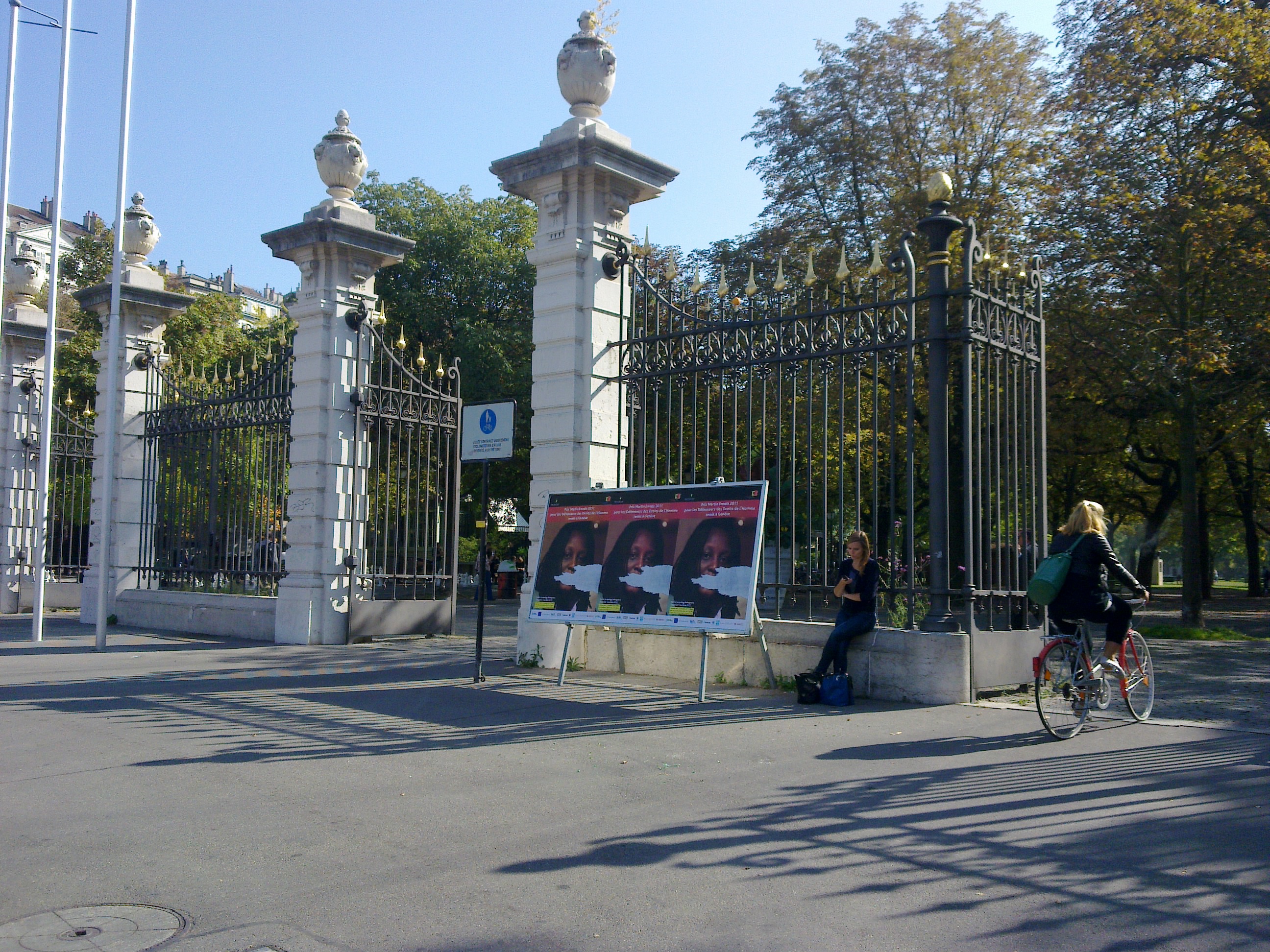
Posters of MEA Laureate 2011 Kasha at the entrance of Geneva university
OMCT changes Secretary General after more than 25 years
September 2, 2011Yesterday and today I was in Geneva to prepare the 13 October MEA ceremony with our partner the City of Geneva. I used the occasion to go and greet the new Secretary General of the World Organisation Against Torture (OMCT), the principal global coalition of anti-torture organizations. As from 1 September 2011, Gerald Staberock succeeds Eric Sottas who had led the organisation since its inception in 1985 and who is taking his extremely well-deserved retirement.
Eric Sottas is the quintessential international human rights worker, constantly in touch with the human rights defenders at the local level and keeping a steady eye on the ever-changing global scene . He made sure the organisation stayed steadfast in the fight against torture, resistant to pressure and intransigent in the face of what was fashionable, initiated studies that provoked reflection on the subject of torture” said Mr Yves Berthelot, OMCT President.
Gerald Staberock, who joined the OMCT nine months ago, bring his own wide experience in anti-torture and rule of law reforms in transition countries. His special interest in the debate on torture and counter-terrorism over the last ten years will serve him well. ” Upon starting his job Gerald Staberock stressed that “The absolute prohibition of torture is challenged today through lack of respect and a pervasive culture of impunity in many parts of the world. At the same time there are opportunities not least through the transitions of the Arab spring to advance the fight against torture. This is the time to double the effort, to assist and support victims of torture, to ensure accountability and prevent torture, and to counter public complacency in the face of torture.
Gerald Staberock, born on June 13, 1968 in Tübingen, Germany, led for eight years different global programs at the International Commission of Jurists , including its Centre for Judges and Lawyers and its Global Security and Rule of Law Initiative. In this context he coordinated the most comprehensive global study on counter-terrorism and human rights . Before joining the ICJ he worked at the OSCE Office for Democratic Institutions and Human Rights (ODIHR) on rule of law and anti-torture projects, including on penitentiary and legal reforms in Eastern Europe and the former Soviet Union.
 Hans Thoolen on Human Rights Defenders and their awards