On Tuesday 12 March 2020 Asharq al-Awsat reported – somewhat garbled – that Tahani Abbas, a Sudanese human rights activist, was awarded “the Martin Institute Prize in Switzerland.” The newspaper surely meant: the Martine Anstett Prize for Human Rights (see: http://www.trueheroesfilms.org/thedigest/awards/martine-anstett-human-rights-prize).
Ms. Abbas told Asharq Al-Awsat that she was proud to receive the prize and because it embodies the distant world’s perception of the Sudanese people’s struggle and shows that the world is watching out for human rights. She went on to say that “personally, the award credits me with a strong role with regards to defending human rights and makes me feel that our efforts and positions in the defense of human rights are appreciated and did not go in vain.” In her acceptance speech, Abbas stressed that all Sudanese women qualify to stand in her place and receive the prize, adding that “I am only a miniature and symbolic example that personifies that struggle of all the women of Sudan. I am an extension of Sudan’s feminist struggle, which is deeply ingrained in its history since before the era of the Kandakes or Nubian Queens, passing through Mendi, daughter of the Sultan Ajabna, and reaching the icon of the Sudanese revolution, Alaa Salah.”
Despite the admiration of observers and the organizers of the prize for the role of Sudanese women in the revolution, Abbas demonstrated her anger at what she calls “women’s weak political participation of after the revolution”. However, she says “Despite being denied political participation after the success of the revolution, our struggle will not stop.” Abbas has been an active human rights defender since 2009 and is a member of many Sudanese feminist and human rights groups. She is a member of the executive committee of the Regional Alliance of Women Human Rights Defenders of North Africa and the Middle East, a member of the executive committee of the No to the Oppression of Sudanese Women Initiative, the My Fair Home campaign which is concerned with domestic workers, the I am Sudanese, which is concerned with nationality and a member of the Sudanese Alliance to End Child Marriage.
In her assessment of the human rights situation in Sudan after the revolution, she says that it has improved a lot as per international standards. She said: ”The reports of international human rights organizations demonstrate this, and, locally, we feel that, as human rights defenders, we have achieved some victories.”
Human rights group Amnesty has warned that concerned citizens across Europe are facing prosecution for offering help and assistance to refugees and migrants.
In a new report published on 3 March 2020, Amnesty Internationalsaid European law enforcement authorities and prosecutors are “misusing already flawed” laws intended to prevent people smuggling and terrorism to target members of the public who offer migrants shelter and warm clothing, or attempt to rescue them at sea. Amnesty examined several cases that took place in Croatia, France, Greece, Italy, Malta, Spain, Switzerland and the UK between 2017 and last year, during which human rights defenders who attempted to help refugees and migrants were targeted under legislation intended to tackle organised immigration crime networks. Amnesty’s report comes as world media attention has once again turned to the Mediterranean migrant crisis after Turkey opened its border with Greece to thousands of Syrian refugees.
In one such case, Frenchman Pierre Mumber was charged with “facilitating irregular entry” into France when he was caught offering tea and warm clothing to four west African asylum seekers before being acquitted on appeal. The report also notes that Swiss citizens have faced prosecution for providing migrants and refugees with shelter or helping them access services and protection. Elsewhere, the agency revealed that people in Italy who have worked to rescue migrants and refugees crossing the Mediterranean on unseaworthy vessels have been subjected to smear campaigns and criminal investigations. See also:
Commenting on the contents of the report, Elisa De Pieri, Regional Researcher at Amnesty International, said: “The increased focus on limiting and deterring arrivals in Europe has meant that making refugees or migrants feel safer or welcomed is seen as a threat. “The failure of European states to fulfil the basic needs of refugees and migrants means it is often left to ordinary people to provide essential services and support. “By punishing the people who step up to fill the gaps, European governments are putting people on the move at even greater risk.”
On January 21st of 2017, millions of women and allies around the world took to the streets to make themselves seen and heard, demonstrating to advance women’s human rights. Now, nearly three years later, the Women’s March movement has announced that on 18 January, 2020, feminists and women’s human rights defenders will march yet again in the 4th Annual Global Women’s March.
Common Dreams also reported that women and men alike marched in France, Spain, Uganda, and other countries in November 2019 to demand that their elected officials work to end violence against women. In Spain, tens of thousands of people marched to recognize the day. But as the New York Times reported, the country’s far-right Vox Party—which, though still a minority party, doubled its representation in Parliament in recent elections—used the opportunity to affirm its opposition to a law aimed at protecting women from gender-based violence. Women gathered at City Hall in Madrid shouted, “This is shameful!” as Vox secretary-general Javier Ortega Smith spoke out against the law and called for national attention to men who are killed by their partners.
Women during a protest on the commemoration of the International Day for the Elimination of Violence Against Women, in Nantes, France, on November 25, 2019. (Photo: Estelle Ruiz/NurPhoto via Getty Images)
As part of the global effort, the International Labor Organization (ILO) called for ratification of its new Convention, adopted in June, to recognize the right of all people to be free from harassment and violence in their workplaces. “This commitment now needs to be turned into concrete, practical action,” the ILO wrote. “Violence and harassment in the world of work has enormous human, social and economic costs. Violence and harassment constitutes one of the greatest threats to decent work. No more excuses. Let’s work together and make the promise of Convention No. 190 a reality for all.”
Tomorrow, 29 November, 2019, young people will gather at locations around the world for a Fridays for Future Global Climate Strike. On 2 December, United Nations delegates, world leaders, business executives, and activists will meet at the 25th Conference of the United Nations Framework Convention on Climate Change (COP25) in Madrid to discuss ways to protect the environment. Participants in these events should also discuss ways to protect the protectors: the individuals and groups targeted around the world for their efforts on behalf of the planet.
Protecting the endangered Asiatic cheetah. Tweeting a satirical poem. Attending a climate conference. Campaigning against a power plant. These actions hardly conjure images of suicide bombers or coup plotters. Yet they have been labeled “eco-terrorism,” “extremism,” or “threats to national security” by governments and businesses that seek to block the work of environmental activists. The dangers facing environmental defenders do not stop at accusations that they are national security risks.From the Amazon rainforest to South African mining communities, activists seeking to preserve ecosystems and ancestral lands are being threatened, attacked, and even killed with near total impunity, Human Rights Watch has found. But in contrast to many of these illegal acts, the unjust labeling of environmentalists as security threats is often more insidious, as it is generally carried out under the color of law.
In a long interesting piece on 28 November Human Rights Watch writes that only in exceptional cases would the actions of environmental activists meet a generally recognized definition of terrorism … When they engage in civil disobedience, their aim is usually to strengthen – and improve the enforcement of – existing environmental protection measures. It lists examples where environmental activists have been smeared as terrorists or other national security threats (for more detail see the original article):
In Kenya, the police and military have frequently labeled environmental activists opposing a mega-infrastructure project in the Lamu coastal region, including a coal-fired power plant, as “terrorists” while subjecting them to threats, beatings, and arbitrary arrests and detentions. In 15 cases documented by Human Rights Watch between 2013 and 2016, the authorities accused environmental defenders of membership in, or links to, the extremist armed group al-Shabab but provided no compelling evidence.
In the Philippines, President Rodrigo Duterte in 2018 placed 600 civil society members, including environmentalists and indigenous rights defenders, on a list of alleged members of the country’s communist party and its armed wing, which he declared to be a terrorist organization. Duterte’s “terrorist list” included Victoria Tauli-Corpuz, an indigenous Filipina who is the UN special rapporteur on the rights of indigenous peoples and a climate change activist.
In Ecuador, eight years passed before the prominent environmental activist José “Pepe” Acacho, a Shuar indigenous leader, was able to clear himself of “terrorism” charges for his activities opposing mining and oil exploration in the Amazon. Acacho was charged with terrorism in 2010 for allegedly inciting violence during Shuar protests against a mining law.
In the US in August 2018, then-US Interior Secretary Ryan Zinke blamed “environmental terrorist groups” that opposed logging for wildfires on the West Coast – a proposition immediately attacked by leading environmental organizations including the Sierra Club. In 2017, 84 members of the US Congress, most of them Republicans, asked the Justice Department if activists mobilizing against the construction of oil pipelines could be prosecuted as terrorists. (The department’s response was that in some cases, yes.)
.
In Russia, at least 14 environmental groups have stopped work in recent years, and the head of the prominent group Ekozaschita! (Ecodefense!), Alexandra Koroleva, fled the country in June to avoid prosecution under the draconian Law on Foreign Agents. The 2012 law requires any Russian group accepting foreign funding and carrying out activities deemed to be “political” to register as a “foreign agent,” a term that in Russia implies “spy” or “traitor.” Authorities have used the law to silence groups that opposed state-sanctioned development projects and petitioned authorities for the release of imprisoned environmental activists, a Human Rights Watch investigation found.
Civil society participation will be crucial to ambitious outcomes at COP25. Parties to the summit, which include all UN member countries and the European Union, should allow activists ample opportunity to air their concerns about the climate crisis and use their combined expertise to help identify solutions. They should also provide activists with a safe space to speak out about the threats they face for carrying out their work.
In addition, parties should publicly commit to robustly carrying out international and regional treaties that protect environmental defenders. One of these treaties is the Escazu Agreement (the Regional Agreement on Access to Information, Public Participation and Justice in Environmental Matters in Latin America and the Caribbean), the world’s first covenant to include specific provisions promoting and protecting environmental defenders. Twenty-one countries have signed the 2018 agreement. But only six countries have ratified it – five shy of the ratifications needed to enter it into force. Chile, which stepped down as COP25 host because of protests stemming from economic grievances, but will still preside over the negotiations in Madrid, should lead by example and ratify the agreement.
COP25 participants should also commit to upholding the Aarhus Convention (the United Nations Economic Commission for Europe Convention on Access to Information, Public Participation in Decision-making and Access to Justice in Environmental Matters), to which Spain is a signatory. The convention – an environmental pact for Europe, the European Union, and Central Asia – grants the public, including environmental groups, an array of rights including public participation and access to information and justice in governmental decisions on the environment, without harassment or persecution. Parties to the treaty, including the EU, and Poland for its crackdown at COP24, have been criticized – including in some cases by the Aarhus Convention’s own oversight body – for flouting these provisions.
COP25 delegates should recognize that to genuinely protect the environment, they also need to protect its defenders – including those unjustly targeted in the name of security.
Louis Joinet (born in Nevers onHe was a French magistrate, independent expert to the United Nations Human Rights Committee and very active in the NGO human rights world in particular with regard to the dictatorships in Latin America (he was named illustrious citizen of Montevideo).
He co-founded the Union of the Judiciary (Syndicat de la magistrature) in 1968. At the beginning of his career, he was interested in the early stages of computer sciences in order to evaluate the impact of these technologies on the law. He represented France in the Council of Europe. His report will gave birth to the Data Protection Act. He then participated actively in the drafting of the law relating to computers, files and freedoms of 6 January 1978. He was an adviser on human rights to the succesive Prime Ministers of François Mitterrand between 1981 and 1993.
In the UN context he was the author, in 1997, of the principles against impunity of the Office of the United Nations High Commissioner for Human Rights , also known as the “Joinet Principles” , which are part of the principles of transitional justice. .
He published his memoirs in 2013 (Mes raisons d’État : mémoires d’un épris de justice, Éditions La Découverte). One of the characters of the French television series Sanctuaire , broadcast in 2015, which addresses in particular the role of France in the attempt to negotiate, in the mid-1980s between ETA and Spain, is inspired by Louis Joinet (“Avec “Sanctuaire” j’ai voulu faire un film sur une gauche qui se perd” [archive], teleobs.nouvelobs.com, 2 mars 2015).
His wife Germaine Joinet, doctor and activist in various associations, died in 2008.
Ciné-ONU and the Goethe Institute screened “Un certain monsieur Joinet” (52 mn) on 24 October 2012 at the Goethe Institute in Brussels. According to Amnesty International, “the documentary gives an insight into the fifty years of struggle by Louis Joinet for human rights, from the war in Algeria to Pinochet’s Chile, from enforced disappearances to the fight against impunity”. Language: French with English subtitles. Directed by: Frantz Vaillant. Only the trailer is on the internet and information on how to get hold of the full film is missing.
The Carmignac Photojournalism Award is an annual prize given to investigative photojournalists covering human rights violations [see: http://www.trueheroesfilms.org/thedigest/awards/carmignac-photojournalism-award]. Each year, a team of environmental and political leaders selects a region to focus on and then selects a recipient, who uses the foundation’s $55,000 prize money to shoot the project they proposed. The annual award, now in its 10th year, focuses on a different region and associated human rights topic each year. For 2019 the jury chose to call for project proposals around deforestation and the Amazon. Evan Nicole Brown writing in Fact Company of 12 September 2019 notes that “in an ironic twist, the recipient of the prize money was announced as the rain forest was being obscured by plumes of smoke from the unprecedented fires.”
The winner, Tommaso Protti, is an Italian-born photographer who has lived in Brazil for the past five years. ..the prize money supported the production of his photojournalism work, which began in January of this year and wrapped up in July. His reportage, developed in tandem with British journalist Sam Cowie, was revealed at the Visa pour l’Image festival in France on September 4.
……
“There’s a big problem with impunity inside the region because of the state—it leads directly to killing the environment and indigenous leaders,” Protti says. “The people there don’t have the protection [like most of us] experiencing climate collapse. The majority of the people I’ve met try to make a living with what the forest offers them.”
Poor environmental health in the Amazon is, in part, responsible for poverty and violence in surrounding favelas too. Rural agricultural workers, who depend on the forest for a living, have been forced to leave the Amazon now that it is less dense and farming has been modernized. The only place left for them to go are Brazil’s cities, resulting in a crowding of favelas and the tension that results from a government pushing disparate communities into close proximity.
One of Protti’s selected photographs depicts members of the Guajajara forest guard beating an indigenous man accused of collaborating with illegal loggers. Over the course of his time photographing the rain forest and its native people, Protti was able to observe how seasonal changes affect the Amazon’s health, during the dry season (July through October) and the rainy season too. The joint work between Protti and Cowie explores the humanitarian crises plaguing the region—from Venezuelan refugee groups to agrarian and religious conflicts—and the ongoing deforestation too. “It’s a really complex award from my point of view. [The Amazon] is a national treasure,” Protti says about his win. “It’s nothing new, fires happen every year . . . but at the same time, the fires are consequences of the social [situation].”
Protti’s photographs and the accompanying reportage will be presented in London and at the Maison Européenne de la Photographie (MEP) in Paris starting December 4. They will also be included, concurrently, in a monograph copublished with Reliefs Éditions.
ISHR had the chance to meet with Cédric Herrou for the Geneva premiere of movie ‘Libre’ where director Michel Toesca follows him in his endeavours in France‘s Roya Valley. During our interview, Herrou, a migrant rights defender and president of association ‘Défends Ta Citoyenneté’, shared his testimony, challenges, aspirations and calls to action. The interview was published on 22 March 2019.
Sometimes good news fall on the right day: a French court acquitted Tom Ciotkowski, a British human rights defender who documented police abuse against migrants and refugees and volunteers who were helping them in Calais. Amnesty International France’s Programme manager on Freedoms, Nicolas Krameyer said: “Today’s decision, delivered on World Refugee Day, is not only a victory for justice but also for common sense. Tom Ciotkowski is a compassionate young volunteer who did nothing wrong and was dragged through the courts on trumped up charges”. [see also: https://humanrightsdefenders.blog/2019/05/15/european-governments-should-stop-treating-solidarity-and-compassion-as-a-crime/]
EuroMed Rights focuses on the current practice of stopping people from disembarking ships/boats on the Mediterranean Sea shoreline, particularly in Tunisia. In many aspects, this situation is emblematic of the obstacles faced by refugees in obtaining protection and access to rights in the Euro-Mediterranean region. It is also emblematic of the unfailing solidarity with refugees of local organisations and individuals.
Freedom United issues a call to close Libyan slave markets.
Medecins Sans Frontieres (MSF) is featuring stories of survival—a collection of video testimonies and first-hand accounts from people who have risked everything for a chance at safety. As an organisation working with refugees and people on the move, we know that nothing—not a wall, or even an ocean—will ever stop people who are simply trying to survive.
Two recent cases of criminalization of human rights defenders in Europe helping people at sea:
Iuventa crew
On 13 May 2019 MarEx reported that the crew of the rescue ship Iuventa operated by the German NGO Jugend Rettet has received the Swiss Paul Grüninger human rights award for saving the lives of around 14,000 of men, women and children in the central Mediterranean. For more on this award, see: http://www.trueheroesfilms.org/thedigest/awards/paul-grueninger-award
The award is seen as a statement against the criminalization of those helping people at sea and comes whilst the crew is under criminal investigations in Italy for “aiding and abetting illegal immigration.” They face up to 20 years in prison and fines of 15,000 Euro ($16,900) per saved person. The prize money of 50,000 Swiss francs contributes to the defense.
The Iuventa was the first rescue vessel seized in Italy in August 2017. Captain Dariush was master of the Iuventa for three voyages off the Libyan coast: “We’re being charged for saving lives. This is absurd,” he said. “It is European politicians who block any safe way for people in need, so we had to act.”
The crew says: “Although we have to stand trial, it is us who accuses Europe. We accuse European politicians of turning their backs on people in need. We accuse the E.U. of collaborating with regimes who violate human rights.” The Italian public prosecutor’s office has been investigating the crew for almost two years. Covert investigators claim to have observed the Iuventa crew cooperating with smugglers. However, the NGO claims that scientists at Goldsmiths, University of London have said there is no evidence for this. “They have compared the accusations of the Italian police with all available data, meteorological measurements, logbooks and recordings of the Reuters agency. In their study for Forensic Architecture, they conclude that the allegations are false.” The trial is expected to begin in autumn, and it is expected that charges will be brought against the 10 crew members. It is a precedent for Europe, says lead lawyer Nicola Canestrini: “This trial will show whether Europe can continue to stand for fundamental rights and solidarity in the world.”
——–
Tom Ciotkowski is facing up to five years in prison and a fine of up to 7,500 Euros on trumped up charges. In July 2018, he was observing French riot police preventing volunteers from distributing food to migrants and refugees in Calais. He was charged with contempt and assault after he challenged the violent actions of a policeman against another volunteer. “Tom Ciotkowski is a compassionate young volunteer who was taking action to support migrants and refugees when he was arrested. He has committed no crime and is being unjustly targeted for documenting the abusive behaviour of the police in Calais,” said Amnesty International’s Senior Campaigner on Migration Maria Serrano.
“Tom’s case is sadly emblematic of the harassment, intimidation and attacks that human rights defenders supporting migrants and refugees face at the hands of police in Calais. His case also reflects a wider European trend of criminalizing acts of solidarity, as a way of discouraging others from standing up for human rights. We need courageous, compassionate people like Tom more than ever
[BACKGROUND At the end of July 2018, Tom Ciotkowski was observing French riot police ID-checking volunteers who were trying to distribute food to migrants and refugees. He recorded on his mobile phone an official pushing and kicking a volunteer. When Tom complained about the behaviour of the police, an officer approached him and another female volunteer, who he hit with a baton. When Tom asked the officer for his identification number and told the policeman not to hit women, he was pushed hard by an officer and fell backwards over a metal barrier separating the pavement from the road. As Tom fell backwards, a passing lorry narrowly missed him. He was then arrested, put in custody for 36 hours and charged with contempt and assault (“outrage et violence”). In May 2019, Tom filed a complaint against the police officer who pushed him and against other officers who provided reports stating false facts against Tom to support his arrest and prosecution.]
The activist is making waves globally (Photo: Anders Hellberg)
Teen climate activist Greta Thunberg – who is a vegan – has won the newly created Prix Liberté, launched last year by the Region of Normandy in France, reports Maria Chiorando in Plantbasednews. Thunberg, 16, is the first recipient of this new award, which was designed to honor a young person ‘engaged in a fight for peace and freedom’. The award comes with prize money of €25,000. [see: http://www.trueheroesfilms.org/thedigest/awards/prix-libert-normandy ] The campaigner has made global headlines through her efforts, which includes encouraging students to attend demonstrations demanding political action on climate change while ‘on strike’ from school. Her influence has spread beyond her native Sweden throughout Europe and beyond
“I am very grateful and honoured to have won the Prix Liberté!” Thunberg said in a post on social media. “The other final nominees have stood up for human rights in a way that I can’t even imagine. We must constantly be reminded of the sacrifices they have made. Lu Guang and Raif Badawi are true heroes of our time.”
Thunberg said she will be splitting all of the prize money between four organizations dedicated to climate justice: These include CARE, which helps women and girls in the global south to cope with the effects of rising temperatures and a changing climate, and The Adaptation Fund – which helps vulnerable communities in developing countries adapt and build resilience to climate change, 350.org and Greenpeace International who in Thunberg’s words ‘both fight for climate justice, the environment, and to keep the fossil fuels in the ground’, will also receive donations. Thunberg will receive her award on June 4, 2019, at the Normandy International Forum for Peace.




 Grajaú, Brazil—A deforested area in the southern Maranhão state seen from a helicopter belonging to IBAMA, Brazil’s national environmental agency [Photo: © Tommaso Protti for Fondation Carmignac]
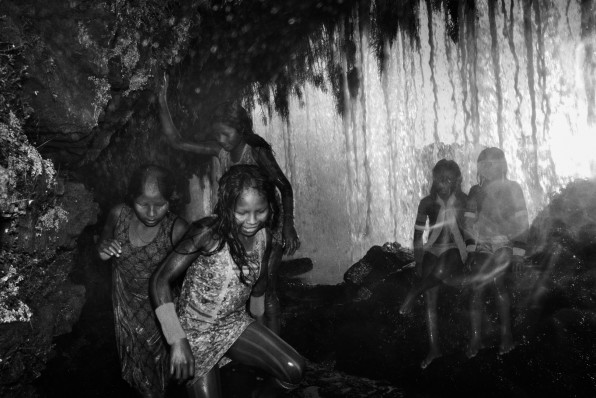 Kayapó Indigenous Land—Kayapo children play behind a waterfall in the Kubenkrãnken indigenous village, in southern Pará state. The Kayapo have only been in contact with nonindigenous society since the 1960s. Their land serves as a crucial barrier to deforestation advancing from the south. [Photo: © Tommaso Protti for Fondation Carmignac]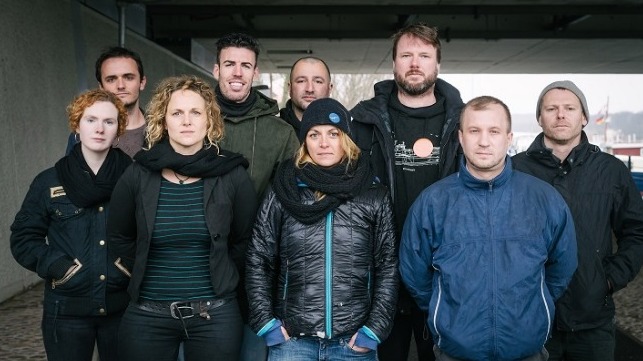

 Hans Thoolen on Human Rights Defenders and their awards