Posts Tagged ‘FIFA’

Third annual Sporting Chance Forum in Paris is over

December 14, 2018
The third annual Sporting Chance Forum brought together some 300 delegates from a broad range of stakeholders to drive progress toward a world of sport that fully respects human rights.  Representatives of affected groups, sports bodies, governments, trade unions, sponsors, NGOs, broadcasters, NHRIs, and intergovernmental organisations gathered in Paris at UNESCO under the backdrop of the 70th anniversary of the Universal Declaration of Human Rights. Reports follow in early 2019.Hosted this year by the new Centre for Sport and Human Rights, UNESCO and Institute for Human Rights and Business, the Forum covered a diversity of geographies and issues including a special spotlight on survivors of sexual abuse, athletes’ rights, worker safety, fan monitoring, media freedom, child rights, and community wellbeing.

There was also a special session  dedicated to Human Rights of Defenders, Activists, and Journalists with the following speakers:

  • Lene Wendland (Chief, Human Rights and Economic and Social Issues Section, Office of the UN High Commissioner for Human Rights)
  • Maryam Shojaei (Founder, My Fundamental Right)
  • Andreas Graf (Human Rights Manager, FIFA)
  • Courtney Radsch (Advocacy Director, Committee to Protect Journalists)
  • Moderated by: Piara Powar (Executive Director, FARE Network)

FIFA was one of the participants and reported as follows on its upcoming participation: FIFA is actively supporting the development of the Centre for Sport and Human Rights and we are glad to participate at the Sporting Chance Forum to share our experiences and best practices, and learn from stakeholders and other experts that are also dedicated to promoting human rights in sport. Since 2016, FIFA has strengthened and systematised its human rights work following guidance from the UN Guiding Principles on Business and Human Rights. Examples include:

  • Inclusion of an article on human rights in the FIFA Statutes in 2016 (see article 3)
  • Development of a Human Rights Policy in 2017 in accordance with principle 16 of the UN Guiding Principles on Business and Human Rights and international best practice
  • Systematic human rights due diligence checks and integration of human rights in the bidding and hosting requirements for its tournaments
  • Set up of an independent Human Rights Advisory Board which provides FIFA with independent expert advice on its efforts to implement article 3 of its statutes, with members from the UN system, NGOs, trade unions, FIFA sponsors and other relevant organisations, as well as regular consultation and cooperation with a large number of additional stakeholders.
  • Launch of a complaints mechanism for human rights defenders and media representatives who consider their rights to have been violated while performing work related to FIFA tournaments.

See also my recent post: https://humanrightsdefenders.blog/2018/12/12/mary-harvey-her-goal-is-now-human-rights/

https://www.sporthumanrights.org

https://www.fifa.com/governance/news/y=2018/m=12/news=fifa-participates-at-the-sporting-chance-forum-in-paris.html


Mary Harvey: her goal is now human rights

December 12, 2018

FIFA’s second report on human rights misses sustainable approach

December 3, 2018

FIFA’s Human Rights Advisory Board, an independent panel with a mandate to look into how FIFA tackles its human rights issues, published its second report in November 2018. (How independence is to be understood in the context of FIFA is perhaps shown by what happened to its Governance Committee: former UN High Commissioner for Human Rights Navi Pillay and others resigned in May 2017 from FIFA’s governance committee (which is not the human rights committee) saying that their independence was undercut and holding out no hope for internal reform [see: https://www.theguardian.com/football/2017/dec/21/our-sin-take-task-fifa-seriously and https://humanrightsdefenders.blog/2017/02/02/fifa-governance-committee-starts-dealing-with-a-human-rights-policy/])

The report covered the period from October 2017 to September 2018, and while it highlights progress it also shows soccer’s governing body still has a lot of work to do. The advisory board only began its work in March 2017, and described human rights as “still in the relatively early stages of being embedded in FIFA’s culture,” acknowledging that past decisions and contracts make it hard to deal with human rights issues. That can be seen by the large number of recommendations involving the Russia 2018 World Cup and the Qatar 2022 World Cup.

Of the advisory board’s six recommendations for Qatar 2022, FIFA still has work to do in two areas: using its leverage to try and improve the ‘kafala’ labor system so that it is more in line with workers’ rights, and encouraging companies linked to World Cup-related employment to do more to meet international human rights standards. The focus on World cups misses out on the same issues at the Club World Cup which takes place in the UAE in December 2018.

The human rights advisory board’s existence appears in some respects to be a reaction to the criticism FIFA received over the decision to award Qatar the right to host the 2022 World Cup, but the World Cup is far bigger than just the stadiums, and ..FIFA’s narrow focus on stadium workers means it misses the chance to create a long-term positive World Cup legacy in regards to human rights.

The report highlighted that FIFA “needs to invest in a sustainable approach” to human rights rather than just provide superficial fixes. Improvements that are made when issues are in the spotlight are often fluid and can be rolled back once the world’s attention swings to another issue.

One issue that the advisory board brought up, and which will be addressed in more detail in the next report, is how women in Iran have been banned from attending men’s soccer matches.

See also: https://humanrightsdefenders.blog/2018/06/27/new-global-center-for-sport-and-human-rights-created-to-address-abuses/

New Global Center for Sport and Human Rights created to address abuses

June 27, 2018

Olympic Games in future bound by human rights standards

March 14, 2017

On 2 February this year I wrote about human rights coming to football [https://humanrightsdefenders.blog/2017/02/02/fifa-governance-committee-starts-dealing-with-a-human-rights-policy/]. Now there is some progress to note on the Olympics: The Sports and Rights Alliance (SRA) reports that the International Olympic Committee (IOC) has moved to incorporate human rights principles in its Host City Contract. This could help prevent major abuses by future Olympic hosts. The revised Host City Contract, developed with recommendations from a coalition of leading rights, athletes’ and transparency organizations, was finalized in January 2017, and will first apply to the 2024 Summer Olympics. [https://humanrightsdefenders.blog/2015/02/26/coalition-of-human-rights-defenders-and-others-call-on-olympic-committee-to-change-its-ways/]

For the first time, the IOC has included explicit reference to the United Nations Guiding Principles on Business and Human Rights (UNGP), which outline the human rights responsibilities of businesses, as well as references to anti-corruption standards. The Guiding Principles explain how commercial enterprises should assess human rights risks, take effective steps to avoid human rights problems, and ensure a remedy for abuses that occur in spite of those efforts.

2014_IOC_Bach
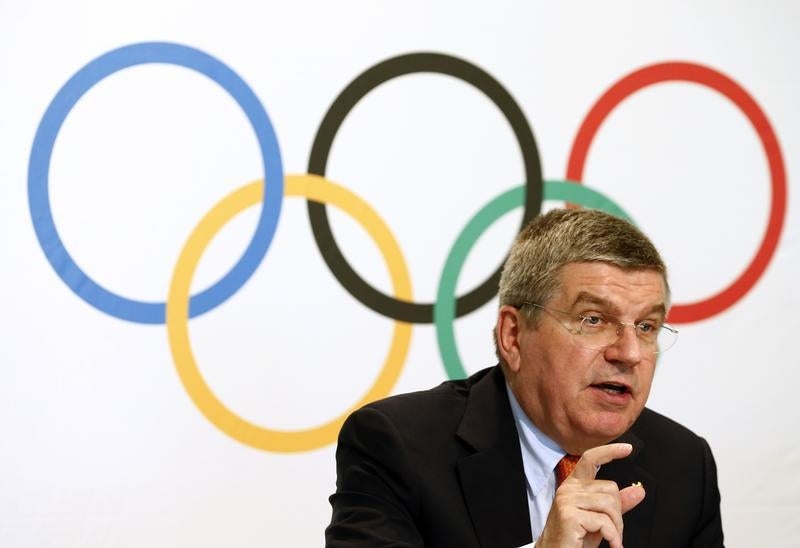
IOC President Thomas Bach in Lausanne 9 July, 2014. © 2014 Reuters

“This is an important step by the IOC for the future,” said Sharan Burrow, International Trade Union Confederation general secretary. “Implementing the UN Guiding Principles across all major global sporting events could help break the cycle of human rights abuses, and this example from the IOC should be applied to all such events, starting now.”

The SRA’s mission is to ensure that sports bodies and mega-sporting events respect human rights, the environment, and anti-corruption requirements at all stages of the process. “Time after time, Olympic hosts have gotten away with abusing workers building stadiums, and with crushing critics and media who try to report about abuses,” said Minky Worden, director of global initiatives at Human Rights Watch. “The right to host the Olympics needs to come with the responsibility not to abuse basic human rights.

The revised contract requires host cities to “protect and respect human rights and ensure any violation of human rights is remedied in a manner consistent with international agreements, laws and regulations applicable in the Host Country and in a manner consistent with all internationally-recognized human rights standards and principles, including the United Nations Guiding Principles on Business and Human Rights, applicable in the Host Country.

If implemented, the revised Host City Contract will help ensure that Olympic hosts respect ‘human dignity’ as required by the Olympic Charter,” said Brendan Schwab, head of UNI World Athletes. “This should have a ripple effect across all mega-sporting events such as the World Cup, and wherever abuses tied to sport still occur.”

[Key provisions of the revised Olympic Host City Contract include:

13. Respect of the Olympic Charter and promotion of Olympism

13.1. The Host City, the Host NOC and the OCOG undertake to abide by the provisions of the Olympic Charter and the IOC Code of Ethics and agree to conduct their activities related to the organisation of the Games in a manner which promotes and enhances the fundamental principles and values of Olympism, as well as the development of the Olympic Movement.

13.2. Pursuant to their obligations under §13.1, the Host City, the Host NOC and the OCOG shall, in their activities related to the organisation of the Games:

a. prohibit any form of discrimination with regard to a country or a person on grounds of race, colour, sex, sexual orientation, language, religion, political or other opinion, national or social origin, property, birth or other status;

b. protect and respect human rights and ensure any violation of human rights is remedied in a manner consistent with international agreements, laws and regulations applicable in the Host Country and in a manner consistent with all internationally-recognised human rights standards and principles, including the United Nations Guiding Principles on Business and Human Rights, applicable in the Host Country; and

c. refrain from any act involving fraud or corruption, in a manner consistent with any international agreements, laws and regulations applicable in the Host Country and all internationally-recognised anti-corruption standards applicable in the Host Country, including by establishing and maintaining effective reporting and compliance.

13.3. The IOC, through its Coordination Commission referred to in §27, shall establish a reporting mechanism to address the obligations referred to in §13.1 and §13.2 in connection with the activities of the Host City, the Host NOC and the OCOG related to the organisation of the Games.

15. Sustainability and Olympic legacy

15.1. The Host City, the Host NOC and the OCOG undertake to carry out all activities foreseen under the HCC in a manner which embraces sustainable development and contributes to the United Nations’ Sustainable Development Goals.]

Source: Olympics: Host City Contract Requires Human Rights | Human Rights Watch

FIFA Governance Committee starts dealing with a human rights policy

February 2, 2017

The FIFA Governance Committee held its first meeting at the Home of FIFA in Zurich on 26 January 2017. Key aspects of FIFA’s future  human rights policy seem to have come up but details are not known yet.  [See also: https://humanrightsdefenders.blog/2014/06/12/42-human-rights-defenders-also-want-to-win-in-world-cup/]. This is what the report said:

Sustainability and diversity: The committee members received an update about FIFA’s concrete measures in the areas of anti-discrimination, environmental protection, social development and sustainability, in particular in the context of the upcoming FIFA World Cups™. 

Human rights: In line with FIFA’s commitment towards human rights enshrined in the FIFA Statutes and FIFA’s 2.0 vision, the committee discussed FIFA’s responsibilities in this area, as well as the key aspects of a FIFA human rights policy, which will eventually be submitted to the FIFA Council for approval. 

……

Integrity in football: While the Governance Committee does not intervene in sports regulatory matters, it was agreed that it would conduct an analysis of the economic and social dimensions of football regulation that intersect with questions of human rights, transparency and conflicts of interest and that may impact on the integrity of the game and public trust.


……Following the meeting, the chairman set up two working groups to work on the human rights policy and the electoral guidelines, to be coordinated by committee members Justice Navi Pillay (former UN High Commissioner for Human Rights) and Joseph Weiler (Professor at New York University Law School and former President of the European University Institute) respectively.

{The FIFA Governance Committee was set up following the reforms approved by the Extraordinary FIFA Congress in February 2016 and its main role is to deal with, and advise and assist the Council on, all FIFA governance matters.}

Source: FIFA Governance Committee assesses implementation of reforms at first meeting – FIFA.com

In countdown to 2014 World Cup, Thousands in Brazil Cope with Forced Evictions

June 13, 2013
VilaCristal_DemolishedHome2_JZ
As Posted on June 12, 2013 by Matisse Bustos Hawkes

Today, Brazilian President Dilma Rousseff and FIFA President Sepp Blatter will officially mark the one-year countdown to the opening of the 2014 World Cup. Read the rest of this entry »