Posts Tagged ‘feminists’

Two young human rights defenders, Raphael Mimoun and Nikole Yanez, on tech for human rights

May 16, 2024

Mozilla is highlighting each year the work of 25 digital leaders using technology to amplify voices, effect change, and build new technologies globally through its Rise 25 Awards. On 13 May 2024 was the turn of Raphael Mimoun, a builder dedicated to making tools that empower journalists and human rights defenders. Aron Yohannes talked with Raphael about the launch of his app, Tella, combatting misinformation online, the future of social media platforms and more.

Raphael Mimoun: So I never worked in tech per se and only developed a passion for technology as I was working in human rights. It was really a time when, basically, the power of technology to support movements and to head movements around the world was kind of getting fully understood. You had the Arab Spring, you had Occupy Wall Street, you had all of these movements for social justice, for democracy, for human rights, that were very much kind of spread through technology, right? Technology played a very, very important role. But just after that, it was kind of like a hangover where we all realized, “OK, it’s not just all good and fine.” You also have the flip side, which is government spying on the citizens, identifying citizens through social media, through hacking, and so on and so forth — harassing them, repressing them online, but translating into offline violence, repression, and so on. And so I think that was the moment where I was like, “OK, there is something that needs to be done around technology,” specifically for those people who are on the front lines because if we just treat it as a tool — one of those neutral tools — we end up getting very vulnerable to violence, and it can be from the state, it can also be from online mobs, armed groups, all sort of things.

There’s so much misinformation out there now that it’s so much harder to tell the difference between what’s real and fake news. Twitter was such a reliable tool of information before, but that’s changed. Do you think that any of these other platforms can be able to help make up for so much of the misinformation that is out there?

I think we all feel the weight of that loss of losing Twitter. Twitter was always a large corporation, partially owned by a billionaire. It was never kind of a community tool, but there was still an ethos, right? Like a philosophy, or the values of the platform were still very much like community-oriented, right? It was that place for activists and human rights defenders and journalists and communities in general to voice their opinions. So I think that loss was very hard on all of us.

I see a lot of misinformation on Instagram as well. There is very little moderation there. It’s also all visual, so if you want traction, you’re going to try to put something that is very spectacular that is very eye catchy, and so I think that leads to even more misinformation.

I am pretty optimistic about some of the alternatives that have popped up since Twitter’s downfall. Mastodon actually blew up after Twitter, but it’s much older — I think it’s 10 years old by now. And there’s Bluesky. So I think those two are building up, and they offer spaces that are much more decentralized with much more autonomy and agency to users. You are more likely to be able to customize your feeds. You are more likely to have tools for your own safety online, right? All of those different things that I feel like you could never get on Threads, on Instagram or on Twitter, or anything like that. I’m hoping it’s actually going to be able to recreate the community that is very much what Twitter was. It’s never going to be exactly the same thing, but I’m hoping we will get there. And I think the fact that it is decentralized, open source and with very much a philosophy of agency and autonomy is going to lead us to a place where these social networks can’t actually be taken over by a power hungry billionaire.

What do you think is the biggest challenge that we face in the world this year on and offline, and then how do you think we can combat it?

I don’t know if that’s the biggest challenge, but one of the really big challenges that we’re seeing is how the digital is meeting real life and how people who are active online or on the phone on the computer are getting repressed for that work in real life. So we developed an app called Tella, which encrypts and hides files on your phone, right? So you take a photo or a video of a demonstration or police violence, or whatever it is, and then if the police tries to catch you and grab your phone to delete it, they won’t be able to find it, or at least it will be much more difficult to find it. Or it would be uploaded already. And things like that, I think is one of the big things that we’re seeing again. I don’t know if that the biggest challenge online at the moment, but one of the big things we’re seeing is just that it’s becoming completely normalized to grab someone’s phone or check someone’s computer at the airport, or at the border, in the street and go through it without any form of accountability. People have no idea what the regulations are, what the rules are, what’s allowed, what’s not allowed. And when they abuse those powers, is there any recourse? Most places in the world, at least, where we are working, there is definitely no recourse. And so I think that connection between thinking you’re just taking a photo for social media but actually the repercussion is so real because you’re going to have someone take your phone, and maybe they’re going to delete the photo, or maybe they’re going to detain you. Or maybe they’re going to beat you up — like all of those different things. I think this is one of the big challenges that we’re seeing at the moment, and something that isn’t traditionally thought of as an internet issue or an online digital rights issue because it’s someone taking a physical device and looking through it. It often gets overlooked, and then we don’t have much kind of advocacy around it, or anything like that.

What do you think is one action everybody can take to make the world and our lives online a little bit better?

I think social media has a lot of negative consequences for everyone’s mental health and many other things, but for people who are active and who want to be active, consider social networks that are open source, privacy-friendly and decentralized. Bluesky, the Fediverse —including Mastodon — are examples because I think it’s our responsibility to kind of build up a community there, so we can move away from those social media platforms that are owned by either billionaires or massive corporations, who only want to extract value from us and who spy on us and who censor us. And I feel like if everyone committed to being active on those social media platforms — one way of doing that is just having an account, and whatever you post on one, you just post on the other — I feel like that’s one thing that can make a big difference in the long run.

We started Rise25 to celebrate Mozilla’s 25th anniversary. What do you hope that people are celebrating in the next 25 years?

I was talking a little bit earlier about how we are building a culture that is more privacy-centric, like people are becoming aware, becoming wary about all these things happening to the data, the identity, and so on. And I do think we are at a turning point in terms of the technology that’s available to us, the practices and what we need as users to maintain our privacy and our security.  I feel like in honestly not even 25, I think in 10 years, if things go well — which it’s hard to know in this field — and if we keep on building what we already are building, I can see how we will have an internet that is a lot more privacy-centric where communications are by default are private. Where end-to-end encryption is ubiquitous in our communication, in our emailing. Where social media isn’t extractive and people have actual ownership and agency in the social network networks they use. Where data mining is no longer a thing. I feel like overall, I can see how the infrastructure is now getting built, and that in 10,15 or 25 years, we will be in a place where we can use the internet without having to constantly watch over our shoulder to see if someone is spying on us or seeing who has access and all of those things.

Lastly, what gives you hope about the future of our world?

That people are not getting complacent and that it is always people who are standing up to fight back. We’re seeing it at. We saw it at Google with people standing up as part of No Tech for Apartheid coalition and people losing the jobs. We’re seeing it on university campuses around the country. We’re seeing it on the streets. People fight back. That’s where any change has ever come from: the bottom up. I think now, more than ever, people are willing to put something on the line to make sure that they defend their rights. So I think that really gives me hope.

—————

The second story comes from Amnesty International, 14 May 2024 [https://www.amnesty.org/en/latest/campaigns/2024/05/i-come-from-the-world-of-technology-where-there-are-very-few-women/]

Nikole Yanez is a computer scientist by training, and a human rights defender from Honduras. She is passionate about feminism, the impact of the internet and protecting activists. She was first drawn to human rights through her work as a reporter with a local community radio station. After surviving the coup d’état in Honduras in 2009, Nikole broadened her approach to focus her activism on technology. When she applied for the Digital Forensics Fellowship with the Amnesty Tech Security Lab in 2022, she was looking to learn more about cybersecurity and apply what she learnt with the organizations and collectives she works with regularly.  

She highlighted her commitment to fostering a network of tech-savvy communities across Latin America in an interview with Elina Castillo, Amnesty Tech’s Advocacy and Policy Advisor:

I grew up in Honduras, where I lived through the coup d’état, which took place in 2009. It was a difficult time where rights were non-existent, and people were constantly afraid. I thought it was something you only read about in history books, but it was happening in front of my eyes. I felt myself just trying to survive, but as time went by it made me stronger and want to fight for justice. Despite the difficulties, people in my community remained hopeful and we created a community radio station, which broadcast stories about everyday people and their lives with the aim of informing people about their human rights. I was a reporter, developing stories about individual people and their fight for their rights. From there, I found a passion for working with technology and it inspired me to train to become a computer scientist.

I am always looking for ways to connect technology with activism, and specifically to support women and Indigenous people in their struggles. As much as technology presents risks for human rights defenders, it also offers opportunities for us to better protect ourselves and strengthen our movements. Technology can bring more visibility to our movements, and it can empower our work by allowing us to connect with other people and learn new strategies.

Is there one moment where you realized how to connect what you’ve been doing with feminism with technology?

In my work, my perspective as a feminist helps me centre the experiences and needs of marginalised people for trainings and outreach. It is important for me to publicly identify as an Afrofeminist in a society where there is impunity for gendered and racist violence that occurs every day. In Honduras we need to put our energy into supporting these communities whose rights are most violated, and whose stories are invisible.

For example, in 2006, I was working with a Union to install the Ubuntu operating system (an open-source operating system) on their computers. We realized that the unionists didn’t know how to use a computer, so we created a space for digital literacy and learning about how to use a computer at the same time. This became not just a teaching exercise, but an exercise for me to figure out how to connect these tools to what people are interested in. Something clicked for me in this moment, and this experience helped solidify my approach to working on technology and human rights.

There are not many women working in technology and human rights. I don’t want to be one of the only women, so my goal is to see more women colleagues working on technical issues. I want to make it possible for women to work in this field. I also want to motivate more women to create change within the intersection of technology and human rights. Using a feminist perspective and approach, we ask big questions about how we are doing the work, what our approach needs to be, and who we need to work with.   Nikole Yanez Honduras Human Rights Defender

For me, building a feminist internet means building an internet for everyone. This means creating a space where we do not reproduce sexist violence, where we find a community that responds to the people, to the groups, and to the organizations that fight for human rights. This includes involving women and marginalised people in building the infrastructure, in the configuration of servers, and in the development of protocols for how we use all these tools.

In Honduras, there aren’t many people trained in digital forensics analysis, yet there are organizations that are always seeking me out to help check their phones. The fellowship helped me learn about forensic analysis on phones and computers and tied the learning to what I’m actually doing in my area with different organizations and women’s rights defenders. The fellowship was practical and rooted in the experience of civil society organizations.
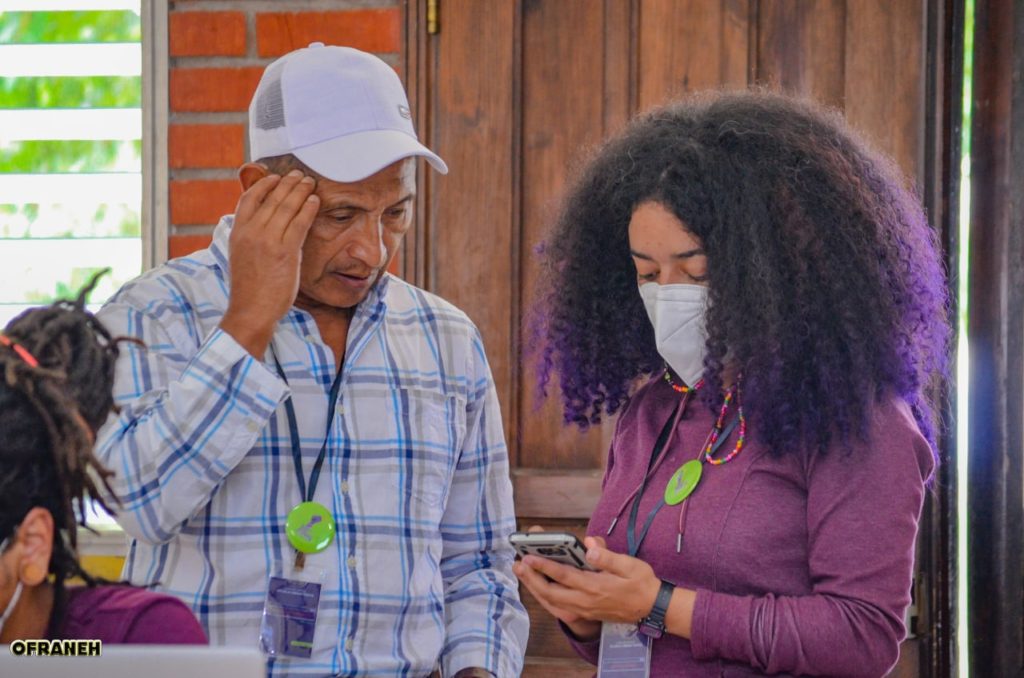
Nikole Yanez running a technology and human rights session in Honduras

How do you explain the importance of digital forensics? Well first, it’s incredibly relevant for women rights defenders. Everyone wants to know if their phone has been hacked. That’s the first thing they ask:, “Can you actually know whether your phone has been hacked?” and “How do I know? Can you do it for me? How?” Those are the things that come up in my trainings and conversations.

I like to help people to think about protection as a process, something ongoing, because we use technology all day long. There are organizations and people that take years to understand that. So, it’s not something that can be achieved in a single conversation. Sometimes a lot of things need to happen, including bad things, before people really take this topic seriously…

I try to use very basic tools when I’m doing digital security support, to say you can do this on whatever device you’re on, this is a prevention tool. It’s not just applying technical knowledge, it’s also a process of explaining, training, showing how this work is not just for hackers or people who know a lot about computers.

One of the challenges is to spread awareness about cybersecurity among Indigenous and grassroots organizations, which aren’t hyper-connected and don’t think that digital forensics work is relevant to them. Sometimes what we do is completely disconnected from their lives, and they ask us: “But what are you doing?” So, our job is to understand their questions and where they are coming from and ground our knowledge-sharing in what people are actually doing.

To someone reading this piece and saying, oh, this kind of resonates with me, where do I start, what would your recommendation be?

If you are a human rights defender, I would recommend that you share your knowledge with your collective. You can teach them the importance of knowing about them, practicing them, as well as encouraging training to prevent digital attacks, because, in the end, forensic analysis is a reaction to something that has happened.

We can take a lot of preventive measures to ensure the smallest possible impact. That’s the best way to start. And it’s crucial to stay informed, to keep reading, to stay up to date with the news and build community.

If there are girls or gender non-conforming people reading this who are interested in technical issues, it doesn’t matter if you don’t have a degree or a formal education, as long as you like it. Most hackers I’ve met become hackers because they dive into a subject, they like it and they’re passionate about it.Nikole Yanez Honduras Human Rights Defender.

See also:¨https://www.amnesty.org/en/what-we-do/technology/online-violence/

blog.mozilla.org/en/internet-culture/raphael-mimoun-mozilla-rise-25-human-rights-justice-journalists/

Urgent Action Fund for Women’s Human Rights provides quick relief

July 6, 2021

Christy Price on 30 June 2021 sets out the way the Urgent Action Funds works: The Urgent Action Fund for Women’s Human Rights works on behalf of women and LGBT+ human rights defenders at critical moments to get them the funding, protection, and strength they need to effect change quickly and without the bureaucracy.

People often speculate on where activists get the money to organize, educate and execute direct actions. Many times, they blame some “nefarious”, rich philanthropist for paying a group of people to protest in actions that lean their way politically. The truth is, at least for Women’s Human Rights Activists, much more nuanced. 

The Urgent Action Fund for Women’s Human Rights works on behalf of women and LGBT+ human rights defenders at critical moments to get them the funding, protection, and strength they need to effect change quickly and without the bureaucracy. 

The Urgent Action Fund For Women’s Human Rights is part of a larger project called the Global Philanthropy Project which is made up of 21 member organizations. The Urgent Action Fund is one of those member organizations. 

The Urgent Action Fund quickly funds women’s human rights defenders (WHRD) who are poised to make great gains and face serious threats to their work. Once a WHRD applies for a grant they receive a decision within 72 hours, with money on the ground being used to defend women and LGBT people within one to seven days. Activists can apply 24/7 and in any language. 

The Urgent Action Fund is led by activists rooted in feminism and strengthened through solidarity. Besides providing rapid response grantmaking, they help grassroots activists by advocacy and alliance building, as well as research and publications. They join a global consortium of Urgent Action Funds in Latin America and Africa. 

The Urgent Action Fund provides funding for direct action, political education, movement resilience, collective care, new grassroots frameworks and leadership building focused on women, transgender, gender diverse, youth and/or the historically marginalized. Collectively Urgent Action Fund support’s women’s rights and LGBT+ rights movements in more than 110 countries worldwide. 

If you are looking for funding for your organization or group, you can visit https://urgentactionfund.org/who-we-are/mission-history/ to learn more about this organization and to apply for a grant. You can also visit their Facebook and Twitter pages to see how you can get involved. The staff are all working remotely due to the COVID-19 pandemic but can be reached at 415-523-0360.

https://www.postnewsgroup.com/womens-human-rights-activists-receive-urgent-action-funds/

Nicaragua moves against women human rights defenders

December 2, 2018
 
Ana Quiros

On Monday 26 November 2018 Ana Quiros, Maria Jesus Ara, Beatriz Huber and Ana Ara were called in to immigration. Quiros was then taken to the El Chipote interrogation prison and subsequently driven to the Costa Rica border. The Havana Times of 27 November carries a long piece on this. “Daniel Ortega and Rosario Murillo’s regime has just raised the level of their harassment against feminist movements, in a day of abuses that culminated on Monday with the expulsion from the country of feminist leader Ana Quiros” write Juan Carlos Bow.

Quiros is a Costa Rican and Nicaragua dual citizen who has lived in Nicaragua for more than 40 years – the entirety of her adult life. Along with Quiros, three European women living in the City of Matagalpa for decades, were also cited by immigration without any explanation to appear on Monday at their offices, where they were held for hours and then had their permanent residency revoked. The authorities refused to allow them to be accompanied by lawyers or human rights defenders.

The Ara sisters are Spanish and Huber is Swiss, all had current permanent residency status. Quiros was born in Costa Rica and is a Nicaraguan national since February 1997. All are part of the national feminist movement that has criticized the repression of the Ortega regime and its responsibility for the death of at least 325 Nicaraguans.

Last week the regime blocked activities of the feminist movement to commemorate the International Day for the Elimination of Violence against Women, which is held annually on November 25th.

Before presenting herself at Immigration, Quiros offered a press conference in which she stated that “the dictatorship must be clear that we are going to continue raising our voices, saying strongly that we want a free homeland in which to live.” “I chose to be Nicaraguan and I feel I have the right to demand that my rights be protected, to demand that in Nicaragua there be peace, justice and freedom, and to repudiate the abuses and arbitrariness that they have committed: the murders, the prison and the kidnapping of all those Nicaraguan brothers and sisters, who only want and are asking for a better Nicaragua, a Nicaragua where we all fit, where no one feels that they are above anyone else,” said Quiros.

This is the second time that a government tries to silence the critical voice of Quiros, who is a specialist in public health. In 2000, the administration of Arnoldo Alemán tried to strip Quiros of her Nicaraguan nationality, after she publicly pointed out the acts of corruption of the liberal party president.

Vilma Nunez, of the Cenidh, lamented the expulsion of Quiros noting that the Ortega government has exceeded its intolerance against everything that annoys and bothers it. “…Nuñez said that the citation of Quiros and the other three feminists “has no legal value because it did not state why they are being called in.” ….Nunez said that in order to revoke someone’s citizenship, a trial must first be held, which has not occurred in this case.

https://havanatimes.org/?p=144719

https://www.frontlinedefenders.org/en/case/deportation-ana-quiros


Helen Hunt joins list of celebrities that show insensitivity on human rights

November 10, 2017

Celebrity support for human rights can do much good but there are still too many who simply do not study the issue before accepting. [see: https://humanrightsdefenders.blog/2014/02/28/and-the-nominees-are-oscars-for-human-rights/]. Two days ago Brian Rohan of Associated Press, reported that actress Helen Hunt just added her name to the list of ignoramuses (“Egyptian activists pan US actress Helen Hunt in open letter”  – 7 November, 2017).

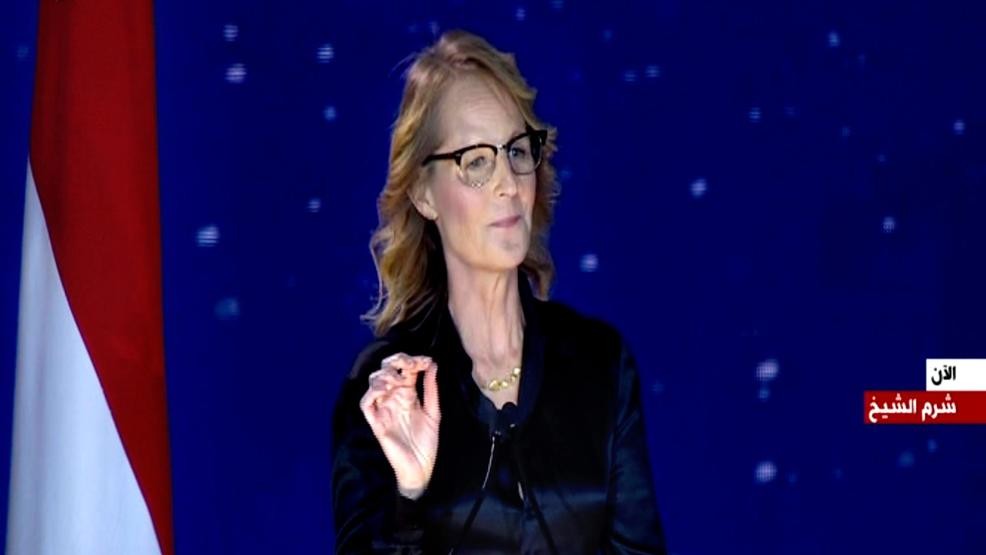
5  November 2017: image taken from video, showing actress Helen Hunt speaking during a government-organized youth conference in the Red Sea resort of Sharm el-Sheikh, Egypt. (AP Photo /CAPITAL BROADCAST CENTER)
Egyptian activists condemned American actress Helen Hunt on Tuesday for her participation in a government-organized youth conference they say is whitewashing authorities’ appalling human rights record and suppression of free speech. The open letter by Mona Seif and other well-known human rights advocates gained nearly 300 signatures by Tuesday afternoon. They included Mohamed Zaree, who last month won the Martin Ennals Award, and Aida Seif el-Dawla, whose Nadeem Center treats victims of torture and trauma and was shuttered by the government earlier this year.

The letter follows a flurry of online criticism against this week’s “World Youth Forum,” hosted under the patronage of President Abdel-Fattah el-Sissi, 62, in the Red Sea resort of Sharm el-Sheikh. Hunt, 54, was a keynote speaker at the opening ceremony. The event’s official Twitter hashtag #WeNeedToTalk has become a battleground for opposing viewpoints, with critics overwhelming the thread with images of Egyptian police beating and chasing down youths during el-Sissi’s rule alongside portraits of young jailed activists.

This isn’t just any forum that you chose to endorse,” the letter to Hunt read. “This is a youth forum with the slogan ‘We Need To Talk’ called for by a dictator who cannot stand any form of opposition or real criticism. He jails journalists for doing their jobs, youth for expressing their opinions, writers for writing fiction that violates ‘public morality,’ gays for coming out, supporters of LGBTQ for daring to support diversity, and he has blocked more than 400 different websites and media platforms.

Human rights defenders and their organizations such as Human Rights Watch and Amnesty International have documented enforced disappearances, widespread torture and a recent arrest campaign targeting people authorities believe are gay. The authorities have blocked hundreds of independent news and critical websites.[see also: https://humanrightsdefenders.blog/tag/egypt/]

The forum, which lasts until Nov. 10, has been broadcast nearly all day long on state and private television since its opening ceremony Sunday night. It has been widely promoted with slick television ads in Egypt, where several major Western PR firms advise and work for the government. A giant billboard hovers over Cairo’s Tahrir Square, epicenter of the youth-led 2011 uprising.

Hunt, an Academy Award-winning actress who now directs films, delivered a speech Sunday in which she criticized the U.S. justice system for its high incarceration rates and voiced support for the online anti-sexual harassment movement #MeToo. That, however, did not deflect criticism from Seif and other Egyptian feminists. “Unbelievable Hypocrisy! @Helenhunt speaks of “Women Rights” in a PR circus for a general who justified forced virginity tests,” Seif tweeted, referring to the military’s “virginity tests” conducted on a group of women protesters detained in 2011. El-Sissi, who was the chief of military intelligence at the time, was quoted then as saying the tests were necessary to head off possible allegations that the women were sexually assaulted by soldiers.

Others accused Hunt, the most famous Western celebrity at the event, of selling out to el-Sissi, pointing out a string of websites that advertise her as a for-hire speaker with fees between $50,000 to $1 million. Hunt did not respond to a social media request to discuss her efforts in Egypt.

http://ktul.com/news/entertainment/egyptian-activists-pan-us-actress-helen-hunt-in-open-letter

https://egyptianstreets.com/2017/11/08/egyptian-rights-activists-slam-us-actress-helen-hunt-in-open-letter/

Women Nobel Laureates ask to fight fundamentalism in all its guises

May 18, 2017
On 16 May 2017 Jennifer Allsopp reported for 50.50 from the second day of the Nobel Women’s Initiative conference at the historic Kaiser-Friedrich-Halle in Mönchengladbach, Germany. [see also: https://humanrightsdefenders.blog/2015/04/20/nobel-womens-initiative-defending-the-defenders-24-26-april-2015/]

Women human rights defenders meet at the 2017 Nobel Women's Initiative Conference. Credit: author.

Women human rights defenders meet at the 2017 Nobel Women’s Initiative Conference. Credit: author.

Jody Williams, Mairead Maguire, Rigoberta Menchu Tum, Shirini Ebadi and Tawakkol Karman have come to address the 900 attendees about their work fighting totalitarianism and fundamentalism in its many global guises in order to build a more peaceful just and equal world. The public event took place on the final evening of the sixth international conference of the Nobel Women’s Initiative. Over the last three days, more than 50 women human rights defenders have been in Mönchengladbach to discuss the future of the feminist movement in collaboration with Initiativikreis Mönchengladbach.

….

The global response to refugees has been a key theme of the conference over the past three days and is a concern of all the laureates. One of the reasons the delegates decided to hold the conference in Germany was to come and congratulate Germany for its policies, explained Tawakko Karman, Yemeni human rights activist and 2011 Nobel Peace laureate. Since the beginning of the so-called ‘refugee crisis’ in Europe, Germany has welcomed more than one million refugees, more than any other country in Europe. For 2016 and 2017 alone, the government has set aside 28.7 billioneuros of funding for their accommodation and integration.

….Many of the young people here have been politicised to defend human rights more broadly because of personal experiences of getting to know refugees in Germany. It heartens me because I know this experience will stay with them for life. I saw the same transformation time and time again myself as a national coordinator with the UK NGO Student Action for Refugees which supports students to set up volunteering and campaigning projects in their local communities. But unlike Germany, the UK – and other countries who are now turning their backs on refugees – are training the next generation to look inwards rather than out. They’re turning away from fostering international consciousness among citizens. This Jody Williams, who won the 1997 Nobel Peace prize for her work to ban antipersonnel landmines, has repeated over the last three days, is “the real fake news”.

Germany’s decision to welcome refugees has nevertheless not come without challenges, especially in terms of the far right explains Brigitte Schuster, a German teacher who has come along to hear the Nobel laureates speak. She teaches as part of a network of state funded programmes run by BAMF (the Federal for Migration and Refugees). Despite some “teething problems” in the provision of services, Bridgette insists, people are nevertheless now moving forward with their lives. They are contributing a lot to the community, she explains, including through sharing their stories and fostering consciousness of totalitarianism in other parts of the world.

After the event in the foyer the laureates message appears to have got through. Attendees have been issued a call to action. The laureates have thanked the German people for welcoming refugees but also asked them to keep up the pressure on the totalitarian regimes that they have fled and to fix the gaps in their own democracies. Tawakkol Karman, Yemeni human rights activist has called on those present not to victimise people but to “be close to people’s dreams, their aspirations and their suffering.” And she’s issued an order. “You will fight for a society of equal citizenship for men and women.

Five boys, all aged 15, jump over one another to tell me what they found most inspiring when I ask them in the foyer after the event. They’ve been brought along by their English teacher Meike Barth from the Gymnasium an der Gartenstraße which has around 900 students. They are also curious to learn about human rights struggles other parts of the world and how they can support them, in part because of the new refugee friends they have made at their school.

Ahmet says he was especially touched when Shirin Ebadi, who received the Nobel Peace Prize in 2003 for her efforts to promote human rights in Iran, mentioned the Berlin wall: “She said that that physical wall and the wall Trump wants to build is like the Berlin wall and we can bring it down,” he recounts. But Ahmet’s also struck by her message about breaking down the walls between people ideologically. “It’s not just physical walls but walls in our hearts. People can always find ways to talk across physical walls, but what’s more hard is what she said about solidarity and people, the politicians trying to stop that connection. Actually,” he reflects, “I was thinking of this different metaphor of a different kind of wall we all build together with that hope, like bricks but you also need cement….It’s a metaphor in progress!”

Ahmet is also inspired by Jody William’s work to erase landmines. “There are still landmines in Vietman”, he tells me, “actually I read about that just last week and I was sat there thinking we need to do something about that.” I ask him what he’s going to do: he’s going to organise a local event and write to politicians.

Sebastian meanwhile tells me what stuck with him was the message advanced by Northern Irish peace activist and 1976 Nobel Peace Prize laurate Mairead Maguire to use academic studies to advance the cause of peace, whatever the discipline. He enjoys chemistry, biology and maths and wants to help tackle climate change. “People thing human rights is just a subject but it’s actually about everything, the whole environment. It’s not just politicians saying this and that.” He’s been inspired by the public meeting tonight to organise his own event. Benjamin, another student, wants to get active on social media and says he is going to help him.


Source: Fight fundamentalism in all its guises: a call to action from Yemen to Germany | openDemocracy

10 women human rights defenders in cartoon images

March 23, 2017

10 December is obviously International Human Rights Day, but there are several countries that have a different or additional Human Rights Day of their own. One of them is South Africa where 21 March is historically linked with 21 March 1960 and the events of Sharpeville (on that day 69 people died and 180 were wounded when police fired on a peaceful crowd that had gathered in protest against the Pass laws – https://www.parliament.gov.za/project-event-details/2)

Boipelo Mokgothu in Traveller24 used the occasion on 20 March 2017 to publish  a compilation of the 10 most inspirational women from historical figures till today:

Read the rest of this entry »

JASS: feminist network supports Women Human Rights Defenders

February 11, 2013

JASS is an international feminist organization founded in 2003 by activists, popular educators, and scholars from 13 countries.  Working with women and diverse organizations and social movements in 27 countries, JASS trains and supports activist leadership and grassroots organizing and builds and mobilizes alliances amplified by creative media strategies to influence change in discriminatory institutions, policies and beliefs. On its website JASS devotes attention to women Human Rights Defenders. It reads in part:

“The insecurity and backlash that women face around the world transcend national boundaries and test the limits of established NGO and civil society responses prompting a demand for fresh alternatives and stronger, more agile alliances and strategic action. States can no longer be relied upon to protect citizens; transnational, non-state actors are exerting increased but often behind-the-scenes influence; and violence is perpetuated by widespread impunity.

Growing levels of influence by organized crime and other non-state actors, along with devastating economic policies have deepened the global crisis, leaving women activists largely unprotected and constantly under threat. State institutions would rather invest in militarization and wartime policies than harness the political will to defend women’s rights. Not only are women activists victims of slander and backlash from outside perpetrators, but also suffer violence from within their own communities and movements. Doubly at risk, their protection is particularly complex.

Despite the risks, women have mobilized around the world, leading struggles against impunity and repression. Suffering threats, intimidation and even death in reprisal for their work, these women activists, many of whom have never identified themselves as human rights defenders, continue to fight on the frontlines of social justice, democracy and rights battles. Women defenders span all levels of activism, joined together by their mutual concerns for justice. They are diverse, from community leaders, teachers, mothers, union members and LGBTI activists who defend social and economic rights to indigenous women, feminists, lawyers, journalists, and academics to advance political and civil rights.”

Guatemala, Honduras and Mexico top the list of reported cases of violence against women, journalists and activists. As a response, JASS is a founding member of the Mesoamerican Women Human Rights Defenders Initiative JASS facilitates dialogue, joint action and capacity building among diverse women activists; it publicizes their contributions to human rights, supports strategy development for protection and self-care, and mobilizes resources for their workAs of 2012, JASS’ program with women human rights defenders is largely being driven by the work of JASS Mesoamerica. However, interest in this work is evident throughout the organization. For example, JASS Southern Africahas begun discussions on how to integrate heart-mind-body strategies into a women human rights defenders approach to support safety, wellbeing and self-care.