Posts Tagged ‘Euronews’

EU directives for SLAPPs and Media Freedom: a long journey

July 2, 2023
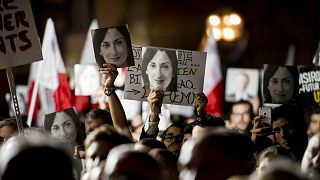
Protesters hold photos of slain journalist Daphne Caruana Galizia outside the office of the Prime Minister of Malta on Nov. 29, 2019

Maria Psara – writing for Euronews of 27June 2023 – says that European Union member States are trying to water down the directives for SLAPPs and Media Freedom…European lawmakers are accusing member states of trying to water down EU legislation aimed at strengthening protections for journalists and media freedom. 

The European Parliament’s Legal Affairs Committee (JURI) will on Tuesday vote on an anti-SLAPP directive first proposed by the Commission in April 2022 and that would enable judges to swiftly dismiss manifestly unfounded lawsuits against journalists and human rights defenders.  [see: https://humanrightsdefenders.blog/2022/04/28/eu-finally-moves-on-law-to-protect-media-from-legal-abuse-slapps/]

It would also establish several procedural safeguards and remedies, such as compensation for damages, and dissuasive penalties for launching abusive lawsuits. The JURI vote will form the basis of the Parliament’s position in negotiations with member states if it is also endorsed by the plenary in mid-July.

SLAPPs or Strategic lawsuits against public participation are a particular form of harassment used primarily against journalists and human rights defenders to prevent or penalise speaking up on issues of public interest. The Commission’s proposal has been dubbed as the ‘Daphne Law’ in honour of murdered Maltese journalist Daphne Caruana Galizia.

Member states, which together form the Council of the EU, have however sought to water down the text, drawing criticism for the Commission.

“I would like to express my regret concerning the weakening of the remedies against abusive court proceedings, in particular the deletion of the provision on compensation of damage and the weakening of the provision on award of costs,” Didier Reynders, Commissioner for Justice, said earlier this month after member states agreed on their negotiating position. 

Parliament is seeking to redress that with German MEP Tiemo Wölken (S&D), the rapporteur on the draft directive, telling Euronews: “We made it stronger and we also added other provisions such as a creation of an ‘one stop shop’ which the SLAPPs targets can contact to receive help by dedicated national networks of specialized lawyers, legal practitioners and psychologists.”

It is not the first time member states are accused of trying to water down a proposal on media freedom.  Earlier this month, a deal among the 27 member states on the European Media Freedom Act (EMFA) made a lot of eyebrows rise, because of a planned exemption to allow for the wiretapping of journalists. The regulation, first proposed by the Commission in September 2022, included safeguards against political interference in editorial decisions and against surveillance. The EU’s executive wanted to put focus on the independence and stable funding of public service media as well as on the transparency of media ownership and the allocation of state advertising.

“We have welcomed in particular as a political symbol the draft regulation for EMFA, as the Commission for the first time has adopted a legislative act dealing with all media, a traditionally sensitive subject dealt with at national level only,”  Renate Schroeder, director of the European Federation of Journalists (EFJ), told Euronews. Yet, the EPJ and other NGOs, still criticised the proposal as “not ambitious enough”.

“In particular we believed that Article 4 on the protection of journalists’ sources and protection from surveillance has not met Council of Europe standards. We also advocated for stronger binding rules on media transparency,” Schroeder added.

But member states are seeking to add an exemption to Article 4, introduced by France and opposed by Germany only, that would allow them to spy on journalists in the name of national security.

The original proposal sought to ensure that governments could not “detain, sanction, intercept, subject to surveillance or search and seizure” journalists in order to uncover their sources, unless “justified by an overriding requirement in the public interest” while the deployment of spyware was to be restricted only to “serious crimes”. 

The Council’s is hoping to broaden the number of offenses allowing such surveillance from 10 to 32.

“The text doesn’t protect journalists anymore and thereby makes the Act almost useless for journalists’ protection at least,” Schroeder said. 

“It still proposes useful tools when it comes to independence of public service media, transparency on state advertisement, some minimum rules on media ownership and on editorial independence. But yes, some member-states are afraid of journalism and thereby give hands to illiberal countries such as Hungary who oppose the Act. We hope the European Parliament will be firm, but we are not too optimistic,” underlined the director of EFJ.

However, on 12 July, with 498 votes to 33 and 105 abstentions, MEPs adopted their negotiating position on new rules to protect those working on matters of public interest like fundamental rights, the activities of public officials or corruption allegations.

On 27 February 2024, the European Parliament formally adopted that text, which has now been published. https://www.lexology.com/library/detail.aspx?g=105f78e8-27de-4fa3-99b1-6ed97c4d659f

See also: https://www.independent.com.mt/articles/2023-07-11/local-news/Protection-of-journalists-in-the-EU-MEPs-back-rules-to-stop-abusive-legal-cases-6736253272

for Latin America, see: https://www.article19.org/resources/inter-american-commission-on-human-rights-ensure-protection-against-slapps/

https://www.euronews.com/my-europe/2023/06/26/meps-accuse-eu-countries-of-undermining-attemps-to-protect-journalists

https://www.europarl.europa.eu/doceo/document/A-9-2023-0223_EN.html

https://www.euronews.com/my-europe/2023/08/23/record-number-of-abusive-slapp-lawsuits-filed-in-europe-in-2022-report

and then on 30 November 2023: https://www.consilium.europa.eu/en/press/press-releases/2023/11/30/council-and-eu-parliament-reach-provisional-agreement-on-eu-law-protecting-journalists-and-human-rights-defenders/

and on 29 April 2024 the UN came with: https://www.ohchr.org/en/documents/brochures-and-leaflets/impact-slapps-human-rights-and-how-respond

Finally:

https://commission.europa.eu/news/new-eu-rules-protect-against-strategic-lawsuits-against-public-participation-enter-force-2024-05-03_en

https://www.hrw.org/news/2024/05/07/joint-statement-civil-society-reaction-adoption-eu-directive-combating-violence

Alexei Navalny wins EU’s Sakharov Prize

October 21, 2021

Imprisoned Russian opposition leader Alexei Navalny has been awarded with the Sakharov Prize for Freedom of Thought. The award winner was selected by the leaders of the political parties represented in the European Parliament during a plenary session in Strasbourg on Wednesday 20 October 2021. [For more on this and other awards in the name of Sakharov, see: https://www.trueheroesfilms.org/thedigest/awards/BDE3E41A-8706-42F1-A6C5-ECBBC4CDB449]

Navalny, the most prominent foe of Russian President Vladimir Putin, was nominated alongside Afghan women, whose plight has taken centre stage after the Taliban takeover, and Jeanine Áñez, a Bolivian politician who became interim president in 2019 after alleged electoral fraud by Evo Morales. Áñez was later arrested for allegedly plotting coup d’état against Morales. [see: https://humanrightsdefenders.blog/2021/09/29/the-nominees-for-the-eus-sakharov-prize-2021/]

The award is supposed to be presented during a European Parliament session in Strasbourg on December 15, although this seems unlikely to happen in the case of Navalny since he’s currently serving a two-and-a-half-year jail sentence for fraud in Russia.

See also: https://www.trueheroesfilms.org/thedigest/laureates/c549c081-1c9f-489a-8ba6-6e2323cb9fcb

He says the charges were politically motivated to halt his challenge to the Kremlin. Russian authorities have opened a new criminal case against Navalny that could see him stay in jail for another decade.

Today’s prize recognises his immense bravery and we reiterate our call for his immediate release,” said David Sassoli, President of the European Parliament, in a tweet. The main political parties also celebrated the laureate’s work and recognition, although some

“His unbroken commitment for a democratic Russia is representative of the many activists who are fighting for liberal rights,” wrote David McAllister, a German MEP of the centre-right EPP group and chairman of the parliament’s committee on foreign affairs.

His bravery for freedom of thought and expression show how they are the precondition for democratic politics, human dignity & peace,” said Belgian MEP Guy Verhofstadt, from Renew Europe.

https://www.euronews.com/2021/10/20/alexei-navalny-wins-sakharov-prize-the-eu-s-highest-award-for-human-rights-work

Euronews on Achilova and the MEA was banned by Turkmenistan

March 10, 2021

It now transpired that Turkmenistan on March 8 stopped broadcasting the news TV channel Euronews, which showed the footage about the 2021 Martin Ennals Award Ceremony for Human Rights Defenders and one of its finalist, the Turkmen journalist Soltan Achilova, independent foreign-based news website Chronicles of Turkmenistan reported.

The 2021 Award Ceremony of the most prestigious award for human rights defenders was held in an online format on 11 February.

As Vienna-based Chronicles of Turkmenistan has reported, l This year’s finalists included Soltan Achilova, a 72-year-old journalist and activist who has reported on state repression in Turkmenistan in the face of relentless intimidation. Her story was well told in a recent profile by AFP news agency. [see also; https://humanrightsdefenders.blog/2021/02/23/soltan-achilova-has-issued-a-rare-rebuke-of-the-turkmen-president-on-youtube/]

Akhal-Teke is a weekly Eurasianet column compiling news and analysis from Turkmenistan. It added on 9 March: Euronews is about as anodyne a news channel as one could hope to find. So much so that the Turkmen Foreign Ministry in January 2020 hosted the channel’s chief business development officer, Roland Nikolaou, for talks on future cooperation. That makes the inclusion of Euronews among the ranks of undesirables all the more remarkable. 

Turkmenistan has the backup option of Mir 24, a Euronews clone based out of Moscow and focused on news from Commonwealth of Independent States members. Turkmenistan is an associate member of the post-Soviet bloc. The station began broadcasting inside the country in December 2020, following a cooperation deal signed with the Turkmen state broadcaster a month earlier. 

Mir 24 also produces content, of the most unimaginably inoffensive kind, from inside the country. Recent reports have included one on a highly chaste beauty contest for female students, several touching upon celebrations for International Women’s Day and a piece about the creation of a national annual holiday devoted to the Alabai dog breed

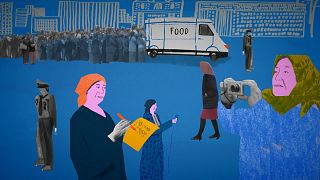
Blocking Euronews is of little import in the larger scheme of things. As RFE/RL wrote on March 7, police are adopting invigorated measures to make sure that smartphone owners are not using VPN services to circumvent censorship. The broadcaster said that authorities in the city of Mary are stopping people in the street for spot inspections of their phones.  

The cause of this alarm is the continued seepage of news belying the absurd government insistence that the country has experienced no cases of COVID-19.

https://www.timesca.com/index.php/news/23543-turkmenistan-stops-broadcasting-euronews-channel-after-tv-footage-about-turkmen-journalist

https://eurasianet.org/turkmenistan-a-ban-on-all-news-ye-who-enter-here

2021 edition of Geneva film festival kicks off in virtual format

March 6, 2021
The FIFDH kicks off in virtual format for its 19th edition
  • Wolfgang Spindler  reported on 0 March 2021 that the 19th edition of the International Film Festival and Forum on Human Rights in Geneva has gone virtual. Usually every year some 40 000 visitors attend to watch and discuss films that focus on human rights violations. Around 300 filmmakers, human rights defenders and politicians from 25 countries across the globe used to be invited. But, this year, the festival has been forced to change and adapt to the COVID-19 pandemic. Participants are now encouraged to click on ‘likes‘ instead of applauding, as physical presence is not possible.

Isabelle Gattiker is the FIFDH Festival Director. She said that the festival had to reinvent itself. They are proposing videos on demand, that she describes as not being able to replace real cinema theatres. But they have tried “to work on public participation despite the digital format”. Online audiences can comment and ask questions during the showings every evening from 8 pm (CET) from anywhere on the planet.

For the first time ever there will also be a public award, where the viewers can give a mark to the films they’ve watched. At the end of the festival, the film with the highest rating from the official selection will be awarded this prize.

Soltan Achilova This 19th edition is dedicated to Turkmenistan Photojournalist, Soltan Achilova. The 71-year-old was amongst this year’s finalists for the “Martin Ennals Award“, an annual prize known as “the Nobel prize for human rights defenders. See: https://humanrightsdefenders.blog/2021/02/23/soltan-achilova-has-issued-a-rare-rebuke-of-the-turkmen-president-on-youtube/

https://www.euronews.com/2021/03/05/the-fifdh-kicks-off-in-virtual-format-for-its-19th-edition

https://fifdh.org/en/program-2021

Internet shutdowns to silence opposition – what to do?

January 28, 2019

“African governments use Internet shutdowns to silence opposition more and more —what can people do?” askson EuroNews of

What would you do if your government decided to intentionally shut down your access to the Internet? Millions of people around the world have had to answer this question time and time again over the past few years, as government-mandated Internet blackouts are on the rise. Less than a month into 2019, Sudan, the Democratic Republic of Congo, Gabon and Zimbabwe have experienced government crackdowns on Internet connections.

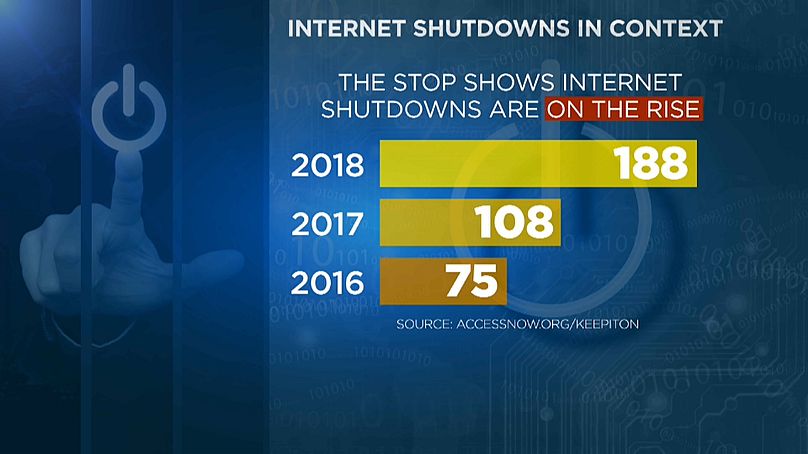
From 2016 to 2018, 371 separate cases of Internet shutdowns were documented around the world. More than half of them occurred last year alone, according to international non-profit organisation Access Now.

Authorities have used a number of reasons to justify the blackouts, including public safety, national security and stopping the dissemination of rumors and illegal content. However, advocacy groups investigating governmental tendencies to exert control over the flow of information don’t buy it. They claim it has more to do with silencing opposition movements and protests and trying to limit political instability.

They harm everyone: businesses, emergency services, journalism, human rights defenders, and demonstrators. They don’t help victims or restore order,” Access Now’s website reads.

In the past few weeks, several African governments have turned to partial or complete shutdowns in attempts to control the public discussion.

Sudan doubled down on social media amid widespread anti-government protests, with Access Now and the #KeepItOn coalition calling on network operators to fight back against state pressure — but it wasn’t the only African country to do so.

Zimbabwean authorities were quick to gag social media — including Facebook and Whatsapp — as soon as civil unrest over rising fuel prices spread in Harare and other major cities, and the DRC also ordered a full blackout following recent elections…..

From 2016 to 2018 alone, Africa witnessed 46 Internet shutdowns,…….Chad, Sierra Leone, Ethiopia, Somaliland, Algeria, Togo, Cameroon, Gambia, Uganda, Gabon, Algeria, Morocco, Lybia, Tunisia, and Algeria have all cracked down on their citizens’ access to the Internet in the past.

How did citizens react to Internet or social media shutdowns?

People always find a way”, Zimbabwean analyst Alexander Rusero told Euronews. “But it {VPN} doesn’t work for everyone”, Rusero pointed out. “Usually the ones in Harare, at the centre of the country, manage to”.

The analyst was quick to underline the issues behind similar crackdowns…”During the Internet blackout there were a lot of lies and rumors — they spread faster than you would believe. Media relies on social media, and so do critical opinion leaders. Outside those platforms, fake news manifest”.

Jean-Hubert Bondo, a journalist from the Democratic Republic of the Congo, doesn’t believe the problems end here. “Many Congolese families live off their small cybercafés. Also, we are in a country where there are not enough physical libraries. Students and researchers use the Internet to research their work at the university. Young people animate pages on Facebook and WhatsApp”, he told Euronews. “To deprive us of the Internet is to take us back to antiquity”. As for the VPNs Rusero mentioned — the most common ways to avoid Internet censorship worldwide — Bondo said that, during the latest shutdown, they failed to work. “In response to what is being perceived as a violation of human rights, Bondo reported that several Congolese civil society organisations have now lodged a complaint against the main telecommunication companies.

In Uganda, a crackdown on Twitter, Facebook, WhatsApp, YouTube, and mobile money apps in February 2016 as citizens were heading to the polls sparked a legal case that will be discussed in court in February 2019. “Shutdowns may not silence people, but they do hinder communication”, said Ugandan blogger Ruth Aine Tindyebwa….

https://www.euronews.com/2019/01/26/african-governments-use-internet-shutdowns-to-silence-opposition-more-and-more-what-can-pe

https://www.dailynews.co.zw/articles/2019/01/27/ed-justifies-internet-shutdown

Cartooning for Peace award in Euronews video clip

May 23, 2014

This clip was produced by True Heroes Films (THF) for Euronews which covered the event of the 2nd international Cartooning for Peace award. [for more on the award see http://www.trueheroesfilms.org/thedigest/award/cartooning-peace-press-award].

The foundation “Cartooning for Peace” went to Syria-Palestinian Hani Abbas and Egyptian Doaa Eladl for their work. Former Secretary General Kofi Annan handed them the international award for press cartoonists in Geneva, as part of World Press Day. French cartoonist Plantu gave Euronews his views on the significance of using cartoons as a form of expression: “We’re trying to show the level of resistance that exists today, from the perspective of the very people that allow us to understand the word “resistance”, the cartoonists that ultimately become the foot soldiers of democracy. In other words, they’re railing against different powers, not just the power of their editors but also against political and religious power.” 

From Lake Geneva, euronews correspondent Wolfgang Spindler said: “Political cartoons can be subversive, provocative and amusing – they make us smile, they give us pause for thought. But we very often forget that the cartoonists behind them sometimes have to risk their lives daily for the sake of their work.”  via: http://www.euronews.com/2014/05/05/drawing-for-peace

The cartoon exhibition on the banks of Lake Geneva runs until the beginning of July and then moves to Sarajevo.

previous post: https://thoolen.wordpress.com/2014/05/04/cartooning-for-peace-international-award-and-exhibit-in-geneva-as-from-today/