The disastrous impact that multinationals have on the environment can no longer be denied. The human right to live in a healthy environment concerns us all, therefore, FIDH and its member organisations are launching coordinated legal actions across the world. The companies implicated and States which allow it to happen must be held accountable.
It is time to recognize the right to a healthy environment as a fundamental human right and to hold companies accountable for their actions.
Environmental impact = human impact Because human rights and the environment are interdependent, it is crucial that States recognise the right to a healthy environment as a fundamental human right. Hundreds of organisations are fighting for a UN resolution to achieve international recognition of this.
Restoring a healthy environment to affected communities In the face of environmental disasters and human rights violations, the balance is still too often tipped in favour of the companies involved. Ensuring access to justice for those most affected and passing laws which hold multinationals accountable are also means to protect the planet.
.. Prayer is a public way for a Pope to make a social and political statement of great importance.
“We pray for those who risk their lives while fighting for fundamental rights under dictatorships, authoritarian regimes and even in democracies in crisis,” he said. Pope Francis is very aware of the struggle and needs of these dedicated human rights activists fighting for justice and peace and the human dignity. Those standing for racial equality in the “Black Lives Matter” campaign and those fighting for women and children’s rights in the “Me Too Movement.”
He addressed all people – Christians, non-Christians, people of all religious beliefs or those with none at all – who have dedicated their lives serving humanity and giving unselfish service without seeking reward. They need and deserve our support when we can’t help the victims of abuse directly. They do the vital work for us defending victims of rights violations and courageously give their lives doing it. In the Philippines, 318 human rights workers and activists were killed between July 2016 and June 2020. As many as 110 lawyers were killed from 1972 to the present. Sixty-one of those killings have taken place since 2016. Also, 86 journalists and reporters have been killed since 1992.
They are accepting serious risks defending victims of abuse and violations of their human dignity and rights. The suffer hardship and abuse, rejection and imprisonment and death because of their work for human rights in supporting the downtrodden and abused victims. They are survivors themselves. They have that most fundamental love of others to uphold the dignity and rights of every human being…..
Many others have escaped to try and reach Europe in search of a new life. Pope Francis has prayed and appealed for European countries to open their borders to welcome the war refugees. Germany and some nations did. Canada has received thousands of refugees and many from Syria in recent years. However, the anti-asylum people and Neo-Nazis of Europe rose up and opposed any welcome and right-wing political parties grew to stop it and largely succeeded. Some Catholic countries slammed shut their doors with dark compassionless hearts and built fences to keep out the refugees, thousands of them homeless children. Too bad if Jesus of Nazareth and his parents were arrested at the Egyptian border and deported them to the cruel baby-killer King Herod for a death penalty, there would have been no Christianity.
Under international law, a person fleeing persecution seeking asylum has a right to reach the country of destination and choice by any means available to ask for protection, shelter and asylum. Many hard-hearted people see them as parasites, pests and vermin to be rejected. The newly proposed UK asylum law is suggesting to do just that by declaring asylum seekers who reach the UK as “illegals.”
There can be no “illegal” entry to a country by an asylum seeker. Many Germans escaping East Germany seeking asylum in the West during the Cold War would have to be declared illegal entry and returned to the communist East if such crossing the border seeking asylum was said to be illegal. Such escapes were cheered and encouraged. The proposed law by the UK wants to make illegal what under international law is right and legal and just. To deport an asylum seeker without due process and evaluation would be a violation of that refugee’s human rights, according to some UK human rights lawyers.
More dictators and populist autocratic leaders have emerged in recent decades. Pope Francis’s prayer is badly needed in Myanmar as the people have shown courage and bravery in facing down the military that staged a coup six weeks ago. The defiance and resilience of the people and youth is inspiring and as many as 260 have been killed by the military, thousands more arrested and detained.
The cries and voices of the oppressed and imprisoned Uyghurs are being heard and supported by the human rights campaigners. They will be encouraged by the prayer and support of Pope Francis, a world-renowned voice for the voiceless and oppressed people. Many are calling for an end to what they call a genocide. Millions of Uyghurs are allegedly imprisoned in re-education camps by the communist regime and women forcibly sterilized, raped and killed, according to escaped witnesses interviewed on world media.
In every country where tyrants and dictators arbitrarily arrest and imprison their own people and kill them with impunity, the voice of protest denouncing the evil deeds can be heard. We are all challenged to join the prayer of Pope Francis and thousands of human rights defenders to campaign on social media and sign petitions in their support. If ever the tyrant’s goons come for us, may we have human rights defenders at our side.
HUMAN RIGHTS DEFENDERS are people who promote and protect the human rights of others, whether individually or in association with others. They are people who act with humanity, serve humanity and bring out the best in humanity. For all of these defenders, international and regional human rights mechanisms can protect and amplify their work and impact on the ground. This strategy has been developed in a context characterised by uncertainty and change, including a worsening climate emergency, a global pandemic and associated financial crisis, deepening inequalities, worsening authoritarianism and populism, as well as the erosion of multilateralism, and the rule of law. It is also a context characterised by increased awareness and action at the local, national, regional and international levels. Human rights defenders are mobilising around issues such as environmental justice, racial justice, gender equality, freedom of For many defenders working in restrictive national contexts, regional and international mechanisms may be the only platforms available. For these mechanisms to be effective, however, they need to be credible, accessible and responsive to defenders, providing them with a safe and influential platform from which to demand justice, push for accountability, and contribute to positive change. freedom of expression and association, access to information, democratic representation and participation, the redistribution of economic and political power, and state and corporate accountability for intersecting human rights violations and abuses.
On many of these issues, we are at an inflection point; a point at which the work of human rights defenders is perhaps more imperilled but more important than ever. For example:
ENVIRONMENTAL ACTIVISTS AND INDIGENOUS PEOPLES, whose knowledge is vital to live more responsibly and sustainably, are being killed and displaced for their work to prevent exploitation and to protect precious forests and oceans.
STUDENTS AND WORKERS mobilising online and offline to call for democratic freedoms and protest against authoritarianism are being surveilled, harassed and criminalised under abusive counter- terrorism laws.
SOCIAL MOVEMENTS taking to the streets to demand racial justice are being met with disproportionate force from police and security forces.
WOMEN’S RIGHTS ACTIVISTS are being detained and tortured in retaliation for their work to challenge patriarchy and demand an end to discrimination and violence.
AT-RISK MIGRANT ACTIVISTS AND HUMANITARIAN WORKERS who support migrant rights are being criminalised and prosecuted as threats to national security.
The freedom, safety and work of these and many other human rights defenders is vital to build a better future for all. The purpose of this Strategic Framework is to guide the effective pursuit of ISHR’s Vision, Mission and Values, and the achievement of ISHR’s Overall Goals. It articulates Strategic Goals and a framework for identifying priorities, and maps an organisational structure and working methods that will ensure agility and sustainability in a fast changing world. The strategy was developed through a highly consultative process over a 10 month period with extensive and invaluable inputs from human rights defenders, NGOs working at the national, regional and inter-national levels, human rights experts, and diplomatic and financial partners, as well as ISHR Board and staff. It is complemented with a results framework, and implemented through an annual activity plan and budget, and reviewed and updated on a biennial basis to ensure it remains relevant, responsive, ambitious and agenda setting. The framework provides the structure for our planning, monitoring, evaluation and learning process.
One often thinks that indigenous issues play mostly in the Americas but the Webinar on Strengthening the Protection of Indigenous Peoples in Asia: “Situation of Indigenous Human Rights Defenders in the Asian region and the responsibility of Business Enterprises to respect Human Rights” show another picture.
Date and time: 26 November 2020, 14.00 -15.30 ICT Location: Virtual Duration: 1 hour and 30 minutes
“Suppression of the right to freedom of association and attacks against and criminalization of indigenous human rights and environmental defenders across the region are closely linked to large-scale development projects and, in certain subregions, to conservation efforts. Threats against indigenous human rights defenders are exacerbated by the intensifying global competition over natural resources and by increasing militarization where State and non-State actors collude to grab indigenous lands for profit.” – Report of the Special Rapporteur on the rights of indigenous peoples Regional consultation on the rights of indigenous peoples in Asia September 2020
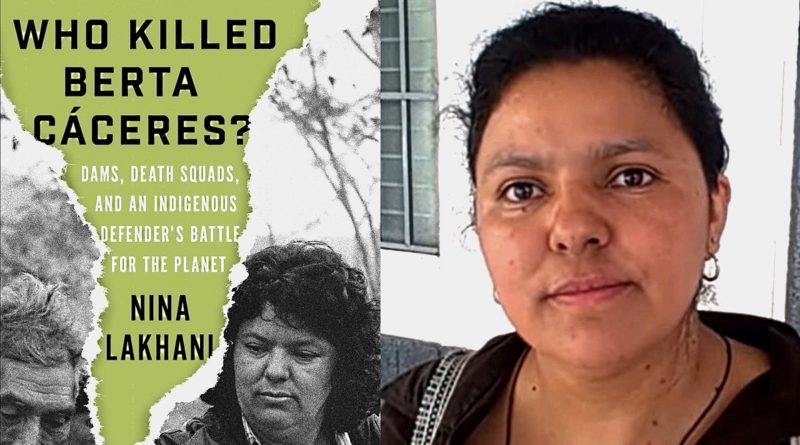
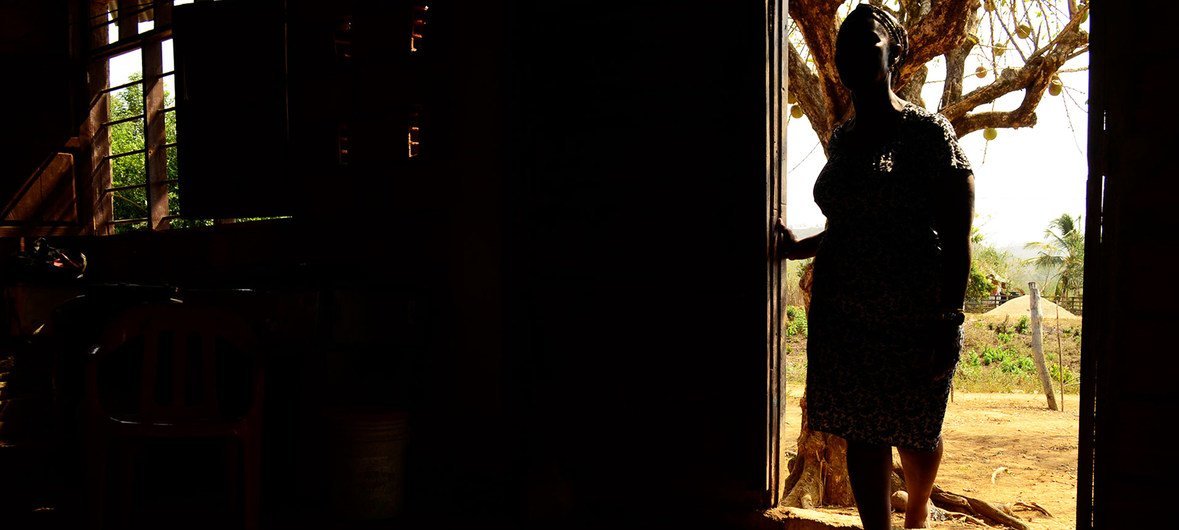
“They build dams and kill people.” These words, spoken by a witness when the murderers of environmental defender Berta Cáceres were brought to trial in Honduras, describe Desarrollos Energéticos SA (DESA), the company whose dam project Berta opposed. DESA was created in May 2009 solely to build the Agua Zarca hydroelectric scheme, using the waters of the Gualcarque River, regarded as sacred by the Lenca communities who live on its banks. As Nina Lakhani makes clear in her book Who Killed Berta Cáceres?, DESA was one of many companies to benefit from the 2009 coup d’état in Honduras, when the left-leaning President Manuel Zelaya was deposed and replaced by a sequence of corrupt administrations. The president of DESA and its head of security were both US-trained former Honduran military officers, schooled in counterinsurgency. By 2010, despite having no track record of building dams, DESA had already obtained the permits it needed to produce and sell electricity, and by 2011, with no local consultation, it had received its environmental licence.
..Lakhani quotes a high-ranking judge she spoke to, sacked for denouncing the 2009 coup, as saying that Zelaya was deposed precisely because he stood in the way of this economic model and the roll-out of extractive industries that it required. The coup “unleashed a tsunami of environmentally destructive ‘development’ projects as the new regime set about seizing resource-rich territories.” After the post-coup elections, the then president Porfirio Lobo declared Honduras open for business, …….
Lakhani’s book gives us an insight into the personal history that brought Berta Cáceres to this point. She came from a family of political activists. As a teenager she read books on Marxism and the Cuban revolution. But Honduras is unlike its three neighbouring countries where there were strong revolutionary movements in the 1970s and 1980s. The US had already been granted free rein in Honduras in exchange for “dollars, training in torture-based interrogation methods, and silence.”… At the age of only 18, looking for political inspiration and action, Berta left Honduras and went with her future husband Salvador Zúñiga to neighbouring El Salvador. She joined the FMLN guerrilla movement and spent months fighting against the US-supported right-wing government. Zúñiga describes her as having been “strong and fearless” even when the unit they were in came under attack. But in an important sense, her strong political convictions were tempered by the fighting: she resolved that “whatever we did in Honduras, it would be without guns.”
Inspired also by the Zapatista struggle in Mexico and by Guatemala’s feminist leader Rigoberta Menchú, Berta and Salvador created COPINH in 1993 to demand indigenous rights for the Lenca people, organising their first march on the capital Tegucigalpa in 1994. From this point Berta began to learn of the experiences of Honduras’s other indigenous groups, especially the Garífuna on its northern coast, and saw how they fitted within a pattern repeated across Latin America….
In Río Blanco, where the Lenca community voted 401 to 7 against the dam, COPINH’s struggle continued. By 2013, the community seemed close to winning, at the cost of activists being killed or injured by soldiers guarding the construction. They had blocked the access road to the site for a whole year and the Chinese engineering firm had given up its contract. The World Bank allegedly pulled its funding, although Lakhani shows that its money later went back into the project via a bank owned by the Atala Faraj family. In April 2015 Berta was awarded the Goldman Prize for her “grassroots campaign that successfully pressured the world’s largest dam builder to pull out of the Agua Zarca Dam.”
…….
The horrific events on the night of Wednesday March 2 are retold by Nina Lakhani. Armed men burst through the back door of Berta’s house and shot her. They also injured Gustavo Castro, who was visiting Berta; he waited until the men had left, found her, and she died in his arms. ,,,By the first anniversary of Berta’s death the stuttering investigation had led to eight arrests, but the people who ordered the murder were still enjoying impunity. Some of the accused were connected to the military, which was not surprising since Lakhani later revealed in a report for The Guardian that she had uncovered a military hit list with Berta’s name on it. In the book she reports that the ex-soldier who told her about it is still in hiding: he had seen not only the list but also one of the secret torture centers maintained by the military.
Nina Lakhani is a brave reporter. She had to be. Since the coup in Honduras, 83 journalists have been killed; 21 were thrown in prison during the period when Lakhani was writing her book. She poses the question “would we ever know who killed Berta Cáceres?” and sets out to answer it. Despite her diligent and often risky investigation, she can only give a partial answer. Those arrested and since convicted almost certainly include the hitmen who carried out the murder, but it is far from the clear that the intellectual authors of the crime have been caught. In 2017 Lakhani interviewed or attempted to interview all eight of those imprisoned and awaiting trial, casting a sometimes-sympathetic light on their likely involvement and why they took part.
….
In September 2018, the murder case finally went to trial, and Lakhani is at court to hear it, but the hearing is suspended. On the same day she starts to receive threats, reported in London’s Press Gazette and duly receiving international attention. Not surprisingly she sees this as an attempt to intimidate her into not covering the trial. Nevertheless, when it reopens on October 25, she is there. The trial reveals a weird mix of diligent police work and careful forensic evidence, together with the investigation’s obvious gaps. Not the least of these was the absence of Gustavo Castro, the only witness, whose return to Honduras was obstructed by the attorney general’s office. Castillo, though by then charged with masterminding the murder, was not part of the trial. Most of the evidence was not made public or even revealed to the accused. The Cáceres family’s lawyers were denied a part in the trial.
“The who did what, why and how was missing,” says Lakhani, “until we got the phone evidence which was the game changer.” The phone evidence benefitted from an expert witness who explained in detail how it implicated the accused. She revealed that an earlier plan to carry out the murder in February was postponed. She showed the positions of the accused on the night in the following month when Berta was killed. She also made clear that members of the Atala family were involved.
When the verdict was delivered on November 29 2018, seven of the eight accused were found guilty, but it wasn’t until December 2019 that they were given long sentences. That’s where Nina Lakhani’s story ends. By then Honduras had endured a fraudulent election, its president’s brother had been found guilty of drug running in the US, and tens of thousands of Hondurans were heading north in migrant caravans. David Castillo hasn’t yet been brought to trial, and last year was accused by the School of Americas Watch of involvement in a wider range of crimes. … Daniel Atala Midence, accused by COPINH of being a key intellectual author of the crime as DESA’s chief financial officer, has never been indicted.
...And a full answer to the question “Who Killed Berta Cáceres?” is still awaited.
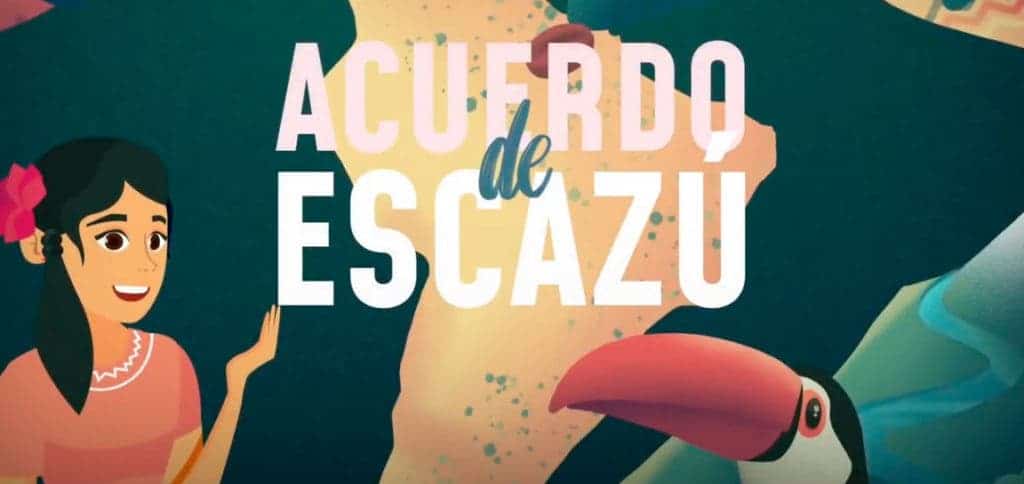
Fermin Koop in ZME Science of 16 December 2019 writes about the Escazú Agreement that wants to protect environmental human rights in Latin America. Approved in 2018 after six years of negotiations, the Escazú Agreement is the first environmental human rights treaty in Latin America and the Caribbean – the region with one of the world’s richest biodiversity, but also very dangerous for environmental defenders. [see also: https://humanrightsdefenders.blog/2019/09/11/opening-statement-by-un-high-commissioner-michelle-bachelet-focuses-very-much-on-climate-change/#more-13457]. The agreement, which name comes from the Costa Rican town where it was signed, forces states to protect the people that defend the environment. But not just states. It is based on the spirit of the UN Guiding Principles on Business and Human Rights regarding companies’ obligations to respect human rights, and aims to bring those principles into play when it comes to the environment.
Despite being signed a year ago, the agreement hasn’t entered into force yet as it requires 11 of Latin America and the Caribbean’s 33 countries to ratify it. Only five have done that so far: Bolivia, Guyana, Saint Kitts, and Nevis, Saint Vincent and the Grenadines, and Uruguay. A group of 16 countries have signed it but not ratified it: Colombia, Antigua and Barbuda, Argentina, Brazil, Costa Rica, Ecuador, Granada, Guatemala, Haiti, Jamaica, Mexico, Nicaragua, Panama, Paraguay, Peru, Dominican Republic and Saint Lucia. Another group of 10 countries has not signed it: Bahamas, Barbados, Belize, Cuba, Dominica, El Salvador, Honduras, Suriname, Trinidad and Tobago, Venezuela and Chile.
A recent journalistic project called Land of Resistants, looked at the situation faced by environmental defenders in Latin America. They were subject to 1.356 attacks and incidences of violence between 2009 and 2019, according to the findings. Up to 50% of the attacks were targeted at people from ethnic minorities.
The Opening statement by UN High Commissioner for Human Rights, Michelle Bachelet, at the 42nd Session of the UN human Rights Council in Geneva on 9 September 2019 was widely reported in the media as having an exceptionally strong focus on climate change and human rights.
The crucial paragraph on environmental human rights defenders is quoted below:
UN Colombia – A wide range of human rights activists have been targeted in Colombia, especially those living in rural areas. Human and environmental rights campaigners are one focus of a new UNEP/OHCHR agreement.
On 16 August 2019 the UN environment agency (UNEP) and the UN human rights office (OHCHR) signed a landmark new agreement aimed at better protecting vulnerable human and environmental rights defenders and their families, while increasing protection for people and the places where they live, across the world. The UN Environment Programme (UNEP) will strengthen cooperation with OHCHR, as threats to individuals and communities defending their environmental and land rights intensify. Reports suggest that an average of more than three rights defenders were killed every week last year.
“A healthy environment is vital to fulfilling our aspiration to ensure people everywhere live a life of dignity”, said UNEP Executive Director, Inger Andersen. “We must curb the emerging trend of intimidation and criminalisation of land and environmental defenders, and the use of anti-protest and anti-terrorism laws to criminalise the exercise of rights that should be constitutionally protected.” “UNEP and the UN Human Rights Office are committed to bringing environmental protection closer to the people by assisting state and non-state actors to promote, protect and respect environmental and human rights. In doing so, we will move towards a more sustainable and just planet,” she added.
UN High Commissioner for Human Rights, Michelle Bachelet, said: “Our planet is being recklessly destroyed, and we urgently need stronger global partnerships to take action to save it…We call on leaders and governments to recognise that climate change and environmental degradation severely undermine the human rights of their people, particularly those in vulnerable situations – including the generations of tomorrow.”
A key part of the new protection agreement is to monitor threats to environmental human rights defenders more closely, develop better defenders’ networks, urge more effective accountability for perpetrators of violence and intimidation, and promote “meaningful and informed participation by defenders and civil society, in environmental decision-making.
Ms. Bachelet said every State needed to be encouraged “to develop and enforce national legal frameworks which uphold the clear linkages between a healthy environment and the ability to enjoy all other human rights, including the rights to health, water, food – and even the right to life…We also strongly encourage greater recognition that the actions and advocacy of environmental human rights defenders are deeply beneficial to all societies.”
The number of environmental human rights defenders murdered across the world has doubled over the past 15 years, climbing above the number of soldiers killed in some conflict zones, research has revealed. Between 2002 and 2017, as many as 1,558 people across 50 countries were killed while defending the environment, according to a study published in the journal Nature Sustainability,“The supply chain of violence”.
That is more than double the number of U.K. and Australian armed service personnel killed while on active duty in war zones during the same period, the researchers emphasized. Since 2004, the recorded number of environmental defenders dying has risen from two per week to four per week. Most were killed due to conflict over natural resources….
“Environmental defenders currently face a wave of violence that includes threats of physical harm, intimidation and criminalization,” the authors wrote. “Deaths represent the ‘tip of the iceberg’ of the violence that environmental defenders face.”
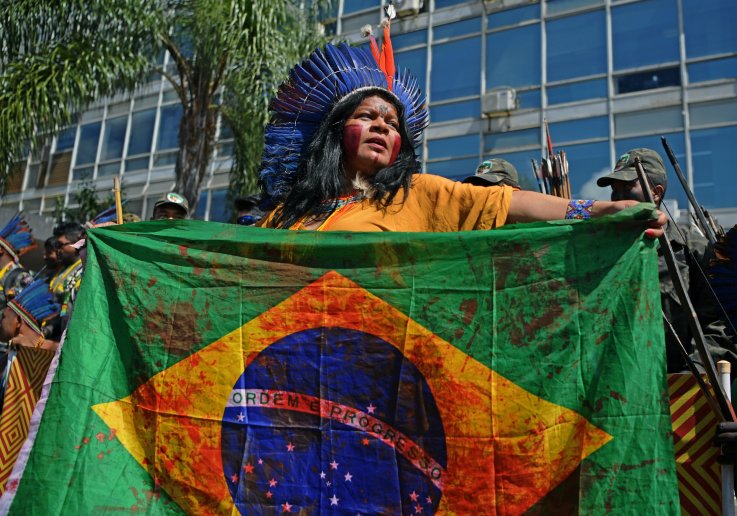
An indigenous woman holds a Brazilian national flag stained in red representing blood during a march in Brasilia on April 26, 2019, on the last day of a protest to defend indigenous land and rights. CARL DE SOUZA/AFP/Getty Images
In 2017, at least 185 activists were killed, with Indigenous peoples making up the biggest portion at around 30 percent, down from 40 percent in 2015 and 2016. At 36 percent, most deaths happened in Central America, followed by South American at 32 percent, and Asia at 31 percent. The most indigenous peoples died in the Philippines and Colombia between 2015 and 2017, with 36 and 22 deaths respectively. In 2017, 56 environmental defenders were killed in Brazil and 47 in the Philippines.
And the loved ones of victims struggle to seek justice, the authors said. Just over 10 percent of murders result lead to a conviction each year. This is likely due to corrupt police and authorities, who are sometimes involved in environmental devastation, and because murders are often carried out in remote areas. For instance, military and civil police are the main suspects after 10 land rights activists were killed in the city of Pau D’Arco, Brazil.
The researchers said the elections of populist leaders Jair Bolsonaro of Brazil and Rodrigo Duterte of the Philippines are a further cause for concern. Bolsonaro has called activists terrorists, and plans to relax gun and environmental protection laws, while the Philippines’ president “has taken a violent stance toward human rights defenders, Indigenous peoples, environmentalists, women, drug users and others,” the authors wrote.
..
Companies and consumers also have a responsibility to “investigate the sources of products, publish the results and commit to eliminating violence from supply chains,” the authors said. Co-author Dr. Nathalie Butt, a researcher fellow at the University of Queensland, Australia, School of Biological Sciences commented in a statement: “The number of reported deaths of environmental defenders has increased, as well as the number of countries where they occur.” Butt told Newsweek she was surprised that corruption was the key driver of the deaths, rather than the resources themselves. “As a lot of the resource demand is driven by international markets, consumers in countries in the Global North need to make sure they are aware of where their products come from, and how they were obtained, and demand (through pressure on supply companies) ethical and transparent supply chain processes,” she said.
Butt continued: “In many cases they [environmental defenders] are trying to protect environments that are important for everyone on the planet such as the Amazon, which is critical in terms of buffering climate change and carbon emissions.”
….Christopher Jeffords, associate professor in the department of economics at the Indiana University of Pennsylvania, told Newsweek: “These studies help shine a light on known instances of extreme violence committed against environmental defenders and thus help illuminate the notion that there are likely many cases which go unreported.” Eve Bratman, adjunct professorial lecturer at the American University Washington, D.C., School of International Service, told Newsweek: “The study tells us that the most important driving forces behind human rights abuses and the killings of environmental defenders are corruption and rule of law; when governments become more accountable, the benefits will likely be seen across the board. “In Brazil and several other countries, there is reasonable cause for concern that rates of violence will spike even higher given the dangers of today’s political climate.”
Taking a stand for environmental justice and protecting natural resources is a dangerous pursuit. A new report from the UK-based NGO Global Witness showed that 164 environmental human rights defenders worldwide were killed for their activism in 2018. That averages to just over three murders per week. And that’s an underestimation.
Global Witness said the true number was likely “much higher, because cases are often not documented and rarely investigated. Reliable evidence is hard to find or verify“. Also, murder is not the only way to quash dissent. Global Witness said, although killings are at a disturbing level, companies and governments were increasingly using other tactics like criminalization, non-lethal violence, harassment and threats, as the Guardian reported. One common tactic is for governments to label activists as terrorists. “Deaths were down last year, but violence and widespread criminalization of people defending their land and our environment were still rife around the world,” said Alice Harrison, a senior campaigner at Global Witness, as the HuffPost reported.
The bulk of the murders took place in Asia or Central and South America. In fact, more than half were in Latin America and most of the victims were indigenous or rural campaigners standing up for their communities against mining, hydrocarbon development, damming and agribusiness. The mining sector was responsible for one-fourth of the murders.
The Philippines replaced Brazil as the most murderous country, with 30 victims, followed by Colombia with 24, India with 23 and then Brazil with 20. It’s the first time since the annual list began in 2012 that Brazil did not top the list, according to the Guardian. The number of reported murders there dropped from 57 the year before to 20 in 2018.
Guatemala had one of the highest numbers per capita and the sharpest increase with a five-fold increase, bringing the total number to 16 deaths in 2018, which Global Witness attributed to new investments in plantations, mining and energy projects, according to US News and World Report. “In general, the surge in killings is because Guatemala is witnessing a major setback with regard to democracy and human rights,” said Jorge Santos, executive director of the non-profit Unit for the Protection of Human Rights Defenders in Guatemala, to Al Jazeera. His group has documented machete attacks and armed militias opening fire on indigenous people campaigning for land rights in areas that are home to mining operations, oil palm plantations and displacement of the Maya Q’eqchi’ community.




 Hans Thoolen on Human Rights Defenders and their awards