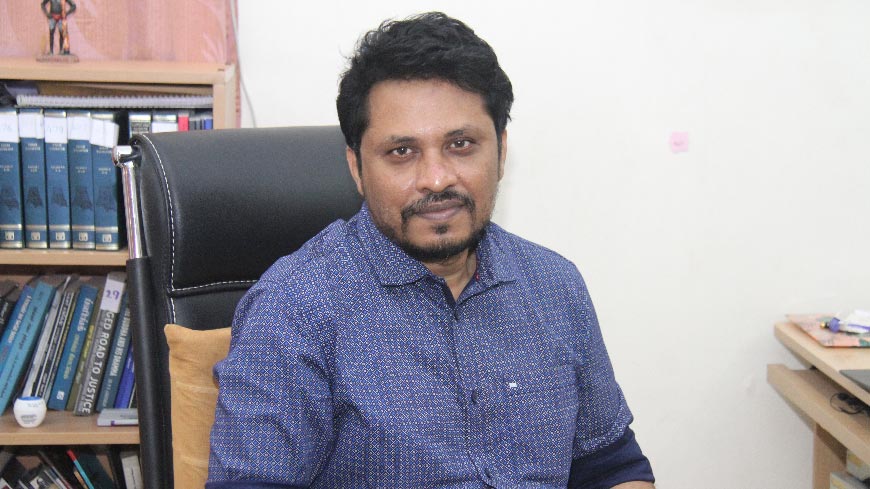
Vincent Raj Arokiasamy, founder of the organisation “Evidence” in India, has been awarded the Council of Europe’s Raoul Wallenberg Prize for his outstanding determination and persistence in bringing meaningful change to the lives of the Dalits, historically known as “untouchables”. For more on this award and its laureates, see: https://www.trueheroesfilms.org/thedigest/awards/730A3159-B93A-4782-830F-3C697B0EC7A0
“Vincent Raj Arokiasamy (better known as “Evidence” Kathir) has risked his life to help an exceptionally disadvantaged part of the Indian population whose plight is often ignored by national and international communities. In defending human rights with incredible commitment and resilience, his courageous actions for the so-called “untouchables” fully reflect the spirit and values of the Raoul Wallenberg prize”, said Marija Pejčinović Burić, the Secretary General of the Council of Europe.
Vincent Raj Arokiasamy has demonstrated enormous courage and taken grave risks regarding his own and his family’s lives. He has rescued some 25,000 victims in 3,000 incidents of human rights violations. As a result, he has to live apart from his family to protect them. He has devoted his life to the cause of promoting justice for Dalits and others whose voices are rarely heard.
The award ceremony will take place on Wednesday 19 January at 12h30 CET in a hybrid format. The event will be live streamed, and speakers include the Secretary General, the Chair of the Jury and the Laureate. A screening of József Sipos’s documentary on the life of Raoul Wallenberg “The Lost European” will follow the ceremony. The documentary can be streamed online, free of charge, until 23 January. The film streaming is made available with the support of the Permanent Representation of Hungary to the Council of Europe.
17 January marks the anniversary of Raoul Wallenberg’s arrest in Budapest in 1945. The Swedish diplomat used his status to save tens of thousands of Jews from the Holocaust. His actions show that one person’s courage and ability can really make a difference. Starting in 2014, at the initiative of the Swedish Government and the Hungarian Parliament, the Council of Europe has created the Raoul Wallenberg Prize to keep the memory of his achievements alive. The Prize, worth €10,000, is awarded every two years in recognition of extraordinary humanitarian achievements by a single individual, a group of individuals or an organisation.
Let’s take a moment to recognise some of the widely known activists. But before starting, let me tell you that the list isn’t exhaustive. Every woman who speaks up for her or others’ rights at home or in public places is an activist. Being an activist requires the perspective to look beyond the given and seek that which is deliberately made invisible.
1. Cynthia Stephen
An independent researcher on gender, poverty, development and policy, Cynthia Stephen has worked as an activist and writer for over 30 years. Stephen is a champion of equality and has supported the cause and rights of Dalit women often. In an article published on SheThePeople, Stephen said, “The life of a human being varies with their position in the caste hierarchy. Women are only objects who fulfil domestic, ritual and reproductive roles in a patriarchal family. The untouchables don’t even figure in the law book as they are outside the pale of the four castes. Women and Dalits are non-citizens, non-people as far as it (the Indian state) is concerned”
Kiruba Munusamy
Munusamy is an advocate at Supreme Court and a prominent anti-caste and equality activist. She is also a writer, research and a founder of many organisations that promote equality. Speaking to SheThePeople, she said, “All of us need to stand against women’s oppression, Islamophobia, violation of the LGBTQIA community. This has to become an anti-status quo revolutionary movement. It has to have leadership from the oppressed community.”
3. Shruti Kapoor
After the Nirbhaya gangrape case shook the world, Shruti Kapoor took the initiative of empowering girls and not letting the incident happen again. Kapoor founded the organisation named Sayfty to educate and empower girls. The organisation also aims at providing knowledge about legal rights and laws to women. It trains girls in self-defence to make them self-sufficient in fighting against crime in India. Kapoor is widely known for her phenomenal work and has been awarded a couple of times. Apolitical named her one of the most influential people in global policy in 2019. In the same year, the Indian Ministry of Women and Child Development recognised Kapoor as one of the 30 #WebWonderWomenwho have been using social media to drive a positive change.
Preeti Singh
Preeti Singh is a prominent disability activist. She often speaks about the stigma that further disables disabled people and advocates the importance of building disability-friendly infrastructure. She was born with Cerebral Palsy, which is a congenital disorder of movement, muscle tone or posture. Being a young child, she received a lot of negative comments like she’s burden, she should die and many other hurtful things.
Sister Lucie Kurien
Sister Lucie Kurien was initially working at HOPE, an organisation founded by Holy Cross Convent that works for abused women. At that time, she was approached for help by a pregnant woman who was constantly abused by her alcoholic husband. But Kurien was unauthorised to invite the woman to spend the night in the organisation. So she told the woman to come next day so that she can arrange alternate accommodation for her. But that night, the pregnant woman was attacked by her husband who set her and her unborn child ablaze. Kurien was devastated and that’s when she thought about opening a shelter home for abused and deserted women. Hence Maher was founded. Maher is an organisation that provides shelter to women and underprivileged children. It has branches in Maharashtra, Kerala and Jharkhand. It not only helps the survivors of domestic violence but also educates the poor and underprivileged. Many villagers were provided with knowledge about rights, duties and responsibilities in society.
Naseema Khatoon
At the age of 28, Naseema Khatoon , daughter of a sex worker, hailing from Muzaffarpur, Bihar founded the organisation named Parcham. The organisation rehabilitates sex workers and their children and protected them from police atrocities. It also educates and employs them by starting a small scale manufacturing business of bindis, candles and incense sticks.
Shweta Katti
Born and raised n Kamathipura, Asia’s most infamous red-light area, Shweta Katti is known for her work towards empowering marginalised girls. At the age of 16, she joined Kranti, an NGO that empowers girls from the red-light area and makes them agents of social change., Katti was included in the Newsweeks-25-Under-15 Women to Wach list in 2013. She also received UN Youth Courage Award. Katti received a scholarship from Bard College hence becoming the first woman from the red-light area to study abroad.
Riya Singh
A doctoral researcher at Delhi’s Ambedkar University, Riya Singh plays a vital role in empowering Dalit voices. She works at the Research and Advocacy Officer at Dalit Women Fight which is India’s largest Dalit women-led organisation to tackle caste based violence and discrimination. She has actively worked with survivors of caste atrocities. Speaking with SheThePeople about the caste-based violence like Hathras gangrape case, she said, “I’ve never understood the need of explaining why caste is important in a caste-based crime. Caste is right in front of our eyes… The first thing people ask is what is your name? If you give your first name, they’ll ask you – aage kya hai? (for surname). But Indian society is hesitant about claiming caste pride when it is about bad things.”
It is important to note that women to defend our rights are at great risk of being deprived of their own rights. In 2015, a report by The Guardian revealed that human rights activists are constantly being targeted around the world. “Women are in a really very bad position in the whole world but in countries like Honduras where we actually no rights all, we may have the worst part. And the women who speak up in a worse [position.]” said Daysi Flores, JASS Honduras country director, in Guardian’s Global Development Podcast.
We have often come across cases of murder, sexual crime and abuse against women activists. A prominent example from India is the reported molestation against female students in Jamia Milia Islamia during the CAA-NRC protest which became a reason for bringing together many women activists. Gladys Lanza Ochoa, a feminist and human rights activist from Honduras was illegally imprisoned for defending the rights of women in the country and fighting against the imprisonment she died due to health problems.
Arundhati Roy was charged with sedition for her comment on the CAA-NRC protest. Aishe Ghosh was brutally hurt during a breakthrough in the college. Many marches for women’s safety and crime against them is shadowed by the danger of being harassed by men involved in the protest or those dressed up as police. Cases of sexual misconduct were reported by women protestors from the Singhu Border too. A woman was reported to have been stalked by a man who took pictures of her at the protest site. Another woman reported that a prominent male protestor from Singhu Border would propose to her each time she bumped into her and touch her face a few times.
As far as India is concerned the major reason for the unaddressed issues of women is their lack of representation in law and government. The representation of women in the Indian judiciary dwindles at 12% which is lower than in Afghanistan (27.6 %). India ranks at 146th in women’s representation in the national Parliament. In Lok Sabha, only 14 per cent of seats belong to women.
If the judiciary and parliament involve fewer women, how can we be assured of the safety of women activists on the ground? How can we be assured that the safety of women activists is a concern of the government? So on this international woman human rights defenders day, let us pledge the safety and security of women who fight for our rights.
Stan Swamy and the adivasis he supports in an impossible battle for their own ancestral lands are pawns pitted against mammoth mining companies. Falsely branding activists as Maoists is the easiest way to condemn to enable vested interests to finish them off.
A file photo of human rights activist Stan Swamy. Photo: PTI
Mari Marcel Thekaekara wrote in the Indian Wire of 10 October 2020 a detailed and personal piece about “The Indomitable Spirit of Father Stan Swamy”
“No, it’s not possible,” were my first thoughts when I heard that Father Stan Swamy, an 83-year-old Jesuit priest and activist had been arrested – for the second time. His crime? He defended the rights of adivasis being exploited in their homeland Jharkhand.
Father Swamy has been accused of having links to a Maoist plot connected to the Bhima Koregaon case and was arrested by the National Investigation Agency on Thursday night. The rights activist is one of the gentlest and kindest men I have ever met. So the entire premise – for anyone who knows him – is entirely ludicrous. Funny even, if it were not so tragic. He has Parkinson’s disease. His hand shakes when he raises a cup of tea to his lips. He speaks so softly, you have to strain to hear him.
Social activists hold a protest after the arrest of Father Stan Swamy by the NIA in the Bhima Koregaon case, in Ranchi, October 9, 2020. Photo: PTI
He assures his interrogators that he has no connection with Maoists. He believes in peaceful, non-violent protest. I believe him. Because I know that his integrity is above reproach.
I heard of Father Stan Swamy in the early seventies, because he was among the first people I knew who advocated living with the adivasi community in Jharkhand to understand their lives and their problems; to help find solutions and a way forward. I went there in the early seventies while still in college to write a story for our student magazine.
On a more personal note, Stan Swamy, introduced my husband, also named Stan, to the adivasi world. He shared Father Swamy’s hut in a Ho village in Jharkhand. My husband always told young activists:
“Gandhiji’s non violence was not merely moral or religious. It was strategic. Gandhi was a brilliant general. Oxymoronic though that sounds. He understood that the fight for freedom could not be won by violence because mere ordinary Indians, even if they poured out on the streets with justice on their side, with God on their side, could never win. Even if there were thousands or lakhs of people marching in protest, they could never match the might of the state. Before 1947, the British could bring out the artillery and finish us off. One wrong step could have changed the course of our history. But the entire world watched India’s non violent battle for independence, open mouthed. Non violence was a new word, a new tactic, made in India. The world sympathised and empathised. Gandhi’s strategic non violence was the most brilliant weapon in our war for Independence’
The same scenario is playing out today. And the average activist understands that putting ordinary villagers, adivasis, Dalits or women in the line of fire is counterproductive and unfair. We learnt this strategy from Gandhi and Jayaprakash Narayan.
In recent times, it has become the norm to equate the word activist with ‘anti-national’. But who is an activist? What do they do?
It’s quite simple. All over India, there are thousands of people who took up the cause of fighting for social justice for the poor, the marginalised and the voiceless. These people were inspired by the brightest and best minds in our country – from Gandhiji to Vinobha Bhave to JP.
Post Independence, when the battle for freedom was won, Gandhi urged his followers to go out and continue the fight for freedom. This time, it was to free the poorest from hunger and poverty, to teach and educate, to weave and spin, to spread harmony and peace. Thousands rallied to his call and Gandhi ashrams were filled with people determined to continue the freedom struggle on a new battlefield – India’s villages.
The sixties saw the rise of the Dalit movement. New leaders emerged. Gandhi raised the question of untouchability in the early days of the Independence movement, but his ‘Harijan’ epithet was subsequently dismissed by Dalits as patronising. Dalit power became a clarion call, drawing inspiration from the African-American Black Panther movement. Dr B.R. Ambedkar showed the way.
The term activist gained popularity during the JP movement and during the fight against the Emergency in the mid seventies. After the Emergency, thousands of young patriots, drawing their inspiration from JPs charisma, accepted his challenge to go out and organise the poor, the under privileged and the vulnerable; to fight for their rights. This period saw a proliferation of human rights defenders, though the term was not used till later.
Women and men dedicated their lives to fighting for Dalit rights, adivasi rights, womens’ rights, farmers’ unions and fisherfolk movements. These activists evolved in their understanding of rights based movements. They often lived with the communities they worked with. They identified with the people and though many were middle class, they tried to live simpler lives than their parents, than the backgrounds and privileged upbringing they had been born into. They were pleased to be branded activists and wore the badge with pride.
From the fifties and sixties, when Gandhians prevailed, we moved into the seventies where a sea change took place. Global thinking wafted across the world to India. The 1968 student movement in France, Latin American thinking, Marxist ideology – all these gained ground and influenced grass roots workers. The focus changed from the passive Gandhian way – the giving of food, clothes, free education and medicine to changing unjust situations at the base. ’Daan’ or mere giving was now passe. Activists were trained to encourage people to ask who was cheating them and why? So if people were encroaching on adivasi or Dalit land, it was time to establish basic human rights; time to equip people to defend themselves, to fight injustice – non-violently, the Gandhian way, and the strategic way.
Soon, womens’ groups began to take action against dowry deaths and acid attacks, and took to the streets and courts to protest and demand justice. Dalit groups found lawyers willing to fight caste atrocity cases in court. Adivasis had activists urging them to defend their ancestral millennia old homelands from dominant caste landlords who shamelessly cheated them and usurped their lands. Environmentalists and eco-warriors hugged trees and stopped forests from being denuded. A huge green movement began. The protest movements grew from strength to strength.
In reality, these people are defending human rights and saving the Earth for future generations. When it comes to central India and defending tribal land from powerful mining companies, the battle assumes David versus Goliath proportions.
Stan Swamy and the adivasis he supports in an impossible battle for their own ancestral lands are tiny pawns pitted against mammoth mining companies. Falsely branding activists as Maoists is the easiest way to condemn them and to enable vested interests to finish them off.
The frail 83-year-old has trumped up charges levelled against him. Yet he has a core of steel, an indomitable strength that comes with moral conviction and a commitment to truth and to the powerless. As they took him to prison, Stan Swamy announced he would begin a fast. His fellow Jesuits who rushed to the prison with his medicines, say he has refused even a sip of water.
I kept asking why, they would arrest this gentle, kind man. Father Cedric Prakash, who is also a Jesuit and activist, said in a TV interview, “It’s to create a fear psychosis. If they can imprison an 83-year-old who has spent his life committed to the poor, who is safe?”
Asianet phoned to interview my husband Stan. People cautioned him, “You will draw attention to yourself. It can boomerang and have repercussions on your work in the Nilgiris.”
visiting Geneva to address the UN about issues faced by Dalit Women.
Abirami Jotheeswaran is a human rights defender and the National Program Coordinator of the National Campaign on Dalit Human Rights NCDHR. Most recently, she was part of a fact-finding team in Mirchpur to investigate a case of caste-based violence. Anagha Smrithi interviewed her for Feminism in India (FII) of 1 July 2019:
Anagha Smrithi: Can you describe your journey towards becoming the National Program Coordinator of the NCDHR?
Abirami Jotheeswaran: Residing in Chennai, I experienced many forms of caste-discrimination throughout my lifetime. A striking incident was during my graduation, when a classmate asked me what caste I belonged to in front of all my other classmates. The question was irrelevant, more so because she was aware of my social background as she knew my family. I felt insulted in front of my classmates and realised that caste certainly exists in urban cities like Chennai. After my Masters in Computer Science, I got married and settled in Delhi. A few years later, I got the opportunity to sit for an interview with the NCDHR. Even though I didn’t have a social work or human rights background, as someone who witnessed caste discrimination during my college days, I excelled in the group discussion and interview about caste-based discrimination. NCDHR changed me as a Dalit Human Rights Defender. When I joined as a Monitoring Associate in 2005, the work was new to me and I learnt everything through trial and error. I had to work hard to improve my Hindi to be able to coordinate with the State Coordinators of Northern states. I also equipped myself with legal knowledge of various legislatures surrounding the question of Dalit human rights. I used to work more than 10 hours a day, sometimes even carrying home documents to meet my deadlines. At the same time, I was also a mother. But I persisted at work so that I could be on par with my colleagues, most of whom were men. The 14 years I have been associated with the NCDHR has deepened my understanding of caste, violence, human rights and Dalit perspectives and ideologies. Today I am the National Program Coordinator and my primary responsibilities are to keep track of human rights violations, torture and ill-treatment of Dalits, and to provide legal assistance to the victims and survivors of caste atrocities across 12 States in India.
As a National Program Coordinator, I have participated in conferences and consultations at the State, National and International level to highlight Dalit human right violations in India, and to hold the state accountable. ..My 14 years with NCDHR has taught me the importance of struggling for justice in the courtroom. Because of this, I decided to pursue my higher studies in law. Most importantly, my association with NCDHR built my Dalit ideology and my strength as a leader to deepen the struggle against the caste system.
Anagha Smrithi: You were part of a fact-finding team about caste atrocities in Haryana. How did you obtain facts when the information was hidden/ fudged by the police and administration?
Abirami Jotheeswaran: On 24 April 2010, the National Dalit Movement for Justice (NDMJ) of National Campaign on Dalit Human Rights (NCDHR) and Anhad facilitated a national fact-finding visit to Mirchpur in Haryana’s Hisar district, where a dominant-caste mob had attacked Dalits in the village. The team consisted of a diverse group of people of journalists, activists, publishers and human rights defenders, including myself. The NDMJ Haryana state team visited the site of violence the day after the incident took place. They identified active victims, witnesses and built trust and a relationship with them. During our fact-finding process, we held detailed interviews with the victims—this was crucial in obtaining information that the police otherwise would not reveal. Through the interviews we gained information about the social background of the victims, the occurrence of previous atrocities in the same village and the events leading up to the incident. We discovered how the mob had planned to commit the offence, which differed from the police claim that it was a spontaneous conflict. We surveyed the loss of property and investigated the collusion of the police, administration and the Khap panchayat in committing the crime and obstructing justice.
Anagha Smrithi:Was any action taken after the fact-finding report?
Abirami Jotheeswaran: Soon after the fact-finding report, the NDMJ conducted a press conference to give visibility to the caste and build pressure on the government. We demanded appropriate sections of the SC & ST act be invoked for the immediate arrest of all those involved in the violence, along with resettling the affected Dalits in a secure place. We strove to register cases against the police and administration for the negligence of official duty, and demanded employment to all the members of the affected families, as well as a proper estimation of the damage inflicted upon the families. At the state level, we participated in protests, approached the Human Rights Law Network for legal interventions and took up advocacy with the Minister of Social Justice and other state authorities to ensure immediate arrest, complete investigation, the submission of a charge sheet, relief and rehabilitation for the affected and protection for the involved witnesses. As of today, we are still consistently engaging with the legal system and following up with the victims to achieve justice.
…… Anagha Smrithi:Even in cases of cruel atrocities & oppression, there is often still resistance and assertion from the community. What sort of resistance did you observe during your fact-finding process?
Abirami Jotheeswaran: Before the incident, violence had taken place against Dalits, but no proper action was taken by the police administration. But when this carnage happened, the Dalit community lost 2 lives and immeasurable damage to the property and possessions. Despite the losses, they unanimously decided to fight for justice and not tolerate any more violence by the dominant caste. They left their houses in Mirchpur and moved towards Mini Secretariat, demanding for justice. Their journey took them to Delhi, and finally to a farmhouse in Tanwar, protesting for justice, security, rehabilitation and jobs all the way. The State Government, faced with renewed pressure finally took action against the accused and the negligent administration. Though the victims continue to live away from their homes, in difficult conditions, the spirit of resistance is still alive.
Indian lawyer and human rights defender Henri Tiphagnehas been awarded the 8th Human Rights Award by Amnesty International Germany. The award is a recognition of Henri Tiphagne’s exceptional commitment to human rights. “For many decades now, Henri Tiphagne has been tirelessly and bravely standing up for human rights. His organisation’s invaluable work includes campaigning against discrimination and the use of torture in India,” Amnesty International said in a statement on 25 January 2016.
Henri Tiphagne is the founder of the organisation People’s Watch, one of the most notable human rights organisations in India. People’s Watch has been researching and documenting human rights violations, as well as providing legal representation to those affected, for over 20 years. The organisation also actively supports human rights education: In 1997, Henri Tiphagne founded an institute offering training for teachers as well as mentoring around school human rights education programmes. So far, they have managed to reach out to around 500,000 children in 18 Indian states.
In recent years, many organisations have come under intense pressure by the Indian government, and People’s Watch is no exception. The organisation’s bank accounts have been frozen repeatedly since 2012. This meant that some employees had to be dismissed and many programmes needed to be abandoned. The Delhi government in power at the time used the Foreign Contribution Regulation Act to justify this kind of harassment. A complaint filed by People’s Watch against these government actions is still pending. The same legal framework is being instrumentalised for political ends by the current government under Prime Minister Narendra Modi. Those targeted by the authorities include non-governmental organisations as well as activists and local protest groups campaigning, for example, against forced evictions to make way for new coal mining projects. [https://thoolen.wordpress.com/2013/11/05/india-should-end-funding-restraints-on-human-rights-defenders-says-hrw/]
“Henri Tiphagne and his organisation People’s Watch, while fighting to ensure the rights of others, are themselves being harassed and hampered in their work by the authorities. And there are other civil society organisations in India that are in a similar position. The award is therefore meant to send a strong signal of support to the whole of the Indian human rights movement,” adds Selmin Çalışkan, Director of Amnesty International Germany.
Award ceremony to be held on April 25 at the Maxim Gorki Theatre in Berlin, Germany. For more information about Henri Tiphagne’s personal background and the situation in India please contact the Press Office mailto:presse@amnesty.de of Amnesty Germany.
How broad the human rights movement is nowadays, is demonstrated by this eulogy of Dr R M Palby Vidya Bhushan Rawat, a social and human rights activist in India. It is a very personal story and I provide the text in toto below. The writer states that at this crucial moment is a great blow to all the right thinking secular forces as Pal was the man who always believed in the idea of a secular inclusive India and spoke regularly against the Hindutva’s communalism.
Dr R.M.Pal: Human Rights of The Most Marginalised Was His Uncompromising Passion
By Vidya Bhushan Rawat
20 October, 2015 Countercurrents.org
It was Prof Y.P.Chibbar, the PUCL General Secretary for years, who introduced me to Dr R.M.Pal when I visited him at ARSD College where he was teaching. ‘Dr Pal is the right person for you. He is the editor of PUCL Bulletin and lives in Greater Kailash. You must meet him,’ suggested Prof Chibbar. And after that it was a relationship that grew up every passing day. As a young aspiring boy from a nondescript town of Uttarakhand, I had come to Delhi ‘incidentally’, during the tumultuous years of anti Mandal agitation where most of our ‘intellectuals’ had been exposed. Staying with Dr Mulk Raj Anand, pioneer of English writing in India, there was a period of great personal churning for me and Dr Pal made it clear to me to earn to learn. ‘What are you doing there’, he asked. Jee, I am looking after his work, typing his scripts and accompany him to various places where he moves, I said. My aim is to do social work and it is a great honor to be with a man who calls himself a ‘Gandhian’. For a young person like me who had so many fantasies about Gandhism as perhaps we did not have the opportunity to know and understand ‘others’ and it seemed the only way to fight against oppression particularly untouchability which Gandhi had claimed to be the biggest ‘sin’ of Hinduism. So for me any one who had seen Gandhi or worked with him became a hero and ‘Lokayat’ where Dr Mulk Raj Anand stayed became my ‘sabarmati’. Dr Pal was a no nonsense person who could speak fearlessly without being hypocritical in front of you and he remained unimpressed. ‘Well, I can tell you Mulk Raj Anand will not help you’, he said. ‘ Don’t live under the romance of ‘Gandhian’ fame as it is good to do ‘social work’ but you need to be independent and earn to do things, he suggested. I know you came from Dehradun and may face prejudices here because of your village background. Better you do some evening courses as you plan and earn for your living and hopefully you will be able to contribute to society as you wish. And I can say with firm conviction that after coming to Delhi and staying here as meek and submissive person for over two and half years, Dr Pal gave me the confidence in myself and helped me become independent and rebuild my self respect and confidence.
Over the years our interaction grew and he became fond of me. He would guide me and ask me write in particular way. He suggested diverse topics to me and so much was the trust that many times he would send me to go on fact finding on particular issues and get direct information for him. It was not just he would ask to write but he would call me and discuss with me the issue in detail and point out those particular references which he would wish me to focus. I was fortunate to have met and acquaint with a number of eminent, Human Rights activists, Ambedkarite scholars and writers at young age and all of them respected me and appreciated my courage and enthusiasm but Dr Pal remain the one who mentored me and guided me. He would appreciate a number of my elderly friends but unlike them he would guide me and even point to me the grammatical mistakes in my writings. I knew them very well and the fact was that being a teacher, it was like a student sitting in his class as if he is dictating and then checking our assignment. Many times, he warned me of being neutral in my criticism and asked me to be as ruthless to Muslim fanatics too who try to defame the community but one thing was clear that he made a distinction between minority communalism and majoritarian communalism and cautioned India of the dangers of the Hindu communalism. He was afraid of the fact that India might become victim of the majoritarian communalism and for that all the like-minded parties and people have to join hand. He would often quote that no movement will succeed unless it is preceded by a political philosophy.
I still remember how he guided me to write a paper for a seminar being organized by Indian Social Institute, Delhi, in collaboration with UGC, on Ambedkar and M N Roy’s relationship and Roy’s thought on rationalism and Buddhism. He was determined despite my own feeling that it was a misfit for a seminar on Human Rights education issue yet he felt only I could have done justice to this and he guided me. Yes, that paper took me to various files including that information where Dr Ambedkar had, as a minister in Viceroy’s Council, sanctioned an amount of Rs 13,000 for anti war efforts of M N Roy and on the basis of this information ‘inspired’ Arun Shourie to write ‘Worshipping the False God’, a book based on hard prejudices and lies. I met Justice Tarkunde several time and got those letters where he mentioned that it was he who took the money many time on behalf of the Party and that Roy never took the money himself. Ambedkar was in deep appreciation of MN Roy and his intellectual honesty and that is why there are lots of similarities on their thoughts and philosophy, which need further elaborations. I can say with conviction that if Dr Pal had not guided me in this regard, I would have missed the great opportunity and work of M N Roy related to caste, religion and fascism.
As the editor of PUCL Bulletin he was able to focus a lot on atrocities against Dalits and issue of communalism in India. Both the issue of caste violence against Dalits and communalism were matter of great concern for him and he remained uncompromising in his condemnation of them. At the various national and international forums he always focused on the issue that Human Rights are not just state laws and their steady implementation which of course are important, but what he spoke and emphasized was ‘societal violation of human rights’ which he always felt, got out of the scrutiny of the human rights defenders and the organsations working for the human rights. It was his conviction that Dalits, Muslims and other marginalized people should join Radical Humanist and Human Rights Movement to raise their issues. As he became president of Delhi PUCL, he ensured that these segments are fairly represented and we know personally many of the radical humanists and PUCL ‘leaders’ were not very happy with his ‘casteist’ approach.
For long he listened to many youngsters claiming that ‘human rights’ organisations in India have no space for the Dalits. He always mentioned to me this point that PUCL is a membership based organisations and if the Dalits, Muslims wanted to lead it, they need to become member and increase their numbers. He introduced many eminent persons in the human rights and said that there is no point complaining if you are unable to be member of it. People’s organisations are led by people and need further understanding and working of the organisations and its structures. Merely blaming the organisations for being representative of ‘upper castes’ was not correct according to him though we knew that many activists became members but frankly speaking the functioning of the organisations like PUCL did not change. The dark fact is that he was not liked inside the PUCL as well as in the Radical Humanists circle for his ‘overemphasis on caste and communalism. His unambiguity and openness made many people his enemy who would be jealous of his forthrightness. The man always enjoyed being with young activists, guiding them and providing ideas to write on particular issues. I can vouch with my own experience having met numerous people of eminence how they just use you. The dirty secret of the ‘intellectual’ world is that it does not want to engage in dialogue with people but work on ‘networking’.
We had lots of disagreement particularly on the issue of Gandhi and Ambedkar. He knew it well that I have no liking for Gandhian philosophy, which I called humbug and absolutely patronizing as far as Dalits are concern. He would always say that though Gandhi made eradication of untouchability and fight against communalism pivot of his philosophy, he failed in both count yet he felt that Gandhi’s intention were not wrong but lots of discussions and debate on the issue actually saw his opinion changing. He said any one who read ‘annihilation of caste’, will only find Gandhi on the wrong side and Ambedkar fighting for the rights of the people. He felt Ambedkar was wronged.
His personal association with M N Roy and later working on the human rights issues had broadened his horizon much bigger than many of his contemporaries who remained very narrow in their personal lives. There are very few who would spare time for you and guide you whatever possible ways and feel good at your achievements. He loved speaking Bangla and always followed the incidents happening in East Bengal or what we call today Bangladesh. The pain of division and migration was always with him and that is why he was always warm to people like me who left home in search of a new identity and to fulfill their commitments. He would always warn me like a teacher of what to do and what not to do. There are so many things to remember where he asked me to write on and suggested me to attend particular programmes.
The last togetherness of mine with him was at a seminar that he has been trying to organize for years in Mumbai on Dr Ram Manohar Lohia but always felt lacking supporting hands there as he would have them in Delhi as it was the city he always missed and left after he had paralytic stroke that confined him on wheelchair and external help. Many of my friends actually spoke to me after visiting him and felt pained to see a vibrant man depended on people for help, a man who was always active doing things at his own. But it was his strong willpower that despite being confined to bed he could do a lot of work, which is highly impossible for many of us to do. I never saw him complaining about himself whenever I spoke to him on phone as it was work work and work. He would ask for certain book or speak to certain person or provide the phone numbers of some friends. He complained that being in Mumbai has curtailed his freedom as he always enjoyed his friendship circle in Delhi and felt that he has got isolated in Mumbai.
The seminar on Ram Manohar Lohia in Mumbai reflected how he wanted to do things so fast. Academics saw him speaking passionately on Lohia-Ambedkar relationship where he quoted Lohia saying that he wanted Dr Ambedkar to lead the entire Indians and not confined to the leadership of the Dalits even when people like me questioned Lohia suggesting his vision ended at Gandhsim, Dr Pal remain open to new ideas which supported freethinking and secular democratic traditions in India.
There are so many fond memories of him. I can only say that he was the one on whom I could count for guidance and support. He never failed and once promised would go to any extent to finish the task. I grew up admiring him for his courage and forthrightness as whenever he spoke he was to the point and blunt. At a seminar, a leading human right academic, who happened to be a Muslim, actually supported practice of Sati as cultural practice and therefore outside the purview of human rights laws in the name of ‘personal laws’ of Hindus. I got up and objected saying whether he feel that veil and Burqa should be put beyond the limit of human rights laws. It became heated and Dr Pal came for my rescue saying that he always wanted human rights defenders and organisations to speak against societal violation of human rights as human rights in South Asia are not just violated by the state but majority of violation happen because of cultural practices and we need to come out in open against such rigid and inhuman practices such as caste system and untouchability.
The demise of Dr R M Pal at this crucial moment is a great blow to all the right thinking secular forces as we would often go to him and seek his advice on many issues confronting us. He was the man who always believed in the idea of a secular inclusive India and spoke regularly against the Hindutva’s communalism. Though he is no longer with us, his writings will always inspire us to work for a secular democratic India. We promise to carry on his legacy for our better future.
Under the title “Urgent Appeals, theory and practice“, the NGO ‘Asian Human Rights Commission‘ reflects on the need and increasing practicality (especially thanks to IT) of conducting urgent appeals. The AHRC Urgent Appeals system was created to give a voice to those affected by human rights violations and it now concludes that “Patterns start to emerge as violations are documented across the continent, allowing us to take a more authoritative, systemic response, and to pinpoint the systems within each country that are breaking down. This way we are able to discover and explain why and how violations take place, and how they can most effectively be addressed. On this path, larger audiences have opened up to us and become involved: international NGOs and think tanks, national human rights commissions and United Nations bodies. The program and its coordinators have become a well-used tool for the international media and for human rights education programs. All this helps pave the way for radical reforms to improve, protect and to promote human rights in the region”.
To illustrate the point the AHRC comes at the same time with a call for action against what it calls a “witch hunt” by the Indian authorities against human rights defender Madhuri Krishnaswami of the Jagrat Dalit Adivasi Sangthan. In the most recent attack, the District Magistrate has written a letter to the Divisional Commissioner that found its way to Chief Secretary accusing the organisation to have links with Maoists and have demanded an inquiry into the issue. The attack is not a stray one but comes high on heels of an externment notice served on her by the same district administration in May, 2012 and subsequent attack on a JADS rally by the local goon with the administration looking away. Interestingly, the charge has been refuted by the police with the Inspector General of Police, categorically denying the presence of any Maoists activities in the reason.[The administration, evidently, is working on the behest of deeply entrenched vested interests whose corruption Madhuri and the organisation have continuously been exposing. The current attack, too, is an attempt to divert attention from the massive scam in the implementation of the Mahatma Gandhi National Rural Employment Guarantee Act in the area tipped to be worth more than 150 crore INR.]
At the same time the AHCR expresses great concern over the abduction of 4 human rights defenders in Pakistan by (probably) members of an outlawed religious organization. The unknown armed persons abducted six workers of a NGO including, two lady workers. However, after some time they threw the two women out of the vehicle. It is feared that the abducted workers would be assassinated as has happened in the past. Many health workers and human rights defenders have been killed after their abduction by such ‘religious groups’. The NGO, ‘HAND’, works under the UN programme. The abducted persons and female workers who were working in the Noor Mohammad Village Goth, Mauripur, Karachi, where they have been distributing medicines and rations to the residents for some time. The male abductees were Engineer Amjad Ali Siyal, Mohammad Ashfaq, dispenser, Khurram Ahmad Abbas, dispenser and driver Humayun Ahmad, driver. The released women, Miss. Shakila and Miss. Rashida told police that the kidnappers had taken the four abducted workers in a car towards Balochistan. The police claim that they were abducted by one of the banned Muslim extremist groups who are opposed to the polio vaccination programme and this incident due to the campaign against NGO volunteers. It is believed that the abductors are convinced that they are working for the interests of America or the West.
The Jury for the Dutch Human Rights Defenders Tulip has awarded the 2012 Tulip to Marimuthu Barathan (note that the spelling is sometimes Bharatan) from India. It will be presented in The Hague on 9 January 2013. True Heroes is making a filmed portrait on his work.
The jury praised Mr Barathan as a ‘tireless campaigner for better living and working conditions for the Dalits in India’.The Human Rights Defenders Tulip, which is being awarded for the fifth time, comprises a statuette and €100,000 for a project to be decided on in consultation with the recipient.


 Hans Thoolen on Human Rights Defenders and their awards