The study from Global Witness, a non-profit human rights environmental watchdog, shows that the killings of Indigenous peoples defending their territories and resources represented nearly 34 percent of all lethal attacks despite making up about 5 percent of the world’s population.
“Governments where these violations are happening are not acting properly to create a safe environment for defenders and a civic space proper for them to thrive,” said Gabriella Bianchini, senior advisor for the land and environmental defenders team at Global Witness. “They are not reporting or investigating and seeking accountability for reprisals against defenders. And most importantly, they are not promoting legal accountability in the proper manner.”
Latin America has consistently ranked as the deadliest region for land defenders overall and saw almost 9 in every 10 recorded killings in 2022. More than a third of those fatal attacks took place in Colombia. In 2021, Brazil was named the deadliest country for land defenders by Global Witness and now sits at second; In July, activist Bruno Pereira and journalist Dom Phillips were murdered in the Brazilian Amazon.
Growing tensions from agribusiness, mining, and logging have led to consistent lethal attacks in the region. Between 2011 and 2021, for instance, more than 10,000 conflicts related to land rights and territories were recorded in Latin America alone.
“The worsening climate crisis and the ever-increasing demand for agricultural commodities, fuel, and minerals will only intensify the pressure on the environment — and those who risk their lives to defend it,” wrote the authors.
Earlier this year, Frontline Defenders, an international human rights organization, released a similar report to Global Witness’ with corresponding findings — including that Colombia was the most dangerous country for land defenders. [see:https://humanrightsdefenders.blog/2023/04/04/front-line-defenders-just-published-its-global-analysis-2022-new-record-of-over-400-killings-in-one-year/ . While Frontline Defenders reported that there were 186 land defender deaths in Colombia and Global Witness reported 60, Bianchini said differences in statistics are the result of different methodologies, which vary by organization. However, both organizations’ reports were united in findings: Indigenous people make up a disproportionate amount of the deaths among land and environment defenders, Latin America sees the highest rates of violence, and the number of killings is likely underreported.
“I am incredibly grateful and impressed to see the fight of all of these communities who are there living in these areas and who have been acting for thousands of years to protect the array of life,” said Bianchini. “I cannot believe that humanity right now is living in a moment where we are killing those who are protecting their own lands and civil rights.”
On 25 July, 2023 – International Afro-Latina, Afro-Caribbean and Diaspora Women’s Day, – Amnesty International highlighted nine defenders and collectives who have devoted their lives to ending inequality and violence, advocating a dignified life for all people because their work deserves the recognition, visibility, protection and resources necessary for it to continue to spread.
Rede Vozes Negras pelo Clima, Brazil
Rede Vozes Negras pelo Clima is an initiative of 11 Black Brazilian women who are working in their respective territories to protect human rights, confront climate racism and promote anti-racist socio-environmental justice. They belong to traditional, riverine quilombola communities. They are also activists and leaders of communities that live on the margins of large urban centres, communities that are being directly affected by the consequences of the climate crisis and development projects that fail to take into account the rights of local populations.
They are thus fighting for anti-racist adaptation policies and an energy transition that will guarantee the promotion of human rights and nature. Mitigation initiatives need to incorporate the ancestral knowledge and wisdom of traditional peoples and communities and ensure the participation of those people affected by extreme weather events when decisions are being made as to the investments that need to be made to repair losses and damage.
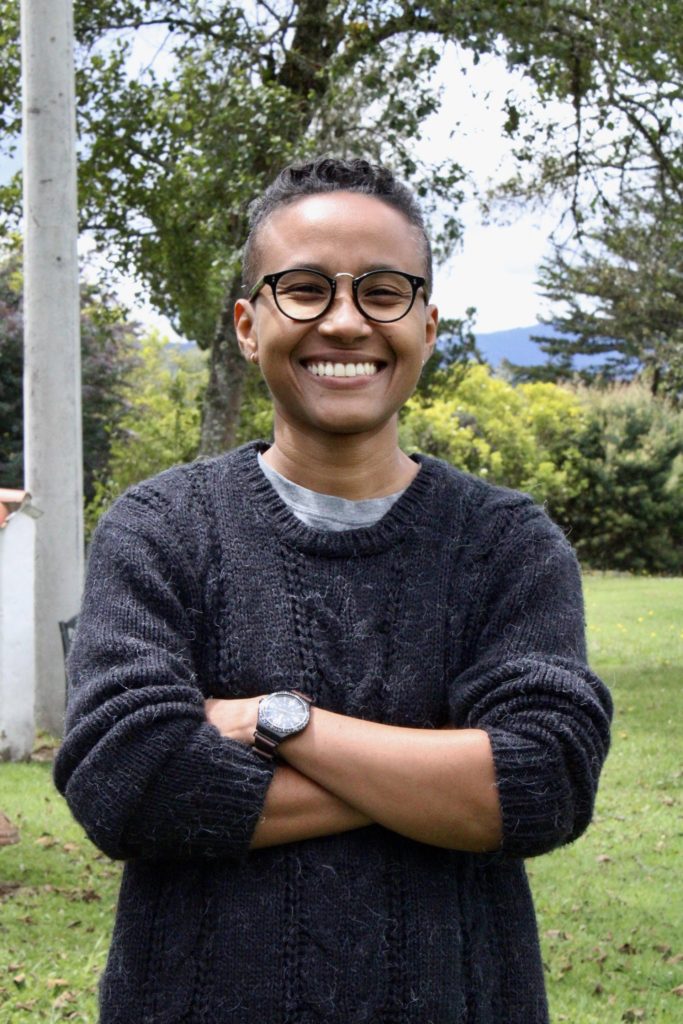
Dayana Blanco Acendra, Colombia
Dayana Blanco is a renowned Colombian lawyer who heads ILEX Acción Jurídica, an Afro-Colombian and Afro-LGBTQI+ organization committed to racial justice in Colombia, Latin America and the Caribbean. According to Blanco, “Racial justice in Colombia requires all of society to commit to combatting the historical inequality that has affected the Afro-descendant population. This means actions to address social and economic inequality.”
With an outstanding academic background and experience in different sectors, Dayana has promoted innovative research on racist police violence, statistical invisibility in the systematization of violence against Afro-descendant leaders and economic and social rights. In addition, together with her team and in coordination with other civil society organizations, she has obtained notable rulings in defence of Afro-Colombian midwifery, overcoming the statistical invisibility of the Afro-descendant population, among others, and demonstrating her dedication to the struggle for equality and justice.
Under her leadership, ILEX has – through legal mobilization, research and strategic communications – become a reference for promoting the rights of the Afro-descendant population. Dayana and her team highlight the importance of addressing social and economic inequality as a fundamental element of racial justice in Colombia, calling on the whole of society to unite in the struggle and build a more equitable future for all.
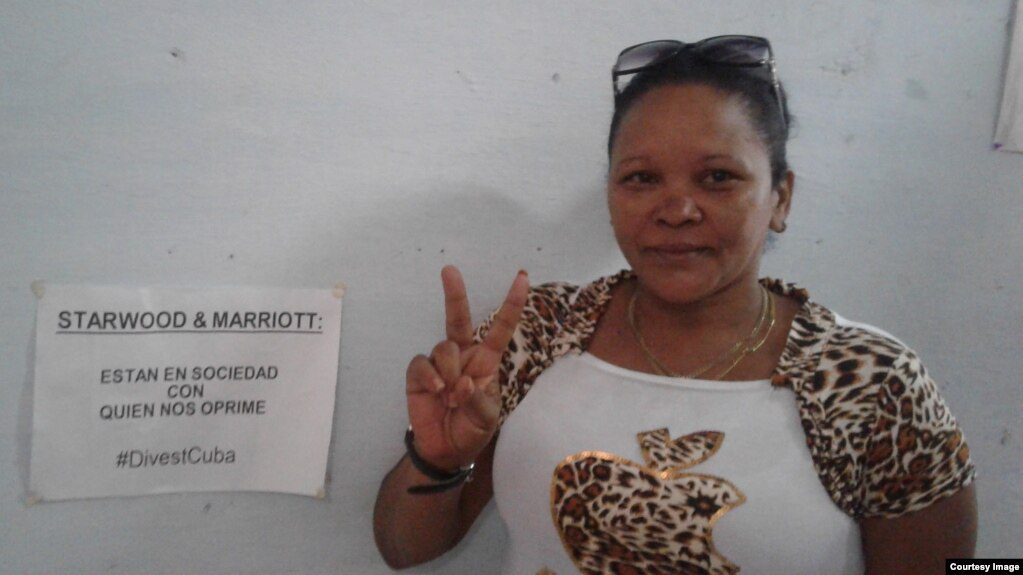
Donaida Pérez Paseiro, Cuba
Donaida Pérez Paseiro is a Black activist, religious leader and president of the Asociación Yorubas Libres de Cuba. Yoruba is a religion of the African diaspora that is practised in many countries, including Cuba. Donaida was arrested on 16 July 2021 and sentenced in February 2022 to eight years’ imprisonment by the Santa Clara Municipal People’s Court for “public disorder”, “contempt” and “attacking” an official. According to the information available to Amnesty International, Donaida should never have been charged with these crimes.
The charges of “contempt” and “public disorder” are frequently used in Cuba to limit the right to freedom of expression and peaceful assembly. Both she and her husband, Loreto Hernández García, were tried along with 14 other protesters in what appears to have been an unfair trial.
Donaida is the wife of Yoruba leader and activist Loreto Hernandez Garcia who was unjustly sentenced to seven years in prison for demanding respect for human rights in Cuba during the 11 July 2021 demonstrations.
Donaida is an example of courage and perseverance in the resistance against repression in Cuba. Her commitment has manifested itself in numerous peaceful marches and protests. According to her family, she was a freelance journalist and founded the Laurel Express press agency, where she gave visibility to the injustices and challenges faced by her community in the city of Placetas. Her activism spans multiple spheres, having been a member of the Orlando Zapata Tamayo resistance front and the central opposition coalition. Donaida’s legacy transcends borders and leaves a profound inspiration for those who seek a Cuba without repression.
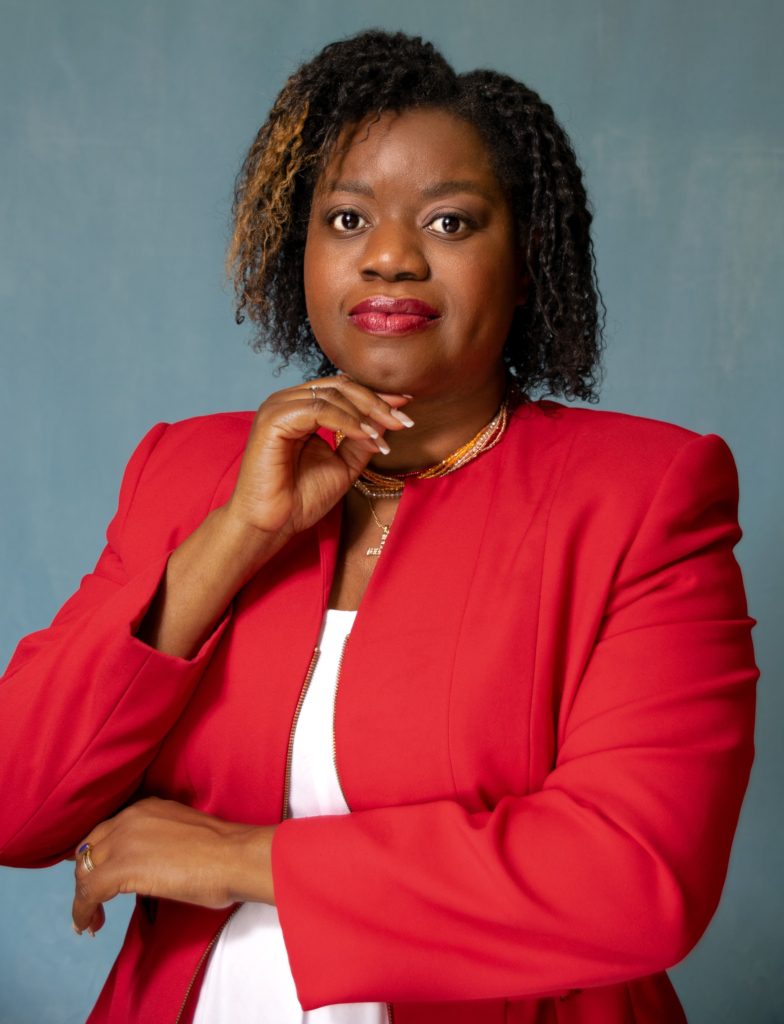
Guerline M. Jozef, Haiti
Guerline M. Jozef is the founder and executive director of the Haitian Bridge Alliance, the only Black and Haitian women-led organization serving migrants on both sides of the U.S.-Mexico border. Named one of the most influential people in 2021 on racial issues by Politico, she is also co-founder of the Black Immigrants Bail Fund and the Cameroon Advocacy Network.
The Haitian Bridge Alliance (HBA), also known as “the Bridge,” is a grassroots community-based organization that advocates for just and humane immigration policies and provides migrants and immigrants with humanitarian, legal and social services, with a special focus on Black migrants, the Haitian community, women and girls, LGBTQIA+ people, and survivors of torture and other human rights abuses. HBA also seeks to highlight issues specific to Black migrants and encourages solidarity and collective action to bring about policy changes. Through her work, Guerline reminds us that together, Anpil men, chay pa lou! Many hands lighten the load!
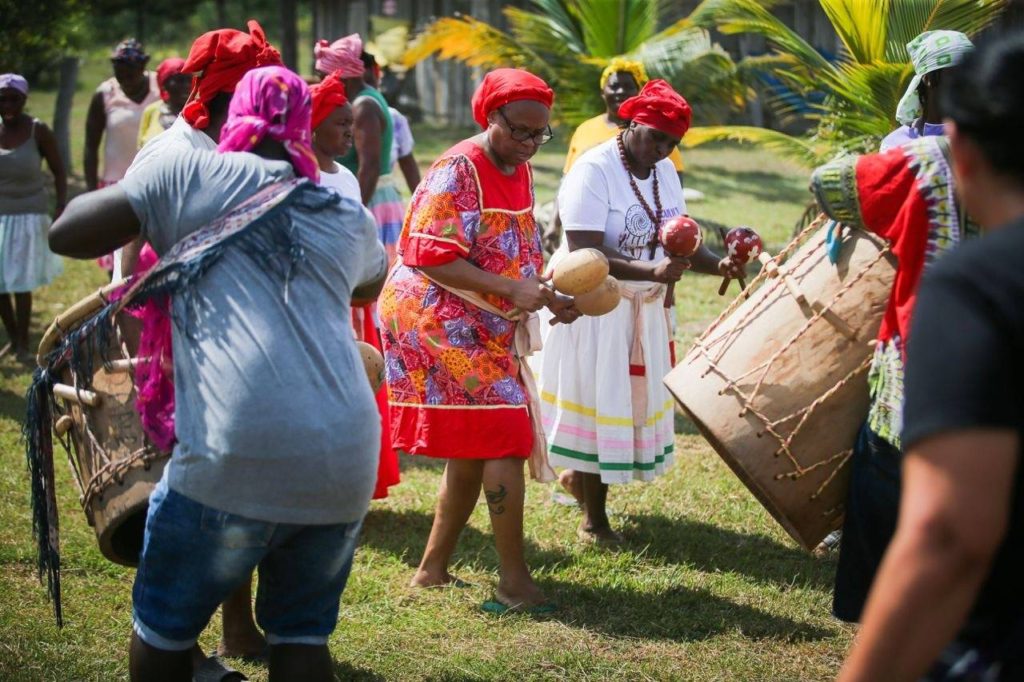
Miriam Miranda, Honduras
An Afro-indigenous Garífuna leader from Honduras, Miriam Miranda stands out as a courageous defender of human and environmental rights. As coordinator of the Organización Fraternal Negra Hondureña (OFRANEH), she has carried out invaluable work to protect and defend the rights of the Garífuna people in Honduras. Her tireless work, lucidity and commitment have earned her the recognition of prestigious awards, such as that of the Friedrich Ebert Foundation, as well as the Carlos Escaleras and Oscar Romero awards.
Miriam’s struggle is deeply rooted in the Garífuna territory of Honduras and is manifested through the history of OFRANEH, an organization through which these people are building their dignity and their future. The land and the sea, as an indispensable part of their identity, determine an essential struggle to preserve the natural assets of their territory.
Miriam is a highly respected thinker and leader within the social movement. She has an enormous capacity to devour books and mobilize energies from all sides to defend her people. She is one of those people who make life possible, whose words always point forward and who finds strength in the deep roots of her origin, where her future of freedom was born. As the daughter of Barauda (representing Garífuna female strength, Barauda is an historical character who pushed the Garífuna hero Sathuye to continue the struggle for the liberation of his people), Miriam has turned her critical eye to the source of it all: the predatory civilization of consumerism.
Her tireless work and courage inspire others to keep fighting. Her contribution and leadership have already left an indelible mark on the history of Honduras and global struggles for territory. [see also: https://humanrightsdefenders.blog/tag/miriam-miranda/]
Shackelia Jackson, Jamaica
The extrajudicial killing of her brother, Nakiea Jackson, in 2014 pushed Shackelia Jackson into a life of activism. Since then she has been healing, evolving, learning and gathering the tools with which to reconcile her conflicting realities. A political science scholar and communicator, Shackelia is the mother of an empathetic child, who longs with innocence to experience the world. Despite challenges and setbacks, Shackelia remains dedicated to the wider struggle, supporting causes that prevent the institutionalization and normalization of practices that violate human rights and erode the sanctity of life.
Through her grassroots organizing efforts in Jamaica, she has raised funds to support back-to-school initiatives and education programmes, recognizing the importance of empowering the younger generation. Shackelia’s work has gone far beyond her local community. She has become a global force, lending her voice and expertise to international platforms. As keynote speaker at an Amnesty International event in London, she captivated the audience with her powerful words, urging them to stand up and take action. In 2017, Shackelia also participated in roundtable discussions at Amnesty International events in Brazil and the United States, amplifying the voices of the oppressed and demanding accountability.
It was on this journey that Shackelia realized that change starts with each individual. She has encouraged others to join her in writing for rights, and to use their words as weapons against injustice. “Let us write until we are heard, let us write until justice is done,” she said.
Ivana C. Fred Millán, Puerto Rico
Ivana Fred is a prominent Black and transgender activist, writer and leader from Puerto Rico. She has dedicated her life to fighting for human rights and equality for transgender people in her country. Her passion for justice has made her an influential figure and a powerful voice in Puerto Rican society.
Since her first steps into activism in 1999, Ivana has formed part of pioneering projects aimed at trans people and has used her voice and pen to amplify the stories and needs of trans people.
As she says: “Life put me in a place where I could develop as a leader, the ‘Ponte el Sombrero’ project gave me the tools to empower and educate socially disadvantaged and discriminated populations. That was how I came to understand that to exist is to resist”.
Ivana has also made her mark in the media, writing for the Metro newspaper and participating in acclaimed documentaries and films such as “Mala Mala” and “Las Muchachas”. Her presence and perspective have helped generate greater visibility and understanding of transgender experiences in Puerto Rico.
Ivana Fred is currently one of the directors of the organization Trans Goofy Games, where she continues to lead and support initiatives that promote transgender inclusion and empowerment. With unwavering commitment, Ivana has remained a visible leader and loyal activist. From her early days of activism to the present day, her voice has been resolute in seeking dignity and respect for all transgender people.
With her courage and determination, Ivana has shown that to exist is to resist and has paved the way for a more inclusive and respectful future in Puerto Rico and beyond. Her legacy as a visible leader and her tireless activism inspire us all to continue fighting for a world where everyone can live with equality and dignity.
Elena Lorac, Dominican Republic
Elena Lorac is a prominent activist and advocate for human rights in the Dominican Republic, especially on the part of Dominicans of Haitian descent. As national coordinator of the Movimiento Reconoci.do, she has led the fight for the right to nationality and full integration of this community into Dominican society.
With more than 12 years’ experience, Elena has worked to strengthen community leadership and empower black women in the country’s bateyes [sugar mill settlements]. She also provides support to Haitian migrants and Venezuelan migrants and refugees, and is known for her community-based approach.
Elena is also a nationally and internationally renowned speaker, speaking on issues such as nationality, discrimination and racism, and raising awareness of policies that affect Dominicans of Haitian descent in the Dominican Republic. Her tireless work has been instrumental in promoting human rights and achieving the real inclusion of this community in Dominican society.
Aracelis Sánchez, Venezuela
Aracelis Sánchez, a human rights defender and the founder of Organización de Familiares de Víctimas de Violación de Derechos Humanos (Orfavideh), is promoting solidarity and demanding justice together with more than 200 mothers of victims of extrajudicial executions in Venezuela.
Aracelis, who lost her son Darwilson Sequera, has been fighting for more than 10 years to get cases of human rights violations committed by Venezuelan state security forces investigated. Orfavideh provides human rights training workshops for mothers, equipping them with tools with which to demand guarantees and use the mechanisms of justice in Venezuela.
Aracelis stresses that when victims are empowered and able to put pressure on prosecutors, their cases are investigated. She believes that support and empowerment are essential to transform grief into positive action and thus achieve justice for victims and their families.
Camila Zuluaga is an international advocacy lawyer at the Colombian Commission of Jurists (CCJ). She spoke to ISHR about her hopes for Colombia, which she hopes to make a safer country for human rights defenders. Camila was also one of the participants to ISHR’s flagship training course, the Human Rights Defender Advocacy Programme (HRDAP).
Front Line Defenders launched its Global Analysis 2022 on the situation of human rights defenders (HRDs) at risk around the world, an in-depth annual publication detailing the variety of risks, threats and attacks faced by HRDs around the world. Front Line Defenders’ Global Analysis 2022 gives a panorama of the threats faced by HRDs in all regions of the world. Despite an assault on human rights and the rule of law in many countries, human rights defenders (HRDs) showed remarkable courage and persistence in advocating for more democratic, just and inclusive societies in 2022. [see also https://humanrightsdefenders.blog/2022/01/17/at-least-78-human-rights-defenders-killed-in-colombia-in-2021/]
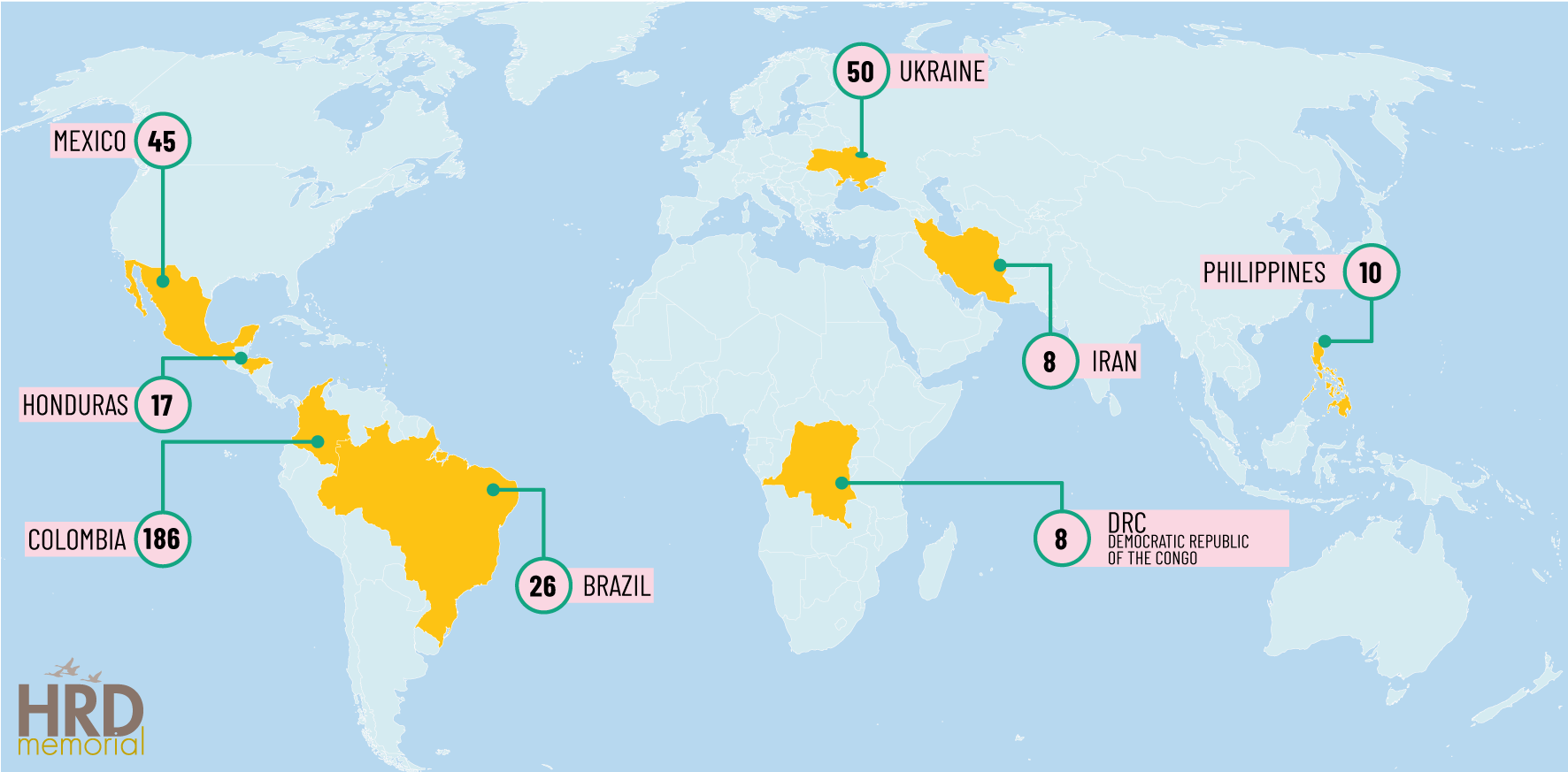
The report also names 401 HRDs killed in 26 countries in 2022 compared to 358 HRDs killed in 35 countries in 2021 – based on statistics by the HRD Memorial, a collective initiative of human rights organisations working to collect and verify data on the killings of HRDs each year.
“In a grim milestone, for the first time we saw more than 400 targeted killings of human rights defenders in 2022. While Latin America remained the deadliest region in the world for human rights defenders, we also saw a more dangerous landscape for defenders in the context of Russia’s full-scale invasion of Ukraine,” said Olive Moore, Interim Director of Front Line Defenders. ”These human rights defenders were deliberately targeted and killed because of their human rights work. Because they choose to speak out and challenge injustice, they paid for it with their lives.”
Five countries – Colombia, Ukraine, Mexico, Brazil and Honduras – accounted for over 80% of killings, according to HRD Memorial data. Colombia alone accounted for 46% of the total, with at least 186 killings documented and verified by HRD Memorial partner Somos Defensores to date. Defenders working on land, indigenous peoples’ and environmental rights were the most frequently targeted sector, accounting for almost half (48%) of the total killings.
In the context of Russia’s full-scale invasion of Ukraine, defenders engaged on humanitarian response and human rights journalists were also specifically targeted, with at least 50 documented killings by Russian military forces.
Wide array of threats
Global Analysis 2022 data is based on more than 1,500 threats and violations reported to Front Line Defenders, and is disaggregated by region, type of threat, sector of human rights work and gender.
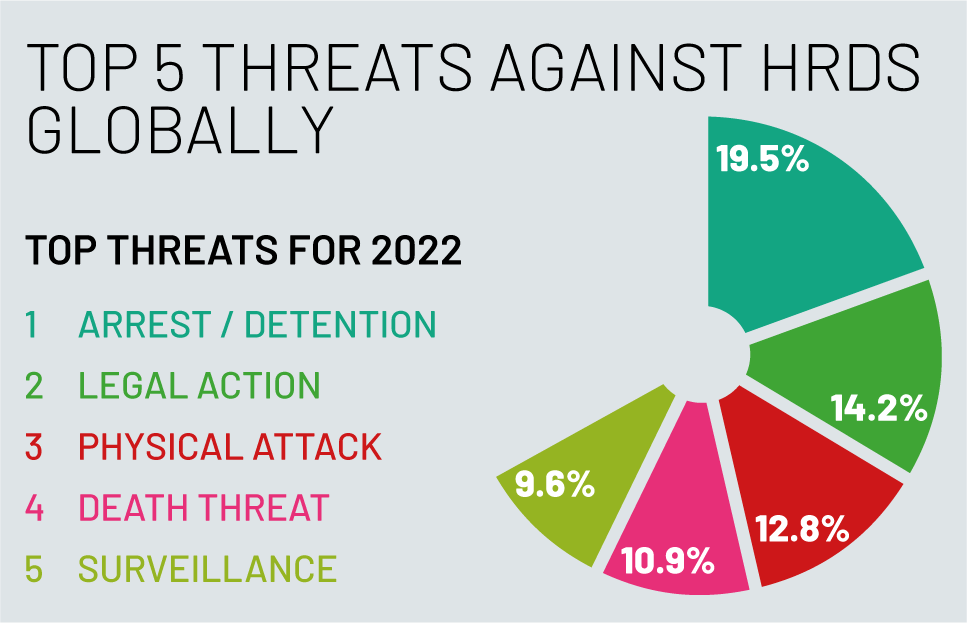
The main threats HRDs reported to Front Line Defenders in 2022 included: arrest or detention (19.5%); legal action (14.2%); physical attack (12.8%); death threats (10.9%); and surveillance (9.6%). In Asia and the Americas, death threats were the most frequent violation against defenders; in Africa it was arrest and detention; while in ECA and MENA it was legal action against HRDs.
Women HRDs (WHRDs) were frequently targeted with death threats, which accounted for the third most common violation against them. Physical violence was the most prevalent violation reported by trans and gender variant/gender nonconforming HRDs.
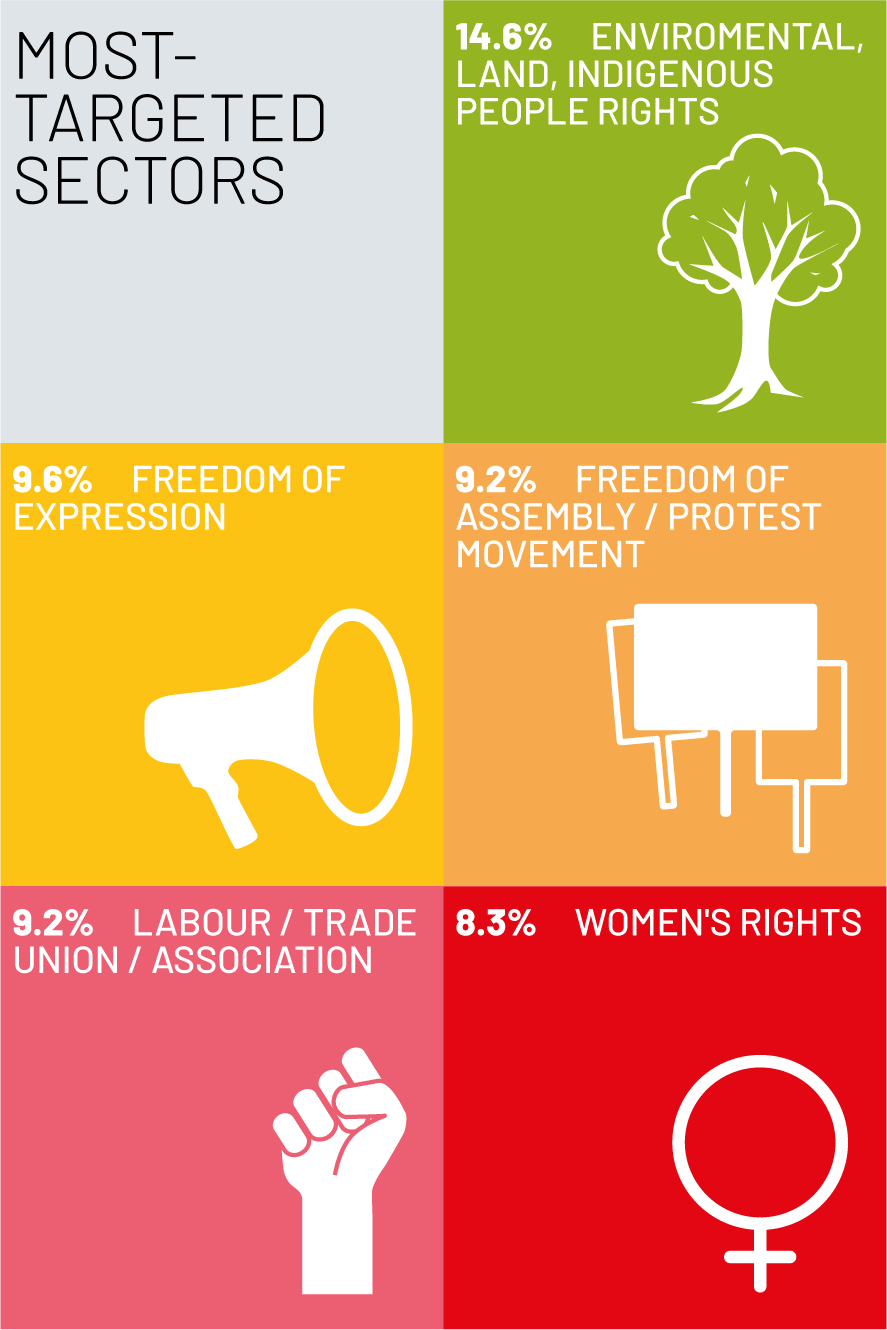
The five most targeted sectors of human rights defence were: environmental, land and indigenous peoples’ rights (11%); freedom of expression (10%); protest movement/ freedom of assembly (9%); women’s rights (7%); and impunity and access to justice (6%).
About the data on killings: Front Line Defenders manages the collection of partner-verified data-sets under the HRD Memorial umbrella. The partners in the HRD Memorial are: ACI-Participa (Honduras); Amnesty International; Comité Cerezo (Mexico); FIDH; Front Line Defenders; Global Witness; Human Rights Defenders’ Alert – India; Karapatan (the Philippines); OMCT; El Programa Somos Defensores (Colombia); Red TDT (Mexico); and UDEFEGUA (Guatemala).
About the data on other violations against HRDs: This is derived from 1,583 reported threats and violations, based on Front Line Defenders’ urgent actions and approved grants between 1 January and 31 December 2022. For more details, see the Methodology section of the report.
Stuti Mishra in the Independent of 29 September 2022 summarises and analyses the report “A Decade of Defiance: Ten years of reporting land and environmental activism worldwide” by Global Witness
More than 1,700 environmental defenders have been killed around the world in the last decade with one death reported every other day on average…The report titled A Decade of Defiance: Ten years of reporting land and environmental activism worldwide, released by Global Witness, reveals the increasing threats environmental activists are facing as the climate and biodiversity crisis worsens.
The research states that a total of 1,733 people have been killed over the past 10 years trying to protect their land and resources. That is an average of one defender killed approximately every two days over 10 years.
The report shows Brazil has been the deadliest country for environmental defenders with 342 lethal attacks reported since 2012 with over 85 per cent of killings within the Brazilian Amazon.
The data found within the report also shows that over half of the attacks over the 10-year period have taken place in three countries — Brazil, Colombia, and the Philippines — with around 300 killings reported in these countries.
Mexico and Honduras witnessed over 100 killings while Guatemala and India saw 80 and 79 respectively, remaining one of the most dangerous countries. The report also reports 12 mass killings, including three in India and four in Mexico.
Mexico was the country with the highest recorded number of killings in 2021, totalling 54 killings, up from 30 the previous year. Almost half of those killed were again Indigenous people while over a third were forced disappearances, including at least eight members of the Yaqui community.
The report also reveals that over three-quarters of the attacks recorded in 2021 took place in Latin America. In Brazil, Peru and Venezuela, a big majority of 78 per cent of these attacks occurred in the Amazon.
Meanwhile, the biggest increase in lethal attacks was witnessed in Brazil and India in 2021 with 26 deaths reported in Mexico, up from 20 and 14 in India, up from four.
Both Colombia and the Philippines saw a drop in killings to 33 in 2021 from 65, and 19 from 30 in 2021 respectively. Yet overall they remain two of the countries with the highest numbers of killings in the world since 2012.
2021 Highlights from Global Witness report
Around 200 Land and Environmental Defenders were killed in 2021 – nearly four people a week
Over three-quarters of the attacks recorded in 2021 took place in Latin America
Nearly 40 per cent of all attacks reported were against Indigenous people
Mexico recorded the highest number of killings in 2021
Brazil and India both saw a rise in lethal attacks in 2021
50 of the victims killed in 2021 were small-scale farmers
In Africa, the Democratic Republic of Congo remained the country with the highest number of attacks — eight defenders were killed there in 2021. All eight of these killings were in Virunga National Park, which remains extremely dangerous for the park rangers protecting it.
The organisation began collecting data on attacks against those defending land and the environment in 2012 and found that the control and use of land and territory is a central issue in countries where defenders are threatened. Much of the increasing killing, violence and repression is linked to territorial conflicts and the pursuit of economic growth based on the extraction of natural resources from the land, it states. The research has also highlighted that Indigenous communities in particular face a disproportionate level of attacks — nearly 40 per cent — even though they make up only 5 per cent of the world’s population.
However, the research found that the figures also do not capture the true scale of the problem, as tightened control on media has led to severe underreporting in some countries where environmental defenders are most vulnerable. Research has also found that few perpetrators of killings are rarely ever brought to justice due to the failures of governments to properly investigate these crimes.
While a majority of these attacks are not properly investigated or reported on, a big proportion of these attacks were linked to sectors like mining and infrastructure, including large-scale agribusiness and hydroelectric dams.
Many authorities ignore or actively impede investigations into these killings often due to alleged collusion between corporate and state interests, the report says.
All over the world, Indigenous peoples, environmental activists and other land and environmental defenders risk their lives for the fight against climate change and biodiversity loss.
They play a crucial role as a first line of defence against ecological collapse, yet are under attack themselves facing violence, criminalisation and harassment perpetuated by repressive governments and companies prioritising profit over human and environmental harm.
a spokesperson for Global Witness said
“With democracies increasingly under attack globally and worsening climate and biodiversity crises, this report highlights the critical role of defenders in solving these problems,” a spokesperson for Global Witness said, adding that the organisation makes an “urgent appeal for global efforts to protect and reduce attacks against them.”
Apart from killings, the report also reveals a number of tactics being used to silence them, like death threats, surveillance, sexual violence, or criminalisation – and that these kinds of attacks are even less well reported.
• Most of the victims are targeted because they clash with the interests of illegal armed groups, including drug trafficking gangs, according to Colombia’s human rights ombudsman.
• The victims include 28 land rights and community rights activists, nine indigenous activists and four farming activists, Colombian newspaper El Tiempo reports.
A total of 52 Colombian human rights activists and community leaders have been killed in the first three months of this year, authorities say.
It is a significant increase from 2021, which saw 145 murders all year.
Most of the victims are targeted because they clash with the interests of illegal armed groups, including drug trafficking gangs, according to Colombia’s human rights ombudsman.
The country is one of the world’s most dangerous for activists, monitors say.
The victims include 28 land rights and community rights activists, nine indigenous activists and four farming activists, Colombian newspaper El Tiempo reports. Of the victims, 48 were men and four were women.
One of the most shocking cases was that of Breiner David Cucuñame, a 14-year-old indigenous activist who was shot dead in January while on patrol with an unarmed group that seeks to protect indigenous lands.
Colombia is officially at peace after signing a deal with the largest rebel group, the Revolutionary Armed Forces of Colombia (Farc), in 2016. But other armed gangs continue to operate in the country, the world’s largest cocaine producer.
Violence started increasing towards the end of last year due to disputes over territory and resources involving dissident Farc rebels and members of another Marxist guerrilla group – the National Liberation Army (ELN) – as well as right-wing paramilitary groups and criminal gangs such as the Gulf Clan.
“The homicides against social leaders and human rights defenders seriously affect the foundations of democracy,” said Carlos Camargo, the human rights ombudsman.
On 12 April 2022 SRSG-SVC Pramila Patten made a statement at a side event in New York on the Protection of Women Human Rights Defenders and Journalists:
…..Today’s meeting is a critical opportunity to take stock of both the persistent and entrenched, as well as new and emerging, challenges that women activists, women human rights defenders, and women journalists face in their daily lives. The annual Report of the Secretary-General on Conflict-Related Sexual Violence, which is due to be debated tomorrow by the Security Council, notes that in 2021, women peace builders and human rights defenders were specifically targeted, including through sexual violence and harassment as a form of reprisal, in order to exclude them from public life in a number of country settings, such as Afghanistan, Libya, Myanmar, Yemen and elsewhere. Moreover, activists working to highlight the plight and rights of survivors of conflict-related sexual violence, and to support their access to justice and services, were also subjected to reprisals and intimidation, which has a chilling effect on their critical work.
The high-risk environment in which women leaders and activists are compelled to operate is directly correlated with the trend of intersecting humanitarian, security and political crises, including coups, military takeovers, and unconstitutional shifts of power seen in recent months. This has exacerbated the root causes and drivers of conflict-related sexual violence, including militarization, the proliferation of arms, impunity, the collapse of rule of law institutions, structural gender-based inequality, and harmful social norms.
Today, we will hear directly from powerful women activists who have raised their voices against injustice, at great personal risk, and continue to advocate for the eradication of conflict-related sexual violence, and the closure of accountability and protection gaps. Today’s panel of speakers will highlight the tireless efforts of women human rights defenders and journalists, as well as the risks they endure working on the frontlines of armed conflict and civic strife. In the work of my mandate, I am continually reminded that we are only as strong as our partnerships. Since I took up this mandate in 2017, I have consistently emphasized the importance of working directly with survivors as the co-creators of solutions. It is in this spirit that today, I recognize Ms. Jineth Bedoya Lima, a trailblazing survivor, activist, and agent of change, with the demonstrated ability to lead and influence others to take action to end the scourge of conflict-related sexual violence. [see: https://www.trueheroesfilms.org/thedigest/laureates/6f49a0f6-7dd6-4f95-902c-9d9f126e0bcc] I commend her courage and commitment in elevating the issue of conflict-related sexual violence onto the public agenda and historical record in Colombia and globally, and her two-decade quest for justice, truth and reparations for these heinous crimes. Her vision and determination contributed to the establishment of the National Day for the Dignity of Women Victims of Sexual Violence in the context of the internal armed conflict in Colombia, which is commemorated every year on the 25th of May. [see also: https://humanrightsdefenders.blog/2021/10/19/inter-american-court-holds-colombia-responsible-in-the-case-of-jineth-bedoya/]
I also congratulate Ms. Bedoya on the emblematic judgment delivered by the Inter-American Court of Human Rights on 18 October 2021, in connection with her case, which sets a powerful precedent for women activists, journalists, human rights defenders, and peace builders the world-over, who are subjected to, or at risk of, sexual violence. This ruling marks the first time that a court has specifically considered the use of sexual violence as a tool to silence a female journalist in the context of the Colombian armed conflict. Significantly, the judgment also entailed important reparative measures, such as the creation of a fund for the prevention, protection, and assistance of women journalists who are victims of sexual and gender-based violence.
I am pleased to announce that today I am naming Ms. Jineth Bedoya Lima a Global Champion for the Fight Against Sexual Violence in Conflict. In this capacity, she will contribute to the efforts of my mandate to enhance advocacy and awareness-raising, and to amplify the voices of survivors.
Please join me in showing our appreciation for Jineth’s remarkable journey and infinite courage. Jineth, I look forward to working with you in common cause to break not only the silence of history, which has hidden these crimes, but also the vicious cycle of violence and impunity, which must be replaced with a virtuous cycle of recognition and redress for all survivors. It is only by facing difficult truths that we can transcend them and end the seemingly endless cycle of violence.
Mongabay.com on 30 December 2021 made a tentative list of deaths of environmental human rights defenders
Between the pandemic, natural disasters worsened by human activities, and violence against environmental defenders, 2021 was another year of significant losses in conservation.
The following is a list of some of the deaths that occurred in 2021 that were notable to the conservation sector.
This list acknowledges some of the deaths in 2021 that are significant to the broader conservation community. In case Mongabay missed a death that occurred in 2021 that’s notable in conservation, it asks to reach out via this form.
6 Congolese rangers: Six Congolese Institute for Nature Conservation (ICCN) rangers working at Virunga National Park in the eastern Democratic Republic of Congo were killed in an ambush by a local militia group in January. They were: SuruMwe Burhani Abdou, 30; Alexis Kamate Mundunaenda, 25; Reagan Maneno Kataghalirwa, 27; Eric Kibanja Bashekere, 28; Innocent Paluku Budoyi, 28; and Prince Nzabonimpa Ntamakiriro, 27. More.
Ann Croissant, 81 (United States): An environmental activist, educator, and botanist who worked to protect native plants like Brodiaea filifolia in California’s San Gabriel Mountains via the Glendora Community Conservancy, which she founded in 1991. More.
Aruká Juma, 88 (Brazil). Aruká Juma, the last of the Juma people in Brazil, died of Covid-19. More.
Bob Scholes, 63 (South Africa). A professor of systems ecology at Wits who served as the Director of the Global Change Institute (GCI) and was one of the world’s leading scientists on climate change. More
Cornelia Hahn Oberlander, 99 (Canada): The landscape architect sometimes known as the ‘Queen of Green’, Oberlander embraced sustainable design before it was fashionable and was an advocate for rewilding. More.
Dave Courchene Jr., 71 (Canada): A Manitoba elder also known by his spirit names Nitamabit and Nii Gaani Aki Inini, Courchene Jr. founded the Turtle Lodge Centre of Excellence in Indigenous Education and Wellness to “exchange intergenerational knowledge, revitalize language, train youth leaders and find environmental solutions to climate change.”. More.
David Wake, 84 (United States). An authority on salamanders who grew alarmed by the disappearance of many amphibians. Wake founded AmphibiaWeb. More.
Deb Abrahamson, 66 (United States): An Indigenous environmental activist who campaigned against mining pollution and uranium contamination on Indigenous lands. Abrahamson was active in the Standing Rock protests and the Murdered and Missing Indigenous Women coalition.. More.
Debra Ann Jacobson, 69 (United States): A lawyer and environmentalist who helped cofound the Women’s Council on Energy and the Environment and served in leadership roles in the local and state Sierra Club groups. Jacobson spent nearly 20 years working on clean energy and other issues at the U.S. Department of Energy. More.
Dongria Kondh or Penny Eastwood, 65 (United Kingdom): A founding member of Treesponsibility and founder of The Source Partnership, Kondh spent 30 years working to slow climate change through tree planting and other initiatives. More.
Edward O. Wilson, 92 (United States). A prominent biologist and prolific author who help raise global awareness and understanding about biodiversity and conservation. Lovejoy is credited with coining the term “biological diversity”, developing the concept of “debt-for-nature” swap programs, and being one of the earliest to sound the alarm about the global extinction crisis. While Wilson’s research on ants was highly influential in scientific circles and won numerous recognitions, he was mostly widely known for his accessible writing, including articles and best-selling books which introduced concepts like biodiversity to the masses. More.
Elsie Herring, 73 (United States): An environmental activist who sued a subsidiary of Smithfield Foods in 2014 for pollution from their industrial hog farms eventually winning a $550 million judgement in 2018 (which was later reduced to $98 million). More.
Estela Casanto Mauricio, 55 (Peru). A human rights defender who founded the Asháninka community of Shankivironi in the Perené valley of Junín in Peru. Mauricio was murdered in March 2021. More.
Francisco “Paco” Javier Valverde Esparza, 48 (Mexico). A conservationist who dedicated his life to protect the vaquita, the world’s smallest porpoise and most threatened marine mammal. He died of COVID-19. More.
Gonzalo “Gonza” Cardona Molina, 55 (Colombia): A conservation biologist who worked to protect the yellow-eared parrot and other critically parrots in the Colombian Andes. Cardona was murdered in January while doing a bird count. More.
Greg Lasley, 71 (United States). Wildlife photographer and naturalist who served in leadership role in several ornithology organizations and published dozens of articles on birds. More.
Guillermo Guerra, 60 (Peru). A logistics specialist at Project Amazonas and Margarita Tours. He died of COVID-19. More.
Ian Lemaiyan, 31 (Kenya). A rhino conservationist and anti-poaching patrol pilot who died in a plane crash in February 2021.More.
Javiera Rojas, 43 (Chile): A Chilean environmental activist who opposed dams was foundered murdered in Calama city. More.
Jene McCovey, 69 (United States): A Yurok elder who was a fierce advocate for Indigenous rights, environmental rights, and social justice. McCovey played an important role in taking down the Klamath Dams and protecting the Headwaters Forest from logging. More.
Jesús Choc Yat, 57 (Guatemala). A Mayan spiritual guide who was found dead with signs of torture. More.
Karapiru AWA, 70s (Brazil). After a violent ambush that killed most of his family in the Brazilian Amazon, Karapiru wandered the forests of eastern Brazil for a decade alone. Karapiru later became a holder of traditional knowledge and an activist for Indigenous rights in Brazil. He died of COVID-19. More.
LaFanette Soles-Woods, 63 (United States): An environmental justice activist who fought pollution from landfills near her community in Florida. More.
Paul J. Crutzen, 87 (Germany). A meteorologist and atmospheric chemist who won the Nobel Prize in 1995 for his work the formation and decomposition of atmospheric ozone, including the effects of chlorofluorocarbon chemicals (CFCs). Crutzen popularized the term Anthropocene to describe the our current epoch where humanity has a substantial impact on the planet. More.
Pentti Linkola, 87 (Finland). Founder of the Finnish Nature Heritage Foundation which works to preserve the few ancient forests still left in southern Finland. More.
Peter Gorrie, 71 (Canada): An environmental journalist who reported on Canadian tar sands and other issues for multiple newspapers in Canada. More.
Prince Philip, Duke of Edinburgh, 99 (United Kingdom). The husband of Queen Elizabeth II who was the royal consort from 1952 until his death in 2021. Philip was an avid conservationist, helping found the Australian Conservation Foundation in 1963 and the World Wildlife Fund (WWF) in 1961. He went on to serve as President of WWF-UK from 1961 to 1982 and President of WWF International from 1981 to 1996. More.
Rafael “Rafa” Gallo (Costa Rica). A prominent figure in the world’s river rafting community, Gallo founded Rios Tropicales in 1985 and became defender of the free-flowing Pacuare River against efforts to dam the popular whitewater river. Gallo also established the International Rafting Federation and was Board Chair at the International Whitewater Hall Of Fame. More.
Rizki Wahyudi, 25 (Indonesia). A forest ranger at Mount Palung National Park in West Kalimantan on the island of Borneo, Wahyudi was killed in the Sriwijaya plane crash off Java in January 2021. More.
Rory Young (Zambia). The co-founder and CEO of Chengeta Wildlife was killed in an ambush on patrol in Burkina Faso in April 2021. More.
Sharon Begley, 64 (United States). Science journalist for the Wall Street Journal, Newsweek, and Reuters. More.
Sharon Matola, 66 (Belize): The biologist, environmentalist, and zookeeper who founded the Belize Zoo and Tropical Education Center. Matola was sometimes known as the “Jane Goodall of jaguars” and the “Jane Goodall of Belize. More.
Shirley McGreal, 87 (United States): Founder of the International Primate Protection League who campaigned to prevent wildlife trafficking. More.
Solomon Chidunuka (Zambia). Senior Wildlife Warden who oversaw the North Luangwa Area Management Unit, Zambia’s only area protecting black rhino. Solomon was a Tusk Conservation Award winner. More.
Sunderlal Bahuguna, 94 (India). An environmentalist best known for leading Chipko movement in the 1970s and the anti-Tehri dam Movement in the 1990s. Bahuguna inspired a generation of environmentalists. He died of COVID-19. More.
Tom Lovejoy, 80 (United States). A prominent and influential conservation biologist who helped catalyze a global movement to save life on Earth as we know it. Lovejoy is credited with coining the term “biological diversity”, developing the concept of “debt-for-nature” swap programs, and being one of the earliest to sound the alarm about the global extinction crisis. More.
On 13 January 2022, Reuters and others reported that at least 78 human rights defenders were killed in Colombia in 2021 according to the U.N. Office of the High Commissioner for Human Rights (OHCHR), adding that more cases were still being verified.
Violence against human rights defenders, environmentalists and community activists – known collectively in Colombia as social leaders – has become a big challenge for President Ivan Duque’s government amid international criticism and demands that it do more to stop the killings.
The government accuses left-wing guerrillas from the National Liberation Army, ex-members of the FARC rebels who reject a 2016 peace deal, and criminal groups, some comprised of former right-wing paramilitaries, of attacking activists as they seek control of drug trafficking networks and illegal mining areas.
The U.N. Office of the High Commissioner for Human Rights (OHCHR) said it received 202 reports human rights leaders killed in Colombia last year. Of these 78 were confirmed as killed, 39 cases were still being verified, and 85 were inconclusive.
The Colombian Ombudsman documented 145 murders of social leaders and human rights defenders during 2021. See: https://www.parisbeacon.com/29669/.
 Hans Thoolen on Human Rights Defenders and their awards