Posts Tagged ‘Civil society’

“Crazy nurses” from Canada stress importance of recognizing non-state torture

March 1, 2018

With all the high-level segment statements by political figures in the first week of the UN Human Rights Council one tends to overlook more down to earth work such as this – proudly reported by the CBC on 28 February 2018: Once dismissed as ‘crazy nurses,’ Jeanne Sarson, Linda MacDonald from Canada travel to Switzerland to address UN Human Rights Council:

Jeanne Sarson and Linda MacDonald travelled to Switzerland where they were one of four so-called “civil society representatives” selected to address the UN Human Rights Council.

Jeanne Sarson reading statement at UN

Jeanne Sarson reading a statement written by her and Linda MacDonald at the UN 37th session of the Human Rights Council in Geneva. (UN Web TV screen capture)

Their long-repeated message has been that torture isn’t just meted out by government officials and agents. Women and girls can be tortured by parents and family members, with atrocities including human trafficking, prostitution, enslavement or pornographic victimization. Naming it torture gives continuing crimes against family members the attention and weight it deserves, they believe. “Non-State Torture is identified as a distinct and specific crime and human rights offence which must not be misnamed as being another form of crime such as an assault causing bodily harm or abuse,” their website nonstatetorture.org says.

MacDonald said it felt “very affirming” for her and Sarson to make the joint statement to the council. Their story of activism began in 1993 when they met a woman who revealed she had been tortured and trafficked since she was a toddler. The nurses turned human rights defenders have now been in touch with 5,000 women around the world who say they are victims of domestic torture. .

But Sarson said she felt nervous reading the statement before the council as “non-state torture was probably a new concept for many of them.” She thought that many would be closing their ears to their message. Sarson and MacDonald’s statement urged the UN Human Rights Council’s countries to recognize non-state torture against women and girls as a gender-based human rights violation and crime. Their message received encouragement from the UN deputy high commission of the human rights council. “She said: ‘Keep pushing. We need civil society to campaign like you’re doing so society will transform,'” said MacDonald. There’s still work to be done at home. The pair have been pushing the federal government for years to include non-state as a human rights violation, but to date there has been no commitment.

MacDonald acknowledged that some members of the UN human rights council have poor records in upholding human rights, but that wasn’t her focus. She said until Canada recognizes non-state torture in its Criminal Code, “we have no room to criticize other countries.”


http://www.cbc.ca/news/canada/nova-scotia/truro-nurses-non-state-torture-1.4555659

The saga of the “anti-NGO” committee in the UN continues

February 9, 2018

This blog has several times paid attention to the rather weird situation that the UN “NGO Committee” (at NY level) has a rather negative attitude towards the very NGOs that it is supposed to assist. See e.g.:

https://humanrightsdefenders.blog/2016/06/01/ngo-committee-of-the-un-shows-its-bizarre-bias-against-human-rights-ngos/

https://humanrightsdefenders.blog/2016/05/04/ishr-starts-campaign-to-monitor-committee-that-throttles-ngo-access-to-the-un/

https://humanrightsdefenders.blog/2016/02/08/un-committee-on-ngos-denies-ngo-the-right-to-speak/

https://humanrightsdefenders.blog/2015/06/07/uns-ngo-committee-seems-not-very-fond-of-ngos/

https://humanrightsdefenders.blog/2015/05/04/jean-daniel-vigny-hopes-to-improve-ngo-participation-at-the-un/

Now, on 29 January 2018, the International Service for Human Rights (ISHR) came out with the video above as well as the following statement:

A group of regional and international human rights NGOs was blocked from making a statement at the UN NGO Committee session today.  Despite a precedent set two years ago for the delivery of a general statement, all requests since have been refused.  Read here the NGOs’ call for leadership and reform:

Today a group of NGOs sought to deliver a general statement  urging the Committee to embrace the principles of transparency, accountability and accessibility in its work to ensure its practice is fair, expeditious and apolitical. The ECOSOC NGO Committee reviews applications for accreditation, providing a gateway for NGOs into the UN.  It has been much criticised – by States, UN officials and NGOs – for practices including repeated questioning of applicants and multiple deferrals of applications for no good reason. The NGOs’ attempt to speak was blocked.

ISHR along with Amnesty International, Civicus, Conectas Diretos Humanos, Human Rights Watch, Jacob Blaustein Institute for the Advancement of Human Rights, International Commission of Jurists and Outright Action International came with two key calls for Committee and observer States, related to participation and membership.

1/  The NGO Committee must provide for remote participation by accredited NGOs:

ECOSOC recently requested the NGO Committee to institute regular meetings with accredited NGOs in regard to the ‘evolving relationship’ between NGOs and the UN. Despite the fact that these have been required since 1996, the meeting scheduled to take place in the next months, will be the first. The NGOs urge that provision be made for remote participation by accredited NGOs unable to travel to New York for the meeting. ‘Clearly, access to UN conversations should not be limited to those who have resources to travel to New York or Geneva or other major UN hubs.  A diversity of voices should be heard,’ they note.  ‘We hope that States will ensure that the principle of accessibility to UN processes will be applied when defining working methods for the upcoming meeting.’

2/  States with good records on key freedoms should stand for membership of Committee:

Safeguarding civil society space at the UN is an essential component in the struggle to protect civil society space globally.  With this in mind, the NGOs call on all States with a commitment to defending the work of civil society to put themselves forward as candidates for the elections to the Committee in April. ‘Action to defend civil society space at the UN starts here at this very Committee’, say the NGOs.

Uruguay invokes ‘right to be heard’ as statement is blocked:

In response to China and Russia’s objections to the presentation of the NGO statement, Uruguay spoke forcefully in favour of hearing from civil society.  Opposition to the NGOs’ ‘right to be heard’ went against the principle of transparency in Committee practice, Uruguay said.  It also represented a step back by a Committee whose very mandate speaks to strengthening links between NGOs and the UN system.

Through their statement, civil society could provide insights that contribute to improving the work of the Committee,’  Uruguay noted. Hearing the statement ‘would allow the Committee to understand civil society’s ideas, experiences and expectations.’ The EU, UK and US also made statements of support.  These were not enough to overcome the opposition.

As we were not permitted to deliver our statement to the Committee today, we shall now request a written version be circulated to all ECOSOC members,‘ said ISHR’s Eleanor Openshaw, reflecting on the morning’s events. ‘We shall also look into ways to ensuring NGOs can make general statements at the Committee in future.

https://www.ishr.ch/news/ngo-committee-ngos-blocked-delivering-statement

5th Werner Lottje lecture in Berlin focuses on Cambodia

February 8, 2018

On 21 February 2018, Bread for the World and the German Institute for Human Rights organise for the 5th time the Werner Lottje Lecture [the lecture is named after the German activist who was a major force in the international human rights movement [see https://humanrightsdefenders.blog/2013/11/16/and-a-lot-more-about-werner-lottje-the-great-german-human-rights-defender/].

This year the focus is on human rights defenders in Cambodia.

For last year’s lecture see: : https://humanrightsdefenders.blog/2017/01/26/the-4th-werner-lottje-lecture-showcases-the-zone-9-bloggers-from-ethiopia-15-february/.

Programme:

Cornelia Füllkrug-Weitzel; President Bread for the World

Naly Pilorge; Acting Director, LICADHO, Cambodian League for the Promotion and Defense of Human Rights

Julia Duchrow; Head Human Rights and Peace, Bread for the World

Michel Forst; UN Special Rapporteur on Human Rights Defenders

19:00 panel discussion with Gyde Jensen; MP, chair of the Bundestag Committee on Human Rights and Humanitarian Assistance; Michel Forst; Naly Pilorge; and Dr. Julia DuchrowModerated by Michael Windfuhr; acting Director German Institute for Human Rights


Date and place: 21/2/2018, 17:30 – 20:00 at Brot für die Welt, Caroline-Michaelis-Straße 1, 10115 Berlin.

To attend please contact eimear.gavin@brot-fuer-die-welt.de (+49 (0)30 65211 1811) before 15 February.


There will be German – English interpretation.


Will Pakistan pass again the human rights progress test in the EU parliament?

February 6, 2018
, in a piece in The News on Sunday (TNS) refers to the upcoming debate in the European Parliament about whether or not Pakistan will get a prolongation of its ‘Generalised Scheme of Preferences (GSP) Plus status‘ by the EU (giving easy access to the EU market for textile). The second periodic review has been done and the report will be discussed in the EU Parliament shortly. The continuation or discontinuation of the status for Pakistan is crucial:

Some of the important observations made by the EU team:

It points out the government of Pakistan has established a system of Treaty Implementation Cells (TICs) at federal and provincial levels, tasked with coordinating the implementation of treaty obligations between different line ministries and departments and between the federal and provincial levels. The National Commission of Human Right (NCHR) has been established though its functional and budgetary autonomy is yet to be fully materialised. Besides, it says, the federal and provincial Commissions on the Status of Women have also played an important role in promoting human rights in Pakistan. It also praises the government’s intention “to improve data collection by establishing a Human Rights Management Information System, which will be anchored in a National Human Rights Institute.”

On the other hand, it identifies outstanding issues and points out that the right to a fair trial remains a major concern, stemming from weaknesses of the judicial system. “A large backlog of cases resulting in defendants spending years in jail before their case is heard continues to be a problem. The registration process of international NGOs (INGOs) continues to be slow and nontransparent.” The issues of forced marriages, forced conversions, forced disappearances, custodial deaths, death penalty etc have been taken up in the report as well. The concerns about freedom of expression, freedom of association and assembly, the situation of human rights defenders and civil society activists, and the overall ‘shrinking civil society space’ are also there.

Regarding the eight conventions on labour rights, the review report talks about the formation of a national labour protection framework by the federal and provincial authorities, the ongoing labour force and child labour surveys, improvements in the area of tripartite dialogue, formation of trade unions in the informal sector etc but calls upon the government to address the persistent obstacles for the registration and functioning of trade unions. The issues of child labour and bonded labour have also been discussed along with the efforts to curb these…

Ume Laila Azhar, Executive Director Homenet Pakistan, says it is a mix picture and the report seems to have categorically analysed the present situation of Pakistan’s executive and legislature. She finds the review report an eye-opener and urges the government functionaries to do the needful. For example, she says, “The number of labour inspectors has been stagnating countrywide and the whole labour inspection system is in need of reform, which is essential to improve the enforcement of labour rights and working conditions. Without an effective labour inspection system it is impossible to ensure labour rights.”

Zulfiqar Shah, Joint Director Pakistan Institute for Labour Education & Research (PILER), hopes the GSP Plus status will continue as the report seems to be appreciative of the pro-rights legislation done by the government. “Though it highlights human rights violation in Pakistan, it appreciates the measures taken for improvement as well.” However, he says, the review appears to be biased in favour of the government in terms of labour rights in a scenario where only one per cent of the workforce is unionised.

Bushra Khaliq, Executive Director Women in Struggle for Empowerment (WISE), shares it with TNS that the second review is different from the first because this time the third party evaluation has also been done on the behest of EU. Due to this, she says, the findings cannot be termed biased as happens when the civil society of the country gives its input. The government shall seek guidelines from the report and its recommendations for the sake of its citizens as well as the continuation of GSP Plus status. Khaliq appreciates the fact that the government has recently submitted its reports to the UN regarding compliance with its certain conventions, terming it a positive trend. Earlier, there would be reluctance and delays in this regard. Lastly, she thinks even the EU Parliament is answerable to the highly vigilant civil society in Europe and cannot ignore it while deciding on the continuation of this preferential status. “So, it is equally important to convince the civil society that we are taking these issues seriously.”

Black Lives Matter awarded 2017 Sydney Peace Prize and spotlights Australia’s racial issues

October 31, 2017

This seems to be the year that human rights awards go broad groups of people. After the Ebert Prize to the  South Korean people [https://humanrightsdefenders.blog/2017/10/18/korean-people-win-friedrich-ebert-human-rights-award-for-candlelight-rallies/] and the EP’s Sakharov award to the Venezuelan opposition [https://humanrightsdefenders.blog/2017/10/27/european-parliaments-sakharov-prize-awarded-to-venezuela-opposition/], the Sydney Peace Prize 2017 has gone to the Black Lives Matter Global Network. This is the first time that a movement and not a person has been awarded the Sydney Peace Prize. Three of the founders will receive the award on 2 November. For more on the award: http://trueheroesfilms.org/thedigest/awards/sydney-peace-prize

On 30 October, Trevor Marshallsea of AP reported from Sydney that this award has put also the spotlights Australia’s racial issues:

The Associated Press – in this 26 January, 2017 file photo Aboriginal activists carry a banner during an Australia Day protest in Adelaide, Australia. The awarding of the Sydney Peace Prize to Black Lives Matter for its work on American race issues is being hailed but Australian activists say such issues need to be addressed at home as well. (Tim Dornin/AAP Image via AP)

Patrisse Cullors, one of the group’s co-founders, welcomed the award “in solidarity with the organizations and organizers of Australia who had and still have faced oppression.” The social media hashtag with which it shares its name began after neighborhood watch volunteer George Zimmerman was acquitted of killing unarmed teenager Trayvon Martin in Florida in 2013. It gained traction when a police officer fatally shot another unarmed black man, Michael Brown, in Ferguson, Missouri the following year, sparking protests.

http://sydneypeacefoundation.org.au/peace-prize-recipients/black-lives-matter/

Black Lives Matter award spotlights Australia racial issues – ABC News

Advice from one defender to another: what to do when your office is raided

October 25, 2017
 The Directorate of Criminal Investigations (CID) in Uganda has written to the Non-Government Organisation Bureau (established under the NGO Act of 2016 to register, regulate, and oversee all NGO operations in the country) about the three civil society organisations it is investigating. The CID is investigating ActionAid Uganda, the Uhuru Institute for Social Development and Great Lakes Institute of Strategic Studies (GLISS) for allegedly funding opposition projects that the government believe are intended to cause unrest in the country. Investigators have demanded from Non-Government Organisation Bureau work plans and budgets of the three organisations. The spokesman of CID, Mr Vicent Ssekate, said the detectives want to understand whether the three organisations are following the law. “After the search of the offices of these organisations, our investigators found evidence that we suspect doesn’t tally with their mandate they stipulated while registering with the NGO Bureau. The purpose of our letter to the bureau is to obtain officially what they committed themselves to do in Uganda,” Mr Ssekate said yesterday.

Two weeks ago, detectives raided ActionAid Uganda and GLISS on the same allegations. The offices of the two CSOs were searched and financial documents and mobile phones of the workers seized by detectives. Another CSO, Solidarity Uganda in Lira District, was raided and its workers arrested on September 21. All affected organisations deny allegations that they are funding projects to destabilise the country. Since the raids, police have not got back to the NGO managers on the offences they committed. The affected NGOs are still open, but their operations have been constrained since their financial departments were disrupted by the detectives.

Since then Arthur Larok, the country director of ActionAid Uganda, shared his view: Our offices were raided in Uganda. Here’s what to do if yours are, too. This may be useful advice for other NGOs in other countries:

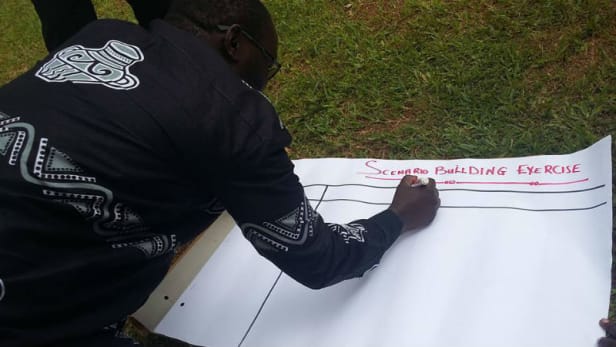
ActionAid Uganda leads a scenario building exercise. Photo by: ActionAid Uganda

The office raid appears to be part of a wider crackdown on legitimate protests against the plan to remove the presidential age limit from the Ugandan Constitution, thus allowing the current president to remain in power indefinitely.

We think these attacks have ulterior motives.

1. To delegitimize civil society. Police raids on our offices immediately present us as subversive elements. This could affect our public image, and that of civil society in general. It could also scare away our funding partners and threaten the stability of our work.

2. To compromise our systems and information. These attacks disrupt our work, and potentially sow seeds for future surveillance by targeting our communications systems and infrastructure.

3. To disrupt and derail us from our mission. Part of our mission as civil society is to help articulate public positions. We are opposed to regressive constitutional amendments. We will invest in organizing citizens to resist attempts to remove the age-limit, even though we know this puts us in direct conflict with the ruling party.

4. To threaten and demoralize civil society. In the hopes of driving us into self-censorship, weakening our resolve, and preventing us from tackling injustice.

5. To provide a justification for further action. Such as halting activities of civil society under the pretext that investigations are still ongoing. We have already seen this happening in the case of ActionAid, where two field activities have been halted by the police.

What can we learn from these attacks and what should civil society do to defend ourselves in ongoing efforts to protect civic space? How can we ensure that we are not derailed in our mission to tackle injustice and poverty?

Here are some tips if your office is at risk of being raided.

1. Always keep your house in order. You must update and back up all institutional information and documentation. During the impromptu siege, the police demanded documents without delay. If we had failed to do so, it may have caused unnecessary suspicion.

2. Staff and board members must understand all processes in the organization. If interrogated, we do not want colleagues to inadvertently arouse suspicion by saying inconsistent things about how we organize ourselves and what our business processes are.

3. Rapid legal response is necessary. As civic and political space continues to shrink in Uganda and globally, we must strengthen our legal response capabilities. The presence of competent lawyers is extremely important.

4. A positive relationship with the media is essential. The media were very helpful in reporting the siege — and established relations meant they did so in a manner that was both supportive and objective. Social media platforms were of increased importance during this crisis, and future investment here is key.

5. Being relevant to civil society and wider citizens’ struggles. The immense show of solidarity from other civil society organizations, politicians, and the public at our time of need demonstrated our value and relevance to civil society. The more outward looking an NGO, the more likely it is to receive much-needed solidarity from others. We were able to call upon our supporters both in Uganda and across the world to amplify our voice and provide solidarity.

6. Beware of potential informers. Finally, we have learned that the forces that seek to undermine our work are in our midst. It is therefore important to better understand our internal environment and partners with whom we work. We must remain vigilant and transparent and have the confidence to defend what we stand for.

The threat to civil society is far-reaching. We must learn from these attacks and work together to protect and defend the legitimacy and effectiveness of the work that we do.

196935scr
Arthur Larok is the current country director of ActionAid Uganda. He has previously worked with the Uganda National NGO Forum, the Forum for Education NGOs in Uganda and World Learning for International Development. He is the current chairperson of the Uganda National NGO Forum, the largest NGO platform in Uganda.

Sources:

Opinion: Our offices were raided in Uganda. Here’s what to do if yours are, too. | Devex

http://allafrica.com/stories/201710090056.html

Korean people win Friedrich Ebert human rights award for candlelight rallies

October 18, 2017

Readers of this blog know my special interest in human rights awards. So you will understand my surprise to learn that the Friedrich Ebert Foundation has granted its 2017 Human Rights Award to all South Korean citizens (a total of 17 million!!) who took to the streets to protest against President Park Geun-hye for months and peacefully removed her from power.

Sven Schwersensky, resident representative at Friedrich Ebert Stiftung’s Korea office, talks about the Human Rights Prize during a press briefing Monday (Yonhap)

As Ock Hyun-ju reported in the Korea Herald of 16 October 2017: “The peaceful exercise of democratic participation and in particular the civic right of peaceful assembly are the essential components of democracy,” said Sven Schwersensky, resident representative in Korea. “In our view, the people’s candlelight demonstrations have given the whole world evidence of this important fact….At the time, authoritarianism was on the rise everywhere in the world, even in the western world,” he said, citing the UN special rapporteur Maina Kiai, who addressed the diminishing rights to public assembly and free speech under the former Park administration during his visit to Korea in 2016. “People of Korea showed resistance to authoritarianism.”

The organizing committee for candlelight demonstrations — an association of over 1,500 civic groups, labor unions and student organizations — took the prize on behalf of all Koreans. The committee received 20,000 euros ($23,590) in prize money. How the money will be spent has not been decided yet, it said.  The award ceremony will take place in Berlin on 5 December. [see also: https://humanrightsdefenders.blog/2014/11/12/friedrich-ebert-award-goes-to-fartuun-adan-from-somalia/]

More about the FES Human Rights Prize: http://www.trueheroesfilms.org/thedigest/awards/friedrich-ebert-foundation-human-rights-award

Source: [Newsmaker] Koreans win global prize for candlelight rallies

Nigeria: NGOs try to prevent the adoption of NGO-unfriendly law

August 1, 2017
Speaker Dogara

In a blog post on Vanguard News it is explained that the appeal dated 28 July 2017 was sent to Ms Annalisa Ciampi, Special Rapporteur on the rights to freedom of peaceful assembly and of association; Mr Michel Forst, Special Rapporteur on the situation of human rights defenders; and Mr. David Kaye, Special Rapporteur on the promotion and protection of the right to freedom of opinion and expression. The organization said, “.. If adopted, the bill which is copied from repressive countries like Somalia, Ethiopia and Uganda, would have a chilling effect not only on expressions of peaceful dissent by the citizens but also on the legitimate work of NGOs and individual human rights defenders and activists scrutinizing corruption in the National Assembly and exposing human rights violations by the government.”

The urgent appeal signed by SERAP executive director Adetokunbo Mumuni read in part: .”.. the bill is by far the most dangerous piece of legislation in the country in terms of its reach and devastating consequences not only for the work of civil society but also the effective enjoyment of constitutionally and internationally recognized human rights of the citizens. The bill will devastate the country’s civil society for generations to come and turn it into a government puppet.”……

SERAP is also concerned that the proposed bill is coming at a time the members of the Senate and House of Representatives are proposing amnesty and immunity for themselves against prosecution for corruption and other economic crimes; and the government is proposing a social media policy to restrict and undermine citizens’ access to the social media ahead of the general elections in 2019.”

……

The provisions of the bill are also not subject to any judicial oversight. SERAP believes that independent groups and activists should have space to carry out their human rights and anticorruption work without fear of reprisals, such as losing their registration or being sent prison.”


[The House of Representatives debated the bill known as ‘An Act to provide for the establishment of Regulatory Commission for the Supervision, Coordination and Monitoring of NGOs, CSOs and Communities Based Organizations in Nigeria’. The bill will establish a commission responsible only to the president and the senate. Under section 7, the commission will monitor and supervise these groups supposedly to “ensure that they accomplish their missions according to law” and under section 26, strictly “in line with the programmes of government.” Section 8 of the bill even goes further by empowering the commission to coordinate the work of all national and international NGOs in the country. All groups must register with the commission and submit their annual reports for discussion and governmental approval. The commission may take any punitive action against civil society and “do all such things incidental to its functions” under the Act. Section 10 establishes ‘a documentation center’ to which all civil society groups must submit the list of their activities and other information that may be required or prescribed. Section 11 then requires submission of all proposed activities by civil society for approval. Section 12 requires registration of all civil society organizations on the payment of unspecified fees and other fees as the commission may require or prescribe. But registration may be turned down, as stated under section 13. Registration is valid for only 24 months and renewable, subject to conditions as may be prescribed. Registration may also be denied if the activities of civil society groups are not in line with “national interest”. Operations of the groups will be terminated without any such registration. Under section 19, workers of the groups must apply for work permits. The groups can only appeal to “a minister” if they are dissatisfied with the application of any of the provisions of the Act, as provided for under section 19. The bill in section 24 criminalizes behaviour that is inherently legitimate by prescribing severe criminal penalties, including fines of N500,000 or 18 months imprisonment or both, for operating without registration under the bill. Under section 26, any such person will be banned for 10 years from doing any civil society work. The combined effect of sections 25 and 26 is that no civil society group will be able to carry out any activity without first seeking and obtaining a ministerial approval.]

Source: SERAP drags Dogara to UN over ‘repressive bill to regulate, crackdown on civil society’ – Gistmaster (It appeared first on Vanguard News)

https://guardian.ng/news/serap-drags-dogara-to-un-over-bill-to-crackdown-on-csos/

Side event on civil society and the promotion of economic, social and cultural rights – 9 June 2017

June 2, 2017

Among the many side events expected to be organized in the margin of the next session of the UN Human Rights Council will be “The role of civil society participation in the promotion of economic, social and cultural rights and poverty alleviation“, on Friday 9 June 2017, from 13.00-14.30 PM in Room IX, Palais des Nations, Geneva.
Respect for economic, social and cultural (ESC) rights is a fundamental element of effective and sustainable poverty alleviation; it is also intimately linked with respect for civil and political rights, progress in sustainable development and the construction of peaceful, cohesive and stable communities. The goal of this panel is to discuss among different stakeholders the crucial principle of participation by NGOs, human rights defenders, and other civil society actors in rights-based approaches to poverty alleviation at the national level. In particular, UN experts on economic, social and cultural rights will reflect on how the experiences and resources of civil society assist them in their work to promote and protect ESC rights, including the development and monitoring of recommendations arising from both reports and country visits. [see also: https://humanrightsdefenders.blog/2016/03/25/human-rights-council-adoption-landmark-resolution-protection-defenders-economic-social-cultural-rights/]
Opening remarks by Marta Maurás Perez, Ambassador of Chile to the UN in Geneva
Panelists:
  • Prof Philip Alston, UN Special Rapporteur on extreme poverty and human rights
  • Prof Sandra Liebenberg, Member of UN Committee on Economic, Social and Cultural Rights
  • Stefan Luca, lawyer and Roma rights advocate
  • Sophie Richardson, Human Rights Watch
Moderator: Lucy McKernan, Global Initiative for Economic, Social and Cultural Rights
The side event is co-sponsored by Global Initiative for Economic, Social and Cultural Rights, OHCHR and the International Service for Human Rights. You can follow the event on Twitter: @ISHRglobal #HRDs

Source: The role of civil society participation in the promotion of economic, social and cultural rights and poverty alleviation | ISHR

34th Session of UN Human Rights Council ended: the summing up by civil society

March 28, 2017

On 24 March 2017 a group of important NGOs that are active at the UN Human Rights Council made a joint statement at the end of the 34th session. These are: International Service for Human Rights, Asian Forum for Human Rights and Development (FORUM ASIA), Global Centre for the Responsibility to Protect, Human Rights House Foundation, CIVICUS, International Lesbian, Gay, Bisexual, Trans and Intersex Association (ILGA), Amnesty International, and Human Rights Watch. They:

….. welcome the renewal of key Special Procedures mandates, and in particular that of the Special Rapporteur on human rights defenders. At a time when defenders are under an unprecedented attack and killings of defenders are on the rise, the united stance of the Human Rights Council is key. While we welcome the restoring of consensus to this key resolution, we deeply regret the fracturing of the same on the right to food resolution, particularly given the increasing interrelationship of food insecurity, conflict and human rights violations.

At the outset of this session, High Commissioner Zeid has described 2017 as a pivotal year for the Council, and has diagnosed an attack on the entire rights-based system. To be a credible part of this system, and rise to the world’s challenges, the Council must – while appropriately engaging the concerned States – respond firmly to human rights violations and victims’ demands for accountability Some actions at this session have struck this balance in part; others – such as the decision hastily ending the mandate on Haiti – have not. The Council still fails to bring needed attention to a range of violations in countries such as Azerbaijan, Bahrain, China, Egypt, Philippines, Turkey and others.

The urgent dispatch of a Fact-Finding Mission [FFM] on Myanmar is a welcome step. We now look to you, President, to consult, including with civil society, on the appointment of the FFM’s members. But we regret the dissociation of Myanmar from the resolution, and call on Myanmar to fully cooperate with the FFM. We look to all States, including in particular those with investment, trade and business relationships with Myanmar, to fully facilitate the work of the FFM. We commend the Council for recognising the fundamental relationship between violations of human rights and the commission of mass atrocities, including by advancing accountability for such crimes in the DPRK, South Sudan, Sri Lanka and Syria.

Finally, Mr President, we are again concerned about allegations of intimidation and reprisals against defenders from Myanmar, Bahrain and Sri Lanka, including during the current session. In line with your legal obligation, we urge you to take these cases seriously, follow-up thoroughly on the allegations, and ensure that all those who engage with the body you preside over can do so safely.