Posts Tagged ‘campaign’

Bahrain: #FreeNabeel campaign more urgent than ever in view of resumption USA security assistance

July 8, 2015

Nedal Al Salman , Head of International Relations and Women & Children’s Rights Advocacy of the Bahrain Centre for Human Rights [BCHR], launched today a day of solidarity for the president of the BCHR, Nabeel Rajab, with videos of supportive MEP’s. There is an urgent resolution adopted by the EU Parliament about Bahrain and in particular the case of Nabeel Rajab. [https://thoolen.wordpress.com/2015/01/20/video-statement-of-troublemaker-nabeel-rajab-who-is-on-trial-today/]

You can join in the campaign by recording your self on video, state your name and the organisation you represent and say a few words about Nabeel Rajab and call for his release. Your video/photo can be shared on twitter under the hashtag #FreeNabeel [https://thoolen.wordpress.com/tag/nabeel-rajab/]

How difficult it is to match human rights diplomacy with geopolitical considerations is shown in the OP-ED in the New York Times of 7 July 2015 by Sayed Alwadaei, the director of advocacy at the Bahrain Institute for Rights and Democracy:

“Last week, the State Department announced the resumption of “security assistance” to Bahrain. This ended a four-year ban on the transfer of arms that the United States put into effect in 2011, after the Bahraini government’s harsh crackdown on Arab Spring protests. In a statement, the State Department argued that Bahrain had made enough progress in human rights reform to be rewarded by ending the embargo, even though the human rights situation in Bahrain was not “adequate.” The State Department dedicated 49 pages of its 2014 report on human rights, released last month, to Bahrain.

It is a damning document: detailing arbitrary detention, torture, prison overcrowding, constraints on free speech and more. The decision to renew security assistance — in the words of a State Department spokesman, “armored personnel vehicles, MRAPs, Humvees, TOW missiles, arms and ammunition, that kind of thing” — is not only incongruous but also shortsighted, with potentially disastrous consequences.

Prince Zeid Ra’ad Zeid al-Hussein of Jordan, the United Nations high commissioner for human rights, criticized acts of torture in Bahrain in his opening remarks at a session of the Human Rights Council in June. He called for “an immediate investigation” into allegations of torture in Bahrain’s prisons and for the release of “all those detained in connection with their peaceful activities.”

If Prince Zeid were a Bahraini, he could probably be arrested on charges of “insulting a statutory body” — as happened to the human rights defender Nabeel Rajab after he called for prosecution of officials who committed torture in prison. He now faces at least 10 years in prison on various charges relating to his activism.

I was arrested on March 16, 2011, a day after the government announced a state of emergency, a month after the protests started. A military court sentenced me to prison for protesting and talking to the media. What they did to me in prison will stay with me for life.

On my first day in Jaw Prison, about 20 miles south of the capital, Manama, an officer spat on me, grabbed me by the hair and threw me against a wall. During interrogation, another smacked me in the face and dared me to raise my arms to shield myself. They told me I’d be beaten even more if I did.

While I was in detention, four people were tortured to death, as Human Rights Watch has reported. In the interrogation rooms, we always thought of those who had been killed, wondering who might be the fifth. After my release from prison, I fled Bahrain and in 2012 sought asylum in Britain. This January, Bahrain revoked my citizenship, along with that of 71 others, leaving me stateless.

Bahrain’s situation has not improved since 2011. Last November, an inmate was beaten senseless and thrown into solitary confinement, where he died from his wounds during the night. In March, a prison riot broke out. Prisoners were angry about their treatment in overcrowded and unsanitary conditions, and about the unfair trials that had put more than a thousand of them there. Prison authorities are accused by prisoners of responding with excessive force.

What happened next was incomparable to what I was put through. According to a report published last month by a coalition of rights groups, including my own, prisoners said that police officers used birdshot and tear gas against inmates inside corridors and cells. Inmates were rounded up, beaten and held in the courtyards, where they spent weeks sitting in Bahrain’s heat. Former prisoners allege that officers forced inmates to kneel and lick their boots. An imprisoned academic named Abduljalil al-Singace has been on a hunger strike for over 100 days, in protest of the ill treatment suffered by prisoners in March. (There are growing concerns for his health.)

In light of the continuing abuses, the State Department’s praise of the release of the political prisoner Ibrahim Sharif as a sign of “meaningful reform progress” is absurd. Never mind that Mr. Sharif, sentenced to five years in 2011, had served most of his sentence, and that as a political prisoner, he should never have been imprisoned to begin with. And as one political prisoner was released, another, Sheikh Ali Salman, received a four-year sentence for his opposition activities. The police also called in his deputy for questioning last week, after he made a speech against torture in prison.

When the United States expressed concerns a few weeks ago to the Human Rights Council in Geneva about “the continuing criminal cases on grounds of political expression and assembly,” Bahrain rejected them as groundless. It is Bahrain’s prerogative to disregard its American ally’s qualms, but must the United States reward such disrespect by renewing military assistance?

The answer lies in geopolitics. Persian Gulf monarchs are on high alert as the United States nears a nuclear deal with their regional rival, Iran. They want to protect their position as the West’s strategic partners and maintain their influence in the Middle East. At the same time, the rise of the Islamic State is a potent threat to their security, which America seeks to bolster militarily. Resuming arms transfers rekindles not only the American-Bahraini relationship but also the hugely important American-Saudi one.

But these diplomatic considerations come at the cost of relinquishing whatever moral standing the United States had in Bahrain. Ending the suspension of military assistance was a misuse of America’s substantial leverage to bring positive change to the human rights situation in Bahrain and the Gulf, which has only deteriorated since 2011. For Bahrainis striving for a democratic country, America’s move is completely regressive.

President Obama promised a “tough conversation” with the Gulf monarchs when he met them in May. Was this the outcome of that conversation?”

Losing Leverage on Bahrain – The New York Times.

#ForFreedom – worth a visit

May 19, 2015

This is an interesting website by the International Federation for Human Rights (FIDH) which allows you to quickly contact decision makers and other persons with influence to help free at least some arbitrarily detained human rights defenders.logo FIDH_seul

http://en.freedom-defenders.org

Monday 2 March, start of the #idefend campaign

February 28, 2015

On Monday 2 March 2015 starts the “#idefend – Making sure civil society has its voice” campaign. It is an initiative of the Delegation of the European Union to the UN in Geneva in partnership with the Office of the High Commissioner for Human Rights and the Permanent Missions of Brazil, the Republic of Korea and Tunisia.

The #idefend campaign takes a public stance to support the voices of civil society.#idefend aims at expressing solidarity with all those human rights defenders and civil society actors, whose dedication and everyday work improve the human rights of people in every corner of the world. Join the campaign and help empower those who speak up for human rights!

Human rights defenders are not violent seditionists, criminals, nor bloody revolutionaries, as so many governments like to portray them. They are the best of us, all of us. And they have a message. To all governments, we say: focus on their message. Listen to what they are saying. Understand the message, talk to them about it, be persuaded or persuade, without violence, instead of silencing them, punishing them, their families, and their communities.
Zeid Ra’ad Al Hussein, UN High Commissioner for Human Rights

Sadly, over the past years, we have observed a worrying trend at the Human Rights Council: Human Rights Defenders and civil society representatives are hampered from speaking at the Council, sometimes they are harassed upon their arrival to Geneva, or subject to reprisals in their home country upon their return. This is not acceptable.
Peter Sørensen, Head of the EU Delegation to the United Nations

#idefend | Making sure civil society has its voice.

UN High Commissioner for Human Rights writes about Women’s Human Rights Defenders

December 8, 2014
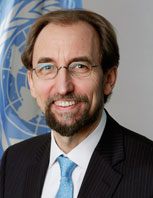
UN HCHR Al Hussein

On 5 December 2014, Zeid Ra’ad Al Hussein, United Nations High Commissioner for Human Rights, wrote a piece in the Huffington Post in which he eloquently calls on all to ‘Stand in Solidarity With Courageous Women’s Human Rights Defenders’. 

In the article he explains that his Office has decided to launch a campaign to pay tribute to women and men who defy stereotypes and fight for women’s human rights. The campaign runs from Human Rights Day, December 10 this year, to International Women’s Day, March 8, 2015. We encourage everyone to join the ranks of these strong and inspiring advocates, on social media (#reflect2protect) and on the ground. Below the text in full:


Almost two decades ago, in Beijing, 189 countries made a commitment to achieve equality for women, in practice and in law, so that all women could at last fully enjoy their rights and freedoms as equal human beings.

They adopted a comprehensive and ambitious plan to guarantee women the same rights as men to be educated and develop their potential. The same rights as men to choose their profession. The same rights to lead communities and nations and make choices about their own lives without fear of violence or reprisal. No longer would hundreds of thousands of women die every year in childbirth because of health care policies and systems that neglected their care. No longer would women earn considerably less than men. No longer would discriminatory laws govern marriage, land, property and inheritance.

In the years that followed, the world has witnessed tremendous progress: the number of women in the work force has increased; there is almost gender parity in schooling at the primary level; the maternal mortality ratio declined by almost 50 percent; and more women are in leadership positions. Importantly, governments talk about women’s rights as human rights, and women’s rights and gender equality are acknowledged as legitimate and indispensable goals.

However, the world is still far from the vision articulated in Beijing. Approximately 1 in 3 women throughout the world will experience physical and/or sexual violence in their lifetime. Less than a quarter of parliamentarians in the world are women. In over 50 countries there is no legal protection for women against domestic violence. Almost 300,000 women and girls died in 2013 from causes related to pregnancy and childbirth. Approximately 1 in 3 married women aged 20 to 24 were child brides. In many parts of the world, women and girls cannot make decisions on their most private matters — sexuality, marriage, children. Girls and women who pursue their own life choices are still murdered by their own families in the dishonorable practice of so-called honor killings. All of our societies remain affected by stereotypes based on the inferiority of women, which often denigrate, humiliate and sexualize them.

Today we have the responsibility to protect the progress made in the past 20 years and address the remaining challenges. In doing so, we must recognize the vital role of women who defend human rights, often at great risk to themselves and their families precisely because they are viewed as stepping outside socially prescriptive gender stereotypes. We must recognize the role of all people, women and men, who publicly call for gender equality and often, as a result, find themselves the victim of archaic and patriarchal, but powerful, threats to their reputations, their work and even their lives. These extraordinary individuals — women’s human rights defenders — operate in hostile environments, where arguments of cultural relativism are common and often against the background of the rise of extremist, misogynistic groups, which threaten to dismantle the gains of the past.

Attacks against women who stand up to demand their human rights and individuals who advocate for gender equality are often designed to keep women in their “place.” In some areas of the world, women who participate in public demonstrations are told to go home to take care of their children. Consider the recent example of a newspaper publishing naked photos of a woman, claiming she was a well-known activist — an attack designed to shame this defender into silence. In other places, when women claim their right to affordable modern methods of contraception, they are labelled as prostitutes in smear campaigns seeking to undermine their credibility. Online attacks against those who speak for women’s human rights and gender equality by so-called “trolls” — who threaten heinous crimes — are increasingly reported.

These attacks have a common thread — they rely on gender stereotypes and deeply entrenched discriminatory social norms in an attempt to silence those who challenge the age-old system of gender inequality. However, these defenders will not be silenced, and we must stand in solidarity with them against these cowardly attacks.

This is why my Office has decided to launch a campaign to pay tribute to women and men who defy stereotypes and fight for women’s human rights. The campaign runs from Human Rights Day, December 10 this year, to International Women’s Day, March 8, 2015. We encourage everyone to join the ranks of these strong and inspiring advocates, on social media and on the ground.

As we approach the 20-year anniversary of Beijing, discrimination and violence against women, and the stereotypes that confine them into narrowly fixed roles must end. Women have the right to make their own decisions about their lives and their bodies. Guaranteeing and implementing these rights are non-negotiable obligations of all States. Women human rights defenders were instrumental in securing the ambitious program laid out in Beijing. Their work, their activism and their courage deserve our recognition, our support and our respect.”

Stand in Solidarity With Courageous Womens Human Rights Defenders | UN Women.

Tribute: Remembering Women Human Rights Defenders

November 26, 2014

As part of the 16 Days Campaign Against Gender Based Violence (November 25 – December 10, 2014) AWID is honoring Women Human Rights Defenders (WHRDs) Who Are No Longer With Us.

The tribute was first launched at AWID’s 12th International Forum on Women’s Rights in Development, held in April 2012 in Istanbul, Turkey. The new version of the tribute takes the form of an online photo exhibition launched on 25 November, Day for the Elimination of Violence Against Women and ends on 10 December, International Human Rights Day with a special slide show featuring 16 WHRDs from around the world. The tribute features photographs and biographies of rights leaders from around the world. Each day of the campaign AWID will share the story of a WHRD(s) on its website as well as through Facebook and Twitter using hashtags #16days and #AWIDMembers and link back to the full online exhibit which will commemorate and celebrate the work and lives of WHRDs who have passed away since January 2011.

An example is Sunila Abeyesekera a lifelong women human rights defender from Sri Lanka, who played a lead role in the global women’s rights movement for over 40 years to be honored on 29 November which is International Women Human Rights Defenders’ Day. [https://thoolen.wordpress.com/2013/09/09/sri-lankan-hrd-sunila-abeysekera-dies-tribute-by-a-paper-bird/]

About one third of those honored in this tribute were killed or disappeared due to their activism. Women like Agnes Torres, from Mexico, Cheryl Ananayo, from the Philippines who was assassinated as she struggled against a mining company; Colombian women’s human rights defender Angelica Bello who died in suspicious circumstances; and Petite Jasmine, board member of Swedish sex worker’s rights organization Rose Alliance who was murdered by the father of her children, who had threatened and stalked her on numerous occasions.

WHRD Tribute / Women Human Rights Defenders / Our Initiatives / Homepage – AWID.

OMCT launches again its 10 days campaign for and with Human Rights Defenders

November 26, 2014

OMCT-LOGOAs from 1 December the Geneva-based NGO OMCT will launch, for the 3rd year in a row, its Campaign “10 Days of Activism against torture and ill-treatment“(coinciding this year with the 30th anniversary of the UN Convention against torture). Through 10 videos, 10 human rights defenders will speak out against torture and discuss the importance of the UN Convention against Torture and its implementation in their respective countries under the slogan: “Nothing Can Justify Torture Under Any Circumstances!”. I will try and cover most of them, but you can also go to the OMCT website:

via 10 Days of Activism against torture and ill-treatment / November 25, 2014 / Events / Human rights defenders / OMCT.

New AI video clip on Torture

May 28, 2014

On 14 May 2014 Amnesty International published a new campaign video on torture.  It is specially interesting as a very short summary – in images – of the history of the anti-torture campaigns started by AI under the leadership of Martin Ennals more than 40 years ago. Read the rest of this entry »

Take a minute to make this social media campaign a success!

April 15, 2014

The International Federation for Human Rights (FIDH) has started a most interesting campaign using social media to free human rights defenders. I strongly advise readers of this blog to take action by subscribing to the idea and retweeting or reblogging it on their own platforms. Let us see what can be achieved by 27 April when the campaign finishes!

https://www.thunderclap.it/projects/9969-forfreedom

logo FIDH_seul


AI animation to galvanise support for human rights defenders

April 15, 2014

We have a tendency to take for granted that there is a worldwide human rights movement to support all the actions and campaigns in favor of human rights defenders. But, this movement needs to be created and galvanised. One tool is the use of animated images with a simple message: that a loud voice can save lives. The example above (animated by Cesare Davolio) is a “commercial’ commissioned by Amnesty Netherlands for the “Use your power” campaign, explaining what the Amnesty urgent action network can accomplish. This short film – published on You Tube on 8 April – explains how the Urgent Action Network works, from receiving news of a human rights defender being arrested to news being sent out to AI activists and members all over the world via text messages (SMS), email etc to individuals taking action. Shows how effective these individual acts can be when coördinated to produce a ‘louder voice’.


THE SILENCED VOICES OF SYRIA: Special campaign aimed at Human Rights Defenders

March 16, 2014

While the whole of the Syrian population suffers terribly, it is important to recognize that human rights defenders, activists, media and humanitarian workers have been particularly targeted for their work since the beginning of the Syrian uprising three years ago. Many have been arrested or abducted by either government forces and pro-government militias or by non-state armed groups. The channels for obtaining reliable information are drying up and that is certainly not a coincidence.

Now several international NGOs such as Amnesty International, the Euro-Mediterranean Human Rights Network, FIDH, Frontline Defenders, Human Rights Watch and Reporters Without Borders have come together to work jointly, with other international, regional and Syrian organizations, to campaign for the release of  these Silenced Voices of Syria.  The campaign is starting with the documentation of 37 emblematic cases.

This campaign will use a three-pronged strategy  of 1. Research and Documentation, 2. Information/Sensitisation and 3/ Mobilization.

via FREE SILENCED VOICES OF SYRIA | Civil society activists, media and medical workers targeted for their work.

https://thoolen.wordpress.com/2014/02/13/one-more-disappearance-in-syria-roshdy-el-sheikh-rasheed/