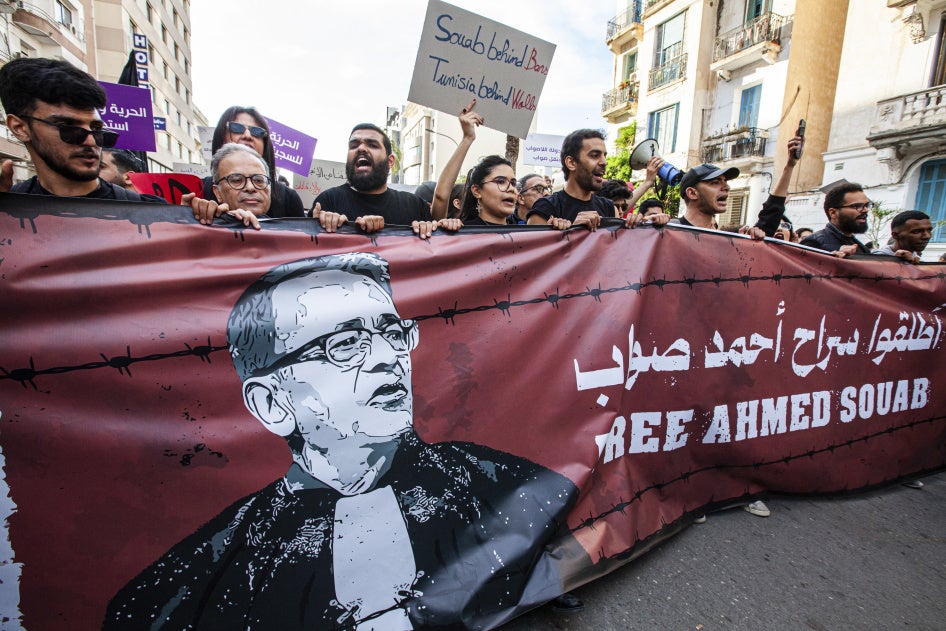
A Tunisian lawyer and human rights defender, Ahmed Souab, who was sentenced to prison on terrorism-related charges, will face a new trial on appeal on February 12, 2026, Human Rights Watch said. The Tunisian authorities should immediately drop the unfounded charges and release him, and stop retaliating against critics and the lawyers defending them.
Tunisian authorities prosecuted Souab, 69, for statements he made outside of court while representing defendants in a notorious case of “conspiracy against state security.” On October 31, 2025, a Tunis anti-terrorism court sentenced him to five years in prison and three years of administrative supervision. His trial lasted just minutes; Souab was not present, and journalists were reportedly barred from attending.
“Ahmed Souab, a lawyer, former administrative judge, and fierce advocate for judicial independence, is behind bars simply for his defense work and outspoken views,” said Bassam Khawaja, deputy Middle East and North Africa director at Human Rights Watch. “His abusive prosecution for defending others from abusive prosecution shows the sheer extent of the Tunisian authorities’ crackdown on any dissent.”
Anti-terrorism agents arrested Souab in his home on April 21, following comments he made after the “conspiracy case” verdict on April 19. That day, 37 people, including lawyers, activists, and opponents, were sentenced after a sham trial for terrorism and security-related offenses to prison terms ranging from 4 to 66 years.
Standing outside the headquarters of Tunis Bar Association, Souab reportedly said: “It seems that it is not the detainees who have a knife turned on them, but rather, it’s the president of the chamber who has a knife [at his throat].” Video excerpts of his statement circulated widely on social media. Souab’s defense committee explained that he was referring to pressure exerted on judges.
Human Rights Watch has documented the authorities’ repeated attacks on the judiciary in Tunisia, including President Kais Saied’s dismantling of the High Judicial Council in February 2022. The attacks have severely undermined the rule of law, allowed the executive to weaponize the judiciary for political ends, and jeopardized Tunisians’ right to a fair trial, Human Rights Watch said.
The Tunisian authorities are increasingly relying on remote trials for terrorism cases, especially for politically motivated trials against dissidents. The practice of remote trial by video is inherently abusive, including by undermining detainees’ right to be brought physically before a judge to assess their well-being and the legality and conditions of their detention.
On October 31, Souab was convicted of “endangering the lives of people entitled to protection by deliberately disclosing information that could reveal their identities” and of “making threats in connection with a terrorist offense,” his family told Human Rights Watch.
Souab’s family said he has a history of cardiac conditions and experienced a deterioration in his health in prison. He has suffered several nosebleeds, the cause of which was not determined, they said.
Over the past three years, the authorities have increasingly relied on an aggressive legal toolbox, including unfounded security and terrorism charges under the penal code and 2015 Counterterrorism Law, to target critics and lawyers with judicial harassment, abusive criminal prosecution, arbitrary detention, and travel bans for the legitimate exercise of their profession. see also: https://humanrightsdefenders.blog/tag/tunisia/
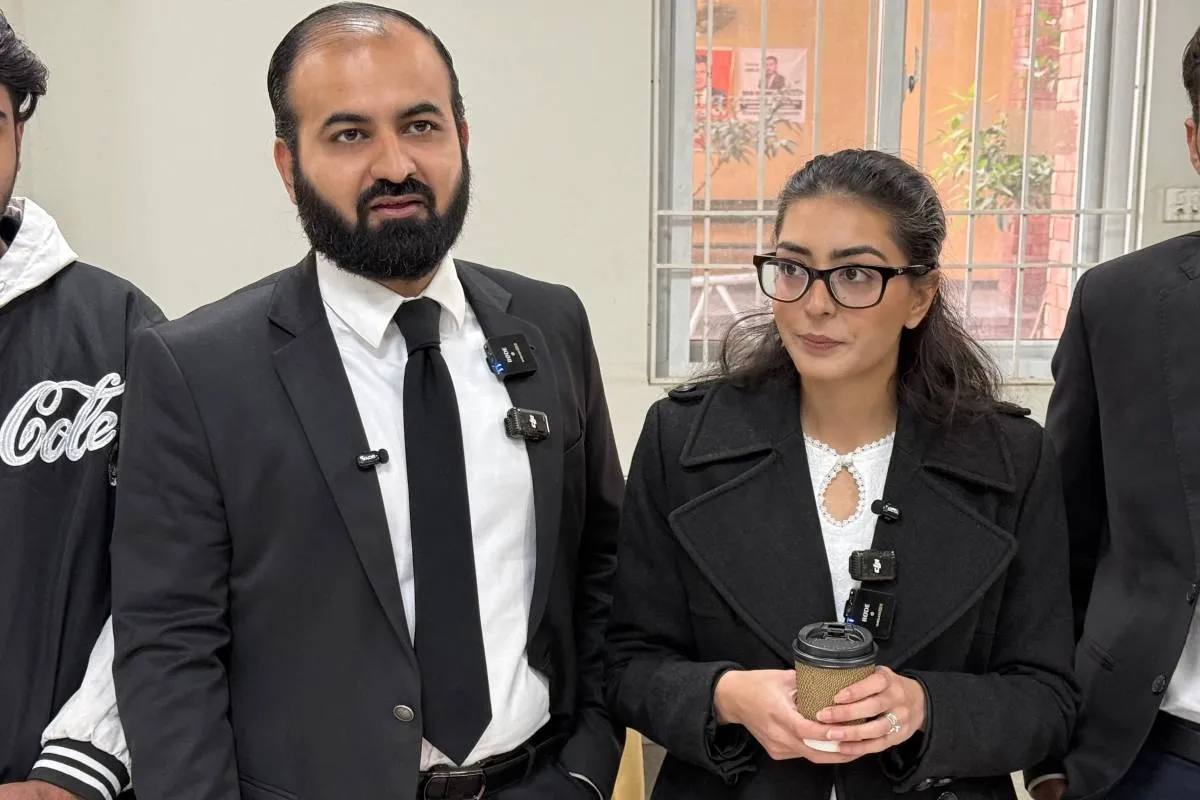
Several media (such as the CSR Journal and Barrons) and NGO (Frontline) talk about the case of human rights lawyer Imaan Mazari and her husband and fellow lawyer Hadi Ali Chattha who were sentenced 10-year-jail by an Islamabad court on 24 January 2026 over anti-state social media posts. However, the pressure and arrest haven’t been able to silence her voice. She said to media agencies, “We will not back down. Truth seems overwhelmingly difficult in this country. But we knew that when we got into this work, we’re ready to face that,”. Mazari noted that the prison term won’t dent her resolve.
Imaan Mazari is a 32-year-old human rights lawyer from Pakistan who rose to fame for fighting some of the most sensitive cases and she has been defending ethnic minorities, journalists facing defamation charges and some of her clients have been branded blasphemers. With Mazari’s coming to prominence, so did the charges by the Pakistani government for cyber terrorism and hate speech. As per a court document, Mazari has been disseminating highly offensive content.
Mazari comes from a well-known family, she is the daughter of former minister for human rights, Shireen Mazari, and her late father was one of the top paediatricians of South Asia. Because of her strong determination of fighting back despite all odds, she is being compared to Pakistan’s one of the popular human rights lawyers, late Asma Jahangir. [see: https://www.trueheroesfilms.org/thedigest/laureates/14CC52FE-5F1B-4EF8-B1F5-607ED173AACC]
Mazari is a pro bono lawyer, she has handled some of the most sensitive cases in Pakistan, e.g. enforced disappearances of ethnic Balochs, she defended Mahrang Baloch. She has also taken up blasphemy cases.
Last year, the UN special rapporteur for human rights defenders said, “Cases against her appear to reflect an arbitrary use of the legal system to harass and intimidate”. She was first targeted in a press conference held sometime in early January, where a military spokesman Lieutenant General Ahmed Sharif Chaudhry, shared Mazari’s post on X posts and filed a case against her, stating her as, “hidden elements committing subtle crimes. They operate under the guise of democracy and human rights to promote terrorism,”.
Independent human rights experts on 14 January 2026 expressed concern over restrictions faced by human rights defenders in Egypt following their release from detention.
“We recently raised concerns about the continued detention of human rights defenders on renewed and similar charges,” the experts said. “Even those who have been released continue to face restrictions that severely limit their ability to return to normal life.”
Many human rights defenders charged under Egypt’s counterterrorism law have faced a travel ban, had their assets frozen, or ended up back on the country’s terrorism watchlist after being released.
“Such restrictions have severe consequences for the affected individuals and their families and their ability to enjoy economic and social rights,” the experts said.
“This is deeply concerning, particularly given that Egyptian law guarantees the right to appeal asset freeze decisions, which the three individuals have done, but to no avail,” the experts said.
Human rights lawyer Mohamed El-Baqer was detained in connection with several cases involving similar charges. During his incarceration in late 2020, his name was added to Egypt’s terrorism watchlist for a period of five years, leading to a travel ban, withdrawal of his passport, and freezing of his bank account and other assets. El-Baqer received a presidential pardon in 2023, but he has remained on the terrorism watchlist.
“What makes it all the more shocking is that, just one day before the end of the five-year period, El-Baqer was added to the terrorist list for another five years, despite no evidence being provided,” the experts said.
Human rights defender Ahmed Samir Abdel-Hai’ was arrested in early 2021 after returning from university in Vienna where his studies focused on Egypt’s anti-abortion laws. He was sentenced to three years in prison but was freed by a presidential pardon in summer 2022.
Since then, Abdel-Hai has been banned from travelling, with the official reason given being that he was a “threat to national security.”
The experts asked how Abdel-Hai could still be regarded as a threat to the country after he received a presidential pardon.
“These human rights defenders were criminalised under vague counterterrorism laws. They have either served their sentences or been granted presidential pardons. They should not continue to face restrictions,” they said.
The experts urged authorities in Egypt to put an end to these restrictions in line with international human rights standards.
A group of UN Special Rapporteurs condemned the criminal prosecution of 85-year-old human rights defender Mark Kuperman, who has a disability and uses a wheelchair.
Kuperman, a prominent Russian human rights advocate, faces severe “terrorism” charges and is being targeted for his anti-war views and human rights work. A celebrated human rights defender, Kuperman is the head of the Public Human Rights Center in Sakhalin region and in 2022, was awarded the Moscow Helsinki Group’s human rights prize.
On 4 April 2024, the Sakhalin Investigative Committee initiated a criminal case against Kuperman on charges of “extremism.” When the investigation concluded in early December 2024, the case was unexpectedly reopened on 20 December 2024, and the authorities escalated the charges to “public calls for terrorist activities” under article 205, part 2 of the Russian Criminal Code. These charges stem from a draft document Kuperman received from a colleague and allegedly shared with his team in January 2023, discussing potential scenarios for Russia’s democratic development and the role of the West in supporting future democratic institutions.
The experts voiced serious concerns about the impact of judicial harassment on Kuperman, especially considering his advanced age, disability, and deteriorating health. The court proceedings, set to start immediately, could endanger his life and well-being, particularly if he is detained.
“It is appalling to prosecute an older human rights defender with a first-degree disability on unsubstantiated charges of “terrorism”, brought against him just to punish him for his criticism of the war against Ukraine,” the experts said.
“Russian authorities rushing the case to trial and denying Kuperman adequate time to prepare his defence demonstrates once again the lack of judicial independence and instrumentalisation of the judicial system to silence the independent and dissenting voices in Russia.”
The Yuzhno-Sakhalinsk City Court set an unreasonably short five-working-day deadline for Kuperman to study the case files, without providing any procedural accommodations and ignoring his disability, cognitive decline, chronic pain, movement restrictions, and weak vision. On 24 January, the investigator arbitrarily ended the review process, hindering Kuperman’s defence preparation and blocking his ability to request case dismissal due to lack of evidence. Additionally, the Russian security services (FSB) apparently installed listening devices in his apartment, preventing his confidential communication with his lawyer, as Kuperman is unable to leave his apartment due to his physical impairment.
“This case fits the broader pattern of using counter-extremism and counter-terrorism legislation in Russia to target human rights defenders, anti-war activists, and political opponents for exercising their freedom of expression,” the experts added. “Kuperman’s private discussions and human rights work have been criminalised, undermining the integrity of legal proceedings and violating due process. All charges against Kuperman should be dropped.”
On 5 December 2023, Mary Lawlor, the UN Special Rapporteur on the situation of human rights defenders concluded her visit to Algeria with the observation: “While I welcome the evident reforms which have taken place over the past four years and the new emphasis on public consultation, I regret that some human rights defenders who work on sensitive issues face continued restrictions”.
The UN expert observed four main patterns of violations used to suppress human rights defenders: ongoing judicial harassment, dissolution of key human rights organisations, limitations on freedom of movement and intimidation and surveillance leading to severely negative impacts on their mental health and that of their families.
“I was saddened that a handful of human rights defenders who attempted to travel to Tizi Ouzou, where I was holding meetings, were prevented from doing so and detained for 10 hours,” Lawlor said.
“Given Algeria’s recent history, robust laws relating to terrorism are clearly necessary,” the expert said. “However, it is disappointing that laws designed to prevent terrorism are instilling terror in human rights defenders through overly broad and vague definitions of what constitutes terrorism in the Penal Code.”
The Special Rapporteur noted that Article 87 bis of the Penal Code was one of the most frequently cited laws used to prosecute human rights defenders.
Despite this, the expert said there were many people working to protect and promote human rights with the full support of the government and the newly created consultative bodies in areas including women’s rights, children’s rights, healthcare, poverty relief and political participation. Based on this collaboration and experience, the Special Rapporteur believes the government is now better equipped to reach out to human rights defenders working on sensitive issues.
Lawlor welcomed the acquittal of three human rights defenders, Jamila Loukil, Kaddour Chouicha and Said Boudour, of terrorism charges in Dar El Baida court on Sunday.
“I hope this acquittal will kickstart a review process of Article 87 bis, and I stand ready to assist the Algerian government in any way I can in this regard,” she said.
11 human rights NGOs had publicly expressed their wish that this visit be an opportunity to free imprisoned activists and for reforms to see the light of day.
On 6 December, following the public report of this visit, NGOs support the main measures recommended by the Special Rapporteur, namely that: • The Algerian government must view Human Rights Defenders as allies and opportunities within society, not as threats. The signatories call for the repeal of all repressive laws and legislative provisions relating to the rights to freedom of association and peaceful assembly, and the adoption, on the basis of broad consultation with Algerian society, a regulatory framework complies with international standards notably respect for human rights in Algeria. • Many civil society organizations are in danger of disappearing. This is already the case of the Algerian League for the Defense of Human Rights (LADDH) and the Rassemblement Actions Jeunesse (RAJ). Civil society organizations must have the freedom to adequately play their role. • Several articles of law must also be reformed in accordance with international standards. This is the case of articles 79 and 87 bis of the Penal Code, relating to the attack on the integrity of the national territory and the fight against terrorism which are abusively used to imprison activists. The same goes for the Ban on Exiting the National Territory (ISTN) which is today used in a punitive manner to restrict the movement of human rights defenders in Algeria.
The signatories finally call on the Algerian government to release all prisoners of conscience and human rights defenders currently in prison
Their key point is worth noting: The problem for human rights defenders in the Gulf region and neighbouring countries is that states have exploited the opportunity to align their cybercrime laws with European standards to double-down on laws restricting legitimate online expression BUT without any of the judicial safeguards that exist in that region.
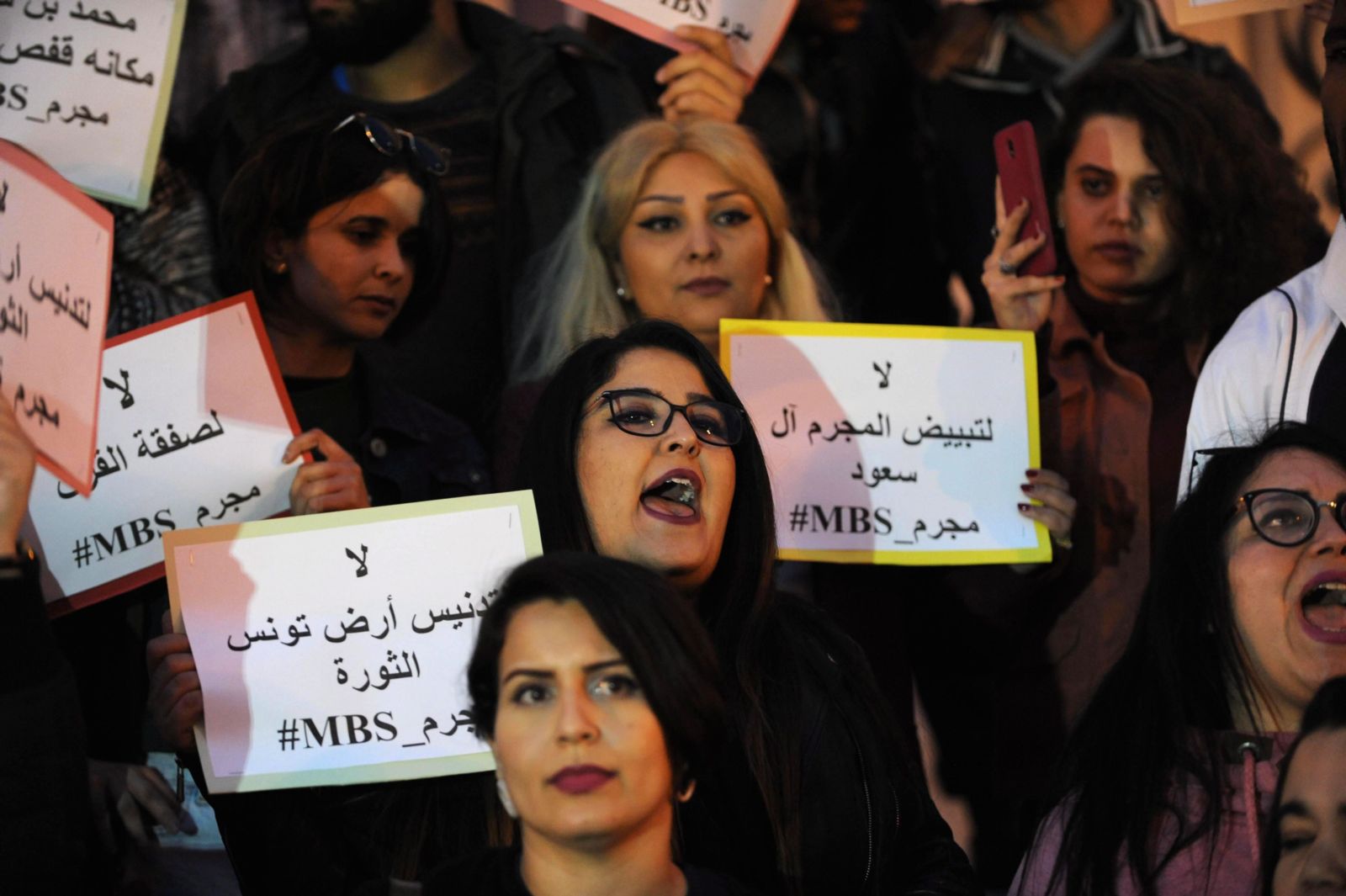
Several women take part in a protest, using a hashtag, against Saudi Crown Prince Mohamed bin Salman’s visit to the country in Tunis, Tunisia, in November 2018. EFE / Stringer
Governments in every region of the world are criminalizing human rights activism. They do it by prosecuting protest organizers, journalists, internet activists, and leaders of civil society organizations under laws that make it a crime to insult public figures, disseminate information that damages “public order,” “national security,” and “fake news.”
In the Gulf region and neighbouring countries, oppressive governments have further weaponized their legal arsenal by adopting anti-cybercrime laws that apply these overly broad and ill-defined offline restrictions to online communications.
In an age when online communications are ubiquitous, and in societies where free press is crippled, laws that criminalize the promotion of human rights on social media networks and other online platforms undermine the ability to publicize and discuss human rights violations and threaten the foundation of any human rights movement.
In May of 2018, for example, the Saudi government carried out mass arrests of women advocating online for women’s right to drive. Charged under the country’s cybercrime law including article six which prohibits online communication “impinging on public order, religious values, public morals, and privacy,” these human rights activists were detained, tortured, and received multi-year sentences for the “crime” of promoting women’s rights.
There is certainly a necessity to address the prevalence and impact of cybercrimes but without criminalizing people who speak out for human rights.
European countries and the United Nations (UN) have encouraged states to adopt a standard approach to addressing crimes committed with online technologies ranging from wire fraud to financing terrorist groups. The Council of Europe issued a 2001 regional convention on cybercrime, to which any state may accede, and the UN is promoting a cybercrime treaty.
Common standards can prevent the abuse of online technologies by enabling the sharing of online evidence and promoting accountability since the evidence of online crimes often resides on servers outside the country where the harm occurred or where the wrongdoers reside.
The problem for human rights defenders in the Gulf region and neighbouring countries is that states have exploited the opportunity to align their cybercrime laws with European standards to double-down on laws restricting legitimate online expression.
European countries have robust human rights oversight from the European Court of Human Rights, which ensures that limitations on freedom of expression online meet stringent international standards. There is no comparable human rights oversight for the Gulf region. Without adequate international judicial review, governments can successfully exploit international processes to strengthen their ability to stifle online expression.
The regional model cybercrime law drafted by the United Arab Emirates and adopted by the Arab League in 2004, follows international guidance. However, it incorporates a regional twist and includes provisions that criminalize online dissemination of content that is “contrary to the public order and morals,” facilitates assistance to terrorist groups, along with disclosure of confidential government information related to national security or the economy.
UN experts reviewed the UAE law and gave it a seal of approval, noting it complied with the European convention, ignoring the fact that UN human rights experts have documented repeatedly that governments use such restrictions to crack down on dissent. A UN-sponsored global cybercrime study, published in 2013, similarly soft-pedaled the threat of criminalizing online dissent by noting that governments had leeway to protect local values. Such protection does not extend to speaking up for universal rights like equality and democracy.
Actually, the universal right to freedom of expression protects online content, and limitations must meet international standards of legality, legitimacy, necessity, and proportionality. In our recent report on the use of anti-cybercrime legislation throughout the Gulf region and neighbouring countries, we found that over an 18-month period (May 2018-October 2020), there were 225 credible incidents of online freedom of expression violations against activists and journalist in ten countries: Bahrain, Iran, Iraq, Jordan, Kuwait, Oman, Qatar, Saudi Arabia, Syria, and the UAE. Each country has adopted anti-cybercrime laws except Iraq, where lawmakers’ drafts of proposed legislation have been met with stiff opposition from domestic and international human rights groups.
The international community needs to increase pressure on the Gulf region and neighboring countries to comply with their international obligations to protect freedom of expression off and online. Turning away from the clear evidence that oppressive governments are expanding the reach of criminal law to stifle online human rights activism undermines legitimate international efforts to address cybercrime.
How can we trust the UN to safeguard the voices advocating online for human rights and democracy in a region that so desperately needs both, if it fails to insist human rights safeguards be written into the regional and national cybercrime laws it champions?
In the age of the internet, online human rights activism needs to be supported—and protected—as a vital part of the cybercommunications ecosystem. In the Gulf region, defenders of human rights pay an untenable price for their work, risking arrest, torture, and even death. It is time to reverse the trend while there are still defenders left.
One of the women human rights defenders in Saudi Arabia said before she was imprisoned, “If the repressive authorities here put behind bars every peaceful voice calling for respect for public freedoms and the achievement of social justice in the Gulf region and neighboring countries, only terrorists will remain out.” History has proven the truth of her words, as most of the individuals who led terrorist groups with a global reach have come from this region and have caused, and still cause, chronic problems for the whole world.
The important lesson that we must learn here is that repressive governments foster a destructive dynamic of expansion and intensification of human rights violations. Repressive governments cooperate with and look to one another for strategies and tactics. Further troubling is that what we see in the Gulf region is enabled by the essentially unconditional support provided by some Western governments, especially the US and UK. This toxic template of Western support to governments that oppress their own people constitutes a threat to world peace and prosperity and must be addressed.
Lawyers have welcomed the decision by Delhi High Court stating that protesters have the right to criticise the government. They also hailed the Court’s verdict defining the lines between criticism of the government and activities that destabilize the country.
Aneesha Mathur in India Today of 16 June 2021 reports that -with the Delhi High Court rapping the government and Delhi Police over imposing UAPA on activists in connection with the clashes, following the anti-CAA protest – lawyers and jurists have said the verdict was significant since it has tried to define the line between criticism of the government, which is a Constitutional right, and activities that destabilize the country.
Former Supreme court justice Madan B Lokur welcomed the High court verdict.: “The judgment is welcome. It’s about time the courts told the State that draconian laws like the UAPA, NSA, sedition and so on may be used, if at all, very rarely and only if there is clinching evidence. Draconian laws cannot and must not be abused otherwise our braveheart judges will strike down arbitrary actions. The Delhi High Court has opened the door for interference and other High Courts should follow quickly while recognising that human rights are for humans and not the faceless State,”.
Senior advocate Dushyant Dave told India Today TV that the court had “not said anything new but laid down the law on the facts of the case.” Dave also called for “proactive and expeditious” movement from the judiciary on similar cases, and said that the activists “had lost one year of their life,” for no reason.advertisement
“We are the world’s largest democracy. We will not be able to call ourselves a democracy if such laws are used to suppress dissent.” Speaking to India Today TV, Dave said despite “rule of law”, India had “become a police state.”
“Not only is BJP government abusing UAPA, but the Congress government also abused POTA and thousands were put in jail,” said Dave.
Lawyer Vrinda Grover also said the HC verdict was “significant” since there has been indiscriminate use of the law in recent years.
“Over the last few years, we see the police frequently using UAPA and sedition to silence critical citizens’ voices by placing them behind bars under stringent anti-terror law. The High Court has pierced through the indiscriminate use of UAPA by the police and unwarranted labelling of activities as terrorism. The Court has reiterated that non-violent contestation of government policies and laws is a constitutionally protected right to protest. Finally, the court has also reminded that if the speedy trial is not possible they must be granted bail,” said Grover.
He added: “In this context, we must raise the issue of incarceration of 16 human rights defenders in the Bhima Koregaon case under UAPA for almost three years and the trial is yet to commence. The judiciary must intervene and not allow the criminal legal machinery to be used by the State to suppress fundamental freedoms of citizens, otherwise democracy is in peril.”
“Anti-terror laws are made very strict because they are meant to handle terrorism cases. The government must balance the right of the citizens to protest and criticise with the need of the state. But governments tend to treat criticism as sedition and anti-national, which is wrong. The two judges have shown courage in calling this out,” said Senior advocate Geeta Luthra.
Former Law Commission chairman, Justice BS Chauhan said that while the potential for misuse “cannot mean repeal of an act”, there is a “need to define the contours of the law, as the UAPA is a wide provision” as it was meant to combat serious threats.advertisement
“Courts need to define contours of sedition and UAPA otherwise they can cover freedom of speech and expression,” said Chauhan.
UN High Commissioner for Human Rights, Michelle Bachelet, has called for the Indian government to protect the rights of human rights defenders and NGOs in India. She praised India for being at the forefront of the fight for human rights but cautioned that vaguely worded laws may put that in jeopardy.
Her Tuesday 20 October 2020 statement comes as a response to worrying uses of the Indian Foreign Contribution Regulation Act (FRCA) which various UN bodies have been worried is overbroad and vague in its objectives. Additionally, it prohibits them from receiving foreign money for “for any activities prejudicial to the public interest.” This can and has had an impact on the right to freedom of association and expression and has prevented foreign NGOs from giving money to Indian causes.
“The FCRA has been invoked over the years to justify an array of highly intrusive measures, ranging from official raids on NGO offices and freezing of bank accounts, to suspension or cancellation of registration, including of civil society organizations that have engaged with UN human rights bodies,” Bachelet said. Most recently it led Amnesty international to close their Indian offices after they were raided and their bank account was frozen. [see: https://humanrightsdefenders.blog/2020/09/29/amnesty-feels-forced-to-shut-sown-its-india-office-amidst-govenment-pressure/]
Bachelet, also called for the Indian government to allow peaceful protest against the Citizenship Amendment Act. More than 1,500 people have been arrested because of their protests to this act and many have been charged with violations of the FCRA.
Finally, Bachelet,called for India to review the arrests of human rights defenders who have been arrested under the Unlawful Activities Prevention Act for exercising their basic human rights.
The Ankara Chief Public Prosecutor’s Office on Friday 11 September issued detention warrants for 60 lawyers on terror charges, following a call by Turkish President Recep Tayyip Erdoğan for the suspension of lawyers accused of terrorist links in a speech on September 1, Turkish Minute reported. According to a statement released by the office, detention warrants were issued for 48 lawyers, seven trainee lawyers, four dismissed judges and a law school graduate over their alleged affiliation with the Gülen movement, a religious group inspired by Turkish cleric Fethullah Gülen.
The lawyers followed up on “the cases of Gülen-affiliated defendants,” and “tried to manipulate the trials to the benefit of the terrorist organization under the guise of the practice of law,” the prosecutor’s statement read.
Rights groups and lawyers criticized the detention warrants and claimed that the latest move was part of a broader strategy to obliterate the right to a defense for many who are jailed on terror charges.
“An assault on lawyers in Turkey was launched after the failed 2016 coup. This assault started with the arrest of the chair of the Konya Bar Association and 20 lawyers and has been ongoing since then,” said Barış Çelik, a lawyer who spoke to Turkish Minute. “Up until the present day, nearly 1,600 lawyers have been detained, more than 600 have been arrested and 441 have been convicted over activities related to the practice of law.”
Another law practitioner, Ömer Turanlı, told Turkish Minute that even though lawyers visited the courthouse regularly, they were rounded up by 1,500 police officers.
“Due process was ignored, case files the lawyers had worked on were gathered as evidence and the lawyers were denied the right to choose their legal representatives, restricted instead to a special lawyer assigned by the prosecution,” Turanlı said. “All this unlawfulness aims to silence lawyers.”
The detentions come in the aftermath of the news that Turkey’s governing party has started working on an amendment to the law on lawyers following Erdoğan’s call on September 1 for the suspension of lawyers accused of links to terrorism
“We should be discussing whether methods such as expulsion from the profession should be introduced for lawyers,” Erdoğan had told judges and prosecutors at a ceremony in Ankara.
Just as thieves should not be called on to defend burglars, “a lawyer who defends terrorists should not be a terrorist,” he had said.
In March 2020, ahead of an anticipated – but since postponed – verdict hearing, Ali spoke with IFEX Regional Editor Cathal Sheerin about how his experience being arrested in Turkey and jailed for four months has affected his life and informed his work. “While I breathe, I hope: In conversation with Ali Gharavi of the #Istanbul10″(interview published through a partnership between Global Voices and IFEX).
Ali Gharavi. Credit Annie Game
CS: How do you feel about the upcoming hearing? I feel a combination of anticipation and anxiety. It’s been a roller coaster of emotions over the last almost three years and the verdict was supposed to have been reached at the last hearing. In terms of realistic outcomes, we’ve talked about two or three possibilities with our families, lawyers and the authorities in Sweden. I’ve been trying to keep my wits about me and not putting all my eggs in one basket, but we’re pretty optimistic that the outcome could be acquittal.
What makes you optimistic for acquittal? I’m only nominally optimistic really because these things can turn on a dime. At the hearing before the last one, the prosecutor said that – of the ten of us plus Taner Kılıç – he would accept acquittal for five because of lack of evidence, but the rest he wanted to convict. I was in the acquittal group. All of us are quite adamant, however, about not having this ‘split’ decision.
Why do you think you were divided into two groups? It’s really hard to say. Two of us in the acquittal group – Peter Steudtner and I – are not Turkish, so it’s possible that they want to remove the international angle from all of this. However, that’s just my speculation. It’s actually quite arbitrary, and I think this is partly because they have no evidence. It might even be a way to ramp this down: Let’s acquit half of them now and then acquit the rest in a trickle.
….. How aware were you when you were detained of the advocacy that was taking place on your behalf? What impact did it have on your morale? Maintaining my morale was one of the biggest challenges for me. I was held at four different sites. At one point, they transferred us to the anti-terrorism headquarters for interrogation, which sounds like – and was – quite a harrowing experience. ……
I’ve done letter-writing campaigns in the past, and I never knew for sure if they had any effect on the people who were in jail, but having been on the inside, I can say that those moments were life-saving. Sometimes my lawyer would search for my name on Twitter and print out all the tweets that had been posted that week about me; there was also this Twitter campaign, #haikusforAli, and demonstrations in Brussels, sit-ins in front of embassies. All of those moments reminded me that people on the outside were thinking of me and mobilising. I’m not exaggerating when I say that those were the things that saved me when I was in the depths of an abyss.
How has the experience affected how you work? The kind of work I’d been doing was intended exactly for this kind of situation, where you need to pay attention to the whole person, not just their devices or the organisation’s activities. Because of my incarceration, I now understand that at a molecular level. For me, the whole experience has placed a higher premium on understanding people – who they are, where they are – as a big part of how we can actually help them regardless of whichever aspect of their work we’re trying to assist them with. One thing the experience revealed was how inadequately resourced and researched care and crisis response is: how do you care for not just the person incarcerated, but also his family, the community around him, his colleagues?
Once the crisis is ‘over’ the assumption is that life goes on as usual, whereas there’s actually recovery that needs to be done. Often there’s also a massive financial burden due to legal costs and the inability to work for a while. After my release I went to Berlin and arrived into a very supportive debriefing environment. It’s a very privileged situation to be in – those ten days were very helpful in making me understand that I’d be going through this trauma and recovery and that it’s not just business as usual. There was a crowd-funder created for me so that I didn’t just have to drop back into work, and there was physical and psychological therapy too. I knew it intellectually, but now I know it viscerally, that just because you get released the trauma doesn’t just go away. It takes years to be functional again. People assume that when you recover you’re going to go back to being who you were, but that’s not true.
Would you ever return to Turkey? It would be very difficult for me to feel safe there, but I would go, if only in order to ‘get back on the horse’. If the verdict doesn’t go the way we expect, then I’d be incarcerated if I turned up there, so I obviously wouldn’t return. I love Turkey – the people and the environment – and I feel like a big part of my life and friends is now off-limits to me. But I dream of when I’ll be able to go back, hug the people who were inside with me and eat baklava with them. As Cicero said: ‘While I breathe, I hope.’
The humanity of what I experienced in detention was humbling. Regardless of why those people were incarcerated with me, they – that young 19-year-old who spoke to me in German, and others – were an amazing source of inspiration and support. During the toughest times I’d be angry with them, but they were amazingly unwavering. I’ve heard via word of mouth that those two supposed ISIS members are now back with their families and all is well. I owe them a big debt of gratitude.
Most of the time I was incarcerated alongside political prisoners who faced trial on specious charges, or who had been (and continue to be) detained for years on end as they wait for an indictment. And now we hear that despite the mortal threat of COVID-19 sweeping through the prison system, those prisoners will stay behind bars.

 Hans Thoolen on Human Rights Defenders and their awards