Posts Tagged ‘Andrew Gilmour’

Human rights defenders in Asia suffer reprisals says Gilmour

May 18, 2018

On 18 May 2018 several newspapers – such as The Guardian and Scoop (NZ) – carried a piece by Andrew Gilmour, UN Assistant Secretary-General for Human Rights based in New York, which describes with great frankness how human rights defenders in Asia are under attack. To quote liberally:

In February, hundreds of Filipino participants in the peace process, environmental activists and human rights defenders were labeled “terrorists” by their own government. The security of the individuals on this list is at stake, and some have fled the Philippines. The UN independent expert on the rights of indigenous peoples – Victoria Tauli-Corpuz – was on this list. This followed the vilification only months before of another UN independent expert – Agnès Callamard – who deals with extra-judicial executions. Philippine President Rodrigo Duterte declared that he wanted to slap her, and later announced that he would like to throw other UN human rights officials to the crocodiles. The national Commission on Human Rights in the Philippines was threatened with a zero budget and its former chair, Senator Leila de Lima, is in detention for her advocacy. [see also: https://humanrightsdefenders.blog/2018/03/10/there-seems-to-be-no-limit-to-what-duterte-is-willing-to-say-and-may-get-away-with/]

…..If governments in the region can target high profile human rights defenders and those associated with the UN with impunity, what is the message to others at community level who are not afforded the same visibility? ..

In the run up to the 2018 national elections in Cambodia, the Government has cracked down on the opposition, independent media and civil society. ..

In Myanmar, there were reports of violent reprisals by Tatmadaw, the armed forces, against civilians who met with Yanghee Lee, UN independent expert on Myanmar, following her visit to Rakhine State. …..

Bogus accusations of abetting terrorism are a common justification that we hear from governments to defend the targeting of the UN’s important civil society partners. We have countless cases of advocates charged with terrorism, blamed for cooperation with foreign entities, or accused of damaging the reputation or security of the state.

I recently met with a group of human rights defenders from across South-East and South Asia about their experiences, which in some cases have been made worse by speaking out or if they share information with the UN. The stories about these reprisals were common – they have been charged with defamation, blasphemy and disinformation. They are increasingly threatened and targeted for their work, indeed some have been labeled as terrorists. There were also accusations of activists being drug addicts or mentally unwell.

Some governments feel threatened by any dissent. They label human rights concerns as “illegal outside interference” in their internal affairs; or as an attempt to overthrow regimes; or as an attempt to impose alien “Western” values.

Opposition to economic development and investment projects seems to incite particular ire. Agribusiness, extractive industries, and large-scale energy initiatives, including those that involve indigenous peoples’ land, often bear the brunt of the backlash.

Women’s rights activists and advocates of the rights of lesbian, gay, bisexual, transgender and intersex persons seem to be particularly targeted. Many are ostracized by their communities, labelled as outcasts, or branded as immoral. Sexual violence is part of this backlash, including rape threats.

Those working for religious freedom have been called ‘anti-Islam’, they and their families threatened or harassed. When advocacy for religious tolerance intersects with that of women’s rights and sexual freedom, the stakes can be even higher.

……

We are taking these allegations seriously, and addressing particular incidents of reprisals with governments. Civil society has to be heard – for the sake of us all.


For more of my posts on reprisals: https://humanrightsdefenders.blog/tag/reprisals/

http://www.scoop.co.nz/stories/WO1805/S00115/human-rights-advocates-in-asia-under-attack.htm
https://www.theguardian.com/commentisfree/2018/may/18/imprisoned-threatened-silenced-human-rights-workers-across-asia-are-in-danger


Repressive governments and Ophelia compete to prevent HRDs to travel to Dublin

October 18, 2017

Andrew Anderson, the executive director of Front Line Defenders, published a piece at the beginning of the Dublin Platform for Human Rights hosted by Front Line Defenders in Ireland

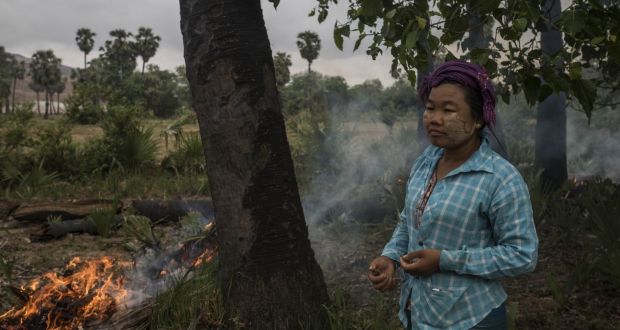
Thwe Thwe Win working on her land near the copper mine in Myanmar. 25 May 2016. Photo: Lauren DeCicca / Front Line Defenders

Thwe Thwe Win working on her land near the copper mine in Myanmar. 25 May 2016. Photo: Lauren DeCicca / Front Line Defenders
Thwe Thwe Win is one of the 117 at-risk activists invited to the 2017 Dublin Platform for Human Rights Defenders who actually made it to the bi-anual gathering of global activists. ….

Like thousands of people trying to get into Ireland on Monday, dozens of our international guests had flights canceled or postponed. Another 11, however, were prevented from attending long before Ophelia hit, banned from leaving home by their governments…..It is an opportunity for defenders typically preoccupied with defending their communities – and surviving the threats that ensure – to spend 72 hours not being physically surveilled by a totalitarian state, threatened at work by an extremist group, or receiving menacing phone calls demanding their stop their activism. It is an opportunity to relax, something activists tend to forget to do. It is also a chance for defenders to learn from their peers around the world. Feminists from Nigeria strategise with Colombians about how to peacefully defend indigenous land from paramilitaries. Emirati human rights defenders chat to Moroccans about the high-tech spying software both their governments recently purchased. Bahrainis lament with Bangladeshis the unrelenting influence of Saudi Arabia in each oppressive state’s policies. Rights activists from most of the former Soviet block tend to tease the Russian about their own governments’ adopting a “copy and paste” approach to many of Russia’s anti-NGO laws.

This year there will be a noticeable gap in our Dublin Castle crowd. Last week, we learned that our Kuwaiti invitee was threatened by state officials not to travel. The Bahraini invited is currently in detention; last time she was there, they sexually assaulted her. The second young Bahraini woman we invited in her place – who boldly took to Twitter to speak out for the former – now has a travel ban. The Saudi activist learned he was on an intelligence surveillance list last week; he rang our Blackrock office to say he was too scared to leave home. The Gulf has been a blackhole of restrictions of freedom of movement for human rights defenders for some time now, but unfortunately that’s not the end of it. Our Syrian colleague has had his passport confiscated by state security in Turkey, and a Ukrainian lawyer has yet to be granted permission to travel.

An activist in Cameroon was arrested for his peaceful activism a few weeks ago – he won’t be joining us this week; he’s in prison. A Cuban human rights defender planned to leave home in Guantanamo City extra early, knowing he’d be stopped at the town’s many American-run military checkpoints – security in Guantanamo is tight. Ultimately, he was never granted the “exit permit” required to leave Cuba. In Colombia, David Rabelo Crespo was recently released from prison after 7 years for a crime he did not commit, but has still been forbidden from travel to Dublin.

Governments world-over know that it is not laws, conventions, or UN resolutions that bring human rights reform to a country – it’s people. They know that activists are only as powerful as their communities, both local and international, and are working harder than ever to ensure that networks of solidarity cannot flourish.

Radical social change – the kind that undermines dictatorships, dismembers racist populist tides, secures indigenous peoples’ rights to their land – has always been born out of collective struggle. It is clear that in preventing our human rights defender colleagues from Bahrain, Kuwait, Colombia, Saudi Arabia, Cameroon, Syria, and Bolivia from traveling, the respective authorities are not only vindictive, they are terrified of activists. Authoritarians think that if they lock human rights defenders away – behind bars or travel bans or physical attacks – that we will stop listening, that we will forget them. Authoritarians are wrong……….When governments work hard to silence activists, we must work harder to hear them.” [see alsohttps://humanrightsdefenders.blog/2015/11/30/closing-civil-society-space-a-euphemism-for-killing-human-rights-defenders/#more-7208]

Andrew Gilmour, UN Assistant Secretary-General for Human Rights,made statement on 17 October 2017 which is worth reading in its totality but I copy here only the part on reprisals:

At times – as some of you have experienced or witnessed – engagement with the UN on human rights can lead to reprisals and intimidation. This has been a long-standing concern to the Organization, and we are distressed at the increasing number of such acts. These range from travel bans, threats and harassment, smear campaigns, surveillance, restrictive legislation, physical attacks, arbitrary arrest and detention, torture and ill-treatment, including sexual violence, denial of access to medical attention, and even killings. Intimidation of human rights defenders is happening all the time. The purpose is to penalize individuals who have already spoken out, thereby also sending a signal to many others from speaking out in future.

Recognising the gravity of this issue, last October the Secretary-General announced that he had asked me to lead efforts to strengthen UN-wide action for prevention of, protection against, investigation into and accountability for reprisals. Many Governments are very supportive, and have offered resources for this endeavor. Our host country Ireland is very strong in this regard. We are trying to get as much information about what is going on, and for this we need your input, and will circulate our email address to help us get it.… I recount a few lines of what I said in my speech to the Human Rights Council three weeks ago as I presented the Secretary-General’s report on reprisals:

We believe the significance of this report goes far beyond the individual cases contained in it. I think we should see these individuals as the canary in the coal mine, bravely singing until they are silenced by this toxic backlash against people, rights and dignity – as a dark warning to us all. (…)

It is frankly nothing short of abhorrent that, year after year, we are compelled to present cases to you, the UN membership, of intimidation and reprisals carried out against people whose crime – in the eyes of their respective Governments – was to cooperate with the UN institutions and mechanisms whose mandate of course derives from you, the UN membership. (…)

I salute the extraordinary courage that it sometimes takes for the victims and their families to come forward and share their stories with us, and also the dedication of the civil society organizations who act on behalf of those affected.

[see also: https://humanrightsdefenders.blog/2017/06/21/assistant-secretary-general-for-human-rights-andrew-gilmour-speaks-very-freely-at-the-united-nations-association-of-the-usa/]

Sources:

Its people and not laws that bring human rights reform to a country

http://www.ohchr.org/SP/NewsEvents/Pages/DisplayNews.aspx?NewsID=22251&LangID=E

United Nations’ Andrew Gilmour: HRDs are like “the canary in the coalmine, bravely singing until they are silenced..”

September 22, 2017

Andrew Gilmour, UN Assistant Secretary-General for Human Rights (file). UN Photo/Manuel Elias

On 20 September 2017 the UN reported that a  growing number of human rights defenders around the world are facing reprisals and intimidation for cooperating with the United Nations, ranging from travel bans and the freezing of assets to detention and torture, says a new report issued by the world body.

“It is frankly nothing short of abhorrent that, year after year, we are compelled to present cases of intimidation and reprisals carried out against people whose crime – in the eyes of their governments – was to cooperate with UN institutions and mechanisms,” said Assistant Secretary-General for Human Rights Andrew Gilmour“We should see these individuals as the canary in the coalmine, bravely singing until they are silenced by this toxic backlash against people, rights and dignity – as a dark warning to us all,” Mr. Gilmour told the Human Rights Council in Geneva, as he presented the Secretary-General’s report.

The report, the eighth of its kind, names 29 countries where cases of reprisal and intimidation have been documented; this is higher than the previous highest number of 20. Eleven of the States are current members of the Human Rights Council, a news release pointed out. Some have featured in the annual report on reprisals nearly every year since it was instituted in 2010. [see my earlier: https://humanrightsdefenders.blog/2017/06/23/reprisals-at-the-un-more-calls-for-action-no-action/]

Mr. Gilmour told the Council that the problem was much more widespread than presented in the report. “Since this report is limited to reprisals against people cooperating with the UN, the cases covered in it represent only a small portion of a far more generalized backlash against civil society and others challenging State authorities, especially human rights defenders”. [see also: https://humanrightsdefenders.blog/2017/06/21/assistant-secretary-general-for-human-rights-andrew-gilmour-speaks-very-freely-at-the-united-nations-association-of-the-usa/]

———

Amnesty International has launched a campaign to publicize what it says is a worsening situation for human rights activists throughout the world. The group hopes its “Brave” campaign will persuade governments to keep the promises they made in United Nations treaties to protect defenders of human rights. The organization Front Line Defenders says 281 people were killed in 2016 for defending human rights. In 2015, the number was 156.

Guadalupe Marengo, head of Amnesty’s Human Rights Defenders Program, told the VOA that “In the current context of us-versus-them, of demonization, of full frontal attack actually I would say on human rights, it is crucial that we take stock and that we call on the authorities to stop these attacks immediately.” …….Amnesty says human rights defenders are arrested, kidnapped and killed around the world. It says they are also attacked using online technology. Surveillance tools are used to study their activity. Marengo says campaigns launched on social media tell lies about the activists in an attempt to cause others to oppose them. “They are accused of being terrorists; they are accused of being criminals, they are accused of defending ‘immorality.’” Amnesty International hopes the “Brave” program will show the worsening situation for human rights activists worldwide.

——–

To underscore the point the NGO CIVICUS made a statement to the same (36th) UN Human Rights Council based on a panel discussion on the rights of indigenous people. 

“I read this statement on behalf of 39 human rights defenders and civil society organisations working on indigenous, land and environmental rights from 29 countries who met in Johannesburg, South Africa from 7-9 August 2017 to discuss strategies to advance the protection of indigenous, land and environmental rights activists. Mr. President, 2016 surpassed 2015 as the deadliest year on record for those stood up against land grabbing, natural resource exploitation and environmental destruction. Worryingly, the number of killed has risen to 200 from 185 in 2016 and spread to several countries across the world.

In the current global climate, where repression of the rights to freedom of expression, association and assembly is becoming the norm rather than the exception, environmental and land defenders are particularly vulnerable. When we express concerns over the collusion between States and corporate actors, we face opposition – dissent is stifled and criminalised, and our lives are threatened. Often our work is discredited and we are labelled ‘anti-national’ and ‘anti-development’.

When we protest peacefully against this attack on our resources and livelihoods, we face violence from state authorities, private security groups and state-sponsored vigilante groups. When we stand up to defend the rights of our communities, we face unfounded criminal charges, unlawful arrests, custodial torture, threats to life and liberty, surveillance, judicial harassment and administrative hurdles, among other actions.

Mr. President, our families are threatened into silence and many of us have had to make the difficult decision to flee our homes and go into exile, retreating from a fight that has become too dangerous. We need global action to counter the threats we face.

We ask the panellists to urge the Council to emphasise the need for all states to ensure that affected communities are adequately consulted, including securing their full consent prior to the development of infrastructure and extractive industries projects. “

Sources:

United Nations News Centre – Growing number of rights defenders facing reprisals for cooperating with UN

http://www.civicus.org/index.php/media-resources/news/united-nations/geneva/2953-joint-statement-on-the-rights-of-indigenous-peoples

https://learningenglish.voanews.com/a/amnesty-human-rights-campaign/3861696.html

Reprisals at the UN: more calls for action – no action

June 23, 2017
The UN and States must take visible and sustained action against acts of intimidation and reprisal against those engaging or seeking to engage with the UN“, says the International Service for Human Rights (ISHR) in two reports issued on 22 June 2017.  Unfortunately, the NGO community (the main victims of the practice of reprisals) finds it difficult to come up with new ideas on how counter the trend while States continue to block the participation and input by human rights defenders. [ see: https://humanrightsdefenders.blog/2014/03/13/zero-tolerance-for-states-that-take-reprisals-against-hrds-lets-up-the-ante/and https://humanrightsdefenders.blog/tag/reprisals/]

ISHR’s latest report to the UN Secretary-General demonstrates again the need for the UN and States to act to prevent and ensure accountability for intimidation and reprisals against those cooperating or seeking to cooperate with the UN, and lays out a series of recommendations in that regard. The report documents a disturbing pattern of reprisals against human rights defenders seeking to cooperate with the UN. It includes alleged cases of travel bans in Bahrain in the context of the Universal Period Review this May; disappearances and detention of defenders and lawyers, as well as intimidation of their families in China; and restrictions imposed on NGOs in Egypt.The report welcomes recent positive steps such as the appointment of Assistant Secretary General Andrew Gilmour as the first high-level official on reprisals against those cooperating with the UN on human rights, but highlights that more needs to be done. ‘In the overwhelming majority of cases, steps taken by the State to prevent, investigate or ensure accountability for reprisals have been inadequate or non-existent, and in many States there has been a high-level of impunity’ said ISHR’s Programme Coordinator and Legal Counsel, Tess McEvoy. [see also: https://humanrightsdefenders.blog/2016/10/05/assistant-secretary-general-andrew-gilmour-appointed-as-the-uns-focal-point-to-combat-reprisals-against-human-rights-defenders/]

The primary duty to prevent and remedy reprisals lies with States. However the UN itself also has a duty to step up. ‘Where States fail to adequately investigate and ensure accountability in relation to credible allegations of intimidation and reprisals, the UN should ensure an international, independent investigation into the case‘, said McEvoy. In the report ISHR called on UN bodies to take a more proactive role in combating reprisals and intimidation, and among other things, urged:

  • The Human Rights Council President and Bureau to clearly outlines steps the Council will take on receipt of information about credible risks of reprisals.
  • Treaty bodies to fully adopt and implement the San Jose guidelines.
  • The Assistant Secretary-General to ensure that rights holders and victims are kept regularly appraised of the status of their case.


    On the same day ISHR published a statement to the 35th session of the Human Rights Council, ISHR calling for a stronger focus on the implementation of Universal Periodic Review recommendations and the development of processes to ensure civil society can freely engage without fear of intimidation and reprisal. ‘Civil society is not only necessary for developing recommendations, but is essential for the working towards the implementation of these recommendations. The role of civil society must therefore be protected and enhanced’, said ISHR.

    While recommendations received are often accepted at ‘Geneva level’, implementation of these recommendations on the ground remains patchy. Item 6 on the agenda of the UN Human Rights Council provides a opportunity for dialogue on implementation.

    Alleged cases of intimidation and reprisals of human rights defenders engaging or seeking to engage in the UPR have escalated. ISHR received reports of cases in Egypt, India and Venezuela in the past year. Ongoing reprisals in Bahrain  are particularly concerning, including the imposition of travel bans on 27 defenders during the 27th UPR pre-session – including Sayed Hadi Al Musawi – as well as the interrogation of Abtisam Alsayegh in relation to her UN engagement. ISHR’s statement reiterated calls for States to ask advance questions, and make recommendations about the prevention, investigation, prosecution and remediation of reprisals.

    Reprisals against human rights defenders for their engagement with the UPR remain worryingly prevalent,’ said McEvoy. Given civil socity’s fundamental role in the UPR, we call on the President, Bureau and Secretariat to establish an institutionalised reprisals mechanism to prevent, investigate, remedy and promote accountability for reprisals associated with the UPR’, McEvoy continued. These calls form part of ISHR’s broader strategy to strengthen the UPR  which can be accessed hereContact: Tess McEvoy, Programme Coordinator and Legal Counsel, and focal point for ISHR’s UPR advocacy, on: t.mcevoy@ishr.ch.

    http://www.ishr.ch/news/report-sg-un-and-states-must-do-more-prevent-and-ensure-accountability-reprisals-0

Assistant Secretary-General for Human Rights, Andrew Gilmour, speaks very freely at the United Nations Association of the USA

June 21, 2017

In a little-noted speech at the Leadership Summit of the United Nations Association of the USA (Washington, D.C., 12 June 2017) Assistant Secretary-General for Human Rights, Andrew Gilmour, tackles populism and does not mince his words.  After viewing a Chaeli video [see e.g. https://www.worldofchildren.org/honoree/michaela-chaeli-mycroft/] to illustrate the message that “we can all make a difference for human rights. Every day, everywhere, at school or the workplace, commuting, or on holiday. It starts with each of us taking concrete steps to exercise our rights and our responsibility to protect and defend the rights of others“, Gilmour describes how after 3 decades of progress for human rights we have come up against a serious backlash, one that takes many forms but all of them counter to the values of rights, freedoms and tolerance. The text is worth reproducing as a whole: Read the rest of this entry »

The Situation of Human Rights Defenders – Amnesty International’s Statement to the UN Human Rights Council 2017

February 15, 2017

The document “The Situation of Human Rights Defenders – Item 3: Amnesty International’s Written Statement to the 34th Session of the UN Human Rights Council (27 February- 24 March 2017)” could of course be obtained directly from AI. However, I do it via: http://www.refworld.org/docid/58a195034.html, in order to highlight this very useful service provided by the documentation service of the UN High Commissioner for Refugees (UNHCR) which regularly gives links to documentation concerning countries of origin of refugees. The entry will look like this:

Title The Situation of Human Rights Defenders – Item 3: Amnesty International’s Written Statement to the 34th Session of the UN Human Rights Council (27 February- 24 March 2017)
Publisher Amnesty International
Publication Date 13 February 2017
Topics Human rights activists | Human rights and fundamental freedoms
Reference IOR 40/5647/2017
Cite as Amnesty International, The Situation of Human Rights Defenders – Item 3: Amnesty International’s Written Statement to the 34th Session of the UN Human Rights Council (27 February- 24 March 2017), 13 February 2017, available at: http://www.refworld.org/docid/58a195034.html %5Baccessed 13 February 2017]
Disclaimer

In their submission AI states in part:

In 1998 the international community adopted, by consensus, the Declaration on the Right and Responsibility of Individuals, Groups and Organs of Society to Promote and Protect Universally Recognized Human Rights and Fundamental Freedoms thereby recognising the importance that civil society actors play in the defence of the values that underpin human rights. The Declaration stresses that we all have a role to fulfil as human rights defenders and urges States particularly to protect human rights defenders from harm as a consequence of their work.

However, almost two decades after that historical moment human rights defenders continue to be harassed, tortured, jailed and killed for speaking out against injustice. During the protests against the Dakota Access Pipeline in the USA last year, the security forces used excessive and unnecessary force when arresting members of the Standing Rock Sioux Tribe and other Indigenous communities who oppose its construction.

Over 3,500 human rights defenders have been killed since the Declaration was adopted in 1998 and according to recent figures released by Frontline Defenders, the number of killings in 2016 marked an increase in the number reported in the previous year.

These killings usually occur after threats and warnings. Berta Cáceres, the leading indigenous, environmental and women’s rights defender from Honduras was killed in March 2016 despite enjoying a high national and international profile. In the aftermath of her killing, Honduras was under increased pressure to protect its human rights defenders, nonetheless, in October 2016, José Ángel Flores and Silmer Dionisio George of the Unified Movement of the Aguán were murdered, and currently international organization Global Witness, along with Honduran organizations MILPAH, COPINH and CEHPRODEC are facing a smear campaign against them for their work defending land, territory and environmental rights.

Amnesty International also continues to receive reports of human rights defenders being subjected to unfounded criminal proceedings, arbitrary detention and judicial harassment, which prevents them from speaking up against injustice, delegitimizes their causes and creates a chilling effect on activities that promote human rights. Human rights defender Narges Mohammadi is serving 22 years’ imprisonment after being convicted of national security related charges in Iran. Her conviction stems from her peaceful human rights activities, including her work to end the death penalty and her 2014 meeting with the former European Union (EU) High Representative for Foreign Affairs and Security Policy.

In Egypt civil society has been subjected to an unprecedented crackdown. In 2016, the authorities intensified a criminal inquiry into NGOs’ registration and foreign funding that could lead to criminal prosecution and sentences reaching up to life imprisonment. The authorities have also subjected NGO personnel to interrogation, freezing of personal and organizational assets, preventing leading human rights defenders from foreign travel, arbitrary arrest and detention.

Amnesty International notes with concern that the organisations, networks and methods people rely on to stand up for their communities are also attacked. Unions are threatened. Lawyers and activists in China have been ill- treated and sometimes tortured in detention. In Pakistan, human rights defenders are labeled as ‘foreign-agents’. In Viet Nam, attacks against human rights defenders are common, and include beatings and daily harassment and surveillance.

In other parts of the world, newspapers are closed down. Social media are banned and digital conversations monitored. Taking to the streets to protest is impossible.

In Turkey, against the backdrop of the failed military coup in 2016, unfair criminal prosecutions under criminal defamation and counter-terrorism laws targeted political activists, journalists and other critics of public officials or government policy. Over 180 media outlets have been arbitrarily shut down and 80 journalists remain in pre-trial detention.

States also repeatedly interfere with human rights defenders’ ability to communicate safely and expose human rights violations to regional and international human rights mechanisms, including this Council and its mechanisms. Recently the Special Rapporteur on the situation on the situation of human rights defenders noted, with great concern, the number of human rights defenders that received social media threats simply for meeting with him on his visit to Mexico at the beginning of this year.

In Burundi in January 2017, the Bujumbura Court of Appeal ruled to disbar three lawyers and suspend another. Each had contributed to a civil society report to the UN Committee against Torture prior to its review of the country in July 2016. The permanent closure of five human rights organizations and the suspension of five others was ordered in October 2016 on the allegation that they tarnished the image of the country. One of the suspended organizations was later banned following publication of a controversial report.

……..Amnesty International urges the Human Rights Council to:

  1. Renew the mandate of the Special Rapporteur on the situation of human rights defenders and cooperate fully with it, including by encouraging swift and comprehensive responses to communications from the Special Rapporteur and acceptance of requests for country visits.
  2. Reaffirm that protecting human rights is necessary for individuals to live in dignity, and that deepening respect for these fundamental freedoms lays the foundation for stable, safe and just societies;
  3. Recognize the legitimacy of human rights defenders and applaud the role they play in the advancement of human rights, and urge States to facilitate and publicly support their work;
  4. Urge States to adopt and implement legislation which recognises and protects human rights defenders;
  5. Stress the urgent need for all States to establish national protection mechanisms for human rights defenders at risk;
  6. Urge States effectively to address threats, attacks, harassment and intimidation against human rights defenders, including, where applicable, by thoroughly, promptly and independently investigating human rights violations and abuses against them and bringing alleged perpetrators to justice in fair trials without recourse to the death penalty, and providing effective remedies and adequate reparations to the victims;
  7. Urge States to ensure that the criminal justice system or civil litigation is not misused to target nor harass human rights defenders;
  8. Refrain from bringing criminal charges or, other judicial proceedings or taking administrative measures against human rights defenders because of the peaceful exercise of their rights;
  9. Ensure that those who challenge injustice peacefully are not portrayed as threats to security, development or traditional values;
  10. Emphasize the fact that human rights defenders who work on gender equality, women’s rights or LGBTIQ rights face particular risk of being subjected to certain forms of violence and other violations that need to be particularly addressed;
  11. Pay particular attention to other groups who may be at risk, such as those who work for economic, social and cultural rights, defenders who work in the area of business and human rights; in an area exposed to internal conflict or a natural disaster; defenders living in isolated regions or conflict zones; and defenders working on past abuses, such as the families of victims of enforced disappearance;
  12. Condemn any acts of intimidation or reprisals against human rights defenders who cooperate or seek to cooperate with international human rights mechanism;
  13. Urge States to cooperate fully with the recently mandated Assistant Secretary-General for Human Rights to prevent, end and redress acts of reprisal and intimidation.

Source: Refworld | The Situation of Human Rights Defenders – Item 3: Amnesty International’s Written Statement to the 34th Session of the UN Human Rights Council (27 February- 24 March 2017)

Assistant Secretary General Andrew Gilmour appointed as the UN’s focal point to combat reprisals against human rights defenders

October 5, 2016

The problem of reprisals against human rights defenders has been the subject of quite a few posts in this blog [see my earlier posts: https://thoolen.wordpress.com/tag/reprisals/]. On 3 October 2016 the SG of the United Nations, Ban Ki-moon, finally unveiled details about the long-awaited focal point against reprisals. This is a much-needed element to help combat the growing problem of governments preventing human rights defenders from engaging with the UN or punishing and even imprisoning them when they do so.

Assistant Secretary General, Andrew Gilmour, will be given a special mandate to receive, consider and respond to allegations of intimidation and reprisals against human rights defenders and other civil society actors engaging with the UN. In announcing the appointment Mr Ban said  ‘These courageous individuals are often our only eyes and ears in extremely tough environments – and we owe them our best possible support’. ‘I have decided, in consultation with the High Commissioner for Human Rights, to designate my new Assistant Secretary-General for Human Rights, Mr. Andrew Gilmour, to lead our efforts within the UN system to put a stop to all intimidation and reprisals against those cooperating with the United Nations on human rights,’.

recent report by the SG shows that reprisals take many forms, including travel bans, the issuance of arrest warrants on terrorism charges, detention and torture, surveillance, death threats, attempts to frame activists for criminal acts, defamation, and intimidation.  In several cases defenders are tarnished as ‘terrorists’ or ‘traitors’, contributing to perceptions that engagement with the UN is an act of betrayal. In some cases reprisals have led to individuals fleeing their country, in others, to death.

This is an extremely welcome development. The ability of people or organisations to provide evidence or submit information or complaints to the UN is not a privilege – it is a fundamental right enshrined in the UN Declaration on Human Rights Defenders and it must be protected,’ said Ms Sinclair, ISHR’s legal counsel.

Source: Ban Ki-moon appoints high-ranking official to combat reprisals against human rights defenders | ISHR