Posts Tagged ‘Access Now’

Access Now – Grants for human rights defenders in 2023

May 29, 2024

On 28 May 2024 ACCESS NOW published its overview of grants in 2023: Through our Access Now Grants program — now in its ninth year —  we provide  flexible, grantee-driven financial support to the grassroots and frontline organizations confronting these threats. We do this because we believe the people most directly impacted by attacks on human rights — from Palestine to Myanmar to Ukraine and beyond — are best placed to define solutions and implement them. Below is an overview of our grant-making in 2023, including a deep dive into the humanitarian response to the Gaza crisis, which was sparked that year. 

AN OVERVIEW

In 2023, Access Now Grants awarded a total of just under $1.7 million USD, fortifying our collective efforts to defend and extend digital rights. We provided 66 grants to 63 organizations and individuals leading digital rights efforts in about 30 countries. [for details, see: https://www.accessnow.org/digital-rights-grants/]

We strive to support those who need it most. Currently, Access Now Grants reserves nearly all of our funding for people and organizations in Global Majority countries. In 2023, we awarded the highest number of grants (20) in Eastern Europe and Central Asia, followed by Asia Pacific (15), Africa (13), the Middle East and North Africa (10), Latin America and the Caribbean (7), and one grantee that works on the global level but supports journalists and human rights organizations operating in countries experiencing armed conflict and crisis

Notably, 71% of our 2023 grants supported efforts in countries that Freedom House has classified as “not free” in its Freedom in the World reporting. We also extended funding to organizations and communities we had not previously supported, including in Libya, Iraq, Palestine, Thailand, and Senegal. In addition, 25% of our grants focused on defending gender and sexuality rights and supported people who identify as women, non-binary, or LGBTQ+

In addition to ensuring we reach people with the funding they need, we work to provide the kind of longer-term support that can help organizations build momentum. In 2023, 60% of the grantees that received core, project, and discretionary grants were receiving their third or more year of consecutive funding.

SPOTLIGHT ON GAZA : It is impossible to remark on any human rights efforts in 2023 without acknowledging the genocide now unfolding in Palestine. After the Hamas attack on Israel on October 7, 2023, we have seen digital threats play a devastating role in deepening the crisis in Gaza:  from the Israeli military’s reported use of  AI technology to bomb and kill Palestinians, often with their family; to internet shutdowns that restrict Gazans’ access to life-saving information and ability to communicate; to communication platforms’ censorship of Palestinians and pro-Palestinian voices; to the documented increase in hate speech and incitement to violence against Palestinians online….

As we continue our grant-making in the year ahead, in Palestine and around the world, we remain committed to human rights organizations and activists who are fighting for justice, security, and dignity for their communities and for all of us. Their collective work is more necessary and urgent than ever.

ACCESS NOW gives a list of the grants awarded in 2023. Some grants are not included for security reasons. Others must be listed anonymously.

About Access Now’s Digital Security Helpline

April 30, 2024

On 25 April 2024 Access Now published a piece about “Visualizing the Digital Security Helpline’s recent impact”

Access Now’s Digital Security Helpline works to support civil society members at risk, so they can safely and securely continue their work to uphold democracy and human rights. Here are a few highlights of the Helpline’s work in 2023. [see also: https://humanrightsdefenders.blog/2021/06/29/joint-statement-by-u-n-rapporteurs-emphasizes-digital-rights-as-top-priority-to-rebuild-civic-space/]

Last year, the Helpline received a total of 3,709 requests for digital security assistance. 

To put this in perspective, the Helpline received 10,000 requests in total between 2014 and 2021, but more than double that number in the three years that followed. 

Helpline Cases

Most (82%) of the cases we dealt with in 2023 were reactive in nature, meaning they related to unfolding incidents or emergencies that required beneficiaries to take rapid measures to strengthen their digital security. The remaining 18% were preventative, whereby beneficiaries preemptively sought out digital security advice, tools, and solutions.

In recent years, the Helpline has been investing in our ability to operate 24/7, 365 days a year, and to deliver more substantial and engaged forms of support. For instance, we’ve been conducting analysis of advanced threats and producing collaborative research in places such as Armenia, Serbia, and Jordan

In 2023, the regional distribution of cases was as follows:

Helpline Case distribution by region

Our work supports a wide spectrum of civil society stakeholders; from individual activists, human rights defenders, and members of marginalized communities, to journalists and media workers. For it to be as impactful as possible, we work closely with the wider digital security community, through networks like CiviCERT. This allows us to deliver adequate support to each of our beneficiary groups, which were distributed as follows in 2023:

Helpline Beneficiaries by category

In 2024, the Helpline will continue improving and increasing how we collaborate with activist groups around the world, as well as working to meet the evolving needs of the global rapid response community. If you are a member of civil society in need of digital security assistance, you can find details about how to get in touch on our website page

Big Coalition urges UN to denounce abuses facilitated by spyware technologies

October 4, 2021

During the 28th U.N. Human Rights Council (HRC) Access Now joined 94 other civil society organizations and independent experts in urging member states to denounce abuses facilitated by spyware technologies.

The Pegasus Project revealed a long list of journalists, activists, human rights defenders, lawyers, world leaders, and civil society actors that were a target of NSO Group’s Pegasus Spyware. The U.N. HRC should mandate comprehensive measures to investigate and prevent further violations linked to the sale, export, and use of Pegasus spyware and cases of targeted surveillance. For earlier post on this hot topic, see: https://humanrightsdefenders.blog/tag/pegasus/

Member States must urgently act to address the perpetual human rights abuses by States facilitated by NSO Group’s Pegasus spyware,” said Laura O’Brien, UN Advocacy Officer at Access Now. “The clandestine surveillance industry must be held accountable.

The recent revelations showcased the unprecedented scale of human rights violations by States facilitated by the use of Pegasus with Budapest-based photojournalist Dániel Németh being the latest victim targeted by the spyware.

In the Middle East and North Africa (MENA), governments continue to use digital surveillance tools to target journalists and activists. In 2016, a Citizen Lab investigation revealed that the UAE spied on human rights defender Ahmed Mansoor, who is now serving 10 years in prison under inhumane conditions. The Pegasus Project revealed that friends and family of slain Saudi journalist, Jamal Khashoggi, were also targets of Pegasus spyware with the iPhone of Khashoggi’s Turkish fiancée, Hatice Cengiz, targeted and successfully infected. Last June, Access Now and the Gulf Centre for Human Rights launched the MENA Surveillance Coalition, convening civil society organizations working to defend freedom of expression, privacy, and fundamental rights, to call for an end to the sales of digital surveillance tools to repressive governments in the region.

“Invasive surveillance invades and corrodes the lives and work of human rights defenders, journalists, and activists across the globe,” said Kassem Mnejja, MENA Campaigner at Access Now. “Companies like NSO have been given free rein to proliferate the market with the dangerous Pegasus spyware used to facilitate these dehumanising and unsafe actions — this must end now.”

Despite the mounting evidence of its human rights abuses, the NSO Group continues to repeat its false claim that its spyware is only used for legitimate purposes like investigating crime and terror. This cannot continue.

U.N. human rights experts and civil society groups have previously called on governments to immediately implement a global moratorium on the sale, export, transfer, and use of private surveillance technology. Supporting this call, civil society organizations and independent experts are today requesting member states of the U.N. HRC to urgently denounce and mandate independent investigations into the human rights violations facilitated by this technology.

Read the full letter.

https://www.scoop.co.nz/stories/WO2110/S00016/act-now-against-spyware-coalition-tells-un-human-rights-council.htm

Joint statement by U.N. rapporteurs emphasizes digital rights as “top priority” to rebuild civic space

June 29, 2021

A bit belatedly, I refer to the statement made by Access Now welcoming on Tuesday, 8 June 2021, the timely new statement from U.N. Special Procedures emphasizing that digital rights are “a top priority” to rebuild civic space amid recovery from the COVID-19 pandemic. The nine experts are taking part in RightsCon 2021 (June 7-11), marking the third consecutive year that Special Rapporteurs have issued a statement in light of thematic discussions to be held at the global summit on human rights in the digital age.

The experts pointed to recent instances of digital repression including non-transparent content takedowns and manipulation — as the world is witnessing in Palestine, India, and Colombia — and called upon businesses to uphold their responsibility to respect human rights. They stressed that “the opacity that prevails in the ways content is moderated by Governments and companies reinforces global perceptions of discrimination, inefficiency and censorship. There is an urgent need for transparency.”

The diversity and scope of issues addressed within the mandates of the nine U.N. experts speaks to the heightened role of technology — and the need to center digital rights — in the pandemic recovery. We are thrilled to have such a robust presence of U.N. Special Rapporteurs and members of the Working Group on Business and Human Rights in this year’s RightsCon program,” said Peter Micek, U.N. Policy Manager at Access Now. “The statement decries patterns of abuse accelerating digital inequalities and discrimination against users most at risk, reminding states and the tech sector to undertake systemic efforts to reach those most affected.”

“We look forward to continuing to engage with the U.N. experts at RightsCon and beyond to address the intersection of technology within their mandates through a human rights-centered and intersectional lens,” said Laura O’Brien, U.N. Advocacy Officer at Access Now. “As we recover from the pandemic, we cannot understate the value of civil society engagement with U.N. experts.”

The experts warned particularly “against using the pandemic as an excuse to rush forward ‘digital transformation,’ as exemplified in digital vaccine certificates, without prioritising foundational digital rights safeguards” — a call that Access Now emphasizes.

The nine Special Procedures and their mandates include: Fionnuala Ní Aoláin, fundamental freedoms while countering terrorism; Clément Voule, the right to peaceful assembly and association; Olivier De Schutter, extreme poverty and human rights; David R. Boyd, human rights and environment; Gerard Quinn, the rights of persons with disabilities; Tlaleng Mofokeng, the right to physical and mental health; Irene Khan, freedom of expression; Mary Lawlor, the situation of human rights defenders; and the Working Group on Business and Human Rights — Dante Pesce, Surya Deva, Elżbieta Karska, Githu Muigai, and Anita Ramasastry.

https://www.scoop.co.nz/stories/WO2106/S00090/un-joint-statement-experts-call-for-centering-digital-rights-in-pandemic-recovery-on-eve-of-rightscon-2021.htm

https://www.manilatimes.net/2021/06/20/business/sunday-business-it/access-nows-digital-security-helpline/1803849

Anti-Censorship initiative with free VPN accounts for human rights defenders

July 15, 2020

On 14 July Business-Wire reported that the VPN company TunnelBear has partnered with NGOs to give away 20,000 accounts (these NGOs inlcude Access Now, Frontline Defenders, Internews, and one other undisclosed participant).

This program aims to empower individuals and organizations with the tools they need to browse a safe and open internet environment, regardless of where they live. The VPN provider is encouraging other NGOs or media organizations across the world to reach out if they too are in need of support. “At TunnelBear, we strongly believe in an open and uncensored internet. Whenever we can use our technology to help people towards that end, we will,” said TunnelBear Cofounder Ryan Dochuk.

TunnelBear’s VPN encrypts its user’s internet traffic to enable a private and censor-free browsing experience.

By undergoing and releasing independent audits of their systems, adopting open source tools, and collaborating with the open source community, TunnelBear has proven itself to be an industry leader in the VPN space and a valuable private sector partner within the internet freedom movement. Internews is happy to support TunnelBear in extending its VPN service to the media organizations, journalists, activists, and human rights defenders around the globe who can benefit from it,” said Jon Camfield, Director of Global Technology Strategy at Internews.

Contact: Shames Abdelwahab press@tunnelbear.com

See also: https://humanrightsdefenders.blog/2020/06/23/trump-now-starts-dismanteling-the-open-technology-fund/

https://www.businesswire.com/news/home/20200714005302/en/TunnelBear-Kicks-Anti-Censorship-Initiative-Free-Accounts-Activists

“.org” saved – human rights defenders happy

May 1, 2020
On Friday, 1 May 2020 announced – with justified satisfaction – a ‘Stunning Victory’ in the efforts to #SaveDotOrg from private equity takeover. [see: https://humanrightsdefenders.blog/2020/01/27/the-favourite-domain-of-human-rights-ngos-org-at-risk/]
Critics of the proposed private equity takeover of the .org domain held a protest in Los Angeles in January 2020.

In a move celebrated by advocacy groups across the globe as “a major victory for the millions of nonprofits, civil society organizations, and individuals who make .org their home online,” a body that oversees web addresses on Thursday blocked a takeover of the top-level domain by the private equity firm Ethos Capital. The decision by the Internet Corporation for Assigned Names and Numbers (ICANN) board to reject the $1.1 billion deal, announced in November 2019, came ahead of a May 4 deadline and followed months of mounting concerns that the takeover could lead to censorship from corporate interests, increased costs, and service issues.

…ICANN’s board explained the decision with a blog post which said in part that “after completing its evaluation, the ICANN board finds that the public interest is better served in withholding consent as a result of various factors that create unacceptable uncertainty over the future of the third largest [generic top-level domain] registry.”

Critics of the attempted private equity takeover—who came together for a global #SaveDotOrg campaign—included NGOs, tech leaders, U.S. lawmakers, and U.N. special rapporteurs. According to the tech nonprofit NTEN, which managed SaveDotOrg.org, nearly 900 groups and 64,000 individuals signed various petitions opposing the sale.

Internet shutdowns in times of COVID-19 could cost lives

April 2, 2020
Intentionally shutting down or restricting access to the internet violates multiple rights and can be deadly during a health crisis such as the COVID-19 pandemic, Human Rights Watch said on 31 March 2020. Governments that are currently imposing an internet shutdown, such as Bangladesh, Ethiopia (it just announced restoring service), India, and Myanmar, should lift them immediately to save lives. During a health crisis, access to timely and accurate information is crucial. People use the internet for updates on health measures, movement restrictions, and relevant news to protect themselves and others.

‘Access Now’ names Usha Ramanathan a ‘Human Rights Hero’ for her opposition to Aadhaar

June 11, 2019
Jahnavi Sen, writing in the Wire of 10 June 2019, reports Usha Ramanathan, a legal researcher and activist based in Delhi, has been declared a ‘human rights hero’ by international rights group Access Now for her criticism of the Aadhaar programme. Since the scheme was launched in 2009, Ramanathan has been raising the security and privacy risks associated with it, as well as the concerns on linking the programme to welfare schemes. While facilitating Ramanathan’s “tireless” efforts to highlight the issues related to Aadhaar, Access Now has said that it also wants to “recognise the entire community that has protested and litigated against Aadhaar”. In September 2018, the Indian Supreme Court upheld the validity of the Aadhaar law, but placed strict restrictions on its scope. Before the final judgment, the court had passed a number of orders which were conveniently ignored by the administration, Ramanathan and others have pointed out. Ramanathan has written a number of articles on why the programme needs to be rebooted, and the risks it poses to people’s privacy. A number of her articles have been published in The Wire.

The award function will be held in Tunis between June 11 and 14, as a part of RightsCon. The awards will be handed out by Michelle Bachelet, the United Nations high commissioner for human rights.

Since 2014 Access Now issues the anual award “in celebration of…the work of people around the globe to protect human rights in the digital age, naming “heroes” and “villains” who have either protected the principles of freedom online, or worked to undermine them.”

There are a total of five winners this year. Other than Ramanathan, Bahraini activist and digital security consultant Mohammed Al-Maskati, Australian human rights lawyer, broadcaster and writer Lizzie O’Shea, Tanzanian digital security trainer Zaituni Njovu and Venezuelan lawyer, writer and human rights activist Marianne Díaz Hernández have also been designated ‘heroes’.

https://thewire.in/rights/usha-ramanathan-aadhaar-opposition

EU Parliament ‘improves’ proposed Terrorist Content Regulation

April 18, 2019

After my earlier piece about the risks in the draft EU regulation on terrorism content [see: https://humanrightsdefenders.blog/2019/01/31/ngos-express-fear-that-new-eu-terrorist-content-draft-will-make-things-worse-for-human-rights-defenders/], I am happy to report that some NGOs have welcomed the changes now made in the latest version.

On 17 April 2019 eub2 reports that “EU Parliament deletes the worst threats to freedom of expression proposed in the Terrorist Content Regulation”: Read the rest of this entry »

Internet shutdowns to silence opposition – what to do?

January 28, 2019

“African governments use Internet shutdowns to silence opposition more and more —what can people do?” askson EuroNews of

What would you do if your government decided to intentionally shut down your access to the Internet? Millions of people around the world have had to answer this question time and time again over the past few years, as government-mandated Internet blackouts are on the rise. Less than a month into 2019, Sudan, the Democratic Republic of Congo, Gabon and Zimbabwe have experienced government crackdowns on Internet connections.

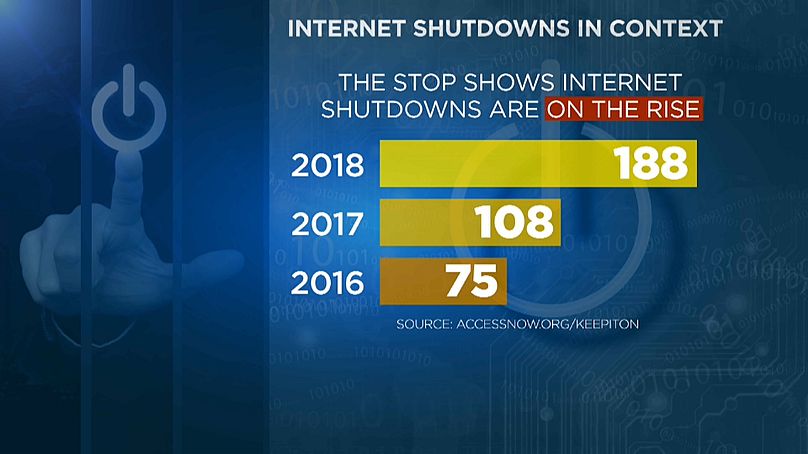
From 2016 to 2018, 371 separate cases of Internet shutdowns were documented around the world. More than half of them occurred last year alone, according to international non-profit organisation Access Now.

Authorities have used a number of reasons to justify the blackouts, including public safety, national security and stopping the dissemination of rumors and illegal content. However, advocacy groups investigating governmental tendencies to exert control over the flow of information don’t buy it. They claim it has more to do with silencing opposition movements and protests and trying to limit political instability.

They harm everyone: businesses, emergency services, journalism, human rights defenders, and demonstrators. They don’t help victims or restore order,” Access Now’s website reads.

In the past few weeks, several African governments have turned to partial or complete shutdowns in attempts to control the public discussion.

Sudan doubled down on social media amid widespread anti-government protests, with Access Now and the #KeepItOn coalition calling on network operators to fight back against state pressure — but it wasn’t the only African country to do so.

Zimbabwean authorities were quick to gag social media — including Facebook and Whatsapp — as soon as civil unrest over rising fuel prices spread in Harare and other major cities, and the DRC also ordered a full blackout following recent elections…..

From 2016 to 2018 alone, Africa witnessed 46 Internet shutdowns,…….Chad, Sierra Leone, Ethiopia, Somaliland, Algeria, Togo, Cameroon, Gambia, Uganda, Gabon, Algeria, Morocco, Lybia, Tunisia, and Algeria have all cracked down on their citizens’ access to the Internet in the past.

How did citizens react to Internet or social media shutdowns?

People always find a way”, Zimbabwean analyst Alexander Rusero told Euronews. “But it {VPN} doesn’t work for everyone”, Rusero pointed out. “Usually the ones in Harare, at the centre of the country, manage to”.

The analyst was quick to underline the issues behind similar crackdowns…”During the Internet blackout there were a lot of lies and rumors — they spread faster than you would believe. Media relies on social media, and so do critical opinion leaders. Outside those platforms, fake news manifest”.

Jean-Hubert Bondo, a journalist from the Democratic Republic of the Congo, doesn’t believe the problems end here. “Many Congolese families live off their small cybercafés. Also, we are in a country where there are not enough physical libraries. Students and researchers use the Internet to research their work at the university. Young people animate pages on Facebook and WhatsApp”, he told Euronews. “To deprive us of the Internet is to take us back to antiquity”. As for the VPNs Rusero mentioned — the most common ways to avoid Internet censorship worldwide — Bondo said that, during the latest shutdown, they failed to work. “In response to what is being perceived as a violation of human rights, Bondo reported that several Congolese civil society organisations have now lodged a complaint against the main telecommunication companies.

In Uganda, a crackdown on Twitter, Facebook, WhatsApp, YouTube, and mobile money apps in February 2016 as citizens were heading to the polls sparked a legal case that will be discussed in court in February 2019. “Shutdowns may not silence people, but they do hinder communication”, said Ugandan blogger Ruth Aine Tindyebwa….

https://www.euronews.com/2019/01/26/african-governments-use-internet-shutdowns-to-silence-opposition-more-and-more-what-can-pe

https://www.dailynews.co.zw/articles/2019/01/27/ed-justifies-internet-shutdown