Archive for the 'Human Rights Council' Category
Human rights defenders of minorities having a hard time in the UN finds UNPO
July 19, 2019
On 17 July 2019 the Unrepresented Nations and Peoples Organization (UNPO) is launched a report, Compromised Space: Bullying and Blocking at the UN Human Rights Mechanisms, with its partners at the University of Oxford and Tibet Justice Centre which details how China, Russia, Iran and other repressive regimes are manipulating the United Nations Human Rights System to block and attack those seeking to hold them accountable for gross human rights violations perpetrated against minorities, indigenous communities and other unrepresented peoples…
The report is based on three years of study conducted by the UNPO and its partners at the University of Oxford and the Tibet Justice Center, supported by the UK’s Economic and Social Research Council. It is based largely on interviews and testimonies from 77 human rights defenders working on behalf of minorities, indigenous communities and other people living in nation states whose political systems do not create governance structures representative of all. It identifies a systemic attack on the United Nations human rights system by these governments, led largely by China, Russia and Iran, designed to shield them from accountability for human rights violations and crimes against humanity. This includes efforts to deny civil society groups participatory status at the UN (so called “ECOSOC status”), to bully and block them when they are able to access the UN, to crowd out the UN space with “GONGOs” – government-sponsored organisations posing as NGOs – and to harass, intimidate and take reprisals against activists and their families, whether at home or abroad.
Among the indicative findings of the report are the facts that:
China has regularly detained or imprisoned activists from its Southern Mongolian, Uyghur and Tibetan communities who have sought to travel to the UN, with such success that, for example, no Tibetan from Tibet who is acting independently of the Chinese government has ever managed to leave Chinese- occupied Tibet to testify at the UN in Geneva or New York, and then return safely;
Russia, in order to shield itself from accountability for its crimes in Russian-occupied Crimea, has asked for rules of participation in forums, such as the UN Minority Forum, to be changed to restrict NGO participation to groups acceptable to Russia, and its Crimea occupation authorities have attacked Crimean Tatar activists and destroyed or confiscated their passports in order to prevent their travel;
Iran regularly engages in practices designed to intimidate activists from their minority communities, even while they are operating within the United Nations buildings, and have taken out reprisals against the family members of these activists still living within the Islamic Republic of Iran.
The story of Dolkun Isa, President of the World Uyghur Congress and Vice President of the UNPO, is indicative of all of these actions. Mr. Isa and his organization have regularly been denied ECOSOC status at the United Nations, his access to the UN buildings and events have been restricted due to Chinese demands, he and his supporters have been followed and harassed in the UN building, his mother was held in China’s anti-Muslim concentration camps as a result of his work and for many years his ability to travel freely around the world was frustrated by Chinese efforts to involve European and other states in his persecution by falsely labelling him a “terrorist”.
Reacting to the launch of the report, UNPO’s General Secretary, Ralph Bunche, stated that “the report presents the disturbing finding that the United Nations Human Rights system, which is the only outlet for many peoples living under repressive regimes to seek accountability for crimes committed against them, is being systemically undermined by perpetrator regimes. Unfortunately, democratic states are not doing nearly enough to push back against this phenomenon and in some instances are even adopting the conduct that we see from the repressive states. The withdrawal of the USA from the UN’s Human Rights Council has certainly not helped matters, but other states are simply not doing enough to counter this problem and protect human rights defenders.”
41st UN Human Rights Council: what the NGOs see as its result
July 16, 2019On 12 july 2019, ISHR published what key civil society organisations thought of the just finished 41st session of the UN Human Rights Council.
Civil society organisations welcomed significant outcomes of the Human Rights Council’s 41st session, including the extension of the SOGI mandate, adopting the first resolution on the Philippines and extending its scrutiny over Eritrea, the Democratic Republic of Congo, Belarus and Ukraine. This session witnessed heightened scrutiny of Council members by shedding light on the situations in Saudi Arabia and China. It missed an opportunity, however, to ensure that human rights are not sidelined in Sudan.

16 leading human rights organisations (see below) expressed regrets that Council members seek to use their seats to shield themselves and others from scrutiny. They called on States to stand with victims of human rights violations. They welcomed the renewal of the mandate of the Special Rapporteur on freedom of peaceful assembly association, that the Council stood up to the global backlash against the rights of women and girls, and that it continued to address the threat posed by climate change to human rights. They also welcomed the reports on Venezuela, called on the High Commissioner to immediately release the UN database of businesses engaged with Israeli settlements, and on all States to pursue accountability for victims of intimidation and reprisals.
Full statement below:
By renewing the mandate of the Independent Expert on sexual orientation and gender identity (SOGI), the Council has sent a clear message that violence and discrimination against people of diverse sexual orientations and gender identities cannot be tolerated. It reaffirmed that specific, sustained and systematic attention is needed to address these human rights violations and ensure that LGBT people can live a life of dignity. We welcome the Core Group’s commitment to engage in dialogue with all States, resulting in over 50 original co-sponsors across all regions. However, we regret that some States have again attempted to prevent the Council from addressing discrimination and violence on the basis of SOGI.
This Council session also sent a clear message that Council membership comes with scrutiny by addressing the situations of Eritrea, the Philippines, China, Saudi Arabia and the Democratic Republic of Congo. This shows the potential the Council has to leverage its membership to become more effective and responsive to rights holders and victims.
The Council did the right thing by extending its monitoring of the situation in Eritrea. The onus is on the Eritrean Government to cooperate with Council mechanisms, including the Special Rapporteur, in line with its membership obligations.
We welcome the first Council resolution on the Philippines as an important first step towards justice and accountability. We urge the Council to closely follow this situation and be ready to follow up with additional action, if the situation does not improve or deteriorates further. We deeply regret that such a resolution was necessary, due to the continuation of serious violations and repeated refusal of the Philippines – despite its membership of the Council– to cooperate with existing mechanisms.
We deplore that the Philippines and Eritrea sought to use their seats in this Council to seek to shield themselves from scrutiny, and those States [1] who stood with the authorities and perpetrators who continue to commit grave violations with impunity, rather than with the victims.
We welcome the written statement by 22 States on China expressing collective concern over widespread surveillance, restrictions to freedoms of religion and movement, and large-scale arbitrary detention of Uyghurs and other minorities in Xinjiang. We consider it as a first step towards sustained Council attention and in the absence of progress look to those governments that have signed this letter to follow up at the September session with a resolution calling for China to allow access to the region to independent human rights experts and to end country-wide the arbitrary detention of individuals based on their religious beliefs or political opinions.
We welcome the progress made in resolutions on the rights of women and girls: violence against women and girls in the world of work, on discrimination against women and girls and on the consequences of child, early and forced marriage. We particularly welcome the renewal of the mandate of the Working Group on Discrimination Against Women and Girls under its new name and mandate to focus on the intersections of gender and age and their impact on girls. The Council showed that it was willing to stand up to the global backlash against the rights of women and girls by ensuring that these resolutions reflect the current international legal framework and resisted cultural relativism, despite several amendments put forward to try and weaken the strong content of these resolutions.
However, in the text on the contribution of development to the enjoyment of all human rights, long standing consensus language from the Vienna Declaration for Programme of Action (VDPA) recognising that, at the same time, “the lack of development may not be invoked to justify the abridgment of internationally recognized human rights” has again been deliberately excluded, disturbing the careful balance established and maintained for several decades on this issue.
We welcome the continuous engagement of the Council in addressing the threat posed by climate change to human rights, through its annual resolution and the panel discussion on women’s rights and climate change at this session. We call on the Council to continue to strengthen its work on this issue, given its increasing urgency for the protection of all human rights.
The Council has missed an opportunity on Sudan where it could have supported regional efforts and ensured that human rights are not sidelined in the process. We now look to African leadership to ensure that human rights are upheld in the transition. The Council should stand ready to act, including through setting up a full-fledged inquiry into all instances of violence against peaceful protesters and civilians across the country.
During the interactive dialogue with the Special Rapporteur on extrajudicial and summary executions, States heard loud and clear that the time to hold Saudi Arabia accountable is now for the extrajudicial killing of journalist Jamal Khashoggi. We recall that women human rights defenders continue to be arbitrarily detained despite the calls by 36 States at the March session. We urge States to adopt a resolution at the September session to establish a monitoring mechanism over the human rights situation in the country.
We welcome the landmark report of the High Commissioner on the situation for human rights in Venezuela; in response to the grave findings in the report and the absence of any fundamental improvement of the situation in the meantime, we urge the Council to adopt a Commission of Inquiry or similar mechanism in September, to reinforce the ongoing efforts of the High Commissioner and other actors to address the situation.
We welcome the renewal of the mandate on freedom of peaceful assembly and association. This mandate is at the core of our work as civil society and we trust that the mandate will continue to protect and promote these fundamental freedoms towards a more open civic space.
We welcome the renewal of the mandate of the Special Rapporteur on Belarus. We acknowledge some positive signs of re-engagement in dialogue by Belarus, and an attempted negotiation process with the EU on a potential Item 10 resolution. However, in the absence of systemic human rights reforms in Belarus, the mandate and resolution process remains an essential tool for Belarusian civil society. In addition, there are fears of a spike in violations around upcoming elections and we are pleased that the resolution highlights the need for Belarus to provide safeguards against such an increase.
We welcome the renewal of the quarterly reporting process on the human rights situation in Ukraine. However, we also urge States to think creatively about how best to use this regular mechanism on Ukraine to make better progress on the human rights situation.
The continued delay in the release of the UN database of businesses engaged with Israeli settlements established pursuant to Council resolution 31/36 in March 2016 is of deep concern. We join others including Tunisia speaking on behalf of 65 states and Peru speaking on behalf of 26 States in calling on the High Commissioner to urgently and fully fulfill this mandate as a matter of urgency and on all States to cooperate with all Council mandates, including this one, and without political interference.
Numerous States and stakeholders highlighted the importance of the OHCHR report on Kashmir; while its release only a few days ago meant it did not receive substantive consideration at the present session, we look forward to discussing it in depth at the September session.
Finally, we welcome the principled leadership shown by Belgium, Luxembourg and the Netherlands, in pursuing accountability for individual victims of acts of intimidation and reprisals under General Debate Item 5, contrasting with other States which tend to make only general statements of concern. We call on States to raise all individual cases at the interactive dialogue on reprisals and intimidation in the September session.
[1]States who voted against the resolution on the Eritrea: Bahrain, Burkina Faso, Cameroon, China, Cuba, Egypt, Eritrea, Iraq, India, Saudi Arabia, Somalia, the Philippines and Pakistan.
States who voted against the resolution on the Philippines: Angola, Bahrain, Cameroon, China, Cuba, Egypt, Eritrea, Hungary, Iraq, India, Qatar, Saudi Arabia, Somalia, and the Philippines.
*Statement delivered by the International Service for Human Rights (ISHR) on behalf of: DefendDefenders (the East and Horn of Africa Human Rights Defenders Project); Global Initiative for Economic, Social and Cultural Rights; Asian Forum for Human Rights and Development (FORUM-ASIA); International Federation for Human Rights (FIDH); International Commission of Jurists (ICJ); Center for Reproductive Rights; ARTICLE 19; Cairo Institute for Human Rights Studies; Human Rights House Foundation; CIVICUS: World Alliance for Citizen Participation; Franciscans International; Association for Progressive Communications (APC); Amnesty International; Human Rights Watch; International Lesbian and Gay Association (ILGA).
For the preview of the the 41st session, see: https://humanrightsdefenders.blog/2019/06/14/guide-to-human-rights-defenders-issues-at-the-41st-human-rights-council-starting-on-24-june/
http://www.ishr.ch/news/hrc41-civil-society-presents-key-takeaways-human-rights-council
Human Rights Defender Ellecer Carlos’ take on Philippines – UN Human Rights Council
July 16, 2019Carlos urged the government to exert all means to prevent extrajudicial killings. He said the United Nations Human Rights Council decision to adopt the resolution calling for a report on Manila’s human rights situation, including extrajudicial killings under President Rodrigo Duterte’s war on drugs, is “to stop the mini-Dutertes that are here, the mini mayors that are doing the very same thing, and the Duterte likenesses elsewhere in the world–Sri Lanka, Bangladesh–who have praised Duterte, who have praised the war on drugs here in the Philippines and that is put a stop to would be tyrants employing this violent approach for populist means,“. [see also: https://humanrightsdefenders.blog/2019/07/11/un-council-agrees-action-on-philippines-in-spite-of-vehement-objection/]
Carlos, meanwhile, welcomed Foreign Affairs Secretary Teodoro Locsin Jnr’s statement that the Philippines will stay in the United Nations Human Rights Council despite the vote. “This is a good development that they were able to rethink their slip-ups,” Carlos said.
“But I find the statement very funny to teach Europeans and other countries manners. After the unbecoming statements, after the derogatory statements, after the behavior of the Philippine delegation led by Undersecretary [Severo] Catura…. Carlos said the Philippine delegation, led by Undersecretary Catura, walked out during the informal session on June 25 to discuss the Iceland resolution on the Philippines at the 41st session of the UNHRC in Geneva, Switzerland. (Duterte hits Iceland after UNHRC Resolution: ‘You have too much ice’). But the Times of Oman reports that President Rodrigo Duterte is “seriously considering” cutting ties with Iceland (https://timesofoman.com/article/1615850)
https://news.abs-cbn.com/news/07/16/19/un-rights-probe-meant-to-stop-would-be-tyrants-rights-group
Joint letter by 22 States to Human Rights Council re China’s Uighurs
July 12, 2019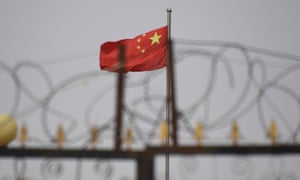
China is reportedly holding one million people, mostly ethnic Uighurs, in internment camps in Xinjiang Photograph: Greg Baker/AFP/Getty Images
UN ambassadors – including Australia, Britain, Canada, France, Germany and Japan – co-signed the letter released Wednesday and sent to the Human Rights Council president, Coly Seck, and the High Commissioner for Human Rights, Michelle Bachelet.
Rights groups and former inmates describe them as “concentration camps” where mainly Muslim Uighurs and other minorities are being forcefully assimilated into China’s majority ethnic Han society. The letter expresses concern “about credible reports of arbitrary detention… as well as widespread surveillance and restrictions, particularly targeting Uighurs and other minorities in Xinjiang.” It calls on China to stop arbitrary detention and allow “freedom of movement of Uighurs and other Muslim and minority communities in Xinjiang.” The authors, who include ambassadors from across the EU as well as Switzerland, requested that the letter become an official document of the Human Rights Council, which ends its 41st session in Geneva on Friday. Chinese officials describe the camps as voluntary “vocational education centres” where Turkic-speaking Uighurs receive job training.
The letter may have been the only available option with China having enough support in the UN Council to vote down a formal resolution. See also: ttps://www.reuters.com/article/us-china-xinjiang-rights-idUSKCN1U721X?utm_campaign=trueAnthem:+Trending+Content&utm_content=5d28c3e00ca7240001cb2eef&utm_medium=trueAnthem&utm_source=twitter
On the same day Human Rights Watch commented: Most importantly, the joint letter sends a strong message that we are moving beyond the era of selectivity, and that no country, large or small, is exempt from the scrutiny of this Council. We understand that the joint letter remains open for additional signatures, and we encourage those delegations that have not yet signed to do so. We are particularly disappointed that OIC member states have not yet engaged meaningfully or credibly with the human rights situation affecting Muslims in Xinjiang, while they have spoken out on other situations. This risks fueling perceptions of double standards and politicization; supporting the constructive joint statement would be a useful step towards addressing such perceptions.
We also welcome China’s acceptance of a UPR recommendation to respond positively to a country visit request by the UN Special Rapporteur on freedom of religion or belief.
We would suggest that China could benefit from technical assistance by drawing on the expertise of other UN Special Rapporteurs, such as the Special Rapporteur on the promotion of human rights while countering terrorism. Given that China has advanced the need to counter terrorism as its rationale for mass programs directed at Uyghurs and others in Xinjiang, the Special Rapporteur could offer useful guidance on whether there are more rights-respecting ways to counter terrorism than mass surveillance, detaining over a million Muslims, and stripping an entire population of its rights to freedom of religion, privacy, culture and expression.
UN Council agrees action on Philippines in spite of vehement objection
July 11, 2019On 11 July 2019 the United Nations Human Rights Council’s approved the resolution initiated by Iceland by a vote of 18 to 14, that requests the UN human rights office to present a comprehensive report on human rights in the Philippines to the council next June. [see also: https://humanrightsdefenders.blog/2019/06/07/philippines-labour-rights-defender-dennis-sequena-shot-dead-while-meeting-with-workers/]. The resolution also expresses concern about the range of rights violations in the country and calls on the government to cooperate with UN human rights mechanisms and experts. The Philippine government earlier denounced the resolution as a “divisive motion” and sought to block it. The Philippines rejected the resolution, with Foreign Affairs Secretary Teodoro Locsin Jr. calling it a “travesty” in a statement a representative read on his behalf.
(A total of 14 countries, meanwhile, voted no, including China; fifteen countries abstained, including Japan, Pakistan, and Brazil.
https://www.hrw.org/news/2019/07/11/philippines-un-takes-critical-step-toward-accountability-0
41st session Human Rights Council: Opening statement by High Commissioner Michelle Bachelet
June 25, 2019On 24 June, 2019, the 41st session of the Human Rights Council started with an opening statement by UN High Commissioner for Human Rights Michelle Bachelet. I refer to the guide to human rights defenders issues published earlier: https://humanrightsdefenders.blog/2019/06/14/guide-to-human-rights-defenders-issues-at-the-41st-human-rights-council-starting-on-24-june/
The High Commissioner’s speech contained many topics including these:
……
I regret Saudi Arabia‘s dismissal of last week’s report by the Special Rapporteur on extrajudicial, summary or arbitrary executions. I also reiterate my strong condemnation of the mass execution of 37 men in April. Some were children when the alleged crimes occurred.
I regret Saudi Arabia‘s dismissal of last week’s report by the Special Rapporteur on extrajudicial, summary or arbitrary executions. I also reiterate my strong condemnation of the mass execution of 37 men in April. Some were children when the alleged crimes occurred.
Iran continues to sentence children to death. I was appalled that the authorities sentenced and executed two boys under the age of 18 in April. I remain particularly concerned about the high number of child offenders on death row – possibly more than 85 individuals – with some at risk of imminent execution.
I take this opportunity to note and commend global progress with respect to the death penalty in this year, which marks the 30th anniversary of the Second Optional Protocol to the International Covenant on Civil and Political Rights, aiming at the abolition of the death penalty. The advances include recent ratifications by Gambia and State of Palestine; removal of the death penalty from the penal codes of Benin and Burkina Faso; and declarations of moratoria in Malaysia and the State of California.
..The inspiring and peaceful popular uprising in Sudan, with its call for democratic governance and justice, has been met with a brutal crackdown by the security forces this month. I regret that the Government has not responded to our request for access to investigate allegations of serious human rights violations by the joint security forces during the crackdown. They include reports that more than 100 protestors were killed, and many more injured, during and following the assault by security forces on a peaceful sit-in on 3 June. In addition, hospitals and clinics were reportedly raided, and medical staff assaulted. We have received allegations of rape and sexual abuse of both women and men during the crackdown, as well as information alleging that hundreds of protestors may be missing. I urge Sudan to grant access to my Office; to put an end to the repression of the people’s human rights; and to immediately end the Internet shutdown. The Sudanese people are entitled to express their opinions, and – like people everywhere – they have a right to live in freedom and at peace, enjoying the rule of law and the conditions necessary to dignity.
In Myanmar, evidence indicates continuing persecution of the remaining Rohingya people in northern Rakhine State, with little or no effort by the authorities to create conditions for the voluntary, safe and sustainable return of refugees. Although restrictions on humanitarian and media access in both Rakhine and in Chin State limit our access to information, the ongoing conflict there has included use of heavy weaponry, airstrikes and helicopter gunships by the military, with significant loss of life on all sides and severe impact on civilians. Based on allegations received, we fear that the conflict is being used as a pretext to carry out attacks against Rohingya civilians, and to cause further displacement. Some 35,000 ethnic Rakhine, Rohingya, Mro, Daignet and Khamee civilians have been internally displaced by fighting. The suspension of humanitarian aid by the government means at least 95,000 people have been cut off from life-saving assistance.
….
My Office is following the situation of human rights in the Philippines very closely. The extraordinarily high number of deaths – and persistent reports of extrajudicial killings – in the context of campaigns against drug use continue. Even the officially confirmed number of 5425 deaths would be a matter of most serious concern for any country. I welcome the recent statement by Special Rapporteurs calling for action by the Council. There should also be comprehensive and transparent information from the authorities on the circumstances around the deaths, and investigations related to allegations of violations. These could dispel any false allegations and help regain trust for the authorities.Human rights defenders, including activists for land rights and the rights of indigenous peoples; journalists; lawyers; members of the Catholic clergy; and others who have spoken out – notably the Special Rapporteur on the rights of indigenous peoples – have received threats, sometimes publicly, from senior Government officials. This creates a very real risk of violence against them, and undermines rule of law, as well as the right to freedom of expression.
In Portugal, where I attended an encouraging conference on drug policies and harm reduction, I also benefited from informative discussions on migration. Portugal’s open and forward-looking migrant policy aims to offer migrants easy access to social and legal assistance and encourages migrants to access the labour market. I visited a centre in Lisbon which offered free pre-school classes, alongside training courses and other support to migrant women aiming to set up their own companies. Ensuring that migrants are included and integrated brings many benefits for host communities, including net financial contributions: Portugal’s High Commissioner for Migration informed me that in 2017, migrants contributed 510 million euros more to the social security system than they took out. I invite all countries to consider learning from this example. Despite extensive disinformation campaigns regarding the supposedly damaging impact of migration on destination countries, close attention to the facts indicates that when their dignity and rights are respected, migrants can be strong drivers of successful economies and societies. We should recognize and cherish these contributions.
Instead, I observe a deeply unfortunate trend towards the criminalisation of basic human compassion for migrants, including those in situations of great vulnerability. The NGO Open Democracy reported last month that over 100 ordinary people in Europe have been arrested or prosecuted this year for acts such as feeding hungry migrants; helping them find shelter; or even assisting a pregnant woman to get to hospital to give birth. Similar prosecutions of ordinary people seeking to help individuals in distress have also taken place in the United States and elsewhere. Moreover, in several countries, new legal measures aim to penalise NGOs which rescue people drowning at sea.
Measures such as these clearly put the lives of children, women and men at risk. But they also put our societies at risk. They violate ancient and precious values that are common to us all, by penalizing compassion. Those who seek to help people in need should be honoured, not prosecuted. Caring should not be considered a crime, and this criminalisation of acts of basic human decency must be resisted. We have, all of us, a right – and even a duty – to help each other.
https://ohchr.org/EN/NewsEvents/Pages/DisplayNews.aspx?LangID=E&NewsID=24724
Rich palette of side events at 41st Session of the UN Human Rights Council
June 21, 2019The 41st session of the UN Human Rights Council is to start soon. In addition to items of the agenda [see https://humanrightsdefenders.blog/2019/06/14/guide-to-human-rights-defenders-issues-at-the-41st-human-rights-council-starting-on-24-june/] there are – as usual – many side events in Geneva, both by States and NGOs, that relate to human rights defenders. You can download the list of NGO events here.
Here a selection:
- Launch of ISHR joint report on strengthening HRC membership on 1 July at 13:00 at the UN Delegates restaurant. Speakers will introduce the report and highlight some of the key challenges, opportunities and practical recommendations, including with regard to good practice relating to candidacy and membership of the HRC.
- Promoting and Protecting Civic Space for Migrants and Refugees is organised by CIVICUS and Solidarity Center and will take place on 24 June at 12:00. This event will examine findings on civic space barriers for migrant/refugees in Germany, Jordan, Kenya, Malaysia and Mexico from a new report by Solidarity Center and CIVICUS; provide an analysis of some of the civic space trends for migrants/refugees across the five countries; and hear from civil society activists on the ground.
- Health impacts for US Asylum is organised by Physicians for Human Rights (PHR) and will be held on 26 June at 10:00 in Room VIII. PHR will present findings from two reports about the asylum crisis in the United States with research based on forensic evaluations of more than 180 child asylum seekers regarding their trauma exposure in country of origin and reasons for fleeing, and documentation of cases where US immigration enforcement has impeded migrants access to emergency health care.
- Defending rights online: Challenges facing human rights defenders and a free and open Internet is organised by Article 19 and will be held on 26 June at 15:30 in Room VIII. It will discuss what more States at the Human Rights Council can do to bolster safeguards for the protection of human rights online, while also holding States accountable for violations of those rights. The panelists include the Special Rapporteur on freedom of opinion and expression and human rights defenders from Russia, Mexico, Tanzania and Tajikistan. https://www.article19.org/resources/event-defending-online-civic-space-challenges-facing-human-rights-defenders/
- Freedoms of expression, assembly, and association in Asia organised by Forum-Asia and will be held on 26 June 2019 at 15:00. This side event aims to discuss issues related to freedoms of expression, assembly, and association in Asian states.
- Ending Impunity for Murdered Journalists: Enhancing the role and impact of the UN is organised by Article 19 and will be held on 27 June at 11:30 in Room VIII. The panelists include the Special Rapporteur on extrajudicial, summary or arbitrary executions, the Special Rapporteur on freedom of opinion and expression, and Hatice Cengiz, Fiancée of Jamal Khashoggi. It will examine how the UN’s response to cases of murdered journalists might be enhanced.
- Criminalisation of solidarity in migration organised by the International Commission of Jurists (ICJ) and OHCHR, and will be held on 27 June in Kazakh Room – Cinema XIV. The event will feature the screening of the movie “The Valley” by Nuno Escudeiro, documenting the situation of human rights defenders and migrants in South of France, with an introductory panel and a discussion session after the movie (THE VALLEY is a coproduction Point du Jour (France), Miramonte Film (Italy) and was awarded the Emerging international filmmaker at the HOT DOCS film festival, Toronto).
- Women’s rights under attack: the case of Poland, organised by the International Federation for Human Rights (FIDH) and Human Rights Watch, will take place on 27 June, at 13:00 in Room XV. This side event will expose attempts to erode sexual and reproductive health and rights, campaigns against women’s rights organisations, and targeting of women’s rights activists – against the backdrop of a decline in the rule of law in the country. It will explore how international and regional organisations should address this concern in Poland and in the rest of the continent.
- Needs, best practices and risks of research and data collection on sexual orientation and gender identity, organised by COC Nederland and sponsored by ISHR will be held on June 27 at 15:30 in Room V.
- Human Rights in Kashmir is organised by the International Commission of Jurists and will be held on 28 June at 13:00 in Room XXI.
- The human rights problem of political marginalisation is organised by Salam for Democracy and Human Rights (Bahrain) and CIVICUS, and will take place on 2 July at 12:00. Despite steadily rising levels of social and political marginalization in Bahrain, the government has sought to convey the appearance of political stability. In a context where freedoms of expression, peaceful assembly and association are severely restricted, what strategies can civil society – in Bahrain and in other countries around the world – bring into play to reduce political marginalisation?
- The situation of migrants and refugees rights in Brazil is organised by Conectas and will be held on 2 July at 14h in Room VIII. The event will discuss the rights of migrants and refugees in Brazil focusing on the situation of Venezuelans refugees coming to the country, the reasons why they are leaving Venezuela and how Brazil is responding to this situation.
- Human rights in Myanmar is organised by Physicians for Human Rights, and will be held on 1 July at 12:00 in Room VIII. PHR will provide an in-depth briefing on new research findings that reveal a painful, long-term legacy of the Rohingya Crisis and underscore the urgent need for accountability.
- Human rights in Myanmar is organised by Forum Asia and will be held on 1 July 2019 at 14:30 in Room VIII. Human rights defenders and the Special Rapporteur on Myanmar will provide updates on the situation in the country since the last Council session.
- Upholding the rule of law: The UN database on businesses operating in the OPT is organised by the Cairo Institute for Human Rights Studies and will be held on 5 July at 14:00 in Room VIII. More than three years following the establishment of the Database mandate pursuant to Human Rights Council Resolution 31/36– the results of this process are not being transmitted with the necessary transparency. The side event will focus on the importance of releasing the database as a public online platform of business enterprises engaged in business activities related to Israeli settlements.
- Human rights in Sudan is organised by DefendDefenders and Physicians for Human Rights. It will be held on 8 July at 13:00 in Room XXIV. This event will bring Sudanese voices to the Council to speak about the situation in Sudan and the ongoing crackdown.
- Human Rights in Venezuela is organised by the International Commission of Jurists and will be held on 8 July at 14:30 in Room IX.
Any others that come to my attebtion will be reported later.
Guide to Human Rights Defenders issues at the 41st Human Rights Council starting on 24 June
June 14, 2019Thanks to the – as always very complete and timely – “Alert to the Human Rights Council’s 41st session” (from 24 June to 12 July 2019) issued by the International Service for Human Rights. I am able to give a short guide to the main items that relate to human rights defenders. To Read the full Alert to the session online click here and stay up-to-date with @ISHRglobal and #HRC41 on Twitter.
Thematic areas of interest:
Sexual orientation and gender identity: The interactive dialogue with the Independent Expert on protection against violence and discrimination on the basis of sexual orientation and gender identity (SOGI) will be held on Monday 24 June at 11:00. The Council will consider the new thematic report of the mandate holder as well as the report of the country visits he made to Georgia and Mozambique. The Council will also consider the renewal of the mandate.
Business and human rights: The Council will hold an interactive dialogue with and consider several reports of the Working Group on the issue of human rights and transnational corporations and other business enterprises on 26 June. The Working Group will present a report on the gender dimensions of the Guiding Principles on Business and Human Rights and the reports of country visits to Thailand and Kenya. The Working Group’s report on the gender dimensions of the Guiding Principles integrates clear recognition that women human rights defenders play a vital role in challenging business-related human rights abuses as well as in promoting and protecting human rights in relation to business activity, including the right to an effective remedy. As a result of this work, women human rights defenders often face gender-specific risks including sexual violence, misogynist public shaming and online harassment. Among its recommendations, the Working Group calls on business enterprises to ensure the meaningful participation of women’s organisations, women human rights defenders and gender experts in all stages of human rights due diligence.
Women human rights defenders and women’s rights: The annual full day discussion on the human rights of women will take place on 27 and 28 June. The discussions will focus this year on violence against women in the world of work, the rights of older women and their economic empowerment. A panel focused on women’s rights and climate change will also be organised, focusing on climate action, best practices and lessons learned. States should place due consideration on the role of women human rights defenders and social movements in this regard, in line with the Human Rights Council resolution focused on environmental human rights defenders adopted in March 2019…
The Council will also hold an interactive dialogue with the Working Group on the issue of discrimination against women in law and in practice which focuses on women deprived of liberty (including women human rights defenders in detention, facing travel bans, among other situations), and will consider their reports including a report on the country visits to Honduras and Poland. The Council will hold an interactive dialogue with the Special Rapporteur on violence against women, its causes and consequences on 27 June and will consider her report including the report of her visits to Canada and Nepal.
Reprisals: In spite of a number of measures, reprisals not only continue, but grow. Item 5 of the Human Rights Council’s agenda provides a key opportunity for States to raise concerns about reprisals, including specific cases, and for relevant governments to provide updates on cases to the Council on any investigation or action taken toward accountability. During the organisational meeting held on 7 June, the President of the Council stressed the importance of ensuring the safety of those participating in the Council’s work, and the obligation of States to prevent intimidation or reprisals. In line with previous calls, ISHR expects the President of the Human Rights Council to publicly identify and denounce specific instances of reprisals by issuing formal statements, conducting press-briefings, corresponding directly with the State concerned, publicly releasing such correspondence, and insisting on undertakings from the State concerned to investigate, hold the perpetrators accountable and report back to the Council on action taken. [see also: https://humanrightsdefenders.blog/2019/05/13/ishr-on-reprisals-un-and-states-must-do-more-to-address-reprisals/]
Other key thematic reports: The Council will hold dedicated debates and consider reports of several mandates relating to civil, political, economic, social and cultural rights, and the role of human rights defenders in that work area, in some instances involving the renewal of the mandate:
- The Special Rapporteur on independence of judges and lawyers and on the right to health (including country visits report to Canada and Kyrgyzstan) on 24 June
- The Special Rapporteur on the rights to freedom of peaceful assembly and association (mandate renewal, reports include country visits to Tunisia and Armenia) on 25 June
- The Special Rapporteur on extrajudicial, summary or arbitrary executions and right to education on 26 June
- The Special Rapporteur on freedom of opinion and expression (including thematic report on surveillance companies and country visit report to Ecuador) on 25 June
- The Special Rapporteur on extreme poverty and human rights (including country visits reports to the UK and Laos) on 28 June
In addition, the Council will hold dedicated debates on rights of specific groups including with:
- The Special Rapporteur on the human rights of migrants (and country visit report to Niger) on 24 June
- The Special Rapporteur on the human rights of internally displaced persons on 28 June (mandate renewal)
- The Special Rapporteur on trafficking in persons (and country visit to Nigeria) on 27 June
- The Special Rapporteur on the elimination of discrimination against persons affected by leprosy and their family members on 24 June
Country-specific developments:
China: For more than a year, the international community has had access to credible reports and first-hand testimony of the harassment, surveillance, and mass detention of more than one million Uyghurs and other Turkic Muslims in Xinjiang. Despite the consistent work of the UN human rights mechanisms to review China, ask questions, and make recommendations, there has been no serious or effective response. The Council should take urgent action to seek access, monitoring and reporting of the situation to inform future actions. ..ISHR urges States to act collectively to advance a resolution calling for China to allow access to the region to independent human rights experts and to end country-wide the arbitrary detention of individuals based on their religious beliefs or political opinions.
Sudan: In response to the gross and systematic human rights violations occurring in Sudan, ISHR andother NGOs have urged Council Member States to urgently hold a Special Session on the human rights situation in Sudan. The Council should urgently establish an international fact-finding mission to document violations, identify perpetrators and push for accountability, in line with calls made by a group of Special Procedures including the Independent Expert on Sudan. Since 3 June, Rapid Security Forces, riot police and national security officers violently dispersed peaceful protesters in Khartoum as well as in different cities across Sudan. The MENA Women Human Rights Defenders’ Coalition reported that at least 113 people have died including women human rights defenders. Civil society documented cases of rape, attacks on hospitals, with hundreds injured and missing. The Transitional Military Council is enforcing a ban on communication causing an internet black out. The High Commissioner has deplored the killings and proposed ‘the rapid deployment of a UN human rights monitoring team’ to Sudan.
Saudi Arabia: The June session provides an important opportunity for the Council to follow up on the joint statement delivered on behalf of 36 States [see: https://humanrightsdefenders.blog/2019/03/08/saudi-arabia-for-first-time-openly-criticized-in-un-human-rights-council/] .. Seven women’s rights activists have been provisionally released, but they are still facing trial, and other women human rights defenders are still in detention, with the human rights situation on the ground deteriorating markedly on other fronts, including through increased use of the death penalty and the authorities’ continuing crackdown on freedom of expression. [see also: https://humanrightsdefenders.blog/2019/03/28/3-saudi-women-human-rights-defenders-released-but-for-how-long-and-what-about-the-others/]
The Special Rapporteur on extrajudicial, summary or arbitrary executions will present her findings of the investigation into the killing of Khashoggi. [see: https://humanrightsdefenders.blog/2019/01/26/other-members-of-the-uns-khashoggi-investigation-team-named/%5D…..ISHR calls on States to advance a Human Rights Council resolution establishing a monitoring mechanism over the human rights violations in the country and calling explicitly for the immediate and unconditional release of all human rights defenders including the detained women human rights defenders and to drop all charges against them, including those provisionally released. ISHR considers the March joint statement as a first step towards more sustained and dedicated review by the Council in its efforts to hold its members accountable.
The Philippines: The Philippines is one of the most dangerous countries for human rights defenders. Several NGOs callied on the Council to advance accountability for human rights violations by adopting a resolution establishing an independent international investigation into extrajudicial killings and this call was strongly endorsed by a group of independent UN experts who condemned a ‘sharp deterioration in the situation of human rights across the country, including sustained attacks on people and institutions defending human rights.’ [see also: https://humanrightsdefenders.blog/2019/06/07/philippines-labour-rights-defender-dennis-sequena-shot-dead-while-meeting-with-workers/]
Egypt: Despite the Egyptian government’s assurances to the African Commission civil society faced restrictions, reprisals and intimidation for engaging or seeking to engage with the Commission. These restrictions and reprisals happened in a context where the Government of Egypt crushes dissent, discourages public participation in public affairs and punishes people who dare to claim basic human rights. Individuals and communities who engaged with the Special Rapporteur on the right to housing during her visit in September 2018 faced systematic reprisals. All other scheduled visits by the Special Procedures have been postponed as a result. [see: https://humanrightsdefenders.blog/2018/12/07/egypt-denounced-for-reprisals-against-human-rights-defenders-who-talked-to-visiting-un-delegation/ and https://humanrightsdefenders.blog/2019/05/12/reprisal-against-egyptian-human-rights-defender-mohamed-soltan/]. ISHR calls on States to condemn the acts of intimidation and reprisals for civil society engaging with the African Commission and with the Special Procedures, and recall Egypt’s obligations to prevent acts of intimidation and reprisals, investigate the allegations and provide victims with effective remedy.
Burundi: The Commission of Inquiry on Burundi will present its oral briefing on 2 July. The closing of the office of the High Commissioner for Human Rights is regrettable and worrying. In addition, ISHR remains seriously concerned over the breaches to due process observed in all of human rights defender Germain Rukuki’s legal proceedings since his arrest without warrant on 13 July 2017. [See: https://humanrightsdefenders.blog/2019/03/29/ngo-statement-condemns-new-irregularities-in-the-case-of-germain-rukuki-burundi/]. For more information on the situation of human rights defenders in Burundi, check ISHR Briefing Paper for the UPR here.
Other country situations: The High Commissioner will present her oral update to the Council on 24 June. The Council will hear reports on and is expected to consider resolutions addressing a range of country situations, in some instances involving the renewal of the relevant expert mandates. These include:
- Interactive dialogue with the Special Rapporteur on the human rights situation in Belarus (mandate renewal) on 1 July
- Interactive dialogue with the Special Rapporteur on the human rights situation in Eritrea (mandate renewal) on 2 July
- Interactive dialogue with the Commission of Inquiry on Syria, the Commission of Inquiry on Burundi and the Special Rapporteur on Myanmar on 2 July
- Enhanced interactive dialogue with the government of Sudan and OHCHR on 9 July
- Enhanced interactive dialogue on the situation in the Democratic Republic of Congo and interactive dialogue with the team of experts on the situation in the Kasai region on 9 July
- Interactive dialogue with the High Commissioner on the situation in Ukraine on 10 July
- Interactive dialogue with the Independent Expert on the Central African Republic on 10 July
- Enhanced interactive dialogue on the report of the High Commissioner on Venezuela on 10 July
- Interactive dialogue with the High Commissioner on the situation of Rohingya Muslims and other minorities in Myanmar on 10 July
- First oral update and enhanced interactive dialogue on the report of the High Commissioner on Nicaragua on 11 July
- Oral update by the High Commissioner on cooperation with Georgia on 11 July
Adoption of Universal Periodic Review (UPR) reports: During this session, the Council will adopt the UPR working group reports on New Zealand, Afghanistan, Chile, Viet Nam, Uruguay, Yemen, Vanuatu, North Macedonia, Comoros, Slovakia, Eritrea, Cyprus, Dominican Republic and Cambodia.
Resolutions to be presented to the Council’s 41st session: At the organisational meeting resolutions were announced (States sponsoring the resolution in brackets); it is possible that more resolutions could be presented at this session. These include:
- The human rights situation in Belarus (European Union)
- Human rights of internally displaced persons (Austria, Honduras, Uganda)
- Human rights and climate change (Bangladesh, Philippines, Viet Nam)
- Human rights, sexual orientation and gender identity (Argentina, Brazil, Chile, Colombia, Costa Rica, Mexico, Uruguay).
- Elimination of discrimination against women and girls (Colombia, Mexico)
- Rights to freedom of peaceful assembly and of association (Czech Republic, Indonesia, Lithuania, Maldives, Mexico)
- New and emerging and digital technologies and human rights (Republic of Korea, Austria, Brazil, Denmark, Morocco, Singapore)
- Accelerating efforts to eliminate all forms of violence against women(Canada)
- The human rights situation in Syria (France, Germany, Italy, Jordan, Kuwait, Morocco, Netherlands, Qatar, Turkey, United Kingdom of Great Britain and Northern Ireland)
There wil be again many side events at the Council, on which I will report separately.
Read here the three year programme of work of the Council with supplementary information.
Read here ISHR’s recommendations on the the key issues that are or should be on the agenda of the UN Human Rights Council in 2019.
One-day dialogue on Human Rights Council membership on 1 july 2019
June 12, 2019ISHR, Amnesty International and Human Rights Watch organise a meeting on STRENGTHENING AND LEVERAGING HUMAN RIGHTS COUNCIL MEMBERSHIP on Monday 1 July 2019, 13h00-14h30 Restaurant des Délégués, 8th Floor, Palais des Nations, Geneva.The composition of the HRC has captured significant public attention over the past year – with people around the world rightly asking: how can States accused of gross and systematic human rights violations become members of the United Nations’ Human Rights Council? And what does that mean for the credibility and effectiveness of this body? Clearly, for the HRC to be effective, and to be credible and relevant to the wider human rights community, and the wider public, it needs members committed to the promotion and protection of human rights at home and abroad in its 47 seats, as foreseen by UNGA resolution 60/251. Of course, no State has a perfect human rights record, and a wide and diverse range of States should be encouraged to address their shortcomings and enhance their commitment to human rights through HRC participation and engagement. While the argument does not apply to candidates that are in clear breach of the membership criteria, HRC membership may be an important incentive for national-level change, particularly where States, as candidates, make voluntary pledges and commitments, and are willing and able to implement them. The framing and implementation of those pledges and commitments is, however, rarely discussed at national or international level. Against this backdrop, in February 2019, Amnesty International, Human Rights Watch, the International Service for Human Rights (ISHR) and HRC-net convened a one-day dialogue bringing together national and regional actors – including human rights defenders and NHRIs – with a cross-regional group of State representatives, OHCHR officials and international civil society, to address two important and interlinked questions regarding HRC membership: 1) how can we encourage greater respect and application of the membership criteria clearly set out in GA resolution 60/251; and 2) how can a State’s membership of the HRC be leveraged for positive change on human rights at national level? Drawing on good practices and lessons learned, participants identified a range of challenges, opportunities and practical recommendations. A report of the one-day dialogue will be presented during a lunch time reception at the Restaurant des Délégués on 1 July, in the side-lines of the 41st session of the Human Rights Council. The reception will provide an opportunity for the presentation of some of the key challenges, opportunities and practical recommendations identified in the report, including with regards to good practice relating to candidacy and membership of the HRC.
Speakers:
- Ambassador Nazhat Shameem Khan, Permanent Representative of Fiji to the UN
- Salma El Hosseiny, ISHR’s Human Rights Council Advocate
- Hilary Power, Amnesty International’s Senior UN Advocate
Please RSVP by clicking here <https://crm.ishr.ch/sites/all/modules/civicrm/extern/url.php?u=884&qid=111418> by 19 June 2019 to confirm your participation at this event.
 Hans Thoolen on Human Rights Defenders and their awards