Archive for the 'ISHR' Category

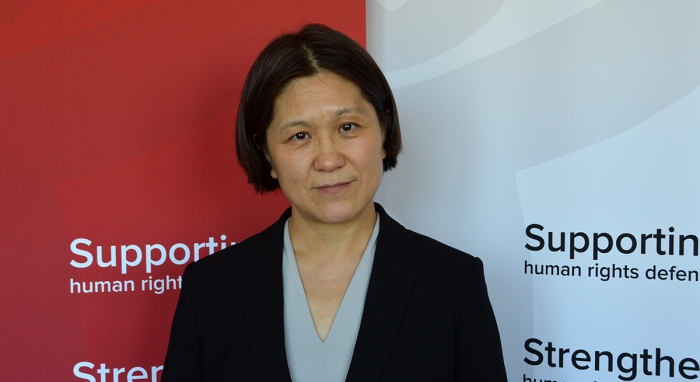
Profile of Sonia Acabal, woman human rights defender from Guatemala

March 7, 2018

 published on 24 November 2017 this video  interview Sonia Acabal from Guatemala about the situation in her country, the women’s network Rednovi and what it means to be a women’s rights defender.

UDHR at 70: human rights defenders are the key to celebration

March 6, 2018

The ISHR on 28 February 2018 made the following statement which seem obvious to the readers of this blog but it cannot be stressed enough: Human rights defenders risk their freedom and sometimes their lives to advocate for the rights of fellow human beings. On the occasion of the Human Rights Council’s High-Level panel commemorating the 70th anniversary of the Universal Declaration on Human Rights (UDHR) and the 25th anniversary of the Vienna Declaration and Programme of Action, ISHR stressed that the realisation of the UDHR depends on the work of human rights defenders and that States who restrict the work of defenders are in turn violating their obligations under the UDHR. 

2018 is not only the 70th anniversary of the Universal Declaration of Human Rights (UDHR) and the 25th anniversary of the Vienna Declaration and Programme of Action (VDPA), it also marks the 20th anniversary of the Declaration on human rights defenders which was adopted by consensus by the General Assembly in 1998.

The rights enshrined in the UDHR cannot be guaranteed without a safe and enabling environment for the people exercising and fighting to defend those rights. States who commit to guarantee the UDHR cannot restrict the work of defenders, nor fail to act upon their obligation to protect them.

20 years after the adoption of the Declaration, human rights defenders have perhaps never been more under threat. They are subjected to judicial harassment, arbitrary arrest and detention, torture, enforced disappearance, physical violence and even murder.

Defenders are also attacked when they bring their voices to the international community. Last year, a report by the Secretary-General found evidence of a strategy on the part of some States to prevent the activities of individuals cooperating with the UN. The report also highlights that the incidence of reprisals is becoming broader and that the means used are increasingly blunt…

The realisation of the UDHR depends on the work of defenders, who risk their lives and their freedom to advocate for the rights of others,” said Salma El Hosseiny, ISHR’s Human Rights Council Advocate. “It is alarming that States are increasingly shrinking civil society space on one hand, and professing their commitment to guarantee the UDHR on the other hand“.  These unprecedented attacks against civil society and defenders amount to violations of the same rights to which they are advocating for.

States must translate their commitment to the UDHR by taking immediate and effective measures to ensure that defenders are able to carry out their legitimate human rights activities without any hindrance, to ensure accountability for all perpetrators, and access to remedies for victims.

The Human Rights Council plays an important role in contributing to the realisation of the UDHR on the ground. Accordingly, any proposals to strengthen or enhance the efficiency of the Council should be measured through the lens of increasing its impact, rather than the relatively insignificant time or money it may save. Finally, it is imperative that any legitimate process to strengthen the Council include the meaningful participation of civil society in all stages.

https://www.ishr.ch/news/hrc37-defenders-are-key-realise-universal-declaration-human-rights

see also: https://www.ishr.ch/news/hrc-consultation-civil-society-key-if-council-be-reformed-fit-purpose

Egypt ‘blessed’ with two side event at Human Rights Council in March 2018

March 6, 2018

On 13 February 2018 fourteen international and regional rights organizations stated that the Egyptian government has trampled over even the minimum requirements for free and fair presidential elections (planned 26-28 March). The government of President Abdel Fattah al-Sisi has relentlessly stifled basic freedoms and arrested potential candidates and rounded up their supporters. “Egypt’s allies should speak out publicly now to denounce these farcical elections, rather than continue with largely unquestioning support for a government presiding over the country’s worst human rights crisis in decades,” the groups said.

The authorities have successively eliminated key challengers who announced their intention to run for president….The current atmosphere of retaliation against dissenting voices and the increasing crackdown against human rights defenders and independent rights organizations have made effective monitoring of the elections extremely difficult for domestic and foreign organizations. Media reports have said that the number of organizations that were granted permission to monitor the elections was 44 percent fewer than in the last presidential election in 2014 and that the number of requests, in general, has gone down. Several opposition parties called for boycotting the elections. A day later al-Sisi threatened to use force, including the army, against those who undermine “Egypt’s stability and security.” On February 6, the Prosecutor-General’s Office ordered an investigation against 13 of the leading opposition figures who called for a boycott, accusing them of calling for “overthrowing the ruling regime.” Seven years after Egypt’s 2011 uprising, the government has made a mockery of the basic rights for which protesters fought,” the groups said. “Egypt’s government claims to be in a ‘democratic transition’ but move further away with every election.

So, the two side events that are coming up are extremely valuable as the national space for dissent is nihil:

  • The Situation of Human Rights and Upcoming Elections in Egypt: Facilitating Radicalisation is an event organised by the Cairo Institute for Human Rights Studies (CIHRS) and co-sponsored by ISHR, that will take place on 9 March at 13:30 to 15:00 in Room XXIII. The event will address the deterioration of the human rights situation in Egypt and the dangers of the international community’s failure to respond.
  • Human rights violations in Egypt and in the Gulf States is an event organised by FIDH, CIVICUS, the Gulf Center for Human Rights. It will take place on 15 March 2018 at 15:00 till 16:00 in Room XXIII. The event will focus on the interlinked plight of human rights defenders in Egypt and the Gulf States as both are facing ongoing targeting by their own governments as well as explore measures for coordination and advocacy at the international level.

In the same context there is the press release of Friday 2 February 2018 in which a number of organisations, under the umbrella Committee for Justice (CFJ), condemned Tuesday’s execution of Egyptian Tayseer Odeh Suleiman after he was convicted in Ismalia’s military court in what they said was a flawed trial inconsistent with international legal and human rights standards. Suleiman, 25, was hanged after the Supreme Military Court of Appeals rejected the defence put foward by his lawyer without explaining the reasons behind the rejection….CFJ confirmed that there had been an unprecedented increase in the implementation of death sentences in Egypt, based on illegal proceedings, with 26 people executed between the end of December last year and the present. CFJ further asserted that the reason for the death penalties “under the guise of combating terrorism” were misleading and in violation of basic standards of a fair trial indicating significant flaws in Egypt’s judicial process.

On only a few days ago (2 March 2018), responding to reports from his family and colleagues that Ezzat Ghonim – a prominent Egyptian human rights lawyer and director of the NGO, Egyptian Coordination for Rights and Freedoms – failed to return home from work yesterday, Najia Bounaim, Amnesty International’s North Africa Campaigns Director, said:  “Given the highly-charged political climate in Egypt and the clampdown on dissent in the lead-up to the presidential elections, we are deeply concerned that Ezzat Ghonim may have been forcibly disappeared. ”

For some of my earlier posts on Egypt, see: https://humanrightsdefenders.blog/tag/egypt/

https://www.iol.co.za/news/africa/rights-groups-condemn-egyptian-executions-done-by-military-13069428

https://www.hrw.org/news/2018/02/13/egypt-planned-presidential-vote-neither-free-nor-fair

https://www.amnesty.org.uk/press-releases/egypt-fears-lawyer-ezzat-ghonim-latest-human-rights-activist-be-disappeared

Preview of Human Rights Defenders issues at the 2018 session of the UN Human Rights Council starting Monday

February 24, 2018

Thanks to the International Service for Human Rights I am able to give you a short overview of what issues directly relevant to human rights defenders are coming up in the 37th session of the UN Human Rights Council starting on Monday 26 February 2018. For the broader human rights view please follow the link at the end of this post.

Thematic

Protection of human rights defenders working in the context of people on the move

A few days ago I posted https://humanrightsdefenders.blog/2018/02/20/michel-forst-empowering-defenders-on-the-move-is-crucial-to-the-prevention-of-further-tragedy/ which refers to:

– the Global Compact for Migration which States will negotiate (in an open letter sent on 21 February, High Commissioner for Human Rights Zeid urged States to develop a compact that ‘explicitly recognizes and fully conforms to the existing international human rights framework as the authoritative protection agenda for all migrants’)

–  a thematic report on the situation of defenders of the rights of people on the move by the Special Rapporteur Michel Forst (read  ISHR’s detailed analysis)

– the OHCHR Principles and Practical Guidance for the protection of the Human Rights of Migrants in Vulnerable Situations (Principle 18 which states that States should ‘respect and support the activities of human rights defenders who promote and protect the human rights of migrants’)

– the Special Rapporteur on Torture’s report which is expected to focus on torture and other forms of ill-treatment in the context of migration.

Reprisals

During its last session, the Council adopted a resolution on reprisals. The resolution established a dedicated dialogue to address acts of intimidation and reprisals at each September Council session. Through the resolution, the Council also affirmed the particular responsibilities of its Members, President and Vice-Presidents to investigate and promote accountability for reprisals and intimidation.Reports of cases of reprisals not only continue, but grow in spite of the passage of this resolution, and the appointment of the UN Assistant Secretary General as the Senior Official on addressing Reprisals. As requested by Council Resolution 12/2, the General Debate under Item 5 of the Council is a key moment for States and civil society to raise and follow up cases of reprisals, and to push for accountability for such acts. [one of my favorite topics: https://humanrightsdefenders.blog/tag/reprisals/]

Other key thematic report will be the one by the body working on developing a treaty on business and human rights. The open-ended inter-governmental working group on transnational corporations and other business enterprises (known as IGWG), will present its third report to the Council. ISHR is concerned about the limited protection for human rights defenders in the current elements discussed at the last session. Any process towards drafting a business and human rights treaty should effectively prevent and respond to cases of reprisals.

Country-specific developments relating specially to HRDs:

Burundi. During the 36th session, the Council passed two resolutions on Burundi; one led by the European Union extending the mandate of the Commission of Inquiry and a second resolution by the African Group that requested OHCHR to urgently dispatch a team of three experts to engage with the Burundian authorities and all other stakeholders. Read here ISHR’s analysis of the two resolutions. At the 37th session, the Commission of Inquiry on Burundi will present an oral briefing to the Council. In addition, the High Commissioner will give an oral briefing of the Council on the mission of the OHCHR. Furthermore, the Secretary-General’s report on Burundi noted that OHCHR continued to receive allegations of serious human rights violations and abuses, primarily by the State and affiliated actors, including killings, enforced disappearances, torture and ill-treatment, more than 1,000 arbitrary arrests and detentions and restrictions on the freedoms of association, expression and movement. Burundi’s vice president criticised the report, suggesting that the Secretary-General has been transformed into an opposition member. ISHR and other NGOs continues to remain highly concerned about the human rights situation in Burundi and its refusal to cooperate with the Council’s mechanisms, which both clearly warrant an invitation to the General Assembly to consider the suspension of Burundi as a member of the Council. [see also: https://humanrightsdefenders.blog/2016/02/08/what-is-burundi-doing-in-the-un-human-rights-council/] For more information on the situation of human rights defenders in Burundi, check ISHR Briefing Paper for the UPR here.

China. Since Xi Jinping’s assumption of power in 2013, the situation for human rights defenders in China has gone from bad to worse. Five current cases illustrate the sense of impunity with which Chinese authorities trample on the rights of civil society actors. ISHR has discussed many of them in detail, but in short they include:

  • the baseless house arrest since 2010 of Liu Xia, a poet and the widow of Nobel Peace Prize Laureate Liu Xiaobo;
  • the prolonged detention of rights lawyer Wang Quanzhang, who has been held incommunicado, and without charge or access to lawyers since July 9, 2015;
  • the seizure and disappearance in January 2018 of bookseller Gui Minhai, a Swedish citizen previously forcibly disappeared from Thailand in October 2015;
  • the detention and prosecution for inciting separatism of Tashi Wangchuk, a Tibetan cultural rights and education advocate; and
  • the punitive disbarment in January 2018 and, later that month, arbitrary detention of Yu Wensheng, a prominent human rights lawyer.

see also: https://humanrightsdefenders.blog/2018/01/10/more-on-residential-surveillance-in-a-designated-location-rsdl-in-china/

Other country situations:

The Council will hear reports on and is expected to consider resolutions addressing a range of country situations, in many instances involving the renewal of the relevant expert mandates and the situation of human rights defenders. They include:

  • The High Commissioner will present his reports on Guatemala, Honduras and Colombia, Afghanistan and give oral updates on the situation of human rights in Haiti, Yemen, Ukraine, Libya, Democratic Republic of Congoand Democratic People’s Republic of Korea.
  • OHCHR will present its report on Cyprus and an oral update on Eritrea.
  • The Council will consider the written update of OHCHR on promoting reconciliation, accountability and human rights in Sri Lanka.
  • The Council will consider the report of the Commission of Inquiry on Syria and renew its mandate.
  • The Council will consider the report of the Commission on Human Rights in South Sudan and the report of the Special Rapporteur on the Democratic People’s Republic of Korea.
  • The fact-finding mission on the situation of human rights in Myanmar will present an oral update to the Council and the Special Rapporteur on Myanmar will also present her report to the Council.
  • The Council will consider the interim report of the Secretary-General on the situation of human rights in Iran and Cambodia.
  • The Council will hold an interactive dialogue with the Independent Expert on the Central African Republic.
  • The Independent Expert on Mali will present his report to the Council, who will also hold an interactive dialogue on the human rights situation in Mali.
  • The Council was intending to consider the report of the Special Rapporteur on Iran, Asma Jahangir, however due to her death, it is currently unclear whether and how the report will be considered. {see also: https://humanrightsdefenders.blog/2018/02/11/asma-jahangir-one-of-the-worlds-most-outstanding-human-rights-defenders-dies-at-age-66/]

The High Commissioner will present his annual report in the last interactive dialogue of his term. Read here ISHR and other regional and international human rights organisations’ open letter to the Secretary General on the selection process of the next High Commissioner. [see also https://humanrightsdefenders.blog/2017/12/22/bound-to-happen-but-still-high-commissioner-zeid-announces-he-will-not-seek-second-term/]

Universal Periodic Review (UPR): States to be reviewed

During this session the Council will adopt the UPR reports which list the recommendations the State under review is expected to implement of the following 14 countries: Czechia, Argentina, Gabon, Ghana, Peru, Guatemala, Benin, the Republic of Korea, Switzerland, Pakistan, Zambia, Japan, Ukraine and Sri Lanka. ISHR submits briefing papers regarding the situation facing human rights defenders in some States under review and advocates for the UPR to be used as mechanism to support and protect human rights defenders on the ground.

Appointment of mandate holders

The President of the Human Rights Council has proposed candidates for the following a number of vacancies of mandate holders to be filled at this session, including:

  • Special Rapporteur on the rights to freedom of peaceful assembly and of association
  • Special Rapporteur on the promotion of truth, justice, reparation and guarantees of non-recurrence
  • Independent Expert on the situation of human rights in Mali


Panel discussions

During each Council session, panel discussions are held to provide member States and NGOs with opportunities to hear from subject-matter experts and raise questions. All panel discussions will be broadcast live and archived on http://webtv.un.org. Seven panel discussions are scheduled for this upcoming session, including:

  • The annual high-level panel discussion on human rights mainstreaming will take place on 26 February 2018 from 16:00 to 18:00. This panel will discuss the challenges and opportunities of the promotion and protection of human rights in the light of the UPR mechanism. The concept note of the panel is available here.
  • High-level panel discussion on the seventieth anniversary of the Universal Declaration of Human Rights and the twenty-fifth anniversary of the Vienna Declaration and Programme of Action will take place on 28 February 2018 at 16:00 to 18:00. The concept note of the panel is available here.
  • Annual full-day meeting on the rights of the child will take place on 5 March 2018 from 09:00 to 11:00 and from 16:00 to 18:00. This panel will discuss the protection of the rights of the child in humanitarian situations. The concept note of the panel is available here.
  • Debate on promoting tolerance, inclusion, unity and respect for diversity in the context of combating racial discrimination will take place on 16 March 2018 at 09:00 to 11:00. This panel will be held in commemoration of the International Day for the Elimination of Racial Discrimination. The concept note will soon be made available here.

Side events. States and NGOs are holding a series of events. You can download the list of State events here and NGO events here. I will post on some of these separately.

https://www.ishr.ch/news/hrc37-key-issues-agenda-march-2018-session

Michel Forst: “Empowering defenders on the move is crucial to the prevention of further tragedy”

February 20, 2018

The ISHR in a piece of 16 February 2018 draws attention to tow complementary reports on the situation of human rights defenders in a migration context. They fit admirably with the outcry of 250 NGOs concerning Hungary referred to in my earlier post of today [https://humanrightsdefenders.blog/2018/02/20/250-ngos-address-letter-to-hungarian-parliament-regarding-restriction-on-the-work-of-human-rights-defenders/].

The first is the report, by UN Special Rapporteur Michel Forst, which examines the many ways in which human rights defenders are impacted by the current environment related to migrant and refugee flows. For example, defenders may become migrants or refugees as a result of the harassment and violence they face in their own communities or countries. ‘Empowering defenders on the move is crucial to the prevention of further tragedy‘.

The second is the OHCHR Principles and Practical Guidance for the protection of the Human Rights of Migrants in Vulnerable Situations, especially Principle 18 which states that ‘States must respect and support the activities of human rights defenders who promote and protect the human rights of migrants’.

Both document will be considered at the upcoming session of the UN Human Rights Council.

The two documents are fully complementary’, Sarah Brooks of the ISHR says. ‘The recommendations of the OHCHR and the UN expert have no daylight between them – their message is quite simple. In order for lives to be saved, States must ensure that human rights defenders and civil society can operate safely and without hindrance.’

Migrants – including migrant workers – who seek to stand up for their rights and those of others face unique threats, including deportation.  The case of Sujana Rana and Rose Limu Jee, two migrant domestic workers from Nepal who were detained and deported after advocating for freedom of association in Lebanon, is a prime example. And defenders in countries of destination – whether the Gulf, the United States, or many Member States of the European Union (e.g. Hungary) – find that their own governments may rollback protections or even funding for civil society and defenders when migration-related issues are the focus, or in the worst cases criminalise assistance to migrants and refugees.

Main challenges

  • Limits on access to migrant and refugee populations. This can appear as overt limits on physical presence in border areas or due to the remote nature of some areas where populations on the move are concentrated. This includes securitised border zones and offshore facilities.  In both cases, the real impact is to increase physical and financial barriers to access, preventing people on the move from accessing independent services and much-needed legal counsel.
  • Criminalisation. Some defenders struggle against risks of criminal prosecution both nationally and as a result of local bylaws, particularly registration requirements (based on geographic areas of work, for example). The overzealous application of existing law has also been sued to accuse people of harbouring or smuggling, when in reality the individual was engaged in humanitarian activity. This threat of criminal charges has a chilling effect, as does the decrease in funding for organisations working in this area (both anti-racism work and traditional legal aid centres).
  • The growing role of non-state actors.  Especially in some parts of Latin America, organised crime poses significant threats to defenders, as well as to States should they try to protect them. Businesses are also implicated, as the report notes particular types of private employment contracts which ‘gag’ service providers and impose outsized fines or criminal penalties for discussing the situation.  Finally, in cases where governments have outsourced certain services, tools like access to information requests (normally directed at public authorities) are no longer available.

http://www.ishr.ch/news/hrc37-global-community-must-recognise-defenders-people-move-says-un-expert

Click to access 201802_ohchr_principles_and_practical_guidance.pdf

Profile of Yaxue Cao of ChinaChange.org

February 9, 2018

On 9 November 2017 ISHR met Yaxue Cao, the founder and editor of ChinaChange.org, an English-language website devoted to news and commentary related to civil society, rule of law, and human rights activities in China. She works to help the rest of the world understand what people are thinking and doing to effect change in China. Reports and translations on China Change have been cited widely in leading global news outlets and in U.S. Congressional reports. Yaxue Cao grew up in northern China during the Cultural Revolution and studied literature in the US. She lives in Washington, DC.

NGOs in Geneva preparing for the 2018 Human Rights Council sessions

January 19, 2018

– in collaboration with the members of HRCnet – is hosting a welcome reception for Vojislav Šuc, the new President of the Human Rights Council on Wednesday 31 January 2018. This is a regular opportunity for civil society staff, human rights experts and diplomats to meet and greet the new President and Vice-Presidents of the Council in a relaxed atmosphere. Those who won’t be in Geneva that evening, can give their thoughts about what the Human Rights Council’s priorities for 2018 should be. Share them on Twitter using #HRC2018 and Michael Ineichen, Human Rights Council Advocacy Director of the ISHR, will share a selection with the HRC President.

See also: https://humanrightsdefenders.blog/2017/10/31/ishr-2018-training-for-human-rights-defenders-is-now-open-for-application/for 

https://humanrightsdefenders.blog/2017/02/24/34th-human-rights-council-ishr-guide-to-key-issues-for-human-rights-defenders/

Mark Thompson – old hand in APT – leaves in 2018

December 15, 2017
Thursday, 14 December 2017, the Association for the Prevention of Torture (APT, founded in 1977 by the Swiss banker and lawyer Jean-Jacques Gautier) announced that its Secretary-General, Mark Thomson, will retire on the 31st of July 2018. Mark, who has served as Secretary General since 2001, says that this is the right time for him to hand over the reins to someone else and that, whilst he intends to remain active in torture prevention and access to justice issues, this will be on a voluntary and ad hoc basis and that his main goal is to seize the opportunity to focus his time and energy on his young family. The President of the APT, Martine Brunschwig Graf expressed her own and the Board’s sincere appreciation for the work Mark has done over the past seventeen years, stating that: “Mark has provided first-class leadership to the APT and during that time he has played a guiding role in some immensely important developments in torture prevention across the globe. He is held in high esteem by public oversight bodies and governmental and non-governmental partners in many countries who will be as sorry as we are to see him move on.” Before 2001 Mark Thompson worked at the International al Service for Human Rights (ISHR)

The APT’s Board, taking into account the quality of the existing team, has chosen not to make a public call and will instead appoint his successor at the next board meeting, on the 13th of April 2018.

https://www.apt.ch/en/news_on_prevention/upcoming-change-in-apt-management/

Side event on human rights defenders working on Business and Human Rights issues

November 23, 2017

This side event will take place during the UN Forum on Business and Human Rights. The event will bring together multiple stakeholders to discuss how to remedy, redress and prevent attacks against human rights defenders working on business and human rights.

Interview with Karla Avelar, human rights defender from El Salvador

November 10, 2017

A former ISHR trainee, Karla Avelar defends the rights of LGBTI people. She is a finalist of this year’s Martin Ennals Award for Human Rights Defenders. In an exclusive interview with ISHR, on 6 November, she talked about her award nomination and what it means to be a trans woman and human rights defender in El Salvador. See also the THF film on her work:


see also: https://humanrightsdefenders.blog/2017/05/16/trans-defenders-karla-avelars-life-is-under-constant-threat/