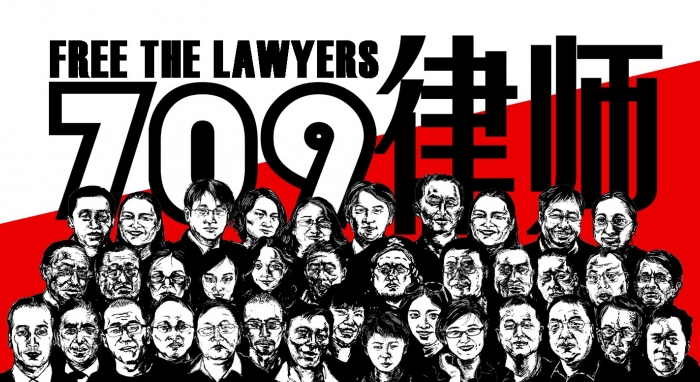
On 9 july 2020 the International Service of Human Rights came out with a good overview of what has happened to the Chinese lawyers since the crackdown five year ago [see: https://humanrightsdefenders.blog/2015/07/29/the-remarkable-crackdown-on-lawyers-in-china-in-july-2015/]. Human rights lawyers are a cornerstone of China’s human rights movement: they represent victims of abuses, promote compliance with international law, and strive for human rights change inside the system.
In the weeks following 9 July 2015, over 300 Chinese weiquan (‘rights defence’) lawyers and legal activists were harassed, detained and disappeared, in a nationwide police sweep that came to be known as the ‘709 Crackdown’. Five years later, these lawyers and their families still face a range of restrictions and rights violations aimed at silencing their efforts for a more just and rights-compliant society.
Disbarment, secret detention, disappearances, harassment of relatives, stigmatisation: the ‘systematic crackdown on lawyers’ denounced by UN experts has changed in form but not in its scale or scope.
Despite the risks, they strive to uphold the fundamental rights of all Chinese citizens, guaranteed under China’s Constitution and international treaties. They represent the most vulnerable and unjustly accused: those who have been evicted from their land or are victims of police abuse; minorities criminalised for their religious belief or ethnicity; human rights defenders and those expressing opinions different from the official Party line.
‘Without independent lawyers, there can be no rule of law,’ says Sarah M Brooks, ISHR Asia Advocate.
‘And when the rule of law is weaponised – as we saw last week with the imposition of the National Security Law in Hong Kong – lawyers are on the front lines of defending rights and freedoms. The least we can do – as individuals and as a global community – is to stand with them.’
In a defiant act of reclaiming, 9 July is now recognised by the human rights movement as ‘China Human Rights Lawyers Day’. To highlight this important day, ISHR has produced a bilingual information flyer on the patterns of repression against Chinese human rights lawyers, and action by the international community. The information flyer is available in English and Chinese. 请点击此处下载中文版。 For more information, please contact Raphael Viana David at r.vianadavid@ishr.ch or on Twitter at @vdraphael.
The ISHR published on 24 June its usual and irreplacable “HRC44 – Key issues on agenda of June 2020 session”
As usual I have lifted out of this the issues that would seem to affect most directly Human Rights Defenders. To stay up-to-date on all issues: follow @ISHRglobal and #HRC44 on Twitter, and look out for its Human Rights Council Monitor.
The UN Human Rights Council (the Council) will hold its 44th regular session at Palais des Nations in Geneva from 30 June to 21 July 2020.
Modalities for participation in HRC44
State delegations not wishing to enter the plenary room physically will be able to deliver their statements by pre-recorded video-message, as provided for under HRC decision 19/119. Similarly, NGOs in consultative status with ECOSOC will be given the opportunity to do the same insofar as interactive dialogues, panels and UPR adoptions are concerned. It won’t be possible to hold “official” side events during the 44th session (online or in-person). Any events happening on the sidelines of the session will be considered independent events and won’t be publicised in the Bulletin of Informal meetings by the Secretariat. Read here the information note by the Secretariat which is updated according to the latest information, and an additional explainer by HRC-net.
Human Rights implications of COVID-19
The High Commissioner will present an oral update on the human rights impact of COVID-19 at the 44th session, as mandated by the presidential statement adopted by the Council in May 2020. The presidential statement also calls on the High Commissioner to produce a report on the impact of the COVID-19 pandemic on the enjoyment of human rights around the world to be presented at the 46th session in March 2021. In addition to their previously mandated reports, some mandateholders will present additional reports to address the impact of COVID-19 as related to their mandate, including the Special rapporteur on freedom of opinion and expression, David Kaye. [for some of my earlier posts on covid and human rights see: https://humanrightsdefenders.blog/tag/covid-19/]
Here are some highlights of the session’s thematic discussions:
Business and human rights
At this session, the Working Group on Business and Human Rights is expected to present reports on their activities over 2019, including a country visit to Honduras and on the theme of anti-corruption and the UN Guiding Principles (UNGPs). They are also meant to present groundbreaking guidance on human rights defenders and the role of business. ISHR expects that such guidance should provide companies with concrete suggestions for how to engage human rights defenders in the development and implementation of their human rights policies. It is important that the guidance explains why this is not simply good practice, but is also aligned with the Guiding Principles’ word and spirit – and thus should be widely mainstreamed for any company committed to the UNGPs. There will tentatively be a resolution presented to renew the mandate of the UN Working Group on Business and Human Rights, as well as to welcome the thematic reporting.
Reports of cases of intimidation and reprisal against those cooperating or seeking to cooperate with the UN not only continue, but grow. Intimidation and reprisals violate the rights of the individuals concerned, they constitute violations of international human rights law, and undermine the UN human rights system. [agains for earlier posts see: https://humanrightsdefenders.blog/tag/reprisals/]
During the 42nd session, the Council adopted a resolution which listed key trends such as the patterns of reprisals, increasing self-censorship, as well as the use of national security arguments and counter-terrorism strategies by States as justification for blocking access to the UN. The resolution acknowledged the specific risks to individuals in vulnerable situations or belonging to marginalised groups, and called on the UN to implement gender-responsive policies to end reprisals. The Council called on States to combat impunity and to report back to it on how they are preventing reprisals, both online and offline.
Item 5 of the Human Rights Council’s agenda provides a key opportunity for States to raise concerns about reprisals, and for governments involved in existing cases to provide an update to the Council on any investigation or action taken toward accountability to be carried out.
Other thematic reports :
At this 44th session, the Council will discuss a range of civil, political, economic, social and cultural rights through dedicated debates with the mandate holders, including interactive dialogues with:
The Working Group on the issue of human rights and transnational corporations and other business enterprises (includes recommendations from 2019 visit to Peru)
The Special Rapporteur on contemporary forms of racism, racial discrimination, xenophobia and related intolerance
The Special Rapporteur on extrajudicial, summary or arbitrary executions
The Special Rapporteur on the rights to freedom of peaceful assembly and of association
The Special Rapporteur on the promotion and protection of the right to freedom of opinion and expression
In addition, the Council will hold dedicated debates on the rights of specific groups including:
The Special Rapporteur on trafficking in persons, especially women and children
The Special Rapporteur on the independence of judges and lawyers
The Special Rapporteur on the human rights of migrants
The Working Group on discrimination against women and girls
The Special Rapporteur on the human rights of internally displaced persons
The Special Rapporteur on violence against women, its causes and consequences
The Independent Expert on protection against violence and discrimination based on sexual orientation and gender identity
#HRC44 | Country-specific developments
China (Hong Kong and Uyghur regions)
Violations in China, especially those linked to freedom of association, were made even more clear during the government’s efforts to respond to the COVID-19 epidemic. …..States should ensure continued calls for access to UN human rights experts, in line with last year’s joint letter condemning China’s suppression of minorities. Finally, following nearly a year of protests – largely of peaceful civilians – the central government in Beijing launched an initiative to draft and pass National Security Legislation in Hong Kong. This alarming development was foreshadowed by increasing police violence and use of chemical weapons; the arrest and political prosecution of more than a dozen pro-democracy leaders; and further restrictions on the free press. Many activists, and the European Parliament, are calling for UN Secretary-General António Guterres to appoint an envoy, rightly recognising that China’s actions violate international agreements aimed at ensuring peace and security.
United States of America
Last week, the Council held an urgent debate and adopted a resolution in reaction to systemic racism and police violence in the US and elsewhere. The UN Special Rapporteur on contemporary forms of racism and the UN Working Group on Experts on People of African Descent had also voiced their support for an international commission of inquiry. They have urged the Human Rights Council to ensure the following outcomes from the debate: (1) the creation of an international commission of inquiry to investigate systemic racism in law enforcement in the United States; and (2) the creation of a thematic international commission of inquiry to investigate systemic racism in law enforcement globally, with a focus on systemic racism rooted in legacies of colonialism and transatlantic slavery. They stressed that “both measures described above are necessary and cannot be substituted for one another”.
Saudi Arabia
Women human rights defenders (WHRDs) have been in prison for over two years, only because they demanded that women be treated equally as men, and no one has been held accountable for their torture. While the Council has sustained pressure on Saudi Arabia in 2019, it is essential that this scrutiny continues as the situation on the ground has not improved. ISHR calls on all States to jointly call on Saudi Arabia to immediately and unconditionally release the WHRDs and drop the charges against them; and implement the bench-marks set out in the two joint statements delivered by Iceland and Australia in 2019, underlining that should these benchmarks not be met, more formal Council action would follow.
Saudi Arabia is running for Human Rights Council election in October 2020 and hosting the G20 in November 2020. These all provide windows of opportunity to push for the immediate and unconditional release of the women human rights defenders and all those detained for exercising their rights.
Nicaragua
The COVID-19 crisis has not prevented the Nicaraguan government from making further use of repressive methods to continue targeting released political prisoners, human rights defenders, as well as indigenous people and other social groups, and their relatives. In a rapidly-deteriorating human rights situation, the authorities’ dangerous denial and inaction in the face of the pandemic have additionally fueled an alarming health crisis.
It is in this context that Council Members renewed a resolution on Nicaragua this week at the resumed 43rd session of the Human Rights Council. ISHR joined Race and Equality and a number of national and international organisations in urging the Council to ensure strong support for the resolution on the human rights situation in Nicaragua. To ensure the international community is fully informed of the worsening national situation, the resolution requests the High Commissioner to prepare a report and two oral updates, the first of which should be presented at the Council’s 44th session.
Honduras
The Working Group on Business and Human Rights will present the report on its official visit to Honduras (carried out between the 19 and 28 August 2019). …According to the end of mission statement, a significant number of human rights defenders who work for the respect and protection of human rights in the context of business activity have been arbitrarily arrested, intimidated, stigmatised, criminalised, threatened and some killed.
This was particularly evident in reference to those working in the field of extractive and hydro-electric industries. The murder of leading land,environment and indigenous peoples´ rights defender Berta Cáceres, who had been campaigning against the construction of the Agua Zarca dam, is one case cited where impunity is ongoing. Individuals responsible for the killing have been tried and jailed. However, those suspected of planning the crime, including senior management from the company building the dam (DESA) according to the independent mission of experts GAIPE, have not been investigated or prosecuted. [see also: https://humanrightsdefenders.blog/2020/06/10/nina-lakhanis-who-killed-berta-caceres-reviewed/]. Another Special Procedure expert – the Special Rapporteur on the independence of judges and lawyers – will also be presenting a report on its official visit to Honduras in August 2019. After completion of the visit, he called on Honduras to take urgent action to end corruption and guarantee an independent judiciary, stressing that ‘the justice system, as well as the political class’ are being ‘called strongly into question by the citizens’.
Burundi
The Commission of Inquiry on Burundi will present its oral briefing during the 44th session of the HRC. ISHR continues to remain highly concerned about the human rights situation in Burundi and its refusal to cooperate with the Council’s mechanisms.
Egypt
Seven UN experts have expressed concern about the collective and corrosive effects of Egypt’s counter-terrorism laws and practices on the promotion and protection of human rights. They stated that “Despite repeated communications by UN experts over arbitrary detention of individuals, human rights defenders and activists, the Egyptian Government has not changed its laws of practice”. The ‘Terrorism Circuit courts’ in Egypt, are enabling pre-trial detention as a form of punishment including against human rights defenders and journalists, such as Ibrahim Metwally, Mohamed El-Baqer and Esraa Abdel Fattah, Ramy Kamel, Alaa Abdel-Fattah, Patrick Zaky, Ramy Shaat, Eman Al-Helw, Solafa Magdy and Hossam El-Sayed. All of the individuals that the Special Procedures and the High Commissioner have written about since September 2019 are still in pre-trial detention by these courts. Once the terrorism courts resumed after they were suspended due to COVID-19, they renewed their detention retroactively.
The government’s response to the UPR in March 2020 demonstrated its lack of political will to address key concerns raised by States and to engage constructively with the Council. For example, the government refused to acknowledge the systematic and widespread attacks against defenders, the practice of torture and ill-treatment in detention centres, and to receive visits by Special Rapporteurs on torture and human rights defenders. The government claimed that no one is detained for exercising their rights, despite the fact that the UN Working Group on Arbitrary Detention found that arbitrary detention is a systematic problem in Egypt and could constitute a crime against humanity.
ISHR urges States to call on Egypt to immediately and unconditionally release all those detained for exercising their human rights, to stop using pre-trial detention as a punishment, and to take immediate measures to guarantee their rights to contact their families on a regular and continuous basis and to ease sending and receiving letters, food and medical supplies to them.
Philippines
The OHCHR issued its report (A/HRC/44/22) on the human rights situation in the Philippines, drawing on extensive engagement with and information provided by civil society in the country, the region and globally. The report refers to the killing of 208 human rights defenders, journalists and trade unionists, including 30 women, between January 2015 and December 2019. Confirming practices of vilification, criminalisation, restrictions of fundamental rights, as well as the continuing attacks including ‘red-tagging,’ the report notes existing impunity and the failure of domestic mechanisms to ensure accountability. The presentation of this report provides an important opportunity for debate on the key findings, and to consider options for how to advance recommendations to address the government’s violations of human rights overall, and restrictions on human rights defenders in particular.
The Council will hold an interactive dialogue on the High Commissioner’s annual report on 2 July 2020. The Council will consider reports on and is expected to consider resolutions addressing a range of country situations, in some instances involving the renewal of the relevant expert mandates. These include:
Interactive Dialogue with the High Commissioner on the human rights situation of Rohingya people
Enhanced Interactive Dialogue with the High Commissioner on the situation of human rights in the Philippines
Interactive Dialogue with the SR on the situation of human rights in Eritrea
Oral update by the High Commissioner on the situation of human rights in Nicaragua
Interactive Dialogue with the SR on the situation of human rights in Belarus
Interactive Dialogue with the High Commissioner on the situation of human rights in the Bolivarian Republic of Venezuela
Interactive Dialogue with the Commission of Inquiry on Burundi
Interactive Dialogue with the SR on the situation of human rights in Myanmar
Interactive Dialogue with the Commission of Inquiry on the Syrian Arab Republic
Interactive Dialogue with the SR on the situation of human rights in the Palestinian Territories occupied since 1967
Enhanced ID on the oral reports of the Government of the Sudan and OHCHR on progress towards the opening of a country office
Oral update of the High Commissioner on cooperation with Georgia
Adoption of Universal Periodic Review (UPR) reports
During this session, the Council will adopt the UPR working group reports on Armenia, Grenada, Guinea, Guinea-Bissau, Guyana, Kenya, Kiribati, Kuwait, Kyrgyzstan, Lao People’s Democratic Republic, Lesotho, Spain, Sweden, and Turkey.
ISHR supports human rights defenders in their interaction with the UPR. We publish and submit briefing papers regarding the situation facing human rights defenders in some States under review and advocate for the UPR to be used as a mechanism to support and protect human rights defenders on the ground. This session of the Council will provide an opportunity for Turkey, Kuwait and Guinea to accept recommendations made in relation to human rights defenders, as proposed in ISHR’s briefing papers.
#HRC44 | Council programme, appointments and resolutions
During the organisational meeting for the 44th session held on 12 and 15 June 2020, the President of the Human Rights Council presented the programme of work. It includes five panels of discussion and 81 reports. States also announced at least 17 resolutions.
Appointment of mandate holders
The President of the Human Rights Council has proposed candidates for inter alia the Special Rapporteur on freedom of opinion and expression and the Special Rapporteur on trafficking.
Resolutions to be presented to the Council’s 44th session
At the organisational meeting the following resolutions were announced (States leading the resolution in brackets) especially relevant:
Elimination of discrimination against women (Colombia, Mexico)
Human rights situation in Eritrea (Australia, Austria, Belgium, France, Germany, Netherlands) mandate renewal
Business and human rights (Norway, Russian Federation, Ghana, Argentina) Working Group + Accountability and Remedy project mandate renewals
Extrajudicial, summary or arbitrary executions (Sweden) mandate renewal
Human rights and climate change (Bangladesh, Philippines, Viet Nam)
Independence and impartiality of the judiciary, jurors and assessors, and the independence of lawyers (Hungary, Australia, Botswana, Maldives, Mexico, Thailand) + mandate renewal
Trafficking in persons, especially women and children (Germany, Argentina, Philippines) + mandate renewal
Freedom of opinion and expression: access to information (Canada, Namibia, Brazil, Fiji, Netherlands, Sweden)
Rights of persons with disabilities (Mexico, New Zealand) mandate renewal
The human rights situation in Belarus (EU)
The right to peaceful protest (Switzerland, Costa Rica)
Panel discussions
During each Council session, panel discussions are held to provide member States and NGOs with opportunities to hear from subject-matter experts and raise questions. All panel discussions are broadcast live and archived on http://webtv.un.org. Five panel discussions are scheduled for this upcoming session:
Annual full-day meeting on the rights of the child (two panels, theme: “Realizing the rights of the child through a healthy environment”)
Annual full-day discussion on the human rights of women
Panel discussion on the impacts, opportunities and challenges of new and emerging digital technologies with regard to the promotion and protection of human rights; including an oral update of the Advisory Committee on its report on new and emerging digital technologies
Panel discussion on promoting and protecting the rights of persons with disabilities in the context of climate change
Annual thematic panel discussion on technical cooperation in the promotion and protection of human rights (theme: “Upholding the human rights of prisoners, including women prisoners and offenders: enhancing technical cooperation and capacity-building in the implementation of the Nelson Mandela Rules and the Bangkok Rules”)
HRCnet was established in 2006 to enhance NGO engagement with the Human Rights Council and to strengthen the Council’s impact and influence on the ground. Since then, HRCnet members working in coordination and solidarity, or as a network as a whole, have contributed significantly to some of the most important initiatives and outputs of the Human Rights Council and its mechanisms.
HRCnet’s membership comprises 16 NGOs and organisations working at the international level and across almost all regions:
Africa
African Centre for Democracy and Human Rights Studies (The Gambia)
DefendDefenders (East and Horn of Africa Human Rights Defenders Project) (Uganda)
Southern African Human Rights Defenders Network (Zimbabwe)
West African Human Rights Defenders Network (Togo)
Asia-Pacific
Asian Legal Resource Centre (Hong Kong, China)
Asian Forum for Human Rights and Development (FORUM ASIA) (Thailand)
Commonwealth Human Rights Initiative (India)
Human Rights Law Centre (Australia)
Latin America
Centro de Estudios Legales y Sociales (CELS) (Argentina)
Conectas Direitos Humanos (Brazil)
Middle East and North Africa
Cairo Institute for Human Rights Studies (Egypt)
Egyptian Initiative for Personal Rights (Egypt)
International
CIVICUS (South Africa)
Human Rights Watch (USA)
International Service for Human Rights (Switzerland)
Open Society Foundations (USA)
HRCnet members have substantially shaped debates and made influential policy proposals on country situations, as well as thematic and institutional issues. HRCnet works to:
Safeguard civil society: through securing actions by key actors that have, in a number of cases, assisted in the release of human rights defenders from detention or in alleviating pressure on NGOs.
Enhance access: by assisting rights holders from the Global South in engaging with the international human rights system and strengthening capacity to influence States, and harness civil society, from all regions.
Amplify impact: by facilitating coordination and collaboration between international and regional NGOs.
Promote accountability: seeking the establishment of commissions of inquiry or other independent expert mechanisms to investigate and promote accountability for gross human rights violations.
Enhance scrutiny: through the mandating of new Special Procedures to monitor human rights and document violations.
Strengthen protection: through the establishment of new Special Procedures and other mechanisms.
ISHR’s report documents a disturbing pattern of intimidation and reprisals that must be addressed. Cases of intimidation and reprisals featured in the submission range from States maligning and stigmatising defenders to banning them from travel and detaining them. ‘Such reprisals violate human rights and fundamental freedoms that regional and international systems are obliged to promote and protect. Moreover, they also seriously impede bodies and mechanisms’ abilities to discharge their mandates effectively, threaten their integrity, and undermine the credibility of their work in the field of human rights’, said Adelaïde Etong Kame, ISHR Africa Programme Manager.
In Malawi and Cameroon, defenders engaging with the ACHPR are threatened, stigmatised, harassed and attacked. In Burundi, increased monitoring by regional and international human rights mechanisms has been met with increased risk, stigmatisation and harassment of defenders working with the mechanisms. In Mauritania, human rights defenders continue to be vilified by the government and accused of being terrorists. In Egypt, defenders engaging with the African human rights system have been maligned, intimidated, and detained.
The report also documents how recent hosts of ACHPR sessions, in particular Mauritania and Egypt, have hindered and restricted access to the sessions, through visa denials, intimidation, harassment, and undue restrictions at the sessions themselves. ..
ISHR’s submission also documents undue restrictions on accreditation, namely the case of the Coalition of African Lesbians (CAL), who have had their observer status to the ACHPR withdrawn, in violation of the rights of freedom of expression, association, and unhindered access to and communication with international bodies of CAL and its members, on discriminatory bases.
The primary duty to prevent and remedy reprisals lies with States—who must do more to prevent, investigate and ensure accountability for reprisals. ‘In that regard, the task for the Focal Point and the ACHPR is now to take up these cases and ensure they are addressed with the perpetrating governments. Otherwise, reprisals ‘work’ to dissuade engagement, and perpetrators will be emboldened’, said Etong Kame.
Participation, promotion and protection are the three watchwords that should guide the UN’s work on and with civil society, says a newly-released UN report. Offering examples of good practice within the UN system -which provide a baseline for a new UN strategy on civil society- and a range of recommendations, the report is timed to inform decision-making at the 44th session of the UN’s Human Rights Council.
On 31 May 2020 the ISHR discussed the new report of the UN on civil society: with countless recent examples of restrictive and repressive measures taken to silence or discredit civil society actors, the UN’s new report drawing together examples of some good practices across the UN, is timely. Re-stating the vital contribution of civil society actors, the report goes on to cite examples of good practices of UN entities engaging with and protecting civil society. The report recommendations – aimed at encouraging improvement across the UN system as well as by States – echo several which ISHR has consistently voiced .
ISHR’s Eleanor Openshaw said that good practice examples to inspire reform by the UN and States were valuable: ‘In days where we’ve seen journalists being arrested in Minneapolis and an increasing number of defenders murdered in Colombia – as just two such examples – we need States and UN bodies to revise and strengthen their practice to ensure the voice of civil society is heard and safeguarded.’…
‘The report contains examples where discussion between different stakeholders has been formalized and where their input is part of the process from policy inception to implementation,’ noted Openshaw.
One such example is the Inter-Agency Standing Committee (IASC), created by the UN General Assembly which styles itself as ‘a unique inter-agency forum for coordination, policy development and decision-making involving the key UN and non-UN humanitarian partners’. ‘This example of civil society having a seat at the table in recognition of the experience and expertise they bring to the issue makes more evident the lack of such opportunities in other spaces, particularly in human rights bodies,’ said Openshaw.
The report also highlights clear gaps. One of the key findings is the absence in 2/3 of UN mechanisms of means to contest restrictions on civil society participation or access to information. Whilst the report makes no explicit reference to Covid-19, having sought input prior to the onset of the pandemic, it does contain recommendations that speak to shifts in practice the pandemic has engendered.It notes how the impact of any modifications should be assessed to ensure civil society is not disadvantaged or disproportionately affected. This is one of several recommendations ISHR and other civil society have been making over time.
‘It’s great to see that the UN has reflected the recommendations of civil society groups such as ISHR, who have experience working with defenders and engaging with UN and regional organisations,’ noted Openshaw. ‘It’s but one example of civil society expertise adding value.’
The need for the UN to improve and make more consistent its work to promote, engage with and safeguard civil society has been a long-term call. The Secretary General made such a recommendation in his 2018 report on the Declaration on Human Rights Defenders, and again in his recent Call to Action for Human Rights. This new UN report was as a result of the request made by the Human Rights Council in 2018.
Lisa Schlein reported on 14 June 2020 that the U.N. Human Rights Council will be faced with many important issues left hanging when its 43rd session was suspended in March because of COVID-19. [see also: https://humanrightsdefenders.blog/2020/02/24/human-rights-defenders-issues-on-the-agenda-of-43rd-human-rights-council/] The 44th session, which opens today, will employ a so-called hybrid approach, with a mix of both real and virtual presentations. To ensure the safety of participants during this time of coronavirus, U.N. officials say social distancing measures will be strictly enforced. Delegations will have a reduced number of representatives attending the session and hundreds of side events by nongovernmental organizations will not take place on U.N. premises.
Presentation of reports and interactive dialogues on human rights issues will involve experts who are either physically present or speaking by video conference. Countries that will come under review include the Democratic Republic of the Congo, Mali, Ukraine, Libya, Afghanistan, and the Central African Republic.
One of the highlights of the weeklong meeting will be an urgent debate on institutionalized racism in the United States underlined by the killing of African American George Floyd while in police custody.
The ISHR states on this topic that it is committed to highlighting how the voices of the families of those killed by police in the U.S., including George Floyd, Breonna Taylor and Michael Brown, and the organisations supporting them are driving the UN to call for action to stop the killings and address deep-seated racism and inequality. This is necessary but not sufficient; we echo the call of the UN independent human rights experts and the Chair of the Committee on the Elimination of Racial Discrimination that ‘this is a time for action and not just talk’.
The international community has a critical role to play in advancing independent, expert inquiry into systemic racism in law enforcement in the U.S., starting with the uprising in Ferguson, Missouri, and the concerns of excessive use of force against protestors and journalists since George Floyd’s murder.
Geneva director of Human Rights WatchJohn Fisher calls this a moment of reckoning for the United States. He said the event will likely be used by some countries to advance their own agendas. “We are also very concerned that China is seeking to exploit this moment of global chaos and the disarray within the U.S. to crack down on rights and freedoms in Hong Kong … And, we are calling upon states to take this moment to bring more attention to Hong Kong, as I mentioned. We feel this is a time when China will be watching the international response, and, if that response is muted, will feel emboldened to go even further down the track,” he said.
At the end of the week, the council will take action on decisions and the adoption of more than 40 resolutions. They include recommendations on improving human rights in countries such as Libya, Iran, Nicaragua, South Sudan, and Myanmar.
The statement addresses several issues, including:
the right to health;
the rise of stigma and discrimination and scapegoating of LGBTI persons;
access to housing, water and sanitation;
the right to work and impacts on livelihood; and
civic space restrictions.
While acknowledging that actions to combat the COVID-19 pandemic are urgent and necessary, signatories of the statement urge UN Member States and stakeholders to ensure that international human rights obligations are complied with, and specific vulnerabilities of LGBTI persons are taken into account, during the implication of such emergency response measures.
Five key recommendations to States and stakeholders are included in the statement, including:
ensure accessibility of health care and services to every person, including sexual and reproductive health, without discrimination of any kind;
comply with international human rights laws and standards when implementing emergency measures, following requirements of legality, necessity, proportionality and non-discrimination, including on the basis of sexual orientation, gender identity and expression and sex characteristics (SOGIESC);
guarantee that shelters are inclusive for all persons regardless of their SOGIESC and implement measures allowing LGBTI persons to report violence and discrimination suffered in a private context, including at homes and shelters;
ensure that emergency measures to address the socio-economic impacts of the pandemic, as well as recovery plans, are inclusive to LGBTI persons – especially to trans, older and homeless LGBTI persons; and
ensure access to national, regional and international systems of accountability. States and stakeholders should implement lines of action designed to sustain and ensure the continuity of the engagement of civil society and human rights defenders in UN bodies and mechanisms.
In its conclusion, the statement urges authorities ‘to ensure that this public health emergency will neither exacerbate existing misconceptions, prejudices, inequalities or structural barriers, nor lead to increased violence and discrimination against persons with diverse sexual orientation, gender identity and expression and sex characteristics.’
Michael Ineichen – ISHR programme director – leaves the International Serivce for Human Rights and on 30 April 2020 he wrote a farewell note: “Leaving ISHR: thanks for 14 years of purpose, inspiration and learning”. He was often mentioned in this blog, see e.g.: https://humanrightsdefenders.blog/tag/michael-ineichen/. But fortunately he stays in Switzerland and in the human rights world: AI Switzerland.
Today, almost 14 years after joining “the service” I’m saying farewell to the International Service for Human Rights……I joined ISHR as an intern in 2006. Fresh off university, with a baby underway while fellow interns were spending their non-existent salaries on drinks by the lake. I was expecting to find a job, but found a purpose, a second family, and inspiration for a lifetime.
With my academic notion of “international human rights”, I knew very little of the reality experienced by the human rights defenders who struggle every day for more just, rights-respecting and equal societies. Back then, I was yet to be inspired by the courage, dedication, pain, doubt, joy and laughter of the many human rights activists I had the privilege of meeting over the years. I was yet to be appalled by the human rights violations and abuses of governments and unscrupulous companies, and the brazen efforts of some diplomats and governments to hide the truth from the eyes of the world, or somewhat reassured by the equally sustained efforts of others to create space for civil society and push for accountability.
In the last 14 years, there was not one week when I did not draw inspiration from one or more of the many human rights defenders ISHR works with. You are the reason this organisation exists. Among the stories which marked me the most, and which illustrates both the tremendous solidarity and deep frustration of engaging with international human rights mechanisms, is that of Chinese defender Cao Shunli.
She campaigned for something that most of us take for granted: independent civil society input into her government’s human rights report to the UN. As a result of her activism, she was blocked from travelling to Geneva, and – having been denied medical treatment – passed away in detention. Together with many civil society activists, I wanted to observe a moment of silence at the Human Rights Council in her memory. But the Chinese delegation was outraged, and interrupted the meeting for more than an hour. To this day, Cao Shunli’s death remains unaccounted for, and six successive Human Rights Council Presidents have failed to fully resolve this most emblematic case of reprisals. So much for the deep frustration. [see also: https://humanrightsdefenders.blog/2015/03/27/china-or-the-un-must-ensure-independent-investigation-into-death-of-cao-shunli/]
However, there’s also solidarity. Instead of stifling opposing views, with its heavy handed response even in the HRC, the Chinese delegation attracted massive attention to Cao Shunli and her struggle, and triggered an intense moment of global solidarity. Every member of civil society in the room was standing up – with Cao Shunli, and the human rights movement as a whole. Afterwards, every diplomat in Geneva knew Cao Shunli, and her story contributed significantly to the creation of a stronger UN response to reprisals. And, years later, Chinese human rights activists whom I’ve never met in my life look at me with a hint of recognition, saying “I know you. You’re the guy who stood up to our government, and made the UPR meaningful. We all watched behind the firewall.”
Hers is but one of the many stories I take with me, as I open a new chapter in my professional life. There are many others, happy and sad, of human rights defenders who have extended their trust to ISHR and myself. From Alphonsus to Ziad, I will always be grateful for the chance to reflect together on using the opportunities of international advocacy towards our common human rights struggle.
… I’ve seen times when donors trust in the track record, dedication and commitment of a civil society organisation like ISHR, or conversely when they insist on wasteful and narrow-minded administrative processes…..And I’ve seen how a strong focus on solidarity, well-being and passion can bring teams and an entire organisation to punch well above their weight. And finally, the last 14 years have been a period of immense personal growth – not always easy and smooth, but I’ve grown as a father, husband and person. And I thank ISHR for being 100% supportive along the way.
As I look forward to opening a new chapter in my professional life by joining Amnesty Switzerland, I wish ISHR – Phil, the amazing team of staff, its dedicated board and the human rights defenders community it works with and supports – all the best for navigating these challenging times. You have and will continue to profoundly shape the human rights world, and I am proud and grateful to have been a part of the team.
In the midst of the COVID-19 crisis, many human rights organisations have been formulating a policy response. While I cannot be complete or undertake comparisons, I will try and give some examples in the course of the coming weeks. If there are special ones you would like to draw my attention to, please do not hesitate. Here is one from Phil Lynch, the Director of the International Service for Human Rights:
Staying true to our values is never more important than during times of hardship or crisis. At ISHR, there are five values driving our response to the COVID-19 global pandemic: solidarity, dynamism, alertness, wellbeing and hope.
Solidarity
…Solidarity is an essential value at this time. At ISHR this means showing solidarity with colleagues – with a number of staff volunteering to help and alleviate the workload of others who may have reduced capacity – as well as solidarity with human rights defenders, with our programme staff reaching out to national and regional-level partners to discuss their wellbeing, situation, priorities and needs. Please do reach out to us if there are any ways we can provide support to you at this vital time. In addition to showing solidarity, we’ve also greatly appreciated receiving solidarity. I’ve personally benefited from the wisdom, insights and advice of other NGO directors in terms of their response to this crisis, and discovered the musical talents of neighbours as we’ve gathered on our balconies every evening to clap and sing our gratitude to the doctors, health care professionals and sanitation workers on the frontlines of this crisis.
Dynamism
This crisis has highlighted the importance of dynamism, adaptability and planning for uncertainty, as well as the limitations of log frames, tightly earmarked funds, and donor restrictions on building organisational reserves.
At ISHR we are determined to use this crisis as an opportunity to innovate and to test and expand new ways of working. Last year, thanks to the support of several donors – including the United Kingdom, Canada, Switzerland and the Netherlands – we launched the ISHR Academy – an interactive, online platform to build the capacity and skills of human rights defenders to leverage the UN human rights system to contribute to national level change. With a significantly increased demand for online training and strategic advocacy support, we’re currently working on new modules for the Academy, as well as translation into Spanish. With further financial support we’d love to develop even more modules and in additional languages. This would increase access to resources, strategic advice and tailored advocacy support for human rights defenders from all regions. The suspension, postponement and cancellation of a significant number of meetings and sessions of international and regional human rights mechanisms has starkly exposed the need for such bodies to develop means by which human rights defenders can more effectively engage and participate remotely. This is relevant not only now in response to the COVID-19 crisis, but in the longer term in response to the climate crisis and the imperative of reducing travel-related emissions. Effective means of virtual participation are also critical for defenders who lack the resources to travel to Geneva or New York, as well as those for whom travel may be restricted or banned by repressive governments. ISHR programme staff are actively engaged on these issues – leading and participating in strategic discussions and the formulation of practical recommendations as to how to use this crisis as an opportunity to make human rights mechanisms more accessible, effective and protective for defenders worldwide.
Alertness
ISHR is not the only body looking at ways to use this crisis as an opportunity. Unfortunately, some governments will use this emergency as a subterfuge to more permanently increase surveillance, as well as restrict fundamental rights to freedom of expression, association, assembly, protest and movement. Alertness is therefore a critical value at this time. We must be vigilant to ensure that any laws or regulations enacted in response to COVID-19 are for the legitimate purpose of protecting public health, and that any restrictions they impose are reasonable, proportionate and strictly time bound….With persons in detention at particular risk, ISHR staff are also using the opportunity to push for the release of arbitrarily detained human rights defenders, including several with underlying health conditions in States including China, the United Arab Emirates and Bahrain.
Wellbeing
..All ISHR staff have worked remotely since at least 13 March, with exceptions only for staff that need to attend the Geneva office for short periods for essential functions. Staff are working from various locations and states of confinement in Switzerland, France, New York, London, Brussels, Abidjan and Jakarta. We have agreed a complete restriction on work-related travel, with both this restriction and the work from home arrangements remaining in place for the indefinite future.
….Financial security is imperative at this time and I am so impressed and thankful for the initiative of major donors such as the Sigrid Rausing Trust and the Open Society Foundations to proactively reaffirm their funding commitment, to indicate that they will be highly flexible in the use of funds and reporting requirements, and to invite us to reach out if we need further support. Best practice at this time of unprecedented uncertainty is to enable the conversion of project or earmarked funds to core or unrestricted funds. I am working with the Board to evaluate and prepare for a range of scenarios, ensuring the long term sustainability of ISHR. Your contributions as private donors will be vital in this regard – every donation helps!
Hope
The final value motivating ISHR at this time is that of hope, which we draw from many places.
We take hope from the doctors, health care professionals and sanitation workers who bravely and tirelessly provide vital care and support.
….
I wish you, your families, your loved ones and your colleagues are and remain healthy, safe and well.
At the 43rd session of the Human Rights Council, States will consider a resolution extending for three years the mandate of the Special Rapporteur on the situation of Human Rights Defenders. Civil society organisations from across the world are calling on all States to support the consensus renewal of the mandate, and to resist any attempt to undermine the mandate and States’ obligations. This is a key opportunity for States and the Council to demonstrate their support and recognition for the indispensable role defenders play to ensure that all people enjoy freedom, dignity, justice and equality. Despite their vital contribution, both some governments and non-State actors are still seeking to silence defenders as they expose injustices and demand accountability for all.
The mandate of the Special Rapporteur on the situation of human rights defenders is integral to their protection and recognition, globally. It gathers and responds to information on the situation of defenders around the world, engages constructively with governments and non-State actors and provides expert recommendations to promote the effective implementation of the Declaration on human rights defenders (‘the Declaration’). See also: https://humanrightsdefenders.blog/2019/09/11/what-should-michael-forsts-successor-as-rapporteur-on-hrds-look-like/
In 2019, the Human Rights Council and the General Assembly supported the vital work of defenders. The Human Rights Council recognised the critical role of environmental human rights defenders in protecting natural ecosystems, addressing climate change, attaining the sustainable development goals (SDGs). The General Assembly passed by consensus a resolution focusing on implementation of the Declaration and some key elements of protection policy; the resolution also attracted a record number of co-sponsors.
More than 50 Civil society organisations from across the world are calling on all States to support the extension of the mandate of the Special Rapporteur by:
Participating positively in the negotiations on the resolution,
Presenting early co-sponsorship of the text,
Resisting any attempts to dilute the mandate or State obligations, and




 Hans Thoolen on Human Rights Defenders and their awards