The winners of this year’s edition of the Lorenzo Natali Media Prize, awarded by the European Commission, were announced on 11 October at a ceremony hosted at the Solvay Library in Brussels.
The winners of the International Prize are:
Three Venezuelan journalists Carmen Victoria Inojosa, Claudia Smolansky and a third whose name cannot be disclosed for security reasons, were awarded the International Prize for their compelling article ‘Así funcionan las casas clandestinas de la Dgcim en Caracas‘ published in Armando.info. Their work exposed the harrowing reality of systematic persecution in Venezuela, targeting political opponents and their families with alarming impunity.
Women fighting for a free, safe and legal abortion in Poland, El Salvador and the US: Justyna Wydrzyńska is a Polish women’s rights defender and member of the Abortion Dream Team, who was sentenced to eight months’ community service for helping a woman obtain an abortion in Poland. Morena Herrera is a feminist and social activist, advocating for safe and legal abortion access in El Salvador. Colleen McNicholas is an American obstetrician-gynaecologist with a strong track record of high-quality patient care and impactful reproductive health advocacy.
19 October: Parliament President Roberta Metsola and the political group leaders decide on the winner
13 December: the Sakharov Prize award ceremony takes place in Strasbourg.
Eddy Wax in Politico of 14 September 2023 reported that the far-right political group in the European Parliament nominated tech billionaire Elon Musk for the EU’s top human rights award. The Identity and Democracy (ID) grouping, which includes members of European Parliament tied to France’s Marine Le Pen and Italy’s Matteo Salvini, put Musk’s name forward, according to a document sent to MEPs on September 14 and seen by POLITICO. An ID official confirmed to POLITICO its decision to nominate Musk.
ID cited Musk’s decision to release the so-called Twitter Files, which consisted of selected internal documents over how the social media platform handled requests to remove political posts. This amounts to a defense of the principle of freedom of expression, ID argued.
Musk is highly unlikely to receive the accolade as the President of the Parliament Roberta Metsola and the leaders of all political groups will select the winner together later this year.
The Greens have nominated Ugandan climate activist Vanessa Nakate, while the right-wing ECR group put forward Nino Lomjaria, a public defender in Georgia who stood up to Russian interference. The Left proposed three women’s rights activists.
On 14 September 2023 the Cyber Tribunal, Dhaka sentenced to two years imprisonment Odhikar’s Secretary Adilur Rahman Khan and Director ASM Nasiruddin Elan for allegedly breaching Section 57 of the Information and Communication Technology Act 2006. They were charged for releasing a report on extrajudicial killings committed on 5 and 6 May 2013, centering around the Hefazat-e-Islam protests.
Immediately, 39 organizations in a joint call said that Bangladesh should quash their convictions, and end all reprisals against them and other human rights defenders for their legitimate human rights work. The Bangladesh Government has persistently targeted and launched a smear campaign against Khan and Elan, the secretary and director, respectively, of prominent Bangladesh human rights organization Odhikar. Following the 2013 publication of Odhikar’s fact-finding report documenting extrajudicial killings during a protest, both defenders were arbitrarily detained; Khan for 62 and Elan for 25 days. After being released on bail, they continued to face prosecution and judicial harassment on trumped-up allegations that their 2013 report was “fake, distorted, and defamatory.”
After the Government reopened the examination of witnesses and presented additional prosecution witnesses in July and August 2023, the judge convicted Khan and Elan to two years in prison and a fine of 10,000 Bangladeshi Taka (equivalent of USD$91.17).
Human rights defenders should be allowed to conduct their necessary and important work without fear of harassment, intimidation, and reprisals. Instead of prosecuting and punishing those who document and expose human rights violations, the Government should investigate and hold the perpetrators of these violations accountable.
List of signatories:
Advocacy Forum Nepal
Amnesty International
Anti-Death Penalty Asian Network (ADPAN)
Asian Federation Against Involuntary Disappearances (AFAD)
Asian Forum for Human Rights and Development (FORUM-ASIA)
Asian Network for Free Elections (ANFREL)
Association of Family Members of the Disappeared, Sri Lanka
Capital Punishment Justice Project, Australia
Citizens’ Alliance for North Korean Human Rights (NKHR)
CIVICUS: World Alliance for Citizen Participation
Defence for Human Rights Pakistan (DHR)
Desaparecidos – Philippines
Eleos Justice, Monash University, Australia
Families of Victims of Involuntary Disappearance (FIND)
FIDH (International Federation for Human Rights), within the framework of the Observatory for the Protection of Human Rights Defenders
Forum ONG Timor-leste
Free Jonas Burgos Movement
HAK Association, Timor-leste
Human Rights First
Human Rights Hub
Human Rights Watch
Indonesian Association of Families of the Disappeared Families (IKOHI)
International Coalition Against Enforced Disappearances (ICAED)
International Federation of ACATs (FIACAT)
International Service for Human Rights (ISHR)
Karapatan Alliance Philippines (KARAPATAN)
KontraS (the Commission of the Disappeared and Victims of Violence)
Latin American Federation of Associations of Relatives of Disappeared-Detainees (FEDEFAM)
Legal Literacy – Nepal
Liga Guatemalteca de Higiene Mental
Madres de Plaza de Mayo – Linea Fundadora, Argentina
Martin Ennals Foundation
Nonviolence International Canada
Robert F. Kennedy Human Rights
Sindhi Foundation
The Asian Alliance Against Torture (A3T)
Torture Abolition and Survivors Support Coalition, Washington DC
We Remember-Belarus
World Organisation Against Torture (OMCT), within the framework of the Observatory for the Protection of Human Rights Defenders
Odhikar itself denounces the arrest, trial and imprisonment of these two human rights defenders and added that “It believes that justice has not been served. As an organisation Odhikar has drawn the sustained wrath of the establishment for becoming the voice of the victims of human rights violations, including those of enforced disappearances, extrajudicial killings, torture, arbitrary detention and against the suppression of free expression and assembly; and for its engagement with the United Nations Human Rights Mechanisms. Earlier the government arbitrarily deregistered the organisation. Today’s judgement is likely to have a chilling effect on human rights defenders and civil society organisations around the country.“
The European Parliament’s Sakharov Fellowship is a two-week training experience for human rights defenders from non-EU countries. Since its inception in 2016, this program has empowered individuals to champion human rights across the globe, thanks to the initiative of the Sakharov Prize Community at the 25th Anniversary Conference.
What We Offer:
Training in Brussels and Venice: Immerse yourself in a comprehensive program that delves into EU and international human rights frameworks, policies, and mechanisms. Equip yourself with the skills to advocate for positive change and protect human rights.
Networking Opportunities: Join an expanding network of Sakharov Fellows to share best practices and disseminate knowledge. Forge lasting connections with the European Parliament and EU Delegations in your home country.
Bespoke Curriculum: In Brussels, focus on EU policies, funding opportunities, communication skills, and security challenges facing human rights defenders. Engage with EU decision-makers, Members of Parliament, and NGOs. Enjoy opportunities for individual advocacy and networking.
Venice Experience: At the Global Campus of Human Rights, benefit from academic expertise in international human rights law, practical tools, and case studies. Learn from distinguished academics, human rights leaders, and Sakharov Prize laureates.
In-Person and Online: Our program will be held in person in Brussels and Venice, with the flexibility to switch to an online format if necessary due to health concerns.
Who Should Apply:
If you have a proven track record in advocating for human rights in an NGO, organization, or individually, this fellowship is for you. Proficiency in English, enabling active participation in discussions and workshops, is essential. We aim to ensure diversity in terms of gender, geography, and human rights focus in our selection process.
Benefits:
The Sakharov Fellowship covers return travel from your home country, accommodation in Brussels and Venice, and a daily living allowance.
Application Deadline: Midnight, October 8, 2023 (CET)
Confirmation Emails: Successful candidates will receive confirmation by November 17, 2023. Regrettably, we will not be able to provide feedback to unsuccessful applicants.
For more information and to apply, go to the website.
What is special is that the report is not a country overview but thematic, including this paragraph on HRDs:
“Assistance to human rights defenders through both political and financial means is one of the flagship EU human rights activities, having a direct impact on individuals, groups and organisations defending human rights. In 2022, human rights defenders continued to face threats and attacks such as killings, arbitrary detention, smear campaigns or judicial harassment. They are also increasingly victims of illegal online surveillance, transnational repression or criminalisation due to ill-motivated “foreign agent” or counterterrorism laws. To counter this trend, the EU raised specific cases of human rights defenders at risk in all its human rights dialogues, subcommittee meetings and consultations (e.g. dialogue with Colombia or India). The protection of human rights defenders was also discussed in EU- supported civil society seminars preceding human rights dialogues (e.g. EU-Brazil and EU-Mexico seminars). The EU also continued to make its voice heard with public statements and declarations to support human rights defenders at risk (for instance on cases in Iran, Russia, or Mexico). Global support for human rights defenders was voiced by The High Representative on the occasion of the World NGO Day in February 2022 and during the 24th EU-NGO Forum on Human Rights in December 2022. EU Delegations and Member States’ embassies engaged and met with human rights defenders, monitored trials, and visited human rights defenders in detention. Annual meetings between EU diplomats and human rights defenders have become an established practice in non-EU countries, increasing the visibility of human rights defenders where appropriate and allowing for in-depth analysis of the challenges they face. Some EU Delegations provided awards to Human Rights Defenders (for instance in Uganda). The support and protection of human rights defenders is also a priority for the EUSR for Human Rights. Throughout 2022, the EUSR continued to raise individual cases of human rights defenders, particularly those in long-term detention, and to meet with human rights defenders, both in Brussels and during country visits. He availed of every opportunity to express support and solidarity directly to the defenders themselves or their families. He raised specific cases during visits to several countries, including India, Uganda, Pakistan, Egypt and Colombia and in other bilateral contacts, notably with Cuba and Brazil. He also participated in a number of high profile events aimed at raising awareness and visibility around their work and the need for their protection, such as the ProtectDefenders.eu beneficiary meeting in September, or the Front Line Defenders Dublin Platform in October. The EUSR was very active on individual cases on social media, notably regarding Belarus. He also highlighted the situation of Palestinian prisoners on hunger-strike and their deteriorating health conditions. The EU remained active in multilateral fora in particular in the United Nations Human Rights Council and the United Nations General Assembly. The EU actively collaborated with the UN Special Rapporteur on the situation of human rights defenders, regularly exchanging information on cases and thematic priorities. The EU advocated for the recognition of human rights defenders in several UN General Assembly resolutions. At the Human Rights Council, the EU highlighted the critical role that human rights defenders play in the protection and promotion of human rights and spoke out in their defence inter alia during the interactive dialogues with several Special Procedures.””Assistance to human rights defenders through both political and financial means is one of the flagship EU human rights activities, having a direct impact on individuals, groups and organisations defending human rights. In 2022, human rights defenders continued to face threats and attacks such as killings, arbitrary detention, smear campaigns or judicial harassment. They are also increasingly victims of illegal online surveillance, transnational repression or criminalisation due to ill-motivated “foreign agent” or counterterrorism laws. To counter this trend, the EU raised specific cases of human rights defenders at risk in all its human rights dialogues, subcommittee meetings and consultations (e.g. dialogue with Colombia or India). The protection of human rights defenders was also discussed in EU- supported civil society seminars preceding human rights dialogues (e.g. EU-Brazil and EU-Mexico seminars). The EU also continued to make its voice heard with public statements and declarations to support human rights defenders at risk (for instance on cases in Iran, Russia, or Mexico). Global support for human rights defenders was voiced by The High Representative on the occasion of the World NGO Day in February 2022 and during the 24th EU-NGO Forum on Human Rights in December 2022. EU Delegations and Member States’ embassies engaged and met with human rights defenders, monitored trials, and visited human rights defenders in detention. Annual meetings between EU diplomats and human rights defenders have become an established practice in non-EU countries, increasing the visibility of human rights defenders where appropriate and allowing for in-depth analysis of the challenges they face. Some EU Delegations provided awards to Human Rights Defenders (for instance in Uganda). The support and protection of human rights defenders is also a priority for the EUSR for Human Rights. Throughout 2022, the EUSR continued to raise individual cases of human rights defenders, particularly those in long-term detention, and to meet with human rights defenders, both in Brussels and during country visits. He availed of every opportunity to express support and solidarity directly to the defenders themselves or their families. He raised specific cases during visits to several countries, including India, Uganda, Pakistan, Egypt and Colombia and in other bilateral contacts, notably with Cuba and Brazil. He also participated in a number of high profile events aimed at raising awareness and visibility around their work and the need for their protection, such as the ProtectDefenders.eu beneficiary meeting in September, or the Front Line Defenders Dublin Platform in October. The EUSR was very active on individual cases on social media, notably regarding Belarus. He also highlighted the situation of Palestinian prisoners on hunger-strike and their deteriorating health conditions. The EU remained active in multilateral fora in particular in the United Nations Human Rights Council and the United Nations General Assembly. The EU actively collaborated with the UN Special Rapporteur on the situation of human rights defenders, regularly exchanging information on cases and thematic priorities. The EU advocated for the recognition of human rights defenders in several UN General Assembly resolutions. At the Human Rights Council, the EU highlighted the critical role that human rights defenders play in the protection and promotion of human rights and spoke out in their defence inter alia during the interactive dialogues with several Special Procedures.“
Other sections specially relevant for HRDs include:
The death penalty…………………………………………………………………………………………….page.21 Torture and other cruel, inhuman or degrading treatment or punishment……………………………………………………………………………………………………………. 24 Freedom of religion or belief ………………………………………………………………………..33 Human rights of persons belonging to minorities………………………………. 38 Gender equality ………………………………………………………………………………………………..40 LGBTI ……………………………………………………………………………………………………………………..50 Migration and mobility – migrants, refugees and asylum seekers ..59 Empowering women ……………………………………………………………………………………….62 Rights of indigenous peoples …………………………………………………………….. 75 Freedom of expression ………………………………………………………………………..78 Safety and protection of journalists…………………………………………………. 80 Countering disinformation, hate speech, extremist and terrorist content………………………………………………………………………………………………………. 81 Academic freedom and protection of the academic community at risk…………………………………………………………………………………………………………….. 84 Labour rights ……………………………………………………………………………………………………… 90
Support to Human Rights Defenders in the Digital Sphere ……………..175
On 26 June 2023 HRW called on Spain use its six-month tenure as EU Presidency to translate into concrete and bold actions commitment to protect fundamental rights and the rule of law.
Spain holds the presidency as the world marks the 75th anniversary of the Universal Declaration of Human Rights (UDHR) on 10 December 2023. In anticipation of this pivotal moment Spain should make every effort to uphold the rights and values enshrined in this historic document.
HRW calls upon the Spanish government to consider the following priority issues and recommendations:
Fundamental Rights and Rule of Law in EU member states
Two EU member states – Hungary and Poland – currently face scrutiny under Article 7 of the Treaty on European Union (TEU)…
The freezing of EU recovery and cohesion funds under the conditionality mechanism represents a welcome step but it is insufficient to address the gravity of the erosion of rule of law and human rights. While Hungary and Poland have adopted some limited measures in response to requirements under the mechanism, these have failed to address fundamental and long-standing concerns. ….We urge the Council to hold the Polish and Hungarian governments to account by using the powers conferred to it under the Treaties and to fulfil the strong mandate to act given to it by the European Commission and Parliament. The urgency of Spain’s leadership and responsibility cannot be overstated as it is one of only two remaining presidencies before Hungary and Poland in turn assume leadership of the Council. It is highly likely that during that time progress on rule of law will at best stall, and at worst Article 7 scrutiny will come to an end altogether…
Rights-Respecting and Principled EU Migration Policy
Spain’s EU Council presidency comes at a critical time for the EU’s migration policy after the Council agreed on 8 June on a negotiating position on an EU-wide reform of its asylum and migration system. Given its mandate to lead on behalf of member states the negotiations with the European Parliament on a final agreement, Spain has an opportunity to broaden the scope for a rights-respecting approach.
We call on your government to:
Support the establishment of proactive, state-led SAR operations in the Mediterranean Sea that could involve expanding the mandates and capacity of existing initiatives like EUNAVFOR MED and Frontex, funding professional rescue NGOs and ensuring predictable disembarkation.
Promote a discussion on the critical role of NGOs to ensure that they are fully able to carry out their lifesaving SAR activities, instead of facing obstruction and criminal and administrative penalties; and provide platforms for discussion of cooperation between member state rescue coordination centers and NGOs.
Advocate for independent and effective border monitoring mechanisms to document human rights violations at EU external borders, such as unlawful pushbacks, to ensure accountability for those responsible for human rights abuses and access to justice for victims.
Ensure that migration cooperation with third countries, and all provision of financial, technical, and material assistance, are contingent on clear and verifiable human rights commitments.
Enable a constructive trialogue on the asylum procedures regulation and the asylum and migration management regulation with a view to limiting the use of accelerated border procedures, the detention of asylum seekers including families with children, and discretionary use of the “safe third country” concept.
Promote a discussion on establishing more safe and legal pathways for migration as called for by EU Justice and Home Affairs Commissioner Johansson.[8]
Human Rights as a Pillar of EU’s Foreign Policy
The EU is equipped with solid instruments to ensure that human rights protection remains at the centre of its external action. The EU has shown resolve in its response to Russia’s invasion of Ukraine and has led at the United Nations to address key human rights crises.
..
During its Presidency, we call on your government to:
Continue to combat impunity for crimes committed in Ukraine, including by providing adequate resources to the International Criminal Court’s (ICC) regular budget, advocating and supporting the implementation of ICC arrest warrants, pressing Ukraine to ratify the Rome Statute and supporting independent investigations and prosecutions under universal jurisdiction.
Continue to support Human Rights Defenders (HRDs) at risk and share your experience with other EU member states. Encourage other EU member states to learn from and replicate Spain’s forward-leaning approach with the Program for Support and Protection of Human Rights Defenders at Risk that provides dedicated one-year residential visas for HRDs. Advocate with EU member states to use their discretion and facilitate access by HRDs to multi-year multi-entry Schengen visas in line with EU guidelines.
…
Recalibrate EU’s engagement with China to address the government of China’s human rights record through measurable deliverables; counter the government of China’s flawed narratives on its own human rights record; reject efforts to undermine international human rights institutions; lead the creation of a UN investigative and monitoring mechanism for crimes against humanity committed in Xinjiang; sanction or hold accountable those responsible for such crimes; and make plans to reduce dependency on a government that assaults human rights both domestically and in its foreign policy.
“This award is for those Ukrainians fighting on the ground. For those who have been forced to flee. For those who have lost relatives and friends. For all those who stand up and fight for what they believe in. I know that the brave people of Ukraine will not give up and neither will we,” said Roberta Metsola, the European Parliament’s head.
EU Commission chief Ursula von Der Leyen congratulated the people of Ukraine and said: “Their spirit and determination to fight for the values we hold dear is an inspiration to us all.”
“At (the EU Council) we’ll focus on continuing our assistance; we will stand with Ukraine for as long as it takes,” European Council President Charles Michel said on Twitter.
Andrew Rettman writing in the EUObserver of 27 April 2022
Independent media should have less to fear in future from malicious lawsuits, after the EU Commission put forward a new law to shield them.
Billionaires, big corporations, and autocrats have, in recent years, resorted ever more frequently to so-called strategic lawsuits against public participation (SLAPPs) in order to try to gag adversaries.
But if EU states and MEPs back the commission’s proposed anti-SLAPP directive, then judges will soon get a fresh mandate to throw out bogus cases — and compensate their victims.
“With these measures we are helping to protect those who take risks and speak up when the public interest is at stake,” EU values commissioner Věra Jourová said in Brussels.
“We promised to defend better journalists and human rights defenders,” she said. “The new law does that,” Jourová said.
The directive lists criteria which individual judges can, using their discretion on a case-by-case basis, use to decide whether litigation is genuine or abusive.
These include seeking disproportionately huge financial damages or launching multiple cases at the same time, for instance.
The anti-SLAPP law applies to non-EU or “third” countries, giving European judges leeway to annul vexatious judgments against EU nationals if they are doled out in London, for example.
It is delimited to civil cases “with cross-border implication”. This is because EU competences do not cover national and criminal media laws in member states under the terms of Europe’s treaties. It means a Polish journalist or LGBTI rights activist, for example, who is sued by a Polish entity would normally not be covered.
But the “cross-border” element has been drafted by Jourová’s lawyers in a canny way so that if their case arguably had relevance beyond their national borders then the EU law would kick in.
EUobserver has faced three lawsuits in the past three years that were designated as SLAPPs by leading pro-free media NGOs.
The first saw a Luxembourg-based firm sue us in Belgium about an article on disinformation in Malta — an archetypal example of a “cross-border” lawsuit falling under the directive.
The second saw a Belgian firm sue EUobserver in Belgium, but as the story covered VIP-jet leasing security for EU and Nato heads of state from all over Europe this would also be covered under the cross-border clause.
The final one, which is ongoing, involves a Belarusian firm suing EUobserver in Belgium over an article about alleged money-laundering in Cyprus, but this would also likely fall under both the “third-country” and “cross-border” provisions, NGO experts told this website Wednesday in a flash analysis.
The commission “did the best it could do”, given its jurisdiction, Julie Majerczak, from the Paris-based NGO Reporters Without Borders, said. “It’s not perfect, but it’s a big step forward — two years ago we were nowhere on this,” she added…
There were at least 438 SLAPP cases in 24 member states in 2021 targeting 978 people or entities, the commission noted. Journalists in Bulgaria, Croatia, Poland, and Slovenia were being routinely targeted, Reporters Without Borders said. Journalists in Italy and environmental activists in France and Spain were also notable victims, it added.
On 14 April 2022, ProtectDefenders.eu published its 2021 annual report:
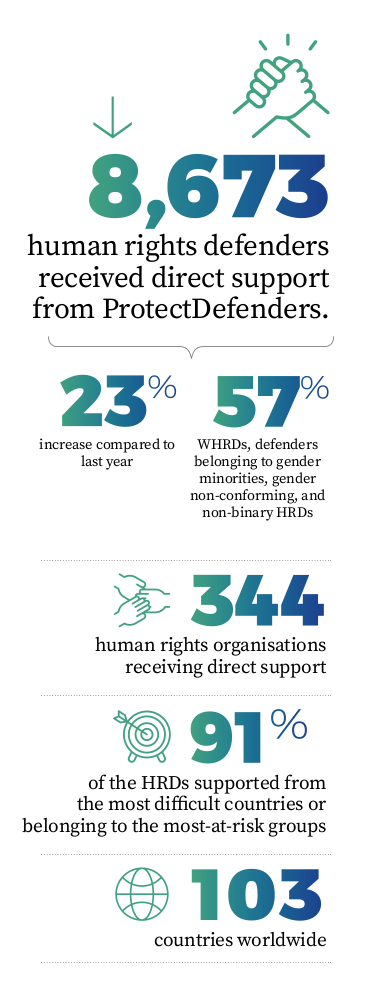
Throughout 2021, the EU human rights defenders mechanism, ProtectDefenders.eu, has delivered life-saving support and multi-faceted assistance to nearly 8,700 of the most at-risk human rights defenders and grassroots human rights organisations around the world – 23% more than in 2020. The EU HRD mechanism’s strategic, flexible, and efficient support has mitigated the ravages suffered by the human rights defence community last year, amid the pervasive impacts of the COVID-19 pandemic and the most critical global and geopolitical environment for human rights defence work reported since the creation of ProtectDefenders.eu in 2015.
Despite this extremely adverse situation, ProtectDefenders.eu has continued to mobilise protective support to individuals at risk, and to provide comprehensive assistance to organisations and movements confronting security threats. The support of ProtectDefenders.eu has helped human rights defenders and grassroots human rights groups to strengthen their resilience and protection globally, particularly in the most difficult contexts, making a significant contribution to their ability to continue their work.
Last year, the activities of the EU HRD mechanism have been impacted by an unprecedented increase in requests for urgent materially protective support from defenders and communities: ProtectDefenders.eu has had to respond to, among other severe crises, the dismantling and repression of civil society in Belarus, the consequences of the coup d’état in Myanmar on civil society and HRDs, and the collapse of Afghanistan as the Taliban took over its government. Thus, significant efforts were made to reach these most difficult countries and the most at-risk groups of defenders, who have absorbed an unprecedented level of the support delivered by the EU HRD mechanism. See also; https://humanrightsdefenders.blog/2019/05/28/the-eu-human-rights-defenders-mechanism-a-short-overview/
In a quickly evolving context, creative and flexible solutions and adaptations have been implemented, and this year the consolidation of the ProtectDefenders.eu consortium has given rise to new spaces to explore the privileged positioning of the EU HRD mechanism in the international community in support of defenders. This is illustrated by the launch of the first HRD resettlement stream by the government of Canada in partnership with ProtectDefenders.eu, the articulation of a comprehensive response in Afghanistan through new programmes in partnership with the EU, and the steps taken towards a more comprehensive and collective approach to advocacy on issues of common interest.
ProtectDefenders.eu has continued to provide a comprehensive, holistic and effective emergency protection for HRDs at the greatest risk, including 24/7 support, and to invest in the resilience and capacity of human rights organisations to continue their work in adverse environments – notably through lifeline and core-funding grant-making to local actors, including communities defending rights. ProtectDefenders.eu has also ensured that international temporary relocation capacities remain operational and accessible for HRDs and members of their families, and has taken a significant step in strengthening regional relocation structures through the Shelter Initiatives program. Furthermore, and despite the prevailing limitations created by the pandemic, capacity-building activities have continued to provide access to knowledge about reinforced protection strategies for the community of defenders. Similarly, ProtectDefenders.eu has strengthened its support to individual HRDs and NGOs through its reactive and protective advocacy work to HRDs at risk through urgent interventions, reports, and related proactive steps, mobilising the international community in an effort that has led to multiple success stories throughout the world.
This coordinated implementation, coupled with a holistic and complementary approach between partners, actions, strategies, and programmes, continues to step up the practical support available to HRDs at risk and local human rights NGOs in a timely and comprehensive manner; the vast majority of HRDs accessing ProtectDefenders.eu’s support have reported enhanced security and protection, and highly positive outcomes. Although the extreme situation in 2021 has pushed the mandate and resources of the EU HRD mechanism to the limit, ProtectDefenders.eu has managed to maintain and generate a consistently noticeable and positive impact on the HRD community at highest risk.
The 2021 ProtectDefenders.eu Annual Report is introduced by Victoria Fyodorova, a woman human rights defender from Belarus, Jamila Afghani, a WHRD from Afghanistan, Josep Borrell, Representative of the Union for Foreign Affairs and Security Policy/Vice-President of the European Commission, Jutta Urpilainen, Commissioner for International Partnerships, and Maria Arena, Chair of the European Parliament’s subcommittee on Human Rights.



 Hans Thoolen on Human Rights Defenders and their awards