Archive for the 'human rights' Category

Looking ahead: next UN SG should be more proactive on human rights

January 12, 2021
Author image

On 11 January 2021 Louis Charbonneau the UN Director of Human Rights Watch looks ahead to the end of the year with: “Next UN Chief Should Fully Commit to Human Rights”

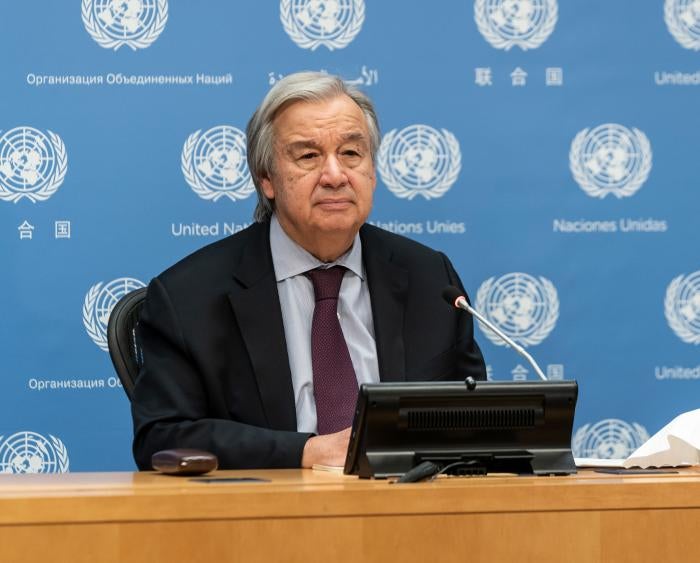
United Nations Secretary-General Antonio Guterres speaks to the press at UN Headquarters in New York, November 20, 2020.
United Nations Secretary-General Antonio Guterres speaks to the press at UN Headquarters in New York, November 20, 2020.  © 2020 Lev Radin/Sipa via AP Images

Antonio Guterres’ term ends on 31 December 2021.  Whoever assumes the role on January 1, 2022 should fully commit to improving the world body’s performance on upholding human rights. It’s crucial that the selection process is competitive and transparent. 

News agencies are reporting that Guterres will seek a second five-year term. If confirmed, he should not be handed a new term on a silver platter. The process should include multiple candidates who all publicly present concrete plans to improve the UN, including how to reinforce its human rights pillar at a time when some governments are actively working to undermine it.

Guterres’ performance on human rights over the past four years has been mixed, largely characterized by an unwillingness to publicly criticize rights-abusing governments by name and a preference for closed-door diplomacy.

Human Rights Watch and other organizations have called on Guterres to publicly urge the Chinese government to release over a million Turkic Muslims arbitrarily detained in so-called education camps and appoint an envoy to monitor rights abuses in China — he has not done so [see: https://humanrightsdefenders.blog/2020/09/09/exceptionally-large-coalition-of-ngos-urge-more-scrutiny-of-china/].

He has been reluctant to use his authority to launch investigations, as in the case of the murder of Saudi journalist Jamal Khashoggi, or name alleged perpetrators when he heeded pressure from member states and authorized a limited inquiry into attacks on humanitarian facilities in Syria. [see also: https://humanrightsdefenders.blog/2020/06/10/the-weakness-of-un-secretaries-general-versus-big-powers-in-speaking-out/]

Guterres took an important step last year when announcing his Call to Action on Human Rights.  While that pledge says all the right things about improving the UN’s commitment to human rights, its implementation remains very much a work in progress. 

The selection of the secretary-general is largely in the hands of the five permanent members of the UN Security Council, as the council nominates a leading candidate for members of the General Assembly to confirm. UN member states should be clear that they will only consider candidates who make credible commitments to resist the efforts of governments seeking to sweep human rights under the carpet.

https://www.hrw.org/news/2021/01/11/next-un-chief-should-fully-commit-human-rights

China-EU deal – what about human rights?

January 6, 2021

A long-awaited deal, the Comprehensive Agreement on Investment includes provisions for settling disputes and outlines clear rules against the forced transfer of technologies — a practice in which a government requires foreign investors to share their technology in exchange for market access.

The EU previously said the agreement should increase the transparency of Chinese state subsidies and make sustainable development a key element of the relationship between the two trading blocs.

China’s Ministry of Commerce said “both sides had made tremendous efforts” at a press conference following Wednesday’s meeting and that they had “overcome difficulties” to conclude talks. It said the deal focuses on institutional opening up with market access as the key principle of the deal, which will mean more investment opportunities for businesses on both sides and “a better business environment”.

But the EU expressed concerns about “the restrictions on freedom of expression, on access to information, and intimidation and surveillance of journalists, as well as detentions, trials and sentencing of human rights defenders, lawyers, and intellectuals in China.” The EU’s diplomatic agency, the European External Action Service, has called for the immediate release of Zhang Zhan, a former lawyer who reported on the early stage of the coronavirus outbreak in China and has been sentenced to four years in prison.

The issue of human rights could prove to be a sticking point for the deal clearing the EU Parliament, with critics drawing attention to reports of forced labour in some regions of China.

The stories coming out of Xinjiang are pure horror. The story in Brussels is we’re ready to sign an investment treaty with China,” Guy Verhofstadt, a Belgian MEP for Renew Europe, said on Twitter. “Under these circumstances, any Chinese signature on human rights is not worth the paper it is written on”.

There could also be friction with the new US President-elect Joe Biden and his administration, as just weeks ago the EU proposed a trans-Atlantic dialogue to address “the strategic challenge presented by China’s growing international assertiveness.”

Amid concerns about the human rights situation in China, the EU said the seven-year-long negotiations were concluded in “principle” during a video conference involving Mr Xi, European Commission president Ursula von der Leyen and EU Council president Charles Michel. German chancellor Angela Merkel – whose country holds the rotating presidency of the EU – and French president Emmanuel Macron also took part in the discussions with the Chinese president, the EU said. Macron highlighted the “concerns” of EU countries regarding human rights and called for the “closure of internment camps”, according to the speech given by his office. He also pleaded in favor of “measures to ban forced labor” and called for “a visit of independent United Nations experts”.

According to the EU, the deal was negotiated after China pledged to continue ratifying the International Labor Organization’s rules on forced labor. “We are open for business but we are attached to reciprocity, level playing field and values,” Ms von der Leyen said.

French president Emmanuel Macron attends an EU-China video conference along with Chinese president Xi Jinping, German chancellor Angela Merkel, European Commission president Ursula von der Leyen and president of the European Council Charles Michel, at the Fort de Bregancon in Bormes-les-Mimosas, southern France
French president Emmanuel Macron attends an EU-China video conference at the Fort de Bregancon in Bormes-les-Mimosas, southern France (Sebastien Nogier, Pool via AP)

The video conference launches a ratification process that will take several months. To enter into force, the agreement will need to be ratified by the European Parliament, and the issue of human rights could be a sticking point.

https://www.chesterstandard.co.uk/news/national-news/18976931.leaders-eu-china-seal-long-awaited-investment-deal/

https://www.euronews.com/2020/12/30/eu-and-china-set-to-sign-historic-investment-deal-but-could-human-rights-concerns-scupper-

Turkey: Our hearts remain in prison again this new year

January 4, 2021

On 2 January 2021 Nurcan Baysal – the winner of the 2018 Front line award [see: https://humanrightsdefenders.blog/2018/05/18/breaking-news-five-front-line-award-winners-2018-announced/] wrote a moving piece in Ahval about her friends and colleagues who are forced to spend their New Year in prison:

“OK,” I say to the children, “We are all overwhelmed in these corona days. Let’s decorate the house, the new year is coming. Down with the corona and with 2020. Let’s enter 2021 with hope. Come on, let’s make popcorn.” While I make the popcorn, I think of my dear friend Osman Kavala, who remains in prison.

I think back to an afternoon when a few human rights defenders had gathered. Whose turn was it to host us that day? “It’s me,” said Şeyhmus. “I’ll even buy you coffee.” Şeyhmus Gökalp, member of the Turkish Medical Association’s honorary board, is now in prison.

I know a walk would do me good. I go outside to get some air. I pick up pace as Leonarda Cohen sings – “Dance with me…” It’s cold outside, but the sun is shining, and I enjoy the birds on trees. I look at the beautiful sky.

I think of novelist Ahmet Altan’s second book written in prison, where he said he would never see the sky without prison walls. The very sky devastates me.

I walk through Diyarbakır’s Bağlar district. Gentrification will begin here soon. I walk up to the building that used to host Kardelen Women’s Centre. I think back to the early 2000s, and the enthusiastic inauguration of Kardelen – literally translates to English as “snow piercer,” refers to the flower snowdrop.

After the opening, we grab a bite in a corner with the then-mayor of Diyarbakır, Gültan Kışanak, and Çağlar, a young employee of the centre. We look at the endless row of coffeehouses that have put their tables on the sidewalk, making it harder for women to walk down that street. “We will change this male-dominated mentality,” Kışanak says proudly. Çağlar is also hopeful for the future.

Both Kışanak and Çağlar Demirel are now in prison.

What should I cook tonight? I open a jar of canned vegetables I prepared with my loving mother. I’ll sauté them, and make some rice on the side.

“Mum, should we put out pickles too?” asks my son. Let’s do it. My pickles have been good this year. I open the lid and I pop one in my mouth.

Nedim wrote in a letter that he liked pickles. Journalist Nedim Türfent and dozens more are in prison.

I go to Diyarbakır’s Sur district. I go in and out of the streets of my hometown, which get stranger every day. Ruins on one street, upscale cafés on the next. A Starbucks a few yards from abject poverty and hunger.

Along the Hevsel Gardens a nice walking path has been put up. I find myself thinking about whose dream that was. “There will be days when we will walk along the Tigris,” says Selçuk.

Selçuk Mızraklı, elected co-mayor of Diyarbakır, will not be able to see his beloved hometown for 9 years, 4 months and 15 days, he is in prison.

With the coronavirus… I feel like I’ve been home for years. The feeling of being trapped and its friend despair surround me. I feel like I haven’t been able to breathe for a long time. I make coffee and go out to the yard. I look at the sky, the stars. I remember my childhood, us sleeping on the roof under the stars, how much hope we had.

Meanwhile, the former leader of the Peoples’ Democratic Party (HDP) Selahattin Demirtaş whispers something from his prison cell.

“When you lose hope, look up at the sky, the stars are still there.”

May 2021 bring good health, but also bring back our loved ones. Let it bring freedom to thousands of people who are imprisoned unlawfully. Let this new year bring us hope, and hope for my hometown that has been destroyed.

https://ahvalnews.com/turkey-kurds/our-hearts-remain-prison-again-new-year

Post Brexit trade deals risk to leave human rights out

January 4, 2021

Simon Tisdall – in a strongly-worded opinion piece in the Guardian of 3 January 2021 entitled “‘Global Britain’ is willing to trade away everything. Including scruples” – attacks the UK’s new deal with Turkey which ignores its appalling human rights abuses and should have been scrutinised by parliament

Simon Tisdall
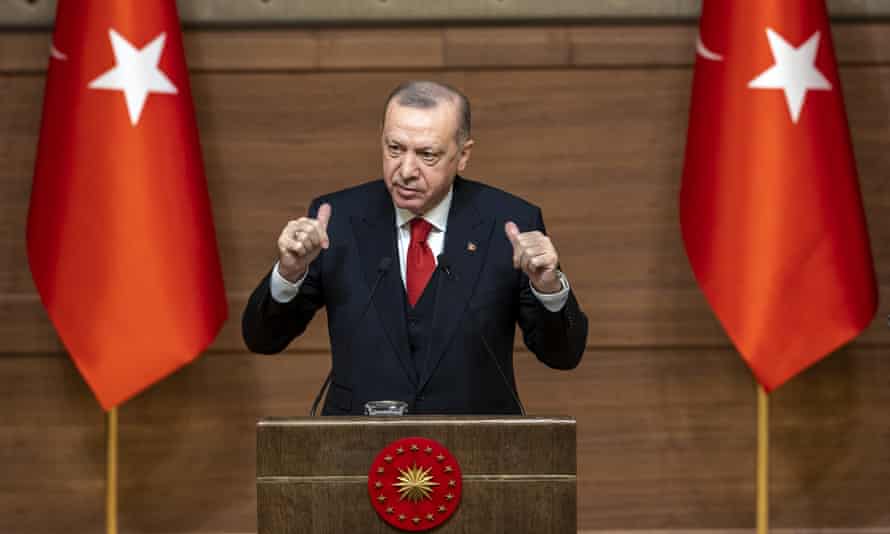
Turkish President Recep Tayyip Erdogan

Turkey’s ‘strongman’ president Recep Tayyip Erdoğan has hailed the trade deal with Britain as the start of a ‘new era’. Photograph: Anadolu Agency/Getty Images Sun 3 Jan 2021 07.00 GMT

The UK’s new trade agreement with Turkey, signed last week, ignores the Turkish government’s continuing human rights abuses, boosts its dangerous president, and undermines ministerial pledges that “global Britain” will uphold international laws and values. The deal took effect on 1 January without even rudimentary parliamentary scrutiny. Here, stripped of lies and bombast, is the dawning reality of Boris Johnson’s scruple-free post-Brexit world.

Recep Tayyip Erdoğan, Turkey’s “strongman” leader, is pleased as punch. He’s the new, biggest fan of Britain’s international trade secretary, Liz Truss, whose shabby work this is. Erdoğan hailed the deal as the start of a “new era” and a landmark for Turkey. After years of disastrous economic mismanagement and fierce rows with the US and EU over Turkish policy towards Russia, Syria, Libya, Greece and Cyprus, Erdoğan badly needed a win. Hapless Truss delivered….

This rushed deal rides roughshod over widely shared human rights concerns. It may be naive to think that the agreement, which replicates existing EU-Turkey arrangements, would allow matters of principle to imperil £18.6bn in two-way trade. Yet Britain is Turkey’s second-largest export market. Ankara was desperate to maintain tariff-free access. This gave Johnson and Truss leverage. It was a sovereign moment. But they failed to demand that Erdoğan change his ways.

…Selahattin Demirtaş, former leader of the pro-Kurdish Peoples’ Democratic party, languishes in jail despite an order to free him – from the European court of human rights.

Alive to these and similar problems relating to other post-Brexit trade partners, the House of Lords amended the government’s Trade Bill last month to require human rights risk assessments when making agreements – to ensure compliance with the UK’s international treaties and obligations. But the government is expected to scrap the amendment when the bill returns to the Commons. The Turkey deal contains no such safeguards.

[see also: https://humanrightsdefenders.blog/2020/02/13/uks-human-rights-policy-after-brexit/]

In its scramble to replace lapsed EU arrangements, Johnson’s government has so far “rolled over” about 30 existing trade deals. Like the Turkey deal, they have not faced thorough parliamentary scrutiny. The list includes other countries or entities with contentious human rights records, such as Egypt, Tunisia, Israel and the Palestinian Authority. Bilateral deals with notorious rights abusers such as China and Saudi Arabia have not been attempted – yet…

This lucrative business, or the prospect of losing it, may help explain the haste in finalising the Turkey deal. Yet the fact that Erdoğan stands accused of using British-made equipment and technology to repress domestic opponents, attack Syria’s Kurds, intervene in Libya’s civil war, and stoke the Azerbaijan-Armenia conflict should have given serious pause. These actions run contrary to British interests, as does Erdoğan’s trouble-making in the eastern Mediterranean. Yet Johnson’s government, ever mindful of its Brexit needs, has kept its head down.

Full and timely parliamentary scrutiny of post-Brexit trade deals would help bring such omissions and contradictions to light – but is sadly lacking, as Emily Thornberry, Labour’s shadow trade secretary, said in November. She accused the government of “sheer bumbling incompetence” after Greg Hands, the trade minister, admitted there was not enough time for MPs to scrutinise trade deals before the 31 December deadline. So much for a sovereign parliament “taking back control” of Britain’s destiny and laws.

The Turkey deal illustrates a bigger, fundamental hypocrisy. Extolling a future “global Britain” in 2019, foreign secretary Dominic Raab promised that “once we’ve left the EU … human rights abusers anywhere in the world will face consequences for their actions”. In January 2020, Raab assured the Commons that “a truly global Britain is about more than just international trade and investment … Global Britain is also about continuing to uphold our values of liberal democracy and our heartfelt commitment to the international rule of law.”

Raab seems to mean well, but ne’er-do-wells such as Erdoğan are laughing fit to burst. Raab’s recent imposition of sanctions on individual rights abusers in Russia, Saudi Arabia and elsewhere does not affect the bigger picture. It is of a British government hellbent on cutting hasty, ill-considered deals with all manner of undesirable customers around the world, without proper regard for the political, legal, strategic and human consequences. And to think Tory aristocrats used to look down on trade.

https://www.theguardian.com/commentisfree/2021/jan/03/global-britain-is-willing-to-trade-away-everything-including-scruples

New Year, New Charges against Thai Protesters – the Lese-majesty law in Thailand

January 4, 2021

Thai authorities on 1 January 2021 made their 38th arrest of a pro-democracy activist in recent weeks under the country’s tough lèse majesté law as authorities crack down on the country’s unprecedented protest movement. That law, Section 112 of the Thai criminal code, forbids defamation of the king and provides for three to 15 years’ imprisonment for violations.The law had been dormant since King Maha Vajiralongkorn succeeded his father, King  Bhumibol Adulyadej, who died in 2016. The Thai government, though, is now using it to try to stamp out continuing protests calling for the government to resign, a new constitution and reform of the monarchy

Thailand’s authorities must stop targeting pro-democracy protesters with draconian legal action and instead enter into dialogue, according to the UN’s special rapporteur for freedom of assembly, who warned the country risks sliding into violence. Clément Voule said he had written to the Thai government to express alarm at the use of the fierce lese-majesty law against dozens of protesters, including students as young as 16.

It is legitimate for people to start discussing where their country is going and what kind of future they want,” Voule said of the protests. “Stopping people from raising their legitimate concerns is not acceptable.

So far, 37 people face charges of insulting the monarchy for alleged offences ranging from wearing traditional dress deemed to be a parody of the royals to giving speeches arguing that the power and wealth of the king should be curbed.

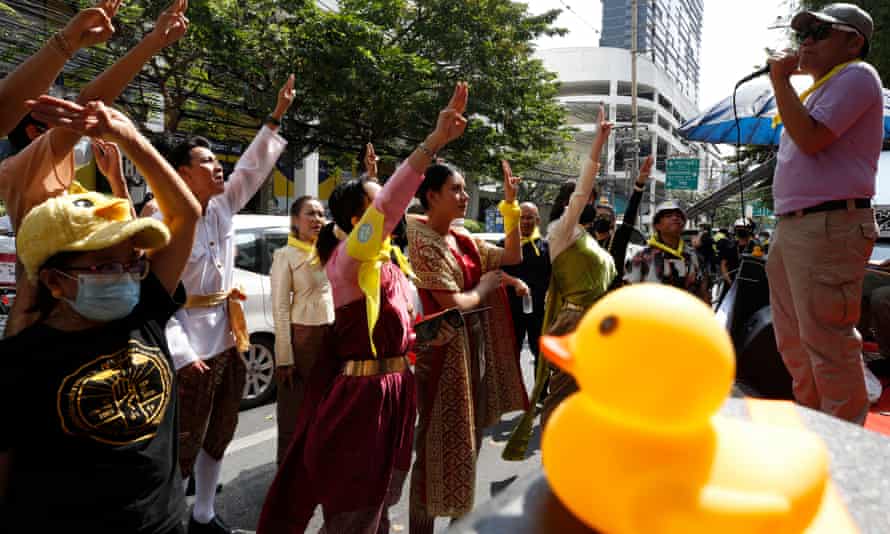
Anti-government protesters flash a three-finger salute – a gesture used adopted by protesters from the Hunger Games films – as they gather in support of people detained under the lese-majesty law at a police station in Bangkok.
Anti-government protesters flash a three-finger salute – a gesture used adopted by protesters from the Hunger Games films – as they gather in support of people detained under the lese-majesty law at a police station in Bangkok. Photograph: Narong Sangnak/EPA

Prominent protest leaders face an unusually high number of charges. This includes the student activists Parit Chiwarak, also known as Penguin, (12 charges) and Panusaya Sithijirawattanakul (six charges) and the human rights lawyer Anon Nampa (eight charges), who have given speeches calling for the power of the royals to be curbed.

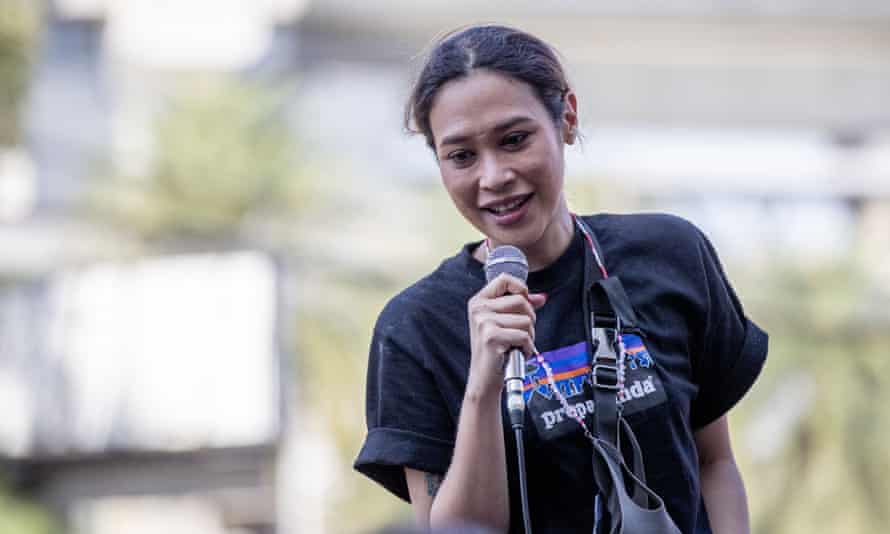
The pro-democracy protest fundraiser Inthira Charoenpura
The pro-democracy protest fundraiser Inthira Charoenpura speaks from a stage outside Bang Khen police station in Bangkok. Photograph: Gemunu Amarasinghe/AP

Protesters – who have faced various other charges over recent months, including sedition – declined to participate in a government reconciliation panel in November, rejecting it as an attempt to buy time. The recent cases come after months of demonstrations in which protesters have made unusually frank and public calls for reform to the monarchy.

Benja Apan, 21, one of 13 people facing charges over a demonstration outside the German embassy in Bangkok, said legal action was unlikely to deter protesters from coming out in the new year. “I actually think it will bring more people out, because it is not fair,” she said.

The human rights group Amnesty International has launched a campaign calling on PM Prayut Chan-o-cha to drop charges pressed on a number of activists for their role in the pro-democracy movement and to repeal, or at least amend, Thailand’s draconian lèse majesté law. According to the campaign, at least 220 people, including minors, face criminal charges for relating to their actions in the pro-democracy movement. Activists are calling on government and monarchy reform, raising issues considered taboo and unprecedented in Thai society. Thailand must amend or repeal the repressive laws it is using to suppress peaceful assembly and the expression of critical and dissenting opinions.

Amnesty International is calling on people to take action and send a letter to the prime minister, calling on the Thai government to change their approach when handing the ongoing protests to protect human rights. Sample letter by AI’s campaign calls on Prayut to:

  • Immediately and unconditionally drop all criminal proceedings against protesters and others charged solely for exercising their rights to freedom of peaceful assembly and expression
  • Cease all other measures, including harassment, aimed at dissuading public participation in peaceful gatherings or silencing voices critical of the government and social issues
  • Amend or repeal legislation in order to ensure it conforms with Thailand’s international human rights obligations on freedom of peaceful assembly and expression, and to train state officials to carry out their duties confirming to Thailand’s obligation to respect, protect and fulfil the peaceful exercise of the rights to freedom of peaceful assembly and expression.

On Saturday 19 December 2020 Maya Taylor in The Thaiger had already reported that the United Nations High Commission for Human Rights has expressed shock and dismay at Thailand’s use of its strict lèse majesté law against a 16 year old pro-democracy activist. The UN High Commissioner for Human Rights’ spokesperson Ravina Shamdasani has called on Thailand to refrain from using the law against those exercising their right to freedom of speech, as she expressed alarm that a minor was being charged under the law. “It is extremely disappointing that after a period of 2 years without any cases, we are suddenly witnessing a large number of cases, and – shockingly – now also against a minor. We also remain concerned that other serious criminal charges are being filed against protesters engaged in peaceful protests in recent months, including charges of sedition and offences under the Computer Crime Act. Again, such charges have been filed against a minor, among others.

The UN Human Rights Committee has found that detention of individuals solely for exercising the right to freedom of expression or other human rights constitutes arbitrary arrest or detention. We also urge the government to amend the lèse majesté law and bring it into line with Article 19 of the ICCPR on the right to freedom of expression.”

Thailand’s Foreign Ministry spokesman has played down the UN High Commissioner for Human Rights’ criticisms over the kingdom’s enforcement of the Lese Majeste law.

See also in 2019: https://humanrightsdefenders.blog/2019/12/23/thailand-amnesty-and-un-rapporteur-agree-on-misuse-of-lese-majeste/

https://thethaiger.com/news/national/pro-democracy-movement-making-little-headway-monarchys-powers-remain-untouched

https://www.theguardian.com/world/2020/dec/27/un-thailand-protesters-royal-insult-law-lese-majesty

https://www.voanews.com/east-asia-pacific/new-year-new-charges-thai-protesters-slapped-royal-defamation-charges

We start 2021 with a long-read about Non-violence and PBI

January 4, 2021

A new year for this blog should start with a bit of transparency: in 2020 there were 35.147 views by 19.777 visitors, which is an increase of approximately 15 % on 2019. Not too bad for a niche blog I think. A theme that does not get enough attention is in my view the principled non-violence of many human rights defenders as illustrated in “Non-violence is always the best choice” by Carl Kline in Brookinsgregister of 29 December 2020:

The year 2021 marks the 40th anniversary of Peace Brigades International. Founded in 1981 at Grindstone Island in Ontario, Canada, PBI has practiced nonviolent accompaniment in numerous countries around the world.

The idea of peace brigades originated with Mahatma Gandhi, concerned about violence in India between various religious factions. Teams of unarmed volunteers would go into conflict situations as nonviolent, non-partisan actors, making contact with all groups to the dispute and helping mediate and resolve the conflict. If necessary, the volunteers were prepared to put their bodies in harm’s way to mitigate or stop the violence.

As the idea of PBI spread in the early ’80s, volunteers stepped forward, the depth of experience increased, more rigorous training developed for those in the field, and an international organization emerged with working groups in 12 countries. In 2020, projects were ongoing in Colombia, Guatemala, Honduras, Kenya, Indonesia, Mexico and Nepal.

PBI does not enter any conflict situation unless invited by a human rights organization in the host country. Volunteers spend their initial time in the country identifying their presence to all sides of the conflict and to government officials. They wear identifying clothing. They have an international network of others willing to respond at a moment’s notice with telegrams, email or letters to appropriate persons, letting them know the whole world is watching.

Their primary purpose is accompanying those human rights workers who are under threat of death. A volunteer is with them 24 hours a day. Oftentimes family members are accompanied as well, to school, to market, wherever they happen to go.

Having done this work for 40 years, PBI has compiled solid experiential evidence that nonviolent, non-partisan accompaniment works and violent conflicts can be lessened and sometimes resolved by the intervention of international nonviolent agents. In 40 years of accompaniment, none of the accompanied, or those who accompanied them, have been lost to violence. Many of the human rights defenders in the various countries have attributed their survival to PBI.

The Nonviolent Peaceforce had its beginnings in 2002 with a founding conference in India with representatives from 49 countries present. They began their first project in Sri Lanka in 2003. Today they are active in Iraq, the Phillipines, Myanmar and South Sudan.

Their mission statement reads: “Nonviolent Peaceforce is a global civilian protection agency based in humanitarian and international human rights law. Our mission is to protect civilians in violent conflicts through unarmed strategies, build peace side by side with local communities, and advocate for the wider adoption of these approaches to safeguard human lives and dignity. We are guided by principles of nonviolence, nonpartisanship, primacy of local actors, and civilian-to-civilian action.”

Both organizations, similar at their core, have matured to the point where they have reputations worldwide, especially among those served. They have enough history and experience they are here to stay.

On a more local level, there is a long history of conflict resolution programs in the public schools. Creative Conflict Resolution  began in New York state in 1972, started by a group of Quakers. At the time, it was called Children’s Creative Response to Conflict. As it grew and expanded its programs across the country, it came to Brookings in the early ‘90s and local volunteers established programs in schools across the state. After a training and installment of a peer mediation program in one South Dakota school, the principal lamented with a grin that he never saw problem cases in his office anymore. They all chose to go to mediation.

The spinoffs from these programs of conflict resolution, started early in the schools and homes, are many and long-lasting. It is clear that we can educate our way to a less violent culture, if only we make it as critical an educational mission as the three r’s.

As we begin a new year, it is clear we have choices. We don’t have to add to the war budget every year. It would be far more productive and encouraging to shift some of those funds to nonviolent alternatives, like PBI or the Nonviolent Peaceforce. Or why can’t we have conflict resolution programs in every school in the country.

This year, in 2021, we have a special opportunity to choose between violence and nonviolence. The Nuclear Nonproliferation Treaty is 50 years old. The new Treaty on the Prohibition of Nuclear Weapons goes into effect on Jan. 22, 2021. 50 countries have now signed it. This treaty prohibits the use, development, testing, production, manufacturing, acquiring, possession, stockpiling, transferring, receiving, threatening to use, stationing, installation or deployment of nuclear weapons. The U.S., along with other nuclear nations, will have a choice: sign on or be a rogue nation.

Can we see the mounting evidence? From our homes and schools to the international community, there is a better way!

See also: https://humanrightsdefenders.blog/2019/12/26/pbis-right-to-defend-a-new-multi-media-awareness-campaign/

https://brookingsregister.com/article/non-violence-is-always-the-best-choice

BEST WISHES FOR 2021

December 31, 2020

Dear Readers

THANK YOU FOR HAVING READ AND SHARED MY POSTS

This is to wish you a very good new year. 2021 is bound to be better in many ways and – with the vaccines – promises to be an improvement. If the corona sceptics would just learn the facts we would all be safer

Loujain Al-Hathloul Sentenced to over 5 Years Prison by Saudi Terror Court

December 29, 2020

Americans for Democracy and Human Rights in Bahrain (ADHRB) posted on 28 the bad news that after 958 days in detention, Loujain AlHathloul was sentenced to 5 years and 8 months in prison in court today by the Specialised Criminal Court (terrorism court).[see: https://humanrightsdefenders.blog/2020/11/26/loujain-al-hathlouls-trial-judge-transfers-her-case-to-even-worse-court/].

The sentence includes a suspension of 2 years and 10 months in addition to the time already served (since May 2018) which would see Loujain’s release in approximately two months. Loujain is also required to serve three years of probation during which time she could be arrested for any perceived illegal activity. She will also be placed on a 5 year travel ban.

After nearly three years in pre-trial detention and now 5 weeks of a rushed trial process in the Specialised Criminal Court, my sister Loujain was sentenced to 5 years and 8 months in prison by the Specialised Criminal Court today. She was charged, tried and convicted using counter-terrorism laws. Loujain and my parents (who are her lawyers) were given little time to prepare so it is hard to understand how this trial process is a fair one. My sister is not a terrorist, she is an activist. To be sentenced for her activism for the very reforms that MBS and the Saudi Kingdom so proudly tout is the ultimate hypocrisy. My sister is the bravest person I know, and while we are devastated that she will have to spend even one more day in prison, our fight is far from over. We will not rest until Loujain is free,” said Lina AlHathloul.

The post includes a full timeline of the Specialised Criminal Court.

https://www.theguardian.com/world/2020/dec/28/saudi-rights-activist-loujain-al-hathloul-sentenced-to-almost-six-years-in-jail

Tech giants join legal battle against NSO

December 22, 2020

Raphael Satter reports on 22 December 2020 for Reuters that tech giants Google, Cisco and Dell on Monday joined Facebook’s legal battle against hacking company NSO, filing an amicus brief in federal court that warned that the Israeli firm’s tools were “powerful, and dangerous.”

The brief, filed before the U.S. Court of Appeals for the Ninth Circuit, opens up a new front in Facebook’s lawsuit against NSO, which it filed last year after it was revealed that the cyber surveillance firm had exploited a bug in Facebook-owned instant messaging program WhatsApp to help surveil more than 1,400 people worldwide. See also: https://humanrightsdefenders.blog/2020/07/20/the-ups-and-downs-in-sueing-the-nso-group/

NSO has argued that, because it sells digital break-in tools to police and spy agencies, it should benefit from “sovereign immunity” – a legal doctrine that generally insulates foreign governments from lawsuits. NSO lost that argument in the Northern District of California in July and has since appealed to the Ninth Circuit to have the ruling overturned.

Microsoft, Alphabet-owned Google, Cisco, Dell Technologies-owned VMWare and the Washington-based Internet Association joined forces with Facebook to argue against that, saying that awarding soverign immunity to NSO would lead to a proliferation of hacking technology and “more foreign governments with powerful and dangerous cyber surveillance tools.”

That in turn “means dramatically more opportunities for those tools to fall into the wrong hands and be used nefariously,” the brief argues.

NSO – which did not immediately return a message seeking comment – argues that its products are used to fight crime. But human rights defenders and technologists at places such as Toronto-based Citizen Lab and London-based Amnesty International have documented cases in which NSO technology has been used to target reporters, lawyers and even nutrionists lobbying for soda taxes.

Citizen Lab published a report on Sunday alleging that NSO’s phone-hacking technology had been deployed to hack three dozen phones belonging to journalists, producers, anchors, and executives at Qatar-based broadcaster Al Jazeera as well as a device beloning to a reporter at London-based Al Araby TV.

NSO’s spyware was also been linked to the slaying of Washington Post journalist Jamal Khashoggi, who was murdered and dismembered in the Saudi consulate in Istanbul in 2018. Khashoggi’s friend, dissident video blogger Omar Abdulaziz, has long argued that it was the Saudi government’s ability to see their WhatsApp messages that led to his death.

NSO has denied hacking Khashoggi, but has so far declined to comment on whether its technology was used to spy on others in his circle.

https://www.reuters.com/article/us-facebook-nso-cyber/microsoft-google-cisco-dell-join-legal-battle-against-hacking-company-nso-idUSKBN28V2WX?il=0

USA and 3 other countries in the Americas downgraded by human rights researchers

December 17, 2020

On Wednesday, 16 December 2020 Débora Leão and Suraj K. Sazawal published an opinion piece in IPS entitled: “USA Downgraded as Civil Liberties Deteriorate Across the Americas” (Débora Leão is a Civic Space Researcher at CIVICUS, the global civil society alliance. She has a Master of Public Policy degree. Prior to joining CIVICUS, Débora worked on advocacy and research related to civic participation, urban development and climate justice. Suraj K. Sazawal serves on the board to Defending Rights & Dissent and is co-author of ‘Civil Society Under Strain’, the first book to explore how the War on Terror impacted civil society and hurt humanitarian aid.

Protests in New York City against racism and police violence, following the death of George Floyd. Credit: UN Photo/Evan Schneider

Few images better illustrate the recent decline in civil liberties in the United States than that of peaceful protesters near the White House being violently dispersed so Donald Trump could stage a photo-op. Moments before the president emerged from his bunker on June 1 to hold a bible outside a boarded-up church, federal officers indiscriminately fired tear gas at people who had gathered in Lafayette Park to protest about the police killing of George Floyd. This was far from an isolated incident: nationwide protests against systemic racism and police brutality have been met with widespread police violence.

Since May, the CIVICUS Monitor, an online platform that tracks fundamental freedoms across 196 countries, documented dozens of incidents where law enforcement officers, dressed in riot gear and armed with military grade-equipment, responded to Black Lives Matter protests with excessive force. These include officers driving vehicles at crowds of protesters and firing tear gas canisters and other projectiles at unarmed people, leaving at least 20 people partially blinded.

Throughout the year, journalists and health workers, clearly marked as such while covering the protests, have been harassed and assaulted. In one incident caught on live TV, a news reporter and camera operator from Louisville, Kentucky were shot by police with pepper balls while covering protests over the police killing of Breona Taylor.

This sustained repression of protests and an increased crackdown on fundamental freedoms led to the USA’s civic space rating being downgraded from ‘narrowed’ to ‘obstructed’ in CIVICUS new report, People Power Under Attack 2020.

This disproportionate response by law enforcement officers to protesters goes beyond what is acceptable practice when policing protests, even during an emergency. Under international law, people have a right to assemble freely. Any restrictions to this right must be proportionate and necessary to address an emergency or reestablish public order.

While recent brutality against protests for racial justice is concerning, the decline in basic freedoms in the USA began before this crackdown. The repression seen in 2020 was preceded by a wave of legislation limiting people’s rights to protest.

In recent years, several states enacted restrictive laws which, for example, criminalise protests near so-called critical infrastructure like oil pipelines, or limit demonstrations on school and university campuses. Increased penalties for trespassing and property damage are designed to intimidate and punish climate justice activists and organisations that speak out against fossil fuels.

In the wake of Black Lives Matter protests, some of the ‘anti-protest’ bills introduced this year seem particularly cruel, for instance, by proposing to make people convicted of minor federal offences during protests ineligible for pandemic-related unemployment benefits.

Growing disregard for protest rights underscores wider intolerance for dissent. In parallel with restrictions on the freedom of peaceful assembly, the USA also saw an increase in attacks against the media, even before Black Lives Matter demonstrations erupted. Over the past three years, the CIVICUS Monitor has documented the frequent harassment of journalists by the authorities and civilians while covering political rallies or when conducting interviews.

Correspondents critical of the Trump administration or reporting on the humanitarian crisis in the USA/Mexico border region sometimes faced retaliation; documents obtained by ‘NBC 7 Investigates’ in 2019 showed the US government created a database of journalists who covered the migrant caravan and activists who were part of it, in some cases placing alerts on their passports.

In January 2020 a journalist was barred from accompanying Secretary of State Mike Pompeo in an official trip to Europe after Pompeo objected to the questions by another reporter from the same outlet.

The harsh treatment of people wanting to express themselves and the decline of civil liberties is part of a broader global decline in fundamental freedoms. Our new report shows less than four percent of the world’s population live in countries that respect the freedoms of association, peaceful assembly and expression.

Each country’s civic space is rated in one of five categories: ‘open, ‘narrowed, ‘obstructed,’ ‘restricted,’ or ‘closed’. The USA was one of 11 countries downgraded from its previous rating.

Another recent example may be that on 15 December 2020 five independent UN human rights experts expressed serious concern over the arrest and charges brought against an indigenous leader (Nicholas Tilsen, human rights defender of the Oglala-Lakȟóta Sioux Nation), for peacefully protesting a political rally held last July at Mount Rushmore National Memorial, located on treaty lands of the Great Sioux Nation.

In the Americas, three other countries showed significant declines: Chile and Ecuador were downgraded to ‘obstructed’ and Costa Rica’s rating changed to ‘narrowed’.[see also: https://humanrightsdefenders.blog/2020/07/01/even-costa-rica-has-serious-problem-with-protection-of-indigenous-defenders/] In the first two countries, as with the USA, rating changes reflected unnecessary and disproportionate crackdowns on mass protest movements.

Violations of protest rights were common across the region, with detention of protesters and excessive use of force among the top five violations of civic freedoms recorded this year. In addition, the Americas continue to be a dangerous place for those who dare to stand up for fundamental rights: across the world, 60 percent of human rights defenders killed in 2020 came from this region.

The authorities must engage with civil society and human rights defenders to create an environment where they are able to fulfil their vital roles and hold officials accountable.

https://news.un.org/en/story/2020/12/1080122