A group of rights activists in India have urged President Droupadi Murmu to withdraw terror-related cases against late Jesuit Father Stan Swamy and 15 other accused in the 2018 Bhima Koregaon violence case.
“It is a false case registered against Father Swamy and others and it should be withdrawn,” said Father Antony P.M, a social activist at a gathering to mark the second death anniversary of the priest, on July 5 in the eastern Jharkhand state. Tributes were paid to the Swamy across the country.
He said a group of activists is appealing to the president, who hails from an indigenous community in eastern India, to use her good office to withdraw “the totally false case registered against right defenders,” Antony told UCA News on July 6.
The activists had gathered in front of the Raj Bhavan, the official residence of the Jharkhand governor, in the state capital Ranchi. It was organized by the Shahid Father Stan Swamy Nyaya Morcha (Martyer Stan Swamy Justice Forum).
“Father Swamy, who fought for the rights of indigenous people in Jharkhand finally had to die for want of medical care as a prisoner,” said Antony, the director of Bagaicha, a Jesuit social center in Jharkhand, where Swamy lived and worked.
Murmu served as the governor of Jharkhand when Swamy’s residence in Ranchi was raided twice and the federal terror investigative agency arrested him in 2020.
He was accused of having links with outlawed Maoists along with 15 well-known human rights activists accused in a case linking them to a violent clash in Bhima-Koregaon village in western Maharashtra state in 2018.
The late priest and others including rights activists, lawyers, academicians, and writers, were also charged under the provisions of a draconian anti-terror law, the Unlawful Activities Prevention Act (UAPA), alleging they had conspired to unleash violence in Bhima-Koregaon.
The priest was also accused of sedition and conspiring with Maoist rebels to overthrow the federal government.
The 85-year-old activist priest died as an under trial prisoner in a private hospital in Mumbai, the capital of Maharashtra.
“We hereby request Your Excellency to take cognizance of the entire Bhima-Koregaon case wherein the intention of the state and the investigation agencies is highly suspicious and does not inspire any confidence in common citizens,” they said in a memorandum.
“Several independent investigations, including by US-based Arsenal Consultancy, have exposed how the case, based on fabricated evidence, is just a witch-hunt by the state,” it said.
“We request that all the human rights activists be immediately released on bail, the case and prosecution be withdrawn and criminal proceedings be initiated against those responsible for fabricating and planting evidence,” the memorandum added.
It also briefly provided details of the findings from Arsenal Consultancy, a digital forensic lab, that said digital evidence was planted on the computer of Father Swamy and others, leading to their arrest and incarceration.
Antony further demanded the scrapping of the draconian UAPA, under which Swamy was arrested.
“Once a person is charged under the UAPA, he/she is not treated well in jail even if there is no connection with the case remotely,” the priest said, citing the example of Swamy.
Despite suffering from Parkinson’s and other age-related diseases, Swamy was denied bail by both the trial court and the high court before his death.
“If the jail authorities cared for him well or the courts had granted bail in time, I think he would have been with us,” Antony, also a Jesuit, observed.
“The investigating agency has still not filed the charge sheet and activists are languishing in jail. This is a gross violation of human rights,” the priest said.
Indian Jesuits have approached the Mumbai High Court seeking “to clear his name from the false cases” that led to his arrest, imprisonment and death in custody.
On 6 July 2023 Oxfam issued a statement that it stands in solidarity with the Bangladesh Garment and Industrial Workers Federation (BGIWF), trade union leaders and all human rights defenders who stand up for workers’ rights and protect human rights.
Oxfam learned of the horrific news of the brutal murder of Shahidul Islam, a union leader who was beaten to death on June 25th for his labour rights activism in Gazipur, a major garment industry hub on the outskirts of Dhaka, Bangladesh. He was an organizer of the BGIWF for 25 years advocating for workers’ rights as a trade union organizer, and was attacked and killed for standing up for basic human rights. We mourn not only the loss of an individual but also the loss of a powerful voice that championed the rights and well-being of workers, including the right to a living wage. We extend our sincere condolences to the grieving family, friends, colleagues and allies mourning his loss.
Kalpona Akter, the president of BGIWF, said: “Shahidul mobilised thousands of workers to join unions, empowering them to become solid factory-level trade union leaders. Throughout his life, he assisted thousands of workers in receiving arrears and severance pay wrongfully denied by their employers. With workers’ needs always in mind, Shahidul and three other union leaders met on the evening of his death to discuss a peaceful resolution to a wage dispute and the Eid-ul-Azha festival bonus. He met his fate due to the industry’s ill practice to promote yellow unionism for years and the neglect of workers’ voices. This needs to stop. Let our workers be free to organize and join unions. Shahid’s contributions to the labour movement were remarkable and will be sorely missed.”
Ahmed Sharif, a union organizer who was wounded in the attack, told the Guardian “As soon as we came out of the gate, a group of assailants grabbed Islam and separated him from us. They started cursing and randomly beating us, particularly Islam, some of them were kicking him mercilessly.”
As an organisation dedicated to the fight to end poverty and injustice, we are deeply concerned by the murder of Shahidul Islam. This tragic incident highlights the vulnerability of union leaders and activists fighting for workers’ rights. Oxfam joins BGIWF in demanding a thorough investigation and ensure justice is served for the death of Islam. We further call on all brands and stakeholders to conduct ethical purchasing practices upholding human rights within their supply chain and paying a living wage. We call on the government of Bangladesh to step up their protection of trade unionists who are exercising their fundamental human rights to freedom of association and collective bargaining.
Oxfam stands in solidarity with BGIWF, raising a resounding call for justice in the case of Shahidul Islam and demanding the unwavering safety of workers, union members and human rights defenders. We stand united in their relentless struggle to defend workers’ rights at Prince Jacquard Sweaters Ltd factory and in workplaces across Bangladesh. Together we demand accountability and an end to the systemic violations that perpetuate injustice.
Background
Shahidul and his colleagues were attacked after leaving the meeting with the management of a factory named Price Jacquard Sweaters Ltd to help the workers collect their due bonuses and wages. The factory management refused to comply despite being directed by the Deputy Commissioner’s (DC) office of Gazipur District to pay the workers’ salaries.
This is not the first time BGIWF has been the victim of such a fatal attack. Eleven years ago, in April 2012, another worker leader, Aminul Islam was tortured and murdered. Aminul was also an organizer with BGIWF, a vital contributor to the nation’s striving movement to advance workers’ rights. The murders of human rights defenders exemplify the extreme measures employed to suppress freedom of association in Bangladesh.
The tragic death of Shahidul, along with countless incidents of other workers being silenced by violence and fear, highlight the urgent need for change. Brands are responsible for ethical business practices and need to ensure that their purchasing practices are not leading to exploitation and deprivation of human rights. Brands must guarantee the right to a living wage and just, safe and healthy working conditions for garment workers.
Despite legal provisions, union leaders and activists face many challenges and restrictions such as anti-union discrimination, harassment, and retaliation against union leaders and members. Additionally, labour activists have raised concerns about the composition and independence of worker participation committees in factories. Labour activists argue that these ‘yellow unions’ are established by factory owners to exert control on workers raising concerns of workers’ rights to collective bargaining and discriminatory power dynamics.
Oxfam Canada, Oxfam Australia and Oxfam Aotearoa’s What She Makes campaign aims to transform the fashion industry into a more just and equitable space by holding brands accountable for their purchasing practices and advocating for a living wage. A living wage is the minimum amount that a worker should earn in a 48-hour work week and adequately covers workers’ and their family’s basic needs, including food, water, housing, energy, healthcare, clothing, childcare, education, transportation and savings for unexpected events. We stand united with the women who make our clothes, advocating for their right to living wages, freedom of association and labour rights.
Aftonbladet, the biggest daily newspaper of Sweden published a call where it was stated that the Turkish authorities and President Recep Tayyip Erdoğan among them, are making calls, at every opportunity, for Sweden to repatriate some authors, journalists, academicians, and human rights defenders living freely in Sweden by obtaining refugee status, the number of whom ranges between 33 and 130.
“Simultaneously with Turkey requesting Sweden to repatriate its opponents, Sweden is facing the largest organized criminal actions in its history. Almost every day comes reports of armed attacks and killings from all parts of Sweden,” the call states*.
“It is as if anyone can be killed anywhere at any time. Most of these cruel attacks are being organized by Swedish criminals now living in luxury in Turkey. These criminals have obtained Turkish citizenship and Turkey is therefore arguing that they cannot be returned to Sweden.”
“One such leader of a criminal gang threatening security in our country is Rawa Majid, the leader of the criminal organization called “Foxtrot” (with nickname Kurdish Fox). Another one organizing these crimes belongs to the group called Bandidos .”
“On the one side, Turkey claims to be fighting terrorism and requests that people who are in Sweden because of their political opinions to be returned to Turkey. On the other side, the country is rejecting to return to Sweden criminals of grave offences, people who risk the security and the future generations in Sweden.
“No, this cannot go on Turkey! It is time to act like a serious state. Return the “Kurdish Fox” and the other criminal people from Sweden to Sweden.”
The signatories of the call:
Kurdo Baksi, Author Göran Eriksson, Ex-Chief of Stockholm Workers Education Center (ABF) Göran Greider, Author, Dala-Demokraten Gazetesi Baş Redaktörü Pierre Schori, Ex-Minister responsible for Refugees and UN Ambassador Olle Svenning, Author
Maria Psara – writing for Euronews of 27June 2023 – says that European Union member States are trying to water down the directives for SLAPPs and Media Freedom…European lawmakers are accusing member states of trying to water down EU legislation aimed at strengthening protections for journalists and media freedom.
It would also establish several procedural safeguards and remedies, such as compensation for damages, and dissuasive penalties for launching abusive lawsuits. The JURI vote will form the basis of the Parliament’s position in negotiations with member states if it is also endorsed by the plenary in mid-July.
SLAPPs or Strategic lawsuits against public participation are a particular form of harassment used primarily against journalists and human rights defenders to prevent or penalise speaking up on issues of public interest. The Commission’s proposal has been dubbed as the ‘Daphne Law’ in honour of murdered Maltese journalist Daphne Caruana Galizia.
Member states, which together form the Council of the EU, have however sought to water down the text, drawing criticism for the Commission.
“I would like to express my regret concerning the weakening of the remedies against abusive court proceedings, in particular the deletion of the provision on compensation of damage and the weakening of the provision on award of costs,” Didier Reynders, Commissioner for Justice, said earlier this month after member states agreed on their negotiating position.
Parliament is seeking to redress that with German MEP Tiemo Wölken (S&D), the rapporteur on the draft directive, telling Euronews: “We made it stronger and we also added other provisions such as a creation of an ‘one stop shop’ which the SLAPPs targets can contact to receive help by dedicated national networks of specialized lawyers, legal practitioners and psychologists.”
It is not the first time member states are accused of trying to water down a proposal on media freedom. Earlier this month, a deal among the 27 member states on the European Media Freedom Act (EMFA) made a lot of eyebrows rise, because of a planned exemption to allow for the wiretapping of journalists. The regulation, first proposed by the Commission in September 2022, included safeguards against political interference in editorial decisions and against surveillance. The EU’s executive wanted to put focus on the independence and stable funding of public service media as well as on the transparency of media ownership and the allocation of state advertising.
“We have welcomed in particular as a political symbol the draft regulation for EMFA, as the Commission for the first time has adopted a legislative act dealing with all media, a traditionally sensitive subject dealt with at national level only,” Renate Schroeder, director of the European Federation of Journalists (EFJ), told Euronews. Yet, the EPJ and other NGOs, still criticised the proposal as “not ambitious enough”.
“In particular we believed that Article 4 on the protection of journalists’ sources and protection from surveillance has not met Council of Europe standards. We also advocated for stronger binding rules on media transparency,” Schroeder added.
But member states are seeking to add an exemption to Article 4, introduced by France and opposed by Germany only, that would allow them to spy on journalists in the name of national security.
The original proposal sought to ensure that governments could not “detain, sanction, intercept, subject to surveillance or search and seizure” journalists in order to uncover their sources, unless “justified by an overriding requirement in the public interest” while the deployment of spyware was to be restricted only to “serious crimes”.
The Council’s is hoping to broaden the number of offenses allowing such surveillance from 10 to 32.
“The text doesn’t protect journalists anymore and thereby makes the Act almost useless for journalists’ protection at least,” Schroeder said.
“It still proposes useful tools when it comes to independence of public service media, transparency on state advertisement, some minimum rules on media ownership and on editorial independence. But yes, some member-states are afraid of journalism and thereby give hands to illiberal countries such as Hungary who oppose the Act. We hope the European Parliament will be firm, but we are not too optimistic,” underlined the director of EFJ.
However, on 12 July, with 498 votes to 33 and 105 abstentions, MEPs adopted their negotiating position on new rules to protect those working on matters of public interest like fundamental rights, the activities of public officials or corruption allegations.
The nomination process for this special year will open in the first quarter of 2024 and will remain live for two months, as done in the past.
A nomination form will be available in several languages. Any individual or organization can be nominated for the Award, keeping in mind these rules and criteria:
Candidates must be currently active in the promotion and protection of human rights (the Award does not consider defenders who are deceased);
The candidate should not employ or advocate violence;
Candidates who are no longer in need of protection (e.g., because they are now in a safe environment) will normally not be considered;
Self-nominations are not accepted.
Once the nominations have been vetted by the Foundation and considered by our Jury of ten human rights organizations, the name(s) of the Laureate(s) will be released in the second quarter of 2024.
Preparations are underway for a 30th-anniversary reunion of former winners of the Award in Geneva as well as a Ceremony, which would take place in the third quarter of 2024.
On 26 June 2023 HRW called on Spain use its six-month tenure as EU Presidency to translate into concrete and bold actions commitment to protect fundamental rights and the rule of law.
Spain holds the presidency as the world marks the 75th anniversary of the Universal Declaration of Human Rights (UDHR) on 10 December 2023. In anticipation of this pivotal moment Spain should make every effort to uphold the rights and values enshrined in this historic document.
HRW calls upon the Spanish government to consider the following priority issues and recommendations:
Fundamental Rights and Rule of Law in EU member states
Two EU member states – Hungary and Poland – currently face scrutiny under Article 7 of the Treaty on European Union (TEU)…
The freezing of EU recovery and cohesion funds under the conditionality mechanism represents a welcome step but it is insufficient to address the gravity of the erosion of rule of law and human rights. While Hungary and Poland have adopted some limited measures in response to requirements under the mechanism, these have failed to address fundamental and long-standing concerns. ….We urge the Council to hold the Polish and Hungarian governments to account by using the powers conferred to it under the Treaties and to fulfil the strong mandate to act given to it by the European Commission and Parliament. The urgency of Spain’s leadership and responsibility cannot be overstated as it is one of only two remaining presidencies before Hungary and Poland in turn assume leadership of the Council. It is highly likely that during that time progress on rule of law will at best stall, and at worst Article 7 scrutiny will come to an end altogether…
Rights-Respecting and Principled EU Migration Policy
Spain’s EU Council presidency comes at a critical time for the EU’s migration policy after the Council agreed on 8 June on a negotiating position on an EU-wide reform of its asylum and migration system. Given its mandate to lead on behalf of member states the negotiations with the European Parliament on a final agreement, Spain has an opportunity to broaden the scope for a rights-respecting approach.
We call on your government to:
Support the establishment of proactive, state-led SAR operations in the Mediterranean Sea that could involve expanding the mandates and capacity of existing initiatives like EUNAVFOR MED and Frontex, funding professional rescue NGOs and ensuring predictable disembarkation.
Promote a discussion on the critical role of NGOs to ensure that they are fully able to carry out their lifesaving SAR activities, instead of facing obstruction and criminal and administrative penalties; and provide platforms for discussion of cooperation between member state rescue coordination centers and NGOs.
Advocate for independent and effective border monitoring mechanisms to document human rights violations at EU external borders, such as unlawful pushbacks, to ensure accountability for those responsible for human rights abuses and access to justice for victims.
Ensure that migration cooperation with third countries, and all provision of financial, technical, and material assistance, are contingent on clear and verifiable human rights commitments.
Enable a constructive trialogue on the asylum procedures regulation and the asylum and migration management regulation with a view to limiting the use of accelerated border procedures, the detention of asylum seekers including families with children, and discretionary use of the “safe third country” concept.
Promote a discussion on establishing more safe and legal pathways for migration as called for by EU Justice and Home Affairs Commissioner Johansson.[8]
Human Rights as a Pillar of EU’s Foreign Policy
The EU is equipped with solid instruments to ensure that human rights protection remains at the centre of its external action. The EU has shown resolve in its response to Russia’s invasion of Ukraine and has led at the United Nations to address key human rights crises.
..
During its Presidency, we call on your government to:
Continue to combat impunity for crimes committed in Ukraine, including by providing adequate resources to the International Criminal Court’s (ICC) regular budget, advocating and supporting the implementation of ICC arrest warrants, pressing Ukraine to ratify the Rome Statute and supporting independent investigations and prosecutions under universal jurisdiction.
Continue to support Human Rights Defenders (HRDs) at risk and share your experience with other EU member states. Encourage other EU member states to learn from and replicate Spain’s forward-leaning approach with the Program for Support and Protection of Human Rights Defenders at Risk that provides dedicated one-year residential visas for HRDs. Advocate with EU member states to use their discretion and facilitate access by HRDs to multi-year multi-entry Schengen visas in line with EU guidelines.
…
Recalibrate EU’s engagement with China to address the government of China’s human rights record through measurable deliverables; counter the government of China’s flawed narratives on its own human rights record; reject efforts to undermine international human rights institutions; lead the creation of a UN investigative and monitoring mechanism for crimes against humanity committed in Xinjiang; sanction or hold accountable those responsible for such crimes; and make plans to reduce dependency on a government that assaults human rights both domestically and in its foreign policy.
The last 25 years have seen significant developments in international law and standards on the role, recognition and protection of human rights defenders. Five years ago, the Human Rights Defenders World Summit called for action, including to: “Take stock of the developments in normative frameworks related to the protection of defenders since 1998 and further develop and deepen the norms contained in the Declaration with the view to afford enhanced protection”. [see: https://humanrightsdefenders.blog/2019/11/01/one-year-after-the-2018-human-rights-defenders-world-summit/ as well as: https://humanrightsdefenders.blog/2018/12/18/premiere-powerful-video-summarizes-human-rights-defenders-world-summit-2018/]. The Declaration +25 Project is a civil society-led initiative that seeks to do just that while putting civil society at the centre of a conversation fundamental to them and their work – the right to defend rights.
A bit too late to actually follow the event (which took place on 20 June), I like to draw attention to the programme. The event was live-streamed on ISHR’s YouTube channel.
This side event, which is co-sponsored by a number of civil society organisations,
wanted to:
enhance awareness of the UN Declaration on human rights defenders, and of the Declaration +25 Project;
present developments in the last 25 years in international law and standards on the role, recognition and protection of human rights defenders;
encourage greater dialogue on the protection needs of defenders;
hear from human rights defenders on their protection needs and the role the Declaration has played to date.
Speakers:
Ketakandriana Rafitoson, Transparency International – Initiative Madagascar
Camila Zuluaga Hoyos, Colombian Commission of Jurists
Robby Mokgalaka, The Groundwork Trust, South Africa
Birgit Kainz-Labbe, Coordinator of Civic Space Unit, OHCHR
Moderator: Tess McEvoy, International Service for Human Rights
The 53rd session of the UN Human Rights Council started 19 June (to end on 14 July 2023). Thanks to the – as usual – excellent documentation prepared by the International Service for Human Rights (ISHR) I will highlight the themes mostly affecting HRDs.
To stay up-to-date you can follow @ISHRglobal and #HRC53 on Twitter, and look out for its Human Rights Council Monitor. During the session, follow the live-updated programme of work on Sched.
Here are some highlights of the session’s thematic discussions
Human rights of migrants
The Council will consider a resolution on the human rights of migrants this session, where a big problem is the criminalisation of the provision of solidarity and support, including rescues at sea, by migrant rights defenders.
Reprisals
..States raising cases is an important aspect of seeking accountability and ending impunity for acts of reprisal and intimidation against defenders engaging with the UN. It can also send a powerful message of solidarity to defenders, supporting and sustaining their work in repressive environments.
Anexa Alfred Cunningham (Nicaragua), a Miskitu Indigenous leader, woman human rights defender, lawyer and expert on Indigenous peoples rights from Nicaragua, who has been denied entry back into her country since July 2022, when she participated in a session of a group of United Nations experts on the rights of Indigenous Peoples. States should demand that Anexa be permitted to return to her country, community and family and enabled to continue her work safely and without restriction.
Vanessa Mendoza (Andorra), a psychologist and the president of Associació Stop Violències, which focuses on gender-based violence, sexual and reproductive rights, and advocates for safe and legal abortion in Andorra. After engaging with CEDAW in 2019, Vanessa was charged with ‘slander with publicity’, ‘slander against the co-princes’ and ‘crimes against the prestige of the institutions’. She has been indicted for the alleged “crimes against the prestige of the institutions” involving a potentially heavy fine (up to 30,000 euros) and a criminal record if convicted. States should demand that the authorities in Andorra unconditionally drop all charges against Vanessa and amend laws which violate the rights to freedom of expression and association.
Kadar Abdi Ibrahim (Djibouti) is a human rights defender and journalist from Djibouti. He is also the Secretary-General of the political party Movement for Democracy and Freedom (MoDEL). Days after returning from Geneva, where Kadar carried out advocacy activities ahead of Djibouti’s Universal Periodic Review (UPR), intelligence service agents raided his house and confiscated his passport. He has thus been banned from travel for five years. States should call on the authorities in Djibouti to lift the travel ban and return Kadar’s passport immediately and unconditionally.
Hong Kong civil society (Hong Kong): Until 2020, civil society in Hong Kong was vibrant and had engaged consistently and constructively with the UN. This engagement came to a screeching halt after the imposition by Beijing of the National Security Law for Hong Kong (NSL), which entered into force on 1 July 2020. States should urge the Hong Kong authorities to repeal the offensive National Security Law and desist from criminalizing cooperation with the UN and other work to defend human rights.
Maryam al-Balushi and Amina al-Abduli (United Arab Emirates), Amina Al-Abdouli used to work as a school teacher. She was advocating for the Arab Spring and the Syrian uprising. She is a mother of five. Maryam Al Balushi was a student at the College of Technology. They were arrested for their human rights work, and held in incommunicado detention, tortured and forced into self-incriminatory confessions. After the UN Special Procedures mandate holders sent a letter to the UAE authorities raising concerns about their torture and ill treatment in detention in 2019, the UAE charged Amina and Maryam with three additional crimes. The UN Working Group on Arbitrary Detention found their detention arbitrary and a clear case of reprisals for communicating with Special Procedures. In April 2021, a court sentenced them to three additional years of prison for “publishing false information that disturbs the public order”. States should demand that authorities in the UAE immediately and unconditionally release Maryam and Amina and provide them with reparations for their arbitrary detention and ill-treatment.
Other thematic reports
At this 53rd session, the Council will discuss a range of civil, political, economic, social and cultural rights through dedicated debates with the mandate holders and the High Commissioner, including:
The Special Rapporteur on the rights to freedom of peaceful assembly and of association
The Independent Expert on protection against violence and discrimination based on sexual orientation and gender identity
The Special Rapporteur on the right to freedom of expression
The Special Rapporteur on the right to health
The Special Rapporteur on extrajudicial, summary of arbitrary executions
The Special Rapporteur on promotion and protection of human rights in the context of climate change
The Special Rapporteur on contemporary forms of racism, racial discrimination, xenophobia and related intolerance
The Working Group on the issue of human rights and transnational corporations and other business enterprises
The High Commissioner on the importance of casualty recording for the promotion and protection of human rights
The Special Adviser to the Secretary-General on the Prevention of Genocide
In addition, the Council will hold dedicated debates on the rights of specific groups including:
The Working Group on discrimination against women and girls
The Special Rapporteur on violence against women and girls, its causes and consequences
The Special Rapporteur on the human rights of migrants
The Special Rapporteur on trafficking in persons, especially women and children
The Special Rapporteur on independence of judges and lawyers
#HRC53 | Country-specific developments
Afghanistan
The Human Rights Council will hold its Enhanced Interactive Dialogue on Afghanistan, with the Special Rapporteur on the situation in Afghanistan and the Working Group on Discrimination against Women in Law and Practice. The joint report of the two mandates follows up from an urgent debate held last year on the situation of women and girls in the country. Their visit to the country concluded that there exist manifestations of systemic discrimination violating human rights and fundamental freedoms in both public and private lives. ISHR has joined many around the world to argue that the situation amounts to gender apartheid, and welcomes the call of the two mandate holders to develop normative standards and tools to address this as “an institutionalised system of discrimination, segregation, humiliation and exclusion of women and girls”. The gravity and severity is urgent, and requires that States act on the ongoing calls by Afghan civil society to establish an accountability mechanism for crimes against humanity.
Algeria
On 15 June, fifteen activists and peaceful protesters will face trial in Algiers on the basis of unfounded charges which include ‘enrolment in a terrorist or subversive organisation active abroad or in Algeria’ and ‘propaganda likely to harm the national interest, of foreign origin or inspiration’. The activists were arrested between 23 and 27 April 2021, and arbitrarily prosecuted within one criminal case. If convicted of these charges, they face a prison sentence of up to twenty years. This case includes HRDs Kaddour Chouicha, Jamila Loukil and Said Boudour who were members of the LADDH before its dissolution by the Administrative Court of Algiers following a complaint filed by the Interior Ministry on 29 June 2022. We urge States to monitor the prosecution closely, including by attending the trial. We also urge States to demand that Algeria, a HRC member, end its crackdown on human rights defenders and civil society organisations, amend laws used to silence peaceful dissent and stifle civil society, and immediately and unconditionally release arbitrarily detained human rights defenders.
China
The recent findings of the Committee on Economic, Social and Cultural Rights in March, the Committee on the Elimination of Discrimination against Women in May, and the seven key benchmarks on Xinjiang by 15 Special Rapporteurs add up to wide range of UN expert voices that have collectively raised profound concern at the Chinese government’s treatment of Uyghurs, Tibetans, Hong Kongers and HRDs in mainland China. Seldom has the gap between the breadth of UN documentation on crimes against humanity and other grave violations and the lack of action by the Human Rights Council in response to such overwhelming evidence been so flagrant: the Council’s credibility is at stake. ISHR calls on the Council to promptly adopt a resolution requesting updated information on the human rights situation in Xinjiang, and a dialogue among all stakeholders on the matter. Governments from all regions should avoid selectivity, put an end to China’s exceptionalism, and provide a meaningful response to atrocity crimes on the basis of impartial UN-corroborated information.
The recent convictions of prominent rights defenders Ding Jiaxi and Xu Zhiyong to 12 and 14 years in jail respectively, and the recent detention of 2022 Martin Ennals awardee Yu Wensheng and his wife Xu Yan for ‘subversion of State power’ a year after his release, point to the need for sustained attention to the fate of HRDs in China. States should address in a joint statement the abuse of national security and other root causes of violations that commonly affect Uyghurs, Tibetans, Hong Kongers and mainland Chinese HRDs. States should also ask for the prompt release of human rights defenders, including human rights lawyers Chang Weiping, Yu Wensheng and Ding Jiaxi, legal scholar Xu Zhiyong, feminist activists Huang Xueqin and Li Qiaochu, Uyghur doctor Gulshan Abbas, Hong Kong lawyer Chow Hang-tung, and Tibetan climate activist A-nya Sengdra.
Egypt
Since the joint statement delivered by States in March 2021 at the HRC, there has been no significant improvement in the human rights situation in Egypt despite the launching of the national human rights strategy and the national dialogue. The Egyptian government has failed to address, adequately or at all, the repeated serious concerns expressed by several UN Special Procedures over the broad and expansive definition of “terrorism”, which enables the conflation of civil disobedience and peaceful criticism with “terrorism”. The Human Rights Committee raised its concerns “that these laws are used, in combination with restrictive legislation on fundamental freedoms, to silence actual or perceived critics of the Government, including peaceful protesters, lawyers, journalists, political opponents and human rights defenders”. Egyptian and international civil society organisations have been calling on the HRC to establish a monitoring and reporting mechanism on the human rights situation in Egypt, applying objective criteria and in light of the Egyptian government’s absolute lack of genuine will to acknowledge, let alone address, the country’s deep-rooted human rights crisis.
Israel and OPT
Civil society continues to call on the OHCHR to implement, in full, the mandate provided by HRC resolution 31/36 of March 2016 with regards to the UN database of businesses involved in Israel’s illegal settlement industry. The resolution mandated the release of a report containing the names of the companies involved in Israel’s settlement enterprise, to be annually updated. The initial report containing a list of 112 companies was released by the OHCHR in February 2020, three years after the mandated release date and despite undue political pressure. Since then, the UN database has not been updated. UN member states should continue to call on the OHCHR to implement the mandate in full and publish an annual update, as this represents a question of credibility of the Office of the High Commissioner and the Council.
The Commission of Inquiry on the Occupied Palestinian Territory, including East Jerusalem, and Israel will present its second report to the Council on 20 June. Member states should continue to support the work of the CoI to investigate the root causes of the situation in line with its mandate with a view to putting an end to 75 years of denial of the Palestinian’s people inalienable rights to self-determination and return. As the Palestinian people commemorate 75 years of Nakba (the destruction of Palestinian homeland and society), the CoI needs to address the root causes of the situation, including by investigating the ongoing denial of the Palestinian people’s right to self-determination and the return of refugees, as well as the ongoing forcible displacement of Palestinians on both sides of the Green Line in the context of Israel’s imposition of a system of colonial apartheid.
In addition, on 10 July, the Council will hold an interactive dialogue with the Special Rapporteur on the situation of human rights in the Palestinian territories occupied since 1967.
Saudi Arabia
In light of the ongoing diplomatic rehabilitation of crown prince and de facto ruler Mohammed bin Salman, the Saudi authorities’ brazen repression continues to intensify, as ALQST has documented. Some notable recent trends include, but are not limited to: the further harsh sentencing of activists for peaceful social media use, such as women activists Salma al-Shehab (27 years), Fatima al-Shawarbi (30 years and six months) and Sukaynah al-Aithan (40 years); the ongoing detention of prisoners of conscience beyond the expiry of their sentences, some of whom continue to be held incommunicado such as human rights defenders Mohammed al-Qahtani and Essa al-Nukheifi, and; regressive developments in relation to the death penalty, including a wave of new death sentences passed and a surge in executions (47 individuals were executed from March-May 2023), raising concerns for those currently on death row, including several young men at risk for crimes they allegedly committed as minors. We call on the HRC to respond to the calls of NGOs from around the world to create a monitoring and reporting mechanism on the ever-deteriorating human rights situation in Saudi Arabia.
Nicaragua
Continued attention should be paid by States at the HRC to the steadily worsening situation in Nicaragua. On 2 June, the spokesperson for the UN High Commissioner for Human Rights raised ‘growing concerns that the authorities in Nicaragua are actively silencing any critical or dissenting voices in the country and are using the justice system to this end’. The OHCHR reports 63 individuals arbitrarily detained in May alone, with 55 charged with ‘conspiracy to undermine national integrity’ and ‘spreading false news’ within one single night, without access to a lawyer of their choosing. States should express support for the monitoring and investigation work of the OHCHR and the Group of Human Rights Experts on Nicaragua (GHREN), and call on the Nicaraguan government to release the remaining 46 political prisoners, revoke its decision to strip deported political prisoners off their nationality, and take meaningful measures to prevent, address and investigate violence by armed settlers against Indigenous Peoples and Afro-descendants.
Russia
Russia’s war of aggression against Ukraine has also been accompanied by a domestic war of repression against human rights defenders, independent journalists and political dissent. Most recently, Russia has adopted a sweeping new law criminalising assistance to or cooperation with a range of international bodies, including the International Criminal Court, ad hoc tribunals, foreign courts and arguably even the UN Human Rights Council itself. This law is manifestly incompatible with the right to communicate and cooperate with international bodies, and a flagrant and institutionalised case of reprisal. With Russian authorities having been found by a UN-mandated Commission of Inquiry to be possibly responsible for crimes against humanity and war crimes, and having a closed and highly repressive environment for civil society (ranking 17/100 in the CIVICUS Monitor), Russia is plainly unfit to be elected to the UN Human Rights Council and should be regarded as an illegitimate candidate. States should support and cooperate with the mandate of the new Special Rapporteur on the human rights situation in Russia, as well as with the Commission of Inquiry into human rights violations and abuses associated with Russia’s illegal war of aggression against Ukraine.
Sudan
Since the beginning of the war in Sudan on 15 April 2023, increasing numbers of Sudanese WHRDs are receiving threats and subject to grave danger. WHRDs are facing challenges in evacuating from Sudan and face further protection risks in neighboring countries. Sudanese women groups and WHRDs are risking their lives to provide support, solidarity, and report on the rising numbers of sexual and gender-based violence crimes. Many survivors are trapped in fighting areas unable to access support, and the occupation of hospitals by RSF is hindering women’s access to health services. The Council must urgently establish an international investigation in Sudan with sufficient resources, including to investigate the threats and reprisals against WHRDs for their work, and to document sexual and gender-based violence. During the debate with the High Commissioner and designated expert on Sudan on 19 June, we urge States to condemn sexual and gender-based violence (SGBV). States should highlight the impacts of the war on women and girls, including sexual and reproductive health as well as lack of support services for survivors of SGBV. States should reaffirm the importance of participation of women and their demands, and amplify the critical work of WHRDs on the ground despite the imminent risks to their lives and safety. States should also condemn the increasing threats against WHRDs and demand their effective protection.
Venezuela
On 5 July, the High Commissioner will present his report on the human rights situation in Venezuela, which will include an assessment of the level of implementation of UN recommendations already made to the State. The Council focus on Venezuela remains critical at a time when some States’ efforts to normalize relations with Venezuela risk erasing human rights from key agendas. Council members and observers should actively engage in the interactive dialogue with the High Commissioner to make evident that the human rights situation in the country remains at the heart of their concerns. The human rights and humanitarian situation in the country remains grave. Human rights defenders face ongoing and potentially increasing restrictions. We urge States to:
Express concern about the NGO bill, sitting with the Venezuelan National Assembly, and call for it to be withdrawn. The potential implications of this bill are to drastically shrink civic space, including by criminalising the work of human rights defenders;
Call for the release of all those detained arbitrarily – including defender Javier Tarazona who has been held since July 2021 and whose state of health is deteriorating;
Call for the rights of human rights defenders and journalists to be respected including during electoral periods, with a mind to Presidential elections next year; and
Call on Venezuela to engage fully with all UN agencies and mechanisms, including OHCHR, and develop a clear plan for the implementation of UN human rights recommendations made to it.
Tunisia
Civil society organisations have raised alarm at the escalating pattern of human rights violations and the rapidly worsening situation in Tunisia following President Kais Saied’s power grab on 25 July 2021 leading to the erosion of the rule of law, attacks on the independence of the judiciary, a crackdown on peaceful political opposition and abusive use of “counter-terrorism” law, as well as attacks on freedom of expression. The High Commissioner has addressed the deteriorating situation in the three latest global updates to the HRC. Special Procedures issued at least 8 communications in less than one year addressing attacks against the independence of the judiciary, as well as attacks against freedom of expression and assembly. Despite the fact that in 2011 Tunisia extended a standing invitation to all UN Special Procedures, and received 16 visits by UN Special Procedures since, Tunisia’s recent postponement of the visit of the Special Rapporteur on the independence of judges and lawyers, is another sign of Tunisia disengaging from international human rights mechanisms and declining levels of cooperation. The upcoming session provides a window of opportunity for the Council to exercise its prevention mandate and address the situation before the imminent risk of closure of civic space in Tunisia and regress in Tunisia’s engagement with the HRC and its mechanisms is complete.
Syria
On 5 July, the Council will hold an interactive dialogue with the Commission of Inquiry on Syria. In a report to the Human Rights Council in 2021, the Commission of Inquiry on Syria called for the establishment of a mechanism to reveal the fate of the missing and disappeared. On 28 March 2023, during the 77th session of the UN General Assembly, the Secretary-General and UN High Commissioner for Human Rights briefed UN Member States on the situation of the missing in Syria, and the findings of the study conducted by the Secretary-General as mandated by Resolution UNGA 76/228. The study concluded that in order to address the situation of the missing in Syria and its impact on families’ lives, it is necessary to create an institution to reveal the fate and whereabouts of the disappeared and to provide support to their families. As discussions are taking place in the UNGA to adopt a resolution establishing a humanitarian institution to reveal the fate and whereabouts of the disappeared, civil society, led by the Truth and Justice Charter, urges States to support the families of the missing to know the truth about the fate and whereabouts of their loved ones by voting in favour of the resolution at the UNGA.
Other country situations
The High Commissioner will present the annual report on 19 June. The Council will hold an interactive dialogue on the High Commissioner’s annual report on 20 June 2023. The Council will hold debates on and is expected to consider resolutions addressing a range of country situations, in some instances involving the renewal of the relevant expert mandates. These include:
Interactive Dialogue with the Special Rapporteur on Eritrea
Interactive Dialogues with the High Commissioner and the Special Rapporteur on Myanmar
Interactive Dialogue with the Special Rapporteur on Burundi
Interactive Dialogue with the High Commissioner on Ukraine
Interactive Dialogue with the Special Rapporteur on Belarus
Interactive Dialogue with the Fact-Finding Mission on Iran
Interactive Dialogue with the Independent Expert on Central African Republic
Appointment of mandate holders
The President of the Human Rights Council has proposed candidates for the following mandates:
Special Rapporteur on minority issues (Mr Nicolas Levrat, Switzerland)
Special Rapporteur on the human rights of migrants (Ms Anna Triandafyllidou, Greece)
Special Rapporteur on the promotion and protection of human rights and fundamental freedoms while countering terrorism (Mr Ben Saul, Australia).
Resolutions to be presented to the Council’s 53rd session
At the organisational meeting on 5 June the following resolutions (selected) were announced (States leading the resolution in brackets):
Human rights situation in Syria (Germany, France, Italy, Jordan, Netherlands, Qatar, Turkey, USA, UK)
New and emerging digital technologies and human rights (Austria, Brazil, Denmark, South Korea, Morocco, Singapore)
Civil society space (Chile, Ireland, Japan, Sierra Leone, Tunisia)
Independence and impartiality of the judiciary, jurors and assessors, and the independence of lawyers – mandate renewal (Australia, Botswana, Hungary, Maldives, Mexico, Thailand)
Human rights of migrants (Mexico)
Mandate of the Special Rapporteur on the situation of human rights in Belarus – mandate renewal (EU)
Mandate of the Special Rapporteur on the human rights situation in Eritrea – mandate renewal (EU)
Business and human rights – mandate renewal (Russian Federation, Ghana, Argentina and Switzerland)
Extrajudicial, summary or arbitrary executions – mandate renewal (Finland, Sweden)
Situation of human rights of Rohiynga muslims and other minorities in Myanmar (Pakistan on behalf of OIC)
Adoption of Universal Periodic Review (UPR) reports
During this session, the Council will adopt the UPR working group reports on Argentina, Benin, Czechia, Gabon, Ghana, Guatemala, Japan, Pakistan, Peru, Republic of Korea, Sri Lanka, Switzerland and Zambia.
Panel discussions
During each Council session, panel discussions are held to provide member States and NGOs with opportunities to hear from subject-matter experts and raise questions. 5 panel discussions are scheduled for this upcoming session:
Panel discussion on the measures necessary to find durable solutions to the Rohingya crisis and to end all forms of human rights violations and abuses against Rohingya Muslims and other minorities in Myanmar
Annual full-day discussion on the human rights of women [accessible panel]. Theme: Gender-based violence against women and girls in public and political life
Annual full-day discussion on the human rights of women [accessible panel]. Theme: Social protection: women’s participation and leadership
Annual panel discussion on the adverse impacts of climate change on human rights [accessible panel]. Theme: Adverse impact of climate change on the full realisation of the right to food
Panel discussion on the role of digital, media and information literacy in the promotion and enjoyment of the right to freedom of opinion and expression [accessible panel]
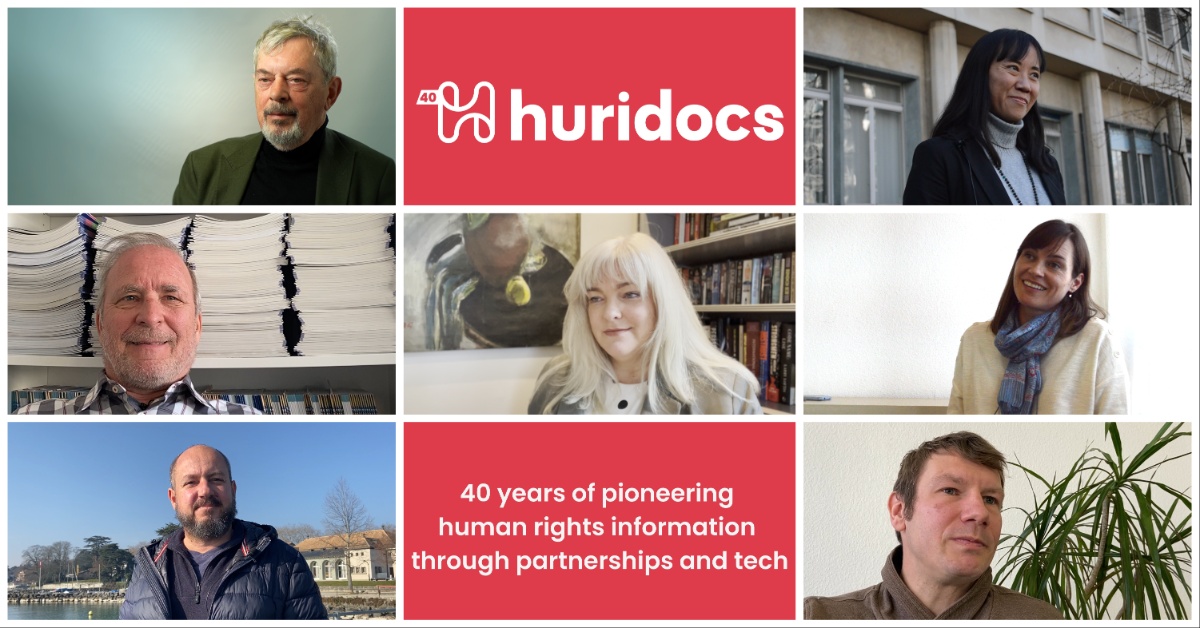
Danna joins HURIDOCS from the Amnesty Tech management team, where she played an integral role in growing globally distributed teams, securing and managing large grants, and providing strategic and operational leadership. She combines perceptive and empathetic leadership with a bright, organised, fearless approach to building organisational strength and resilience. See: https://humanrightsdefenders.blog/tag/danna-ingleton/
“At a time when the power of accurate, accessible and secure information has never been more important to those seeking justice and the fulfilment of their human rights, I am thrilled to be starting as the new Executive Director of HURIDOCS.”
It is exciting to be joining an organisation with such a rich history of harnessing the power of information to facilitate change. Together with my new colleagues and our diverse, valiant partners we will build on this history to ensure HURIDOCS is consistently at the sharp-edge of information management and technological developments, and always strategically growing.
As an activist myself who has been working in human rights for more than a decade I have seen how the battle for justice can take its toll on the people behind the movements. I am therefore also committed to ensuring HURIDOCS is an effective and accountable workplace that values health and the well-being of us all. – Danna Ingleton
Danna will officially assume her responsibilities on 1 July 2023
Volker Türk speaking to journalists after a press briefing at the Palais des Nations in Geneva, 24 May 2023. (Geneva Solutions/Paula Dupraz-Dobias)
Gabriela Galindo on 24 May 2023 in Geneva Solutions reports that Volker Türk said that $800 million are needed yearly, noting rich nations are quick to splurge when it comes to banks or the military, but not ‘when it comes to people’.
Dire humanitarian crises are piling up across the world, yet the United Nations’ human rights watchdog is still strapped for cash, its chief warned Wednesday.
But as these parallel crises continue to flare and some spiral, Türk warned that his organisation was running on empty and chided global leaders for not taking human rights funding more “seriously”.
“The needs have exponentially increased, but there isn’t the commensurate funding available on the humanitarian front – that’s just the reality,” he said. “And, unfortunately, that trend has been there for quite a number of years.”
“We have this combination of protracted conflict situations; we have the increase in new and emerging crises and [in] both non-international armed conflict and international armed conflict,” he said, referring to the Russian invasion of Ukraine.
Responding to a question on their funding needs, the UN rights chief said he “would want to see a doubling, which would be about $800 million per year, for the organisation”s
Türk addressed a grim roster of situations currently followed by the OHCHR, where human rights were being trampled on amid active armed conflicts, including in Sudan and Ukraine, or at the hands of authoritarian governments in Myanmar and Iran.
In Sudan, he said that the “senseless” fighting between two generals vying for power had civilians “besieged” as ceasefires were broken and added that his office had documented at least 25 cases of sexual violence…
Türk added that he was “deeply troubled by the growing phenomenon of anti-rights movements” targeting asylum seekers in the US and Europe as “hateful narratives against migrants and refugees also continue to proliferate”, spurring “anti-migrant” laws and policies that undermine basic human rights and international refugee laws.
“The developments that are unfolding in various countries including the United Kingdom, the US, Italy, Greece and Lebanon are particularly concerning,” he said, as they “appear designed” to hinder the right to seek asylum, to penalise citizens for assisting those in need or to organise returns in “unlawful, undignified and unsustainable ways”.
“We have some [crises] in the headlines all the time, but others are not. Haiti is a good example. There seems to be (…) no sense of urgency when it comes to dealing with a situation like this.”..
“When you look at how quickly billions can be made available when there is a banking crisis or and – I’m sure, rightly so – including military expenditure and so forth… when it comes to people and the plight of people, there doesn’t seem to be the same,” he said.
“Donor countries, they have a budget for peace and security, they have a budget for development (…) but they don’t actually have a budget down for human rights,” he said. “It is actually important to take human rights seriously, not just by (…) coming to the [UN Human Rights] Council and having all these discussions here and working with us, but also by having and increasing the funding for the organisation.”