Archive for the 'Human Rights Defenders' Category

Sudanese woman human rights defender laureate of Martine Anstett Prize 2020

April 21, 2020
Tahani Abbas Khartoum- Ahmed Younes
On Tuesday 12 March 2020 Asharq al-Awsat reported – somewhat garbled – that Tahani Abbas, a Sudanese human rights activist, was awarded “the Martin Institute Prize in Switzerland.” The newspaper surely meant: the Martine Anstett Prize for Human Rights (see: http://www.trueheroesfilms.org/thedigest/awards/martine-anstett-human-rights-prize).
Ms. Abbas told Asharq Al-Awsat that she was proud to receive the prize and because it embodies the distant world’s perception of the Sudanese people’s struggle and shows that the world is watching out for human rights. She went on to say that “personally, the award credits me with a strong role with regards to defending human rights and makes me feel that our efforts and positions in the defense of human rights are appreciated and did not go in vain.” In her acceptance speech, Abbas stressed that all Sudanese women qualify to stand in her place and receive the prize, adding that “I am only a miniature and symbolic example that personifies that struggle of all the women of Sudan. I am an extension of Sudan’s feminist struggle, which is deeply ingrained in its history since before the era of the Kandakes or Nubian Queens, passing through Mendi, daughter of the Sultan Ajabna, and reaching the icon of the Sudanese revolution, Alaa Salah.”

Despite the admiration of observers and the organizers of the prize for the role of Sudanese women in the revolution, Abbas demonstrated her anger at what she calls “women’s weak political participation of after the revolution”. However, she says “Despite being denied political participation after the success of the revolution, our struggle will not stop.”  Abbas has been an active human rights defender since 2009 and is a member of many Sudanese feminist and human rights groups. She is a member of the executive committee of the Regional Alliance of Women Human Rights Defenders of North Africa and the Middle East, a member of the executive committee of the No to the Oppression of Sudanese Women Initiative, the My Fair Home campaign which is concerned with domestic workers, the I am Sudanese, which is concerned with nationality and a member of the Sudanese Alliance to End Child Marriage.

In her assessment of the human rights situation in Sudan after the revolution, she says that it has improved a lot as per international standards. She said: ”The reports of international human rights organizations demonstrate this, and, locally, we feel that, as human rights defenders, we have achieved some victories.”

See also: https://humanrightsdefenders.blog/2015/10/16/martine-anstett-honored-with-own-human-rights-award/

https://aawsat.com/english/home/article/2176746/sudanese-female-activist-wins-martin-institute-prize-human-rights-defenders

2020 World Press Freedom Index is out…

April 21, 2020

The 2020 World Press Freedom Index has come out with as title: “Entering a decisive decade for journalism, exacerbated by coronavirus”. [For last year’s: https://humanrightsdefenders.blog/2019/04/20/the-2019-world-press-freedom-index-launched-on-18th-of-april/]


The 2020 World Press Freedom Index, annualy compiled by Reporters Without Borders (RSF), shows that the coming decade will be decisive for the future of journalism, with the Covid-19 pandemic highlighting and amplifying the many crises that threaten the right to freely reported, independent, diverse and reliable information.

This 2020 edition of the Index, which evaluates the situation for journalists each year in 180 countries and territories, suggests that the next ten years will be pivotal for press freedom because of converging crises affecting the future of journalism: a geopolitical crisis (due to the aggressiveness of authoritarian regimes); a technological crisis (due to a lack of democratic guarantees); a democratic crisis (due to polarisation and repressive policies); a crisis of trust (due to suspicion and even hatred of the media); and an economic crisis (impoverishing quality journalism).

These five areas of crisis – the effects of which the Index’s methodology allows us to evaluate – are now compounded by a global public health crisis.

“We are entering a decisive decade for journalism linked to crises that affect its future,” RSF secretary-general Christophe Deloire said. “The coronavirus pandemic illustrates the negative factors threatening the right to reliable information, and is itself an exacerbating factor. What will freedom of information, pluralism and reliability look like in 2030? The answer to that question is being determined today.”

There is a clear correlation between suppression of media freedom in response to the coronavirus pandemic, and a country’s ranking in the Index. Both China (177th) and Iran (down 3 at 173rd) censored their major coronavirus outbreaks extensively. In Iraq (down 6 at 162nd), the authorities stripped Reuters of its licence for three months after it published a story questioning official coronavirus figures. Even in Europe, Prime Minister Viktor Orbán of Hungary (down 2 at 89th), had a “coronavirus” law passed with penalties of up to five years in prison for false information, a completely disproportionate and coercive measure.

“The public health crisis provides authoritarian governments with an opportunity to implement the notorious “shock doctrine” – to take advantage of the fact that politics are on hold, the public is stunned and protests are out of the question, in order to impose measures that would be impossible in normal times,” Deloire added. “For this decisive decade to not be a disastrous one, people of goodwill, whoever they are, must campaign for journalists to be able to fulfil their role as society’s trusted third parties, which means they must have the capacity to do so.”


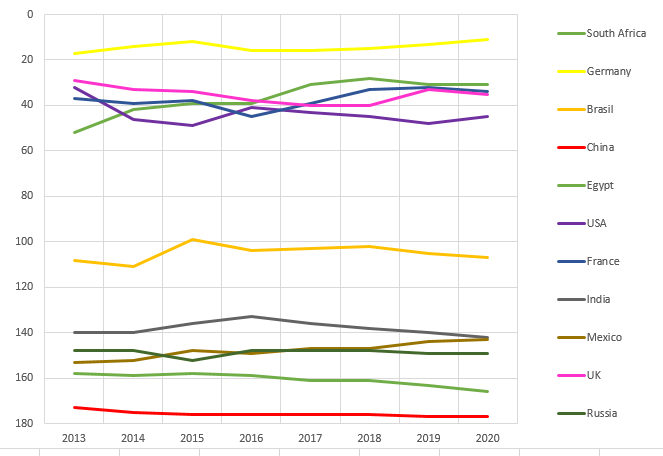
Evolution of some countries ranked since 2013

The main findings of the 2020 Index: Norway tops the Index for the fourth year in a row in 2020, while Finland is again the runner-up. Denmark (up 2 at 3rd) is next as both Sweden (down 1 at 4th) and the Netherlands (down 1 at 5th) have fallen as a result of increases in cyber-harassment. The other end of the Index has seen little change. North Korea (down 1 at 180th) has taken the last position from Turkmenistan, while Eritrea (178th) continues to be Africa’s worst-ranked country.

Malaysia (101st) and the Maldives (79th) registered the biggest rises in the 2020 Index – 22nd and 19th, respectively – thanks to the beneficial effects of changes of government through the polls. The third biggest leap was by Sudan (159th), which rose 16 places after Omar al-Bashir’s removal. The list of biggest declines in the 2020 Index is topped by Haiti, where journalists have often been targeted during violent nationwide protests for the past two years. After falling 21 places, it is now ranked 83rd. The other two biggest falls were in Africa – by Comoros (down 19 at 75th) and Benin (down 17 at 113th), both of which have seen a surge in press freedom violations.

https://rsf.org/en/2020-world-press-freedom-index-entering-decisive-decade-journalism-exacerbated-coronavirus

Joint NGO statement on civil and political rights at First Virtual Informal Dialogue with the UN High Commissioner for Human Rights on COVID-19

April 15, 2020

In the context of policy response by Human Rights NGOs to COVID-19 this joint statement should not be missing: On 9 April 2020 Reliefweb published the Joint NGO statement on civil and political rights at First Virtual Informal Dialogue with the UN High Commissioner for Human Rights on COVID-19

This joint statement on the protection of civil and political rights in the context of the COVID-19 crisis was delivered on behalf of 33 non-governmental organizations (NGOs) during the first virtual informal briefing with the UN High Commissioner for Human Rights on 9 April 2020. It was delivered in conjunction with a separate joint statement on economic, social and cultural rights (IOR 40/2124/2020).

See also: https://humanrightsdefenders.blog/2020/04/14/un-guidelines-for-use-of-emergency-powers-in-time-of-covid-19-pandemic/

Covid-19 a gift for authoritarians and dictators?

April 14, 2020

…..However, even in this emergency, it is necessary to maintain a very high level of attention to what is happening to democracy in this historical phase. The fight against the pandemic cannot be used as a pretext for a global attack on human rights and democracy, as is unfortunately happening in several parts of the world. We are not ‘diverting attention’. Quite the opposite. While we are doing everything we can to stop the contagion and start thinking about how to get out of the pandemic socially and economically, we also need to assess the risks for democracy and human rights at a global scale. It is essential to take care ‘now’ also of democracy and rights, because ‘later’ there is a real risk of regression, and without them our future can only be darker.

Three issues emerge among others:

First, we are witnessing the progressive “suspension” of democratic guarantees: while some measures restricting individual freedom or privacy can be justified and understood for health reasons, especially if they are temporary, others are unacceptable and very dangerous. The literal cancellation of democracy implemented by Orban can only be met by a vehement European reaction…. [see also: https://humanrightsdefenders.blog/2020/04/07/good-example-of-authoritarian-abuse-of-covid-19-emergency-hungary/%5D

Second, many countries, on the pretext of Covid-19, are quietly taking advantage of the lack of world public opinion reaction to restrict the space and quality of democracy and eliminate opponents and human rights defenders.….

Finally, refugees in camps, detainees in every country in the world, homeless people, who have the right to be protected and safeguarded as far as possible against the epidemic, must not be forgotten in the emergency. In this context, Europe cannot waive its leading role in the protection of human rights.

We therefore welcome the joint proposal presented last Wednesday, 25 March, by the EU High Representative for Foreign Affairs and the European Commission to the European Council to adopt a decision on the “EU Plan on Human Rights and Democracy 2020-2024“. This includes, inter alia, strengthening the EU’s leadership in promoting and protecting human rights and democracy around the world, and identifying priorities for action, maximising the EU’s role on the world stage by expanding the “human rights toolbox”.  [see: https://humanrightsdefenders.blog/2020/03/27/new-eu-action-plan-for-human-rights-and-democracy-2020-2024/]

An important move was the proposal that issues relating to the EU’s human rights policy in the world should no longer be subject to unanimity but to qualified majority voting, in order to avoid vetoes and denials by countries now in dangerous drift.

—–

https://euobserver.com/opinion/148007

Call for applications: COVID-19 funding for artists and human rights defenders working together

April 14, 2020

The CAHR recognises that collaborative endeavours between activists and artists have the potential to provide innovative responses to the current COVID-19 emergency, whether in a reactive, therapeutic or imaginative form. The centre seeks applications from artists and activists to address one or more of the following three objectives:

  • Document, monitor and analyse events in real time.
  • Reflect on well-being, both your own and that of your communities/organisations.
  • Go beyond a reactive response to imagine new, alternative futures. This future oriented work could assess how crises and disruption open up new possibilities for creativity and innovation, as well as for regressive and repressive measures, and/or build on positive responses to the virus itself (local and global forms of solidarity).

Expected outputs

Activists could write a diary, make a weekly podcast, write a blog, etc. Artists could work in their chosen media to respond to the activist’s contribution and/or to wider developments in their country/region. The CAHR is open to innovative suggestions on the nature of the collaboration between activists and artists.

Project proposals

Activists and artists should apply by presenting a single collaborative project proposal that does not exceed two pages in length and includes the following:

  • A brief profile/bio of the artist(s) and activist(s) involved.
  • A brief description of the project/programme of work, highlighting in particular how it responds to the COVID-19 emergency and its links to activism and civic/political space; which of the three objectives set out above it responds to; any safety, security and ethical concerns, and how these will be addressed; whether it builds on existing initiatives or is a new collaboration, and through which media/methodologies it will be carried out.
  • The main beneficiaries and audiences of the project/programme of work and why the methodology/medium is appropriate for the local context.
  • Details of additional sources of funding or contributions.
  • The envisioned output(s) of the project/programme of work, for both the activist(s) and artist(s).
  • The amount of funding you are applying for, and a brief justification for the specific amount requested in the form of a basic budget and justification of resources (subsistence/salary costs can be included). It is envisaged that most grants will be for between £1 000 and £2 000. Additional justification will be required for larger awards, up to £3 000, for example, that the application involves groups of activists and/or artists.
  • One appendix featuring examples of artistic work can be included in the application. The appendix can be additional to the two-page application.

While applications need to be in English, activist and artist outputs that are in part or completely in local languages are welcome.

Criteria for assessment

  • Clear description of the link between COVID-19, and responses to the virus, on the one hand, and threats to activism and civic/political space on the other, affecting either the artists/activists making the application and/or their country.
  • Evidence of a strong working relationship between the artist(s) and activist(s).
  • Feasibility and relevance of the project in challenging and difficult circumstances (including consideration of safety, security and ethics).
  • Evidence of innovation and creativity.

Deliverables

Artists and activists are expected to provide a timeline for outputs in their application, between now and 31 December 2020. Artists and activists are also expected to submit a short joint report (two pages) detailing the activities undertaken as well as all expenses incurred, by 31 January 2021.

All inquiries and submissions should be directed to Piergiuseppe Parisiat at piergiuseppe.parisi@york.ac.uk (link sends e-mail)and Pippa Cooper at pippa.cooper@york.ac.uk(link sends e-mail).

Timeline

There is no fixed deadline for proposals – applications will be considered on a rolling basis over the coming months. The CAHR will endeavour to get back to applicants within two weeks. Successful proposals will be selected by a panel that will include CAHR staff and associates from a variety of backgrounds.

Copyright

Copyright for the outputs remains the sole and exclusive property of the artist and the activist. Terms of reference/contracts will provide the CAHR with the limited right to reproduce, publicly display, distribute and otherwise use the expected outputs in relation to the CAHR’s work, and as an example of work commissioned through the Open Society Foundations’ grant. Copyright will be addressed in terms of reference/contracts developed with successful applicants.

Confidentiality and ethics

The CAHR will discuss anonymity, confidentiality and other ethical issues with artists and activists as they arise in relation to specific projects.

Read the full call callforarctivists.pdf

Fundamental Rights Agency (Europe): human rights defenders and COVID-19; 17 April on-line

April 12, 2020

https://fra.europa.eu/en/event/2020/discussing-impact-covid-19-measures-human-rights-defenders

https://fra.europa.eu/en/news/2020/international-organisations-discuss-how-support-human-rights-defenders-during-covid

Algorithms designed to suppress ISIS content, may also suppress evidence of human rights violations

April 11, 2020
Facebook and YouTube designed algorithms to suppress ISIS content. They're having unexpected side effects.

Illustration by Leo Acadia for TIME
TIME of 11 April 2020 carries a long article by Billy Perrigo entitled “These Tech Companies Managed to Eradicate ISIS Content. But They’re Also Erasing Crucial Evidence of War Crimes” It is a very interseting piece that clearly spells out the dilemma of supressing too much or too little on Facebook, YouTube, etc.  Algorithms designed to suppress ISIS content, are having unexpected side effects such as suppressing evidence of human rights violations.
…..Images by citizen journalist Abo Liath Aljazarawy to his Facebook page (Eye on Alhasakah’s) showed the ground reality of the Syrian civil war. His page was banned. Facebook confirmed to TIME that Eye on Alhasakah was flagged in late 2019 by its algorithms, as well as users, for sharing “extremist content.” It was then funneled to a human moderator, who decided to remove it. After being notified by TIME, Facebook restored the page in early February, some 12 weeks later, saying the moderator had made a mistake. (Facebook declined to say which specific videos were wrongly flagged, except that there were several.)The algorithms were developed largely in reaction to ISIS, who shocked the world in 2014 when they began to share slickly-produced online videos of executions and battles as propaganda. Because of the very real way these videos radicalized viewers, the U.S.-led coalition in Iraq and Syria worked overtime to suppress them, and enlisted social networks to help. Quickly, the companies discovered that there was too much content for even a huge team of humans to deal with. (More than 500 hours of video are uploaded to YouTube every minute.) So, since 2017, beg have been using algorithms to automatically detect extremist content. Early on, those algorithms were crude, and only supplemented the human moderators’ work. But now, following three years of training, they are responsible for an overwhelming proportion of detections. Facebook now says more than 98% of content removed for violating its rules on extremism is flagged automatically. On YouTube, across the board, more than 20 million videos were taken down before receiving a single view in 2019. And as the coronavirus spread across the globe in early 2020, Facebook, YouTube and Twitter announced their algorithms would take on an even larger share of content moderation, with human moderators barred from taking sensitive material home with them.

But algorithms are notoriously worse than humans at understanding one crucial thing: context. Now, as Facebook and YouTube have come to rely on them more and more, even innocent photos and videos, especially from war zones, are being swept up and removed. Such content can serve a vital purpose for both civilians on the ground — for whom it provides vital real-time information — and human rights monitors far away. In 2017, for the first time ever, the International Criminal Court in the Netherlands issued a war-crimes indictment based on videos from Libya posted on social media. And as violence-detection algorithms have developed, conflict monitors are noticing an unexpected side effect, too: these algorithms could be removing evidence of war crimes from the Internet before anyone even knows it exists.

…..
It was an example of how even one mistaken takedown can make the work of human rights defenders more difficult. Yet this is happening on a wider scale: of the 1.7 million YouTube videos preserved by Syrian Archive, a Berlin-based non-profit that downloads evidence of human rights violations, 16% have been removed. A huge chunk were taken down in 2017, just as YouTube began using algorithms to flag violent and extremist content. And useful content is still being removed on a regular basis. “We’re still seeing that this is a problem,” says Jeff Deutsch, the lead researcher at Syrian Archive. “We’re not saying that all this content has to remain public forever. But it’s important that this content is archived, so it’s accessible to researchers, to human rights groups, to academics, to lawyers, for use in some kind of legal accountability.” (YouTube says it is working with Syrian Archive to improve how they identify and preserve footage that could be useful for human rights groups.)

…..

Facebook and YouTube’s detection systems work by using a technology called machine learning, by which colossal amounts of data (in this case, extremist images, videos, and their metadata) are fed to an artificial intelligence adept at spotting patterns. Early types of machine learning could be trained to identify images containing a house, or a car, or a human face. But since 2017, Facebook and YouTube have been feeding these algorithms content that moderators have flagged as extremist — training them to automatically identify beheadings, propaganda videos and other unsavory content.

Both Facebook and YouTube are notoriously secretive about what kind of content they’re using to train the algorithms responsible for much of this deletion. That means there’s no way for outside observers to know whether innocent content — like Eye on Alhasakah’s — has already been fed in as training data, which would compromise the algorithm’s decision-making. In the case of Eye on Alhasakah’s takedown, “Facebook said, ‘oops, we made a mistake,’” says Dia Kayyali, the Tech and Advocacy coordinator at Witness, a human rights group focused on helping people record digital evidence of abuses. “But what if they had used the page as training data? Then that mistake has been exponentially spread throughout their system, because it’s going to train the algorithm more, and then more of that similar content that was mistakenly taken down is going to get taken down. I think that is exactly what’s happening now.” Facebook and YouTube, however, both deny this is possible. Facebook says it regularly retrains its algorithms to avoid this happening. In a statement, YouTube said: “decisions made by human reviewers help to improve the accuracy of our automated flagging systems.”

…….
That’s because Facebook’s policies allow some types of violence and extremism but not others — meaning decisions on whether to take content down is often based on cultural context. Has a video of an execution been shared by its perpetrators to spread fear? Or by a citizen journalist to ensure the wider world sees a grave human rights violation? A moderator’s answer to those questions could mean that of two identical videos, one remains online and the other is taken down. “This technology can’t yet effectively handle everything that is against our rules,” Saltman said. “Many of the decisions we have to make are complex and involve decisions around intent and cultural nuance which still require human eye and judgement.”

In this balancing act, it’s Facebook’s army of human moderators — many of them outsourced contractors — who carry the pole. And sometimes, they lose their footing. After several of Eye on Alhasakah’s posts were flagged by algorithms and humans alike, a Facebook moderator wrongly decided the page should be banned entirely for sharing violent videos in order to praise them — a violation of Facebook’s rules on violence and extremism, which state that some content can remain online if it is newsworthy, but not if it encourages violence or valorizes terrorism. The nuance, Facebook representatives told TIME, is important for balancing freedom of speech with a safe environment for its users — and keeping Facebook on the right side of government regulations.

Facebook’s set of rules on the topic reads like a gory textbook on ethics: beheadings, decomposed bodies, throat-slitting and cannibalism are all classed as too graphic, and thus never allowed; neither is dismemberment — unless it’s being performed in a medical setting; nor burning people, unless they are practicing self-immolation as an act of political speech, which is protected. Moderators are given discretion, however, if violent content is clearly being shared to spread awareness of human rights abuses. “In these cases, depending on how graphic the content is, we may allow it, but we place a warning screen in front of the content and limit the visibility to people aged 18 or over,” said Saltman. “We know not everyone will agree with these policies and we respect that.”

But civilian journalists operating in the heat of a civil war don’t always have time to read the fine print. And conflict monitors say it’s not enough for Facebook and YouTube to make all the decisions themselves. “Like it or not, people are using these social media platforms as a place of permanent record,” says Woods. “The social media sites don’t get to choose what’s of value and importance.”

See also: https://humanrightsdefenders.blog/2019/06/17/social-media-councils-an-answer-to-problems-of-content-moderation-and-distribution/

https://time.com/5798001/facebook-youtube-algorithms-extremism/

Policy response from Human Rights NGOs to COVID-19: Front Line (tips for human rights defenders working from home)

April 10, 2020

In the midst of the COVID-19 crisis, many human rights organisations have been formulating a policy response. While I cannot be complete or undertake comparisons, I will try and give some examples in the course of these weeks. Here one by Front Line Defenders on the “Physical, emotional and digital protection while using home as office in times of COVID-19

Ideas & tips for human rights defenders

….. Front Line Defenders has experience advising HRDs working remotely and part of its own team has been working remotely – and securely – for years. Below is some of our thinking and learning around the challenges of this modality of work. It is hard to put down one size fits all solutions, especially for physical and emotional protection. This is offered as inspiration to evaluate and improve protection of your particular situation. And if you are a HRD or HRO at risk in your country, you may always reach out to Front Line Defenders for help – the organisation is at work and fully operational during this time.

We encourage you to communicate clearly and promptly with your donors and partners regarding your particular situation. Donors in the human rights space are highly sensitive to the difficulties this crisis is posing to its partners and grantees, even as they face a variety of unprecedented challenges. We believe it makes situation much more manageable if they know what is possible and impossible at this moment for you and your organisation regarding your work or cooperation with them. They also may be able to help you with your specific needs right now, things like portable equipment to work from home or additional at-home security measures.

Physical protection
physical_protection.jpg

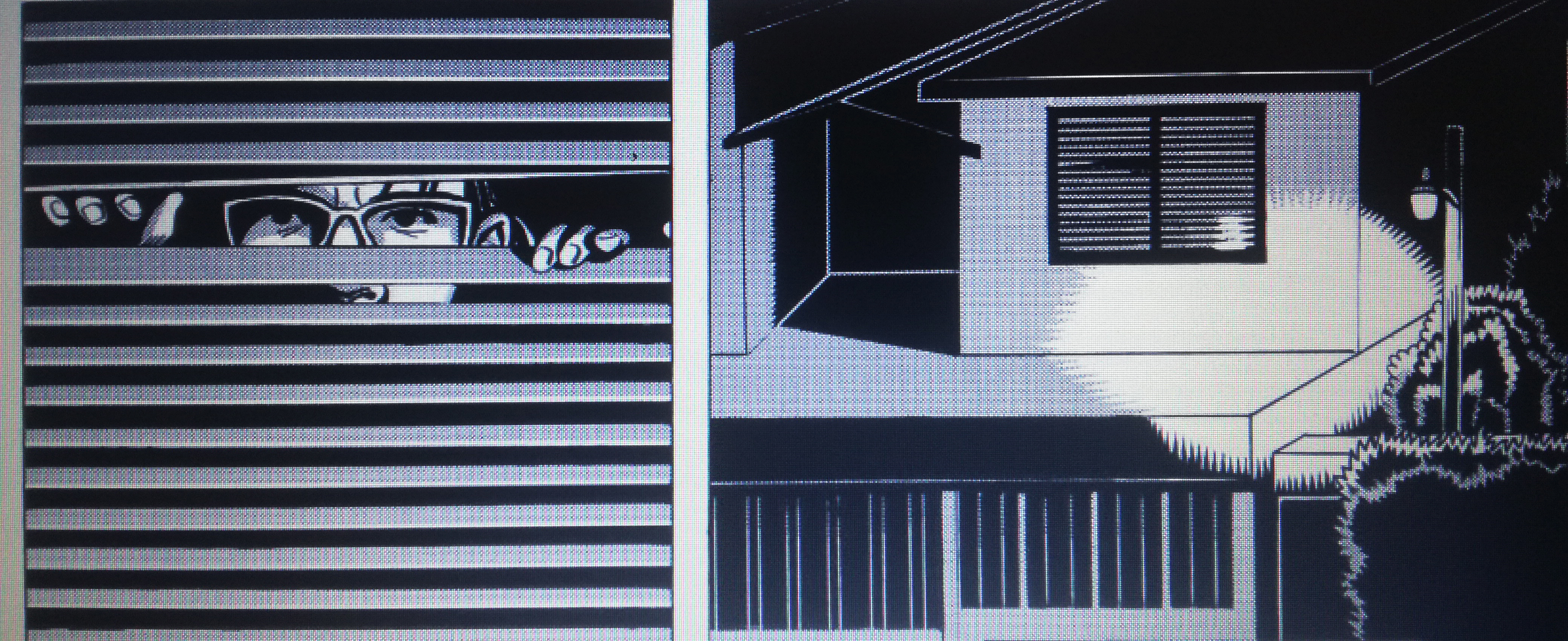
Consider which place or room is best to be working on sensitive issues. Is, for example, a basement a best option? How easy is it to get to your work space from entry doors to your apartment or house? Can people see your computer screen or desk/papers from the outside? Do you want/can you avoid house-mates see you working? Or overhear sensitive conversations on the phone or over the internet. You can try to talk quietly if neighbours can overhear conversations, use a headset, close windows when you talk, or use veiled/coded language.

Try not to leave your work around the house (leaving USBs & documents around). Stay organised and protect sensitive information. Think about getting locks on drawers, or lockable cabinets etc. Consider locating some good hiding places (or some kind of safety box) for your valuable information if you need to quickly hide them. Be creative eg. taking out a brick or tile in the floor or wall, in the rooftop, under a floorboard, taped inside a shower drain, etc. At the end of each day, put everything away in a safe space including documents, computers and phones. Keep a clean desk policy. Turn off computers, don’t just put them to sleep or leave them on. Have a system for destroying sensitive information and files. This could be shredding it, tearing into small pieces, burning it, etc.

Consider using a simple surveillance system of the space at times when you are not there. This could be simple traps to detect if someone has entered has the house or room, or opened a drawer. Alternatively, there are digital solutions such as mobile phone applications such as Haven app which you could use with an old Android phone to monitor your work space.

Make sure you have a good ergonomic set up of your work station so that you are sitting comfortably without straining your back, neck or other parts of your body – and take regular breaks.  Reduce tripping hazards. Have first aid kits and sufficient medications. Have enough water for 4 days, and some hibernation kits.

If you share accommodation with others (family, friends, room-mates), have a meeting to make sure everyone is aware of the security rules you want to apply ( i.e. don’t open the door without first checking who it is, don’t touch the laptop, etc.) It is good to have a security check-in meeting with them everyday to see how situation is changing and if they notice anything new or out of place.

Prepare emergency numbers and have them handy such as written/printed and stuck up on the wall, saved in your phone, and kept in your wallet. Consider having a household communication planin case you need support. This means calling one or two people, and then they themselves know who to call and what to do to give you support.

Have an evacuation plan prepared, with different exits and an outside meeting point. It is recommended that you practice it. Sometimes simply placing a ladder near a fence can make a big security improvement in your home. Some people also have a pre-packed bag that they keep next to the exits, that contains copies of sensitive documents, some cash, phone charger, torch/flashlight, medication and other items you would want to have with you.

If you consider the risks are increasing as an HRD and you might need to relocate, review your relocation plan. Are the travel arrangements and end destination still feasible? How can you adapt your plan to reduce your visibility and physical presence?

If you are considering having sensitive in-person meetings in your home, be aware of the restrictions in place and comply with health advisories. Prepare a cover story with your visitors, including who are they and why are they visiting you, in case your neighbours or somebody else asks. Also, it can be a good idea for visitors not to tell taxis (including ride-hailing apps) your exact address, but somewhere close like a well-known place of worship, park, shop, etc. If they come in their own vehicle, it is better that they not park out the front of your house – they can park further down the street so they are not immediately connected with you. Make sure you give very clear instructions so visitors do not have to ask anybody how to find you.

Always consider safety risks like fire in homes. You might be cooking more indoors, using more electricity outlets, smoking indoors, children might be more housebound, and your neighbours will also be home, increasing the risk of them starting a fire. Have a fire plan. Consider things like woollen blankets as fire blankets, smoke detectors if possible, manage your electricity usage and try to use surge protectors, reduce fuel load, etc.

Consider having a personal alarm with you in the home and when you leave to attract attention if you need, this could be something like a whistle.

Keep your doors locked, with the key in the lock on the inside of the door – unless someone on the outside can reach through to open it. In this case, keep the key in a set location, away from the door (and out of sight) ready in case it is needed in an emergency. Consider what is a pattern of criminal attacks in your area. Rates of home burglaries generally fall when more people are at home, but other crime (against offices or shops) may increase. Protect (or take with you) the valuable information from your office before leaving. Consider how your adversaries will try to benefit from you working from home and then mitigate that.

Avoid regular routines especially in leaving and travelling around. When leaving your home to go shopping, consider the risks of leaving your devices in the home vs taking the devices with you. If you leave home, switch off devices and hide them. When leaving, ensure that someone knows where you are going, how you will get there (the route), what time you are expected to return, how to contact you if there is any reason, etc. You may also use things like live location sharing, check-in procedures (“I’ve arrived”, “I’m leaving now”, “should be there in 20 minutes”, etc.)

Be discreet and avoid being targeted by police or security forces by violating any legal local rules.

It is easier said than done but try to plan for economic security or sustainability, this situation could go on for longer than currently envisaged. If possible discuss this with donors or supporters. Try to identify an emergency fund you can establish or have access to – perhaps in cooperation with others. Connect online with your local communities to see what are possible self-organizing strategies for mutual support.

Let Front Line know of your protection ideas or suggestions based on your experience that may benefit other HRDs or HROs at risk, it will develop this guide further.

See also: https://humanrightsdefenders.blog/2020/04/10/policy-response-from-human-rights-ngos-to-covid-19-civicus-protocol/

Policy response from Human Rights NGOs to COVID-19: Human Rights Watch

April 10, 2020

In the midst of the COVID-19 crisis, many human rights organisations have been formulating a policy response. While I cannot be complete or undertake comparisons, I will try and give some examples in the course of these weeks. Here the one by Human Rights Watch, as submitted during the Informal Dialogue with UN High Commissioner for Human Rights on 9 April 2020

—-

Policy response from Human Rights NGOs to COVID-19: Amnesty International

April 10, 2020
In the midst of the COVID-19 crisis, many human rights organisations have been formulating a policy response. While I cannot be complete or undertake comparisons, I will try and give some examples in the course of these weeks. Here the one by Amnesty International as posred on 8 April in Reliefweb: “Human rights defenders: We need them more than ever! States worldwide must protect Human Rights Defenders in the current COVID-19 crisis“:

At a time when some of our human rights have been restricted in order to implement public health measures, human rights defenders are more crucial than ever in our struggle to overcome the COVID-19 pandemic and ensure that no one is left behind…..

Crisis like this one put these commitments to the test. It is paramount that states around the world recommit to protect and recognize those who individually or collectively take action to protect our human rights, including in the context of the pandemic. In particular, states must ensure that all measures restricting the right to defend human rights, including those imposing limitations on the rights to freedom of expression, association and peaceful assembly, are strictly necessary and proportionate for the protection of public health. The authorities must not use restrictions imposed during the pandemic to suppress relevant information uncomfortable for the government or use the situation as a pretext to crack down critics and human rights defenders. States must recognise that human rights defence is an essential activity during emergency periods and ensure that human rights defenders can exercise their work free from reprisals, intimidation or threats, so that together we can all face up to this crisis.

Human rights defenders, including those working in the field of research, health and social care, journalism and other areas, have been key in informing the public about the challenges posed by COVID-19 at all stages of the crisis. Their work is essential in ensuring states provide accessible and reliable information in a fair and transparent manner and can raise the alarm when measures are damaging or inadequate. Governments must ensure that those carrying out this role can continue to do so. They must respond by being accountable and open to scrutiny as well as by providing evidence-based and accurate information as the pandemic unfolds. Other activists, including women and LGBTI human rights defenders, trade unionists, environmental and land defenders, refugees and migrants’ rights defenders and indigenous rights defenders, are also helping the public understand the impact and implications of COVID-19 in their communities and how it affects different sectors of society, particularly the most marginalized and at risk.

Human rights defenders play a key role in watching that the measures taken by authorities do not infringe unduly on human rights – for example on the right to freedom of expression, on the right to privacy, or on the rights to health, housing and to an adequate standard of living – and speak out when this happens.

Human rights defenders raise the alarm and demand action when marginalized groups or individuals are being disproportionately affected or forgotten by the new measures, that is those historically discriminated against: people in the informal economy, people at risk of domestic violence, refugees and migrants, or people in detention, for example.

Human right defenders keep a check on the misuse of power of non-state actors. For example, they raise their voice against abuses by businesses and corporations, including when they fail to uphold labour and human rights standards in their responses to the pandemic, or when they shift the economic impact on workers, or when they fail to provide adequate protection from contagion for workers at risk.

Health and social care workers are at the frontline of this pandemic, continuing to deliver services despite the personal risks to them and their families, including contracting COVID19 while doing their jobs, working long hours, enduring psychological distress and fatigue. At the same time, thousands of individuals are volunteering to help those in need and provide crucial services. Many others, such as those involved in cleaning, sanitation and domestic work, in running transport systems, in the production of food, and other key workers, are also providing critical services, sometimes without adequate protection for themselves. All these individuals are not only doing their jobs, they are also protecting everybody’s right to health despite serious challenges and risks. They should be given with urgency adequate and quality tools, protection measures and any other support they need to carry out their work in safety.

Without all the individuals and collectives who defend our human rights worldwide, it would be almost impossible to tackle COVID-19 and save as many lives and livelihoods as possible. It is therefore not just states’ obligation, but it is in the interest of states and society at large to recognise, protect and enable human rights defenders to carry out their crucial work so that the harshest impact of the crisis can be mitigated and ensure that no one is left behind.

Recommendations

In the weeks since the outbreak of COVID-19, we have seen a flourishing of solidarity and empathy towards people in need and those most at risk, including a revival of community initiatives and self-help groups. It is time for those in power to recognise and protect human rights defenders, who are precisely those leading the way in showing how to include all sectors of society in the effort against the pandemic. Human rights defenders have long led the way in delivering justice, equality and rights for all without discrimination, with their empathy, activism, passion and hope. They must be protected!

Authorities worldwide must send a clear, unequivocal message in all their communications stating that:

  • Human rights defenders are key allies to address the challenges posed by the COVID-19 pandemic, and therefore will be recognised and protected without discrimination at all times
  • Physical or verbal attacks against human rights defenders will not be tolerated and, where applicable, those responsible will be brought to justice in fair trials
  • Human rights defenders are key to overcoming the pandemic in a way that is inclusive and respectful of human rights, and therefore need to be included in any collective actions to tackle it
  • Those human rights defenders on the frontline of the pandemic must be given the necessary information, the tools and the protective equipment they need to carry out their human rights activities in safety